

You wake with the feeling that something important just happened. A place that never existed felt familiar. Someone you have not seen in years spoke as if no time had passed. Then, while you reach for the details, the whole experience begins to dissolve.
Dreams can be vivid, ordinary, frightening, repetitive, or almost impossible to remember. That variety makes a simple question surprisingly difficult: why do we dream? Researchers can describe when dreams are reported, study brain and body activity during sleep, compare dream accounts, and test particular hypotheses. They still have not established one purpose that explains every dream.
A useful approach is to separate what is well supported from what remains possible. Dreaming is a form of conscious experience during sleep. It can occur in rapid eye movement (REM) sleep and non-REM sleep. Memories, emotions, recent concerns, and ongoing brain activity may all contribute, but no single ingredient explains every dream. A dream can also feel personally meaningful without functioning as a secret diagnosis, a prediction, or a universal symbolic code.
Quick Answer
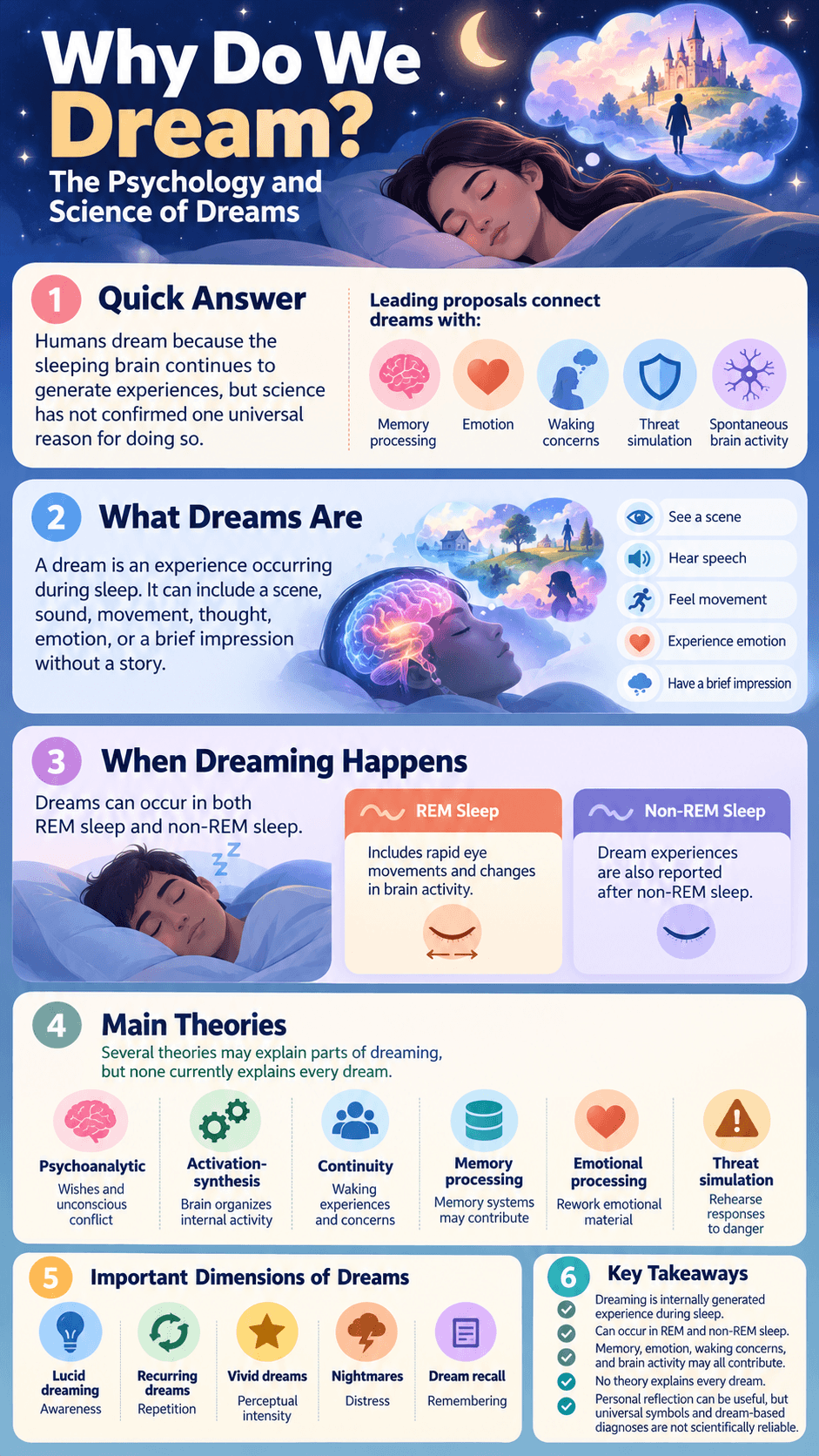
Humans dream because the sleeping brain continues to generate experiences, but science has not confirmed one universal reason for doing so. Leading proposals connect dreams with memory processing, emotion, waking concerns, threat simulation, and spontaneous brain activity. These accounts may explain parts of dreaming, yet none currently explains every dream or proves that all dreams serve the same necessary function.
What research can say with reasonable confidence
Dreaming is genuine mental experience during sleep, even though the scenes are internally generated. People report images, thoughts, movement, speech, sensations, and emotion. By pairing reports with sleep stage, electrical activity, eye movements, muscle tone, and timed awakenings, researchers have shown that dreams can occur in REM and non-REM sleep and vary across a single night.
Why one universal purpose has not been established
Different theories address brain activation, mental content, possible function, or later interpretation. A theory may explain why recent concerns enter some dreams but not why another dream is bizarre or forgotten. Measurement adds difficulty because researchers usually learn about the experience after waking, when details may already be lost or reorganized.
What Dreams Are
Dreaming as subjective experience during sleep
A dream is an experience occurring during sleep. The dreamer may see a scene, hear speech, feel movement, think, experience emotion, or have a brief impression without a story. Researchers can measure sleep physiology and collect a report, but the experience remains subjective because it belongs to the sleeper.
Dream imagery, narrative, feelings, and sensations
Many dreams combine familiar pieces in unfamiliar ways. A childhood house may appear in a different city, identities may shift, and contradictions may feel acceptable until waking. Dreams can include sound, touch, movement, social interaction, thought, and emotion, with either a clear sequence or only fragments.
Dreaming versus waking imagination
Dreaming and imagination both involve internally generated experience, but they occur under different conditions. Waking imagination usually preserves awareness of the environment, while an ordinary dream often becomes the accepted reality of the moment.
| Feature | Dreaming during sleep | Waking imagination or daydreaming |
|---|---|---|
| State | Occurs while asleep | Occurs while awake |
| Awareness of surroundings | External surroundings are usually reduced or disconnected | Awareness of the environment usually remains available |
| Reality judgment | Strange events may be accepted as real | The person usually knows the scene is imagined |
| Control | Often limited, except to varying degrees in some lucid dreams | May be directed, interrupted, or revised more easily |
Sleep onset can include dreamlike imagery, and waking thought can become absorbing. Even so, dreaming during sleep is not another name for fantasy, visualization, or ordinary mind wandering.
When Dreaming Happens

REM sleep and frequent dream reports
Sleep moves through periods of non-REM and REM sleep. REM includes rapid eye movements, changes in brain activity, and reduced ordinary skeletal muscle activity, as explained in the NINDS guide to understanding sleep. REM awakenings frequently produce vivid reports, but REM does not account for every dream.
Dreams during non-REM sleep
People also report experiences after non-REM awakenings. Some are thoughtlike or fragmented, while others are detailed. An open-access review of current dream research and its open questions explains why the older idea that REM equals dreaming and non-REM equals no dreaming is too simple.
Why the sleep stage does not explain every dream experience
Two people awakened from the same stage may provide very different reports, and one person may remember a detailed scene once and nothing the next time. Local activity, brief arousal, timing, individual differences, and retention may all matter, so a dream cannot be reduced to a stage label.
Why Dreaming Matters to Psychology
A window into sleeping cognition
Dreams show that mental life does not switch off when contact with the ordinary environment is reduced. Imagery, emotion, memory fragments, social situations, and a sense of self can continue, giving researchers a way to examine self-awareness, reasoning, time perception, and reality judgment during sleep.
Memory, emotion, and waking experience as research questions
Dream content can include recognizable pieces of waking life without replaying life exactly. This has led researchers to examine memory processing, waking concerns, and emotional adaptation. A resemblance shows that waking experience may contribute material, but it does not prove that the dream resolved or stored the event.
The limits of retrospective dream reports
Most evidence depends on a person waking and describing what occurred. The dream may fade, a fragment may be mistaken for the whole, or waking thought may impose a clearer story. Reports remain valuable when researchers use controlled collection, repeated sampling, and physiology without treating every detail as a perfect transcript.
The Main Scientific Theories of Why We Dream
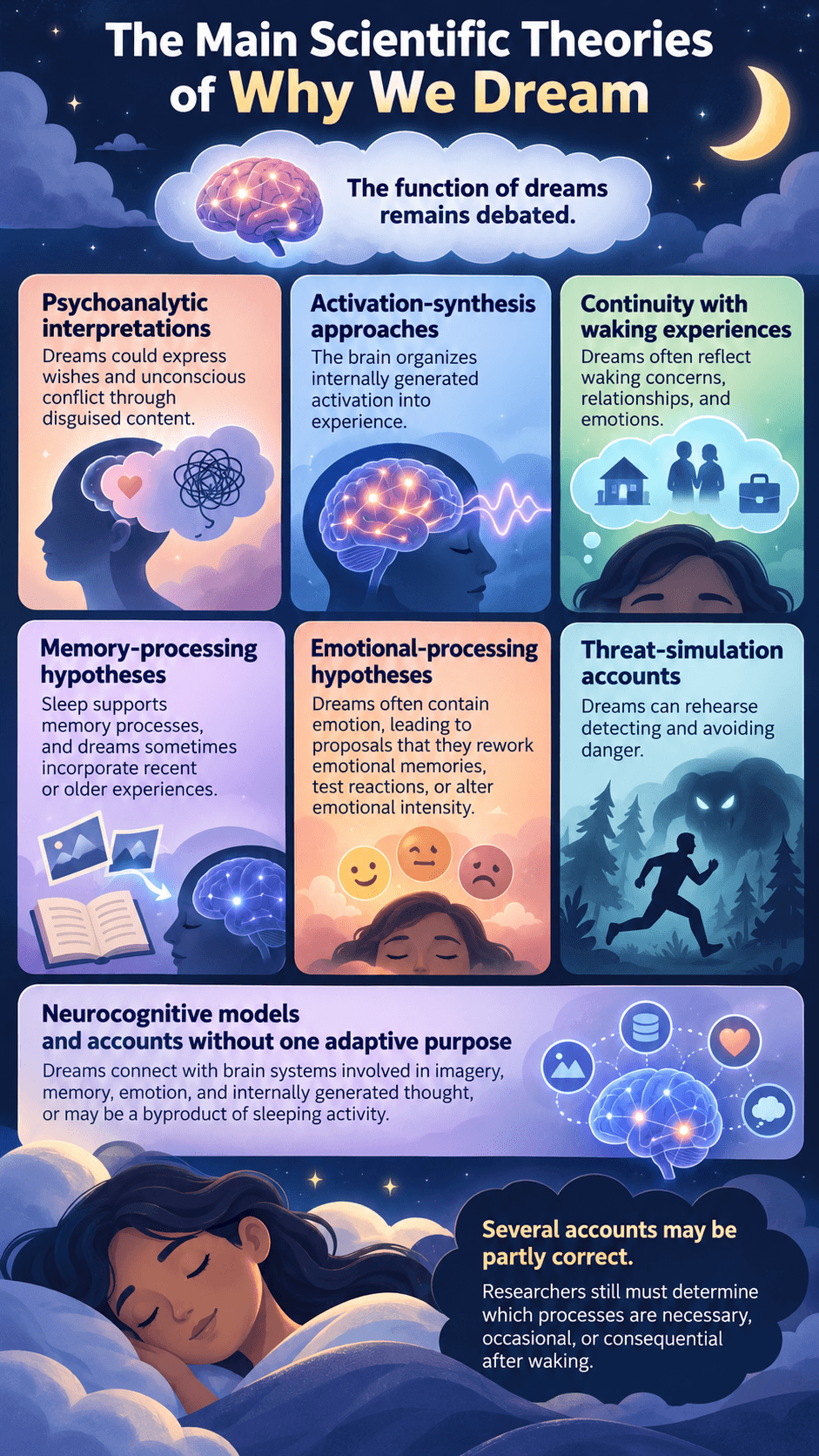
Dream theories are easier to understand when they are treated as different proposals rather than contestants with one final winner. A recent review of the neurobiology, psychology, and possible functions of dreaming emphasizes that the function of dreams remains debated.
Historical psychoanalytic interpretations
Freud argued that dreams could express wishes and unconscious conflict through disguised content. Later approaches often emphasized personal associations rather than fixed symbols. These ideas shaped psychology, but historical influence is not experimental confirmation. A dream does not reliably decode into one hidden wish or establish a diagnosis.
Activation-synthesis approaches
Activation-synthesis accounts propose that the sleeping brain organizes internally generated activation into experience. A narrative may be the mind’s response to shifting signals rather than an encoded message. Memories, expectations, and emotion can still shape that activity, so the account does not reduce dreams to meaningless noise.
Continuity with waking experiences
The continuity hypothesis suggests that dreams often reflect waking concerns, relationships, and emotions. The overlap may be obvious or transformed into a different setting. Many daily events never appear in remembered dreams, so continuity predicts influence rather than a dictionary that converts each image into a waking cause.
Memory-processing hypotheses
Sleep supports memory processes, and dreams sometimes incorporate recent or older experiences. A review of dreaming and offline memory processing examines links between memory systems and dream experience. Memory activity can contribute to dreams, but this does not prove that conscious dreaming is required for consolidation.
Emotional-processing hypotheses
Dreams often contain emotion, leading to proposals that they rework emotional memories, test reactions, or alter emotional intensity. The claim does not fit every dream: a nightmare may increase distress, and a calm dream may have no measurable effect. Possible benefit cannot be inferred from intensity alone.
Threat-simulation accounts
Threat-simulation theory proposes that dreams can rehearse detecting and avoiding danger. Chases, traps, or helplessness may resemble low-risk practice. Yet many dreams contain no threat, and a frightening scene does not prove that rehearsal occurred or improved waking responses.
Neurocognitive models and accounts without one adaptive purpose
Neurocognitive models connect dreams with brain systems involved in imagery, memory, emotion, and internally generated thought. Other accounts treat dreaming as a byproduct of sleeping activity or other sleep functions. Dreams may therefore have consequences without having evolved for one specific task.
Why the theories do not amount to scientific consensus
| Account | Main question it addresses | Important limit |
|---|---|---|
| Psychoanalytic | Could dream content express personal conflict or wishes? | Universal symbolic interpretations are not reliably testable |
| Activation-synthesis | How might the brain organize internally generated activation? | Does not settle whether dreams also have functions |
| Continuity | How does waking life appear in dreams? | Overlap does not prove purpose or causation |
| Memory processing | How might memory activity contribute to dream content? | Sleep-related memory benefits do not prove the dream is required |
| Emotional processing | Could dreams alter or explore emotional material? | Not every emotional dream is helpful or resolving |
| Threat simulation | Could some dreams rehearse responses to danger? | Many dreams are not threatening, and rehearsal is difficult to verify |
Several accounts may be partly correct. Brain activation can provide conditions, waking concerns can influence content, and memory or emotion can shape the experience. Researchers still must determine which processes are necessary, occasional, or consequential after waking.
A Working Model of Dream Experience
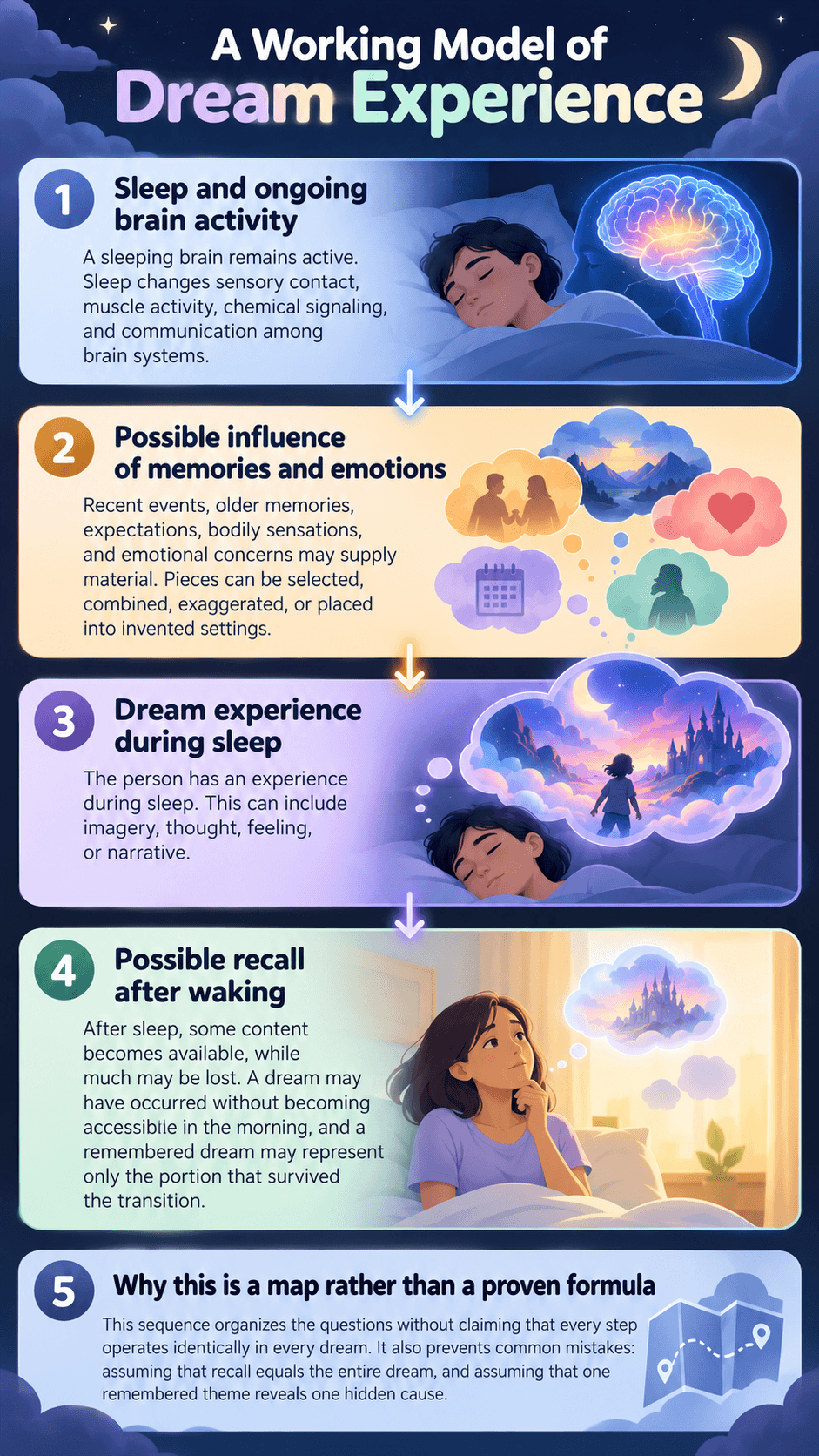
Sleep and ongoing brain activity
The first condition is a sleeping brain that remains active. Sleep changes sensory contact, muscle activity, chemical signaling, and communication among brain systems. Internally generated experience can become prominent because ordinary environmental input and waking control are altered.
The possible influence of memories and emotions
Recent events, older memories, expectations, bodily sensations, and emotional concerns may supply material. They do not enter as untouched files. Pieces can be selected, combined, exaggerated, or placed into invented settings.
Dream experience and later recall
The person then has an experience during sleep, followed by either awakening or continued sleep. Recall is a later step. A dream may have occurred without becoming accessible in the morning, and a remembered dream may represent only the portion that survived the transition.
Why this is a map rather than a proven formula
- Sleep state: the brain and body are in changing physiological conditions.
- Ongoing activity: internally generated signals continue to support mental experience.
- Possible contributions: memory, emotion, expectation, and bodily sensation may shape content.
- Dream experience: imagery, thought, feeling, or narrative is experienced during sleep.
- Possible recall: some content becomes available after waking, while much may be lost.
This sequence organizes the questions without claiming that every step operates identically in every dream. It also prevents two common mistakes: assuming that recall equals the entire dream, and assuming that one remembered theme reveals one hidden cause.
What Psychology Can and Cannot Tell Us About Dream Meaning
Personal associations and reflection
A dream may feel meaningful because it involves a person, fear, place, or choice that matters to you. Reflection can be useful when it stays exploratory. You might ask what emotion was strongest, which elements were familiar, and whether the dream resembles a current concern.
Those questions generate possibilities, not verdicts. The value may come from noticing your response to the dream rather than decoding the dream as an objective message.
Why universal symbols are unreliable
The same image can carry very different associations. A dog might represent comfort to one person, responsibility to another, and fear to someone who was bitten. Culture, personal history, recent events, and the rest of the dream all change the context.
A universal dictionary removes that context and offers certainty that research cannot justify. It may create an appealing story, but an appealing story is not the same as evidence.
Why dream content cannot diagnose a condition or hidden event
A dream by itself cannot establish trauma, depression, anxiety, psychosis, repressed memory, deception, or a defense mechanism. Frightening or unusual content also does not predict that an event will occur.
If a dream raises concern, look at waking evidence: sleep quality, frequency, distress, behavior, functioning, medical changes, and current circumstances. A qualified professional evaluates patterns and context. No responsible assessment rests on one dream image.
Five Important Dimensions of Dreams

Lucid dreaming and awareness
Lucidity concerns whether the dreamer recognizes the dream while it is happening. Awareness can appear without full control. Someone may know, “This is a dream,” yet be unable to change the scene or keep the experience from ending.
Recurring dreams and repetition
Recurrence concerns whether identical or similar content returns across nights. The repeated element may be a place, challenge, relationship, emotion, or storyline. A recurring dream can be neutral, pleasant, or frightening.
Vivid dreams and perceptual intensity
Vividness concerns clarity, realism, sensory detail, or emotional intensity. A vivid dream does not require awareness that one is dreaming. It may feel completely real until the person wakes.
Nightmares and distress
Nightmares concern frightening or severely distressing dream experiences, often with awakening and recall. Distress is the defining dimension, not repetition. A nightmare can occur once, and a recurring dream need not be a nightmare.
Dream recall and remembering
Recall concerns what becomes available after waking. It is not a direct measure of how much a person dreamed. Timing of awakening, attention, individual differences, and the rapid arrival of new information may affect what remains accessible.
How the dimensions overlap
| Dimension | Core question | Possible overlap |
|---|---|---|
| Awareness | Did I know I was dreaming? | A lucid dream may also be vivid or frightening |
| Repetition | Did similar content return? | A recurring dream may also be a nightmare |
| Vividness | How clear or lifelike did it feel? | A vivid dream may be pleasant, neutral, or distressing |
| Distress | Was the experience frightening or upsetting? | A nightmare may be remembered clearly or only partly |
| Recall | What could I remember after waking? | Recall can vary independently of the other dimensions |
These dimensions describe features, not five sealed categories. Keeping them separate helps prevent confusion. “Vivid,” for example, describes intensity, while “lucid” describes awareness.
Lucid Dreaming and Awareness
Awareness is not the same as control
In a lucid dream, a person recognizes the dream while still asleep. Control may follow, but it varies from directing action to simply observing before waking. Trained dreamers can sometimes signal with planned eye movements during verified REM sleep, giving researchers a marker for awareness. This does not make every report controlled, and deliberate induction remains unreliable.
Recurring Dreams and Repetition
What returns may be a theme rather than an exact replay
A recurring dream may replay a sequence or preserve only a theme, such as always being late or unable to speak. Identifying what recurs is more useful than assigning every detail the same meaning. Waking concerns may contribute, but repetition does not prove trauma or hidden conflict. Describe the pattern before trying to explain it.
Vivid Dreams and Subjective Intensity
Feeling real does not make a dream externally real
Some dreams contain striking color, touch, movement, or emotion and remain convincing after waking. Vividness describes experience, not truth or predictive power. Waking close to a dream may preserve detail. Sleep, stress, medication, or health changes may also matter, but one intense night rarely identifies a cause.
Nightmares and Dream Distress
Frightening dreams require context, not symbolic certainty
Nightmares can involve threat, helplessness, loss, or disturbing imagery. An occasional nightmare does not establish a disorder or past event. Frequency, awakenings, sleep disruption, daytime distress, and health context matter more. Support may be appropriate when fear of sleep or impairment persists.
Dream Recall After Waking
Experiencing a dream and remembering it are different
Dream memory is fragile. A scene may disappear as attention shifts to an alarm or the day’s tasks, and people differ in recall frequency. Not remembering does not prove that no dream occurred. Journaling may capture fragments, but it neither guarantees recall nor reveals hidden memories.
How Researchers Study Dreams
Sleep-laboratory awakenings
In a sleep laboratory, researchers can monitor brain activity, eye movements, and muscle activity, then wake a participant at a planned time. Immediate questions reduce the delay between experience and report. Repeated awakenings also allow comparisons across sleep stages and different parts of the night.
Dream reports and memory limitations
Researchers may collect spoken reports, written diaries, questionnaires, or structured ratings. Each method captures something different. A diary can show patterns across many nights, while a laboratory report offers precise timing but may occur in an unfamiliar setting.
No method removes the recall problem. Report length can reflect memory, verbal style, motivation, or the experience itself. Good interpretation keeps those possibilities separate.
Sleep physiology and brain measurement
Electroencephalography records electrical activity from the scalp, while other methods examine blood flow, connectivity, or localized activity. These measurements can be compared with later reports. They can identify conditions associated with dream experience, but they do not display a dream like a video.
Why studying subjective experience is difficult
A creative study reported real-time communication with some lucid dreamers during verified REM sleep. Participants sometimes answered simple questions using planned eye or facial movements. The result was a proof of concept, not a general ability to interview any sleeping person.
Newer approaches combine timed awakenings, physiology, computational analysis, stimulation, and carefully designed dream tasks. A review of new strategies in the cognitive science of dreaming describes how these methods can improve observation and experimental control while leaving major limits in place.
Which Dream Question Should You Explore Next?
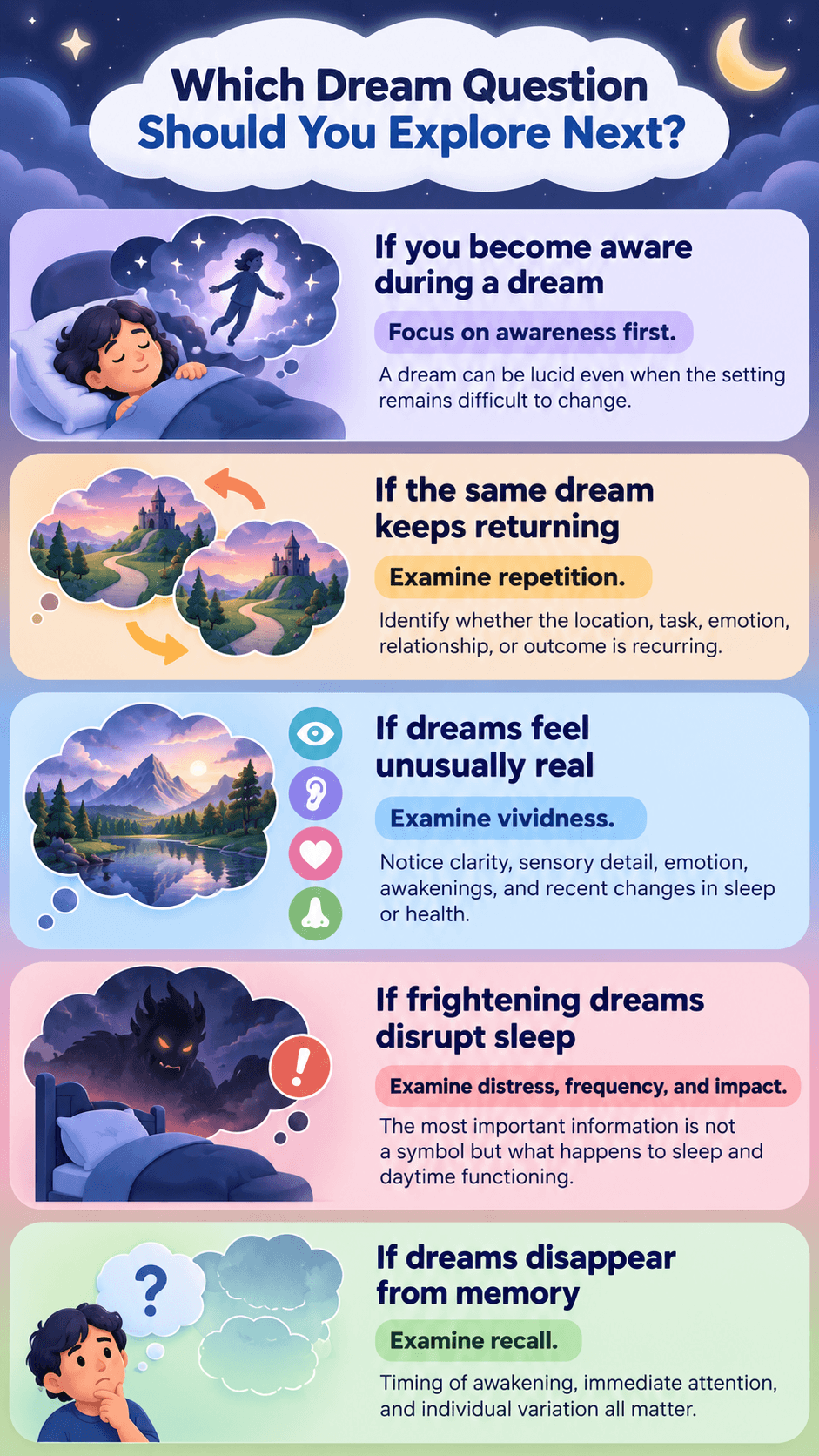
If you become aware during a dream
The most useful next question is how lucid awareness differs from control and what research says about deliberate induction. Focus on awareness first. A dream can be lucid even when the setting remains difficult to change.
If the same dream keeps returning
Examine repetition. Identify whether the location, task, emotion, relationship, or outcome is recurring. This separates recurring dreams from a single memorable nightmare and makes reflection more precise.
If dreams feel unusually real
Examine vividness. Notice clarity, sensory detail, emotion, awakenings, and recent changes in sleep or health. Do not assume that realism means lucidity or that intensity proves a hidden message.
If frightening dreams disrupt sleep
Examine distress, frequency, and impact. The most important information is not a symbol but what happens to sleep and daytime functioning. Persistent disruption deserves more attention than an isolated frightening scene.
If dreams disappear from memory
Examine recall rather than asking whether dreaming stopped. Timing of awakening, immediate attention, and individual variation all matter. Limited recall is often ordinary, especially when no other sleep or health concern is present.
Common Misconceptions About Dreams
Dreams only happen in REM sleep
REM awakenings often produce vivid reports, but dream experiences are also reported after non-REM sleep. The frequency and qualities may differ, yet REM is not the only sleep state in which dreamlike experience can occur.
Every dream contains a hidden message
A dream can invite reflection without containing a coded statement. Some elements may relate to current concerns, while others may result from ordinary recombination or be difficult to connect with waking life. Uncertainty is more accurate than a forced explanation.
Not remembering dreams means not dreaming
Recall is only the last part of the sequence. Dream experience may fail to remain accessible after waking. People who rarely remember dreams should not assume that their sleeping minds are inactive.
Lucid dreaming always means controlling the dream
Lucidity means recognizing the dream state. Control is a separate feature that can range from minimal to substantial. Treating the two as identical creates unrealistic expectations and misrepresents the experience.
When Dreams Affect Sleep or Daily Functioning
Persistent distress, sleep disruption, or daytime impairment
Most unusual dreams do not require intervention. Consider professional guidance when nightmares are frequent, sleep becomes something you fear, awakenings repeatedly reduce rest, or dream-related distress interferes with concentration, mood, work, or relationships.
New dream changes may also be worth discussing with a clinician when they occur alongside medication changes, unusual movement during sleep, waking perceptual experiences, severe daytime sleepiness, or other health symptoms. Do not stop prescribed medication based only on dream changes.
Why individualized assessment may be appropriate
A clinician can evaluate sleep history, health, medication, stress, and waking symptoms together. That context matters because similar dream complaints can arise for different reasons. Educational information cannot determine which explanation applies to one person.
Dream content alone is not a diagnostic test. The reason to seek help is the broader pattern of distress, impairment, or health change, not the presence of one symbol or strange storyline.
FAQ About Why We Dream
Has science proved why humans dream?
No single purpose has been proved for all dreams. Researchers have developed serious hypotheses involving memory, emotion, waking-life continuity, threat simulation, and spontaneous brain activity. Each explains some evidence, but none currently accounts for every type of dream or demonstrates that conscious dreaming is always necessary for a particular benefit.
Do dreams happen outside REM sleep?
Yes. People frequently report dreams after REM awakenings, but reports also occur after non-REM sleep. Some non-REM experiences are shorter or more thoughtlike, although detailed dreamlike reports can occur. Sleep stage influences probability and quality without creating a perfect dividing line.
Do all dreams reflect waking concerns?
No. Waking relationships, activities, memories, and emotions often contribute to dream content, but the relationship can be indirect or absent from the remembered report. A resemblance does not prove that the dream solved the concern, and a bizarre dream does not require a hidden waking explanation.
Can a dream reveal a diagnosis or repressed memory?
A dream cannot reliably diagnose a mental-health condition, confirm trauma, or prove that a forgotten event occurred. Memory is reconstructive, and dream imagery is not an objective record. Concerns about symptoms, safety, or past events deserve careful assessment based on waking evidence and appropriate professional support.
Why can a dream feel meaningful without having a universal meaning?
Dreams draw on a person’s own memories, relationships, expectations, and emotions, so a dream may resonate deeply. Personal relevance does not require a symbol to mean the same thing for everyone. Meaning can emerge through thoughtful reflection while remaining tentative, personal, and open to revision.
Key Takeaways
- Dreaming is internally generated experience during sleep, not simply another name for waking imagination.
- Dream reports are common after REM sleep, but dreaming can also occur during non-REM sleep.
- Memory, emotion, waking concerns, and brain activity may all contribute, yet no theory explains every dream.
- Lucidity, recurrence, vividness, distress, and recall describe different dimensions that may overlap.
- Personal reflection can be useful, but universal symbols, predictions, and dream-based diagnoses are not scientifically reliable.
- Persistent sleep disruption, distress, unusual sleep behavior, or daytime impairment is a better reason to seek guidance than one strange dream.
A practical next step is to describe one remembered dream without interpreting it immediately. Note the sleep timing, strongest emotion, familiar elements, unusual features, and what remained after waking. That small separation between experience, recall, and interpretation keeps curiosity open without turning uncertainty into certainty.

Michael Reed is the Founder and Lead Writer at Psychology Exposed. He writes about human behavior, relationships, emotional patterns, self-awareness, and practical psychology topics using research-informed, easy-to-understand content.
Read More About Michael Reed: https://psychologyexposed.com/michael-reed/