

The message is clear: the application was declined. Yet the recipient keeps planning as though approval is still likely, telling friends that the decision is probably temporary. A team has missed every milestone for months, but its leader treats each result as an isolated setback. A friendship has changed in ways neither person wants to name. In each case, denial might be one explanation, but it is not the only one.
Denial as a defense mechanism refers to a proposed failure to acknowledge a distressing fact, experience, or implication. The idea is not simply that a person holds an incorrect belief. It is that recognizing reality feels emotionally threatening, and nonacknowledgment may provide temporary psychological protection. Sometimes that distance gives a person time to absorb a shock. If it persists, it can also delay decisions, narrow attention, and keep corrective action from beginning.
The term requires care. Disagreement, uncertainty, missing information, deliberate lying, privacy, and fear-driven silence can all look like denial from the outside. A responsible explanation therefore begins with evidence and context, not a label attached to someone who will not accept our interpretation.
Quick Answer

Denial is a proposed defense mechanism in which a distressing reality or its implications are not fully acknowledged, reducing emotional discomfort in the short term. It is not the same as uncertainty, ordinary disbelief, avoidance, rationalization, or conscious dishonesty. One disagreement cannot prove denial, and the concept is best used as a cautious hypothesis for self-reflection.
What Denial Means as a Defense Mechanism
Psychological denial concerns a gap between information that may be available and what a person can presently acknowledge about it. The proposed defensive function separates it from a simple factual mistake.
Not acknowledging a distressing reality
The APA Dictionary of Psychology entry on denial describes a defense in which unpleasant facts, events, or experiences are not acknowledged. The reality may concern an outcome, a repeated pattern, a personal limitation, or the meaning of another person’s behavior. The uncomfortable element is often not the bare fact alone, but what accepting it would change.
Nonacknowledgment can be complete or partial. Someone may reject the fact itself, accept the event while minimizing its importance, or admit the evidence but refuse its likely implications. These forms should not be treated as interchangeable, because each leaves a different opening for reflection and action.
Historical and contemporary definitions
Classical psychoanalytic theory described denial as operating outside full awareness to protect the mind from a reality that generates anxiety or emotional conflict. Later accounts have tried to define defensive processes in ways that can be observed and studied. Phebe Cramer’s review of the history and empirical study of defense mechanisms discusses unconscious functioning, development, adaptation, and the question of whether defenses are necessarily pathological.
Within the wider framework of psychological defense mechanisms, denial is distinguished by nonacknowledgment rather than by a change in attribution, access, or outward expression.
A review by Baumeister, Dale, and Sommer found social psychology evidence relevant to denial and other proposed defenses, particularly in ordinary self-protective responses to threat. Such findings may support narrower cognitive processes without proving that every classical explanation is correct in its original form.
Why Denial May Offer Short-Term Psychological Protection

A useful model follows four moments: distressing evidence, emotional threat, temporary distance, and possible decision cost. It describes a potential sequence rather than a universal rule.
Emotional threat and overwhelming information
A fact can threaten identity, belonging, competence, trust, hope, or a sense of control. Accepting that a carefully chosen plan is failing may mean confronting lost time and embarrassment. Recognizing that a relationship has changed may bring grief and uncertainty. When the emotional meaning feels larger than the person can manage at once, acknowledgment may narrow.
This does not require a conscious decision to ignore reality. The person may sincerely experience a reassuring interpretation as more convincing, attend to exceptions, or fail to integrate information that conflicts with what feels psychologically necessary.
The temporary benefit of distance
Immediate distance from painful meaning can preserve functioning. After sudden news, a person may continue ordinary tasks before the implications feel real. A brief pause can prevent emotional overload and create time to gather support or understand what happened. This temporary function helps explain why denial should not be treated as a moral failure.
Still, needing time is not automatically denial. People absorb information at different speeds, and some situations genuinely remain unclear. The defensive hypothesis becomes more plausible when relevant evidence is repeatedly available but remains excluded, minimized, or stripped of its practical meaning.
When short-term protection can become costly
Protection becomes costly when nonacknowledgment prevents a needed response. Deadlines pass, feedback goes unused, preventable losses grow, or conversations stay frozen. The person may have to reinterpret more and more information to keep the original view intact, making later correction feel even more threatening.
| Possible moment | What may happen | Useful question |
|---|---|---|
| Distressing evidence | A fact or pattern challenges an important expectation. | What information is actually available? |
| Emotional threat | The meaning touches identity, security, hope, or belonging. | What would acknowledging this seem to cost? |
| Temporary distance | The fact or its implications feel less immediate. | Is this pause helping me return to the issue? |
| Decision cost | Delay or distortion begins to affect choices. | What becomes harder if nothing changes? |
Different Ways Nonacknowledgment Can Appear

Denial is not limited to saying that an event never happened. It may concern the fact, its importance, or the conclusion that the evidence reasonably supports.
Rejecting an uncomfortable fact
The clearest form is direct rejection: a result, statement, or event is treated as unreal despite credible information. A person might insist that a confirmed decision has not been made or that a recorded agreement never existed. Before interpreting this as defense, check whether the information is authentic, accessible, understandable, and shared by everyone involved.
Memory errors, confusing communication, and different records can create sincere factual disputes. The label becomes circular if any challenge to our evidence is counted as proof that the other person is denying it.
Minimizing the implications of an experience
Someone may acknowledge what occurred while reducing what it means. “Yes, it happened, but it changes nothing” can preserve an existing plan or self-understanding. Partial acknowledgment is important because the unresolved issue may be consequence rather than fact.
Minimization also has ordinary alternatives. People can reasonably differ about severity, acceptable risk, or what action follows. The relevant question is whether the interpretation remains proportionate to the evidence and open to revision.
Maintaining an interpretation despite relevant evidence
Denial may appear as a fixed interpretation protected from contradictory information. Research on self-affirmation and the evaluation of challenging evidence found that identity-related motives can contribute to resistance, while affirming another source of self-worth can make people more receptive. This is evidence about motivated evaluation, not a test that diagnoses denial.
A belief should not be called denial simply because it survives one contrary fact. Evidence varies in quality, and good reasoning often requires weighing multiple sources. Concern grows when standards shift only to protect the preferred conclusion or when no conceivable information could change it.
It helps to ask whether the person applies the same evidence standard to welcome and unwelcome conclusions. A demand for perfect proof only when the result is painful may reveal motivated resistance. It still does not identify the exact psychological mechanism without more context.
Denial vs Rationalization, Uncertainty, and Avoidance

Several processes can reduce discomfort without being denial. The decisive question is what happens to the reality: is it unacknowledged, explained away, still unresolved, deliberately set aside, or knowingly misrepresented?
This focus on acknowledgment also separates denial from psychological projection, which concerns attributing uncomfortable self-related material to someone else.
Not acknowledging a fact versus justifying it
Rationalization begins after some version of the fact or action is acknowledged. The person supplies a reassuring explanation that makes it feel reasonable: “The project failed, but the market was impossible.” Denial may instead resist that the project failed or that the result has meaningful consequences.
Justifications can be partly true. External conditions may genuinely matter. A rationalization hypothesis concerns whether the explanation selectively protects self-image while neglecting relevant causes. A denial hypothesis concerns whether reality or its implications are being acknowledged at all.
Lacking evidence versus resisting available evidence
Uncertainty is appropriate when the evidence is incomplete, conflicting, ambiguous, or unreliable. Saying “I do not know yet” can reflect intellectual honesty. Denial is a less justified interpretation when someone has legitimate reasons to wait, asks what would resolve the question, and updates as better information arrives.
Ordinary disbelief can also be reasonable when a claim is extraordinary, the source has been unreliable, or the apparent facts may have another explanation. Confidence and speed of acceptance are not measures of psychological health. The issue is responsiveness to sufficiently relevant evidence.
Avoiding a topic versus not acknowledging reality
A person can acknowledge a fact and deliberately avoid discussing it because they need privacy, lack emotional capacity, or fear consequences. That is different from not recognizing the reality. Avoidance concerns contact with the topic; denial concerns acknowledgment of what is true or what it means.
If the main question is whether distressing content was unconsciously excluded or consciously postponed, the comparison between repression and suppression is more relevant than denial.
| Possible process | Relationship to the fact | What distinguishes it |
|---|---|---|
| Denial | The fact or its implication is not fully acknowledged. | Nonacknowledgment may protect against distress. |
| Rationalization | The event is acknowledged but given a protective explanation. | The justification, rather than the fact, is central. |
| Uncertainty | The conclusion remains genuinely unresolved. | Evidence is incomplete or reasonably disputed. |
| Avoidance | The fact may be acknowledged but contact with it is postponed. | Attention or discussion is being limited. |
| Conscious lying | The person recognizes the fact but knowingly states otherwise. | Intentional misrepresentation is involved. |
Visible behavior cannot always settle which row fits. A person may knowingly misrepresent part of a situation while having difficulty acknowledging another part even to themselves. Rather than guessing awareness, describe the discrepancy, verify the evidence, and focus on the decision or boundary that follows.
Everyday Examples of Denial
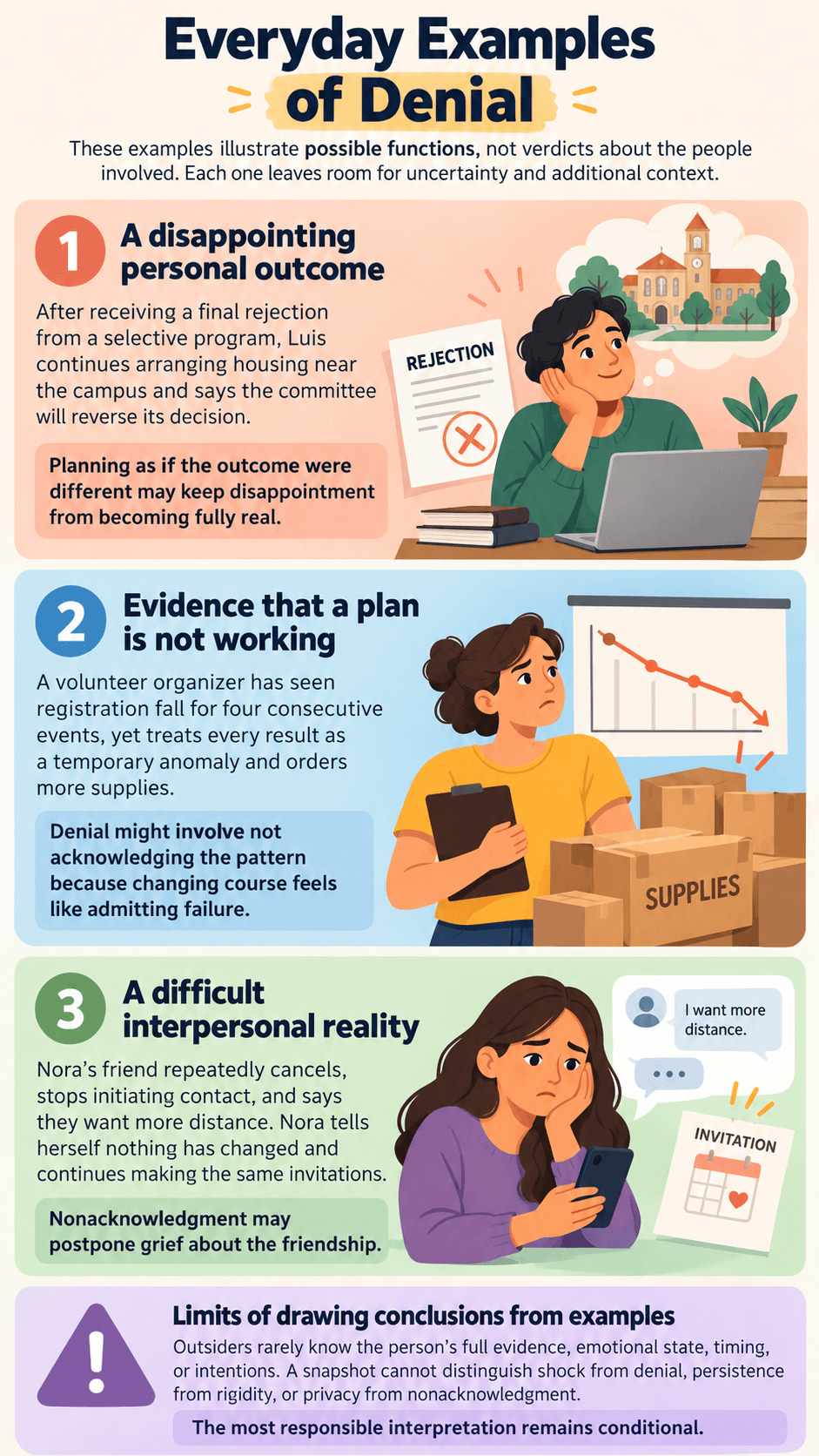
These examples illustrate possible functions, not verdicts about the people involved. Each one leaves room for uncertainty and additional context.
In each case, notice three separate questions: what happened, what the person appears to acknowledge, and what action the situation now requires. Mixing those questions makes the defense label seem more certain and more useful than it is.
A disappointing personal outcome
After receiving a final rejection from a selective program, Luis continues arranging housing near the campus and says the committee will reverse its decision. Planning as if the outcome were different may keep disappointment from becoming fully real. It could also reflect an active appeal, confusing communication, or hope that he knows is unlikely.
A grounded next step is to verify the decision and its appeal rules, then plan separately for what is confirmed and what remains possible. That approach respects emotion without requiring an immediate judgment about defense.
Evidence that a plan is not working
A volunteer organizer has seen registration fall for four consecutive events, yet treats every result as a temporary anomaly and orders more supplies. Denial might involve not acknowledging the pattern because changing course feels like admitting failure. Seasonal variation, poor measurement, or a deliberate long-term strategy could also explain the choice.
The useful question is what evidence would trigger revision. If no result could count against the plan, the interpretation may be protecting identity at the expense of learning.
A difficult interpersonal reality
Nora’s friend repeatedly cancels, stops initiating contact, and says they want more distance. Nora tells herself nothing has changed and continues making the same invitations. Nonacknowledgment may postpone grief about the friendship. It is also possible that the friend’s messages are mixed or that temporary stress explains the change.
Nora can respond to the observable pattern without claiming certainty about either person’s unconscious motives. She might ask once for clarity, respect the requested distance, and direct energy toward relationships that are reciprocal.
Limits of drawing conclusions from examples
Outsiders rarely know the person’s full evidence, emotional state, timing, or intentions. A snapshot cannot distinguish shock from denial, persistence from rigidity, or privacy from nonacknowledgment. Cultural expectations may also shape how openly someone discusses loss, error, or conflict.
The most responsible interpretation remains conditional: denial may be worth considering if available evidence repeatedly fails to enter a person’s conclusions because acknowledgment feels threatening. Even then, the pattern is not a diagnosis and does not define the person.
When Denial May Interfere With Judgment

The practical concern is not the label itself. It is whether nonacknowledgment prevents choices that fit the available reality.
Delayed decisions
Some decisions become more expensive or less reversible with time. Ignoring a final deadline, a repeated performance problem, or a clear change in an agreement can reduce later options. Emotional pacing is understandable, but delay needs a limit when action protects important interests.
A decision can be divided into what must happen now and what can wait. Gathering records, requesting clarification, or pausing a new commitment does not require complete emotional acceptance.
A preselected review date can protect against endless postponement. It gives the person time to process while making clear when the facts, options, and consequences will be examined again.
Repeatedly overlooking relevant information
Denial may narrow which information receives attention. Exceptions feel decisive, while the broader pattern disappears. Sources that support the preferred view are accepted quickly, and sources that challenge it face ever-changing standards.
A simple safeguard is to record predictions before the outcome. Later, compare what happened with what was expected. This makes it harder to redefine every result after the fact, while still allowing genuine new information to change the interpretation.
Protecting self-image at the expense of correction
If being wrong feels equivalent to being incompetent or unworthy, correction becomes an identity threat. The person may defend the old conclusion rather than learn from the result. Separating worth from accuracy makes a different response possible: “This plan failed” does not have to mean “I am a failure.”
Accountability remains important. Understanding a protective function explains why correction may be hard; it does not erase consequences or require others to keep absorbing preventable harm.
How to Examine Difficult Evidence Without Shame
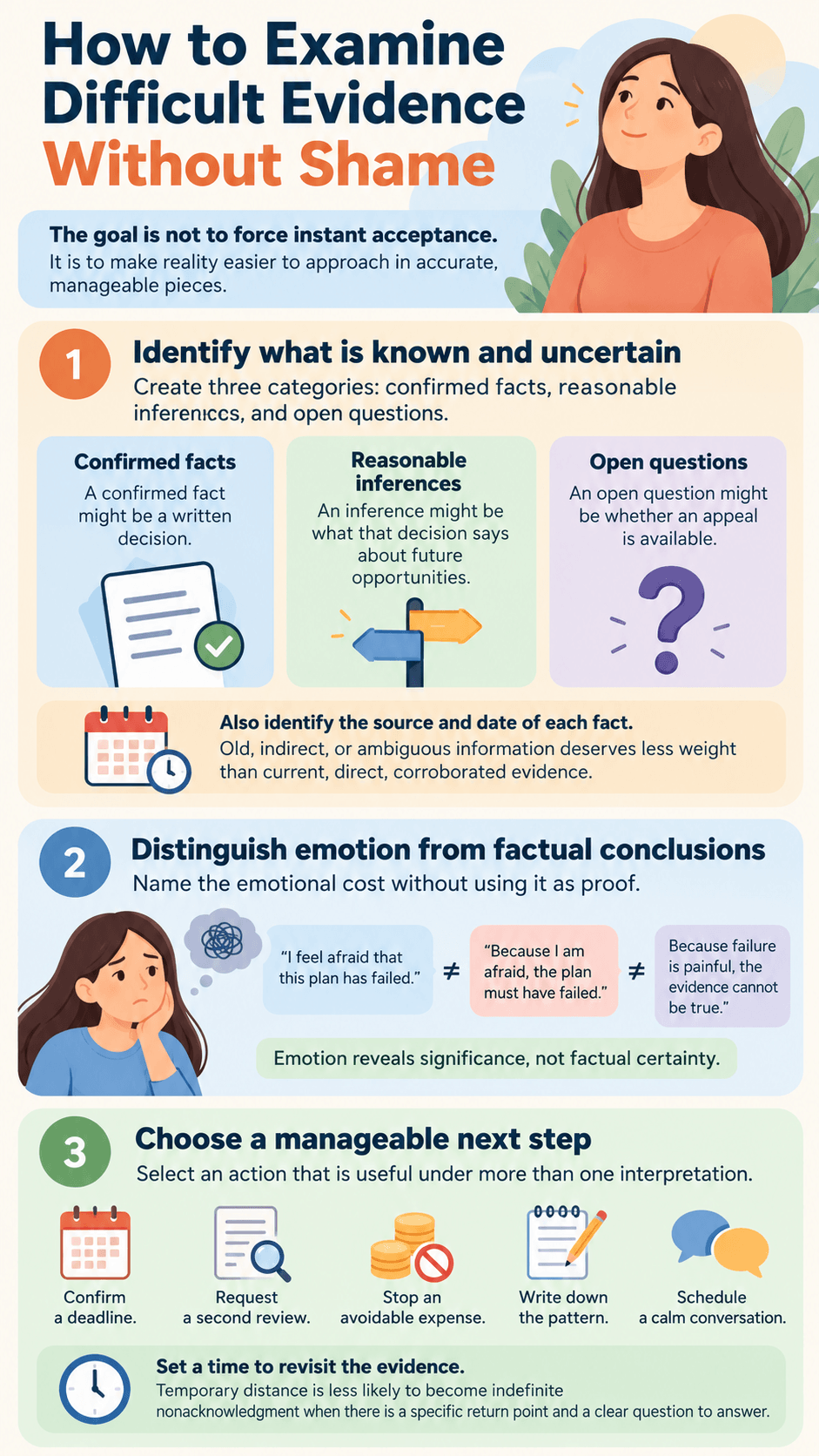
The goal is not to force instant acceptance. It is to make reality easier to approach in accurate, manageable pieces.
Identify what is known and uncertain
Create three categories: confirmed facts, reasonable inferences, and open questions. A confirmed fact might be a written decision. An inference might be what that decision says about future opportunities. An open question might be whether an appeal is available. Keeping these levels separate prevents both minimization and catastrophic overreach.
Also identify the source and date of each fact. Old, indirect, or ambiguous information deserves less weight than current, direct, corroborated evidence.
Distinguish emotion from factual conclusions
Name the emotional cost without using it as proof. “I feel afraid that this plan has failed” is different from “Because I am afraid, the plan must have failed,” and also different from “Because failure is painful, the evidence cannot be true.” Emotion reveals significance, not factual certainty.
Experimental work on self-affirmation and acceptance of personally relevant risk information suggests that reducing threat to self-image can make difficult information easier to consider. The practical lesson is modest: approach the evidence without making one outcome a verdict on your entire worth.
Choose a manageable next step
Select an action that is useful under more than one interpretation. Confirm a deadline, request a second review, stop an avoidable expense, write down the pattern, or schedule a calm conversation. A reversible step can protect options while emotional understanding catches up.
Set a time to revisit the evidence. Temporary distance is less likely to become indefinite nonacknowledgment when there is a specific return point and a clear question to answer.
When Denial Is Not the Right Explanation
Because denial describes an inferred psychological function, it should not be used when simpler explanations fit the situation or when the label could silence legitimate experience.
Genuine uncertainty or disagreement
Reasonable people can weigh evidence differently. They may disagree about reliability, probability, severity, or what action a fact requires. A person who states what would change their mind and engages with contrary information is showing a process that can be evaluated, not necessarily a defense.
Calling disagreement denial makes our own conclusion unfalsifiable. It also avoids the harder task of explaining why the evidence supports one view more strongly than another.
Differences in access to information
Two people may not possess the same records, context, expertise, or language access. One may have heard a direct statement while the other received a summary. Confusion can persist when terms carry different meanings or when important details were never communicated.
Before inferring nonacknowledgment, ask what information each person actually received and whether it was understandable. An evidence gap needs clarification, not psychological labeling.
Fear, coercion, or safety constraints
A person may appear to minimize mistreatment because speaking openly could trigger retaliation, financial loss, social punishment, or physical danger. They may understand the situation clearly while choosing cautious language. Silence and compliance under coercion are not evidence that the person cannot recognize reality.
Do not use denial to dismiss reports of threats, stalking, violence, harassment, exploitation, or abuse. Evaluate concrete behavior and safety needs directly. When serious fear or retaliation is present, confidential individual support and a locally appropriate safety resource are more suitable than pressure to confront another person.
When Professional Support May Help
Support may be useful when difficulty acknowledging a situation repeatedly disrupts work, relationships, sleep, finances, or essential decisions. A qualified mental health professional can help a person explore emotional threat, evidence, and choices without reducing the issue to a character flaw. The purpose is not to force a confession or impose another person’s interpretation.
Practical expertise may also matter. Financial, legal, workplace, or other specialized questions require advice from an appropriately qualified professional. If there is immediate danger, contact local emergency services or a trusted crisis resource. Safety takes priority over determining whether denial is occurring.
When seeking help, bring concrete information rather than a conclusion about denial: dates, decisions, repeated outcomes, messages, and the choices that feel blocked. This gives a professional a clearer basis for helping you distinguish emotional protection, uncertainty, communication problems, and practical risk.
FAQ About Denial as a Defense Mechanism
These distinctions address common questions without turning denial into a remote diagnosis.
Is denial always unconscious?
Classical defense theory generally treats denial as outside full awareness. In everyday language, however, people also use “denial” for deliberate refusal or public contradiction. Those meanings should not be confused. If someone knows a fact and intentionally states the opposite, conscious dishonesty may be a better description.
How is denial different from rationalization?
Denial concerns not fully acknowledging a fact or its implications. Rationalization generally acknowledges the event or choice but supplies a reassuring explanation for it. They may occur together, yet they make different claims about what the person recognizes and how discomfort is managed.
Does refusing evidence always mean a person is in denial?
No. The evidence may be incomplete, unreliable, misunderstood, or genuinely disputed. People can also need time to evaluate surprising information. Consider source quality, access, standards of proof, and willingness to update before proposing a defensive explanation.
Can denial ever be temporarily helpful?
Temporary psychological distance may help a person remain functional while absorbing distressing news. That does not mean every delay is denial or that nonacknowledgment is beneficial overall. The key question is whether the pause supports a return to reality or prevents necessary action.
How can I discuss difficult evidence without accusing someone of denial?
Refer to specific information, ask what the other person understands, and separate confirmed facts from interpretations. Explain the practical decision that concerns you. If the conversation becomes unsafe or coercive, stop trying to secure agreement and focus on boundaries, documentation, and appropriate support.
Key Takeaways
- Denial is a proposed defense in which a distressing reality or its implications are not fully acknowledged.
- Its short-term function may be psychological protection, but persistent nonacknowledgment can delay decisions and correction.
- Denial differs from rationalization, genuine uncertainty, ordinary disbelief, avoidance, and conscious lying.
- Disagreement alone does not prove denial; evidence quality, access, context, and willingness to revise all matter.
- Difficult evidence is easier to examine when facts, inferences, emotions, and open questions are kept separate.
- Fear, coercion, threats, or danger require direct safety attention, not a debate about defense mechanisms.

Michael Reed is the Founder and Lead Writer at Psychology Exposed. He writes about human behavior, relationships, emotional patterns, self-awareness, and practical psychology topics using research-informed, easy-to-understand content.
Read More About Michael Reed: https://psychologyexposed.com/michael-reed/