

Someone may speak confidently during a project meeting but remain quiet at a crowded dinner. Another person may be meticulous when checking financial records yet relaxed about organizing a weekend trip. Does that mean their personality changes whenever the setting changes? Not necessarily. A personality tendency can be relatively enduring even when its expression varies considerably from one situation to another.
Trait activation theory explains part of that variation by looking at whether a situation gives someone a reason, an opportunity, or enough freedom to express a particular trait. The focus is not simply whether the setting is stressful or comfortable. It is whether something about that setting is relevant to the tendency being considered. This distinction helps us interpret behavior without treating one visible action as a complete personality assessment.
Quick Answer: What Is Trait Activation Theory?

Trait activation theory proposes that personality traits are more likely to be expressed in behavior when a situation contains cues relevant to those traits. A demand, opportunity, or social expectation may make a tendency easier to observe, while constraints may suppress its expression. The theory does not mean traits switch on and off or that a single behavior proves what someone is like.
Trait + trait-relevant situational cue → trait expression
Consider someone who tends to enjoy taking initiative. When a group needs a volunteer to coordinate a task, that tendency has a direct opening. In a setting where every action is assigned in advance, it may be much less visible. The person has not necessarily acquired or lost initiative; the situations differ in how readily that tendency can be expressed.
The concise model is TRAIT + RELEVANT CUE → GREATER POSSIBILITY OF TRAIT-EXPRESSIVE BEHAVIOR. The arrow represents an increased likelihood, not a guaranteed outcome. Motivation, competing goals, skill, consequences, and other aspects of the setting still matter.
Why activation changes likelihood, not the existence of the trait
It is tempting to imagine an invisible switch: a cue arrives, a trait turns on, and the matching behavior follows. Real people are less predictable. Someone might recognize an opportunity to lead and deliberately choose to listen instead, or feel unable to act because the timing is poor. Trait activation describes conditions that make a tendency relevant, not a machine that produces a fixed response.
The Problem Trait Activation Theory Tries to Explain
Why the same trait is not equally visible everywhere
Trait descriptions summarize general tendencies. They do not require identical behavior in every room, relationship, or task. A person inclined to be sociable may talk at length with close friends, remain reserved in an unfamiliar formal ceremony, and focus quietly while reading. Each situation invites a different range of responses.
The useful question is not simply, “Is this person sociable?” It is, “What about this situation makes sociable behavior relevant, possible, or worthwhile?” That change in the question is the distinctive contribution of trait activation theory.
Behavior is an imperfect snapshot of personality
If a colleague says nothing in a discussion, a single observation cannot establish that they lack confidence, curiosity, or useful ideas. Perhaps the discussion did not concern their expertise, a senior colleague was dominating it, or they had already expressed their view privately. Behavior provides evidence, but its meaning depends partly on the circumstances in which it occurred.
Research on personality states also shows why isolated snapshots are limited. William Fleeson’s experience-sampling research on variability within individuals found considerable changes in everyday trait-relevant behavior alongside more stable individual averages. Variation and enduring tendencies can coexist.
Opportunity, demand, and constraint as missing context
Three practical distinctions clarify what may be happening. An opportunity permits behavior without requiring it. A demand makes certain behavior useful or expected. A constraint narrows what a person can safely or realistically do. These features do not have the same effect, and the absence of an opportunity should not be confused with a person’s inability or unwillingness.
What Counts as a Trait-Relevant Cue?

A cue must make the trait useful, expected, rewarded, or possible to express
A cue is not just anything noticeable. It matters because it bears on a specific tendency. An open invitation to contribute ideas may be relevant to assertiveness or openness to new possibilities. A task requiring careful checking may be relevant to conscientiousness. A chance to meet unfamiliar people may make sociability easier to observe.
In their 2000 study of situation trait relevance, Robert Tett and Hal Guterman examined how opportunities for trait expression related to trait-behavior associations across scenarios. The broader lesson is that a situation’s relevance to a particular trait matters more than describing every situation as equally revealing.
Demands that call for a response
Some situations require particular actions. A deadline may call for planning and careful follow-through. An unexpected group disagreement may call for someone to speak directly. These demands can bring particular tendencies into view, although the task can also make people act outside their usual preferences. Showing a behavior because it is required is not automatic proof of a strong corresponding trait.
Opportunities that permit expression
Other situations leave room for choice. A community event may allow someone to start conversations, help a newcomer, or stay near familiar people. When the options are genuinely open, individual tendencies may have more space to influence the selected response. Still, a person’s current goals and energy can affect which opportunity they take.
Constraints that inhibit expression
A strict speaking order, limited time, privacy concerns, or possible penalties can restrict how someone behaves. Consider a normally outspoken participant in a meeting where disagreement has consequences. Silence under those conditions should not be read as a reliable absence of assertiveness. Constraints are especially important when the behavior in question is difficult or costly to display.
The Trait Activation Process
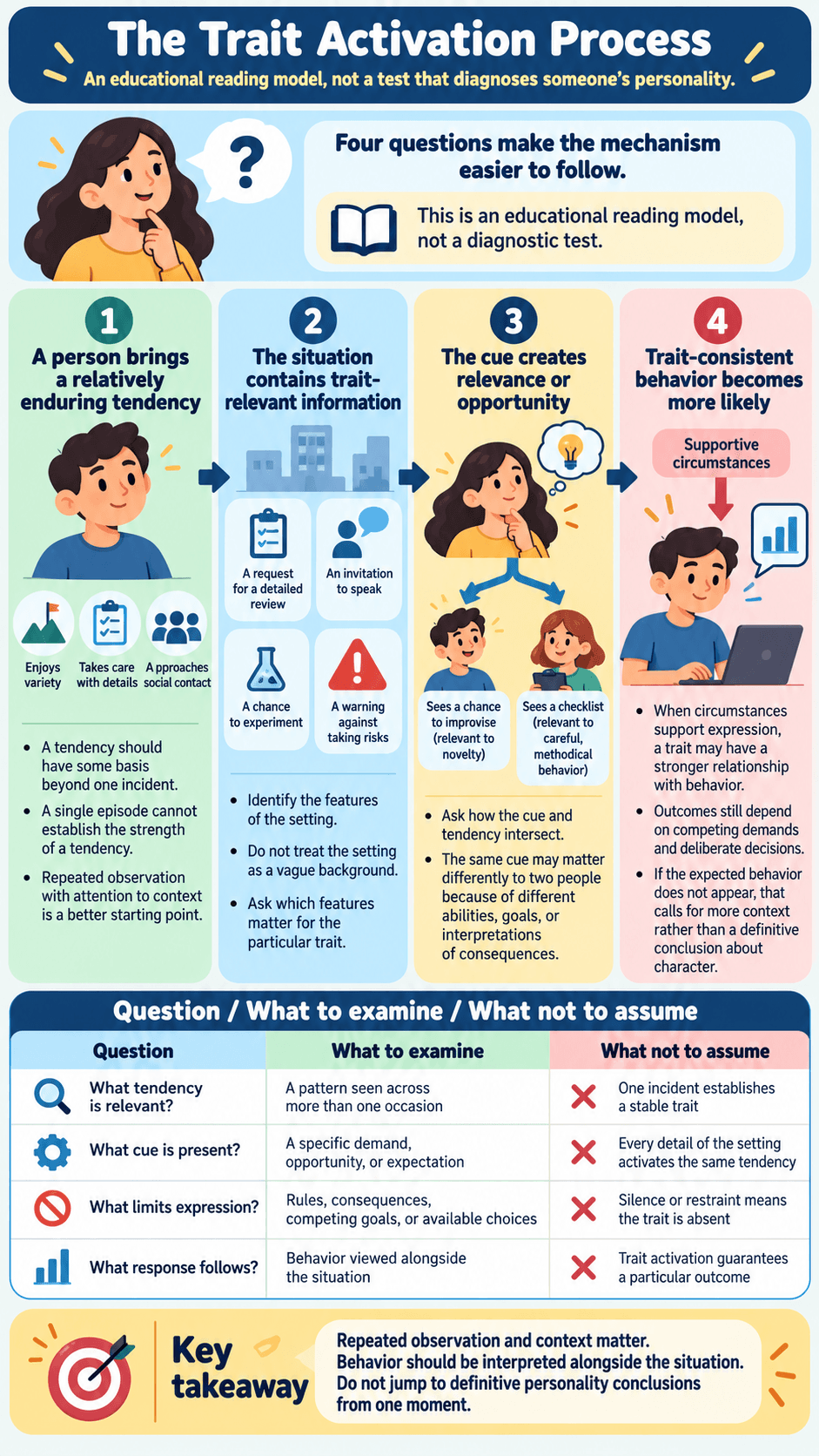
Four questions make the mechanism easier to follow. They are an educational reading model, not a test that diagnoses someone’s personality.
Step 1: A person brings a relatively enduring tendency
Begin with a tendency that has some basis beyond the incident being examined. Perhaps the person commonly enjoys variety, takes care with details, or readily approaches social contact. A single episode cannot establish the strength of that tendency. Repeated observation, with attention to context, gives a more sensible starting point.
Step 2: The situation contains trait-relevant information
Next identify the features of the setting. Is there a request for a detailed review, an invitation to speak, a chance to experiment, or a warning against taking risks? Avoid treating the setting as a vague background. The question is which features might matter for this particular trait.
Step 3: The cue creates relevance or opportunity
Now ask how the cue and tendency intersect. An invitation to improvise is relevant to someone who often enjoys novelty. A checklist is relevant to careful, methodical behavior. The same cue may matter differently to two people because they have different abilities, goals, or interpretations of its consequences.
Step 4: Trait-consistent behavior becomes more likely
Finally consider the visible response. When circumstances support expression, a trait may have a stronger relationship with what the person does. But outcomes still depend on competing demands and deliberate decisions. If the expected behavior does not appear, that observation calls for more context rather than a definitive conclusion about the person’s character.
| Question | What to examine | What not to assume |
|---|---|---|
| What tendency is relevant? | A pattern seen across more than one occasion | One incident establishes a stable trait |
| What cue is present? | A specific demand, opportunity, or expectation | Every detail of the setting activates the same tendency |
| What limits expression? | Rules, consequences, competing goals, or available choices | Silence or restraint means the trait is absent |
| What response follows? | Behavior viewed alongside the situation | Trait activation guarantees a particular outcome |
Activated vs Constrained Traits
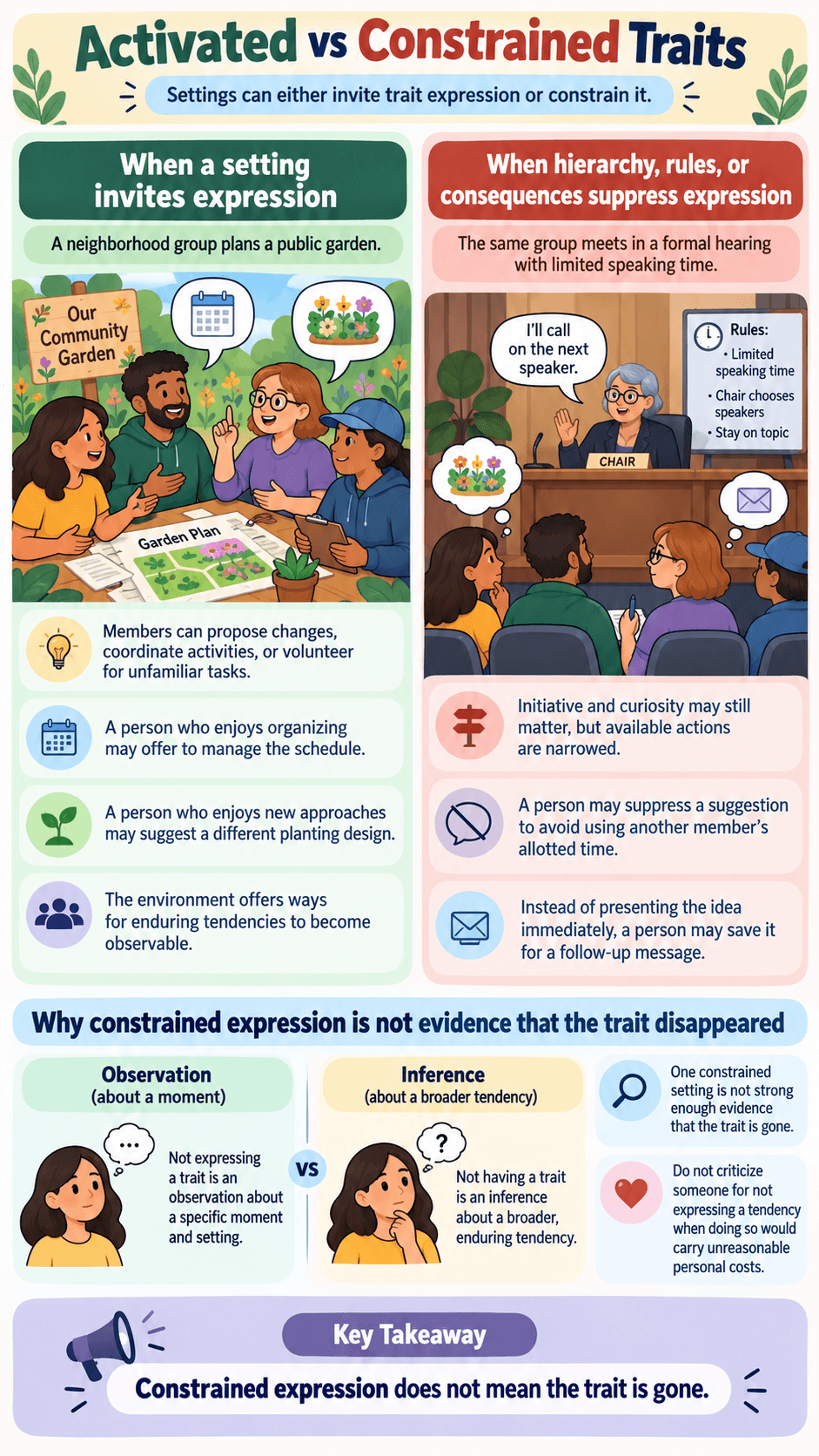
When a setting invites expression
Imagine a neighborhood group planning a public garden. Members can propose changes, coordinate activities, or volunteer for unfamiliar tasks. A person who usually enjoys organizing others may readily offer to manage the schedule. Someone who enjoys trying new approaches may suggest a different planting design. The environment offers different ways for enduring tendencies to become observable.
When hierarchy, rules, or consequences suppress expression
Now place the same group in a formal hearing with limited speaking time and a chairperson who chooses speakers. Both initiative and curiosity may still matter, but the available actions have narrowed. One person may suppress a suggestion to avoid using another member’s allotted time. Another may save their idea for a follow-up message rather than presenting it immediately.
Why constrained expression is not evidence that the trait disappeared
A useful distinction is between not expressing a trait and not having a trait. The first is an observation about a moment; the second is an inference about a broader tendency. That inference needs stronger evidence than one constrained setting can provide. Nor should a person be criticized for failing to express a tendency when doing so would carry unreasonable personal costs.
The Same Trait Across Different Situations

The following examples are illustrations of the mechanism, not ways to classify people from brief observations.
Assertiveness when speaking up is required
A project group reaches a decision point and explicitly asks each member for a recommendation. Someone who usually speaks clearly when a position must be taken may become especially vocal. The invitation creates a relevant occasion for assertive behavior. If their view differs from the group’s, a direct but respectful disagreement is one possible expression.
Assertiveness when disagreement is discouraged
Contrast that with a gathering where challenging the host would embarrass a family member. The same person may decide not to confront a minor claim. This response need not indicate less assertiveness. A social cost or a competing value, such as courtesy, can limit an otherwise relevant behavior.
Conscientiousness under clear versus vague task demands
A volunteer asked to verify names on a donation list has a defined standard, and careful checking is clearly useful. Give the same volunteer a loosely described creative task, and meticulous checking may not stand out. The difference is not that conscientiousness has vanished; the tasks make different behaviors central to success. Even an organized person can appear flexible or spontaneous when a task allows it.
Sociability in familiar versus highly formal settings
Someone who enjoys conversation might be lively at a local club but restrained at a formal awards ceremony. Familiarity, conversational freedom, and uncertainty about etiquette all change the relevance and cost of speaking. A quieter response in the second setting is not enough to conclude that the person’s sociability is low.
| Tendency | Context that may invite expression | Context that may limit expression |
|---|---|---|
| Assertiveness | Explicit invitation to challenge a proposal | High penalties for disagreement |
| Carefulness | Accuracy is necessary and can be checked | Rapid improvisation is rewarded |
| Sociability | Open, informal conversation | Highly scripted social interaction |
| Novelty seeking | Several new options can be explored | Procedure allows only a fixed method |
Trait Activation vs Situationism

Broad situational influence versus trait-specific cue relevance
Situationism emphasizes the role of circumstances in shaping behavior. Trait activation theory asks a narrower question: how does a particular feature of those circumstances make an existing tendency relevant? A rule may make nearly everyone behave similarly, but an open-ended invitation may reveal differences related to particular traits.
These perspectives are not opposites. A situation can exert a broad influence while also creating or limiting opportunities for some individuals to express their tendencies. Keeping the questions separate prevents a general claim about the power of context from being mistaken for an account of trait expression.
Why situation strength can reduce or channel trait expression
Strong situations have clearer expectations or more consequential constraints. They may narrow the range of visible actions, making some traits harder to distinguish from behavior that everyone is required to display. Weaker or more flexible situations sometimes allow more room for individual differences, but flexibility alone does not guarantee that every trait becomes relevant.
Trait relevance and situation strength answer different questions. A setting can make carefulness important while also requiring everyone to follow an exact checking protocol. In that case, the cue is relevant, but the rule may reduce observable differences. Both features must be considered.
How both ideas fit an interactionist view
An interactionist explanation considers the person and the circumstances together. Sometimes a rule dominates. Sometimes an opportunity reveals more variation. Sometimes a trait-relevant cue matters differently depending on a person’s existing tendency. This is why a single formula such as “the strongest trait wins” would be misleading.
Trait Activation vs State vs Trait
Activation concerns expression of an enduring tendency
Trait activation begins with a tendency that is relatively stable and asks when the situation makes it relevant to behavior. It does not require the person’s underlying tendency to change. What varies most visibly is often the opportunity to show it or the decision to act on it.
A state concerns a temporary condition in the moment
A psychological state describes how someone is doing at a particular time, such as feeling unusually energetic, worried, calm, or socially confident. A trait concerns a more enduring pattern. Someone may feel temporarily nervous during an introduction without having a generally fearful disposition, and someone usually outgoing may be tired on a particular evening.
Why visible behavior alone cannot settle the distinction
A person may remain silent because of temporary fatigue, a restrictive setting, an enduring tendency toward reserve, or several factors at once. Trait activation explains one possible mechanism, not a reliable way to decide all these causes from observation. Repeated patterns and information about the person’s current state are needed for a more careful interpretation.
Trait Activation vs Personality Psychology
What is the trait versus when does it become behaviorally relevant
Personality psychology includes questions about how traits are defined, measured, organized, and related to behavior. Trait activation assumes such tendencies can be meaningful and looks at the circumstances under which they are more likely to show up. One question concerns the tendency itself; the other concerns the opportunities and demands surrounding its expression.
Why trait labels alone cannot explain behavior
Broad trait categories can give researchers a language for describing individual differences, but trait activation does not depend on assigning a label to every action. A more useful everyday observation is that a situation can make carefulness, directness, cooperation, or openness especially relevant. That approach reduces the temptation to turn complex behavior into a simplistic personality type.
Where Trait Activation Theory Came From
Why the theory developed strongly in work-performance research
Much of the formal theory developed through research on work roles, where tasks, organizational rules, and social expectations provide identifiable opportunities or constraints. Tett and Burnett’s 2003 interactionist model of job performance distinguished several kinds of situational features, including demands, distracters, constraints, releasers, and facilitators, across task, social, and organizational levels.
An important distinction in that model is that behavior expressing a personality trait is not identical to good job performance. For instance, speaking frequently may be expressive of a tendency without necessarily helping the team. Whether a behavior is valued or effective depends on the work and its requirements.
Trait activation in ordinary settings
Outside work, the broad idea remains understandable. A hobby group, classroom, shared household task, or public meeting can offer relevant demands and opportunities. A person who enjoys planning may step forward when a trip needs coordinating, but not when a friend simply wants company. These are reasonable illustrations, not proof that all everyday behavior follows the same patterns as formal workplace research.
Boundaries on generalization
The 2021 review by Tett, Toich, and Ozkum describes substantial applications of trait activation theory while also identifying unresolved research questions. The evidence is not a license to infer a person’s traits from any situation, or to assume one cue will affect all individuals in the same way.
A 2026 study examining trait activation in daily life found support for connections between relevant situational opportunities and corresponding behavior, while some predicted trait-by-situation interaction effects were limited. That mixed picture is a useful reminder: the framework guides questions, but research findings are more nuanced than a perfectly predictable cue-response rule.
Common Mistakes When Interpreting Trait Activation
Treating traits as literal on-off switches
A relevant cue does not manufacture a personality characteristic, and an irrelevant cue does not erase one. Activation is a way of describing conditions linked to expression. People remain capable of choosing, adapting, and responding to other pressures.
Assuming every cue activates the same trait for everyone
An unexpected request to present information might invite assertiveness for one person, careful preparation for another, and hesitation for someone facing unfamiliar material. Relevance depends on the trait being examined and the person’s relationship with the situation. A cue cannot be understood fully apart from the person.
Ignoring competing demands and constraints
A chance to lead can coincide with limited preparation time, a family obligation, or a rule against changing the agenda. Focusing on the invitation alone misses those constraints. When interpreting behavior, the available alternatives may explain more than the action that ultimately occurred.
Inferring stable personality from one activated moment
One unusually forceful response does not establish that someone is consistently domineering. One quiet evening does not establish low sociability. Looking across varied situations and over time gives a better basis for discussing tendencies. Even then, personality language should remain descriptive rather than a verdict on a person’s worth.
Four Questions for Interpreting Trait Expression
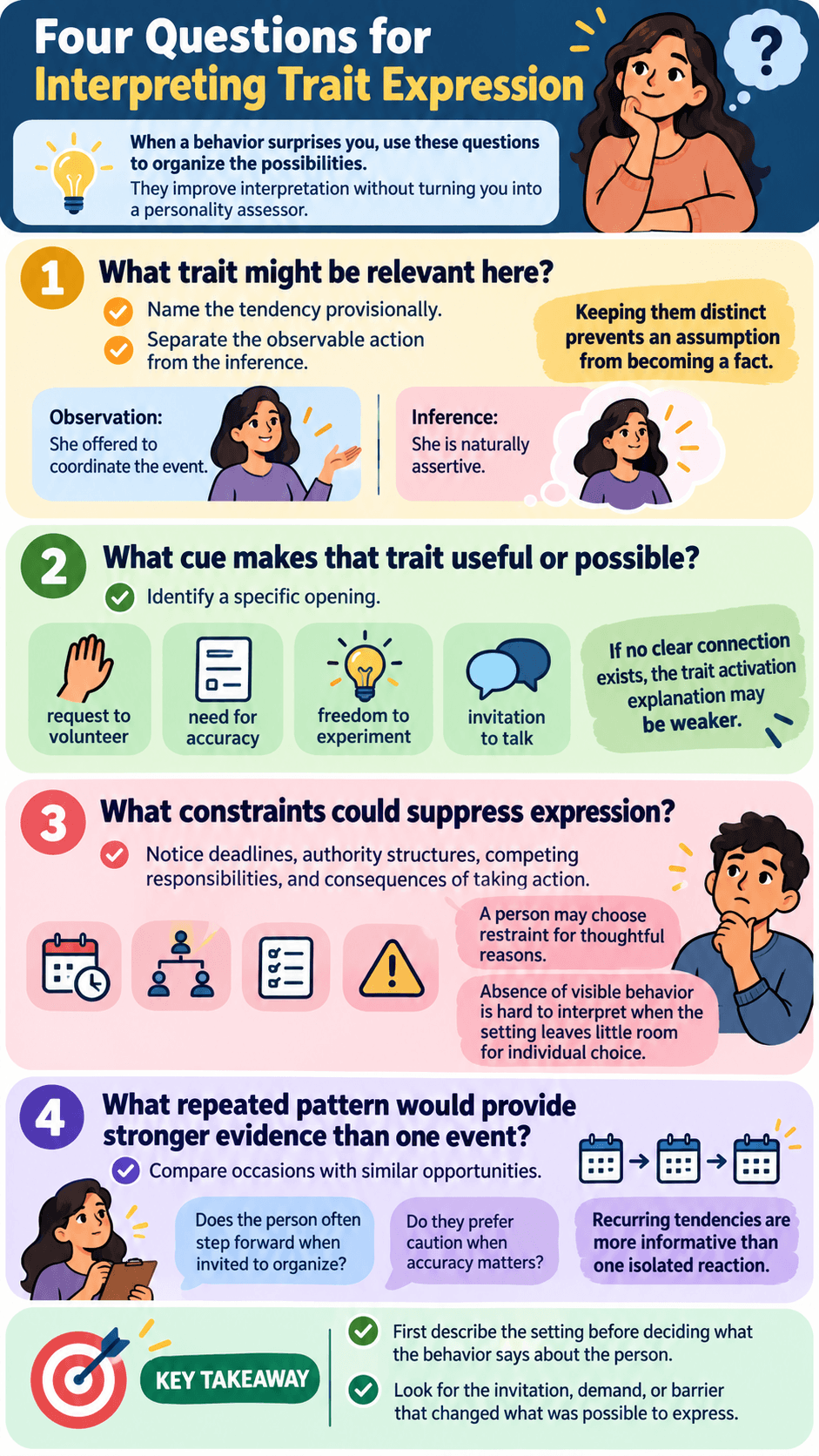
When a behavior surprises you, use the following questions to organize the possibilities. They can improve your interpretation without turning you into a personality assessor.
What trait might be relevant here?
Name the tendency provisionally and describe the observable action separately. For example, “She offered to coordinate the event” is an observation. “She is naturally assertive” is a broader inference requiring more information. Keeping them distinct prevents an assumption from becoming a fact.
What cue makes that trait useful or possible?
Identify a specific opening: a request to volunteer, a need for accuracy, freedom to experiment, or an invitation to talk. Ask why this detail would make the proposed tendency relevant. If no clear connection exists, the trait activation explanation may be weaker than another explanation.
What constraints could suppress expression?
Notice deadlines, authority structures, competing responsibilities, and consequences of taking action. A person may choose restraint for thoughtful reasons. The absence of a visible behavior is especially hard to interpret when the setting leaves little room for individual choice.
What repeated pattern would provide stronger evidence than one event?
Compare occasions that offer similar opportunities while differing in other important ways. Does the person often step forward when invited to organize? Do they prefer caution when accuracy matters? Recurring tendencies are more informative than an isolated success, awkward conversation, or surprising reaction.
A useful first step: the next time someone’s behavior seems out of character, describe the setting before deciding what it says about the person. Look for the invitation, demand, or barrier that might have changed what was possible to express.
FAQ About Trait Activation Theory
Can a trait exist even if I rarely show it in one setting?
Yes. A setting may offer few opportunities to express a tendency or may discourage it through rules and consequences. That does not prove the tendency is present, either. Consider what happens across several settings where the relevant behavior is actually possible.
Is trait activation the same as changing personality?
No. Trait activation concerns when an existing tendency becomes more or less visible through behavior. Personality change concerns whether broader tendencies shift over longer periods. A change in circumstances can alter behavior immediately without demonstrating a lasting personality change.
Can strong situations suppress trait expression?
They can limit the range of responses, particularly when expectations are clear and consequences matter. But a strong situation may also demand a behavior related to a particular trait. The outcome depends on both how relevant the cue is and how much freedom the person has to respond differently.
Does every personality trait need a specific situational cue?
Trait activation theory emphasizes relevant situational features, not a single unique trigger assigned to each trait. Many situations contain several demands or opportunities at once. The same person may express a tendency in different ways, and multiple tendencies may contribute to one action.
Is Trait Activation Theory only used in workplace psychology?
No, although its formal development and much of its evidence come from organizational research. The underlying person-situation question can also be investigated in everyday life. Applying a workplace-derived finding to other settings requires care rather than assuming that every example has been tested in the same way.
Key Takeaways
- A personality tendency can be relatively enduring even when the behaviors associated with it vary from situation to situation.
- Trait-relevant cues matter because they create demands or opportunities for a particular tendency to be expressed.
- Rules, consequences, competing goals, and limited freedom can make a trait less visible without showing that it is absent.
- Trait activation differs from situationism: it focuses on a specific trait meeting a relevant cue, not situational influence in general.
- One behavior is not enough to label personality. Repeated observations across contexts are more informative.
When a familiar person behaves in an unfamiliar way, resist the urge to rewrite your entire view of their personality. First consider what that particular moment asked of them and what it allowed them to do. The relationship between a tendency and its opportunity for expression is often more illuminating than the behavior viewed alone.
Written for educational purposes by Michael Reed, Founder & Lead Writer at Psychology Exposed. This discussion explains psychological research; it does not provide a personality assessment or clinical diagnosis.

Michael Reed is the Founder and Lead Writer at Psychology Exposed. He writes about human behavior, relationships, emotional patterns, self-awareness, and practical psychology topics using research-informed, easy-to-understand content.
Read More About Michael Reed: https://psychologyexposed.com/michael-reed/