
Imagine someone who is usually thoughtful and patient becoming unusually abrupt during a difficult meeting. Should that reaction tell us something about their personality, or about the pressure of the meeting? Perhaps both. The distinction matters because we often treat an observed action as though it reveals an enduring characteristic, while overlooking the circumstances in which the action happened.
The person-situation debate in psychology examines how much human behavior reflects relatively stable characteristics of a person, how much reflects a particular setting, and how these influences work together. It was a major controversy in personality psychology, but its lasting value is not a verdict that one side defeated the other. It is a more accurate way of thinking about what an action can tell us, and what it cannot.
Quick Answer: Is Behavior Caused by the Person or the Situation?
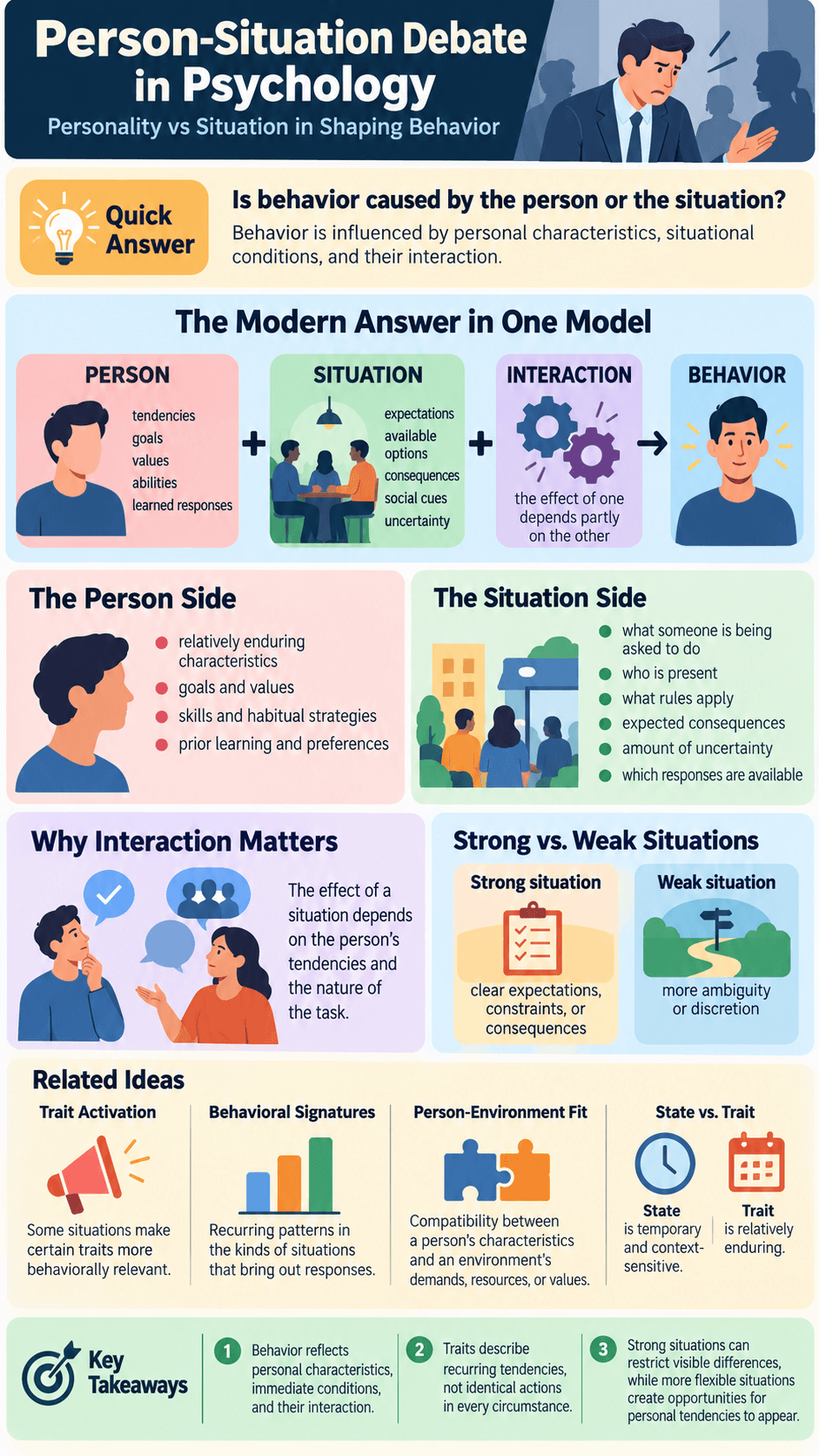
Behavior is influenced by personal characteristics, situational conditions, and their interaction. Personality traits help describe relatively enduring tendencies, but they do not require a person to act identically everywhere. Situations create demands, opportunities, and constraints that can change what people do. Contemporary person-situation thinking explains behavior by considering both the person’s tendencies and the context in which those tendencies become relevant.
The Modern Answer in One Model: Person + Situation + Interaction
A simple organizing model is PERSON + SITUATION + INTERACTION → BEHAVIOR. The person contributes tendencies, goals, values, abilities, and learned responses. The situation contributes expectations, available options, consequences, social cues, and uncertainty. Interaction means that the effect of one depends partly on the other.
This is a teaching model rather than a literal equation that assigns a numerical percentage to each cause. In a particular setting, personal preferences may have wide room to shape action. In another, strict procedures may leave little room for visible differences. The same setting can also affect people differently depending on what they bring to it.
Why Neither Side Alone Explains Every Behavior
Knowing that a person is generally conscientious might help predict how reliably they handle obligations over time. It may not predict whether they will remember one task while exhausted, distracted, or dealing with conflicting demands. Conversely, knowing that a deadline is approaching tells us something about the pressure people face, but not exactly how each person will organize a response.
What the Person-Situation Debate Means

What Counts as the Person Side
The person side includes relatively enduring characteristics, but personality traits are not the whole story. A person’s goals, values, skills, habitual strategies, prior learning, and preferences can also influence choices. These factors may shape which opportunities a person notices, which consequences matter, and how they respond when choices are available.
In research, a personality trait describes a relatively stable characteristic inferred from a broader pattern of feelings, attitudes, habits, or actions. The definition is important: a trait is inferred from patterns, not established by one striking moment.
What Counts as the Situation Side
A situation is more than a physical place. It includes what someone is being asked to do, who is present, what rules apply, what consequences are expected, how much uncertainty exists, and which responses are available. A quiet library and a noisy party differ physically, but two conversations in the same room can also be very different situations if one is casual and the other is a high-stakes evaluation.
Why Interaction Is More Than Simply Adding Two Causes
Suppose two people both value accuracy. One may be most comfortable working independently, while another benefits from discussing uncertain details with colleagues. A collaborative setting may help one person verify a complex answer and distract the other. The effect of collaboration therefore depends on the person’s working tendencies and the nature of the task.
Similarly, the value someone places on careful work might influence behavior more strongly when checking is possible than when a rigid process prevents revision. Interaction means that characteristics and circumstances change each other’s practical significance.
Why the Debate Became Important in Psychology

Trait Explanations and the Expectation of Consistency
Early trait-centered accounts helped psychologists describe meaningful differences among individuals. People vary in broad tendencies such as sociability, orderliness, and emotional responsiveness. If those tendencies are real, it seems reasonable to expect some consistency in behavior. Yet exactly what kind of consistency should we expect?
There is a substantial difference between expecting someone to be somewhat more sociable on average than another person and expecting them to talk more in every single room. The first is a statement about a pattern; the second is a prediction about each occasion. Confusing them made the controversy harder to resolve.
Walter Mischel and the Consistency Controversy
Walter Mischel’s influential 1968 book, Personality and Assessment, challenged simple assumptions about how reliably broad trait measures predict specific behavior across different situations. The controversy encouraged psychologists to inspect evidence about behavioral consistency rather than assume that a label such as “friendly” or “careful” could explain every individual action.
Mischel did not establish that human beings have no enduring dispositions. His challenge helped sharpen questions about measurement, prediction, and the role of context. Researchers subsequently examined both regularities across repeated observations and variation within the same person. A review of the controversy by Fleeson and Noftle describes an emerging synthesis rather than a simple victory for either position.
What the Debate Did and Did Not Show About Personality
The debate highlighted limitations of predicting one isolated action from a broad personality measure. It did not show that personality measures are meaningless, that every behavior is arbitrary, or that the immediate situation fully determines what happens. Different methods answer different questions. A brief observation, a questionnaire about usual tendencies, and many observations across weeks will not necessarily produce the same kind of information.
The Trait View: Why Stable Tendencies Still Matter
Traits Describe Average Tendencies, Not Identical Behavior Everywhere
Consider a person who is generally outgoing. They may become quiet when concentrating on a difficult puzzle, listen rather than speak during a colleague’s presentation, or avoid socializing when tired. Those moments do not necessarily contradict a higher average tendency toward sociability. A trait describes where someone tends to fall over many opportunities, not a rule that every moment must obey.
Aggregation and Why Repeated Observations Matter
Aggregation means considering observations together rather than treating each one as the final measure. If you want to know whether someone usually arrives on time, one train delay provides weak evidence. Arrival patterns across many days and different conditions reveal more about what generally happens.
Cross-Situational Consistency Without Perfect Uniformity
Cross-situational consistency asks whether tendencies show some regularity across settings. It does not require the identical action in every setting. Someone who works carefully might check a report twice, read instructions before assembling furniture, and verify travel details. Those are different behaviors that may reflect a broader carefulness tendency.
The Situationist Challenge
How Constraints, Expectations, Incentives, and Opportunities Change Behavior
Situation-focused explanations begin by examining what the environment makes likely. A clear rule can prohibit an otherwise preferred action. A deadline can prioritize speed over exploration. A chance to contribute anonymously may change whether someone offers criticism. These are not necessarily shifts in enduring personality. They are changes in what the situation invites, permits, or discourages.
Strong and Weak Situations as a Supporting Concept
A strong situation has relatively clear expectations, constraints, or consequences. For example, an emergency procedure may specify exactly what each person must do. Because choices are restricted, some individual differences may be less visible in the immediate action.
A weak situation leaves more ambiguity or discretion. At an open-ended team brainstorming session, people may choose whether to speak, how often to question suggestions, and which ideas to pursue. Personal preferences and skills may become more apparent. Strength is not a moral judgment: a strong situation can be useful for coordination, while a weak situation can create room for creativity or confusion.
Why Situationism Is Not the Claim That Personality Is Unreal
Situationism emphasizes the explanatory power of situational forces. A strong version might underestimate enduring personal differences, but recognizing situational influence does not require denying traits. Likewise, acknowledging traits does not mean treating the environment as irrelevant.
The more useful question is which features of the current situation shape the behavior being examined, and how much freedom remains for other influences to matter.
The Interactionist Synthesis
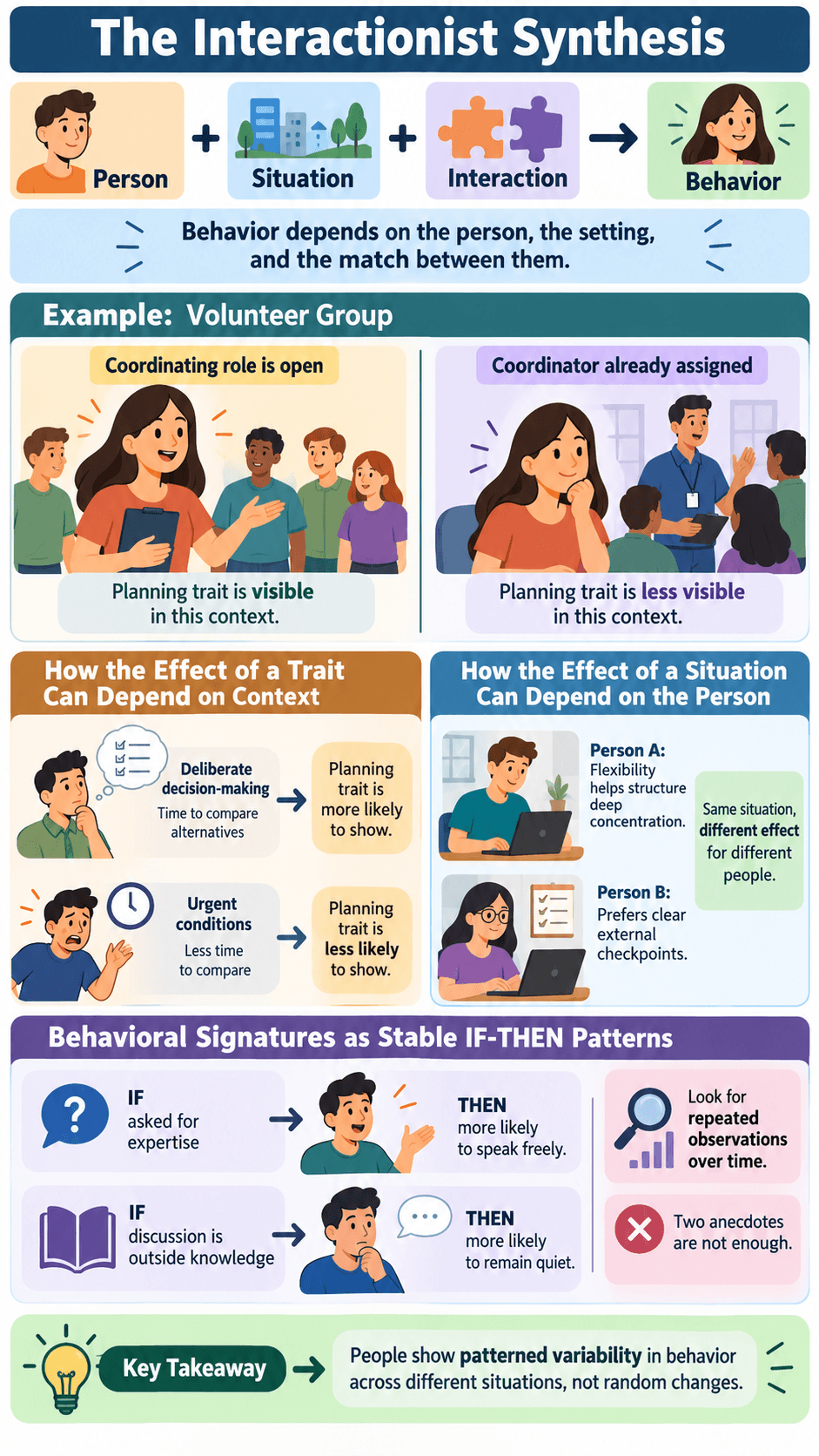
Person + Situation + Interaction → Behavior
A modern account, Whole Trait Theory, joins stable trait patterns with processes producing varying personality states. It illustrates how broad tendencies and momentary expressions can be studied together.
An interactionist explanation does not choose one side in advance. Suppose a volunteer group needs someone to coordinate a complex event. A person who enjoys planning may readily take charge when the role is open. If a coordinator has already been assigned and others are asked only to follow instructions, the same person’s planning tendencies may remain largely invisible.
The trait has not necessarily changed. Instead, the opportunity to express it has changed. The reverse also matters: an open coordinating role may be inviting to one person and uncomfortable to another. The setting matters, the person matters, and the match between them helps explain what happens.
How the Effect of a Trait Can Depend on Context
A preference for deliberate decision-making may be useful when there is time to compare alternatives. Under urgent conditions, that same preference may be difficult to express or may lead to a different compromise. A tendency toward direct speech may be welcomed in a candid discussion but suppressed in a highly formal presentation.
How the Effect of a Situation Can Depend on the Person
Offering flexibility is not guaranteed to help everyone in the same way. One worker may use flexibility to structure deep concentration, while another may prefer clear external checkpoints. Greater choice changes the demands of self-direction, and those demands may fit people’s tendencies and current resources differently.
Behavioral Signatures as Stable IF-THEN Patterns
A behavioral signature is a useful way to imagine patterned variability. Instead of expecting one behavior everywhere, consider the possibility that someone responds in a recurring way under certain conditions: IF the situation includes X, THEN response A becomes more likely; IF it includes Y, THEN response B becomes more likely.
Someone might speak freely when asked for expertise but remain quiet when a discussion is outside their knowledge. If that conditional pattern recurs, it reflects regularity rather than randomness. Still, the pattern should not be assigned from two anecdotes. It takes enough observations across relevant conditions to judge whether it is reliable.
Four Ways to Think About Person-Situation Effects

Trait Tendency
A trait tendency summarizes what a person generally does or experiences across many occasions. It helps when the question is about a relatively enduring pattern: is this person typically careful, sociable, or comfortable with novelty? A trait provides a broad expectation, not certainty about a single event.
Situational Constraint
A constraint limits what someone can do. A meeting that allows two minutes per speaker restricts how much anyone can contribute, regardless of their usual talkativeness. The constraint may compress behavioral differences without eliminating the underlying dispositions.
Trait Activation
Sometimes a setting makes a particular characteristic more relevant. A task requiring persuasive discussion can create opportunities for assertive behavior. A quiet records-checking task may allow meticulousness to appear. The point is not that personality switches on and off, but that different tasks afford different forms of expression.
Person-Environment Fit
Other cases concern how well a person’s needs, abilities, values, or preferences match an environment’s demands and resources. A setting that is challenging but supportive may suit one person; a setting with identical resources may not match another person’s needs. Fit concerns compatibility and outcomes, not just whether a particular trait is visible.
| Question | Most useful perspective | What to examine |
|---|---|---|
| What does someone generally tend to do? | Trait tendency | Repeated behavior across time |
| What options were restricted? | Situational constraint | Rules, demands, consequences |
| When is a trait likely to show? | Trait activation | Relevant cues and opportunities |
| Why might one setting suit someone better? | Person-environment fit | Compatibility between needs and demands |
Four Deeper Questions About People and Situations
Situationism Psychology: When the Situation Is the Main Theoretical Focus
Situationism concentrates on the capacity of circumstances to shape behavior. It asks how much of what we observe is explained by roles, rules, incentives, expectations, and restricted choices rather than by stable individual characteristics. The historical debate made this question prominent because an action can be strongly influenced by the circumstances in which it occurs.
For example, a strict examination setting directs nearly everyone toward quiet, individual work. It reveals little about who would normally enjoy talking with peers. To understand situationism, focus on the power and limits of contextual forces, including why strongly structured settings sometimes make people appear more alike than they otherwise would.
Trait Activation Theory: When a Situation Makes a Trait Relevant to Behavior
Trait activation examines a more specific mechanism: why existing tendencies become more likely to influence visible behavior when the situation contains relevant cues. Someone who enjoys resolving disagreement may display that tendency during a collaborative negotiation, but have little opportunity to show it during a routine, solitary task.
Its key distinction is between possessing a tendency and having the opportunity or reason to express it. A quiet performance is not proof that someone lacks assertiveness, creativity, or initiative. Whether those tendencies matter depends partly on what the circumstances call for and permit.
Person-Environment Fit Psychology: When Compatibility Matters
Person-environment fit asks how well someone’s characteristics match those of a surrounding setting. Compatibility can involve what a person needs compared with what an environment provides, what abilities they bring compared with what tasks require, or whether the values of a setting align with their own.
It is not simply another way to say that surroundings affect behavior. Fit is a relationship between characteristics on both sides. It also is not identical to comfort: a demanding environment can be a good match when it fits someone’s abilities and values, while an easy environment may fail to meet important needs.
State vs Trait Psychology: When the Question Is Temporary Versus Enduring
The state-trait distinction helps answer a different question: does a response reflect how someone is right now, or a relatively enduring tendency? A temporary state may involve current confidence, worry, energy, or sociability. A trait refers to a broader pattern that usually requires repeated observations to identify.
This distinction matters when a particular moment seems unusually revealing. One confident presentation does not establish an enduring personality characteristic, and one anxious experience does not define someone as habitually anxious. Temporary states can be meaningful without providing enough evidence for a stable label.
Which Explanation Should You Explore Next?
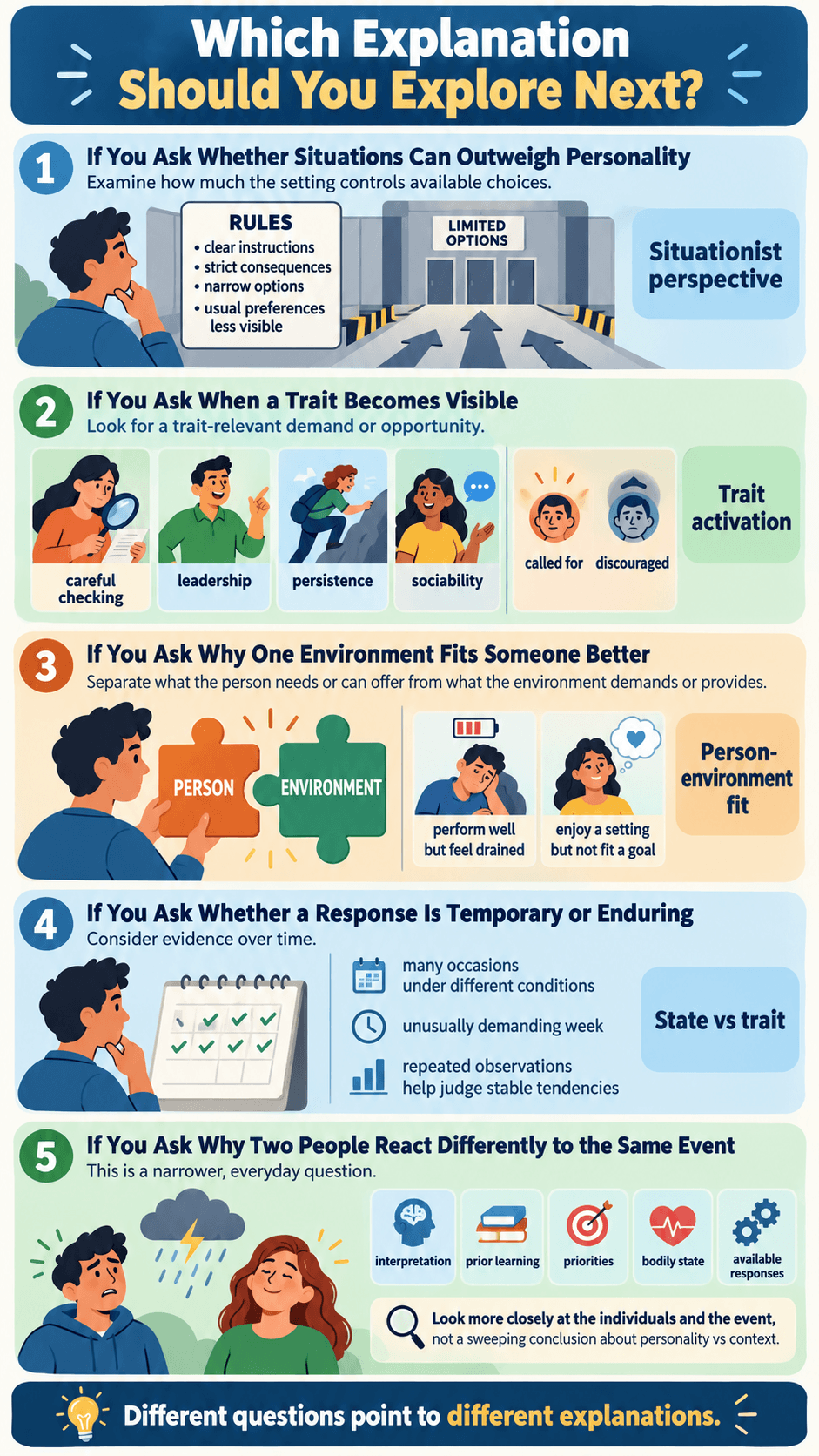
If You Ask Whether Situations Can Outweigh Personality
Examine how much the setting controls what choices are available. Clear instructions, strict consequences, and narrow options may make differences in people’s usual preferences less visible. That question belongs most directly to the situationist perspective.
If You Ask When a Trait Becomes Visible
Look for a trait-relevant demand or opportunity. Does the setting call for careful checking, leadership, persistence, or sociability? Does it discourage those behaviors? This points toward trait activation rather than a debate over whether traits exist at all.
If You Ask Why One Environment Fits Someone Better
Separate what the person needs or can offer from what the environment demands or provides. Consider which outcome you are explaining. A person may perform well in a setting yet find it draining, or enjoy a setting without finding it well matched to a particular goal. Those distinctions belong to person-environment fit.
If You Ask Whether a Response Is Temporary or Enduring
Consider evidence over time. Has this response appeared on many occasions under different conditions, or only during an unusually demanding week? A single moment can be informative, but repeated observations are better suited to questions about stable tendencies.
If You Ask Why Two People React Differently to the Same Event
That is a narrower, everyday question about differences in interpretation, prior learning, priorities, bodily state, and available responses. It is distinct from the historical theoretical debate over the relative explanatory roles of person and situation. Different reactions invite a closer look at the specific individuals and the event, not a sweeping conclusion about whether personality or context matters more in general.
Common Misunderstandings About the Person-Situation Debate
Personality Traits Do Not Require Identical Behavior in Every Setting
Calling someone reliable does not predict a flawless record. Traits concern characteristic tendencies across enough occasions to identify a pattern. Variation is expected, especially when tasks, resources, health, attention, or constraints change.
Research on personality states illustrates this coexistence of stability and variation. In one study involving repeated laboratory observations, researchers found substantial within-person changes in trait-relevant behavior while also finding stable individual differences in average levels of that behavior. The open-access report by Fleeson and Law offers a concrete example of why variability does not automatically undermine traits.
Situational Influence Does Not Erase Choice or Responsibility
Explaining that a setting increased the likelihood of an action does not necessarily excuse it. A demanding workplace may help explain why an employee rushed a decision; it does not establish that every consequence was unavoidable. People can face unequal pressures and options while still having some responsibility for choices within their control.
It is also reasonable to consider structural limits. A person with no authority to change a rule does not have the same options as someone empowered to redesign it. Good explanation examines constraints without automatically denying agency or assuming complete freedom.
Person-Situation Psychology Is Not the Same as Nature Versus Nurture
Nature-versus-nurture questions generally concern how inherited and environmental influences contribute to development. The person-situation debate asks a more immediate question: how do personal tendencies and current circumstances relate to behavior now?
These perspectives can complement each other, but they operate at different levels. Understanding how a tendency developed is not the same as understanding whether a particular setting gives it room to influence today’s response.
Explaining Behavior Is Not the Same Task as Attribution by an Observer
Attribution concerns how we infer why an action occurred. Someone watching a missed deadline may attribute it to carelessness, unreasonable workload, or a mixture of both. The observer’s explanation may or may not be accurate.
Person-situation psychology asks about the actual contributing processes. To evaluate those processes, we need more than the observer’s first impression: details about the task, competing demands, past patterns, resources, and available choices can all be relevant.
A Practical Reading Model: Person → Context → Fit or Cue → Response

When an action seems to reveal someone’s character, a useful response is to slow the inference and inspect four parts of the event. This model is a tool for organizing questions, not a clinical assessment or a formula that can determine anyone’s personality.
What Tendencies Does the Person Bring?
Identify characteristics that might reasonably matter: a habit of preparing carefully, a preference for independence, experience with similar tasks, or a strong goal to avoid mistakes. Resist turning impressions into absolute labels. “Often double-checks details” is more informative than “always meticulous,” especially when the evidence is limited.
What Does the Context Demand, Allow, Reward, or Discourage?
List the practical conditions. How much time was available? Were expectations clear? Could someone ask for help? Were there penalties for delay? Did the role require initiative or compliance? These questions illuminate why a particular response may have been easier, harder, or more costly than it first appeared.
Does the Context Activate, Constrain, or Fit Those Tendencies?
Now examine their relationship. A setting may invite a familiar strength, restrict a preferred response, or demand something that conflicts with a person’s abilities or needs. Do not assume one relationship applies across all outcomes. A setting could support accurate work but interfere with sociability, for example.
What Response Becomes Visible?
Describe what actually happened, with as little interpretation as possible. “They submitted the report after the deadline” is an observation. “They do not care about their responsibilities” is an inference. The first can be checked; the second requires much more evidence.
For a practical illustration, imagine a skilled organizer who fails to coordinate an event well. They may feel embarrassed or frustrated afterward. The personal side includes their usual planning habits; the contextual side includes unclear authority and last-minute changes; the interaction includes whether those conditions allowed their skills to be used. Rather than immediately assigning a trait label, the next useful step is to clarify responsibilities and observe performance across more than one event.
This reflective approach is especially valuable in work, education, and relationships because it reduces the temptation to treat one episode as a complete portrait. It does not require excusing harmful behavior or dismissing the impact of an action. It simply distinguishes what is known from what is being inferred.
FAQ About the Person-Situation Debate
Did Walter Mischel Prove That Personality Traits Do Not Matter?
No. Mischel challenged expectations that broad trait measures could strongly predict specific actions across varied situations, helping stimulate research on context and behavioral consistency. Later work examined stable average tendencies alongside substantial moment-to-moment variation. Treating his contribution as proof that traits do not exist misrepresents both the debate and its subsequent development.
Can Personality Predict Behavior if People Act Differently Across Situations?
Yes, depending on what behavior is being predicted and how it is measured. Traits can be informative about broad tendencies and aggregated patterns even when a single action is difficult to predict. A good prediction also considers whether the situation permits the behavior, what competing demands exist, and how much evidence is available about the person’s usual responses.
What Is the Difference Between Person-Situation Interaction and Situationism?
Situationism gives particular emphasis to the power of situational conditions. Person-situation interaction refers to the idea that effects of personal characteristics can depend on circumstances, and effects of circumstances can depend on the person. Interaction therefore includes both sides rather than presuming that the same setting has an identical impact on everyone.
Is the Person-Situation Debate the Same as Nature Versus Nurture?
No. Nature versus nurture is mainly about how characteristics develop through inherited and environmental influences. The person-situation debate concerns how relatively enduring individual characteristics and immediate contexts relate to behavior. Developmental origins can help explain what a person brings to a situation, but they do not replace analysis of the current setting.
What Does Behavioral Consistency Mean if Behavior Varies by Context?
Consistency can refer to stable average tendencies, recurring responses within certain kinds of situations, or the relative ordering of individuals across many observations. It need not mean that a behavior happens every time. The crucial step is to define the kind of consistency being discussed before drawing a conclusion about someone’s personality.
Key Takeaways
- The person-situation debate asks how personal characteristics, immediate conditions, and their interaction contribute to behavior.
- Traits describe recurring tendencies rather than predicting identical actions in every circumstance.
- Strong situational demands can restrict visible differences, while more flexible situations may create opportunities for personal tendencies to appear.
- Repeated observations can reveal stable averages even when behavior varies substantially from moment to moment.
- Trait activation, person-environment fit, and the state-trait distinction answer different, more specific questions about behavior.
- Before interpreting one action as someone’s character, separate the observed response from the person, context, and opportunities surrounding it.
A useful next step: Think of a recent action that surprised you. Write down what you directly observed, what you know about the person’s broader tendencies, and which situational demands were present. If the evidence is thin, leave the personality judgment open. Understanding human behavior often improves when a single moment is treated as one piece of a larger picture.
Written for Psychology Exposed by Michael Reed, Founder & Lead Writer. This article is educational and does not provide an individual psychological assessment.

Michael Reed is the Founder and Lead Writer at Psychology Exposed. He writes about human behavior, relationships, emotional patterns, self-awareness, and practical psychology topics using research-informed, easy-to-understand content.
Read More About Michael Reed: https://psychologyexposed.com/michael-reed/