
Two people can look at the same expression, hear the same feedback, or enter the same room and come away with different impressions. The difference does not always begin with deliberate reasoning. It may begin earlier, while the mind is deciding which cues deserve attention, how strongly each cue should count, how separate details fit together, and what an ambiguous signal is likely to mean.
That early tilt is what people often mean by perceptual bias psychology. The phrase is best treated as a broad description rather than a diagnosis or one perfectly uniform research category. In laboratory studies, perceptual bias may refer to a measurable tendency in a specific visual, auditory, or decision task. In everyday life, it can describe a recurring direction in how someone notices and interprets incomplete information.
Not every disagreement proves bias, and a first impression is not automatically wrong. The concern is a repeated directional lean, especially when one vivid cue dominates, contradictory details receive little weight, or certainty arrives before enough information.
Quick Answer: Bias Can Begin Before Judgment
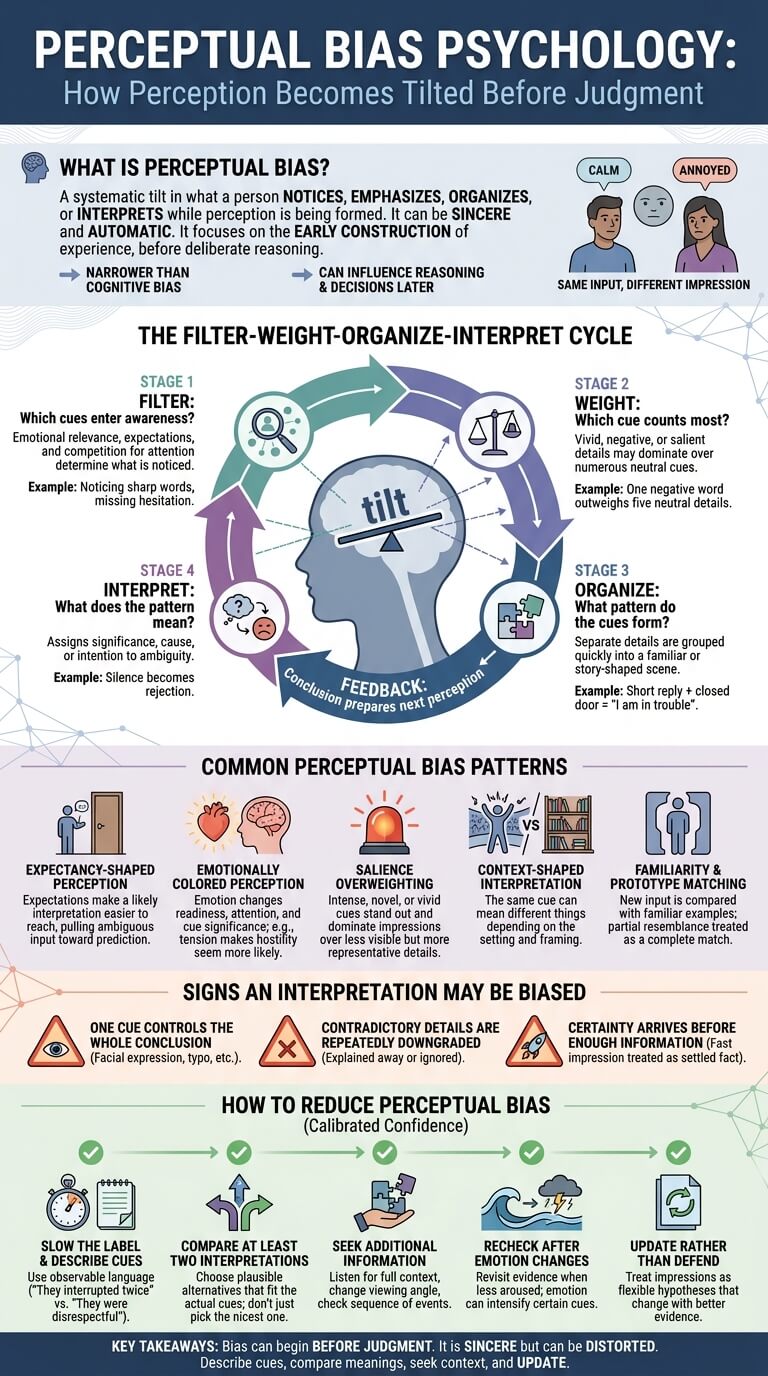
Perceptual bias is a systematic tilt in what a person notices, emphasizes, organizes, or interprets while perception is being formed. It can be sincere and automatic. It is narrower than cognitive bias because it focuses on the early construction of experience, although that early tilt can later influence reasoning, memory, and decisions.
Perceptual bias can affect selection, weighting, organization, or interpretation
A perceptual tilt may appear at more than one point. You may notice one cue and miss another, give unusual importance to a vivid detail, group separate signals into a familiar pattern, or settle on one meaning for an ambiguous event. These are related processes, but they are not identical.
It can be automatic and sincere
A person does not need to be lying, careless, or intentionally unfair. Their experience may honestly feel clear because the mind has already produced a coherent picture. Sincerity tells you that the person experienced the interpretation as convincing. It does not guarantee that every relevant cue was available or equally weighted.
It is narrower than cognitive bias
Cognitive bias is a broader family of predictable tendencies in judgment, belief, memory, and decision-making. Perceptual bias concerns what happens closer to the point where sensory and contextual information becomes an experienced object, event, or social meaning. One can feed the other, but they should not be treated as interchangeable labels.
Where Perceptual Bias Enters the Process
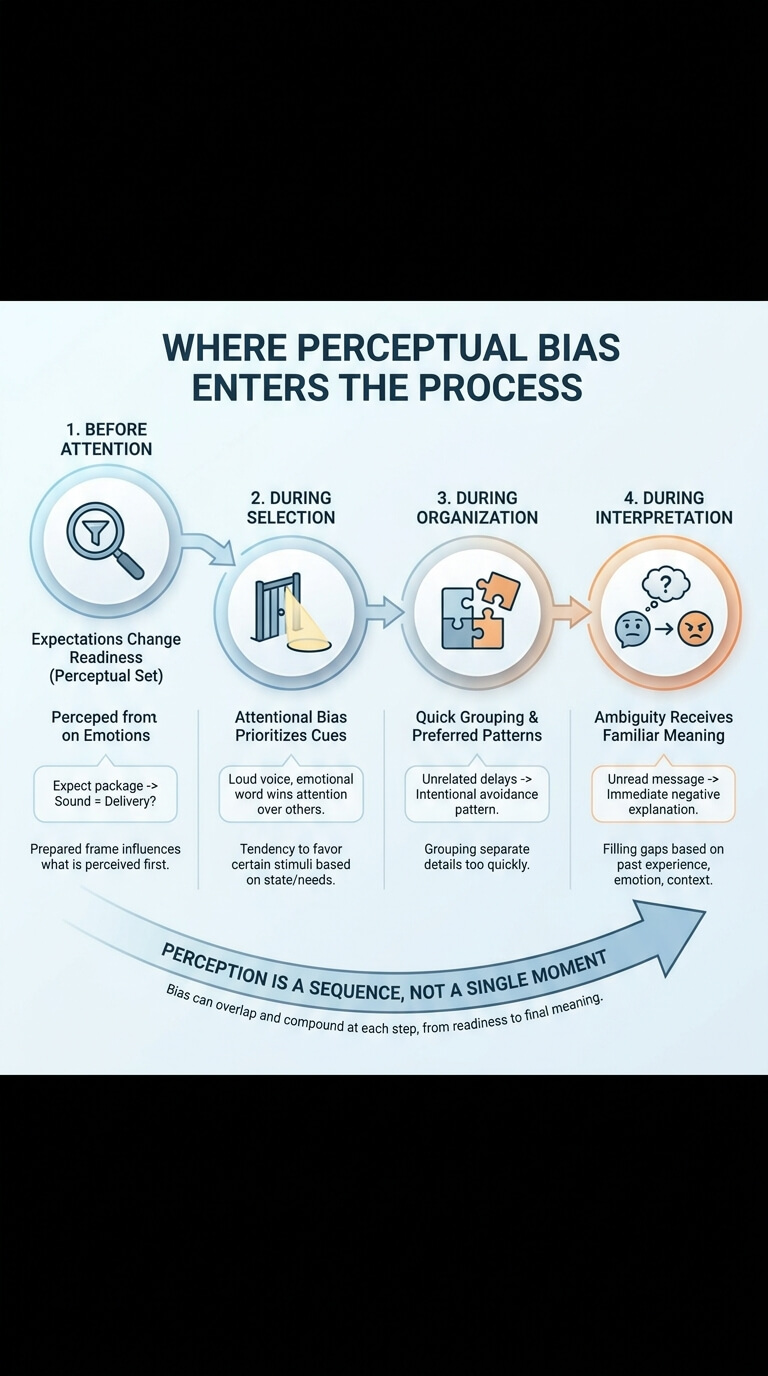
Perception is not a single camera-like moment. It is a sequence of selections and interpretations that may overlap in time. A tilt can enter before a cue is consciously noticed, while cues compete for attention, while the scene is organized, or while meaning is assigned.
Before attention: expectations change readiness
If you expect a package at the door, a small sound in the hallway may quickly register as a delivery. If you expect criticism in a meeting, a neutral pause may feel loaded. Expectations can prepare the system to detect some possibilities more readily than others. The APA Dictionary of Psychology defines perceptual set as a readiness or frame that influences what a person is prepared to perceive.
During selection: some cues receive more access
Many signals compete at once. A loud voice, bright color, emotionally meaningful word, or familiar face may win attention. Attentional bias describes a tendency to prioritize certain stimulus types based on factors such as emotional state, needs, or experience. When that priority repeatedly favors one class of cues, perception may lean before a broader picture forms.
During organization: details are grouped into a pattern
The mind does not leave every detail separate. It groups edges into objects, sounds into words, and behaviors into social episodes. Most of the time this is efficient. A bias can appear when separate details are grouped too quickly into a preferred pattern, such as treating several unrelated delays as evidence of intentional avoidance.
During interpretation: ambiguity receives a familiar meaning
An unread message, a brief facial movement, or a vague sentence can support several explanations. Interpretation fills the gap. Past experience, current emotion, cultural learning, and situational context may make one meaning feel immediate while alternatives remain less available.
Perceptual bias occurs within the wider process by which the mind constructs meaning from input.
The Filter-Weight-Organize-Interpret Cycle
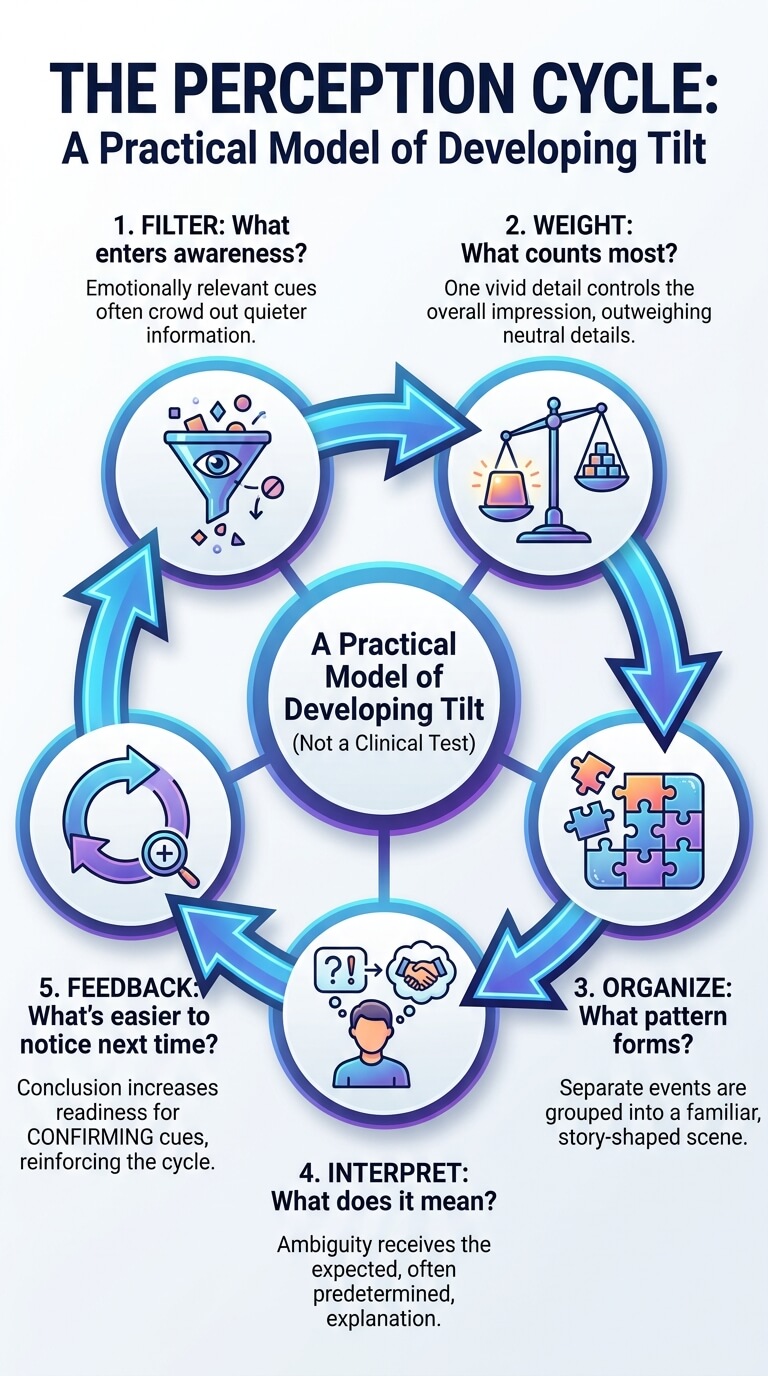
The following model is a practical way to examine perception. It is not a clinical test or a universal scientific scale. Its purpose is to show where a directional tilt may develop and how the first conclusion can influence the next round of perception.
Filter: which cues enter awareness?
Filtering determines what becomes noticeable enough to work with. In a conversation, one person may register the sharpness of a sentence but miss the speaker’s hesitation. Another may focus on the hesitation and barely register the wording. Neither has processed the full event.
Weight: which cue counts most?
Noticing a cue does not mean treating every cue equally. A single negative word may outweigh five neutral details. A bright warning symbol may dominate a page of calm information. Weighting becomes biased when the same kind of cue repeatedly controls the conclusion beyond what the available evidence supports.
Organize: what pattern do the cues form?
The mind links selected details into a meaningful structure. A manager’s short reply, closed office door, and rescheduled meeting might be organized as “I am in trouble.” The same details might also fit “the manager is overloaded.” Organization creates a story-shaped scene before the story has been verified.
Interpret: what does the pattern mean?
Interpretation assigns significance, cause, or intention. A look becomes disapproval, silence becomes rejection, speed becomes recklessness, or familiarity becomes trustworthiness. This step often feels like direct perception because the assigned meaning arrives together with the cue.
Feedback: the conclusion prepares the next perception
Once a conclusion forms, it can change what gets filtered and weighted next time. If you decide a coworker is dismissive, you may notice future interruptions faster and give less weight to their supportive behavior. The cycle becomes self-reinforcing without anyone consciously deciding to distort the scene.
| Stage | Everyday question | Possible tilt |
|---|---|---|
| Filter | What entered awareness? | Emotionally relevant cues crowd out quieter information |
| Weight | What counted most? | One vivid detail controls the overall impression |
| Organize | How were details grouped? | Separate events are joined into a familiar story |
| Interpret | What meaning was assigned? | Ambiguity receives the expected explanation |
| Feedback | What will be easier to notice next time? | The conclusion increases readiness for confirming cues |
Common Perceptual Bias Patterns
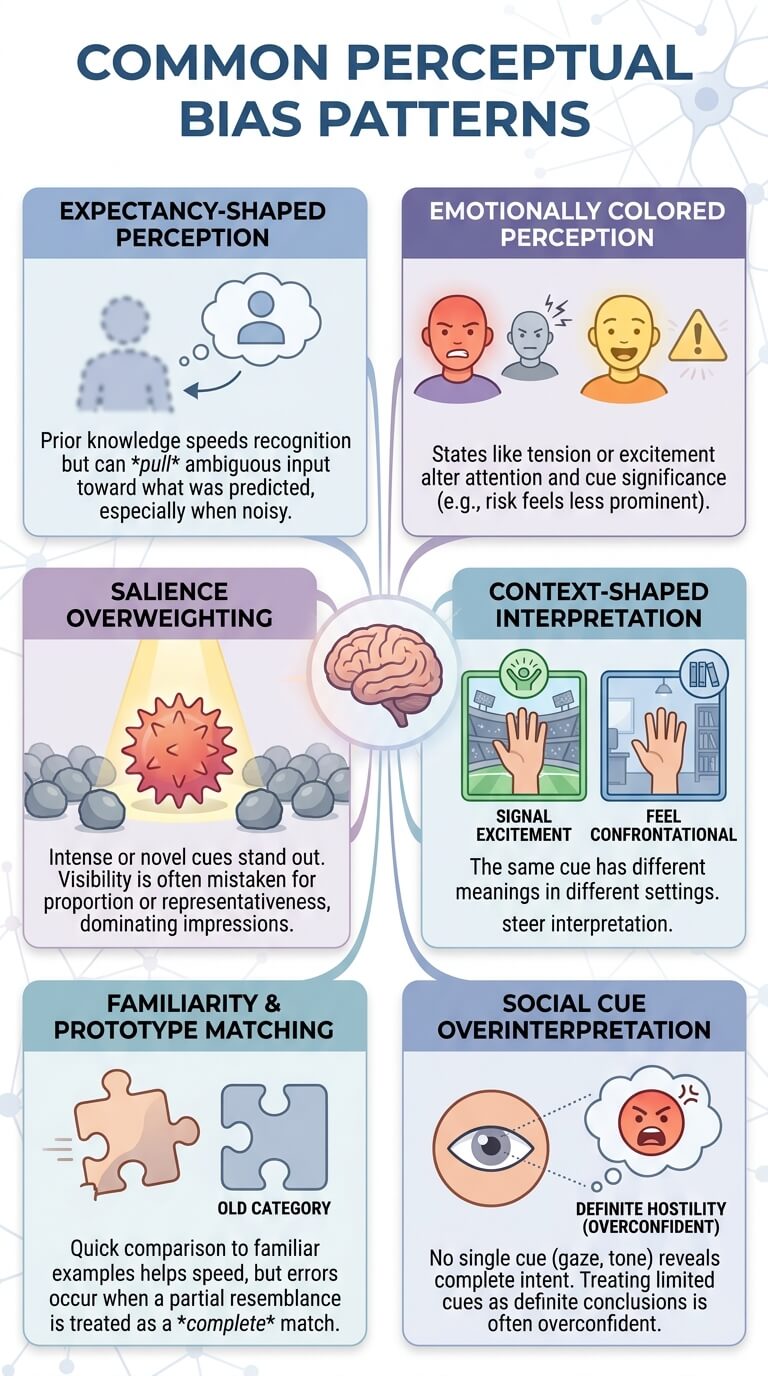
Scientific studies use perceptual bias in task-specific ways. In everyday life, several recurring forms show how perception can lean without becoming a long list of named reasoning errors.
Expectancy-shaped perception
Expectation can make a likely interpretation easier to reach, especially when input is incomplete or noisy. Research on learning what to expect in visual perception examines how prior knowledge and statistical regularities can influence perceptual inference. Expectations are useful because they speed recognition, but they can also pull ambiguous input toward what was predicted.
Emotionally colored perception
Emotion can change readiness, attention, and the apparent significance of a cue. When tense, an uncertain expression may seem more hostile. When excited, risk cues may feel less prominent. A review of affective influences on perception describes evidence that emotional and motivational states can shape what aspects of the environment become easier to detect or how spatial features are experienced.
Salience overweighting
Salient cues stand out because they are intense, novel, contrasting, moving, or personally relevant. Standing out is not the same as being representative. A dramatic complaint may dominate your impression of a service even when dozens of ordinary experiences point elsewhere. The bias lies in allowing visibility to substitute for proportion.
Context-shaped interpretation
The same cue can mean different things in different settings. A raised voice at a sports event may signal excitement, while the same volume in a quiet office may feel confrontational. Context usually improves perception, but a misleading frame can also steer interpretation. Reviews of top-down influences on visual processing describe how current demands, associations, and context dynamically affect what visual information is selected and represented.
Familiarity and prototype matching
New input is often compared with familiar examples. This helps identify objects and situations quickly. It can also create errors when a partial resemblance is treated as a complete match. A new coworker who resembles a former difficult colleague may be placed into the old category before their behavior has been observed over time.
Social cue overinterpretation
Faces, posture, tone, timing, and distance all provide information, but no single cue reliably reveals a complete intention or personality. A narrowed gaze might reflect concentration, light sensitivity, confusion, or irritation. Treating it as definite hostility turns a limited cue into an overconfident social conclusion.
Everyday Examples of Biased Perception
These examples show how a perceptual tilt can develop without assuming that the first interpretation is foolish or dishonest. Each situation includes a cue that is real, followed by weighting or meaning that may exceed what the cue alone can establish.
Seeing hostility in an ambiguous expression when tense
Situation: After a stressful commute, you see a coworker briefly tighten their face. What you may feel: watched, judged, or unwelcome. What it may mean: tension has increased the weight given to possible threat cues, but the expression could also reflect concentration or discomfort. What to do next: wait for speech and behavior before assigning intention.
Overweighting one vivid detail in a complex scene
Situation: A presentation contains one visible error alongside accurate analysis. What you may feel: doubt about the presenter’s competence. What it may mean: the error is perceptually salient and therefore feels more representative than it is. What to do next: compare the vivid detail with the full quality of the work.
Interpreting feedback through a role expectation
Situation: You expect a senior manager to be intimidating, so their brief question sounds like a challenge. What you may feel: defensive or exposed. What it may mean: the role expectation shaped tone perception before the purpose of the question was clear. What to do next: answer the literal question and look for additional cues about intent.
Seeing a familiar pattern in incomplete information
Situation: Two friends cancel plans within a month. What you may feel: certain that people are pulling away. What it may mean: separate cancellations have been organized into a familiar rejection story. What to do next: check timing, reasons, and the broader pattern of contact instead of relying on the grouped impression alone.
Reading intention from limited social cues
Situation: Someone avoids eye contact while answering. What you may feel: suspicious. What it may mean: eye behavior is ambiguous and affected by culture, stress, thinking, environment, and individual habits. What to do next: assess consistency, words, context, and follow-through rather than treating one cue as a lie detector.
Perceptual Bias vs Cognitive Bias
The two ideas overlap, but they answer different questions. Perceptual bias asks how the experienced scene became tilted. Cognitive bias asks how thinking, evaluation, memory, or choice may depart from a neutral or fully evidence-based process.
Early perceptual tilt versus later judgment error
A perceptual tilt can occur while a face, sound, object, or event is being experienced. A cognitive bias may occur after perception, such as interpreting evidence to protect a belief or estimating probability from an easily recalled example. In real life, the stages are connected, so the distinction is conceptual rather than a perfect timeline.
Why one can feed the other
Suppose a person notices signs of disagreement faster than signs of agreement. That selective access creates an input set that already looks negative. Later reasoning may then use that input to conclude that “everyone opposed the idea.” The later belief did not arise from reasoning alone because the evidence reaching reasoning was uneven.
Why a catalog of thinking errors would miss the point
Listing anchoring, hindsight, availability, and dozens of other named tendencies would shift attention away from perception itself. The central issue here is earlier: what became visible, how much it counted, how it was grouped, and which meaning felt immediate.
| Question | Perceptual bias | Cognitive bias |
|---|---|---|
| Main focus | Construction of the experienced cue or scene | Judgment, belief, recall, or decision |
| Typical example | An ambiguous expression looks hostile | Contrary evidence is dismissed after a belief forms |
| Useful check | What did I notice and overweight? | How did I evaluate the evidence? |
| Relationship | Can shape the evidence that becomes mentally available | Can reinforce expectations that guide later perception |
Perceptual Bias vs Selective Perception
Selective perception is one possible part of perceptual bias, but the terms should not be collapsed. Selection concerns which stimuli receive attention. Bias may involve selection plus weighting, grouping, and interpretation.
Selecting cues is not the whole pathway
The APA Dictionary description of selective perception focuses on choosing to attend to one or a few stimuli from the many presented to the senses. A person may select an angry word and miss a calming gesture. Perceptual bias asks what happens after selection as well, including how much the word counts and what it comes to mean.
When selection becomes one component of bias
Selection contributes to bias when the same category of cues repeatedly gets privileged and that uneven input shapes a directional interpretation. For example, repeatedly noticing errors but not corrections can make a person or process appear less reliable than the full record supports.
Perceptual Bias vs Perceptual Set
Perceptual set describes readiness to perceive something in a particular way. It is a condition that can help explain bias, not proof that a biased result will occur.
Readiness for a meaning versus directional distortion
If you are waiting for a friend in a crowd, your readiness to detect familiar features may improve recognition. That is not necessarily a harmful distortion. Bias becomes a better description when readiness repeatedly pulls ambiguous cues toward the expected meaning despite meaningful contradictory information.
When a perceptual set contributes to bias
A set may guide the filter and interpretation stages. Expecting disrespect can increase readiness for dismissive cues, which may then receive extra weight. The distinction matters because expectations can be adaptive, accurate, or neutral in many settings. The question is how flexibly perception updates.
Perceptual Bias in Social Situations
Social events are especially open to interpretation because intention cannot be directly seen. People infer it from expressions, language, timing, roles, history, and context. These inferences are necessary, but their uncertainty should remain visible.
When the cues concern another person’s motives or character, the task belongs to social perception, while the bias describes the direction of the tilt.
First impressions are built from limited evidence
A face, clothing style, job title, accent, or greeting may rapidly shape an impression. Some first impressions later prove useful, while others reflect prototypes and context more than the person’s stable qualities. A strong first impression should be treated as an early hypothesis that needs behavioral evidence.
Warmth, competence, and role expectations guide interpretation
People often evaluate whether another person seems well-intentioned and capable. These broad dimensions can organize many cues quickly. Roles also matter: the same direct sentence may seem confident from a leader, rude from a peer, or surprising from a newcomer. The words did not change, but the frame changed their social meaning.
Body language is only one cue source
Nonverbal behavior provides useful context, but it is not a fixed dictionary. A review addressing common misconceptions about nonverbal communication cautions against assuming that body movements can be decoded as simple, dependable messages. Good social perception combines multiple cues and leaves room for uncertainty.
Signs an Interpretation May Be Perceptually Biased
No single sign proves bias. The following patterns are reasons to slow down and collect more information, especially when the conclusion affects trust, conflict, safety, or another person’s reputation.
One cue controls the whole conclusion
A facial expression, typo, pause, outfit, or tone becomes the main evidence for a global judgment. Ask whether that cue deserves its weight and whether the rest of the scene supports the same conclusion.
Contradictory details are repeatedly downgraded
You notice disconfirming information but immediately explain it away. Kind behavior becomes “performative,” a clear correction becomes “too late,” or neutral evidence becomes “irrelevant.” The concern is not one explanation but a repeated inability to let contradictory cues change the picture.
Emotional intensity determines certainty
The stronger the feeling, the more factual the interpretation seems. Emotion offers meaningful information about your state and concerns, but intensity does not measure another person’s intent or the completeness of your evidence.
The interpretation arrives before enough information
You know what a message means before reading the full thread, what a person is like after one encounter, or why an event happened before checking the sequence. Fast impressions are normal. Treating them as settled conclusions is where error risk grows.
A Perceptual Bias Self-Check
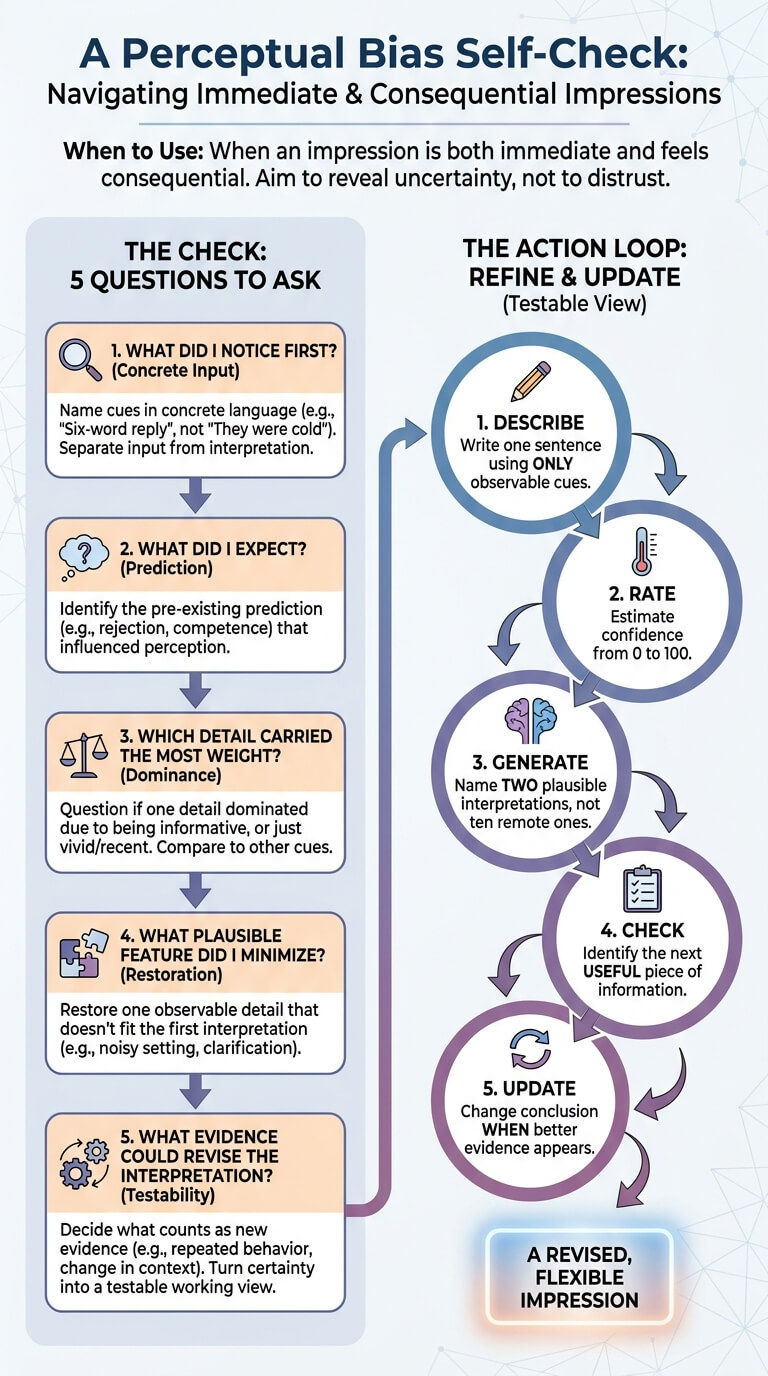
Use this check when an impression feels both immediate and consequential. The aim is not to distrust every perception. It is to reveal where uncertainty entered and what new information could genuinely update the picture.
What did I notice first?
First-noticed cues often set the direction for everything that follows. Name the cue in concrete language: “Their reply was six words,” rather than “They were cold.” This separates input from interpretation.
What did I expect?
Identify the prediction you carried into the scene. Perhaps you expected rejection, praise, dishonesty, competence, or conflict. An expectation can be reasonable and still influence what becomes easiest to perceive.
Which detail carried the most weight?
Ask whether one detail dominated because it was informative or because it was vivid, emotional, recent, or familiar. Then compare its weight with the number and quality of other cues.
What plausible feature did I minimize?
Look for one observable detail that does not fit the first interpretation. Do not force a positive reading. Simply restore a feature that may have been underweighted, such as the person’s later clarification, the noisy setting, or the fact that the behavior was unusual for them.
What evidence could revise the interpretation?
A conclusion that cannot be updated is no longer functioning as a flexible impression. Decide what would count: repeated behavior, direct clarification, a second observation, records, or a change in context. This turns certainty into a testable working view.
- Describe: Write one sentence using only observable cues.
- Rate: Estimate how confident you are from 0 to 100.
- Generate: Name two plausible interpretations, not ten remote possibilities.
- Check: Identify the next useful piece of information.
- Update: Change the conclusion when better evidence appears.
How to Reduce Perceptual Bias Without Distrusting Every Impression
The solution is not endless doubt. Fast perception is necessary for ordinary life. The goal is calibrated confidence: quick enough to function, flexible enough to update, and cautious when the consequences of a mistake are high.
Slow the label and describe the cue
Replace “They were disrespectful” with “They interrupted twice and looked at their phone.” Description preserves the relevant information while postponing the broad label. It also makes later clarification easier because another person can respond to an observable event.
Compare at least two interpretations
Choose alternatives that fit the actual cues. A short reply might reflect irritation, hurry, distraction, or a concise communication style. The purpose is not to pick the nicest explanation. It is to prevent the first available meaning from becoming the only imaginable one.
Seek additional sensory or contextual information
Listen for the full sentence, change viewing angle, improve lighting, read the preceding messages, or ask what happened before you arrived. More information does not guarantee certainty, but it can reduce dependence on one narrow slice of the event.
Recheck after emotional arousal changes
When emotion is intense, some cues may capture attention more strongly. Revisit the same evidence after your body has settled enough to process more of the scene. This does not mean the original concern was false. It provides a second observation under different conditions.
Update rather than defend the first perception
An impression is useful when it can change. Try: “My first read was that you were annoyed, but I may be missing context. Was that what was happening?” This wording names the perception without presenting it as proven fact.
How Nearby Perception Processes Fit Together
Several related processes can appear in one event. Keeping their roles separate makes it easier to identify what needs checking instead of using “bias” as a vague accusation.
Attention explains which information gained access
If a cue never reached awareness, the issue may begin with limited or divided attention. The useful question is what was available but not noticed, not whether a later interpretation was morally wrong.
Selective perception explains early filtering
Selective perception narrows the field to a few stimuli. It becomes especially relevant when the same category of cues repeatedly enters awareness while others remain outside it.
Perceptual set explains expectation-based readiness
Perceptual set describes how context, experience, and expectation prepare the mind for certain objects or meanings. It can make recognition faster, but it can also help explain why ambiguous input was pulled toward a familiar interpretation.
Evidence-checking tests the resulting impression
After an impression forms, compare it with observable details, independent information, and later behavior. This final step does not erase subjectivity. It helps distinguish a meaningful experience from a conclusion that still needs support.
For consequential conclusions, the impression should also be tested against the difference between perception and verifiable reality.
Frequently Asked Questions About Perceptual Bias
These questions clarify the boundaries of the concept and what a realistic response to perceptual bias looks like.
Is perceptual bias the same as cognitive bias?
No. Perceptual bias focuses on a directional tilt while information is being selected, weighted, organized, or interpreted as an experience. Cognitive bias is broader and includes tendencies in reasoning, memory, belief, and decision-making. In practice, each can reinforce the other.
Can emotions bias perception?
Yes, emotional states can influence attention, readiness, and the apparent importance of cues. That does not make emotions fake or useless. It means an emotionally powerful perception may still benefit from a second look, especially when the input is ambiguous and the consequences are significant.
Is an optical illusion a perceptual bias?
An optical illusion demonstrates that perceptual systems use rules and context that can produce a result different from physical measurement. Researchers may study bias within perceptual tasks, but not every illusion should be treated as a personal belief problem. Many illusions are widely shared effects of normal visual processing.
Does perceptual bias mean a person is irrational?
No. Perception must prioritize and infer because information is incomplete and processing capacity is limited. Bias often grows from mechanisms that are usually efficient. The concern is not that a person has shortcuts, but whether the same shortcut produces a rigid or consequential distortion that resists better evidence.
Can awareness remove perceptual bias completely?
Awareness helps, but it does not create perfect neutrality. Some effects occur rapidly and outside deliberate control. A more realistic aim is to notice high-risk conditions, lower confidence when evidence is thin, gather better information, and update when the scene no longer supports the first impression.
Key Takeaways
- Perceptual bias can begin before deliberate judgment, while cues are being selected, weighted, grouped, and interpreted.
- A biased perception can be sincere. Honesty and accuracy are related questions, not identical ones.
- Selective perception and perceptual set can contribute to bias, but neither is automatically a distortion.
- One vivid cue, repeated downgrading of contradictory details, and certainty under ambiguity are useful reasons to slow down.
- Describe observable cues, compare plausible meanings, seek more context, and revise the impression when evidence changes.
- The aim is not to distrust perception. It is to match confidence to the quality and completeness of the available information.
A practical next step is to choose one recent impression that felt immediate and important. Write down the first cue, the meaning you assigned, one detail you may have underweighted, and the evidence that would change your view. That small separation between cue and conclusion is often enough to make perception more flexible without dismissing what you genuinely experienced.

Michael Reed is the Founder and Lead Writer at Psychology Exposed. He writes about human behavior, relationships, emotional patterns, self-awareness, and practical psychology topics using research-informed, easy-to-understand content.
Read More About Michael Reed: https://psychologyexposed.com/michael-reed/