
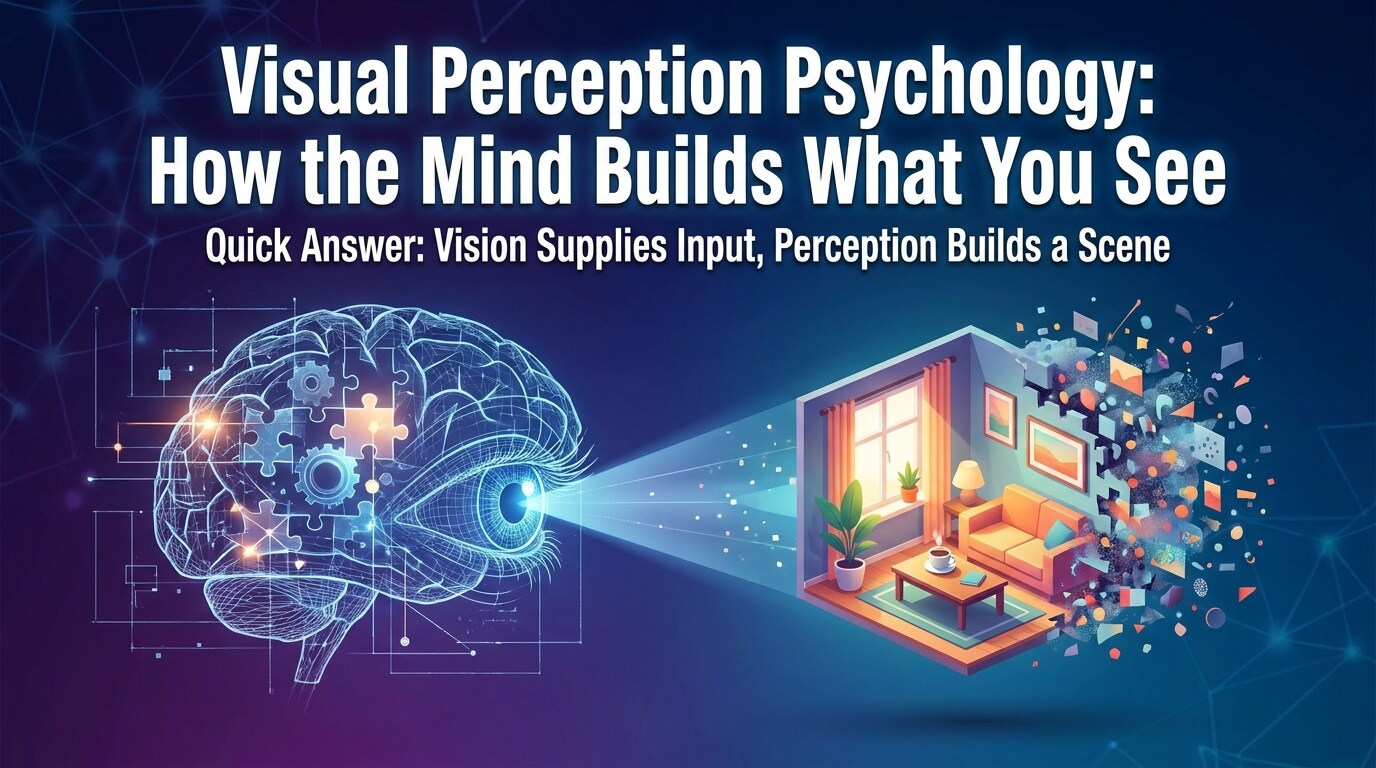
You open a kitchen drawer and immediately spot the scissors among dozens of objects. You recognize a friend in poor light, judge whether a car is approaching, and experience a flat screen as a scene with depth and movement. The finished visual world arrives before you notice the work behind it.
Visual perception psychology examines how the mind turns changing input into objects, distance, motion, faces, and scenes. Seeing is not a simple recording. The system separates figure from background, groups features, maintains stability across viewpoints, and uses context to resolve uncertainty.
This does not make vision unreliable. Its shortcuts are usually efficient, but they become visible in clutter, ambiguity, illusions, and moments when a brief expression receives more meaning than the evidence supports.
Quick Answer: Vision Supplies Input, Perception Builds a Scene
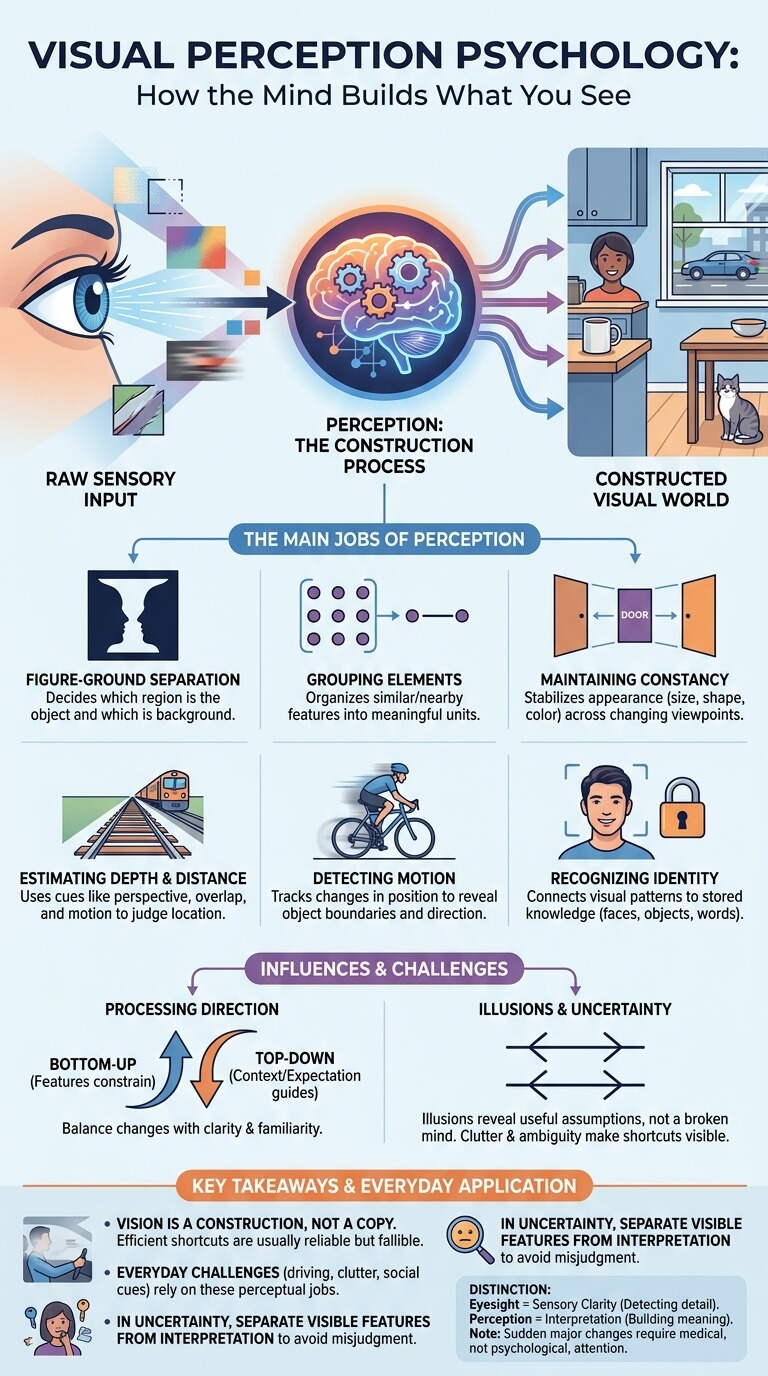
Visual perception organizes visual information so that light, edges, color, contrast, and movement become recognizable objects and scenes. Eyes detect changing input; the mind groups features, estimates depth, maintains constancy, and resolves uncertainty. What you see is a useful construction, not a frame-by-frame copy.
Eyes detect visual information
Light reflected from surfaces reaches the eyes and is converted into signals. This gives the visual system raw differences in brightness, color, location, and change. It does not arrive already labeled as “cup,” “doorway,” or “worried face.” Those useful categories depend on later organization and interpretation.
The mind organizes features into objects and space
Edges must be joined, regions must be separated, and related details must be treated as parts of one thing. At the same time, the mind estimates which objects are near, which are far, and what lies in front of what. A coherent scene depends on these operations working together.
Context helps resolve incomplete or ambiguous scenes
Visual input is often blocked, noisy, brief, or viewed from an unusual angle. Context narrows the possibilities. A curved handle beside a ceramic shape is likely to belong to a mug, while the same curve in another setting may be part of a bicycle. Context guides recognition without guaranteeing it.
From Light to a Meaningful Visual World
The visual system transforms physical stimulation through several overlapping steps. The sequence below is a practical mental model, not a claim that perception moves through isolated boxes one at a time.
Basic visual features such as edge, color, contrast, and movement
Early processing is sensitive to brightness, color, edges, and change. An accessible overview of the pathways of information in the visual system explains how specialized processes contribute to shape, color, motion, and three-dimensional surroundings.
Grouping features into objects
The mind groups compatible features into candidate objects. A rectangle, two circles, and a curved top may become a car because their positions fit a familiar structure. Grouping turns many local details into fewer meaningful units.
Locating objects in depth and space
Overlap, perspective, relative size, texture, shadows, movement, and differences between the eyes help place objects in space. The result is not a conscious calculation but an experienced layout that supports reaching, walking, driving, and avoiding obstacles.
Recognizing identity and meaning
Recognition connects a visual pattern with stored knowledge. You identify not only “an object,” but your keys, a stop sign, a familiar face, or a word. Meaning also depends on purpose. The same red shape may be decoration in one place and an urgent signal in another.
Visual perception is one branch of the broader psychology of how the mind interprets reality.
The Main Jobs of Visual Perception
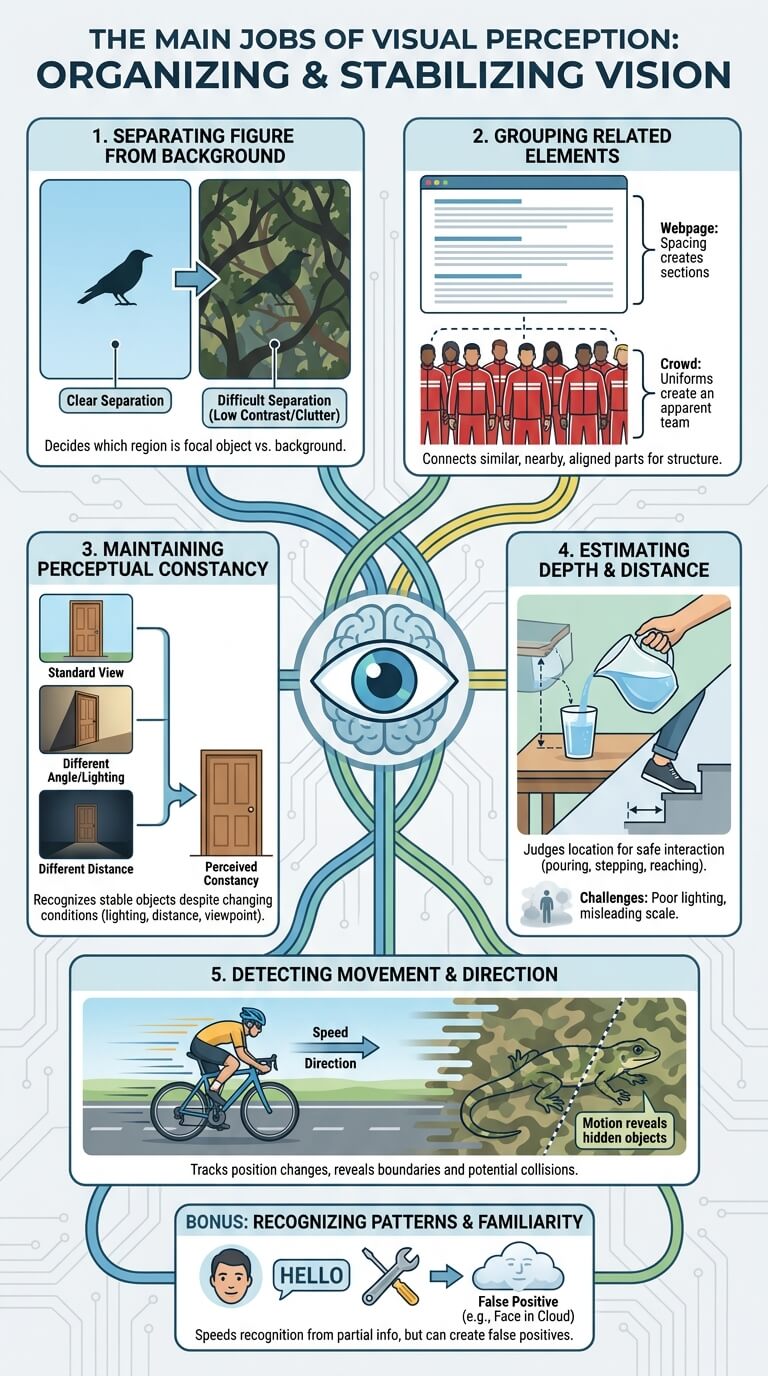
Five broad construction jobs help explain why vision feels organized and stable. They overlap constantly, and difficulty in one scene may come from more than one job.
Separating figure from background
The system decides which region belongs to a focal object and which region continues behind it. This is why a black bird stands out against a pale sky, yet the same bird can become difficult to find in a dark tree. Figure-ground separation affects what becomes easy to identify and act on.
Grouping related elements
Nearby, similar, aligned, or smoothly connected parts are often experienced as belonging together. On a webpage, spacing can make several lines feel like one section. In a crowd, matching uniforms turn separate people into an apparent team. Grouping gives structure before every element is examined individually.
Maintaining perceptual constancy
An object can cast different images as lighting, distance, and viewpoint change, yet it usually appears to keep the same basic size, shape, and color. Constancy prevents daily life from feeling like a sequence of unrelated visual snapshots. It lets the mind recognize stable things across unstable conditions.
Estimating depth and distance
The system combines cues to judge where things are, helping you pour, step, reach, and pass safely. Distance estimates are useful rather than perfect, especially in poor lighting, high speed, or scenes with misleading scale.
Detecting movement and direction
Motion perception tracks changes in position while considering the background and the viewer’s own movement. It helps reveal object boundaries, speed, direction, and possible collision. A moving edge can make an otherwise camouflaged animal suddenly visible because motion separates it from its surroundings.
Recognizing faces and familiar patterns
Faces, words, tools, and familiar layouts can be identified from partial information. Familiarity speeds recognition but may also create false positives, such as seeing a face in a cloud when no real face is present.
| Visual job | Everyday example | What can make it harder |
|---|---|---|
| Figure-ground | Finding a dark phone on a light desk | Low contrast or visual clutter |
| Grouping | Reading spaced items as one menu category | Inconsistent spacing or alignment |
| Constancy | Recognizing a door from an angle | Unusual lighting or viewpoint |
| Depth | Judging the height of a step | Weak shadows or misleading scale |
| Motion | Tracking a cyclist through traffic | Background movement or low visibility |
| Recognition | Identifying a familiar face at a distance | Occlusion, blur, or an unfamiliar angle |
Figure-Ground Perception
Before an object can be recognized clearly, some region must be treated as the figure and the rest as background. That assignment can change with attention and context.
How one region becomes the object of attention
Contrast, borders, size, position, symmetry, and familiarity can help one region stand out. Once a region is treated as figure, it tends to appear more object-like and memorable. The background still matters, but it is experienced as supporting space rather than the main thing being examined.
Why clutter makes separation difficult
Clutter creates competing edges, colors, and shapes. Keys may be visible yet hard to locate because nearby items share similar features. The problem may be separating the relevant pattern from a busy field, not poor eyesight.
Clutter, change blindness, and missed objects also depend on how attention shapes perception.
Reversible images and competing interpretations
Some images support two figure-ground assignments. You may see a vase, then two profiles, but not hold both interpretations equally at the same moment. The switching shows that perception is choosing an organization. The physical image remains unchanged while the experienced figure changes.
Grouping and Pattern Organization
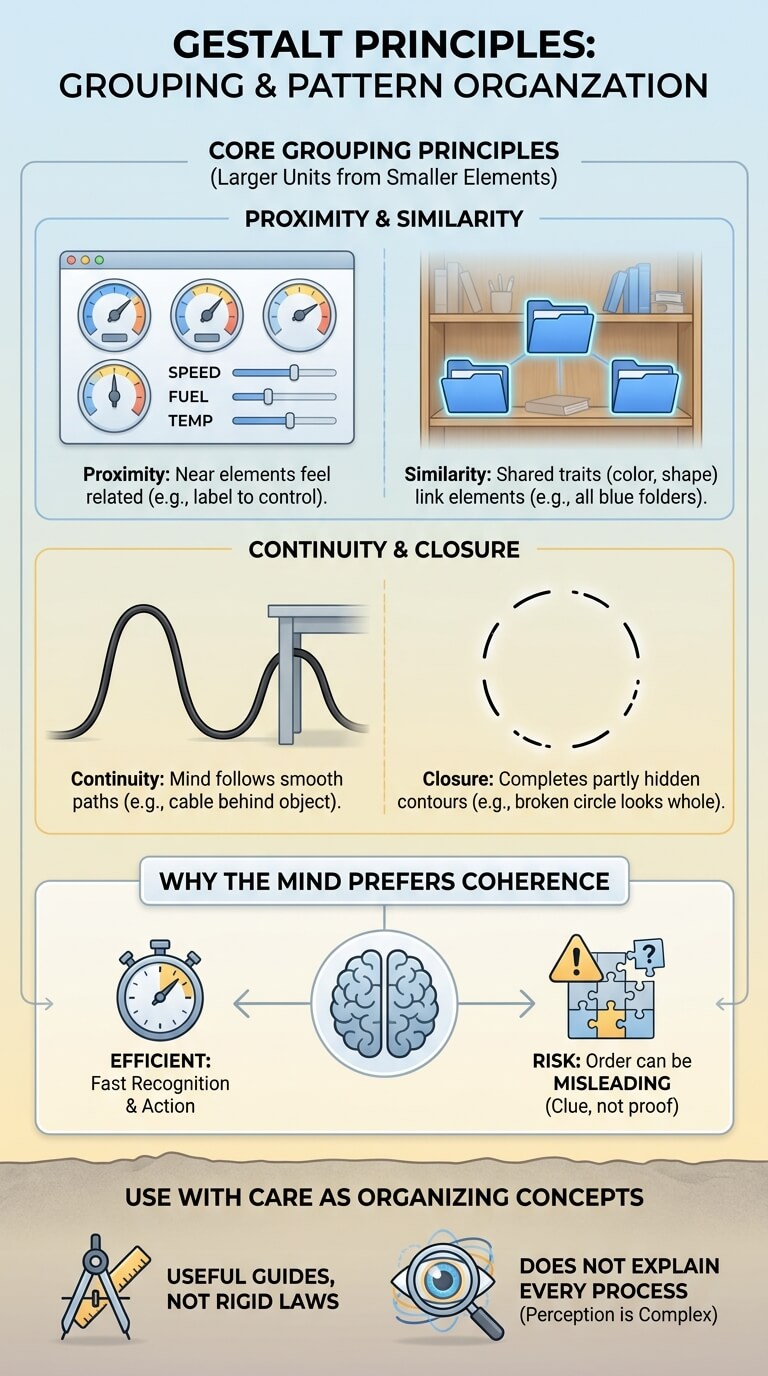
Visual scenes contain more detail than can be treated as unrelated pieces. Grouping principles describe common ways the mind forms larger units from smaller elements.
Proximity and similarity
Elements placed near one another tend to feel related, as do elements that share color, shape, size, or texture. A dashboard uses proximity to show which label belongs to which control. Similarity helps you spot all blue folders at once, even when they are spread across a shelf.
Continuity and closure
The mind follows smooth paths and completes partly hidden contours. A cable passing behind a table is perceived as one cable, while a broken circle may still look complete when enough structure remains.
Why the mind prefers coherent patterns
Coherent organization is efficient. It supports fast recognition and action without requiring every fragment to be checked separately. The cost is that the most orderly interpretation can occasionally win even when the scene was arranged to mislead. Order is a strong clue, not proof.
Use Gestalt principles carefully as organizing concepts
Gestalt ideas describe recurring forms of grouping but do not explain every visual process. A major review of Gestalt psychology in visual perception examines the continuing complexity of grouping and figure-ground research. Treat the principles as useful guides, not rigid laws.
Perceptual Constancy
Constancy explains how a changing retinal image can support a stable experience of the same object. The mind uses surrounding information to separate changes in the object from changes in viewing conditions.
Size constancy
A person walking away creates a smaller image but does not seem to shrink. Perceived size is adjusted for estimated distance, which is why manipulating distance cues can produce convincing size illusions.
Shape constancy
A round plate viewed from the side produces an oval-like image, yet it still appears round. Viewpoint information helps the system treat the changing projection as the same three-dimensional object. Shape constancy supports recognition from angles that have never produced exactly the same image before.
Color and brightness constancy
A white page reflects different amounts and mixtures of light indoors, outdoors, and in shadow. It usually continues to look white because the system considers surrounding illumination and contrast. This correction is useful, though unusual lighting can make two identical colors appear different.
Why a stable world requires interpretation
The APA Dictionary description of perceptual constancy emphasizes that object properties appear unchanged despite variations in stimulation. Stability is therefore an achievement of perception. Without it, every step, shadow, and head turn would make familiar objects seem newly transformed.
Depth and Distance Perception
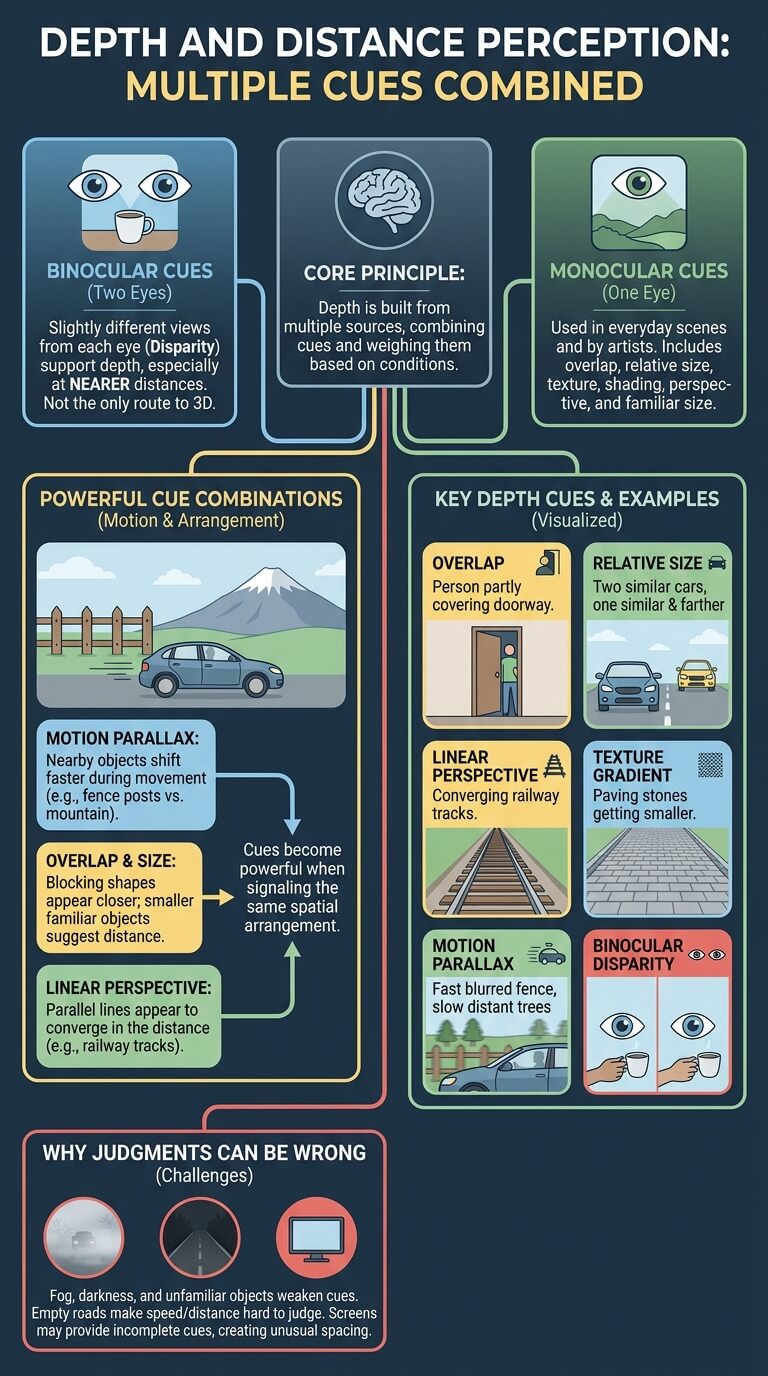
Depth is built from multiple sources rather than one single depth signal. The system usually combines cues, giving more weight to those that are useful in the current conditions.
Binocular information as a light overview
The eyes receive slightly different views because they occupy different positions. The visual system can use this disparity, along with information related to eye alignment, to support depth judgments. Binocular input is especially useful at nearer distances, but it is not the only route to a three-dimensional experience.
Monocular cues in everyday scenes
One eye still receives overlap, relative size, texture gradients, shading, and linear perspective. Artists use these cues to create depth on flat surfaces. Familiar size also helps because a smaller image of a known object often suggests greater distance.
Motion, overlap, size, and perspective
As you move, nearby objects shift across the visual field faster than distant ones. When one shape blocks another, the blocking shape is usually judged as closer. Parallel lines appearing to converge can signal distance. These cues become powerful when several point toward the same spatial arrangement.
Why distance judgments can be wrong
Fog, darkness, and unfamiliar objects weaken depth cues. A long empty road can make speed and distance harder to judge. Screens may provide some cues while omitting others, creating convincing space that still feels unusual during movement.
| Depth cue | What it suggests | Simple example |
|---|---|---|
| Overlap | The blocking object is nearer | A person partly covers a doorway |
| Relative size | Smaller images may be farther away | Two similar cars at different distances |
| Linear perspective | Parallel lines recede into depth | Railway tracks appear to converge |
| Texture gradient | Fine, dense texture suggests distance | Paving stones look smaller farther away |
| Motion parallax | Nearby objects shift faster during movement | Fence posts pass quickly from a car window |
| Binocular disparity | Different eye views support near-depth estimates | Reaching accurately for a nearby cup |
Motion Perception
Movement is not read from a single frozen frame. The system compares changing information across time while accounting for backgrounds and the observer’s own motion.
Detecting movement against a background
A moving object changes position relative to nearby features. Strong contrast and clear boundaries make this easier. Movement can also define an object’s shape, which is why an animal hidden by matching color may become obvious as soon as it runs.
Apparent motion and screen-based examples
Film and animation present still images in rapid sequence, yet viewers experience continuous movement. Apparent motion shows that the system interprets timed changes as a moving event. A review of motion perception and its development highlights motion’s role in object boundaries, depth, navigation, and social information.
Why self-motion and object motion can be confused
When the train beside you moves, you may briefly feel that your own train is moving. Bodily and environmental cues settle the question. Self-motion perception combines vision with balance and body information rather than relying on vision alone.
Face and Expression Perception
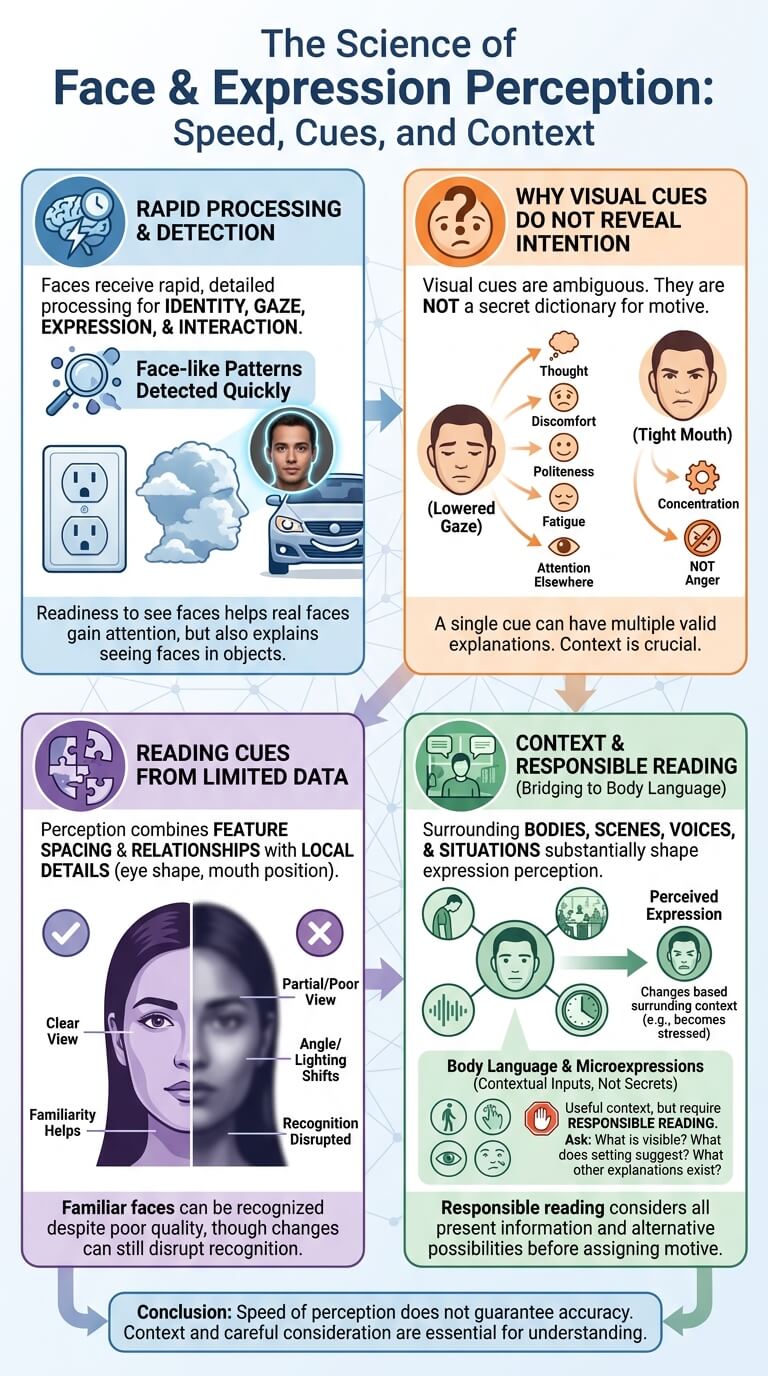
Faces receive rapid and detailed processing because they carry information relevant to identity, gaze, expression, and interaction. Speed does not make every social conclusion accurate.
Rapid detection of face-like patterns
People detect face-like arrangements quickly, even in simple shapes or ordinary objects. This readiness helps real faces gain attention in crowded scenes. It also explains why outlets, clouds, and car fronts sometimes look as if they have eyes and a mouth.
Reading identity, gaze, and expression from limited cues
Face perception combines the spacing and relationship among features with local details such as eye shape or mouth position. Familiar faces can be recognized from partial or poor-quality views, although changes in angle, lighting, hairstyle, or expression can still disrupt recognition.
Why visual cues do not reveal intention with certainty
A lowered gaze may reflect thought, discomfort, politeness, fatigue, or attention to something else. A tight mouth may accompany concentration rather than anger. Reviews of faces in context show that surrounding bodies, scenes, voices, and situations can substantially shape how facial expressions are perceived.
Bridge lightly to Body Language and Microexpressions
Posture, gesture, gaze, and facial movement are visual inputs within social interaction. They can add useful context, but they do not operate as a secret dictionary. A more responsible reading asks what is visibly present, what the setting suggests, and what other explanations remain possible before assigning motive.
Faces, gaze, and movement become socially meaningful through social perception, not vision alone.
How Top-Down and Bottom-Up Processing Shape Vision
Vision depends on incoming features and on knowledge that helps interpret them. The balance changes with clarity, familiarity, attention, and uncertainty.
Features build recognition from the bottom up
Edges, orientation, color, contrast, and movement provide evidence from the scene. When an object is unfamiliar, careful feature analysis may carry more weight. You may inspect the outline, material, moving parts, and relation to nearby objects before deciding what it is.
Context and expectation guide interpretation from the top down
Knowledge narrows possibilities. In a grocery aisle, a partly hidden cylinder is more likely to be read as a can than laboratory equipment. Expectations speed recognition but may briefly favor an expected object when input is unclear.
Ambiguity reveals the interaction
When a symbol can be read as a letter in one sequence and a number in another, the same physical shape receives different meanings. Bottom-up features constrain the options, while surrounding context favors one. Ambiguous images make this collaboration visible because interpretation can switch without the image changing.
Recognition becomes faster when top-down knowledge works with bottom-up visual detail.
What Visual Illusions Teach About Perception
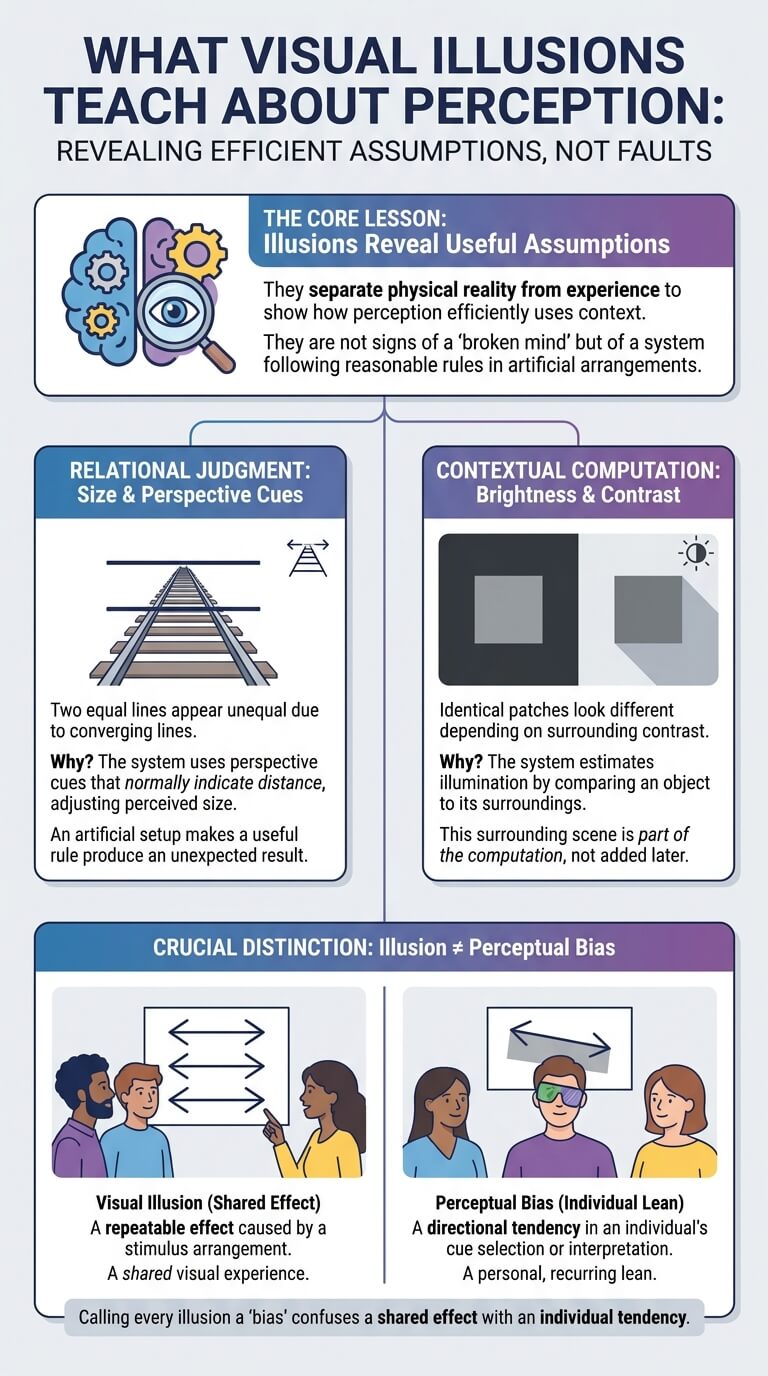
Illusions are useful demonstrations because they separate the physical arrangement from the experience it produces. They reveal assumptions that usually help perception operate efficiently.
Illusions reveal useful assumptions, not a broken mind
A size illusion may use perspective cues that normally indicate distance. A brightness illusion may use surrounding contrast that usually helps estimate illumination. The system follows a reasonable rule in an artificial arrangement designed to make that rule produce an unexpected result.
Context, contrast, and size relationships
Two equal lines can look unequal when placed among converging lines. Identical gray patches can look different on light and dark backgrounds. These effects show that visual properties are often judged relationally. The surrounding scene is part of the computation, not decorative information added afterward.
Why an illusion is not automatically a perceptual bias
A visual illusion is a repeatable effect produced by a stimulus arrangement. Perceptual bias is a directional tendency in cue selection or interpretation. Calling every illusion a personal bias confuses a shared visual effect with an individual’s recurring lean.
Visual Perception in Everyday Life
Visual construction becomes most noticeable when a task is fast, cluttered, uncertain, or socially meaningful. The following examples show different jobs rather than repeated versions of the same error.
Driving and judging distance
Situation: A driver approaches a motorcycle at dusk. What may be felt: The distance seems obvious. What it may mean: Low contrast and unfamiliar size can weaken judgment. What to do next: Increase following distance and use movement over time rather than one quick glance.
Finding an item in clutter
Situation: You cannot find the charger on a crowded table. What may be felt: “It is not here.” What it may mean: Similar colors and overlapping edges prevent clean figure-ground separation. What to do next: change the search angle, reduce clutter, or search by one feature such as the cable shape.
Reading screens and visual hierarchy
Situation: A form seems confusing despite simple wording. What may be felt: The instructions are poorly explained. What it may mean: spacing, contrast, and grouping may hide which label belongs to which field. What to do next: follow alignment and section boundaries before rereading every sentence.
Recognizing people in poor conditions
Situation: You wave at someone who turns out to be a stranger. What may be felt: embarrassment or surprise. What it may mean: distance, silhouette, clothing, and expectation supported a familiar identity. What to do next: treat recognition as provisional until facial detail, voice, or movement confirms it.
Misreading a brief expression
Situation: A colleague briefly frowns during your presentation. What may be felt: You assume disapproval. What it may mean: the visible cue is real, but its cause is unknown. What to do next: continue observing the wider interaction or ask for specific feedback instead of treating one frame as a verdict.
Visual Perception vs Eyesight
Eyesight and visual perception are connected, but they answer different questions. One concerns the clarity and availability of visual input; the other concerns how that input is organized and understood.
The process begins with detectable visual input, but the difference between sensation and perception explains why seeing is more than receptor activity.
Sensory clarity versus interpretation
Eyesight measures often involve acuity, visual field, contrast, color discrimination, or focusing ability. Perception includes recognizing objects, separating figure from ground, judging spatial relations, and assigning meaning. Clear input supports these tasks, but clarity alone does not complete them.
Why good eyesight does not eliminate perceptual error
A person with sharp eyesight can still be fooled by perspective, miss an object in clutter, or misread an ambiguous expression. These outcomes come from organization and interpretation, not necessarily poor visual acuity. Conversely, reduced eyesight does not mean a person lacks understanding of visual scenes.
| Question | Mostly eyesight | Mostly visual perception |
|---|---|---|
| Can the detail be detected clearly? | Yes | Uses the available detail |
| Which shape belongs to the object? | Provides edges | Groups and separates them |
| How far away is it? | Provides visual cues | Combines cues into depth |
| Who or what is it? | Provides a visible pattern | Connects the pattern with identity |
| What does the expression mean? | Provides visible movement | Interprets it with context and uncertainty |
Visual Perception vs Body Language
Body language is one application of visual interpretation within social settings. It is not the whole visual system, and it should not be treated as direct access to another person’s private thoughts.
Visual perception is the broad processing system
Visual perception covers objects, text, surfaces, motion, faces, distance, color, and scenes. The same processes that help separate a cup from a counter also help separate a person’s hand movement from a busy background. Social cues use a broad system built for many tasks.
Body language is one category of social cue
Posture, gesture, gaze, interpersonal distance, and facial movement may contribute to an impression. Meaning depends on timing, culture, relationship, setting, speech, and baseline behavior. A cue can support a possibility, but it rarely proves intention by itself.
First Steps When a Visual Interpretation Is Uncertain
Uncertainty does not require distrusting everything you see. It calls for matching confidence to the amount and quality of information available.
Change the viewing angle or context
Move closer when safe, improve lighting, look from another angle, or reduce competing background detail. A different view can reveal whether a contour belongs to the object, whether a shadow created the apparent shape, or whether perspective distorted size.
Separate visible features from inferred meaning
Describe first: “The eyebrows lowered and the person looked away.” Then name the interpretation: “I read that as annoyance.” Keeping the two statements separate preserves the useful cue while making room for other explanations.
Seek additional cues before judging intention
Use time, words, repeated behavior, and situational context. A brief expression becomes more informative when it matches the conversation and later actions. When the conclusion matters, ask a clear question or wait for more evidence rather than trying to decode motive from one image.
When Visual Changes Need Medical Support
Psychological explanations of perception should never be used to dismiss a new physical change in vision. Sudden or severe symptoms need medical assessment rather than self-analysis.
Sudden loss, distortion, double vision, flashes, or severe change
Seek urgent medical care for sudden vision loss, new double vision, flashes, many new floaters, a curtain-like shadow, severe eye pain, or a major unexplained change. The Mayo Clinic guidance on sudden eye problems lists abrupt vision changes among reasons to get emergency care.
This information is educational and not a diagnostic guide
Visual symptoms have many possible causes, and written guidance cannot distinguish them safely. Discuss ongoing changes or repeated difficulty with a qualified professional. Never assume a sudden change is merely stress, attention, or an illusion.
Frequently Asked Questions About Visual Perception
These questions clarify common points that can otherwise make visual perception sound more mysterious or more error-prone than it is.
Why does the brain fill in missing visual information?
Visual scenes are frequently incomplete because objects overlap, lighting varies, and the eyes sample from changing positions. Completing likely contours helps maintain object continuity. The process usually relies on nearby edges, familiar structure, and context, so the result is efficient but occasionally mistaken.
Are visual illusions errors?
They are systematic differences between a physical arrangement and the experience it produces. Many reveal rules that are normally useful, such as using perspective to estimate depth or contrast to judge brightness. Calling them failures misses what they teach about efficient visual assumptions.
How do we judge depth with one eye?
Monocular cues include overlap, relative size, perspective, texture gradients, shading, height in the visual field, and motion parallax. One eye therefore provides substantial depth information. Two-eye cues can add precision, particularly for nearby objects, but they are not required for every depth judgment.
Why do faces capture attention so quickly?
Faces carry identity, gaze, emotion, and interaction information, so rapid detection is useful in social life. The system is highly practiced at finding face-like arrangements. That readiness can also produce false alarms, such as seeing a face in an object or pattern.
Can expectations change what we see?
Expectations can guide attention and make one interpretation easier, especially when a scene is incomplete or ambiguous. They do not allow the mind to create any visual experience without constraint. Clear, strong sensory evidence can correct an expectation, while weak evidence leaves more room for context.
Key Takeaways
- Visual perception organizes changing input into objects, depth, motion, faces, and meaningful scenes.
- Figure-ground separation, grouping, constancy, depth estimation, motion detection, and recognition solve different visual problems.
- Bottom-up features constrain what is possible, while context and expectation help resolve uncertainty.
- Illusions expose useful assumptions and do not mean the mind is generally broken or irrational.
- Visible social cues support possibilities, not certain conclusions about intention.
- Sudden major visual changes require medical attention rather than a psychological explanation.
A useful next step is to choose one uncertain visual moment and describe it twice: first as visible features, then as your interpretation. That small separation preserves trust in perception while making room for better context, a second look, or a more careful conclusion.

Michael Reed is the Founder and Lead Writer at Psychology Exposed. He writes about human behavior, relationships, emotional patterns, self-awareness, and practical psychology topics using research-informed, easy-to-understand content.
Read More About Michael Reed: https://psychologyexposed.com/michael-reed/