
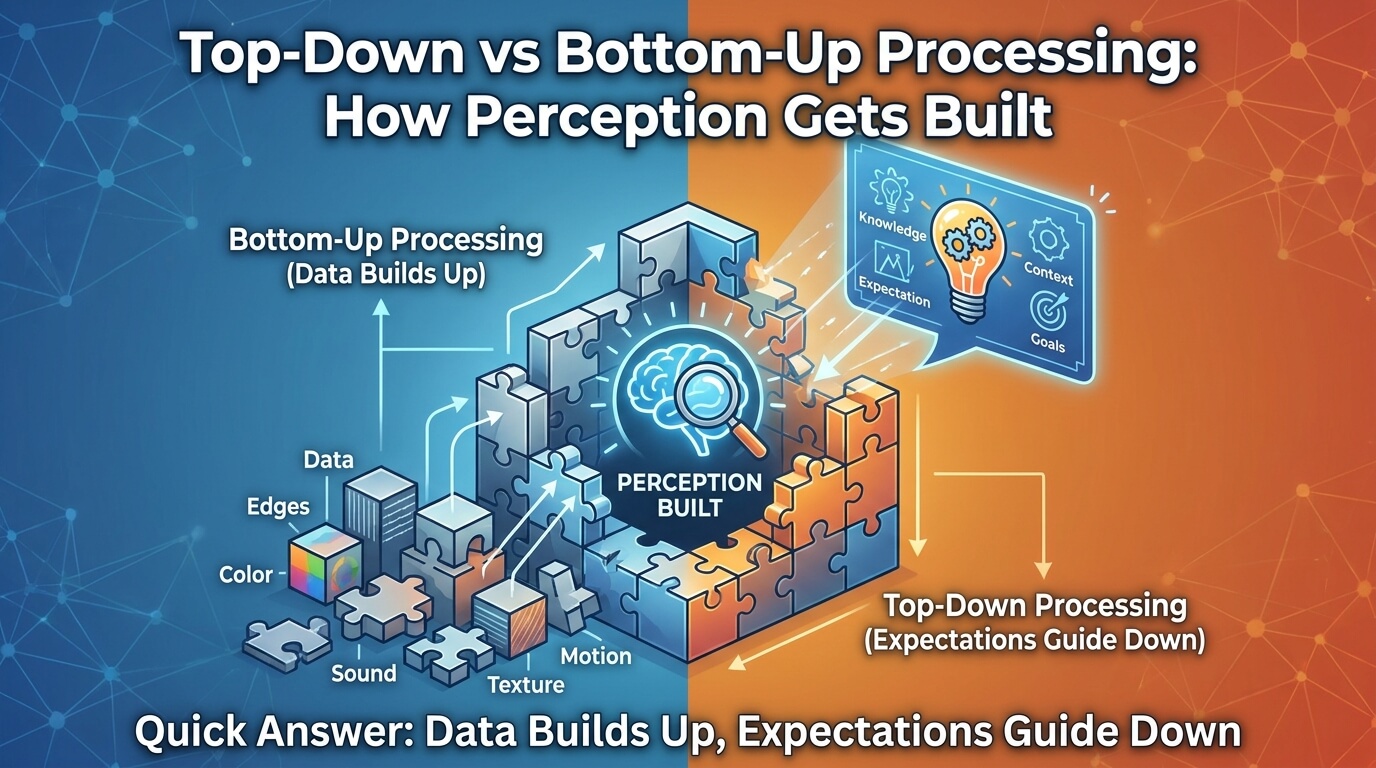
You walk into a dim room and see a shape near the chair. For a moment, it looks like a person. Then your eyes adjust, more details become clear, and you realize it is a coat hanging from the backrest. Two directions of processing helped create that experience. The visible edges, color, size, and position supplied information from the environment. Your knowledge of rooms, people, coats, and possible danger supplied expectations that helped interpret the incomplete view.
This is the basic difference between bottom-up and top-down processing. Bottom-up processing begins with incoming sensory details and builds toward recognition. Top-down processing begins with knowledge, goals, context, or expectations and uses them to guide interpretation. They are often taught as opposites, but everyday perception usually depends on both.
This two-way flow is one part of the wider psychology of perception.
Understanding the distinction helps explain why unfamiliar situations demand careful inspection, why context makes familiar information easier to recognize, and why an expectation can sometimes help you see correctly or lead you toward the wrong conclusion.
Quick Answer: Data Builds Up, Expectations Guide Down
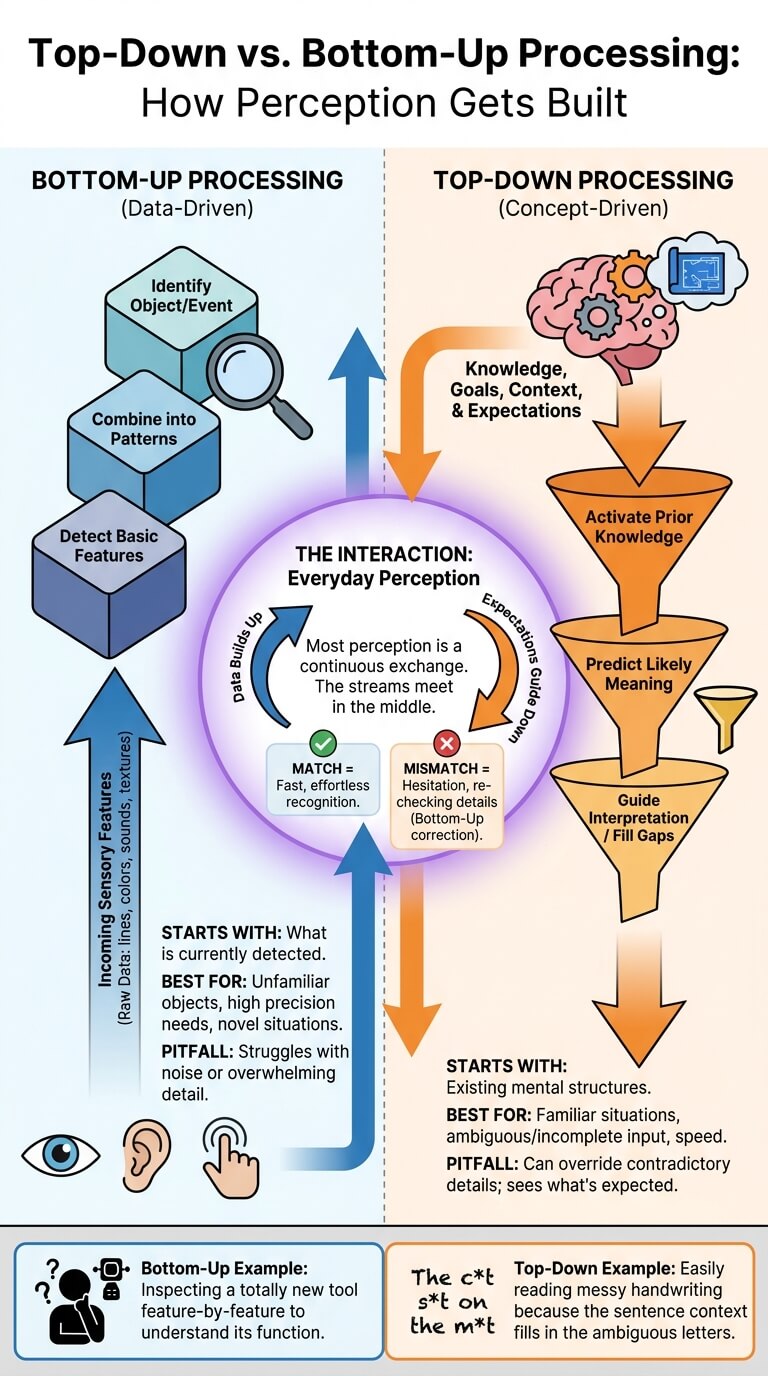
Quick answer: Bottom-up processing starts with sensory features, such as lines, sounds, textures, or smells, and combines them into a meaningful whole. Top-down processing starts with what you already know or expect and uses that context to interpret incoming information. Most real perception is a continuous exchange between the two rather than a choice of one route.
Bottom-up processing begins with sensory details
In bottom-up processing, the information arriving through the senses drives recognition. The APA Dictionary of Psychology definition of bottom-up processing describes incoming stimulus data as initiating the higher-level processes involved in recognition, interpretation, and categorization.
Imagine handling an unfamiliar kitchen tool without knowing its purpose. You notice its weight, sharp edge, grip, moving parts, and shape. Those features gradually support a judgment about what the object may be and how it might be used.
Top-down processing begins with knowledge, goals, or expectations
Top-down processing uses information already available in the mind. According to the APA definition of top-down processing, higher-level knowledge, concepts, or expectations influence how incoming details are analyzed.
If the unfamiliar tool is lying beside vegetables and a cutting board, the kitchen context immediately narrows the possibilities. You do not need to analyze every curve from the beginning because the setting activates likely meanings.
Most perception uses both at once
The senses provide evidence, while knowledge helps decide what that evidence probably means. A useful picture is not two separate machines but two streams meeting in the middle. One stream carries details upward. The other sends predictions, goals, and context downward.
When the streams agree, recognition feels fast and effortless. When they conflict, you may hesitate, look again, move closer, ask for clarification, or revise your first interpretation.
Bottom-Up Processing Step by Step
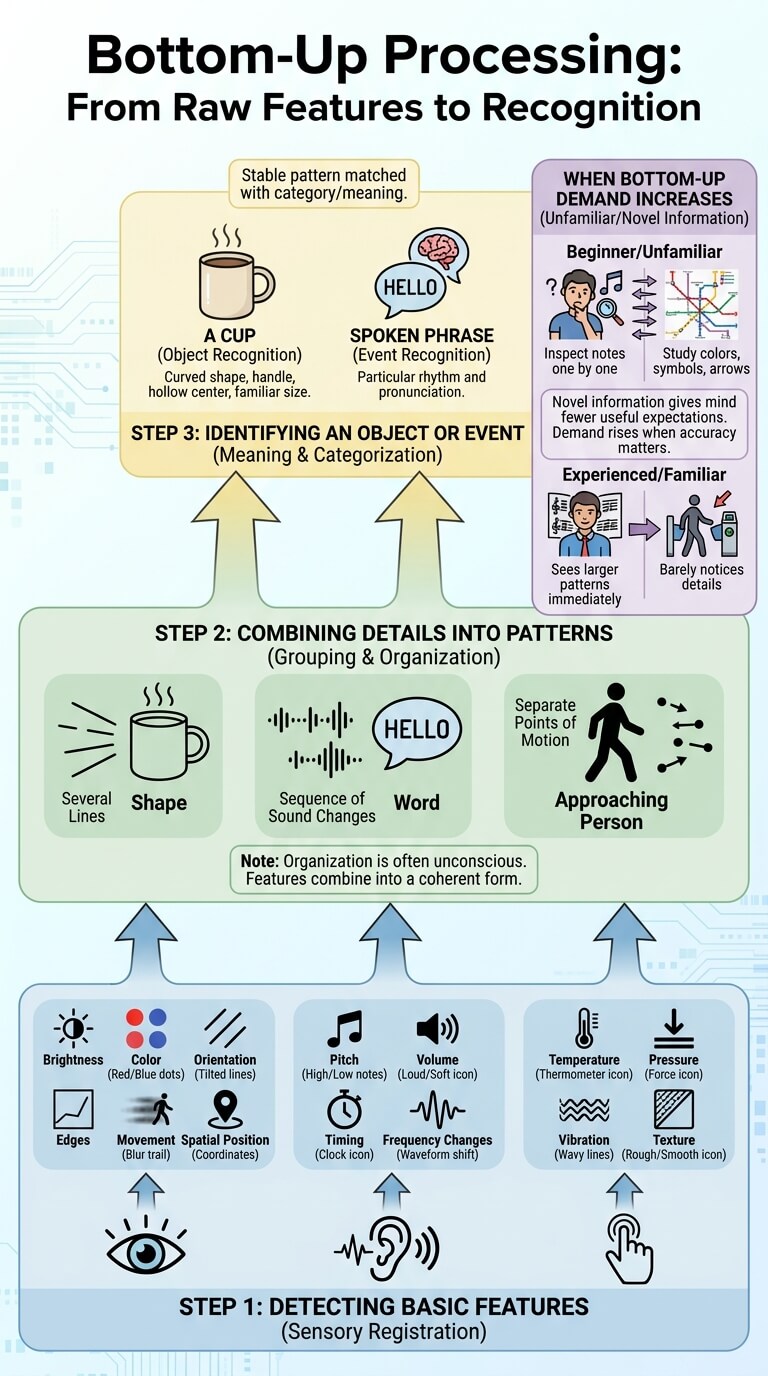
Bottom-up recognition becomes easier to understand when it is separated into the small operations that turn raw features into an identifiable event.
Detecting basic features
Bottom-up processing begins with simple properties that the sensory systems can register. In vision, these may include brightness, color, orientation, edges, movement, and spatial position. In hearing, they may include pitch, volume, timing, and changes in frequency. In touch, they may include temperature, pressure, vibration, and texture.
Bottom-up processing begins after sensory systems detect change, which is why it helps to separate sensation from perception.
Combining details into patterns
Single features rarely carry enough meaning by themselves. They are grouped into larger patterns. Several lines become a shape. A sequence of sound changes becomes a word. Separate points of motion become an approaching person.
The organization is not always conscious. You usually do not experience each edge before seeing a cup. Still, the cup can only be recognized because enough features have been combined into a coherent form.
Identifying an object or event
Once the pattern is stable enough, it can be matched with a category or meaning. The curved shape, handle, hollow center, and familiar size support the recognition of a cup. A particular rhythm and pronunciation support the recognition of a spoken phrase.
When unfamiliar information increases bottom-up demand
Novel information gives the mind fewer useful expectations. A beginner reading music may inspect notes one by one. An experienced musician sees larger patterns immediately. A traveler facing an unfamiliar transit system may study colors, symbols, platform numbers, and arrows that a local barely notices.
Bottom-up demand also rises when accuracy matters and assumptions need to be checked. A technician examining an unknown fault may deliberately return to the visible or measurable details before choosing an explanation.
Top-Down Processing Step by Step
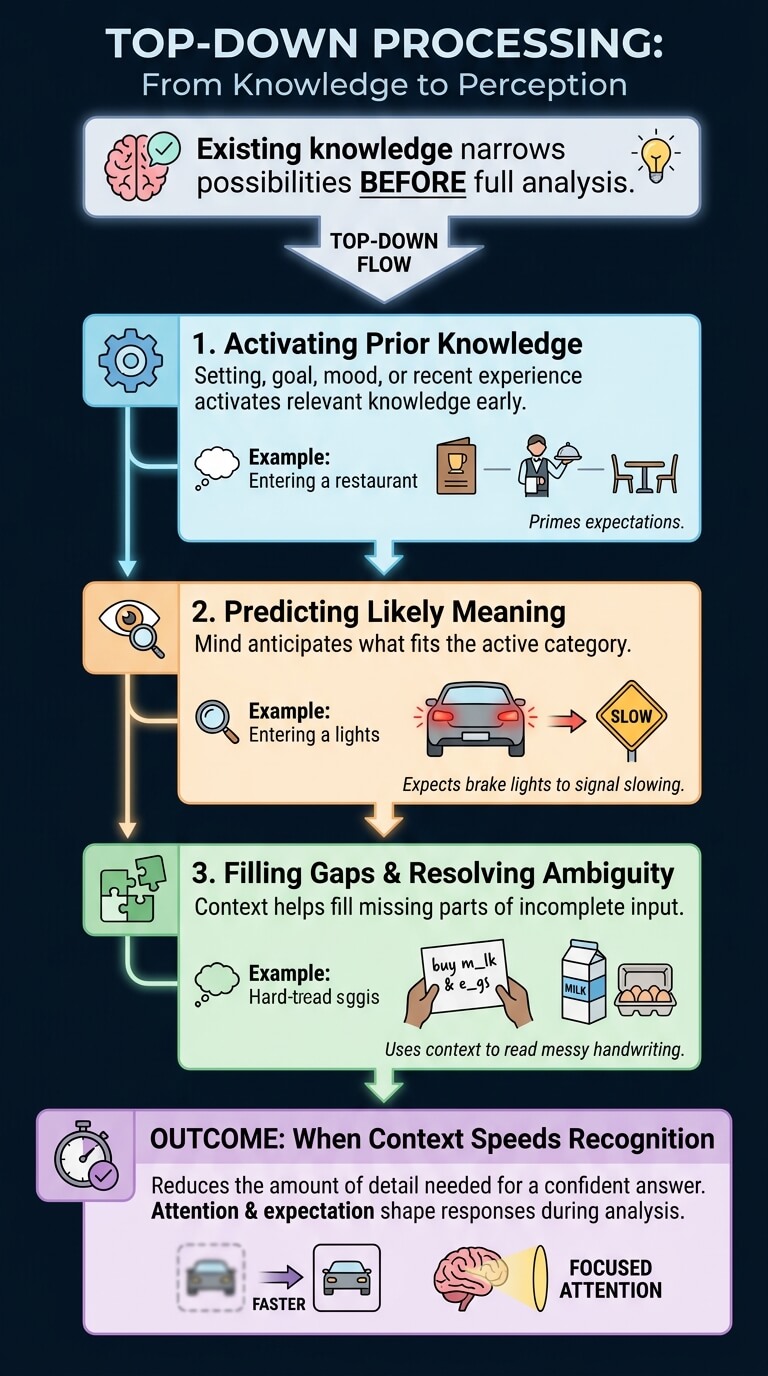
Top-down guidance follows a different logic: existing knowledge narrows possibilities before every detail has been fully analyzed.
Activating prior knowledge
A setting, goal, word, mood, or recent experience can activate relevant knowledge before the full input is clear. Entering a restaurant prepares you to notice menus, servers, tables, and signs related to ordering. Hearing the beginning of a familiar sentence activates likely words that could follow.
Predicting likely meaning
Once a likely category is active, the mind anticipates what should fit. A reader expects letters to form familiar words. A driver expects brake lights to signal slowing traffic. A listener uses the topic of a conversation to anticipate likely phrases.
Filling gaps or resolving ambiguity
Real input is often incomplete. A word may be partly covered, a speaker may be difficult to hear, or a face may be seen briefly. Context helps fill the missing parts and choose among possible meanings.
The interaction is especially visible in visual perception, where incomplete features are organized into stable objects and scenes.
This is one reason you can read a sentence with messy handwriting or understand a friend in a noisy café. The surrounding information limits the number of plausible interpretations.
When context speeds recognition
Context can reduce the amount of detail needed for a confident answer. Research reviewing top-down influences on visual processing describes how attention, expectation, and the current perceptual task can shape responses during visual analysis.
Side-by-Side Comparison
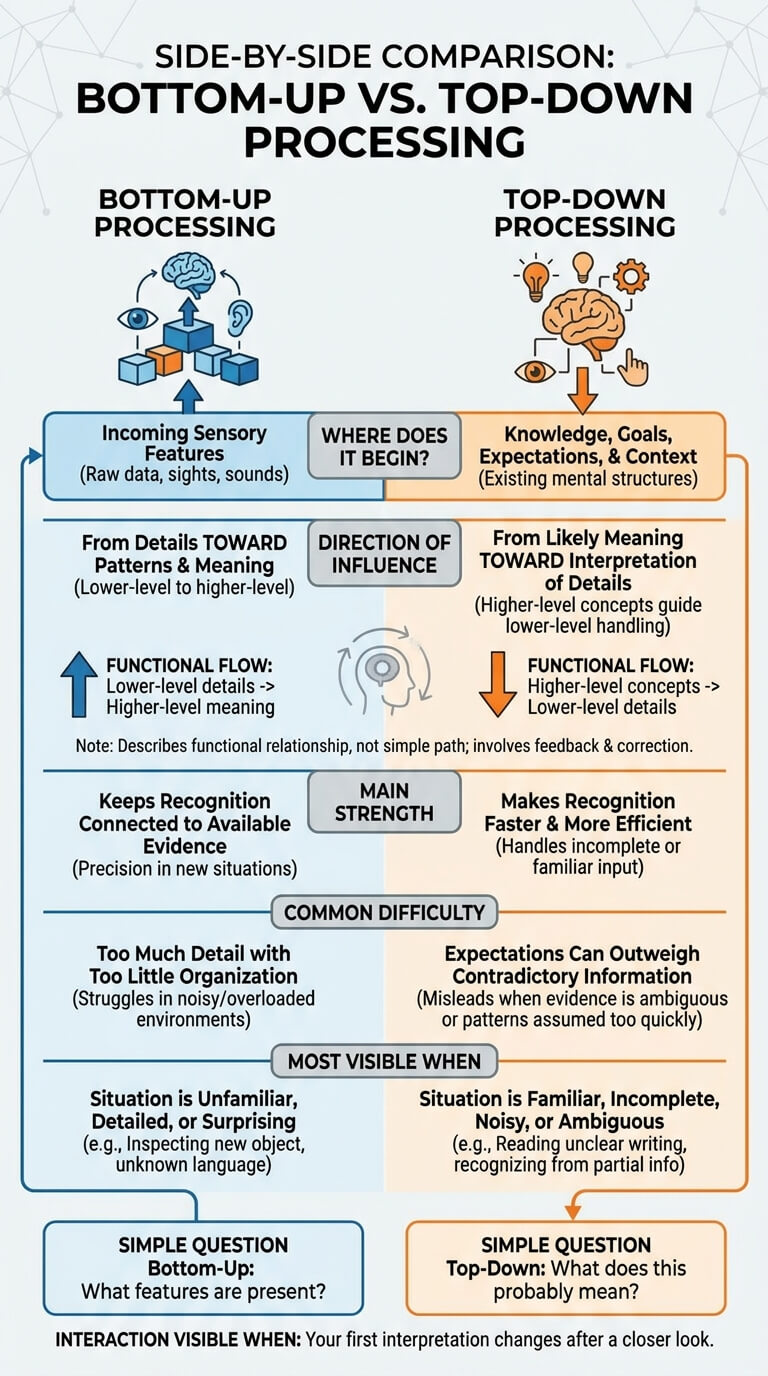
| Question | Bottom-up processing | Top-down processing |
|---|---|---|
| Where does it begin? | Incoming sensory features | Knowledge, goals, expectations, and context |
| Direction of influence | From details toward patterns and meaning | From likely meaning toward the interpretation of details |
| Most visible when | The situation is unfamiliar, detailed, or surprising | The situation is familiar, incomplete, noisy, or ambiguous |
| Main strength | Keeps recognition connected to available evidence | Makes recognition faster and more efficient |
| Common difficulty | Too much detail with too little organization | Expectations can outweigh contradictory information |
| Simple question | What features are present? | What does this probably mean? |
Starting point
The easiest distinction is the starting point. Bottom-up processing starts with what is currently detected. Top-down processing starts with an existing mental structure that guides detection and interpretation.
Information flow
Bottom-up influence is often described as moving from lower-level details toward higher-level meaning. Top-down influence moves from higher-level concepts, expectations, or goals toward the handling of lower-level details.
These directions describe a functional relationship, not a simple single-file path through the brain. Perception includes repeated interactions, feedback, and correction.
Strengths
Bottom-up processing helps when the situation is new or when precision requires a fresh look. Top-down processing helps when the input is incomplete, familiar, or time-sensitive. Neither route is inherently more rational. Each solves a different problem.
Common errors
Bottom-up processing can struggle when the environment is noisy or overloaded with detail. Top-down processing can mislead when an expectation is strong, the evidence is ambiguous, or a familiar pattern is assumed too quickly.
Situations where each becomes more visible
- Bottom-up becomes easier to notice when you inspect an unfamiliar object, hear an unknown language, or discover a detail that does not fit your expectation.
- Top-down becomes easier to notice when you read unclear writing, recognize a familiar person from partial information, or interpret an ambiguous cue through context.
- The interaction becomes visible when your first interpretation changes after a closer look.
Everyday Bottom-Up Examples
These situations make data-driven processing easier to recognize because the person begins without a reliable category or explanation.
Identifying an unfamiliar sound
You hear a repeated tapping outside at night. Before knowing the cause, you notice its rhythm, direction, loudness, and pauses. The sound might be rain, a loose branch, an animal, or a mechanical problem. Each new feature narrows the possibilities.
The experience is mainly bottom-up while the details remain more informative than your existing guess.
Inspecting a new object feature by feature
Someone gives you a tool you have never seen. You turn it over, press a moving part, examine the material, and compare both ends. Recognition grows from accumulated properties rather than from a familiar label.
Once you learn its purpose, future encounters become more top-down because the category now guides what you notice.
Noticing an unexpected pattern without context
A warning light begins flashing on an unfamiliar device. Its color, timing, and location capture attention before you know what it means. You may then consult labels or instructions. The initial alert is driven by visible changes, while later interpretation uses acquired knowledge.
Everyday Top-Down Examples
Top-down influence is especially visible when context changes what unclear or incomplete information seems to mean.
Reading messy handwriting from sentence context
A single handwritten word may be difficult to identify in isolation. Inside a sentence, grammar and meaning reduce the possibilities. You may read the word correctly even though one letter is poorly formed.
This efficiency can also hide mistakes. When the sentence is highly predictable, a missing or repeated word may be overlooked because the expected meaning dominates the exact letters.
Hearing a word differently after receiving a clue
An unclear recording may sound like random syllables at first. After someone tells you the topic, the same sounds can become recognizable speech. The auditory signal did not change. The available interpretation did.
Research on top-down and bottom-up contributions to speech perception illustrates that immediate acoustic input and language experience can both contribute to what listeners perceive.
Interpreting an ambiguous facial expression based on the situation
A tight smile could reflect politeness, nervousness, discomfort, concentration, or amusement. If you already know the person is entering an important interview, nervousness may seem most likely. If the same expression follows a joke, amusement becomes more plausible.
Context helps, but facial expressions are not perfect windows into intention. A reasonable interpretation should remain open to correction.
How the Two Routes Work Together
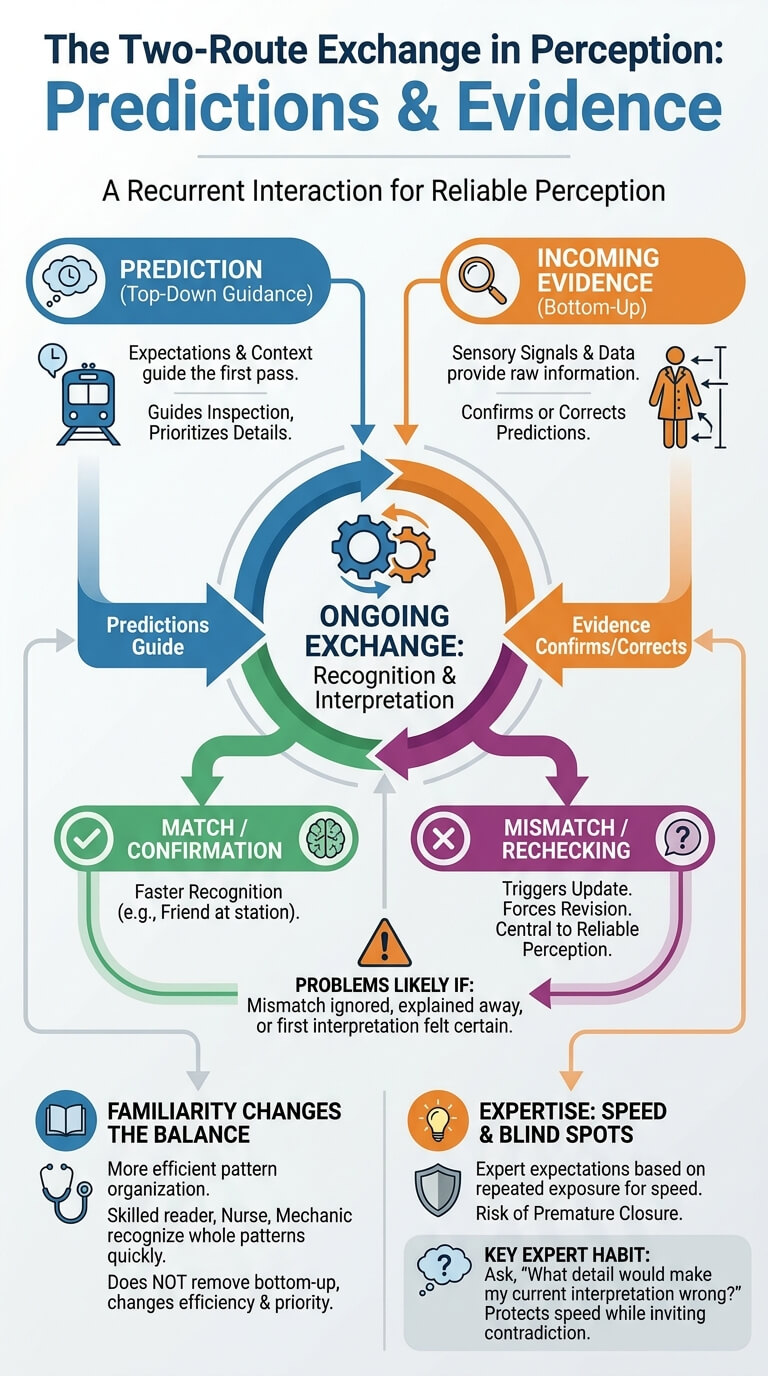
The clearest model is an ongoing exchange in which predictions guide inspection and incoming evidence confirms or corrects those predictions.
Prediction meets incoming evidence
Consider recognizing a friend across a crowded station. Their coat, height, movement, and location provide bottom-up evidence. Your expectation that they will arrive at that time provides top-down guidance. Together, these signals make recognition faster than inspecting every person equally.
Studies examining the interaction of expectation, attention, and sensory signals support the broader point that perception depends on recurrent interaction rather than a purely one-way sequence.
Mismatch triggers rechecking
If the person turns around and their face does not match, the incoming evidence creates a mismatch. You update the interpretation. This correction is central to reliable perception. Expectations guide the first pass, but details can force revision.
Problems become more likely when the mismatch is ignored, explained away too quickly, or never examined because the first interpretation feels certain.
Familiarity changes the balance
With practice, more of a task can be handled through familiar patterns. A skilled reader recognizes whole words quickly. A nurse notices combinations of signs that a novice processes separately. A mechanic hears a pattern in an engine that sounds like undifferentiated noise to someone else.
Familiarity does not remove bottom-up information. It changes how efficiently the information is organized and which details receive priority.
Expertise can improve speed and also create blind spots
Expert expectations are often accurate because they are built from repeated exposure. They help a person identify meaningful patterns quickly. Yet expertise can also encourage premature closure when a familiar explanation is applied to an unusual case.
A useful expert habit is to ask, “What detail would make my current interpretation wrong?” That question protects the speed advantage while inviting contradictory evidence.
When Top-Down Processing Helps
Knowledge-guided interpretation is most useful when speed, familiarity, or incomplete information makes full inspection inefficient.
Fast recognition in familiar environments
In a familiar home, office, or neighborhood, you do not need to inspect every object from the beginning. Stored knowledge helps you locate doors, tools, signs, and routes quickly.
Understanding incomplete language
Conversation contains pauses, background noise, shortened words, accents, and unfinished sentences. Knowledge of vocabulary, grammar, the speaker, and the topic helps reconstruct meaning.
Using context under noisy conditions
When the sensory signal is weak, context can make the difference between confusion and useful understanding. This happens when reading faded print, recognizing a distant object, or following speech in a crowded place.
The safest use of context is flexible. It supplies a likely meaning while remaining open to new evidence.
When Top-Down Processing Misleads
The same efficiency becomes a weakness when a likely answer receives more weight than the details currently available.
Expecting what is not there
A familiar sequence can make you perceive the expected item before checking it closely. You may think a label shows the usual date, assume a colleague used their usual wording, or overlook a spelling error in a predictable sentence.
Overriding contradictory details
An expectation becomes risky when every conflicting detail is forced to fit it. If you expect someone to be unfriendly, a neutral pause may seem dismissive. If you expect a machine problem to have a familiar cause, an unusual sound may be discounted.
The goal is not to eliminate expectations. It is to notice when the available details are no longer supporting them.
Confusing confidence with evidence
Top-down interpretations can feel clear because they create coherence quickly. That feeling is not the same as proof. Confidence may reflect familiarity, emotional importance, or a strong prediction rather than detailed inspection.
When consequences matter, confidence should be paired with a check: What did I directly detect, and what did I supply from context?
When Bottom-Up Processing Helps or Struggles
Careful attention to sensory evidence supports correction, but details alone may remain confusing without an organizing context.
Careful inspection of novel information
Returning to raw details is useful when a situation is unfamiliar, a first impression may be wrong, or small differences matter. Comparing exact wording, measuring a result, or observing a sequence can reveal information that a broad expectation missed.
High detail with low meaning
Bottom-up processing can become demanding when there are many features but no organizing structure. A beginner sees dozens of separate controls. An expert sees a small number of functional groups.
Learning creates categories that reduce this burden. The same information becomes easier to interpret because it no longer arrives as unrelated pieces.
Sensory noise and missing data
Weak lighting, background noise, distance, speed, and obstruction reduce the quality of incoming evidence. Bottom-up processing cannot recover details that are not available. In those moments, top-down context becomes more influential, but uncertainty should also increase.
Top-Down Processing vs Perceptual Set
These terms overlap, yet one describes a broad direction of influence while the other names a narrower state of readiness.
Broad processing route versus readiness to perceive a particular meaning
Top-down processing is the broad use of knowledge, expectations, goals, and context to shape perception. A perceptual set is a readiness to interpret something in a particular way. It is one specific way that top-down influence can appear.
How perceptual set operates through top-down influence
If you are told that an unclear image contains an animal, you become prepared to organize its lines as an animal. That readiness guides which features stand out and how ambiguity is resolved.
Why the terms should not be used as synonyms
Not every top-down effect is a perceptual set. Reading a word through sentence context, using expertise to identify a pattern, and following a goal-directed search all involve higher-level guidance without necessarily creating the same readiness effect.
Top-Down Processing vs Selective Perception
Both can involve expectations, but they answer different questions about interpretation and the selection of information.
Meaning construction versus selective noticing
Top-down processing describes how existing knowledge and expectations guide interpretation. Selective perception focuses more narrowly on why some parts of a situation receive attention or weight while others are neglected.
A person may use context to understand unclear speech without showing a broad selective filter. Selective perception becomes more relevant when beliefs or emotions repeatedly shape which evidence is noticed and emphasized.
How expectations can affect both
Expectations can guide the meaning of an ambiguous cue and also guide attention toward expectation-consistent information. The processes overlap, but the question differs. One asks how meaning was built. The other asks what was selected or filtered.
A Fast Identification Test
Three questions can reveal which direction is most visible without pretending that the other direction has disappeared.
Ask whether the interpretation began with features or expectations
Begin with the first useful information. Did you notice a sound, edge, movement, or texture and build from it? That suggests stronger bottom-up influence. Did a label, goal, context, or expectation prepare the meaning first? That suggests stronger top-down influence.
Look for missing or ambiguous input
Top-down influence becomes easier to see when the input is unclear or incomplete. Ask whether the same detail might have been interpreted differently in another setting.
Check whether new evidence changed the first interpretation
If a closer look overturns the first answer, you have a clear example of interaction. The initial expectation guided perception, then stronger incoming evidence corrected it.
| Question | What it suggests |
|---|---|
| Was the object unfamiliar and examined feature by feature? | More bottom-up demand |
| Did context make an unclear word easy to understand? | Strong top-down guidance |
| Did an unexpected detail overturn a confident guess? | Bottom-up correction of a top-down prediction |
| Did expertise make recognition faster? | Efficient interaction of learned expectations and sensory evidence |
What to Do When the Two Routes Conflict
When the first meaning and the available details disagree, use a deliberate check rather than choosing certainty too quickly.
Slow down and describe the raw details
Use neutral language before interpretation. Instead of “They looked angry,” describe what was visible: “Their voice became louder, they stopped smiling, and they looked away.” This does not make the observation perfectly objective, but it separates more of the detected information from the conclusion.
State the expectation separately
Name the assumption as an assumption: “I expected them to be annoyed because of the earlier disagreement.” Separating expectation from observation makes it easier to see how much work context is doing.
Test an alternative interpretation
Ask what else could explain the same details and what evidence would distinguish the possibilities. In low-stakes situations, a second look may be enough. In conversation, a simple question such as “How did you mean that?” may be more accurate than treating an ambiguous cue as certain.
For important decisions, use more than one check. Reinspect the details, change the viewing conditions, ask another person what they noticed, or compare the interpretation with a measurable result.
Frequently Asked Questions About Top-Down and Bottom-Up Processing
The answers below address common points of confusion about reading, illusions, awareness, expertise, and timing.
Is reading mainly top-down or bottom-up?
Reading uses both. Visual features help identify letters and words, while vocabulary, grammar, and sentence meaning help resolve unclear input. Beginning readers often rely more heavily on deliberate feature analysis. Fluent readers use familiar patterns more efficiently, but exact letters still matter, especially when a word is unexpected.
Are optical illusions caused by top-down processing?
Some illusions involve context, assumptions, or learned expectations, but not every illusion can be explained as top-down processing alone. Visual organization, contrast, motion signals, and properties of the sensory system may also contribute. It is better to examine the specific illusion than assign one universal cause.
Can bottom-up processing be unconscious?
Yes. Basic sensory analysis and feature detection can occur without conscious awareness of each step. You experience the recognized object or event, not a narrated sequence of every edge, frequency, or texture that contributed to it.
Does expertise increase top-down processing?
Expertise usually provides richer expectations and more useful categories, which can speed recognition. It can also improve attention to meaningful details. However, expertise does not mean sensory evidence stops mattering, and familiar expectations can occasionally create blind spots when a case is unusual.
Which process happens first?
The classroom distinction can sound sequential, but real perception includes fast, repeated interaction. Incoming information begins influencing the system while context and expectations are already active. Research discussions also caution that top-down does not simply mean voluntary or consciously controlled. The most useful answer is that the relative influence changes with the task, familiarity, clarity, and available context.
Key Takeaways
- Bottom-up processing builds recognition from incoming sensory features.
- Top-down processing uses knowledge, goals, context, and expectations to guide interpretation.
- Most everyday perception reflects interaction between both directions.
- Novel information and careful inspection increase bottom-up demand.
- Familiarity and incomplete input make top-down guidance especially useful.
- When expectations and evidence conflict, separate the observed details from the predicted meaning and check an alternative explanation.
Next step: The next time your first impression changes, reconstruct the sequence. Identify the details that arrived from the environment, the expectation that shaped the first meaning, and the new evidence that caused the correction. That small exercise makes the two routes much easier to recognize in daily life.
Educational note: This explanation is intended for general learning and does not assess vision, hearing, neurological functioning, or any mental health condition. Sudden or persistent changes in perception should be discussed with an appropriate licensed health professional.

Michael Reed is the Founder and Lead Writer at Psychology Exposed. He writes about human behavior, relationships, emotional patterns, self-awareness, and practical psychology topics using research-informed, easy-to-understand content.
Read More About Michael Reed: https://psychologyexposed.com/michael-reed/