

Your phone vibrates against your leg. At first, there is only pressure and movement on the skin. A fraction of a second later, you recognize the pattern as a notification and may even assume who sent it. Those moments feel like one event, but psychology separates them into two closely connected processes.
Sensation is the detection of physical energy or change by sensory systems. Perception is the organization and interpretation of that information into a meaningful experience. The difference matters because detecting something does not guarantee that you will identify it correctly, notice it consciously, or understand what caused it.
This distinction is useful far beyond an exam definition. It helps explain why a sound can be heard but not recognized, why food tastes different when your nose is blocked, why a repeated background signal fades from awareness, and why two people can receive similar input yet experience it differently.
Quick Answer: Sensation Detects, Perception Interprets

Sensation begins when sensory receptors respond to stimulation, such as light, sound waves, pressure, temperature, or chemicals. Perception is the mind’s attempt to organize that input and decide what it is. Sensation provides information. Perception turns that information into an experienced object, event, quality, or possible meaning.
One-sentence definition of sensation
Sensation is the basic process through which sensory systems detect stimulation from outside the body or from within it. The APA Dictionary of Psychology definition of sensation includes basic awareness produced when a sensory receptor is stimulated.
One-sentence definition of perception
Perception is the process of organizing and interpreting sensory information so that it becomes a coherent experience, such as recognizing a face, locating a sound, identifying a smell, or judging that a surface is slippery. It is not a perfect copy of stimulation. It is an informed construction from the information available.
The simplest everyday example
Imagine hearing three rising notes. Sensation involves the auditory system registering changes in sound frequency and intensity. Perception involves hearing those notes as your doorbell. The same sensory pattern may mean something different in another context, such as a sound effect in a video, because interpretation depends on more than detection alone.
Sensation and Perception Side by Side

| Question | Sensation | Perception |
|---|---|---|
| What begins the process? | A physical or chemical stimulus reaches a sensory system. | Sensory information is selected, organized, and interpreted. |
| What is the main job? | Detect change or energy. | Build a meaningful experience. |
| Must it be clearly conscious? | No. Some sensory processing may occur without clear awareness. | Often refers to experienced recognition, though terminology varies across research traditions. |
| What shapes it most? | Stimulus properties, receptor sensitivity, thresholds, and adaptation. | Input plus attention, context, expectation, learning, and current goals. |
| What can go wrong? | The signal may be too weak, masked, distorted, or poorly detected. | The signal may be organized or interpreted in a misleading way. |
Source of information
Sensation begins with stimulation. Light reaches the eyes, pressure changes the skin, molecules interact with receptors involved in smell or taste, and vibrations move through the auditory system. Sensory information also comes from inside the body, including balance, body position, hunger, temperature, and pain-related signals. The familiar list of five senses is therefore useful but incomplete.
Main psychological job
The main job of sensation is detection. The main job of perception is meaning. When you touch a mug, receptors respond to pressure and temperature. Perception combines those signals into an experience such as, “This cup is hot, smooth, and safe to hold by the handle.” Meaning makes action possible, but meaning also introduces room for error.
Level of awareness
Sensory activity does not always become a clear conscious experience. A weak sound may affect processing without being confidently heard, and background pressure from clothing may stop attracting attention. Perception usually refers to what becomes organized and experienced, but consciousness and attention are not identical. Research on the relationship between attention and consciousness shows why simple one-to-one claims are risky.
Role of context and experience
Context has a much stronger role in perception than in the initial fact that stimulation occurred. A faint shape in a hallway may be perceived as a coat in daylight and as a person when you are tense at night. The visual input matters, but recent thoughts, expectations, lighting, and familiarity influence the identity assigned to it.
Typical errors or limits
Sensory limits include thresholds, masking, fatigue, damage, and adaptation. Perceptual limits include ambiguity, mistaken grouping, expectation-driven completion, and confusion about causes. A person may accurately detect a raised voice yet misread whether it reflects anger, excitement, urgency, or difficulty hearing. Accurate detection does not guarantee accurate interpretation.
The Input-to-Meaning Chain
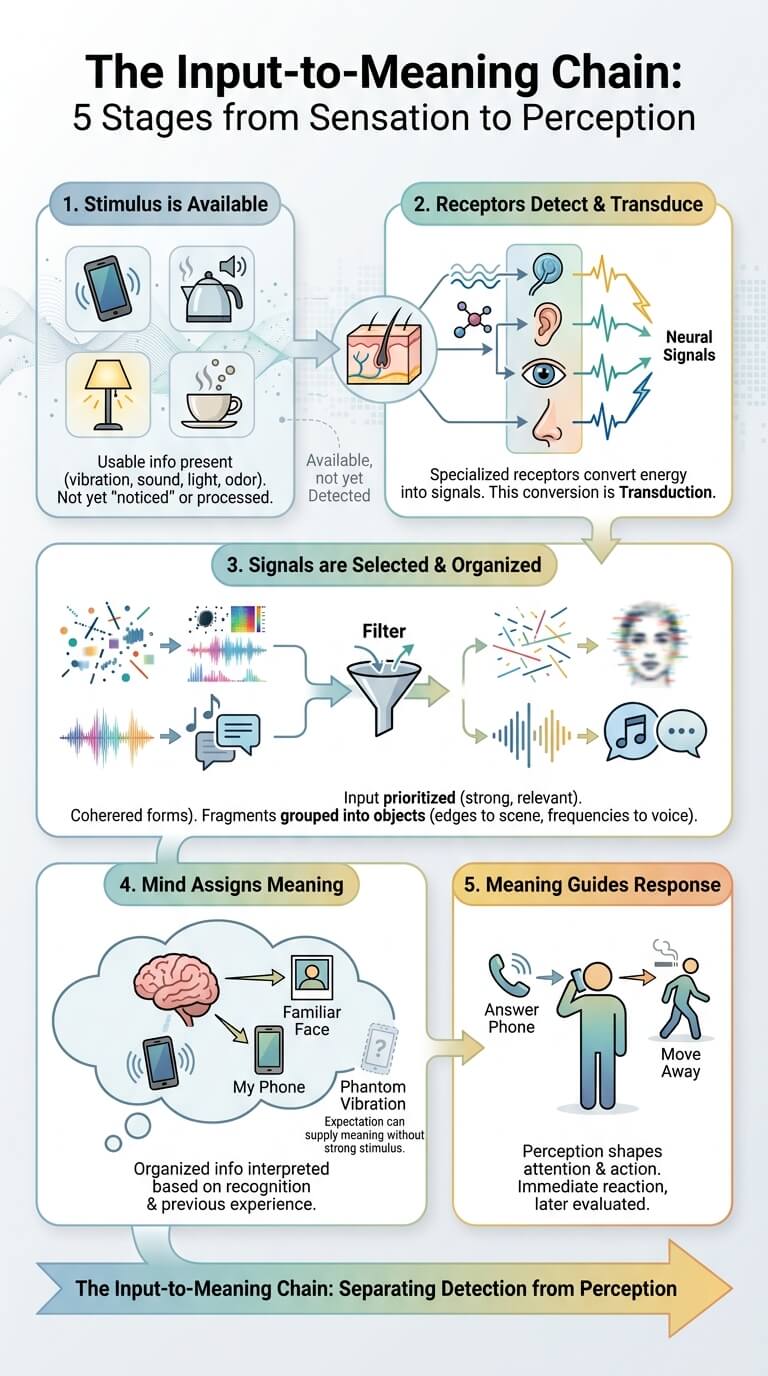
A practical way to separate the two concepts is to follow information through five stages. The boundaries are not perfectly sharp, because the nervous system works through interacting processes. Still, the chain helps identify where detection ends and meaning begins.
This distinction sits within the broader process of perception, where selection, organization, and interpretation turn available input into experienced meaning.
A stimulus is available
Something must first provide usable information. A phone motor creates vibration, a kettle creates sound, a lamp reflects light, and coffee releases airborne molecules. “Available” does not mean “noticed.” A stimulus can be present while being too faint, too brief, masked by stronger stimulation, or outside the range a sensory system can detect.
Sensory receptors detect change
Specialized receptors respond to particular forms of stimulation and convert them into signals the nervous system can use. This conversion is called transduction. A concise NCBI Bookshelf overview of sensory receptors describes how different receptor systems convert energy into neural messages without requiring readers to master detailed anatomy.
Signals are selected and organized
The system does not treat every signal equally. Strong, sudden, relevant, or expected input may receive priority. Separate pieces also need organization. The edges, colors, and movement detected in a scene are grouped into objects. Sound frequencies are grouped into a voice, melody, alarm, or background hum. This is already more than passive recording.
The mind assigns meaning
Meaning appears when organized information is recognized or interpreted. The vibration becomes “my phone,” the odor becomes “coffee,” and a pattern of light becomes “a familiar face.” Previous experience helps, but it can also steer interpretation too quickly. You may reach for your phone after a phantom vibration because a familiar expectation supplied meaning without a strong matching stimulus.
Meaning guides response
Once input has meaning, it can guide attention and action. You answer the phone, move away from smoke, lower your voice after recognizing a sleeping child, or stop eating when a flavor signals spoilage. Later thinking may evaluate the meaning further, but perception has already shaped what seems present and relevant.
Everyday Examples Across the Senses

The same distinction becomes easier to remember when it is applied across different sensory systems. In each example, ask two separate questions: What changed physically, and what did the person experience it as?
Hearing a sound versus recognizing a familiar voice
You may detect speech-like sound from another room without understanding the words. That is a useful example of sensation without complete identification. As you move closer, rhythm, pitch, and pronunciation become clearer, and you recognize your sibling’s voice. The incoming sound improved, but memory and familiarity also helped convert sound into identity.
Detecting light versus seeing a face
Visual receptors respond to light, contrast, and change, yet you do not experience a scattered collection of brightness values. You see a face looking toward you. If the lighting is poor, you may still detect a person-shaped form but misidentify who it is. Detection can be adequate for “someone is there” while remaining inadequate for “that is Maya.”
Feeling pressure versus identifying a phone vibration
Pressure and movement against the thigh are sensory events. Recognizing the pattern as a message alert is perception. If your phone is on a table, muscle movement or fabric friction may still produce a similar sensation. Expectation can then create a mistaken identification, which is why people sometimes check a silent phone after feeling a phantom buzz.
Smelling molecules versus recognizing smoke or coffee
Chemical molecules interact with receptors involved in smell, but the experienced odor is organized as something familiar. “Coffee” is more than a chemical event. It includes learned associations, intensity, context, and often information from other senses. The same smoky odor may be read as pleasant near a fireplace and alarming near an electrical outlet.
Tasting basic qualities versus experiencing flavor
Taste and flavor are not identical. Taste receptors contribute qualities such as sweet, sour, salty, bitter, and umami. Flavor is a broader perception that combines taste with smell, texture, temperature, and expectation. This is why congestion may leave basic taste partly available while making food seem flat or difficult to identify.
Can Sensation Happen Without Clear Perception?
Yes, if “clear perception” means conscious identification. Sensory systems can register input that never becomes a stable, reportable experience. The reason may be weak stimulation, limited attention, rapid presentation, competing input, or adaptation to something that remains constant.
Faint, ambiguous, or unattended input
A sound near your detection threshold may produce uncertainty: “Did I hear something?” You might register movement at the edge of vision without identifying it. At a busy event, your ears receive many voices while only one conversation becomes clear. The OpenStax comparison of sensation and perception explains thresholds, attention, and the difference between detecting information and consciously organizing it.
Sensory adaptation and unnoticed background signals
Unchanging stimulation often becomes less noticeable. A watchband feels obvious when first put on, then disappears from awareness. A room’s smell may be strong when you enter and less prominent several minutes later. Adaptation may occur at several levels, including reduced receptor response and reduced attentional priority. It protects awareness from being dominated by stable, low-value input.
Why detection does not guarantee identification
Identification needs enough quality and structure. You may hear a muffled sound but lack the timing details needed to decide whether it was a knock, a dropped object, or thunder. The sensation is not imaginary simply because the cause remains uncertain. A careful response separates “I detected something” from “I know exactly what it was.”
Can Perception Work With Incomplete Sensation?
Perception often works with partial input because real environments are noisy, fast, and obstructed. The mind uses patterns, context, and prior knowledge to complete what is missing. This usually makes experience efficient. It can also produce confident mistakes when the guessed information is wrong.
Filling gaps from context
During a conversation in a loud café, parts of a sentence may be masked by music or dishes. You still understand the message because grammar, topic, lip movement, and expectation narrow the possibilities. You did not clearly sense every sound. Perception assembled a likely whole from the fragments that reached you.
Reading incomplete words or scenes
A partly covered street sign may remain readable because the visible letters and location constrain the answer. A face behind sunglasses is still experienced as a whole face. The system uses edges, continuity, familiar forms, and relationships between parts. This is valuable, but it means that what you experience includes both detected information and inferred structure.
Expectations that complete ambiguous input
Expectation can resolve uncertainty before you realize the input was ambiguous. When waiting for a delivery, a vehicle door outside may be perceived as the courier arriving. When reading a sentence quickly, you may see the word that fits the grammar rather than the word that was printed. Expectation improves speed, but accuracy depends on how well the expectation matches reality.
Sensation vs Perception vs Cognition
Sensation and perception are often taught within cognitive psychology, but they are not interchangeable with all thinking. A useful distinction is detection, experienced meaning, and later evaluation. In real life, these phases overlap, yet naming them separately makes examples easier to analyze.
Where interpretation ends and later judgment begins
Suppose you hear a sharp tone and recognize it as a smoke alarm. Detection belongs mainly to sensation. Recognizing the sound belongs mainly to perception. Deciding whether it is a test, remembering where the exits are, and choosing how to respond involve later cognition. The transition is gradual, but the jobs are different.
Why the boundaries overlap but should not be collapsed
Perception draws on memory, expectation, and attention, so it already contains cognitive influence. Still, collapsing everything into “thinking” hides an important fact: the experienced world has been organized before deliberate reasoning begins. A person may reason carefully from a mistaken perception, just as they may reason poorly from accurate input.
The broader process of interpreting reality
Sensation supplies raw constraints, while perception builds the experienced scene. That broader process includes selecting information, grouping it, identifying patterns, and assigning likely meaning. Later judgments depend on this starting point. Understanding the distinction makes it easier to ask whether a disagreement began with different input, different attention, or different interpretation.
Sensation vs Top-Down and Bottom-Up Processing
Sensation versus perception compares two stages or functions. Bottom-up versus top-down processing compares two directions of influence used while perception is being built. The pairs are connected, but they answer different questions.
Sensation supplies data for bottom-up processing
Bottom-up processing begins with features in the stimulation. Brightness, edges, pitch, pressure, and chemical properties provide data that can be combined into larger patterns. Sensation is essential here because the process is constrained by what sensory systems detect. Better input can improve identification, as when moving closer makes a distant sign readable.
Perception can be shaped by top-down expectations
Top-down influence brings prior knowledge, goals, and expectation into interpretation. You recognize messy handwriting partly because you know the language and the topic. You notice your name in a noisy room because it is personally meaningful. The input still matters, but existing knowledge helps decide which interpretation fits best.
Why these are related but not identical comparisons
It would be misleading to say sensation equals bottom-up and perception equals top-down. Perception uses both bottom-up evidence and top-down guidance. Sensory systems also involve complex processing before awareness. The cleanest memory aid is this: sensation versus perception asks “detection or meaning?” Bottom-up versus top-down asks “data-led or expectation-led?”
Common Mistakes When Explaining the Difference
Simple definitions are useful only if they do not create new misunderstandings. Four mistakes appear often in classroom answers and everyday explanations.
Treating sensation as fully conscious
People sometimes define sensation as “what you consciously feel.” That is too narrow. Sensory processing may begin without clear awareness, and a signal may influence orientation or attention before it can be described. A better definition centers detection by a sensory system, then treats conscious experience as a later question.
Treating perception as always accurate
Perception is meaningful, not guaranteed to be correct. A shadow may be experienced as movement, a neutral expression may look unfriendly, and an unclear word may be heard as the expected word. Calling something a perception describes the experience of meaning. It does not certify that the meaning matches the external cause.
Reducing the topic to the five senses only
Vision, hearing, smell, taste, and touch are central examples, but the body also detects balance, movement, position, temperature, internal state, and potentially harmful stimulation. The APA Dictionary entry on sense modalities includes several systems beyond the traditional five. This wider view makes examples such as dizziness, posture, hunger, and pain easier to place.
Using interpretation and judgment as exact synonyms
Interpretation can happen rapidly within perception, while judgment often implies a later conclusion or evaluation. Seeing a facial movement as a smile is perception. Deciding the person is trustworthy is a broader judgment. The boundary is not absolute, but separating them prevents perception from expanding into every belief or decision that follows.
A Fast Self-Check for Any Example

When an example feels confusing, use three questions. They can be applied to a textbook scenario, a daily misunderstanding, or your own moment-to-moment experience.
Ask what was physically detected
Name the simplest available information without adding a story. Examples include a rising sound, pressure on the skin, a bitter quality, a moving dark shape, or warmth in the hand. This is the closest part of the example to sensation. If the physical input is unknown, acknowledge uncertainty rather than inventing precision.
Ask what meaning was assigned
Next, name the experienced object or event: a doorbell, a phone alert, spoiled food, an approaching person, or a hot cup. This is the perceptual step. The assigned meaning may be correct, partly correct, or mistaken. What matters is that the input has become something recognizable.
Ask what context changed the meaning
Finally, identify the information that influenced interpretation. Was the person expecting a call? Was the room dark? Had they smelled smoke earlier? Did a label change what they thought they tasted? Context reveals why similar stimulation can produce different experiences without requiring either person to be dishonest.
What to Explore Next
Once the basic distinction is clear, three nearby questions become easier to study. Each one takes a different part of the input-to-meaning chain and examines it more closely.
Attention and perception when the question is what reached awareness
Use this topic when the central puzzle is why a visible or audible event was missed. Attention determines which parts of available input receive priority and become clear enough to guide awareness. This is different from asking whether receptors detected any stimulation at all.
Top-down vs bottom-up processing when the question is how meaning was built
Use this comparison when you want to separate evidence coming from the stimulus from influence coming from knowledge and expectation. It explains why perception is neither a blank recording nor pure imagination. Meaning emerges from an ongoing negotiation between incoming information and what the mind already knows.
Visual perception psychology for detailed visual examples
Use visual perception when the focus is how the mind organizes edges, depth, motion, faces, patterns, and scenes. Sensation versus perception provides the vocabulary, but visual organization deserves its own explanation because seeing a coherent world requires more than detecting light.
Frequently Asked Questions About Sensation vs Perception
These questions address the places where the simple definition needs more nuance, especially consciousness, pain, flavor, and the order of processing.
Which comes first, sensation or perception?
In the simplest teaching model, sensation comes first because stimulation must be detected before it can be interpreted. In actual nervous system activity, processing is fast, interactive, and recurrent. Expectations can influence what is prioritized very early. It is still useful to say sensation supplies input and perception turns that input into experienced meaning.
Is pain a sensation or a perception?
Pain involves both. Nociception refers to sensory detection and signaling related to potentially harmful stimulation. Pain is the experienced result, which can be influenced by attention, context, expectation, emotion, and prior learning. This does not make pain unreal. It means pain is a protective perceptual experience, not a direct meter that always matches tissue damage.
Can perception occur without conscious sensation?
The answer depends on how the terms are defined. Information can be processed and can influence responses without a person clearly reporting the sensation. Many psychologists reserve “conscious perception” for an experience that reaches awareness. It is safer to say that sensory processing can occur without clear awareness than to claim that full conscious perception occurs with no sensory basis.
Are taste and flavor the same process?
No. Taste is one sensory contribution involving qualities such as sweet, salty, sour, bitter, and umami. Flavor is a combined perception shaped by taste, smell, texture, temperature, and expectation. A blocked nose often reduces flavor recognition even when the tongue can still detect some basic taste qualities.
Why do textbooks teach sensation and perception together?
They form a continuous path from stimulation to experience. Studying them together shows how physical information becomes a psychologically meaningful world. Studying them separately prevents the false idea that sensory systems simply deliver a finished, objective picture that needs no organization or interpretation.
Key Takeaways
- Sensation is the detection of stimulation; perception is the organization and interpretation of sensory information.
- A signal may be detected without being clearly identified or consciously noticed.
- Perception can complete missing information by using context, familiarity, and expectation.
- Sensation versus perception compares detection with meaning, while bottom-up versus top-down compares directions of influence.
- Taste is one sensory contribution to flavor, and nociception is one sensory contribution to the experience of pain.
- For any example, separate what was physically detected, what meaning was assigned, and what context shaped that meaning.
A useful next step is to test the distinction during an ordinary moment. When a sound, smell, vibration, or expression catches your attention, pause before the conclusion. Name the input first, then name the meaning. That small separation makes the difference between sensation and perception much easier to recognize.
Educational note: Sudden or persistent changes in vision, hearing, smell, taste, balance, touch, or pain should not be explained only as a psychological interpretation issue. A qualified medical professional can assess possible sensory or neurological causes.

Michael Reed is the Founder and Lead Writer at Psychology Exposed. He writes about human behavior, relationships, emotional patterns, self-awareness, and practical psychology topics using research-informed, easy-to-understand content.
Read More About Michael Reed: https://psychologyexposed.com/michael-reed/