
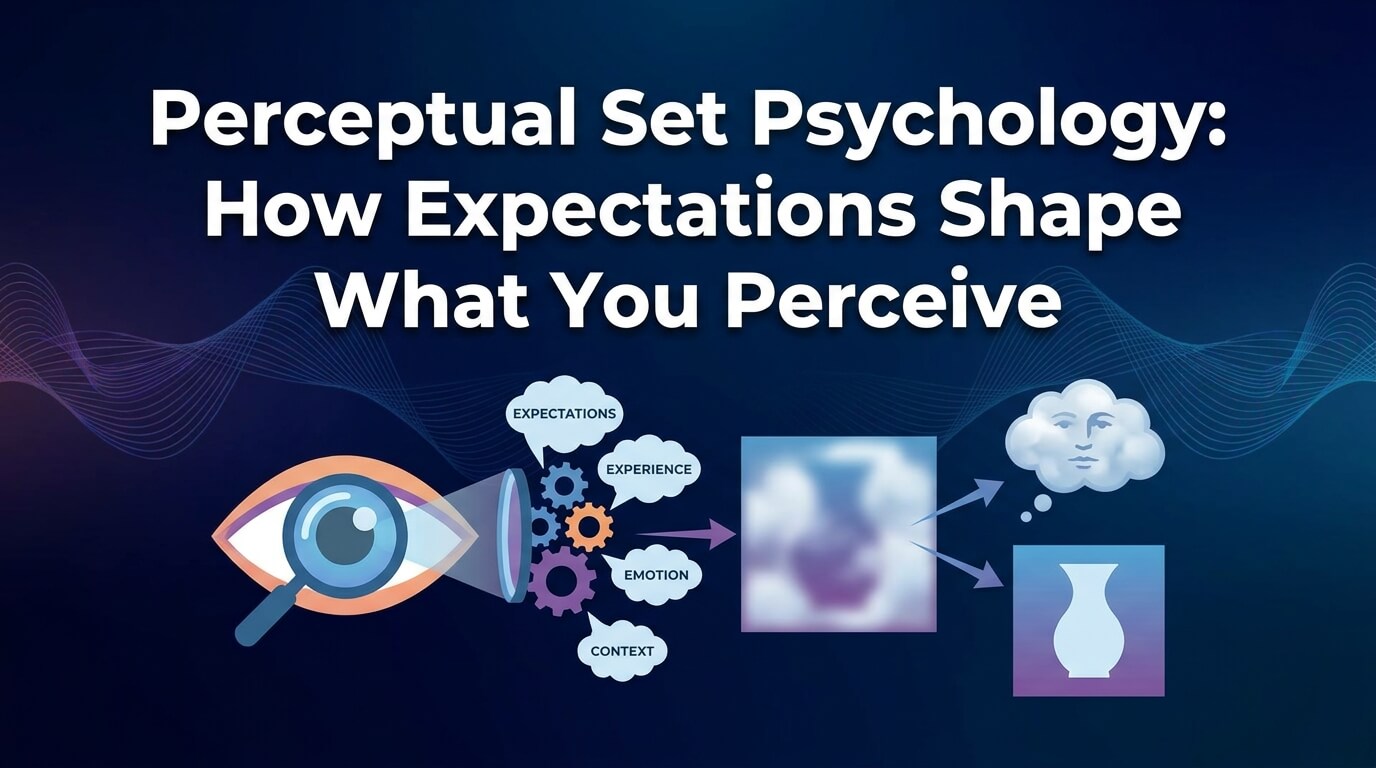
You enter a meeting expecting criticism. Your manager pauses before speaking, glances at a document, and says, “We should go over this.” The words are not automatically hostile, but the expectation already in place makes the pause feel ominous and the sentence sound harsher. Someone expecting ordinary feedback might perceive the same moment as neutral.
That readiness for one interpretation is called a perceptual set. It helps the mind make fast sense of incomplete information, but it can also make an old meaning feel obvious before enough evidence has arrived. The effect is easiest to notice when a picture, sound, facial expression, or situation can reasonably be understood in more than one way.
Perceptual set is not proof that perception is imaginary or that expectations always overpower the senses. It describes a tilt in readiness. Incoming details still matter, and a strong mismatch can correct the first interpretation. The useful question is not “Was my perception real?” but “What prepared this meaning to arrive first, and what evidence would help me update it?”
Quick Answer: The Mind Becomes Ready for One Meaning
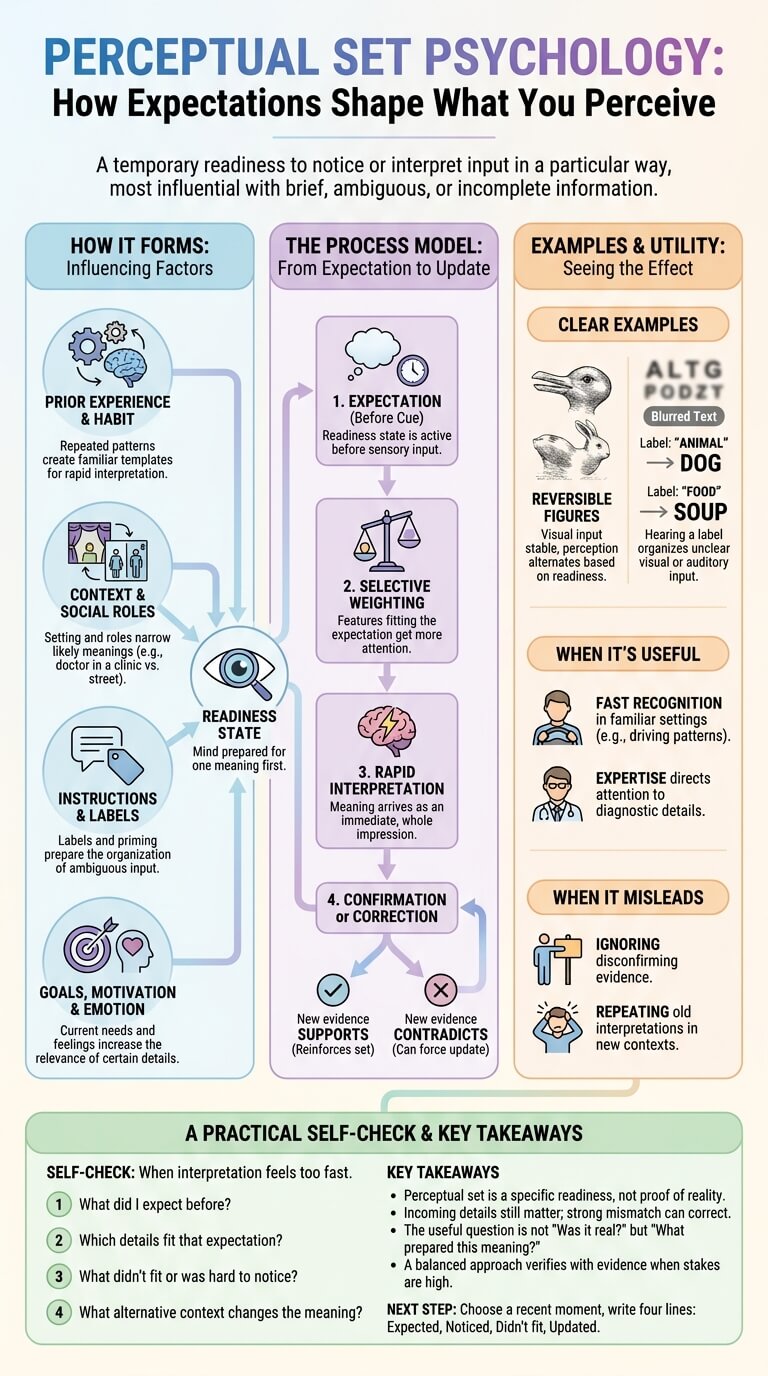
Quick answer: In psychology, a perceptual set is a temporary readiness to notice or interpret a person, object, or event in a particular way. Expectations, context, instructions, goals, prior experience, and emotion can create that readiness. It is most influential when sensory information is brief, noisy, incomplete, or ambiguous, and it can be revised when new evidence does not fit.
A concise definition of perceptual set
The APA Dictionary of Psychology defines perceptual set as a readiness to perceive certain objects or events rather than others, and also as a mental frame that influences how objects, events, or people are perceived. In everyday language, the mind becomes prepared for a likely answer before all the details are clear.
Perceptual set is one specific mechanism within the broader process of perception.
Readiness is not deliberate pretending
A perceptual set can operate quickly and without a conscious decision. You may honestly hear irritation in an ambiguous tone or recognize one object in a reversible picture before noticing the alternative. The interpretation feels immediate because the preparation happened before conscious reflection.
This is why accusing someone of “seeing what they want to see” may oversimplify the process. Motivation can matter, but so can habit, role, context, recent exposure, and learned expertise.
Ambiguous input makes the effect easier to see
When information strongly supports one answer, expectations have less room to redirect it. A clear red stop sign remains a stop sign even if you were thinking about a restaurant logo. Perceptual set becomes more visible when several meanings are plausible, such as a faint sound, a brief facial expression, unclear handwriting, or an image that can flip between two interpretations.
How a Perceptual Set Forms
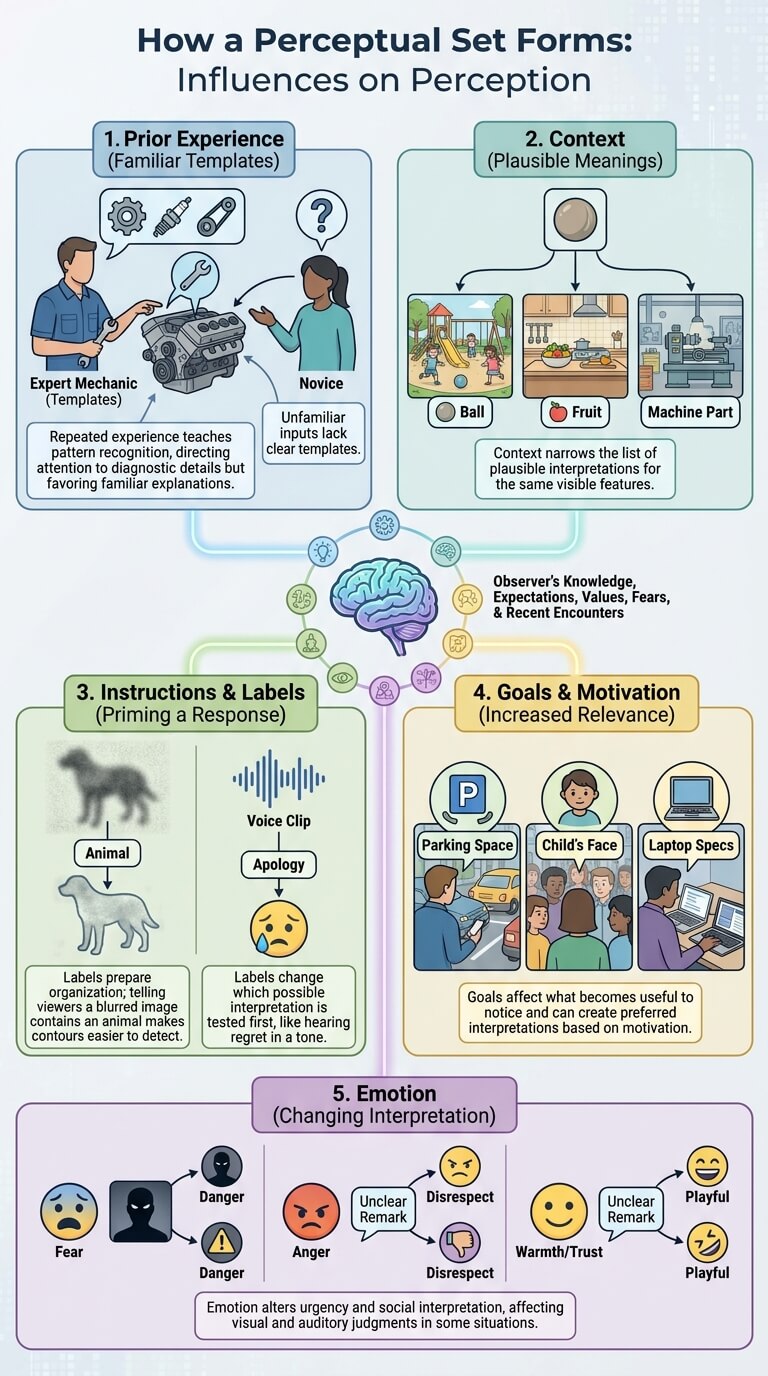
A perceptual set does not come from one source. It forms when the current cue meets what the observer already knows, expects, values, fears, or has recently encountered.
Prior experience creates familiar templates
Repeated experience teaches the mind which patterns usually belong together. A mechanic hears an engine noise and rapidly considers a small set of likely causes. A novice hears only an unfamiliar rattle. The expert’s readiness is often useful because it directs attention toward diagnostic details, but it can also favor the familiar explanation when the current case is unusual.
Personal experience works in a similar way. Someone who has often received bad news after the phrase “Can we talk?” may become prepared for threat whenever the phrase appears, even when the present conversation is routine.
Context makes some interpretations more likely
Context narrows the list of meanings that seem plausible. The same round shape may be seen as a ball in a playground, a fruit in a kitchen, or part of a machine in a workshop. The visible features have not necessarily changed, but the setting gives one category an advantage.
Reviews of how expectations are learned in visual perception describe expectations as continuously updated from regularities in the environment. This learning helps recognition become faster, especially when input is uncertain.
Instructions and labels prime a response
A label can prepare a person to organize information in a particular way. Tell viewers that a blurred image contains an animal, and animal-like contours may become easier to detect. Introduce a voice clip as an apology, and listeners may hear regret in a tone that might otherwise sound tired or uncertain.
The label does not manufacture unlimited detail. It changes which possible interpretation is ready to be tested first.
Goals and motivation increase relevance
What you are trying to do affects what becomes useful. A driver scanning for a parking space is prepared to notice gaps between cars. A parent waiting at an airport is prepared to detect the child’s face in a crowd. A buyer comparing laptops is prepared to see specifications that another shopper might ignore.
Motivation can also create a preferred interpretation. A person hoping for approval may read an ambiguous reply optimistically. Someone preparing for rejection may detect distance instead. Neither reaction proves what the other person intended.
Emotion changes threat, safety, and social interpretation
Emotion alters what feels urgent. Fear may prepare the mind to detect danger in uncertain movement or sound. Anger may make disrespect a more available explanation for an unclear remark. Warmth and trust may make the same remark feel playful.
Research reviewing ways emotion can influence perception suggests that emotional states can affect visual and auditory judgments in some situations. These effects are not universal, and mood should not be treated as a complete explanation for every perceptual difference.
A Simple Perceptual Set Model
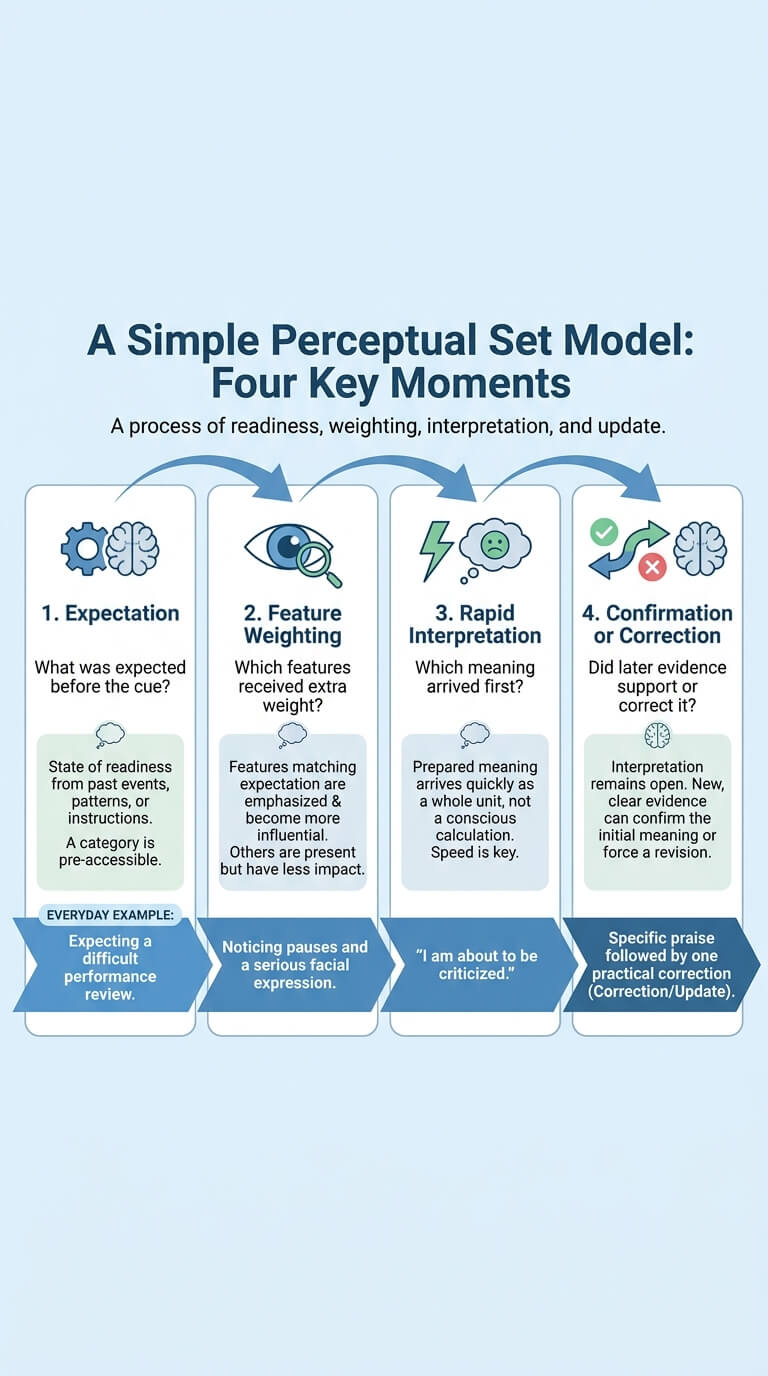
A useful way to follow the process is to separate four moments: what was expected, which features received extra weight, which meaning arrived first, and whether later evidence supported or corrected it.
Expectation before the cue
The process begins with a state of readiness. It may come from a warning, a recent event, a familiar role, a repeated pattern, or a direct instruction. Before the cue is fully processed, one category is already more accessible than its alternatives.
Selective weighting of features
Features that fit the expectation may become easier to notice or more important in the interpretation. If you expect annoyance, a short reply and flat tone carry more weight. A later smile may be treated as politeness rather than evidence against the first impression.
This does not necessarily mean the other features were invisible. They may simply have had less influence on the initial meaning.
Rapid interpretation
The prepared meaning often arrives as a whole. You experience “that sounded angry,” not a conscious calculation of pauses, volume, word choice, and history. Speed is part of the benefit. Perception would be painfully slow if every possibility had to be compared from the beginning.
Confirmation or correction from new evidence
The interpretation remains open to incoming information. Clearer lighting, a repeated phrase, a direct question, or a contradictory action may support the first answer or force a revision. Research on prior expectations and sensory templates illustrates how expectations can prepare sensory systems before a stimulus appears, while the actual stimulus still contributes evidence.
| Stage | Question to ask | Everyday example |
|---|---|---|
| Expectation | What was I prepared to encounter? | Expecting a difficult performance review |
| Feature weighting | Which details felt most important? | Noticing pauses and a serious facial expression |
| Rapid meaning | What conclusion arrived first? | “I am about to be criticized” |
| Update | What later evidence confirmed or changed it? | Specific praise followed by one practical correction |
Classic and Everyday Examples
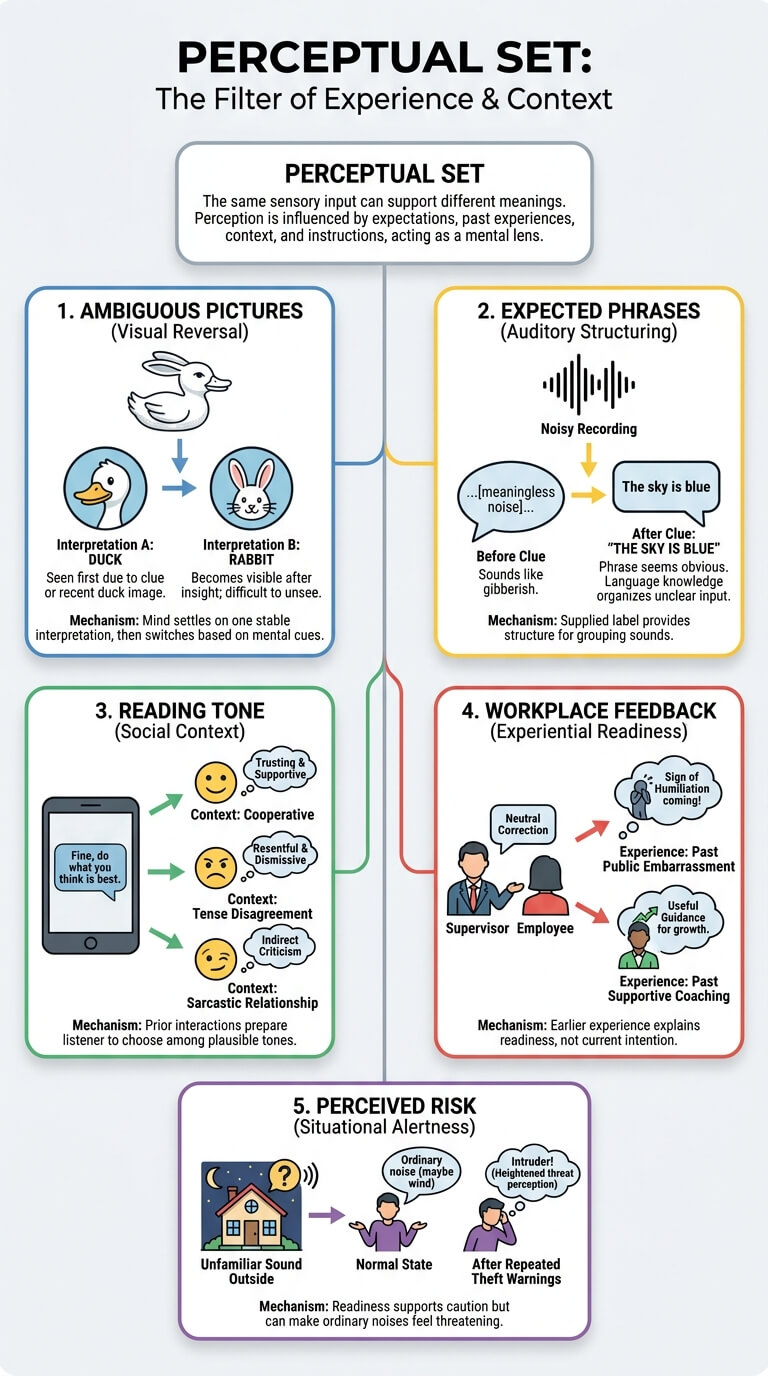
Perceptual set becomes clearer when the same input can support different meanings. The following examples range from laboratory-style demonstrations to ordinary social situations.
Ambiguous pictures and reversible figures
A reversible figure can be seen in two valid ways, such as a drawing that appears to be a duck and then a rabbit. The visual information remains stable while perception alternates. Research on ambiguous figures and spontaneous perceptual reversals uses this feature to study how the mind settles on one interpretation and later switches.
A clue, recent image, or instruction can make one version appear first. Once the alternative is discovered, it may become difficult to understand why it was invisible moments earlier.
Hearing a phrase after being told what to expect
A noisy recording may sound meaningless until someone supplies a possible phrase. On the next replay, the expected words can seem obvious. The acoustic signal is the same, but the label provides a structure for grouping the sounds.
This does not guarantee that the supplied phrase is correct. It demonstrates how language knowledge can organize unclear auditory input.
Reading tone through the context of a relationship
Imagine receiving the message “Fine, do what you think is best.” In a cooperative conversation, it may sound trusting. After a tense disagreement, it may sound resentful. In a relationship where sarcasm is common, it may be heard as indirect criticism.
The words alone do not contain the full tone. Prior interactions prepare the listener to choose among several plausible meanings. Clarification becomes especially useful when the consequences of guessing are high.
Interpreting workplace feedback through prior experiences
An employee who has been publicly embarrassed by a previous supervisor may hear neutral correction as a sign that humiliation is about to happen again. Another employee with a history of supportive coaching may hear the same sentence as useful guidance.
The earlier experience explains the readiness, but it does not decide the present supervisor’s intention. A fair check includes both history and current behavior: Was the feedback specific? Was it delivered respectfully? Was there room to respond?
Seeing risk after repeated warnings
After hearing several reports about theft, a person may become prepared to interpret an unfamiliar sound outside as an intruder. That readiness can support caution, yet it can also make ordinary noises feel more threatening than before.
The responsible response is proportional checking, not self-criticism or certainty. Turn on a light, verify doors, review available evidence, and seek appropriate help when there is a concrete safety concern.
Why Context Changes Perception So Quickly
Context is efficient because it reduces uncertainty. Instead of treating every interpretation as equally likely, the mind uses the setting and recent information to narrow the field.
Context narrows possible meanings
A spoken word can have several meanings, but the sentence around it often makes one meaning far more likely. A hand raised in a classroom means something different from the same gesture on a busy street. Context does not merely add background information. It changes which interpretation fits.
Familiar patterns reduce processing effort
Recognition becomes easier when a cue belongs to a known pattern. You do not need to inspect every letter in a familiar word or every movement in a routine task. The perceptual set supplies a likely structure, allowing partial details to be enough.
The tradeoff is that familiar structure may be imposed too quickly. A typo can go unnoticed because the expected word is read instead of the letters actually present.
Social roles create expectations about behavior
Roles carry scripts. A doctor is expected to ask health questions, a waiter to approach a table, and a security guard to watch the surroundings. These expectations speed interpretation, but they can become misleading when the person acts outside the expected script or when a role-based assumption is inaccurate.
When Perceptual Set Is Useful
Perceptual set is not a defect to eliminate. It is one way the mind uses learning to function efficiently in a world where information is often incomplete.
Fast recognition in familiar settings
Familiar environments contain regular patterns. A driver anticipates pedestrians near a crosswalk. A cook notices the sound of boiling over. A teacher recognizes the shift in classroom noise that often precedes a question or problem.
Readiness allows action before every detail has been consciously reviewed.
Expertise and pattern detection
Expertise creates refined perceptual sets. An experienced radiologist, musician, editor, athlete, or craftsperson may detect meaningful configurations that a beginner overlooks. The advantage is not simply better eyesight or hearing. It is a learned readiness for task-relevant patterns.
Good expertise also includes correction habits. Experts compare an initial pattern match with evidence that could disprove it.
Interpreting incomplete or noisy information
Background noise, poor lighting, distance, and brief exposure leave gaps. Expectations help fill enough of those gaps to recognize a familiar voice, follow a conversation, or identify an object. Without prior knowledge, ordinary perception would require more time and clearer input.
When Perceptual Set Misleads
The same efficiency becomes a problem when readiness remains stronger than contradictory information. Three warning signs are especially useful.
Ignoring disconfirming features
An expectation becomes misleading when fitting details receive attention and mismatching details are repeatedly discounted. Someone expecting hostility may notice a firm tone but overlook a helpful action, a later clarification, or evidence that the speaker was under time pressure.
A set becomes more concerning when it repeatedly produces a directional perceptual bias that resists meaningful contradictory evidence.
Repeating an old interpretation in a new context
A readiness learned in one environment may not fit another. Direct feedback from an abusive former boss and direct feedback from a respectful current manager may use similar words but occur within very different patterns of behavior.
History deserves compassion, while the present deserves fresh observation.
Treating emotional readiness as objective proof
Feeling prepared for danger does not prove that danger is absent, but it also does not prove that danger is present. Emotion is information about your state and your learning history. It should be considered alongside observable details, context, and the cost of being wrong.
A balanced rule: When the stakes are low, curiosity may be enough. When the stakes involve physical safety, health, money, or serious consequences, verify with stronger evidence and appropriate professional support.
Perceptual Set vs Top-Down Processing
These ideas overlap, but they are not interchangeable.
Specific readiness effect versus broad direction of influence
Top-down processing is the broad influence of knowledge, context, goals, and expectations on perception. Perceptual set is a narrower readiness for a particular kind of object, event, or meaning. It names the prepared state, not every form of knowledge-guided processing.
Why all perceptual sets are top-down influences but not all top-down processing is a perceptual set
A perceptual set uses information already in the mind to guide interpretation, so it is a top-down influence. But top-down processing also includes using language rules to read, using expertise to search for features, and applying task instructions without necessarily becoming prepared for one specific answer.
It is also worth remembering that top-down does not mean voluntary. Expectations may shape perception even when a person is not choosing the influence.
Perceptual Set vs Selective Perception
One process prepares a meaning; the other concerns which available cues receive attention or weight.
Prepared interpretation versus selective noticing
Perceptual set asks, “Which interpretation was the mind ready to make?” Selective perception asks, “Which parts of the available information were noticed, emphasized, or filtered?” A person can be prepared to hear criticism and therefore interpret an ambiguous sentence negatively, even if every word was noticed.
How the two can reinforce each other
A readiness for criticism can also guide attention toward pauses, corrections, and serious expressions. Those selected details then strengthen the initial interpretation. The processes form a loop, but separating them helps identify where a correction is possible.
Perceptual Set vs Self-Perception
The shared word “perception” can make these topics sound more similar than they are.
Perceiving situations or stimuli versus interpreting the self
Perceptual set concerns readiness to perceive an external object, event, person, or cue in a particular way. Self-perception concerns how people understand their own traits, motives, feelings, or behavior. One may affect the other, but they answer different questions.
Why the distinction matters
If you expect criticism, that expectation may shape how you hear a manager’s tone. If you conclude “I am incompetent” after the conversation, that conclusion involves self-evaluation. Keeping the steps separate prevents one ambiguous cue from becoming a global identity claim.
A Perceptual Set Self-Check
This four-question check is most useful after an interpretation feels immediate but the evidence remains incomplete.
What did I expect before the event?
Name the preparation without judging it. “I expected rejection because the reply was delayed.” “I expected praise because the earlier meeting went well.” “I expected danger after reading several warnings.”
Which details fit that expectation?
List the observations that supported the first meaning. Use specific language, such as “They answered with three words,” rather than “They were cold.” This makes the evidence easier to review.
Which details were harder to notice or explain?
Look for information that did not fit neatly. Perhaps the person also offered help, the lighting was poor, the sound came from a known appliance, or the feedback included clear praise. A mismatch does not automatically cancel the first interpretation, but it deserves weight.
What alternative context would change the meaning?
Ask how the same cue would appear in another setting. Would the short message seem different if the sender were driving, ill, or rushing into a meeting? Would the unfamiliar sound seem different after learning that construction had begun nearby?
| Self-check step | Unhelpful version | More useful version |
|---|---|---|
| Name the expectation | “I knew this would happen.” | “I was already expecting this outcome.” |
| Describe evidence | “They were disrespectful.” | “They interrupted twice and did not answer the question.” |
| Find mismatch | “Nothing else matters.” | “What does not fit my first explanation?” |
| Test context | “There is only one meaning.” | “What conditions would make another meaning plausible?” |
How to Loosen an Unhelpful Perceptual Set
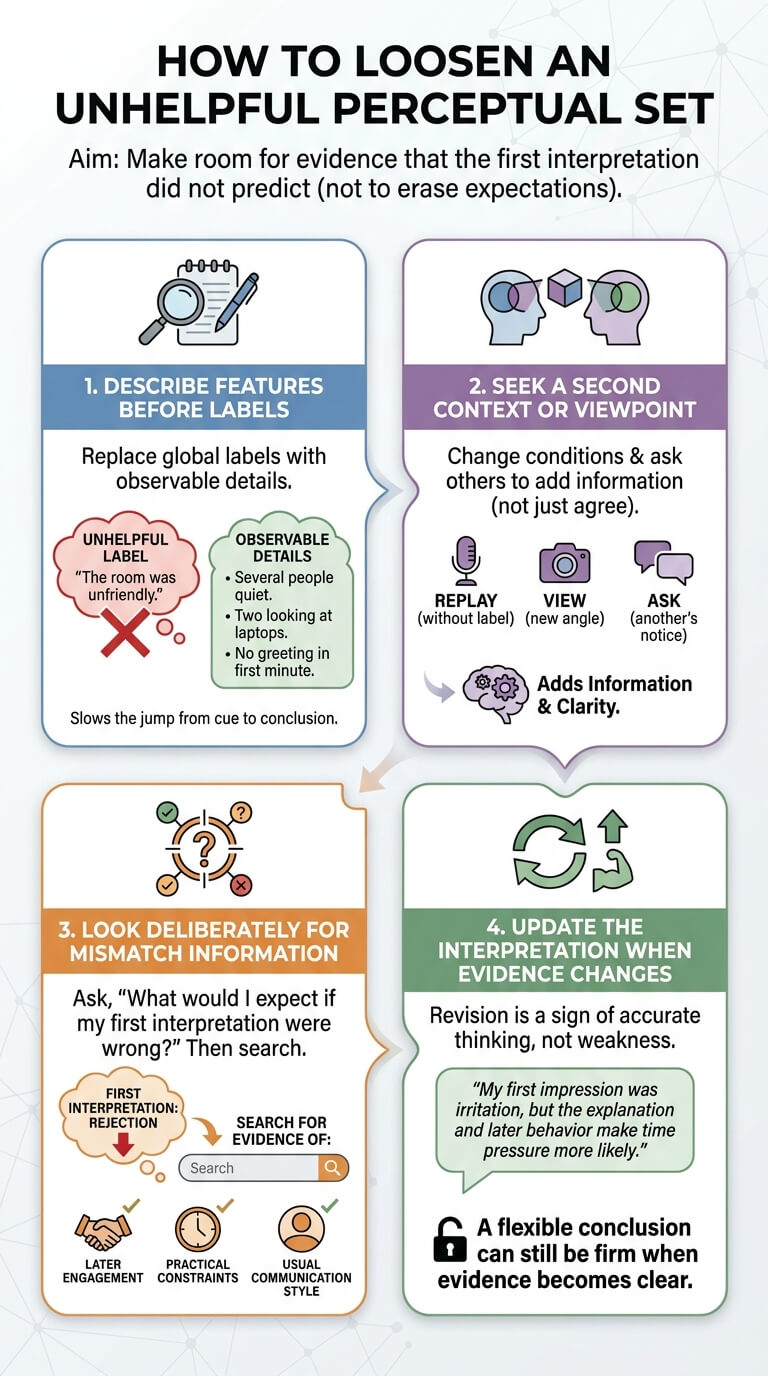
The aim is not to erase expectations. It is to make room for evidence that the first interpretation did not predict.
Describe features before labels
Replace a global label with observable details. Instead of “The room was unfriendly,” note that several people were quiet, two were looking at laptops, and no one greeted you during the first minute. Description does not remove subjectivity, but it slows the jump from cue to conclusion.
Seek a second context or viewpoint
Change the conditions when possible. Replay the audio without the original label, view the image from another angle, ask what another observer noticed, or clarify the speaker’s meaning. A second viewpoint should add information, not merely provide agreement.
Look deliberately for mismatch information
Ask, “What would I expect to see if my first interpretation were wrong?” Then search for that evidence. If you interpreted a message as rejection, look for later engagement, practical constraints, and the person’s usual communication style.
Update the interpretation when evidence changes
Revision is a sign of accurate thinking, not weakness. Use language that allows movement: “My first impression was irritation, but the explanation and later behavior make time pressure more likely.” A flexible conclusion can still be firm when evidence becomes clear.
How Perceptual Set Interacts With Other Perception Processes
Perceptual set is one influence within a larger sequence. Understanding the boundaries prevents every disagreement or perceptual error from receiving the same explanation.
The broader flow of top-down and bottom-up information
Perceptual set belongs on the expectation side of perception, while sensory features continue to arrive from the environment. A mismatch between the expected and detected information can slow recognition or produce a correction.
What selective perception adds
Selective perception becomes more relevant when the main question is why some available cues were noticed or weighted while others were missed. Perceptual set focuses on readiness for a meaning, although the two often work together.
Why reality checking comes afterward
Once an interpretation has formed, a reality check compares it with additional evidence, records, other viewpoints, and alternative explanations. The goal is not to dismiss the experience. It is to learn how complete and accurate the first meaning appears to be.
When an expectation feels convincing but the consequences matter, compare it with the distinction between perception and external reality.
Frequently Asked Questions About Perceptual Set
These answers clarify common confusion about expectation, labels, mood, expertise, and confirmation bias.
Is perceptual set the same as expectation?
Expectation is a major ingredient, but perceptual set refers more specifically to readiness to perceive a certain object, event, or interpretation. An expectation about a future outcome may influence decisions without changing perception. It becomes a perceptual set when it prepares how incoming cues are noticed or interpreted.
Can a label create a perceptual set?
Yes. A label can activate a category and make category-consistent features easier to organize. The effect is strongest when the input is ambiguous. Clear contradictory evidence can weaken or overturn the label-based interpretation.
Does mood affect perceptual set?
Mood can make some meanings more available, especially in uncertain emotional or threat-related situations. However, mood is only one influence. Context, learning history, goals, sensory clarity, and current evidence also matter. A negative mood does not make every perception inaccurate.
Can expertise reduce perceptual set errors?
Expertise can improve recognition because it creates accurate, detailed expectations and better correction habits. It can also create blind spots when a familiar pattern is applied too quickly. The strongest expertise combines rapid pattern recognition with deliberate checks for exceptions.
How is perceptual set different from confirmation bias?
Perceptual set concerns readiness at the stage of perceiving or interpreting incoming information. Confirmation bias is broader and involves seeking, interpreting, or remembering information in ways that support an existing belief. A perceptual set may contribute to a confirmation process, but the terms do not describe the same scope.
Key Takeaways
- A perceptual set is a readiness to perceive one object, event, or meaning more readily than alternatives.
- Prior experience, context, labels, goals, motivation, and emotion can create that readiness.
- The effect is easiest to observe when sensory input is incomplete or ambiguous.
- Perceptual set is a specific top-down influence, not a synonym for all top-down processing.
- It differs from selective perception, which focuses more on which available cues are noticed or weighted.
- A useful correction process separates the expectation, the observed features, the first meaning, and the evidence that supports an update.
Next step: Choose one recent moment when a meaning seemed obvious before you had much information. Write four lines: what you expected, what you noticed, what did not fit, and what later evidence changed or confirmed the interpretation. That brief reconstruction turns perceptual set from an abstract term into something you can recognize without automatically distrusting yourself.
Educational note: Ordinary expectation effects are common and do not by themselves indicate a mental health condition. If perceptual experiences are sudden, persistent, frightening, or interfere with daily functioning, consider speaking with an appropriate licensed medical or mental health professional.

Michael Reed is the Founder and Lead Writer at Psychology Exposed. He writes about human behavior, relationships, emotional patterns, self-awareness, and practical psychology topics using research-informed, easy-to-understand content.
Read More About Michael Reed: https://psychologyexposed.com/michael-reed/