
Two people can leave the same conversation with sharply different accounts of what happened. One remembers a dismissive tone. The other remembers trying to stay calm. Both may be sincere, yet neither account necessarily contains the whole event.
Psychology does not reduce this difference to “one person is right and the other is imagining things.” Perception is an active process. The mind receives limited information, gives some details more attention than others, connects them with expectations and emotion, then forms a meaningful experience. That experience matters because it shapes feelings and behavior. It is not, however, a perfect recording of everything that occurred.
Understanding perception versus reality helps with everyday disagreements, uncertain impressions, stressful interpretations, and memories that do not match. The useful question is not simply, “Whose reality is true?” A better question is, “What was experienced, what was observed, and what can be checked?”
Quick Answer: A Perception Can Feel Real Without Being a Complete Record
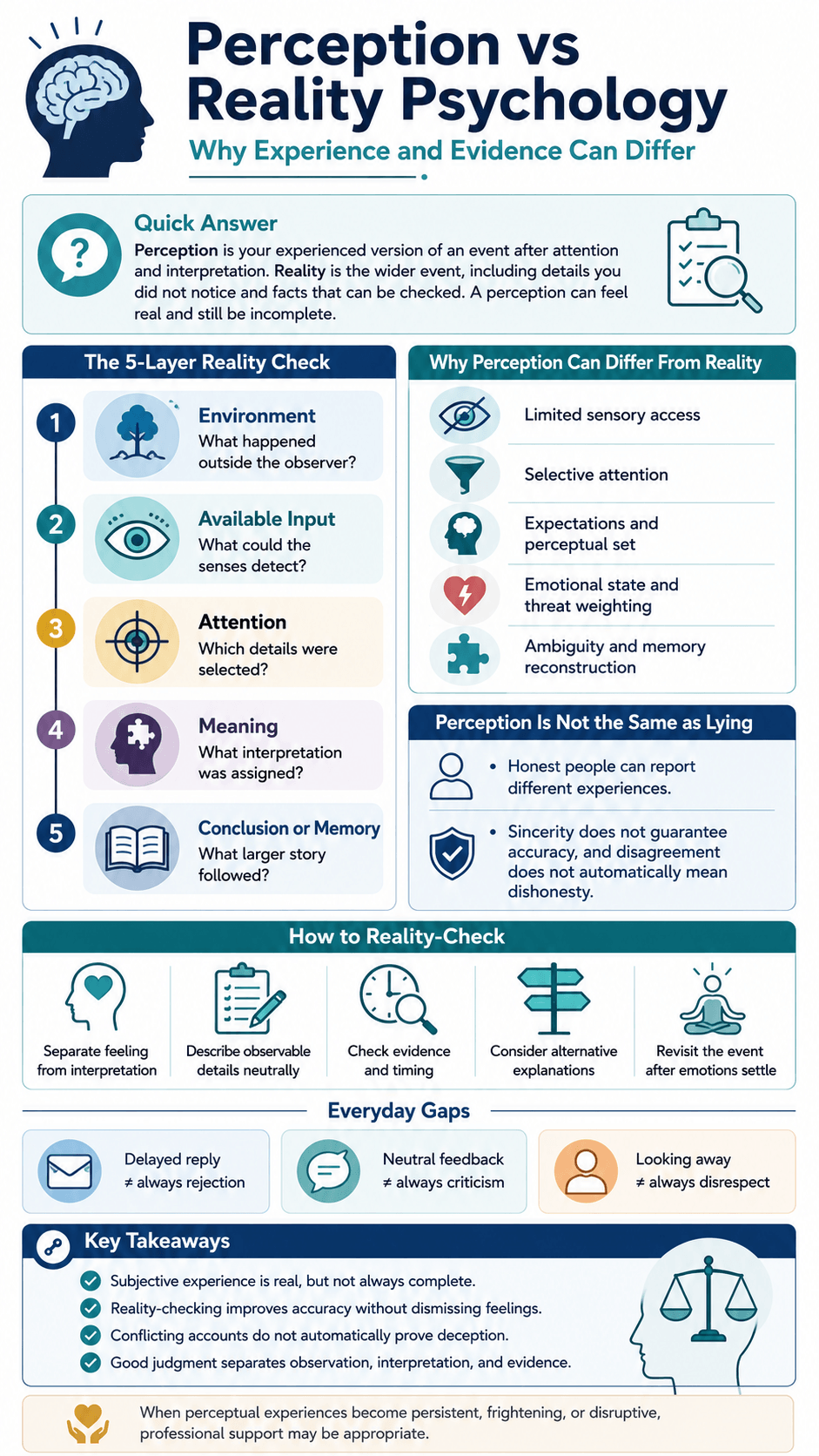
Perception is a person’s experienced version of an event after sensory information has been selected and interpreted. Reality includes the wider event, including details the person did not notice or could not access. A perception can be sincere and emotionally powerful while still being incomplete, mistaken, or uncertain. Checking reality means comparing interpretation with observable evidence, not dismissing the experience.
Subjective experience is psychologically real
If a comment sounded hostile to you, the tension you felt was real as an experience. Your body may have tightened, your attention may have narrowed, and your next response may have been shaped by that meaning. The APA Dictionary of Psychology describes perceived reality as subjective experience in contrast with objective external reality. The distinction matters because subjective does not mean fake. It means the experience belongs to an observer.
External reality may contain information outside awareness
The wider event can include details you never saw, heard, or knew. A delayed reply may have happened because someone was busy, upset, avoiding the message, or dealing with an unrelated problem. Your perception is built from the information available to you, not from every fact that exists.
Respecting experience does not require treating every conclusion as proven
You can say, “I felt dismissed,” without claiming, “You definitely intended to humiliate me.” The first statement reports an experience. The second makes an inference about another person’s mind. Keeping these separate allows emotional honesty and evidence-checking to coexist.
What Perception and Reality Mean in This Article
In daily conversation, people often use “my reality” to mean personal experience and “the reality” to mean what actually happened. These phrases can be useful, but they become confusing when feelings, observations, interpretations, and facts are treated as identical.
Perception as selected and interpreted experience
Perception begins with sensory input, but it does not end there. The mind organizes sounds, sights, movement, timing, context, and prior knowledge into something meaningful. You do not merely hear a voice. You hear impatience, warmth, uncertainty, sarcasm, or urgency. That meaning may be accurate, partly accurate, or mistaken.
Reality as the broader event, including unknown and verifiable details
Reality is broader than what one observer experienced. It includes physical conditions, other people’s actions, timing, records, context, and information that may be independently checked. A security camera may clarify where someone stood, but it may not reveal what they intended. A message log may confirm when words were sent, but not how they were received.
Why objective certainty is often limited in everyday life
Many situations do not offer a complete, neutral record. Tone is difficult to measure. Intention is usually inferred. Memories change over time. People may agree about the words but disagree about what those words meant. Reality-checking improves accuracy, but it does not always produce perfect certainty.
The gap becomes easier to understand within the broader psychology of perception, where selection and interpretation occur before judgment.
The Five-Layer Reality Check
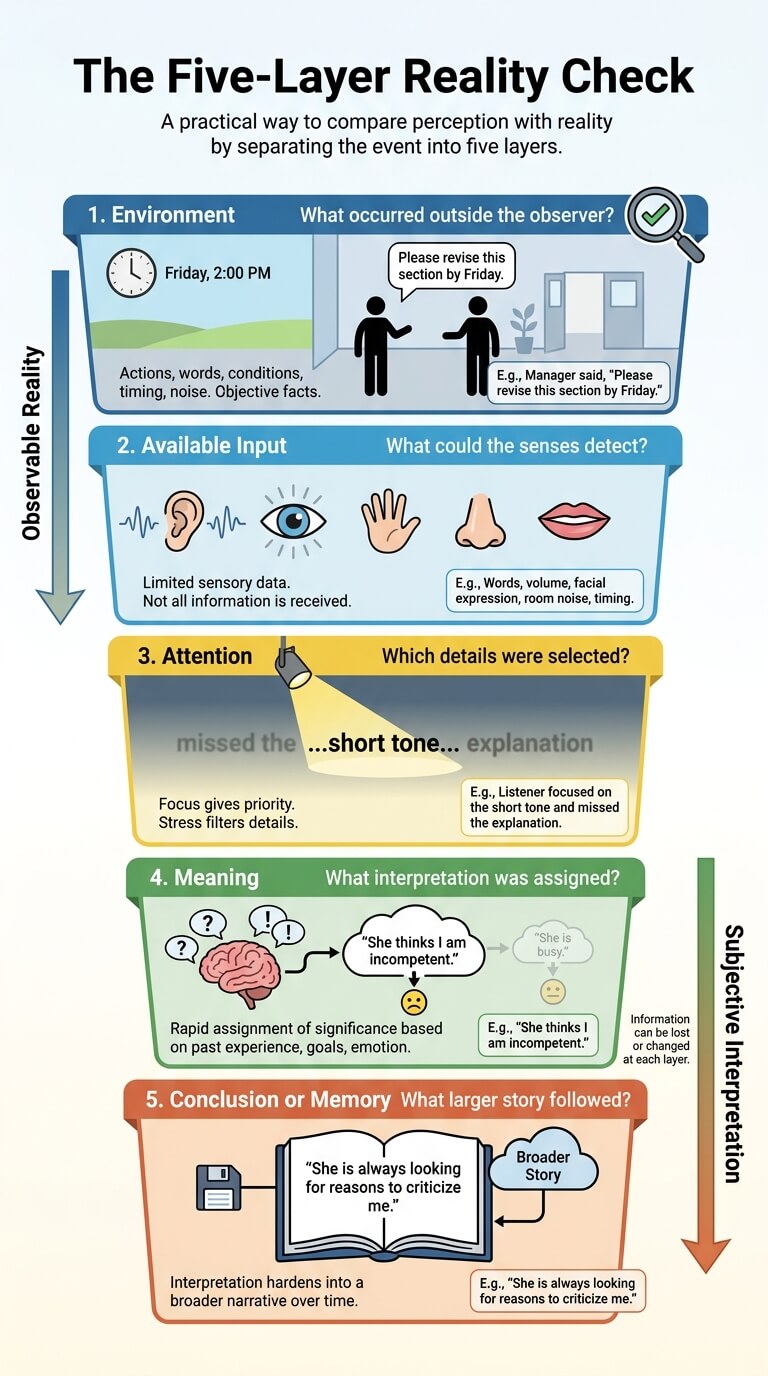
A practical way to compare perception with reality is to separate the event into five layers. Each layer adds something, and each creates a new place where information can be lost or changed.
| Layer | Question | Example |
|---|---|---|
| Environment | What occurred outside the observer? | A manager said, “Please revise this section by Friday.” |
| Available input | What could the senses detect? | Words, volume, facial expression, room noise, timing. |
| Attention | Which details were selected? | The listener focused on the short tone and missed the explanation. |
| Meaning | What interpretation was assigned? | “She thinks I am incompetent.” |
| Conclusion or memory | What larger story followed? | “She is always looking for reasons to criticize me.” |
What happened in the environment
This layer includes actions and conditions that existed outside your interpretation. It may contain spoken words, physical movement, timing, distance, lighting, noise, or written records. Describing this layer well requires neutral language. “He looked at his phone twice” is more observable than “He did not care.”
What sensory information was available
An event can contain more information than your senses could receive. You may not hear a quiet sentence in a crowded room. You may see a facial expression but not the text message that caused it. Limited access is normal, and it means no observer begins with the entire event.
What received attention
Attention gives some details priority. During stress, one sharp phrase may dominate while softer context disappears. In a fast-moving scene, you may track the nearest object and miss movement at the edge of vision. What you did not notice cannot contribute fully to the interpretation you form.
What meaning was assigned
The mind asks, often rapidly, “What is this?” and “What does it mean for me?” Prior experience, current goals, expectations, and emotion help answer. A pause may become thoughtfulness, awkwardness, disapproval, or distraction depending on context.
What conclusion or memory followed
Interpretation can harden into a broader conclusion, then later become part of memory. “The conversation felt tense” may become “The conversation was an attack.” Once the summary is stored and repeated, it can feel more like a direct observation than an interpretation.
Why Perception Can Differ From Reality
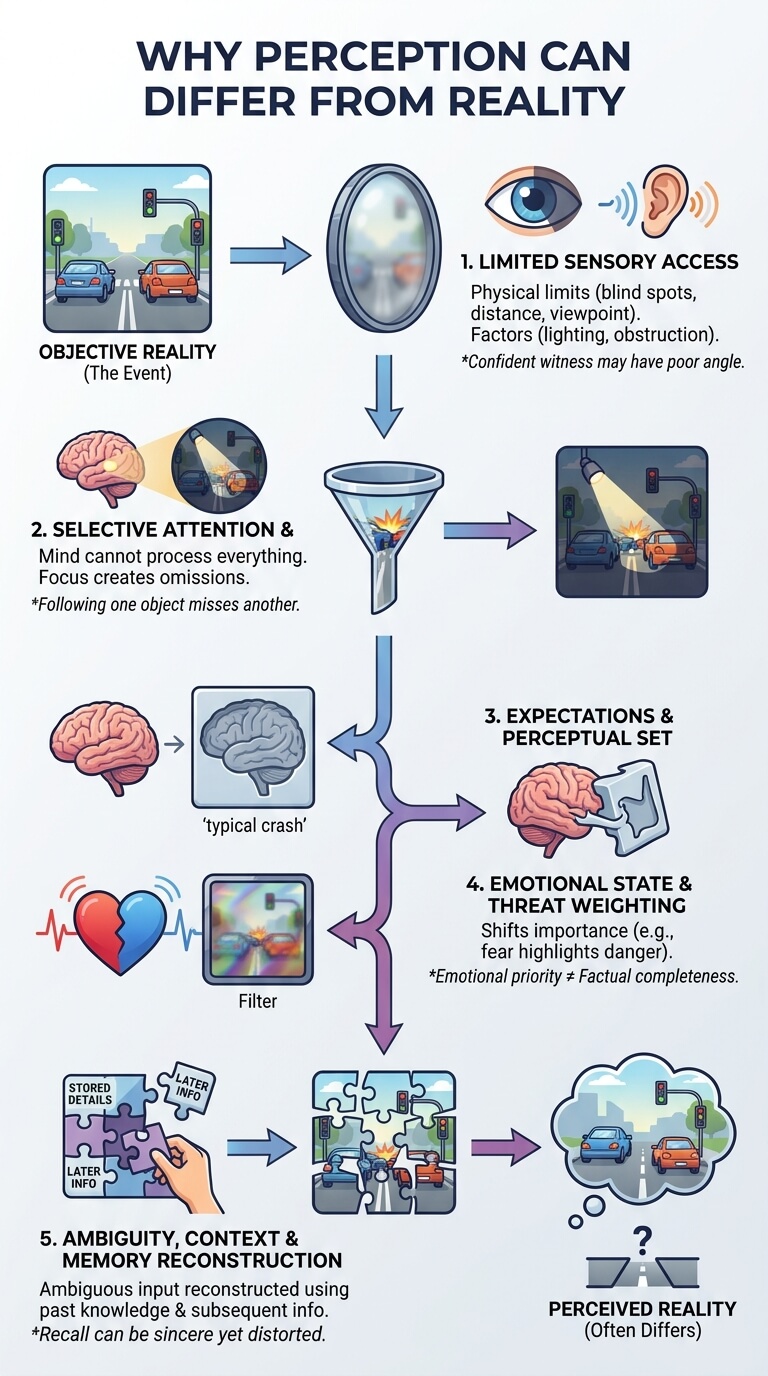
The gap is not caused by one single flaw. It can arise at several stages, from incomplete sensory access to later memory reconstruction.
Limited sensory access
Eyes have blind spots, hearing has limits, and viewing position changes what can be detected. Distance, fatigue, lighting, background noise, speed, and obstruction all affect the input available. A confident witness may still have had a poor angle.
Selective attention and missing information
Attention is necessary because the mind cannot process everything with equal depth. Selection is useful, but it creates omissions. You may hear the criticism in feedback and miss the praise, or follow one car in traffic while overlooking another entering from the side.
Expectations and perceptual set
Expectations prepare the mind for likely meanings. This helps recognition happen quickly, especially when input is unclear. It can also make one interpretation arrive before alternatives are considered. Research reviewing top-down influences on ambiguous perception shows that both stable traits and temporary states can affect how ambiguous input is resolved.
Prior context may create an expectation-based perceptual set that makes one meaning feel immediate.
Emotional state and threat weighting
Emotion changes what feels important. Fear may increase attention to possible danger. Sadness may make loss-related information more noticeable. Anger may increase the salience of obstruction or unfairness. A review of emotion and perception describes multiple ways affective information can influence visual processing, including early stages of perception.
This does not mean emotion always makes perception inaccurate. Emotion can direct attention toward genuinely important information. The issue is that emotional priority and factual completeness are not the same thing.
Ambiguity, context, and later memory reconstruction
Ambiguous input allows several plausible interpretations. Context pushes the mind toward one. Later, memory reconstructs the event using stored details, current knowledge, and subsequent information. Reviews of the reconstructive nature of memory explain why recall can be sincere while still vulnerable to distortion.
Perception Is Not the Same as Lying
When accounts conflict, people often jump from “that is not what happened” to “you are lying.” Sometimes deception does occur, but disagreement alone does not prove it.
Honest people can report different experiences
One person may focus on exact words. Another may remember tone and facial expression. A third may have missed the beginning. Their reports differ because their access, attention, and interpretation differed. Sincerity does not guarantee accuracy, but inaccuracy does not automatically imply dishonesty.
Confidence can grow from coherence rather than completeness
A story feels convincing when its parts fit together. Once someone interprets a brief reply as rejection, later details may appear to confirm the same story. Confidence may rise because the explanation is coherent, even when key information is missing. Research on how confidence is constructed in perceptual decisions treats confidence as a judgment about whether a choice is likely to be correct, not as direct proof that it is correct.
When deliberate deception is a separate question
Evidence of fabrication, changing a story to avoid accountability, hiding records, or knowingly stating something false raises a different issue. That question should be evaluated through behavior and evidence, not inferred merely because two people remember differently.
Everyday Examples of the Gap
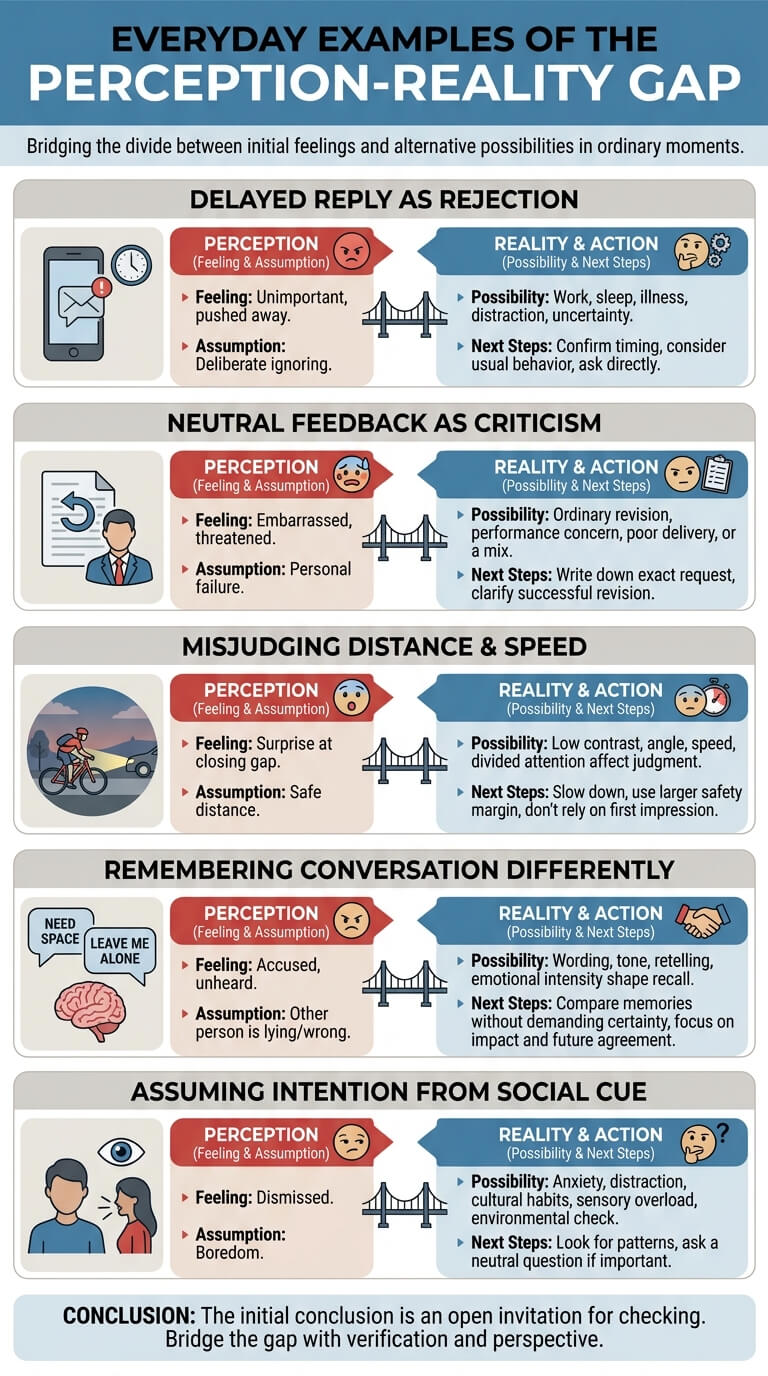
The difference between perception and reality is easiest to understand in ordinary moments. In each example, the experience makes sense from the information selected, but the conclusion remains open to checking.
Interpreting a delayed reply as rejection
Situation: A close friend does not answer for eight hours. What you may feel: unimportant or pushed away. What it may mean: rejection is one possibility, but work, sleep, illness, distraction, or uncertainty about how to respond are also possible. What to do next: confirm the timing, consider the person’s usual behavior, and ask directly before turning delay into intention.
Hearing neutral feedback as criticism
Situation: A supervisor asks for changes. What you may feel: embarrassed or threatened. What it may mean: the request may reflect ordinary revision, a real performance concern, poor delivery, or a mix of these. What to do next: write down the exact request and ask what successful revision would look like.
Misjudging distance, speed, or visibility
Situation: A cyclist appears farther away than expected at dusk. What you may feel: surprise when the gap closes quickly. What it may mean: low contrast, angle, speed, and divided attention affected visual judgment. What to do next: slow down and use a larger safety margin rather than relying on the first impression.
Remembering a conversation differently
Situation: You remember saying, “I need a little space,” while the other person remembers, “Leave me alone.” What you may feel: accused or unheard. What it may mean: wording, tone, later retelling, and emotional intensity may have shaped recall. What to do next: compare what each person remembers without demanding immediate certainty, then focus on the impact and the next clear agreement.
Assuming intention from a brief social cue
Situation: Someone looks away while you speak. What you may feel: dismissed. What it may mean: boredom is possible, but so are anxiety, distraction, cultural habits, sensory overload, or checking the environment. What to do next: look for a pattern across several cues and ask a neutral question if the interaction matters.
Perception vs Reality in Disagreement
Disagreement becomes harder when each person treats their interpretation as the only possible description. A more accurate conversation separates what is shared from what remains disputed.
Separate the event from each person’s interpretation
Try two sentences: “The meeting ended after ten minutes” and “I experienced the ending as abrupt.” The first describes timing. The second describes meaning. Both may be relevant, but they are different claims.
Identify shared facts and disputed meanings
List what both people agree occurred. Then list what is uncertain. You might agree that a door was closed and disagree about whether it was slammed. You might agree that no reply came and disagree about whether the silence was punishment.
Look for information unavailable to one observer
Ask what each person could not know at the time. One person may not have heard the earlier warning. Another may not know about a medical appointment, deadline, or private concern. Missing context does not excuse harmful behavior, but it can change the explanation.
Avoid forcing agreement before clarifying evidence
Pressure to admit “what really happened” can make both people defend their stories more strongly. A better aim is precise disagreement: “We agree on the words. We disagree about the tone and intention.” Precision reduces the number of claims being argued at once.
How to Check Reality Without Invalidating Yourself or Someone Else
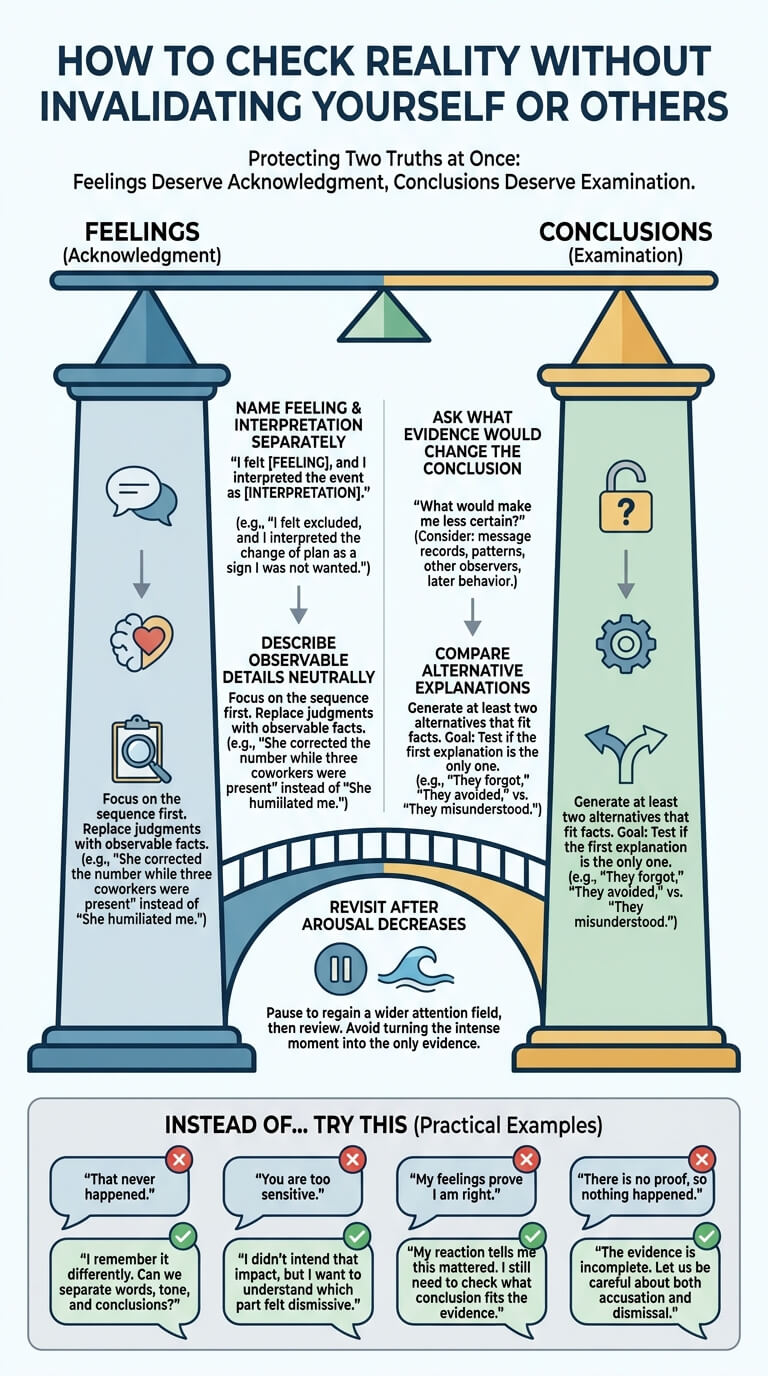
Reality-checking works best when it protects two truths at once: feelings deserve acknowledgment, and conclusions deserve examination.
Name the feeling and the interpretation separately
Use language such as, “I felt excluded, and I interpreted the change of plan as a sign that I was not wanted.” This does not weaken the feeling. It shows where uncertainty begins.
Describe observable details in neutral language
Replace “She humiliated me in front of everyone” with the observable sequence first: “She corrected the number while three coworkers were present and spoke before I finished.” You can then discuss whether the behavior was necessary, respectful, or harmful.
Ask what evidence would change the conclusion
If no possible evidence could affect your view, the conclusion may have become closed. Ask, “What would make me less certain?” The answer might be a message record, a repeated pattern, another observer, or a direct explanation supported by later behavior.
Compare alternative explanations
Generate at least two alternatives that fit the known facts. Do not force a positive interpretation. The goal is to test whether your first explanation is the only plausible one. “They forgot,” “they avoided the issue,” and “they misunderstood the request” can each lead to different next steps.
Revisit after arousal decreases
When the body is highly activated, threat-related details can dominate. Pause long enough to regain a wider field of attention, then review the event. This is not a demand to suppress emotion. It is a way to avoid turning the most intense moment into the only available evidence.
| Instead of | Try |
|---|---|
| “That never happened.” | “I remember it differently. Can we separate the words, the tone, and what each of us concluded?” |
| “You are too sensitive.” | “I did not intend that impact, but I want to understand which part felt dismissive.” |
| “My feelings prove I am right.” | “My reaction tells me this mattered. I still need to check what conclusion fits the evidence.” |
| “There is no proof, so nothing happened.” | “The evidence is incomplete. Let us be careful about both accusation and dismissal.” |
Perception vs Perspective
These terms are often used interchangeably, but they point to different levels of experience. Separating them helps explain why two people may occupy different positions and also notice different cues within the same event.
Perception as how information is experienced
Perception concerns how sensory and contextual information becomes an experience. It includes what stands out, how a cue is organized, and what it seems to mean in the moment.
Perspective as the broader viewpoint shaped by role and history
Perspective is wider. It includes position, responsibilities, values, knowledge, culture, and personal history. A customer and an employee may perceive the same delay, but their perspectives shape which pressures and consequences they understand.
Why the terms overlap but answer different questions
Perception asks, “What did this seem like?” Perspective asks, “From what position am I viewing it?” Perspective can influence perception, but it also includes beliefs and context beyond the immediate sensory event.
Perception vs Perceptual Bias
Not every mismatch between experience and evidence should be labeled a bias. Sometimes the input was simply incomplete. Bias becomes more relevant when the same kinds of cues are repeatedly favored or interpreted in a consistent direction.
A general gap versus a mechanism that systematically tilts interpretation
A perception can differ from reality because information was unclear, unavailable, or briefly missed. Perceptual bias refers to a more consistent tilt in what is noticed or how cues are interpreted. The first is a broad outcome. The second names a mechanism that may repeatedly push perception in a direction.
When bias language is useful and when it becomes accusatory
Bias language is useful when it helps identify a repeatable influence, such as giving threat cues more weight across many situations. It becomes unhelpful when used as a label to end discussion: “That is just your bias.” A fair assessment asks what evidence supports the pattern and whether the same standard is being applied to everyone.
Perception vs Memory
Perception and memory can both create distance from the original event, but they do so at different times. First the event is filtered and interpreted. Later, the stored experience is reconstructed during recall.
The event is perceived before it is remembered
Memory cannot preserve details that were never detected or attended to. If you did not notice the second person enter the room, later recall starts with that omission. Perception shapes the material memory receives.
Recall can add a second layer of reconstruction
When recalling an event, the mind rebuilds it rather than replaying a complete recording. New information, repeated retelling, current emotion, and the need for a coherent story can alter the result. This is why checking notes or records early can be useful when details matter.
Common Mistakes in Reality Checking
Reality-checking can fail in opposite directions. One mistake treats a personal conclusion as unquestionable fact. Another treats only measurable details as meaningful and dismisses emotional impact. Good checking avoids both extremes.
Treating emotion as proof
Strong emotion is evidence that something affected you. It is not automatic proof of the cause, intention, or full sequence. Fear may reflect real danger, learned expectation, uncertainty, or several factors together.
Treating missing evidence as proof of the opposite
Lack of proof does not prove that an event occurred, but it also does not always prove that nothing occurred. Everyday evidence is often incomplete. Match certainty to what is known rather than using uncertainty as a weapon.
Using objective reality to dismiss subjective impact
A person may not have intended harm, and the impact may still deserve attention. “I did not mean it that way” answers a question about intention. It does not fully answer what happened in the relationship or what needs repair.
Assuming disagreement means one person is irrational
Different access, attention, language, and memory can produce disagreement without either person being irrational. The more useful task is to locate the exact layer where accounts separate.
First Steps When You Are Unsure What Happened
You do not need a formal investigation for every uncertain interaction. A brief written check can slow the jump from impression to certainty and show which details deserve clarification.
Write observation, interpretation, and evidence in separate lines
Use three headings on paper. Under Observation, record what a camera or transcript might capture. Under Interpretation, write what you think it meant. Under Evidence, note what supports or weakens that meaning. This simple separation often reveals which part feels certain and which part is inferred.
Check timing, context, records, or neutral witnesses when appropriate
For practical disputes, use proportionate checks. Review the calendar, message history, written instructions, receipt, location, or timeline. A neutral witness may help with observable details, although their perception and memory also have limits.
Keep uncertainty proportional to the available evidence
You do not need to choose between total certainty and total confusion. Try confidence levels: “I am sure the words were said, fairly sure the tone was sharp, and unsure about the intention.” Calibrated uncertainty is more useful than pretending to know nothing or everything.
When Perceptual Experiences Need Professional Support
Most everyday differences between perception and reality involve ordinary limits of attention, ambiguity, or memory. A different response is appropriate when experiences are persistent, sudden, highly distressing, or disruptive to daily functioning.
Persistent experiences others cannot verify that cause fear or impairment
Occasional misperceptions happen in ordinary life. Professional support is worth considering when sensory experiences or beliefs that others cannot verify are persistent, intensifying, frightening, or interfering with sleep, work, relationships, or daily functioning. The NIMH guide to understanding psychosis explains that changes in perceptions and difficulty recognizing what is real can occur in psychosis and encourages reaching out when changes intensify or do not go away.
Sudden sensory or perceptual changes
A sudden major change in seeing, hearing, confusion, orientation, or awareness can have many possible causes, including medical, neurological, medication-related, substance-related, sleep-related, or mental health factors. Seek prompt medical assessment rather than trying to identify the cause alone.
Seek qualified mental health or medical support without self-diagnosing
A clinician can consider timing, health history, medication, substance use, sleep, stress, and functional impact. One unusual experience does not establish a diagnosis. If there is immediate danger, inability to care for basic needs, or risk of self-harm or harm to others, use local emergency or crisis services.
Frequently Asked Questions About Perception vs Reality
The questions below address common misunderstandings about subjective experience, evidence, certainty, and respectful disagreement.
Does perception create reality?
Perception creates your experienced representation of reality, not the entire external world. It strongly affects what you feel, remember, expect, and do, so it can influence later outcomes. That is different from saying thoughts alone create physical facts or other people’s intentions.
Can feelings be valid if the interpretation is inaccurate?
Yes. A feeling can accurately report your internal response even when the explanation for that response is incomplete. You can validate fear, hurt, or anger while checking whether the assumed cause fits the evidence.
Is there always one objective account of an event?
Some details have clear answers, such as time, location, wording in a written message, or measurable distance. Other details, including tone, intention, and emotional meaning, may remain partly uncertain. The absence of a complete objective record does not make every account equally supported.
Why does certainty remain high when evidence is weak?
Certainty can come from familiarity, emotional intensity, repeated retelling, or a story that fits prior expectations. Confidence is useful information about how convinced someone feels, but it should still be compared with access, conditions, consistency, and independent evidence.
How can two people reality-check without invalidating each other?
Begin with each person’s experience, then separate shared observations from disputed meaning. Use neutral descriptions, ask what information was unavailable, and state uncertainty clearly. The aim is not to force identical feelings. It is to build the most accurate shared account possible while taking impact seriously.
Key Takeaways
- Perception is a meaningful subjective experience, not a complete recording of everything that occurred.
- Reality-checking separates environment, available input, attention, interpretation, and later conclusion or memory.
- A feeling can be valid even when the assumed cause or intention remains uncertain.
- Conflicting accounts do not automatically prove dishonesty, irrationality, or equal accuracy.
- Neutral observations, alternative explanations, records, and calibrated confidence improve everyday judgment.
- Persistent or sudden perceptual changes that cause fear or impair functioning deserve qualified medical or mental health support.
Author note: Michael Reed is the Founder & Lead Writer at Psychology Exposed. He writes research-aware explanations of human behavior, emotional patterns, self-awareness, and everyday decisions for general readers.
The most useful next step is small: choose one uncertain event and write three lines for observation, interpretation, and evidence. You may still reach the same conclusion. The difference is that you will know which part came from the event, which part came from meaning, and where uncertainty remains.

Michael Reed is the Founder and Lead Writer at Psychology Exposed. He writes about human behavior, relationships, emotional patterns, self-awareness, and practical psychology topics using research-informed, easy-to-understand content.
Read More About Michael Reed: https://psychologyexposed.com/michael-reed/