
You can feel generally capable and still freeze when you face one specific task. A confident manager may doubt their ability to give a difficult presentation. A strong student may avoid statistics because earlier attempts went badly. Someone who handles daily life well may hesitate to make a phone call in a language they are still learning. These experiences are not necessarily signs of low self-worth. Often, they involve a narrower judgment: Can I actually do what this situation requires?
Psychology uses the term self-efficacy for this kind of capability belief. The APA Dictionary of Psychology definition of self-efficacy emphasizes a person’s subjective perception of their capability in a particular setting or for a desired result. That specificity matters. Self-efficacy can influence whether you begin, how much effort you invest, how you respond to difficulty, and what you learn from the outcome. It is useful precisely because it does not reduce your entire identity to one moment of doubt.
Quick Answer
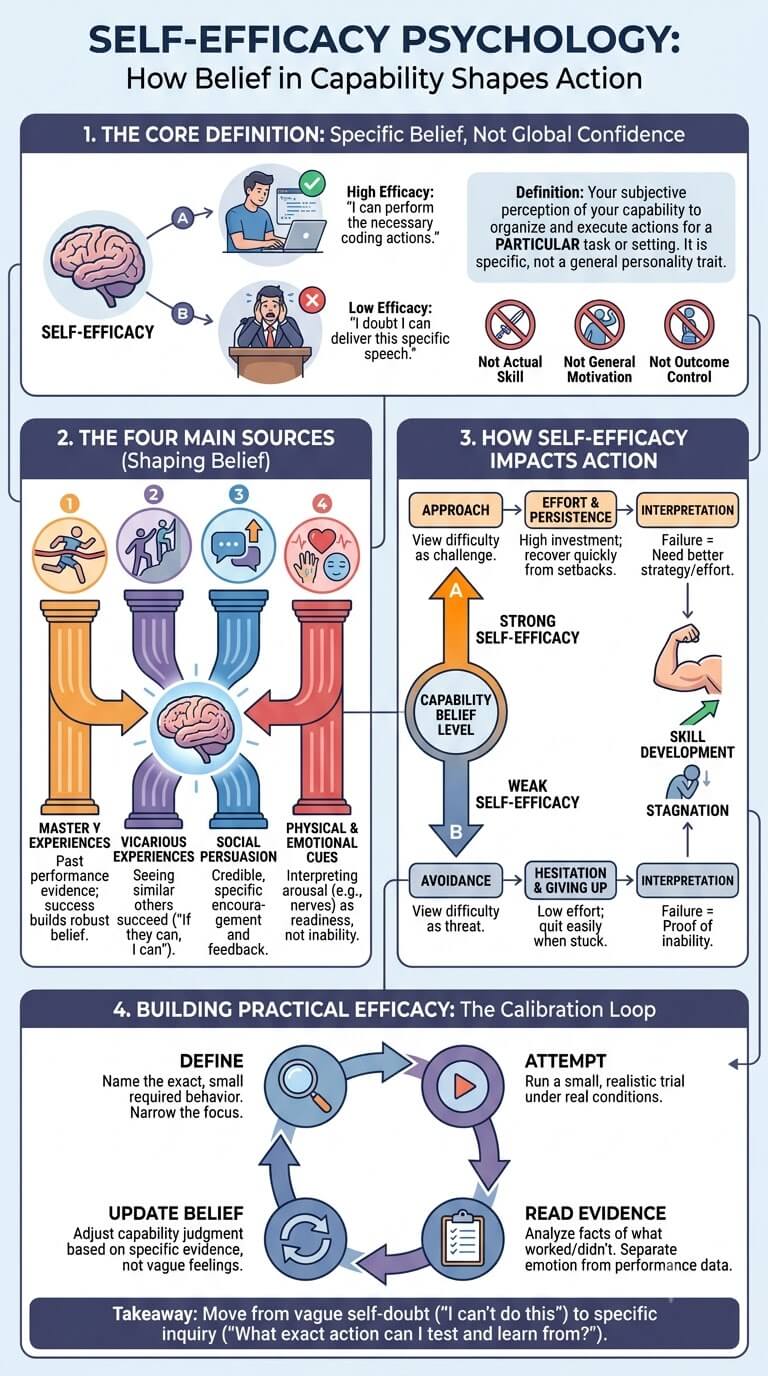
Self-efficacy is your belief that you can organize and carry out the actions needed for a particular task or situation. It is not the same as actual skill, general confidence, motivation, or control over the outcome. Because it is usually specific, you may have high self-efficacy in one area and low self-efficacy in another. Experience, observation, encouragement, and how you interpret physical or emotional reactions can all shape it.
Why Self-Efficacy Is Usually Specific, Not Global
Self-efficacy makes more sense when you stop asking, “Am I a capable person?” and ask, “How capable do I believe I am at this particular action, under these conditions?” Research discussions of self-efficacy repeatedly stress this task- and domain-specific quality. An open-access review of academic self-efficacy, for example, explains that efficacy judgments are tied to particular areas of functioning rather than acting like a single general trait.
High efficacy in one domain and low efficacy in another
Imagine a graphic designer who is excellent at producing visual work but has never negotiated a freelance contract. Their belief about designing may be strong because they have years of successful experience. Their belief about negotiating may be weak because they have little evidence about how they perform in that situation.
Difficulty, novelty, and context can change the judgment
The same skill can also feel different across situations. You may believe you can explain an idea to one colleague but doubt that you can explain it to a large audience. You may trust your driving on familiar roads but feel less capable in heavy traffic in an unfamiliar city. You may be comfortable cooking for yourself and uncertain about preparing the same dish for ten guests.
How Self-Efficacy Changes What People Do
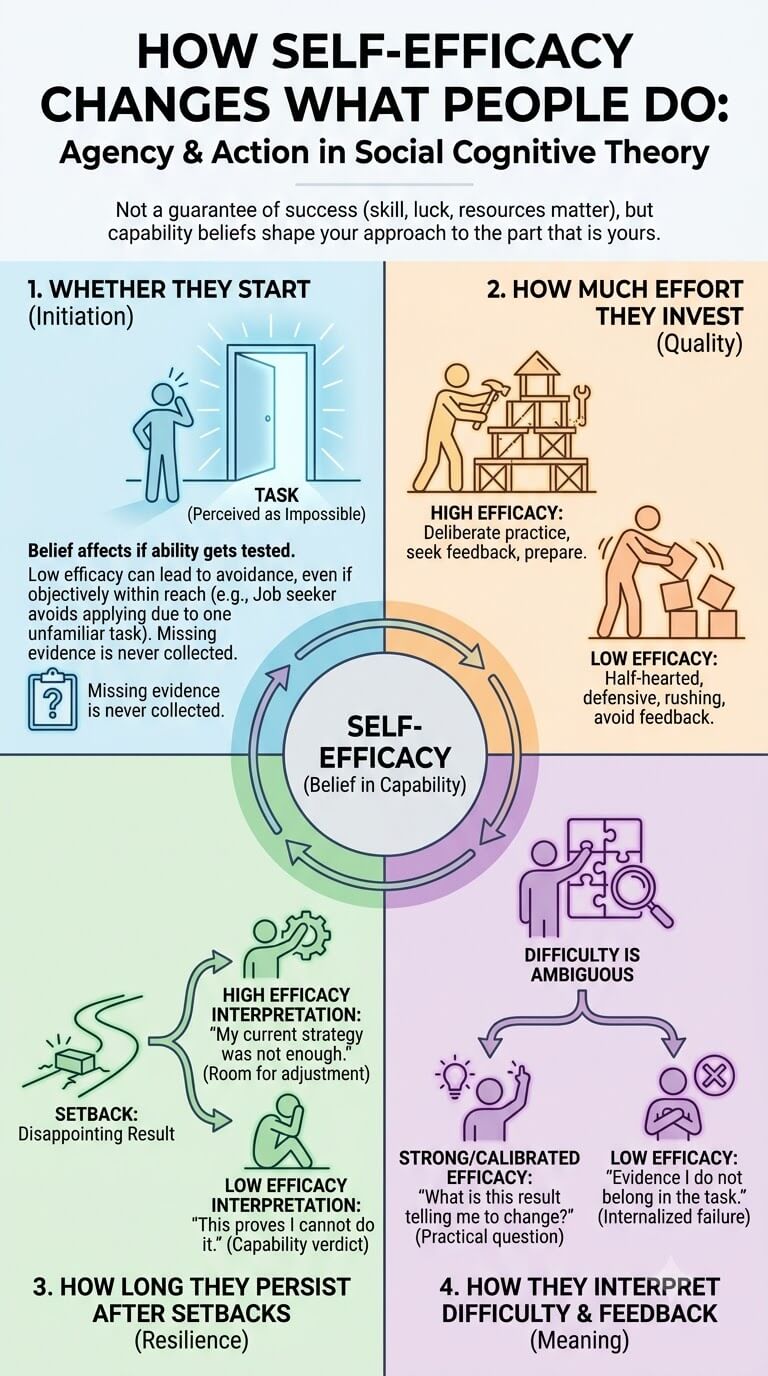
Self-efficacy does not guarantee success. Skill, opportunity, resources, luck, health, time, and other people still matter. Yet capability beliefs can affect how you approach the part that is yours to do. In social cognitive theory, people are understood as active interpreters of their actions and environments, rather than passive receivers of experience. The APA overview of social cognitive theory places self-efficacy among the factors involved in a person’s sense of agency and action.
Whether they start
A task that seems impossible is easy to postpone. If you expect that you cannot perform the necessary actions, avoiding the attempt may feel rational. This can happen even when the task is objectively within reach. The important point is not that every hesitation comes from low self-efficacy, but that belief about capability can affect whether ability ever gets tested.
For example, a job seeker may meet most requirements for a role but avoid applying because one unfamiliar responsibility dominates their attention. The missing evidence is never collected because the person does not enter the situation.
How much effort they invest
Capability beliefs can also shape the quality of effort. When people think a task is possible but demanding, they may prepare, seek feedback, or practice deliberately. When they assume failure is inevitable, effort can become half-hearted or defensive: rushing, avoiding feedback, or doing only enough to say they tried.
How long they persist after setbacks
A setback carries information, but it does not tell you how to interpret that information. Two people can receive the same disappointing result and update their beliefs differently. One thinks, “My current strategy was not enough.” The other thinks, “This proves I cannot do it.” The first interpretation leaves room for adjustment. The second turns a result into a capability verdict.
How they interpret difficulty and feedback
Difficulty itself is ambiguous. It can mean the task is advanced, your method is inefficient, you need a missing skill, you are tired, or you need more practice. Low self-efficacy can make difficulty feel like evidence that you do not belong in the task. Stronger and better-calibrated self-efficacy makes it easier to ask a more practical question: “What is this result telling me to change?”
The Four Main Sources That Shape Self-Efficacy
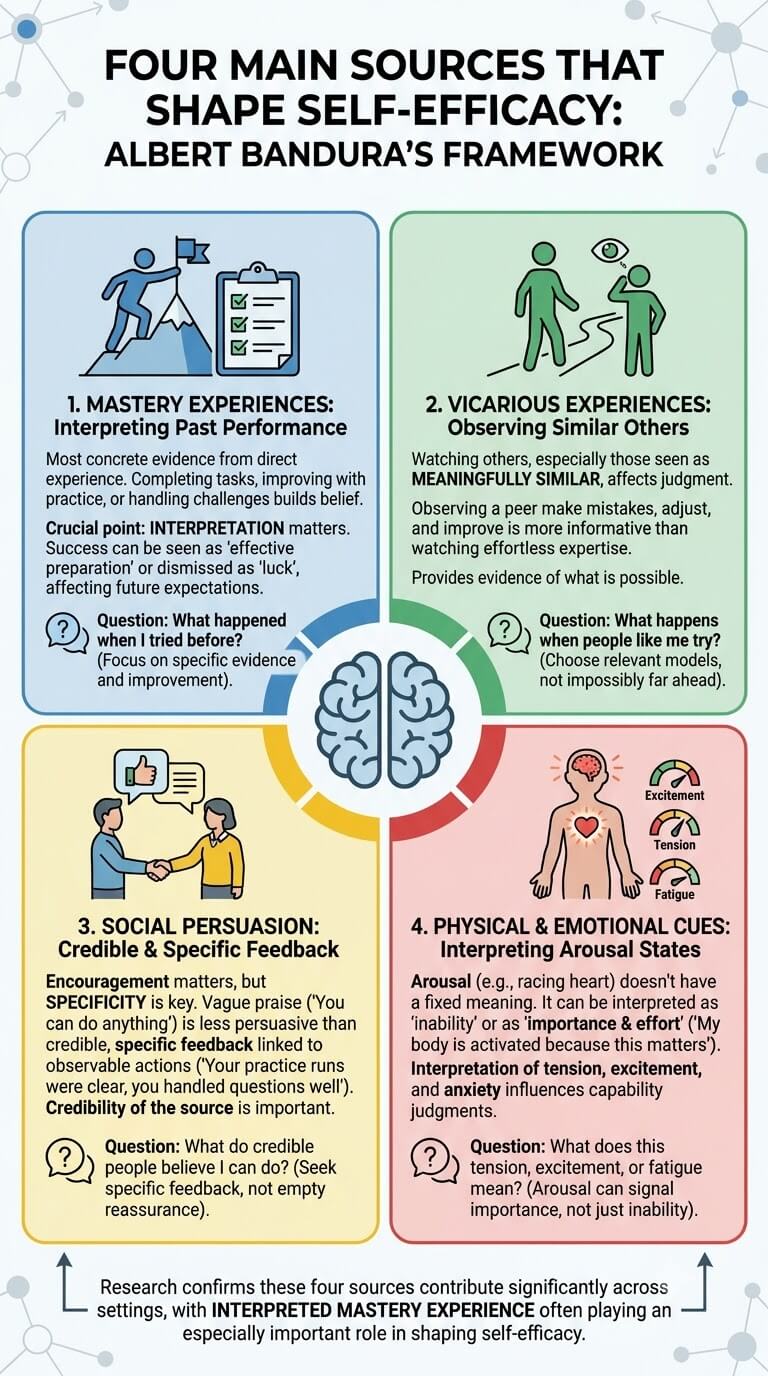
Albert Bandura’s framework identifies four broad sources people use when forming capability beliefs: mastery experiences, vicarious experiences, social persuasion, and physiological or affective states. Research using this framework continues to examine how these sources contribute across different settings. A study of preservice teachers, for example, describes the same four sources and found an especially important role for interpreted mastery experience in changes in teaching self-efficacy. See the open-access discussion of Bandura’s four sources of self-efficacy.
| Source | Question your mind may be answering | Helpful interpretation |
|---|---|---|
| Mastery experience | What happened when I tried before? | Use specific performance evidence, including what improved with practice. |
| Vicarious experience | What happens when people like me try? | Choose models who are relevant, not impossibly far ahead. |
| Social persuasion | What do credible people believe I can do? | Specific feedback is more useful than empty reassurance. |
| Physical and emotional cues | What does this tension, excitement, or fatigue mean? | Arousal can signal importance or effort, not only inability. |
Mastery experiences: what past performance teaches
Direct experience is often the most concrete evidence available. Completing a task, improving after practice, or handling a harder version of something you once struggled with can change what you expect from yourself next time. But the experience is not simply recorded like a score. You interpret it.
If you give a presentation that goes reasonably well, you might conclude, “I prepared effectively and can do this again.” Or you might dismiss it as luck because the audience was friendly. The same outcome can strengthen capability belief or leave it unchanged depending on what you think caused the result.
Vicarious experience: what similar others make seem possible
Watching another person can affect your judgment, especially when you see that person as meaningfully similar to you. A beginner watching an expert make something look effortless may feel more intimidated. Watching another beginner make mistakes, adjust, and improve can provide more useful information.
Social persuasion: when encouragement helps and when it does not
Encouragement can matter, but vague praise has limits. “You can do anything” gives little evidence. “Your first two practice runs were clearer, and you handled the questions well” points to observable capability. Feedback is more persuasive when it is credible, specific, and connected to actions the person can actually perform.
Physical and emotional cues: how arousal is interpreted
A racing heart before a performance does not have one fixed meaning. One person reads it as, “I am not capable of this.” Another reads it as, “My body is activated because this matters.” Fatigue, tension, excitement, and anxiety can influence capability judgments partly through interpretation.
Self-Efficacy Is Not the Same as Self-Confidence
The two terms overlap in everyday speech, but they are not interchangeable. Self-efficacy is more precise: it concerns your perceived capability to perform actions under particular demands. “Self-confidence” is often used more broadly for general assurance, social ease, trust in oneself, or a positive sense of competence.
Specific capability judgment versus broader everyday confidence language
Consider someone who is socially confident at work but has never used a new data-analysis tool. They may speak comfortably in meetings and still have low self-efficacy for building a complex model in that software. Another person may describe themselves as shy and not very confident while having very high self-efficacy for repairing bicycles because they have years of successful experience.
When someone simply says they lack confidence, comparing self-efficacy with self-confidence can reveal whether the doubt is actually tied to one specific task.
The distinction matters because the response should match the problem. If the doubt is task-specific, the most useful intervention is usually better evidence, practice, modeling, or feedback about that task. General pep talks may miss the point.
Why the comparison deserves its own deeper article
The difference becomes especially useful when someone says “I need more confidence” but the real obstacle is one narrow performance demand. Naming the narrower belief helps match the response to the problem.
Self-Efficacy and Personal Agency
Capability matters, but action also depends on whether a person has room to choose and whether their effort can affect what happens. This is why self-efficacy fits inside a broader picture of agency rather than replacing it.
Capability is one part of agency, not the whole system
Believing you can perform an action is not the same as believing you can shape the situation. Self-efficacy concerns capability. Personal agency is broader and includes the experience of choosing, initiating, and influencing action within real conditions.
You might have strong self-efficacy for writing a persuasive proposal and still feel little agency if every proposal is ignored without review. Conversely, you may have meaningful freedom to choose a path while feeling unsure whether you currently possess the skills to carry it out.
High self-efficacy with low control: “I can do it, but it may not matter here”
This combination appears in many ordinary settings. An employee knows they can do high-quality work but has no authority over whether a project receives funding. A patient may feel capable of following a treatment plan but cannot control how their body responds. A student may know how to prepare well but cannot control which exact questions appear on an exam.
Recognizing this distinction protects against a common mistake: treating every disappointing outcome as evidence of low ability. Sometimes capability is not the limiting variable.
Self-Efficacy and Perceived Control
Two doubts can sound similar while pointing to different problems. One is about your ability to act; the other is about whether the situation will respond to your action.
Can I perform the action? versus Can the action influence the outcome?
These questions are related but different. Self-efficacy asks whether you believe you can execute the behavior. Perceived control asks whether you believe the situation is influenceable through that behavior or other actions available to you.
| Situation | Self-efficacy question | Control question |
|---|---|---|
| Job interview | Can I explain my experience clearly? | How much can my interview affect the hiring decision? |
| Exam | Can I use the study methods effectively? | How much can preparation influence my score? |
| Team project | Can I complete my part well? | Will my contribution meaningfully affect the team’s result? |
| Health behavior | Can I follow the planned routine? | How much will that routine influence the outcome I care about? |
Examples where the two beliefs move in opposite directions
A skilled customer-service representative may know exactly how to de-escalate a tense call, so self-efficacy is high. Yet if company policy prevents any meaningful resolution, perceived control may be low. In the opposite direction, a new employee may believe the organization gives them real freedom to improve a process but doubt their own ability to present the proposal. Control feels possible, capability does not yet feel secure.
When you separate these beliefs, the next step becomes clearer. Capability problems call for learning and evidence. Control problems call for identifying what is genuinely influenceable, what is constrained, and whether a different route is available.
How Self-Efficacy Becomes More Accurate Over Time
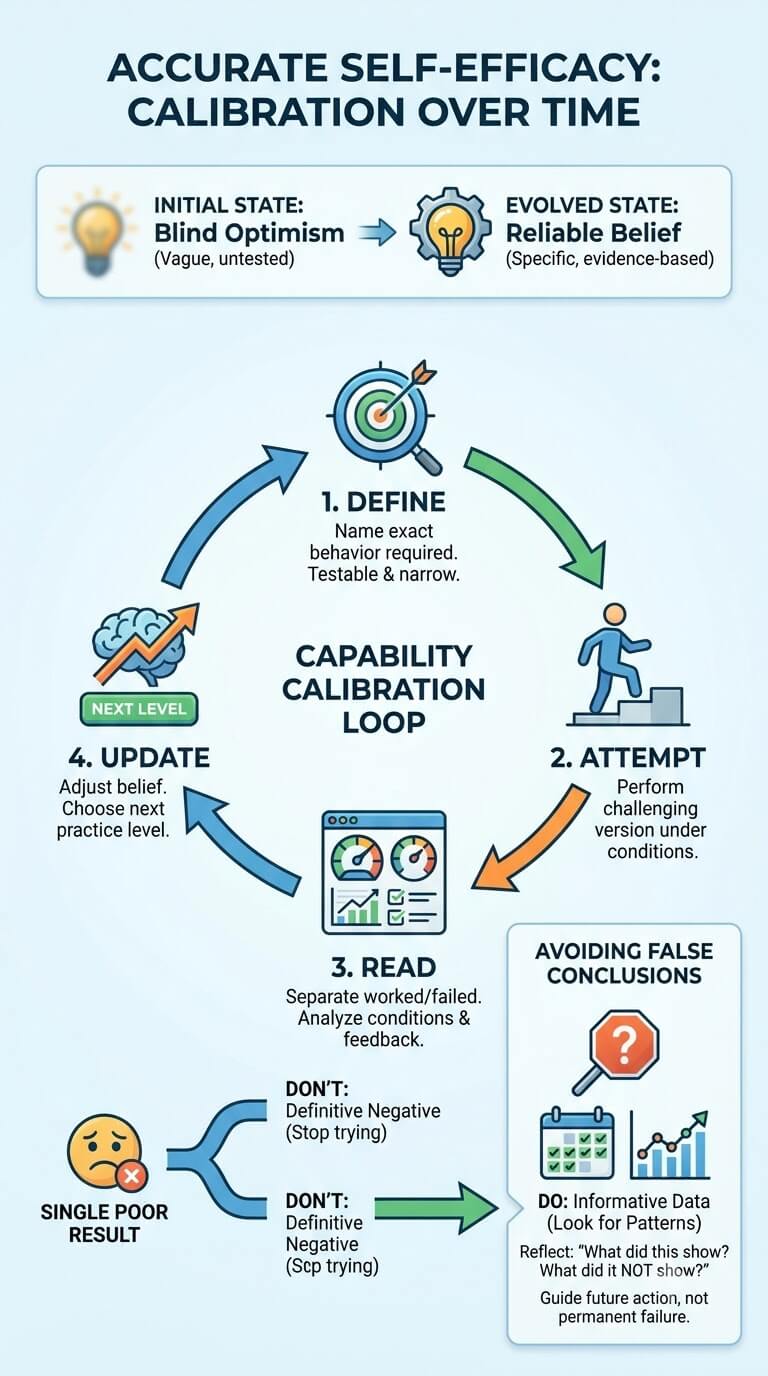
Useful self-efficacy is not blind optimism. It becomes more reliable when beliefs are repeatedly compared with specific performance evidence.
Calibrating belief through specific attempts and feedback
A practical way to improve calibration is to replace broad predictions with small, observable attempts. Instead of asking, “Can I become good at public speaking?” test something narrower: “Can I deliver a two-minute explanation without reading from notes?” Then collect feedback on that specific performance.
This creates what we can call the Capability Calibration Loop: define the action, attempt it under realistic conditions, read the evidence, and update the next judgment. Each cycle turns a vague belief into something more testable.
- Define: Name the exact behavior required.
- Attempt: Perform a version challenging enough to produce useful information.
- Read: Separate what worked, what failed, and what conditions affected the result.
- Update: Adjust your belief and choose the next level of practice.
Separating one poor result from a stable capability conclusion
One outcome can be informative without being definitive. A poor interview may reflect weak preparation, an unusually difficult question, lack of sleep, or a skill that needs practice. The evidence becomes stronger when you look for patterns across attempts and conditions.
A useful reflection is: “What did this result show about my current skill, and what did it not show?” This keeps feedback specific enough to guide action.
Common Self-Efficacy Mistakes
Capability beliefs become less useful when they are built from vague reassurance, unfair comparisons, or overly broad conclusions. These mistakes can make the belief less accurate in either direction.
Treating motivation as proof of capability
Wanting something badly does not automatically mean you know how to do it. Motivation may get you to practice, but self-efficacy concerns your belief about performing the required actions. When motivation is high and capability is low, the answer is usually learning, not more desire.
Using affirmations without evidence or practice
Positive self-talk may reduce hesitation for some people, but unsupported declarations can feel hollow when your mind is asking for evidence. A stronger approach is to pair encouragement with a concrete practice task. “I can learn this” becomes more believable when followed by an attempt that produces visible progress.
Comparing yourself to an expert instead of a relevant model
Experts often hide the steps that beginners need to see because those steps have become automatic. If comparison repeatedly makes the task look effortless and your own effort look defective, choose a more informative reference point. Someone one or two stages ahead may show what improvement actually looks like.
Generalizing one failure to every related task
Failing a driving test does not prove you cannot drive safely. Struggling in one coding language does not prove you cannot learn programming. A poor first date does not prove you cannot have a good conversation. The more precisely you define what went wrong, the less likely one result is to become an identity statement.
A Practical Self-Efficacy Check Before a Difficult Task
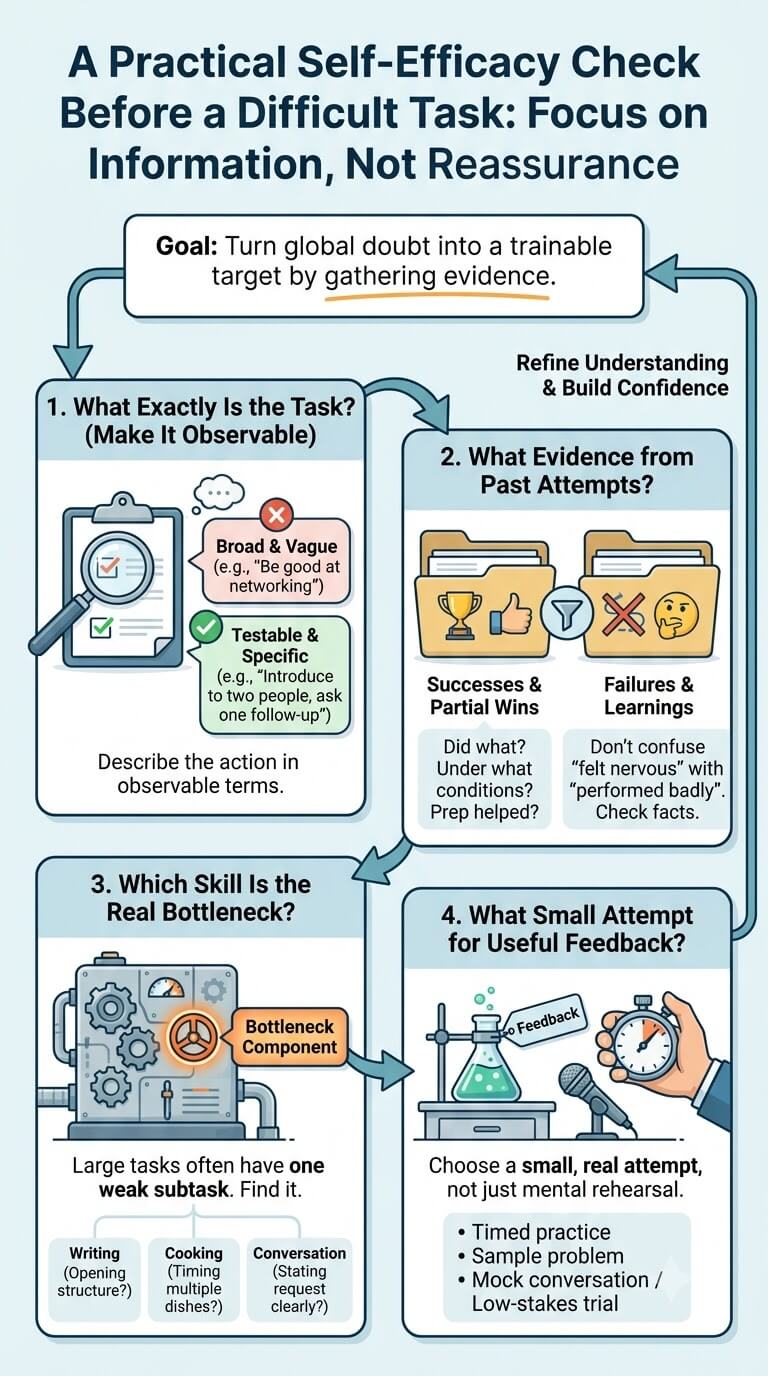
When capability doubt appears, use questions that produce information rather than reassurance. This check is designed to identify where the doubt is coming from and what kind of evidence would actually help.
What exactly is the task?
Describe the action in observable terms. “Be good at networking” is too broad. “Introduce myself to two people and ask one follow-up question” is testable. “Handle conflict better” is broad. “Explain one concern without raising my voice or changing the subject” is more specific.
What evidence do I have from past attempts?
Look for both successes and failures, including partial successes. Ask what you did, under what conditions, and whether the result changed with preparation. Avoid turning “I felt nervous” into “I performed badly” unless performance evidence supports that conclusion.
Which skill or subtask is the real bottleneck?
A large task may contain one weak component. Writing a report may be easy except for structuring the opening. Cooking may feel difficult because timing multiple dishes is the bottleneck. A difficult conversation may feel impossible because you do not know how to state the request clearly. Finding the bottleneck turns a global doubt into a trainable target.
What small attempt would produce useful feedback?
Choose an attempt that is small enough to do but real enough to teach you something. A rehearsal alone in your head often produces less useful evidence than a timed practice, a sample problem, a mock conversation, or a real low-stakes trial.
What to Do Next When Self-Efficacy Is Low
The next step is usually not to force yourself to feel certain. It is to create better evidence about what you can do now and what becomes possible with practice.
Shrink the task without shrinking the goal
You do not have to lower every ambition because belief is low. Instead, reduce the size of the next performance. If the goal is to lead a meeting, first practice opening the meeting and summarizing one agenda item. If the goal is to run five kilometers, the next task may be completing a shorter interval safely and consistently.
Smaller steps help when they still generate relevant evidence. Making the task so easy that it teaches nothing may feel comfortable without improving capability belief.
Create a feedback-rich attempt rather than waiting to feel confident
People often wait for certainty before acting, but self-efficacy frequently changes through action. A short attempt with clear feedback may tell you more than an hour of predicting how you will perform. Systematic reviews in educational settings, such as research on interventions for mathematics self-efficacy, illustrate why actual learning experiences and how learners interpret them matter when capability beliefs are being developed.
Use realistic modeling and specific encouragement
Look for examples that reveal the steps, not only the result. Ask for feedback from someone who understands the task and can name what you did effectively and what needs work. “You are talented” is pleasant. “Your explanation was clear until the final example; practice that transition” gives you something actionable.
When Repeated Failure Starts to Feel Like “Nothing I Do Matters”
Sometimes the problem shifts from “I cannot do this” to “my actions do not change anything.” That change in meaning deserves a different psychological lens.
A brief distinction from learned helplessness and perceived control
Low self-efficacy sounds like, “I do not think I can perform this action.” A control problem sounds more like, “Even if I perform it, I do not think it will change the outcome.” Those experiences can occur together, but they should not be automatically treated as the same thing.
Repeated experiences of uncontrollability may sometimes teach a person to expect that responding will not make a difference, which is closer to the idea of learned helplessness. That is a broader mechanism than simply doubting a skill. If you feel powerless because of severe distress, coercion, threats, humiliation, stalking, retaliation, or an unsafe environment, the issue should not be reduced to “believing in yourself.” Real conditions matter, and professional or safety-focused support may be more appropriate than a performance exercise.
FAQ About Self-Efficacy Psychology
These questions clarify where capability belief ends and where skill, calibration, or other control beliefs begin.
Can self-efficacy be high even when skill is low?
Yes. Self-efficacy is a belief about capability, not a direct measurement of capability. A beginner may overestimate what they can do, especially when they have not yet encountered the harder parts of a task. That is why calibration matters. Useful self-efficacy develops alongside accurate feedback, practice, and a clearer understanding of task demands.
Is self-efficacy learned?
It develops and changes through experience rather than operating as a fixed label. Direct performance, observing others, feedback from credible people, and interpretations of physical or emotional states can all contribute. New evidence can therefore update an older belief, although change may be slower when a person has a long history of interpreting experiences in the same way.
Does failure always reduce self-efficacy?
No. The meaning assigned to failure matters. A failed attempt can reduce self-efficacy if it is interpreted as proof of inability. It can also leave belief intact, or even support future confidence, when the person can identify a correctable cause, see improvement, or recognize that the challenge required a new strategy.
Can self-efficacy become unrealistic?
Yes. Overestimating capability can lead someone to underprepare, ignore feedback, or choose demands far beyond current skill. The most useful goal is not to feel maximally certain. It is to hold a belief strong enough to support appropriate action while remaining responsive to evidence.
Key Takeaways
- Self-efficacy is a task- and situation-specific belief about your ability to carry out required actions.
- You can have strong self-efficacy in one area and weak self-efficacy in another without contradiction.
- Capability beliefs can influence starting, effort, persistence, and the meaning you assign to difficulty.
- Four major inputs are mastery experience, vicarious experience, social persuasion, and physical or emotional cues.
- Self-efficacy is not the same as actual skill, general self-confidence, motivation, or perceived control.
- A useful next step is to define the exact task, run a small realistic attempt, read the evidence, and update your belief.
Final Thoughts
When you catch yourself thinking, “I cannot do this,” make the sentence more precise before you believe it. Name the exact action, the conditions, and the evidence behind the judgment. Then choose one attempt that can teach you something real. Self-efficacy becomes most useful when it moves you away from vague judgments about yourself and toward a clearer question: What am I capable of doing here, and what evidence would help me know more accurately?
Educational note: This article is for general psychology education and does not diagnose mental health conditions or replace individualized professional care. Capability beliefs are only one part of behavior, and real environmental, social, physical, financial, and safety constraints deserve to be taken seriously.

Michael Reed is the Founder and Lead Writer at Psychology Exposed. He writes about human behavior, relationships, emotional patterns, self-awareness, and practical psychology topics using research-informed, easy-to-understand content.
Read More About Michael Reed: https://psychologyexposed.com/michael-reed/