
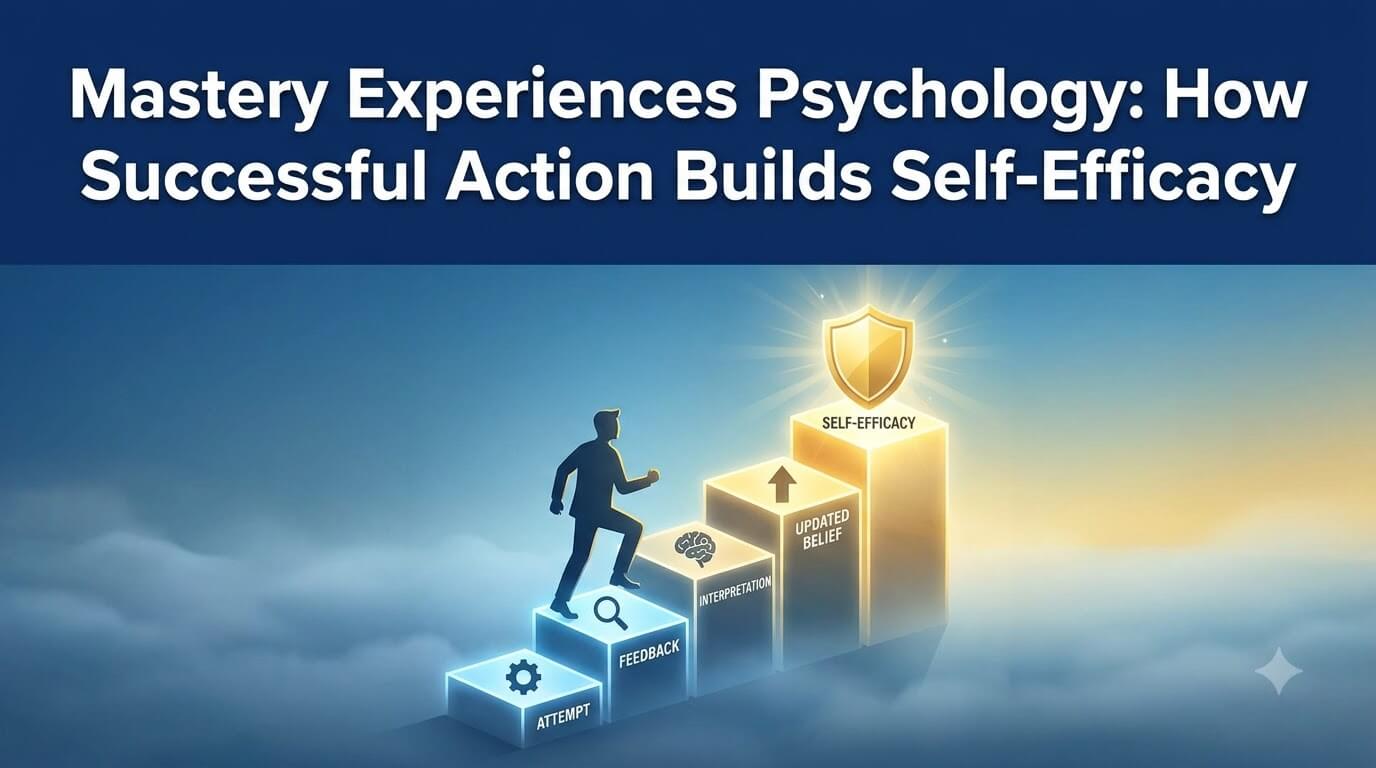
You can hear ten people tell you, “You can do this,” and still feel uncertain. Then you complete one difficult task yourself, understand how you did it, and suddenly the next attempt feels more possible. That difference captures the practical importance of mastery experiences in psychology.
Mastery is not simply collecting victories. The useful part is the evidence created when your own action, strategy, and adjustment lead to a meaningful result. That evidence can change a narrow prediction from “I probably cannot handle this” to “I have done something close to this, I know what worked, and I have a reasonable basis for trying the next level.”
This matters when you want confidence that is tied to reality rather than reassurance. A successful attempt can strengthen self-efficacy when the task is informative and the result is interpreted accurately. Effortless wins may prove little, while difficult attempts can teach more.
Quick Answer
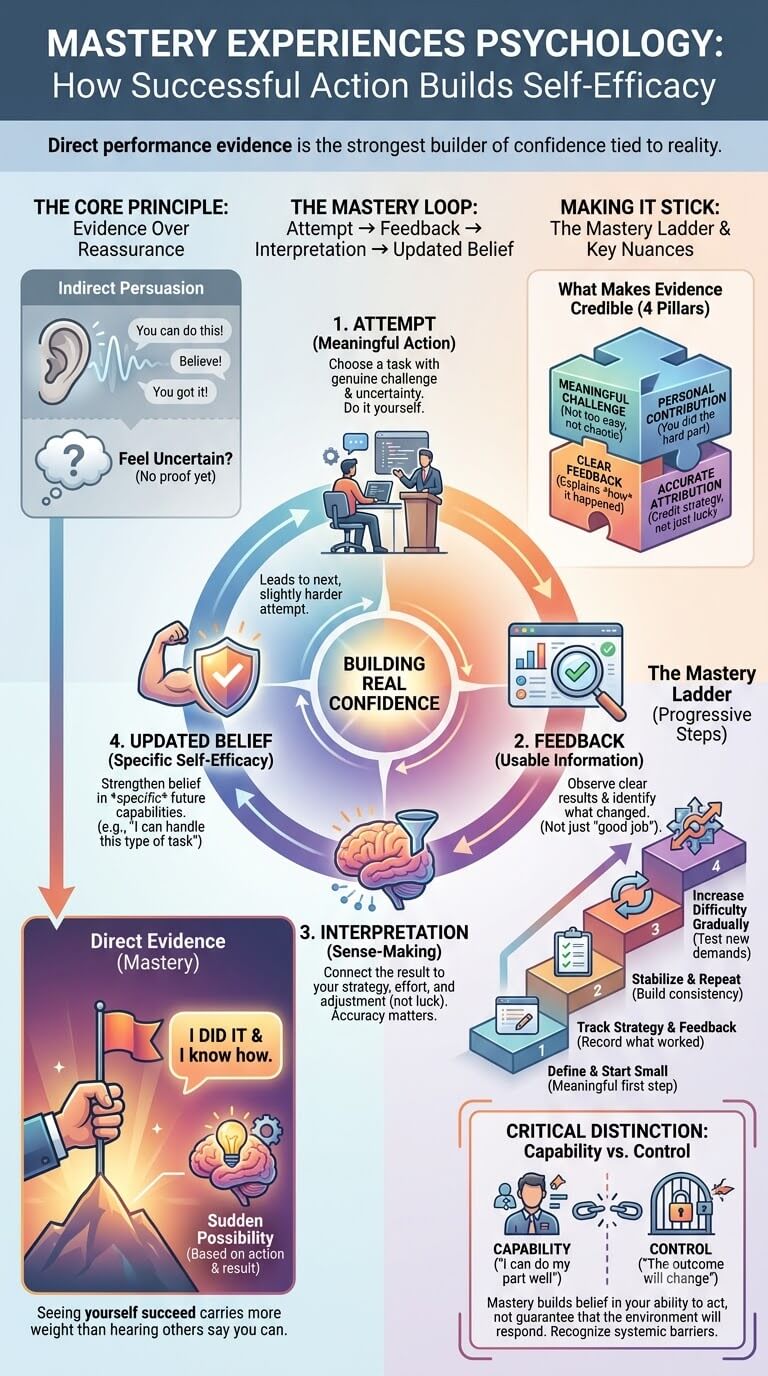
Mastery experiences are direct performance experiences that give you evidence about your capability. They tend to strengthen self-efficacy when success follows meaningful effort, useful strategy, and learning. The effect is strongest when you can see what you did, what changed the result, and what the experience reasonably predicts about a similar future task.
Why Mastery Experiences Matter So Much
The APA Dictionary of Psychology definition of self-efficacy centers on a person’s perceived capability to perform in a particular setting or reach a desired result. That makes evidence from your own performance especially relevant. You are testing whether you can produce the result yourself.
Direct evidence usually carries more weight than reassurance
Encouragement and observation can expand what seems possible, but neither answers the same question as doing the task yourself: “What happens when I try?”
This is also why the difference between self-efficacy and self-confidence matters: successful performance gives task-specific evidence rather than merely a broad feeling of assurance.
A review of academic self-efficacy describes enactive mastery experiences as especially influential because they provide direct evidence that a person can organize the resources needed for a task. The same review also notes an important nuance: the effect of success and failure depends on prior beliefs, timing, and interpretation, not merely on whether an outcome was labeled a win or a loss. This PubMed Central review of academic self-efficacy is a useful overview of that process.
Success changes predictions about future capability
Self-efficacy is forward-looking. After a meaningful performance, the useful update is not “I am a capable person at everything.” It is closer to “I can probably perform this class of task under conditions similar to the ones I just handled.”
That specificity protects against underconfidence and overconfidence. One successful five-minute presentation supports belief about similar presentations, not every demanding speaking situation.
When successful action also changes what someone believes they can influence, it may strengthen their broader sense of personal agency.
The Mastery Loop: Attempt → Feedback → Interpretation → Updated Belief
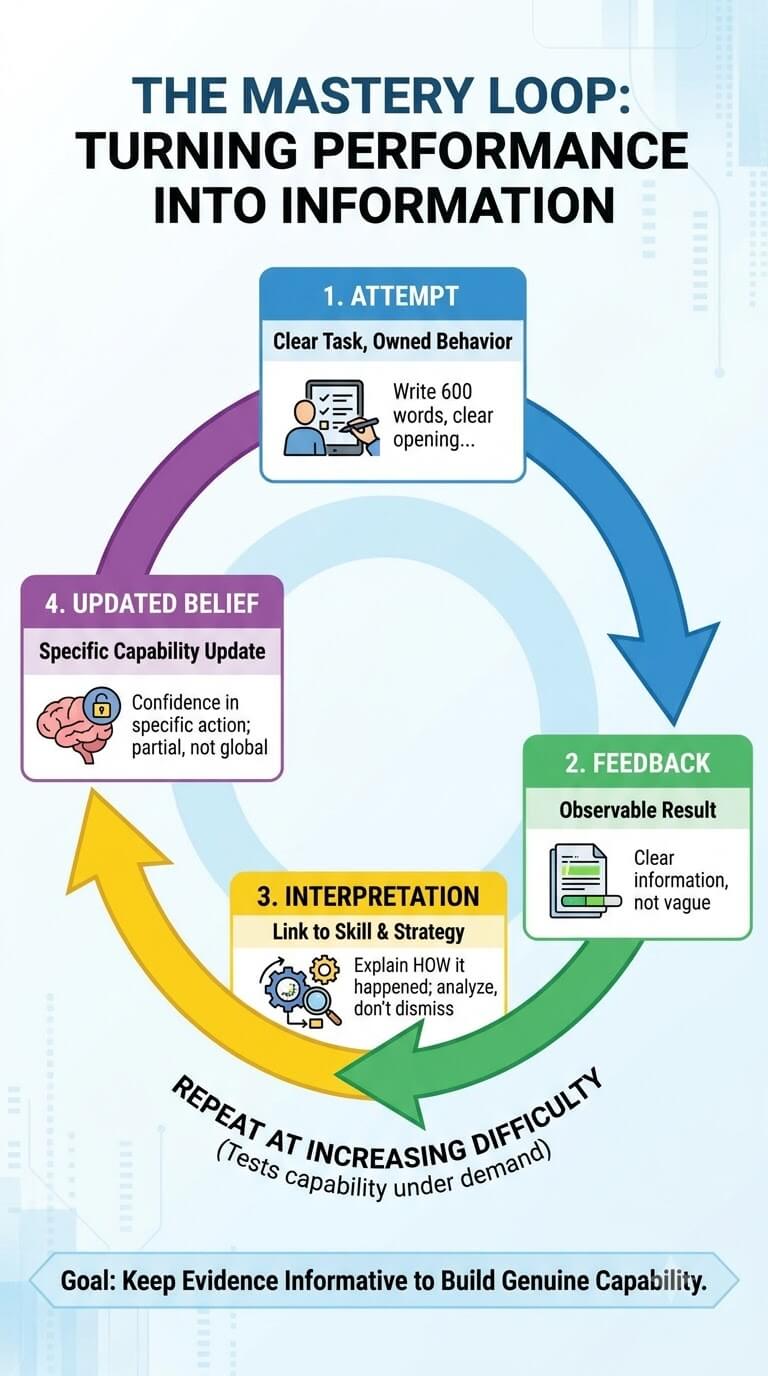
Mastery becomes useful when performance turns into information: attempt, feedback, interpretation, then a specific update to capability belief.
Choose a task that produces clear information
Vague goals produce vague evidence. “Write a 600-word explanation with a clear opening, three supporting points, and no major factual errors” is easier to evaluate than “get better at writing.”
The task should also involve behavior you actually perform. If another person completes the difficult part for you, the outcome may feel good without telling you much about your own capability. Assistance is often useful during learning, but you need enough ownership of the attempt to know what your own contribution was.
Notice what the result says about skill and strategy
A result is more informative when you can explain how it happened. If a spreadsheet task improved because you broke it into stages, checked formulas, and caught an error, you now have evidence about repeatable behavior.
Sometimes luck matters. But dismissing every success as luck prevents useful updating, just as taking full credit for a heavily assisted result can inflate the update.
Update the belief specifically rather than globally
After an attempt, ask: What can I now say with more confidence than I could before? Keep the answer close to the task. “I can hold a basic conversation with a customer using the new script” is more accurate than “I am great at sales.”
After a partial success, keep the update partial. “My opening skill is improving, while objection handling still needs practice” is more useful than either “I failed” or “I mastered sales.”
Repeat at increasing difficulty
One success is evidence. Repeated success across gradually harder conditions is stronger because it tests whether capability holds as demand changes.
If you can explain a concept to one colleague, the next step might be explaining it to a small group. The point is not difficulty for its own sake. It is to keep the evidence informative.
What Makes an Experience Feel Like Mastery
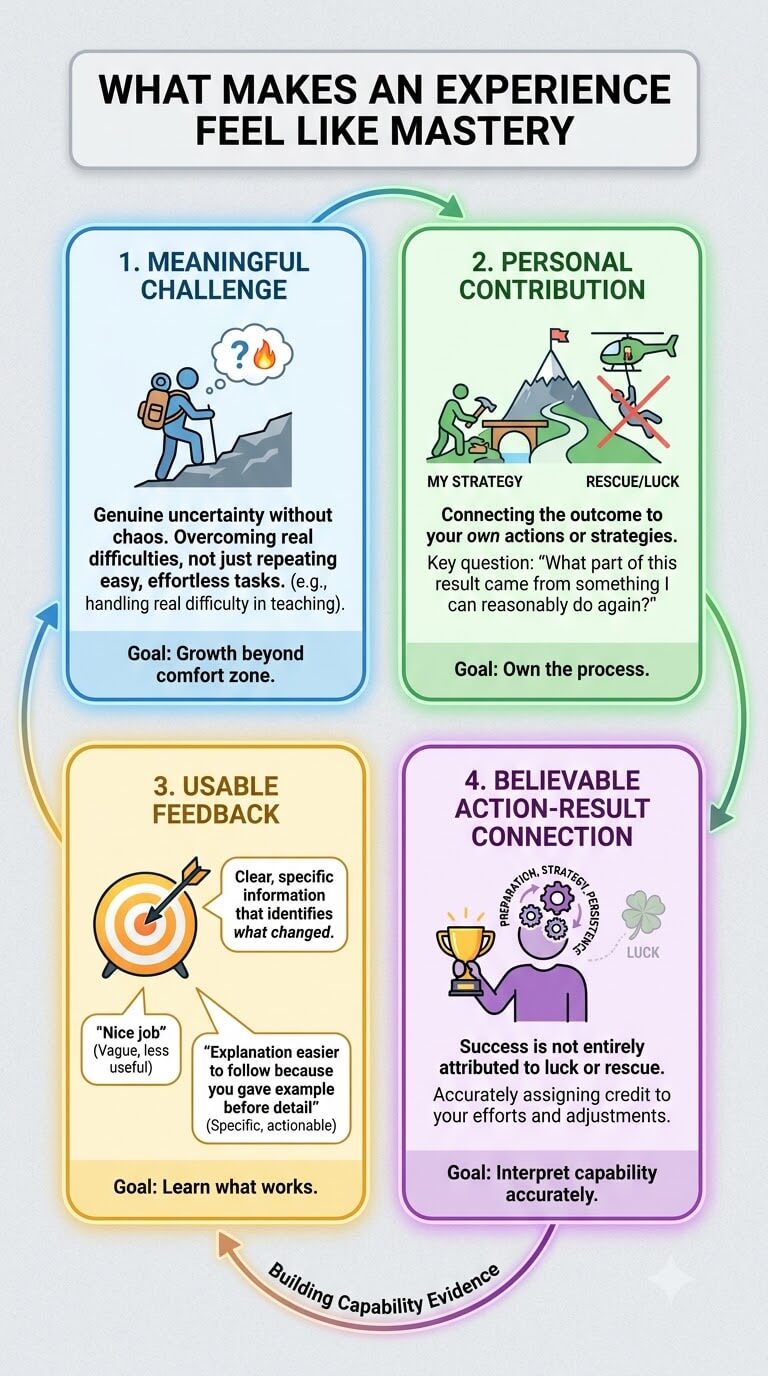
Four features make an experience more credible as capability evidence: meaningful challenge, personal contribution, usable feedback, and a believable action-result connection.
The task is challenging enough to mean something
If you already know you can do a task easily, repeating it may maintain familiarity but add little new information. A mastery experience usually becomes more informative when there is genuine uncertainty, but not so much difficulty that the attempt becomes chaotic.
Research discussions of mastery often emphasize overcoming challenge rather than merely accumulating effortless successes. For example, work examining teaching self-efficacy describes mastery as especially meaningful when successful performance occurs while handling real difficulty. A PubMed Central study discussing mastery experiences in teaching illustrates this emphasis.
The person can connect outcome to their own action or strategy
Imagine two learners who receive the same high score. One completed the problems independently after changing how they studied. The other relied heavily on a friend who supplied the difficult answers. The score is identical, but the capability evidence is not.
For mastery, the crucial question is not “Did something good happen?” but “What part of this result came from something I can reasonably do again?”
Feedback is clear enough to learn from
Feedback can be a measured time, an error rate, a specific comment, a recording, or the fact that a task now works when it did not before.
Useful feedback identifies what changed. “Nice job” feels encouraging, but “Your explanation was easier to follow because you gave the example before the technical detail” gives you information you can reuse.
Success is not entirely attributed to luck or rescue
Interpretation is part of mastery. Research on speaking self-efficacy describes mastery experience as the interpreted result of previous performance, not merely an objective accomplishment. This open-access study on sources of speaking self-efficacy highlights the role of how learners interpret their efforts and outcomes.
The aim is not to claim control you did not have. It is to assign credit accurately. If your preparation, strategy, persistence, and adjustment materially contributed, those are legitimate pieces of capability evidence.
Why Easy Wins Do Not Always Build Strong Self-Efficacy
A positive result only changes capability belief when it provides information that feels relevant and credible.
No meaningful challenge means weak evidence
Suppose you want to become comfortable cooking. Making the same sandwich every day may give you a sense of completion, but it says little about whether you can plan and cook a new meal. The activity is real, yet the evidence has stopped expanding.
This is why “make it easy” is only part of good progression. The first step should be manageable enough to attempt, but meaningful enough that completing it teaches you something about your capability.
Over-scaffolding can make success feel externally caused
Support can reduce unnecessary confusion. The problem comes when a coach, template, or checklist performs so much of the task that you cannot tell what you can do without it.
A better progression gradually changes the support. First you may follow a worked example. Next you complete a similar task with a checklist. Later you perform without the checklist and compare the result. Each stage answers a different capability question.
Repetition without progression can stop updating belief
Once a task becomes predictable, repetition may improve fluency without changing expectations about harder situations. Confidence at level one is not evidence about level two.
That does not make repetition useless. It means repetition and mastery evidence are not identical. When your goal is to update self-efficacy, progression should eventually test a new but related demand.
Why Failure Does Not Automatically Destroy Mastery
Failure can still improve capability beliefs when it gives useful information and leads to a better next attempt.
Informative failure versus identity-level failure conclusions
“I missed two questions because I confused these formulas” points toward a specific gap. “I am bad at math” turns one result into a broad identity claim. Only the first interpretation helps you design a meaningful next test.
Occasional setbacks also do not necessarily erase an established record of success. When a person already has repeated evidence of capability, one difficult performance may be interpreted as a problem to solve rather than proof that the capability never existed.
Strategy changes can preserve capability beliefs
Sometimes a failure means the current strategy was insufficient, not that the person lacks all capacity to improve. A runner who starts too fast and cannot finish the planned distance learns something about pacing. A student who rereads notes but cannot retrieve information on a test learns that recognition was not enough.
The useful question is narrower: What does this result tell me to change before the next attempt?
Difficulty progression matters
If you move from a beginner task directly to an expert task, failure may reveal more about the size of the jump than about your underlying potential. A mastery ladder should increase difficulty enough to produce learning without turning every step into an extreme test.
A systematic review of mathematics self-efficacy interventions treats mastery experience as a major information stream while showing that self-efficacy changes occur within broader instructional conditions.
Mastery Experiences vs “Small Wins”
The two ideas overlap, but a small win matters for self-efficacy only when it says something useful about the capability being tested.
Small wins can help when they provide credible capability evidence
A small win is useful when it answers a real question. If you have avoided making a professional phone call because you doubt you can stay composed, completing one call with a prepared outline may be modest in scale but psychologically meaningful. It gives you direct evidence about a task you previously doubted.
Size is not the key variable. Information value is. A five-minute task can produce strong evidence if it represents a genuine step into uncertain territory.
Cosmetic progress and easy checkboxes may not transfer
Opening a document and choosing a font may create momentum, but those actions do not prove you can structure an argument.
Ask whether the win resembles the future performance you want to feel more capable of doing. If not, treat it as preparation rather than proof.
Mastery Experiences vs Vicarious Learning and Encouragement
Other experiences can support self-belief, but they provide different kinds of information than performing the task yourself.
Seeing others succeed can open possibility
Watching someone similar to you handle a task can make success seem possible and reveal useful strategies, especially before you have much personal experience.
But observation is still evidence about another person’s performance. It helps answer “Could someone like me do this?” more than “Can I do this under these conditions?”
Persuasion can support effort
Specific encouragement can influence whether you attempt a task long enough to generate your own evidence. “Your last explanation was clear; try presenting the first two slides” is more useful than vague praise because it points to an observed capability and a concrete next step.
Persuasion is weak when repeated experience contradicts it. Better task design or support may matter more than stronger reassurance.
Direct performance evidence usually does the heavier updating
The four commonly discussed information streams for self-efficacy include mastery experiences, vicarious experiences, social persuasion, and physiological or emotional states. Research across educational and performance domains repeatedly treats direct performance as especially influential because it involves one’s own behavior. Research on sources of teaching self-efficacy also emphasizes that how a person cognitively processes mastery matters, not just the event itself.
Other information streams still matter, often by helping create the conditions for a useful attempt. Mastery is different because it gives you firsthand evidence to evaluate afterward.
A Mastery Ladder for Building Capability Belief
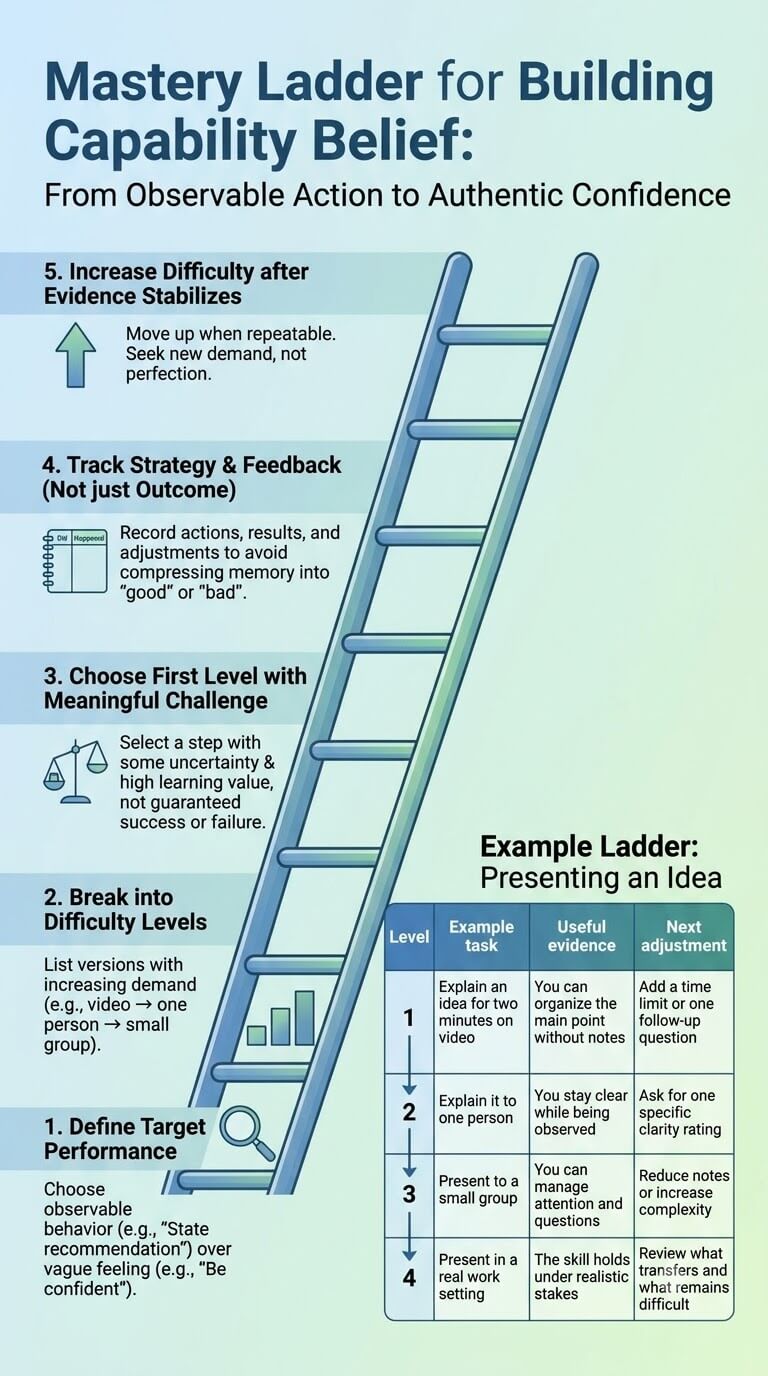
A useful mastery ladder moves from a clearly defined performance to gradually stronger evidence, without manufacturing artificial wins.
Define the target performance
Choose an observable behavior, such as “state one recommendation and answer one follow-up question,” rather than “be confident in meetings.”
Break it into difficulty levels
List several versions that differ in demand, such as explaining an idea on video, to one person, to three colleagues, then to a larger group.
Choose the first level with meaningful challenge and high learning value
Pick a step that creates some uncertainty without requiring a huge leap. If success is guaranteed, the evidence may be weak. If failure is almost guaranteed because the step is far beyond current skill, the attempt may be hard to interpret.
Track strategy and feedback, not only outcome
Afterward, record three things: what you did, what happened, and what you would repeat or change. This prevents your memory from compressing the whole event into “good” or “bad.”
Increase difficulty after evidence stabilizes
Move up when the current level has become repeatable. You do not need perfection. You need enough evidence that the next step tests a new demand instead of repeatedly retesting the same one.
| Level | Example task | Useful evidence | Next adjustment |
|---|---|---|---|
| 1 | Explain an idea for two minutes on video | You can organize the main point without notes | Add a time limit or one follow-up question |
| 2 | Explain it to one person | You stay clear while being observed | Ask for one specific clarity rating |
| 3 | Present to a small group | You can manage attention and questions | Reduce notes or increase complexity |
| 4 | Present in a real work setting | The skill holds under realistic stakes | Review what transfers and what remains difficult |
Common Mistakes When Using Mastery Experiences
The goal is accurate evidence, so the design of the attempt matters as much as whether it ends in success.
Making the first step so easy it proves nothing
A tiny first step can reduce avoidance, but it should eventually connect to the capability in question. If your goal is to learn to swim, buying goggles is preparation. Entering shallow water with appropriate instruction begins producing performance evidence.
Increasing difficulty too fast
Making the next challenge dramatically harder can turn progression into a test of endurance rather than calibrated learning.
Treating external praise as the main evidence
Praise may feel rewarding, but it is stronger when it points back to observable behavior. “You handled those questions well because you paused, clarified, and answered one part at a time” gives the learner something concrete to own.
Ignoring how success happened
Identify the strategy behind a result. Ask what preparation, pacing, sequence, tool, or decision contributed, because repeatable components make success easier to reproduce.
Generalizing mastery beyond the domain
Mastery should make beliefs more accurate, not simply more positive. Budgeting skill does not prove investing skill, and running a 5K does not prove marathon readiness. Transfer requires evidence.
Mastery Experiences and Personal Agency
Evidence of capability may make action easier to initiate, but it does not automatically give a person control over the surrounding situation.
Capability evidence can increase willingness to act
Evidence that you can perform a task makes action less speculative. You know more about useful preparation and realistic difficulty, which can support effective action.
Still, capability is only one part of the picture. You might be highly capable and still face a system that gives you little opportunity to influence the result.
Mastery cannot create control where the environment is genuinely unresponsive
Consider an employee who repeatedly delivers excellent work but has no authority over a decision controlled by regulation, senior leadership, or a fixed budget. More practice may improve performance without changing the external constraint.
This learning process contrasts with repeated uncontrollability, where action repeatedly fails to produce meaningful change.
This distinction prevents an unfair conclusion: “If I just master the skill, I should be able to control the outcome.” Sometimes the best evidence says both “I can do my part well” and “this outcome is not fully responsive to my effort.”
When the Problem Is Not Capability but Controllability
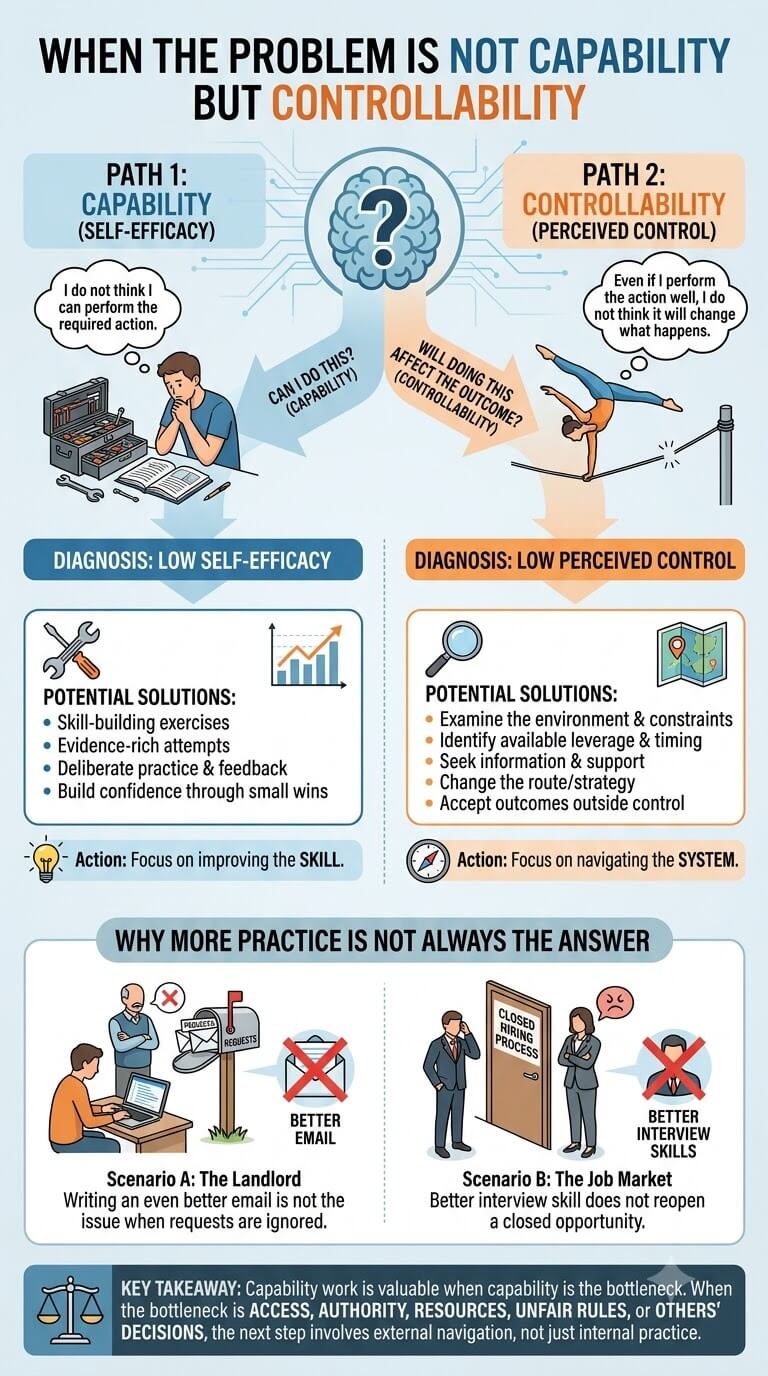
Before prescribing more practice, separate “Can I do this?” from “Will doing this actually affect the outcome?”
Distinguish low self-efficacy from low perceived control
Low self-efficacy sounds like, “I do not think I can perform the required action.” Low perceived control sounds more like, “Even if I perform the action well, I do not think it will change what happens.”
The first problem may benefit from skill-building and evidence-rich attempts. The second requires examining the environment, available leverage, constraints, timing, and whether the outcome is actually responsive to your behavior.
Why more practice is not always the correct answer
If a landlord ignores repeated documented repair requests, writing an even better email may not be the central issue. If a hiring process is closed, better interview skill does not reopen that opportunity.
Capability work is valuable when capability is the bottleneck. When the bottleneck is access, authority, resources, unfair rules, or another person’s decision, the next useful step may involve changing the route, seeking information, finding support, or accepting that some parts of the outcome are outside your control.
What to Do Next: Build One Evidence-Rich Attempt
Choose one narrow task you want to feel more capable of performing. Define success in observable terms, select a difficulty that is meaningful but manageable, and decide in advance what feedback you will use.
After the attempt, write four short lines:
- Attempt: What exactly did I try?
- Feedback: What happened that I can actually observe?
- Interpretation: What does this say about my current skill or strategy?
- Next level: What slightly harder or more independent version should I test next?
If the result is mixed, keep the update mixed. You might discover that your technical skill is solid while speed needs work, or that you can perform well with notes but not yet without them. Accurate confidence grows from accurate evidence.
Educational note: Mastery practice is not a promise that effort can overcome every barrier. Real constraints, disability, access, discrimination, unsafe conditions, limited resources, and decisions controlled by other people may affect what is possible. A fair assessment separates what you can learn from what the environment actually allows.
FAQ About Mastery Experiences Psychology
These questions clarify where mastery evidence helps and where a more careful interpretation is needed.
Do small successes always increase self-efficacy?
No. A small success is most useful when it provides credible evidence about a capability you care about. If the task is too easy, unrelated to the future challenge, or completed mostly by someone else, it may improve mood or momentum without substantially changing your belief about what you can do.
Can failure become a mastery experience?
A failed attempt is not a mastery success, but it can still contribute to the mastery process when it provides specific feedback and leads to a better strategy. A later success after adjustment may become particularly informative because you can see what changed. Avoid turning one failed performance into a broad judgment about your identity or potential.
How difficult should a mastery task be?
There is no universal percentage or perfect difficulty level. The task should contain enough challenge that success would tell you something new, while remaining realistic enough that you can learn from the attempt. If success is automatic, increase the demand. If the task is so difficult that the result is mostly confusion, reduce or restructure it.
Why does praise sometimes fail to build confidence?
Praise is indirect information. If someone tells you that you are capable but your own performance still feels uncertain, the message may not outweigh your experience. Praise becomes more useful when it points to specific behavior, strategy, or improvement and then supports another opportunity for you to test the skill yourself.
Key Takeaways
- Mastery experiences build self-efficacy through firsthand performance evidence, not through positive thinking alone.
- A useful mastery attempt is challenging enough to matter, clear enough to evaluate, and owned enough that you can identify your contribution.
- The psychological update depends on interpretation. Success dismissed as luck and failure turned into an identity judgment can both distort what the evidence actually says.
- Small wins are valuable when they resemble the capability you want to strengthen. Easy checkboxes may support momentum without proving much.
- A mastery ladder should increase difficulty gradually and track strategy as well as outcome.
- More practice is not always the answer. If the environment is genuinely unresponsive, distinguish a capability problem from a controllability problem.

Michael Reed is the Founder and Lead Writer at Psychology Exposed. He writes about human behavior, relationships, emotional patterns, self-awareness, and practical psychology topics using research-informed, easy-to-understand content.
Read More About Michael Reed: https://psychologyexposed.com/michael-reed/