
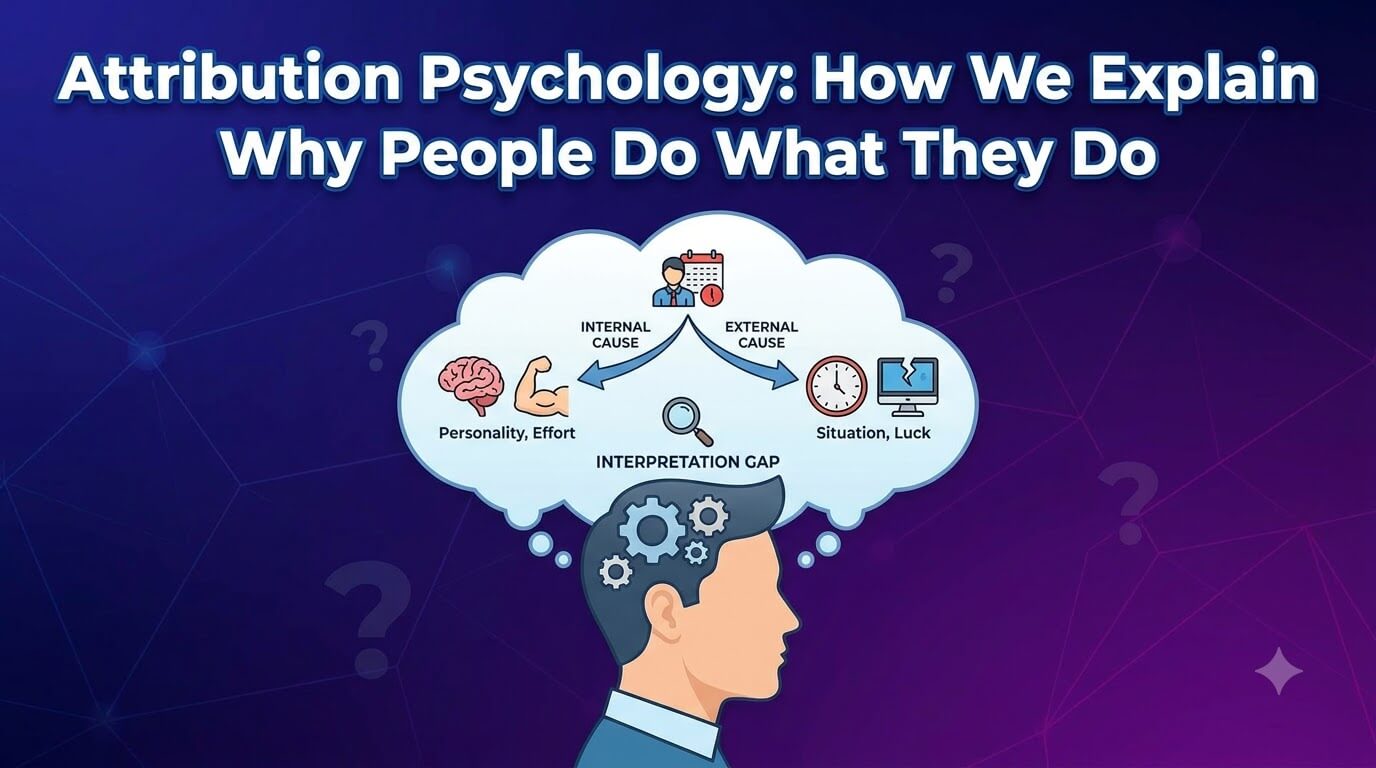
A coworker misses a deadline. One person thinks, “They are careless.” Another thinks, “They were given too much work.” A third wonders whether the instructions were unclear. The event is the same, but the explanations are not. That gap between what happened and why we think it happened is the territory of attribution psychology.
Attributions matter because explanations shape responsibility, emotion, expectations, and what we do next. Understanding them requires more than choosing between “the person” and “the situation.” Evidence, context, stability, controllability, intention, and uncertainty all matter.
Quick Answer
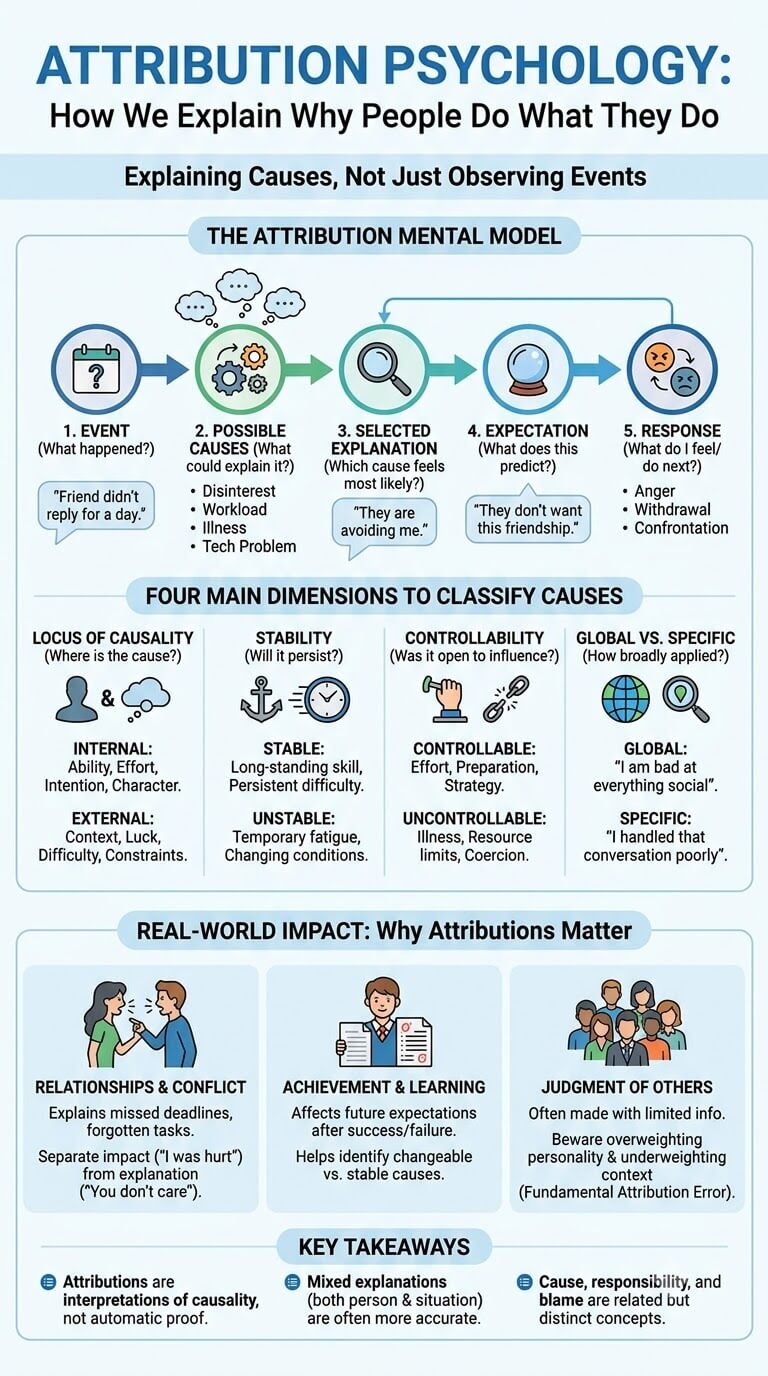
Attribution psychology studies how people explain the causes of behavior, events, success, failure, and other outcomes. We may locate a cause inside the person, in the surrounding situation, or in a combination of both. Those explanations can then influence emotion, responsibility judgments, expectations, and future behavior. An attribution is an interpretation of causality, not automatic proof that the chosen cause is correct.
What Attribution Means in Psychology
Attribution is an explanation for causes, not merely a judgment
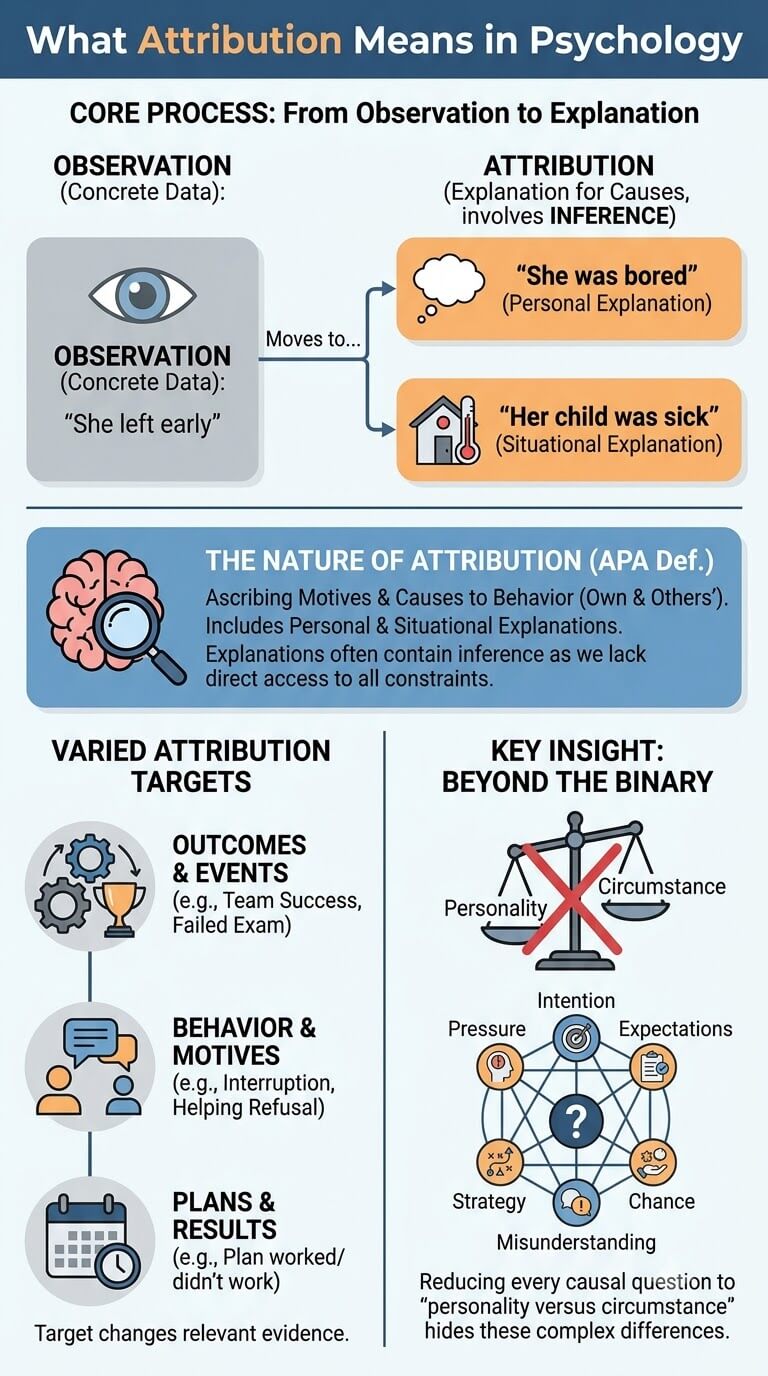
In everyday life, we constantly move from observation to explanation. “She left early” is an observation. “She left because she was bored” is an attribution. “She left because her child was sick” is a different attribution. The APA Dictionary of Psychology definition of attribution theory describes this tradition as the study of how people ascribe motives and causes to their own and other people’s behavior, including personal and situational explanations.
Observations can be relatively concrete, while explanations often contain inference. We rarely have direct access to every motive, constraint, conversation, or competing demand that produced an outcome.
Events, behavior, outcomes, and motives are different attribution targets
We can ask causal questions about many kinds of things. Why did someone interrupt? Why did a team succeed? Why did a relationship conversation become tense? Why did I fail an exam? Why did a stranger refuse to help? Why did a plan work this time but not last time?
The target changes what evidence is relevant. An exam result may involve preparation, difficulty, sleep, strategy, and chance. A social action may involve intention, pressure, expectations, or misunderstanding. Reducing every causal question to “personality versus circumstance” can hide these differences.
Why the Mind Searches for Causes
Prediction, learning, responsibility, and uncertainty reduction
Causal explanations help us decide what an event means for the future. If a failed attempt happened because a strategy was ineffective, changing the strategy may make sense. If it happened because a task was unusually difficult, the next attempt may require more time or resources. If we think another person acted intentionally, we may respond very differently than if we think the same outcome was accidental.
We also use causal explanations to decide who deserves credit, who should repair harm, whether a promise is trustworthy, and whether an outcome is likely to repeat. This is one reason attribution overlaps with personal agency, even though the two are not the same. Attribution asks what caused an outcome. Agency is more about whether a person experiences themselves as able to choose and act.
Why two observers can explain the same event differently
People rarely enter an event with identical information. A manager may know a report was late but not know that the employee spent half the day fixing an urgent client problem. The employee knows about the interruption but may underestimate their own planning problem.
Prior beliefs also matter. If someone already believes a teammate is unreliable, an ambiguous delay may look like further evidence of unreliability. If they believe the teammate is usually conscientious, the same delay may prompt a search for situational explanations. That does not mean every attribution is merely subjective. It means causal judgment is often made under incomplete information.
A Core Mental Model for Attribution
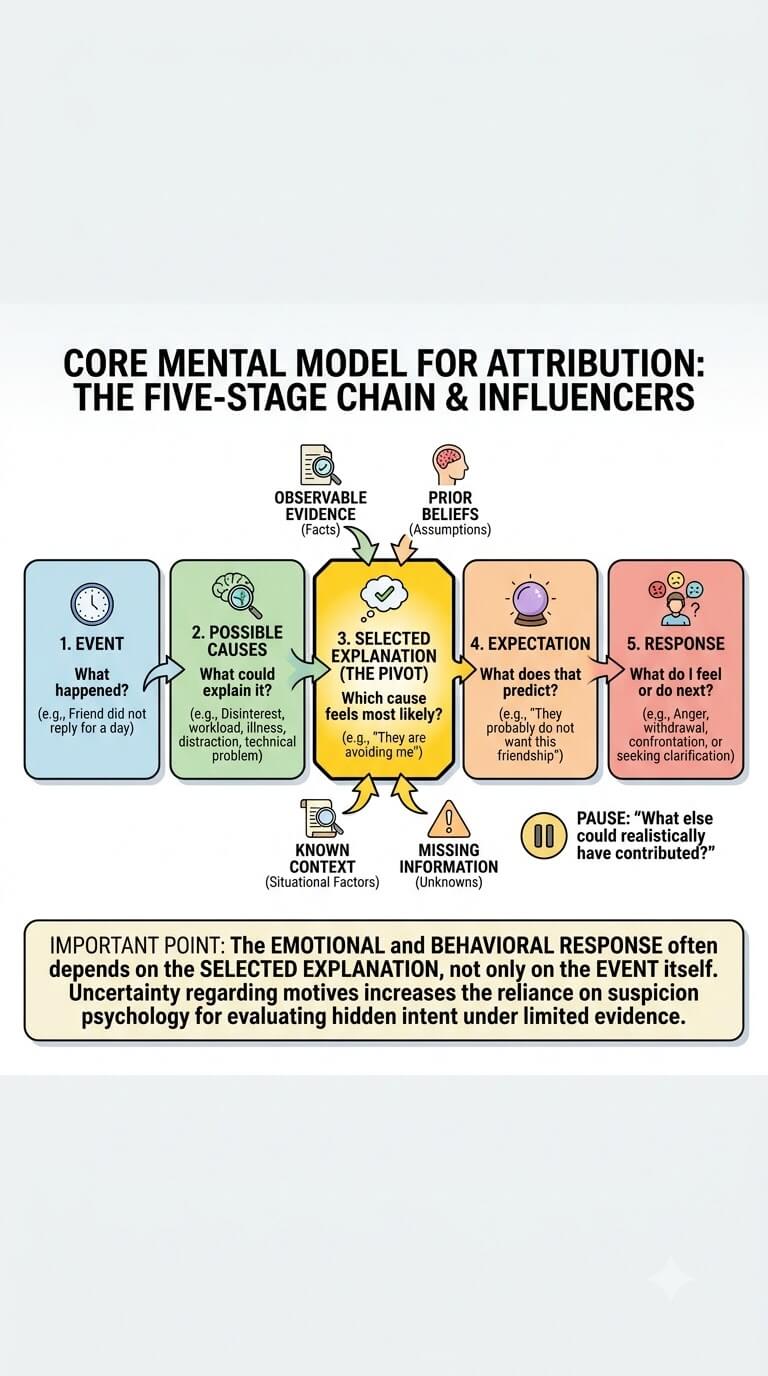
Event or behavior → possible causes → selected explanation → expectation → response
A useful way to understand attribution is as a five-stage chain:
| Stage | Question | Example |
|---|---|---|
| 1. Event | What happened? | A friend did not reply for a day. |
| 2. Possible causes | What could explain it? | Disinterest, workload, illness, distraction, a technical problem. |
| 3. Selected explanation | Which cause feels most likely? | “They are avoiding me.” |
| 4. Expectation | What does that explanation predict? | “They probably do not want this friendship.” |
| 5. Response | What do I feel or do next? | Anger, withdrawal, confrontation, or seeking clarification. |
The important point is that the emotional and behavioral response often depends on the selected explanation, not only on the event itself. This is especially visible when people face uncertainty about another person’s motives. In those situations, ideas from suspicion psychology can become relevant because a person may be evaluating hidden intent under limited evidence.
Evidence, prior beliefs, context, and missing information
Before settling on a cause, separate four inputs: observable evidence, prior beliefs, known context, and missing information.
This need not become endless analysis. A useful pause is: “What else could realistically have contributed?”
Person-Based and Situation-Based Explanations
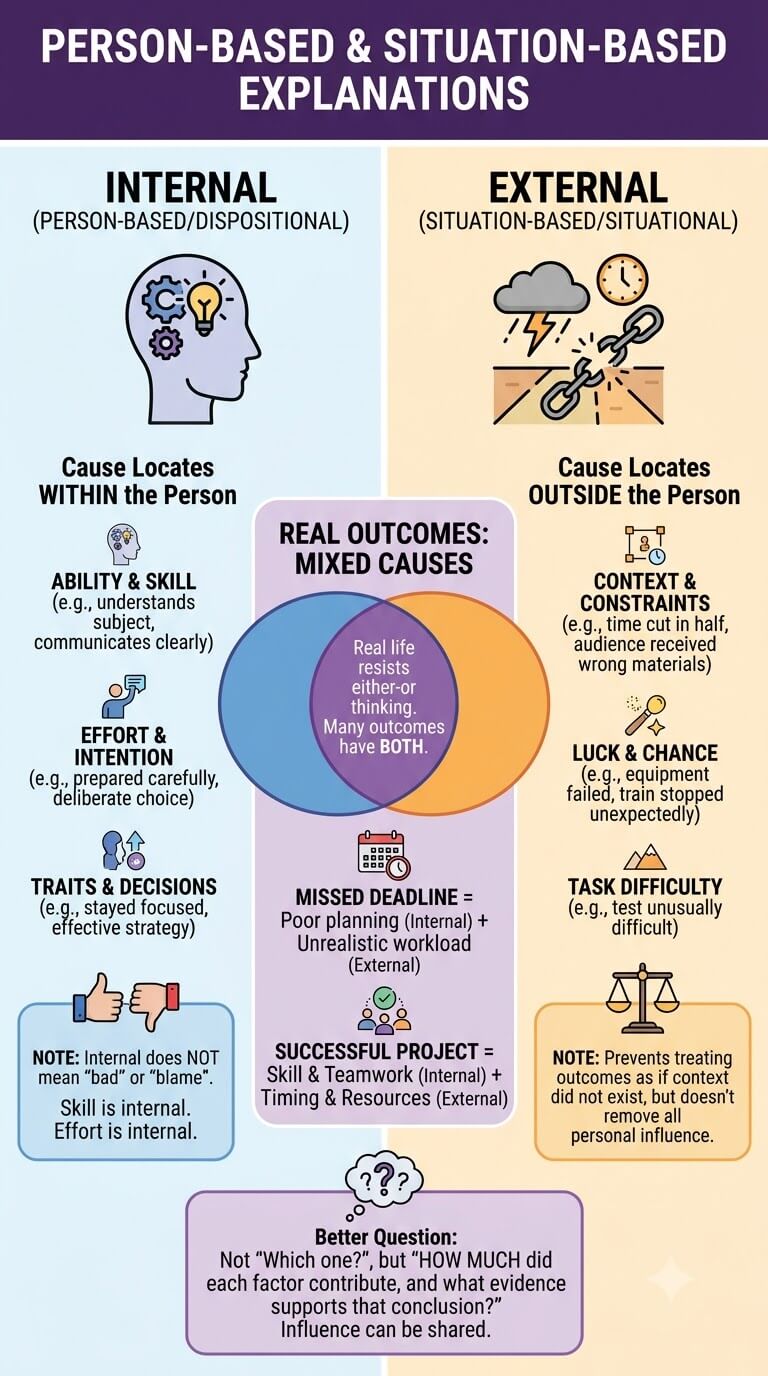
Internal causes such as ability, effort, intention, and character
An internal attribution places the cause within the person. According to the APA Dictionary entry on dispositional attribution, internal explanations can involve traits, moods, attitudes, decisions, abilities, or effort.
Suppose someone performs well in a presentation. An internal explanation might be that they prepared carefully, understand the subject, communicate clearly, or stayed focused under pressure. If they perform poorly, an internal explanation might involve inadequate preparation, an ineffective strategy, or a deliberate choice not to practice.
Internal does not mean “bad,” and it does not mean “blame.” Skill is internal. Effort is internal. Intention is internal. So are many strengths. The category tells us where the proposed cause is located, not whether the person deserves praise or criticism.
External causes such as context, luck, task difficulty, and constraints
An external attribution locates the cause outside the person. The APA Dictionary definition of situational attribution includes circumstances such as luck, pressure from others, and external conditions.
A presentation may go poorly because the equipment failed, the time was cut in half, or the audience received the wrong materials. A student may struggle because the test was unusually difficult. A person may be late because a train stopped unexpectedly. These explanations do not automatically remove all personal influence, but they prevent us from treating outcomes as if context did not exist.
Why many real outcomes contain both person and situation causes
Real life often resists either-or thinking. A missed deadline might involve poor planning and an unrealistic workload. A successful project might involve skill, teamwork, timing, and resources.
A better causal question is often not “Was it the person or the situation?” but “How much did each factor contribute, and what evidence supports that conclusion?” This mixed-cause view is especially helpful when discussing responsibility because influence can be shared without being equal.
The Main Dimensions Used to Classify Causes
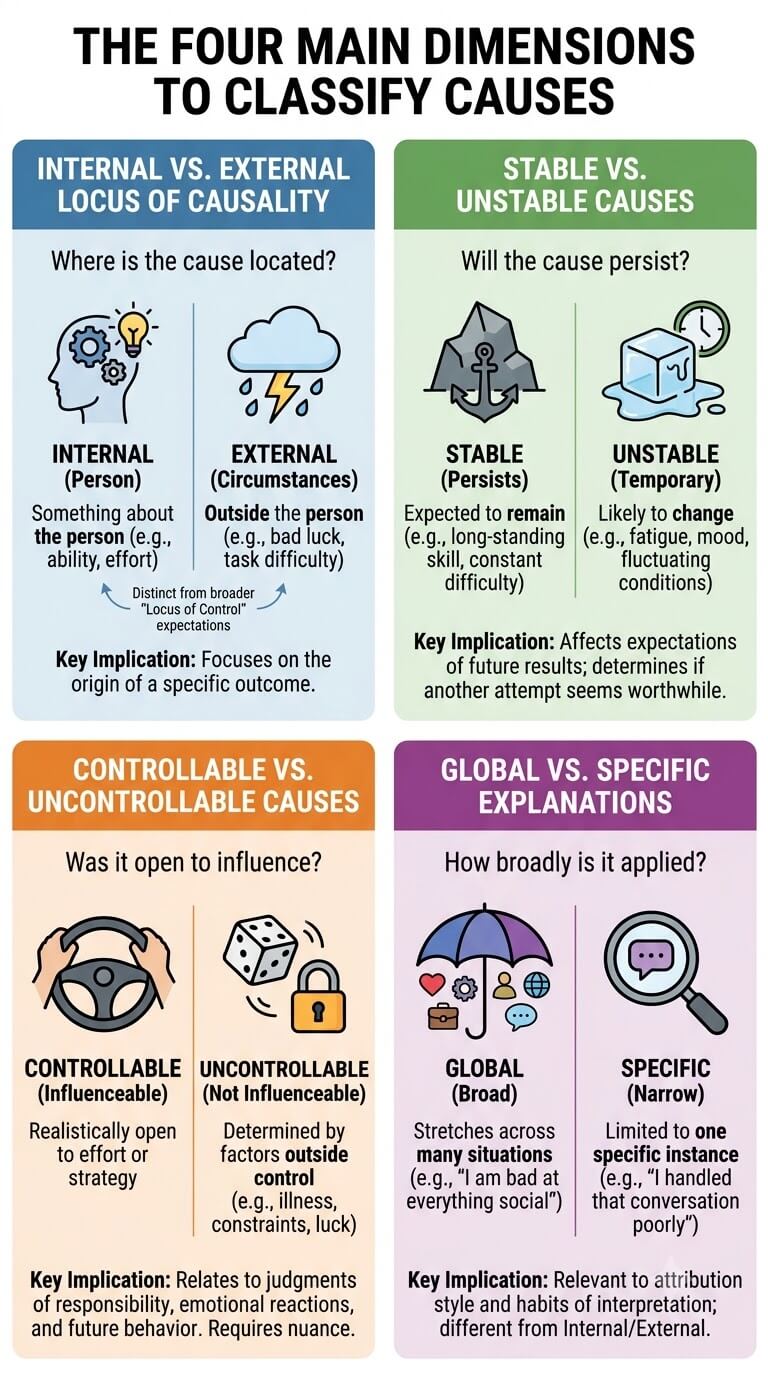
Internal versus external locus of causality
The internal-external distinction asks where a proposed cause is located. Did the outcome arise mainly from something about the person, or mainly from circumstances outside the person?
This use of “locus” can be confusing because locus of control is a separate concept. Attribution can describe the cause of one specific outcome. Locus of control concerns a broader expectation about what generally determines outcomes. Someone can make an external attribution for one event while still believing they can influence many future outcomes.
Stable versus unstable causes
Stability asks whether the cause is expected to persist. A long-standing skill level may be treated as relatively stable. Fatigue after one bad night of sleep is usually more temporary. A difficult task can be stable if the same difficulty will remain, or unstable if conditions change next time.
This dimension matters because stability affects expectations. If a person interprets a failure as caused by something unchangeable, they may expect the same result again. If they see the cause as temporary or modifiable, another attempt may seem more worthwhile.
Controllable versus uncontrollable causes
Controllability asks whether the cause was realistically open to influence. Effort is often treated as more controllable than luck, but real situations require nuance. Illness, disability, resource limits, caregiving demands, coercion, and institutional constraints can alter how much control a person actually has.
Research based on attribution theory has examined how controllability judgments relate to responsibility, emotion, and future behavior. A systematic review of causal attributions in educational settings summarizes the role of locus, stability, and controllability in expectations and emotional reactions. These dimensions are useful tools, but they should not be treated as mechanical verdicts about blame.
Global versus specific explanations in attribution style
Global versus specific explanations ask how broadly a cause is applied. After one rejection, “I am bad at everything social” is global. “I handled that conversation poorly” is more specific. A global conclusion stretches the explanation across situations that may not share the same cause.
This dimension is especially relevant to attribution style, where repeated ways of explaining outcomes can become habits of interpretation. It is not identical to the internal-external distinction. An explanation can be internal but specific, such as “I did not prepare well for this meeting.”
Major Attribution Theories at a Glance
Heider and everyday causal explanation
Fritz Heider’s early work helped establish the idea that ordinary people behave like informal cause-seekers. We try to make sense of behavior by considering personal forces and environmental forces. In practical terms, we ask whether someone acted because of intention, ability, effort, pressure, opportunity, or some combination.
Heider’s contribution is useful because it reminds us that attribution is not only something psychologists do in research. It is a routine part of everyday social understanding.
Kelley and covariation information
Harold Kelley developed a more structured way to think about causal information. One important idea is covariation: a cause becomes more plausible when it appears together with the effect across relevant observations. In everyday terms, we can ask whether other people react the same way, whether this person reacts this way only in this situation, and whether the pattern repeats over time.
Imagine an employee complains about one manager. If nearly everyone complains about that manager, the situation becomes more informative. If the employee complains about every manager, something about the employee’s broader pattern becomes more relevant. If the complaint happened once after an unusual incident, a stable explanation may be premature.
Weiner and explanations of success and failure
Bernard Weiner’s work is especially influential for understanding achievement-related outcomes. It organizes causes using dimensions such as locus, stability, and controllability, then connects those classifications with expectations and emotion.
After failure, “I lack ability,” “I used the wrong strategy,” “the task was unusually difficult,” and “I had bad luck” imply different futures because they differ in location, stability, and controllability.
Attribution Style: When Explanations Become Recurring Patterns
How repeated causal explanations can become habits of interpretation
One attribution concerns one event. Attribution style refers more to recurring tendencies in how a person explains positive and negative outcomes. Some people repeatedly interpret setbacks as personal and enduring. Others tend to see them as temporary, specific, or strongly shaped by context.
A recurring style is not a permanent identity. People may explain work setbacks one way and relationship setbacks another, and new evidence can change those habits.
Optimistic and pessimistic explanatory tendencies without forced positivity
An optimistic explanatory style is often associated with seeing negative events as more temporary and specific, while a pessimistic style may involve more permanent or broad explanations. The useful distinction is not “positive people versus negative people.” It is how widely and permanently a cause is being applied.
Accuracy still matters. A temporary explanation is not automatically healthier if the problem is genuinely recurring. A situational explanation is not automatically better if personal choices clearly contributed. The goal is a causal story proportionate to the evidence.
How Attributions Change Emotion and Future Behavior
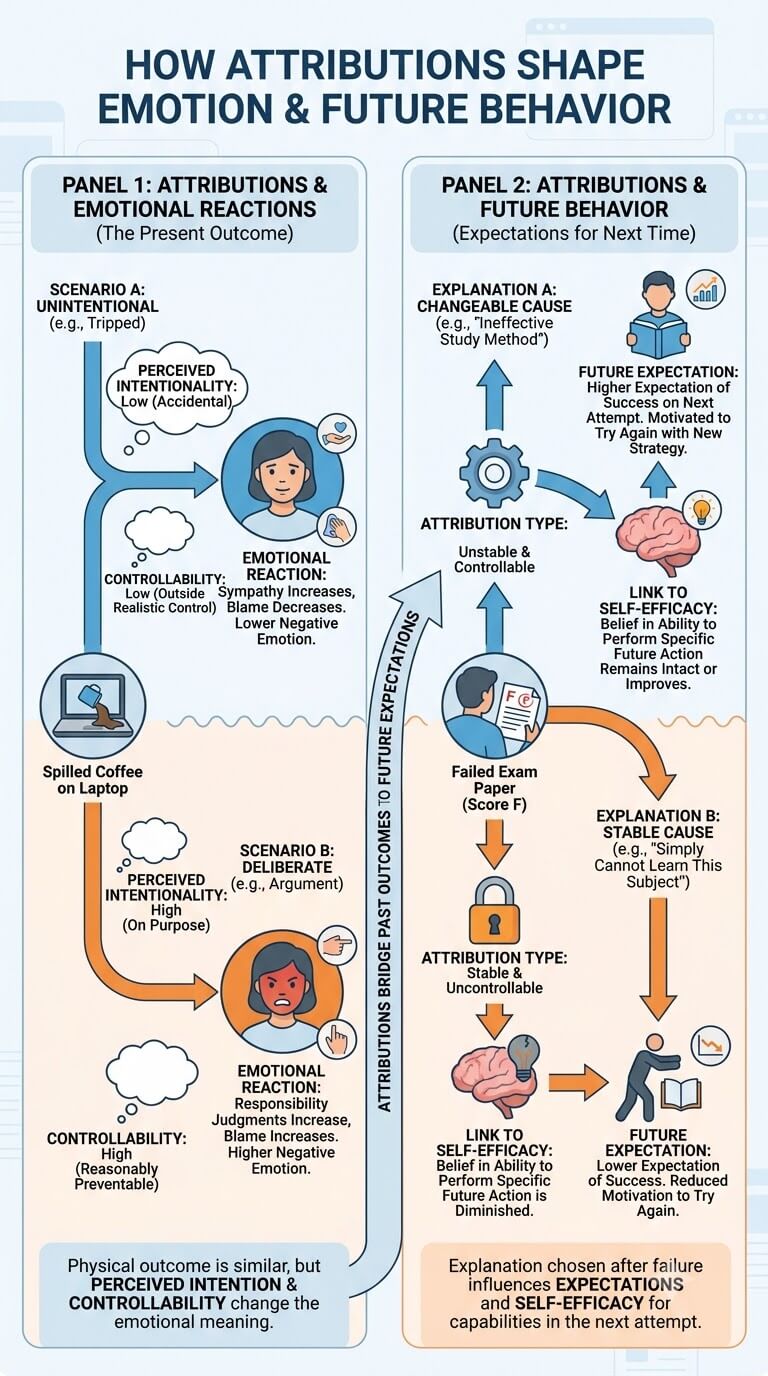
Intentionality, controllability, stability, and emotional reactions
Imagine two people spill coffee on your laptop. In one case, the person trips. In the other, they pour it deliberately during an argument. The physical outcome may be similar, but perceived intention changes the emotional meaning.
Controllability also matters. If someone could reasonably have prevented an outcome, responsibility judgments may increase. If the cause was outside realistic control, sympathy may increase and blame may decrease.
How explanations alter expectations about trying again
Attributions change expectations for the next attempt. “I used an ineffective study method” identifies a potentially changeable cause, while “I simply cannot learn this subject” selects a more stable explanation.
This is where attribution can intersect with self-efficacy. The concepts remain distinct: attribution concerns what caused the previous outcome, while self-efficacy concerns whether someone believes they can perform a specific action. Still, the explanation chosen after failure can influence what a person expects from their capabilities next time.
Attribution, Blame, and Responsibility Are Not the Same Thing
Cause, influence, responsibility, and moral blame are separate questions
These ideas often collapse into one another, especially during conflict. Yet they answer different questions:
| Question | What it asks |
|---|---|
| Cause | What factors helped produce the outcome? |
| Influence | Who or what changed the probability of the outcome? |
| Control | What could realistically have been changed? |
| Responsibility | What portion of the outcome is reasonably attributable to a person’s choices or duties? |
| Blame | What negative judgment is assigned after considering cause, intention, control, norms, and consequences? |
Keeping these questions separate reduces two common errors: assuming that anyone who contributed to an outcome deserves equal blame, and assuming that identifying situational causes excuses all behavior. It also helps distinguish causal reasoning from the broader moral evaluations discussed in topics such as moral hypocrisy.
Why explanation should not erase situational constraints
A person may influence an outcome without having full control over it. Someone can make a mistake while exhausted from caregiving. An employee can plan poorly inside an impossible deadline. A person can respond imperfectly while under intense social pressure.
In more serious contexts, coercion, threats, stalking, violence, exploitation, and abuse sharply change what realistic choice looks like. Causal explanation should never be used to transfer responsibility for harmful acts onto the person being harmed. When safety or retaliation is a concern, communication advice is not a substitute for specialized support.
Common Attribution Mistakes Without Turning This Into a Bias List
Overweighting personality and underweighting context
One familiar error is to see another person’s behavior and quickly infer a stable personal cause while giving too little weight to the surrounding situation. The APA Dictionary description of the fundamental attribution error defines it as overestimating personal characteristics and underestimating situational influence when explaining behavior.
This is useful as a warning, not as a universal explanation for every disagreement. Sometimes a personal characteristic really is relevant. Sometimes context dominates. The stronger question is whether the evidence justifies the weight being given to each cause.
Self-protective explanations and selective evidence
Attributions can protect self-image. After success, a person may highlight skill and effort. After failure, they may focus on bad luck or unfair circumstances. The reverse can also happen, especially in people who habitually discount their strengths and over-assign responsibility to themselves.
Rather than assuming a self-serving motive every time, look for selective evidence. Are favorable facts being counted while inconvenient facts are ignored? Would the same standard be applied if another person had produced the outcome?
When a bias label is less useful than checking the causal evidence
Labels can be useful shorthand, but “that is a cognitive bias” does not tell you which cause is more accurate. Evidence, context, alternatives, and missing information still need examination.
For a broader view of systematic judgment errors, the site’s guide to cognitive biases and examples covers several related patterns. Attribution psychology is broader because it includes ordinary causal explanation even when no identifiable bias is present.
Where Attribution Matters in Everyday Life
Relationships and conflict
Many arguments contain a hidden attribution dispute. One partner says, “You forgot because you do not care.” The other says, “I forgot because I was overwhelmed.” The disagreement is no longer only about the missed task. It is about whether the cause was indifference, overload, habit, priorities, or some combination.
A practical move is to separate impact from explanation. The impact may be real even when the motive is uncertain. “I was hurt that you forgot” can be valid without “you forgot because I do not matter” being proven.
Achievement, learning, work, and motivation
After success or failure, attribution affects what people learn. Calling a good result pure luck can hide repeatable practices; crediting only talent can hide preparation; blaming a setback entirely on ability can hide a changeable strategy problem.
Good reflection asks which causes are supported, which are changeable, and which should be monitored next time. This turns attribution into a learning tool rather than a verdict on identity.
Judgment of strangers, teams, and social events
We often judge causes with little information. A driver cuts us off or a stranger seems cold, and thin context can make simple explanations feel more certain than they deserve.
Research on how people explain behavior has also questioned whether traditional attribution concepts capture every type of explanation. A theoretical framework on how people explain behavior distinguishes reason explanations from other causal explanations and highlights limits in treating all social explanation as one process. That is a useful reminder that human causal reasoning is more varied than a single person-versus-situation rule.
Which Attribution Question Should You Explore Next?
If you want the major theories
Go deeper into attribution theory itself. The main question becomes how different theoretical traditions explain causal inference, including Heider’s early person-situation distinction, Kelley’s use of covariation information, and Weiner’s treatment of achievement outcomes.
If you keep mixing up person and situation causes
Focus on internal versus external attribution. That comparison is most useful when you want to distinguish ability, effort, intention, and character from context, luck, difficulty, pressure, and other external conditions.
If your explanations repeat across many setbacks
Attribution style is the more relevant question. Instead of asking only why one event happened, you examine whether explanations repeatedly become internal or external, stable or unstable, and global or specific.
If success and failure change your expectations strongly
Weiner’s framework is helpful when you want to classify a cause by locus, stability, and controllability. It is particularly useful for understanding why “I lacked ability,” “I used the wrong strategy,” and “I had bad luck” lead to different expectations.
If blame is the central issue
It helps to examine whether causal responsibility is being assigned mainly inward, mainly outward, or defensively. Self-blame, blaming others, and defensive attribution involve different questions even though all concern explanations for negative outcomes.
If attribution and control feel interchangeable
Keep the time frame in mind. Attribution asks why this event happened. Locus of control asks what tends to determine outcomes more generally. Neither one is identical to responsibility, agency, or capability.
Common Misunderstandings About Attribution Psychology
An internal attribution is not automatically accurate or inaccurate
Internal explanations can be well supported or poorly supported. “I did not prepare enough” may be accurate. “Everything failed because I am fundamentally incapable” may stretch one result into a much broader conclusion. Location of the cause and quality of the evidence are separate issues.
An external attribution does not remove all responsibility
Context can matter while a person still has choices. A stressful environment may explain why patience was harder, but it does not automatically justify harmful behavior. Conversely, demanding accountability does not require pretending the situation had no effect.
Attribution is broader than fundamental attribution error
Fundamental attribution error is one possible mistake in causal judgment. Attribution psychology is the larger subject of how people explain causes in the first place, including accurate explanations, mixed explanations, achievement explanations, repeated explanatory styles, and judgments under uncertainty.
FAQ About Attribution Psychology
What is a simple example of attribution in psychology?
If a student receives a low grade and says, “I did poorly because I used the wrong study method,” they are making an attribution. The proposed cause is internal and potentially changeable. If they instead say, “The exam covered material we were never taught,” they are making an external attribution. Either explanation may be accurate, inaccurate, or partly correct depending on the evidence.
Is attribution always conscious?
No. People can make causal assumptions quickly and with little deliberate reflection. You may feel irritated before noticing that you have already interpreted someone’s silence as disrespect. Slowing down can make the attribution more visible, which allows you to ask what evidence supports it and what alternatives remain plausible.
Can one event have both internal and external causes?
Yes. Many outcomes are produced by interacting factors. A successful presentation may reflect preparation, skill, supportive colleagues, good timing, and a receptive audience. A failure may involve both poor planning and an unrealistic deadline. Mixed explanations are often more realistic than forcing every outcome into a single category.
How is attribution different from blame?
Attribution identifies or proposes a cause. Blame adds a negative judgment about responsibility and often depends on intention, controllability, expectations, and social norms. Someone can contribute causally to an outcome without deserving the same degree of blame as another person, and some causal factors are not people at all.
Can attribution patterns change over time?
They can. People may revise explanations when they receive better information, encounter new outcomes, or notice that a repeated interpretation is too broad for the evidence. Change does not require replacing every negative explanation with a positive one. A more useful goal is to make causal judgments more specific, proportionate, and testable.
Key Takeaways
- Attribution psychology examines how people explain causes, not whether the first explanation that comes to mind is true.
- Person-based and situation-based causes often interact, so mixed explanations can be more accurate than either-or judgments.
- Locus, stability, controllability, and global versus specific thinking answer different causal questions and should not be collapsed into one dimension.
- Attributions influence emotion and future action because they change what people think an event means and whether they expect it to repeat.
- Cause, control, responsibility, and blame are related but distinct. Separating them produces fairer and more useful judgments.
- A practical next step is to identify the explanation you are using, name what evidence supports it, and ask what realistic alternative cause would change your response.
About the author: Michael Reed is the Founder & Lead Writer at Psychology Exposed. He writes about human behavior, relationships, emotional patterns, self-awareness, and everyday decisions in a clear, research-aware way for general readers.

Michael Reed is the Founder and Lead Writer at Psychology Exposed. He writes about human behavior, relationships, emotional patterns, self-awareness, and practical psychology topics using research-informed, easy-to-understand content.
Read More About Michael Reed: https://psychologyexposed.com/michael-reed/