
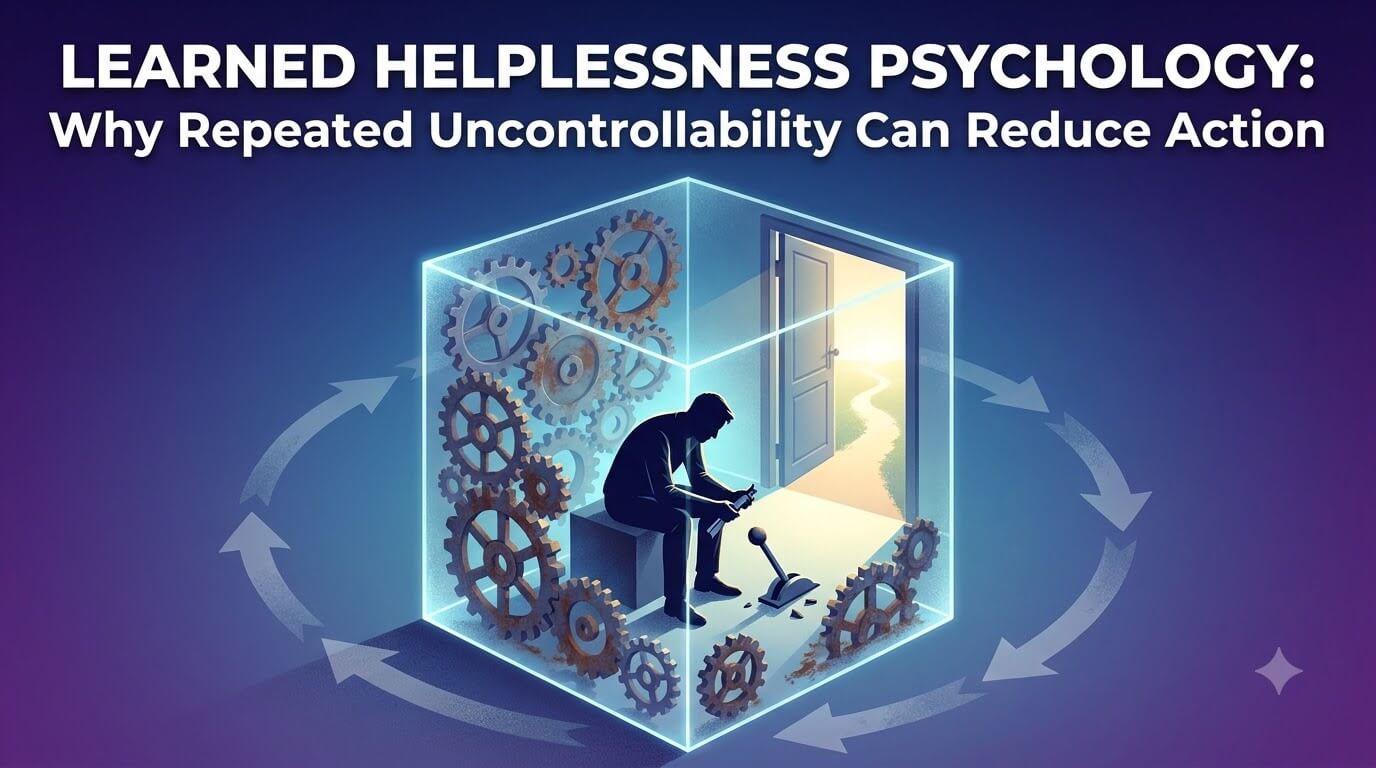
A situation can change while your expectation stays the same. After enough experiences in which effort seems useless, people may expect new effort to make little difference and become less willing to test options that are now available.
Psychologists use learned helplessness for a specific idea about how repeated uncontrollability can affect later behavior. It is not a label for laziness, weakness, or a fixed personality, and it is not a diagnosis. The narrower question is whether experience taught you that action and outcome are disconnected even when some influence may now be possible.
Quick Answer
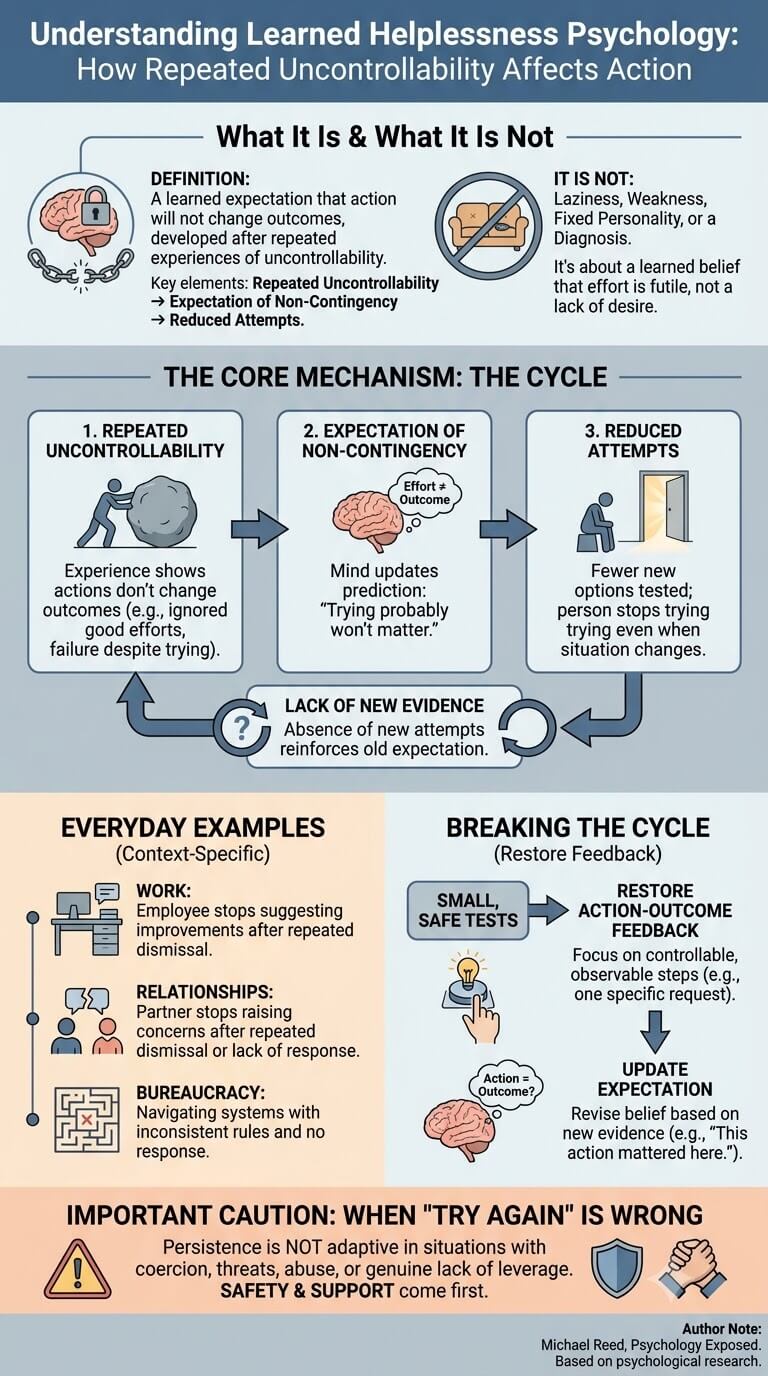
Learned helplessness is a response associated with repeated experiences in which actions do not change important outcomes. Over time, a person may expect future efforts to be ineffective and make fewer attempts, even when a later situation offers some real control. The key sequence is not simply failure. It is repeated uncontrollability, an expectation that action will not matter, and reduced testing of new options.
What Learned Helplessness Means
The term becomes clearer when learned control expectations are separated from character judgments.
It is about learned expectations of non-contingency
The APA Dictionary of Psychology definition of learned helplessness centers on repeated exposure to uncontrollable stressors followed by failure to use control options that later become available. In plain language, the person or organism has experienced too many situations where “what I do” and “what happens” did not seem connected.
This action-outcome connection is called contingency. When changing your behavior reliably changes a result, you learn that action matters. When repeated attempts produce the same outcome regardless of what you do, the opposite lesson may form.
It is not the same as laziness, weakness, or a fixed identity
Calling someone lazy assumes that effort is available and that the main problem is unwillingness. Learned helplessness points to a different possibility: the person may have learned that effort is unlikely to pay off. From the outside, both can look like “not trying,” but the internal prediction is different.
That distinction matters because pressure can miss the mechanism. Telling someone to “want it more” does not provide evidence that their actions can affect the outcome. It may even deepen shame if the person interprets their reduced action as a character defect.
It is also possible to feel helpless in one area while acting confidently in another. Someone may persist strongly in fitness or work but stop speaking up in a setting where previous requests were repeatedly ignored. A learned expectation can be context-specific rather than a permanent description of the person.
The Core Mechanism: Uncontrollability, Expectation, and Reduced Attempts
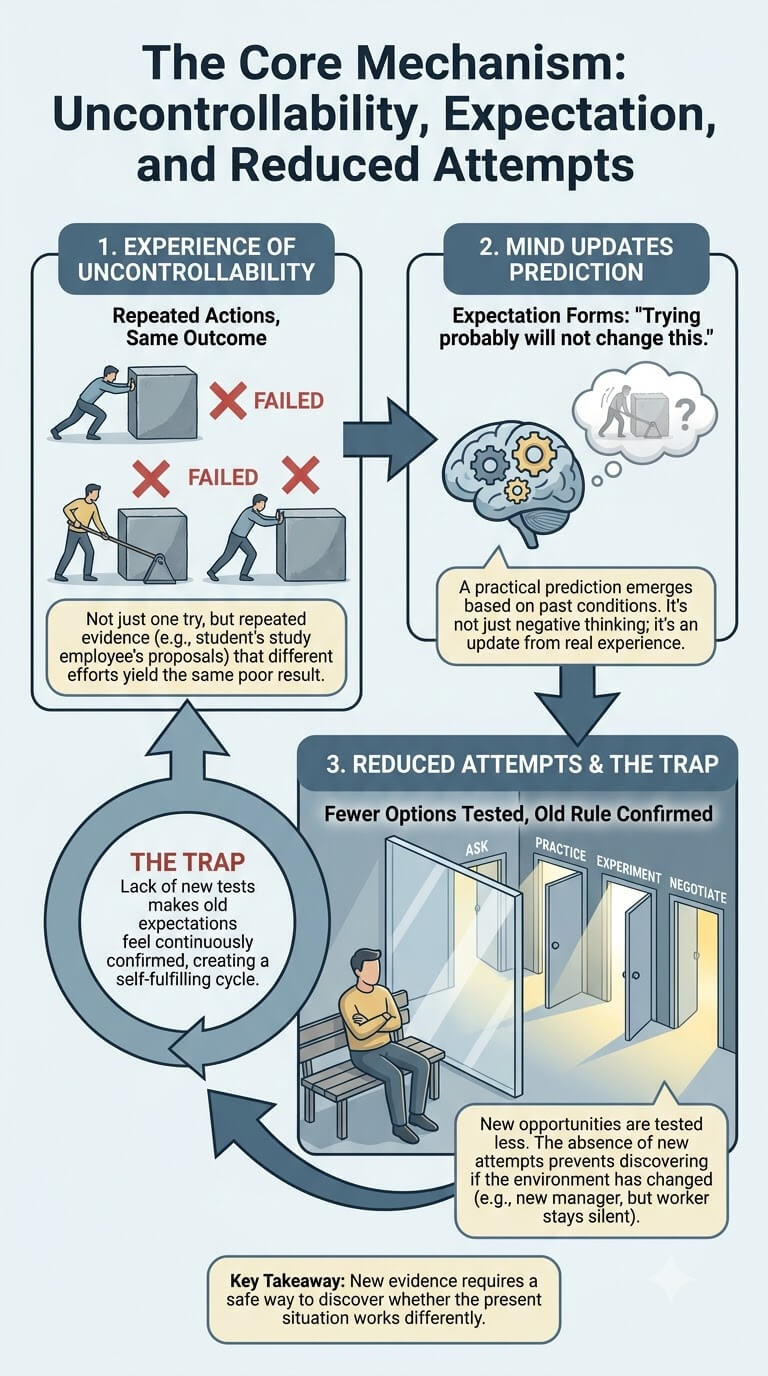
The mechanism is easiest to understand as a sequence in which experience changes what future effort seems worth trying.
Repeated action does not change the outcome
The process begins with experience. A student tries several study methods but gets the same poor result. An employee proposes improvements but decisions are made elsewhere. A person follows a bureaucratic process yet receives inconsistent rules and no meaningful response.
One disappointing attempt is usually not enough to explain a helplessness pattern. What matters more is repeated evidence, or perceived evidence, that different actions lead to essentially the same outcome.
The mind updates its prediction about control
People constantly form expectations from experience. If the environment repeatedly teaches that effort is unrelated to outcome, a practical prediction can emerge: “Trying probably will not change this.” That prediction may be inaccurate in a new setting, but it is understandable as an update from the old one.
This is why learned helplessness should not be reduced to negative thinking. The expectation may have been shaped by real conditions. The question is whether the old rule still fits now.
New opportunities are tested less often
Once action feels pointless, fewer options get tested. A person may stop asking, practicing, negotiating, or experimenting even while thinking about the problem constantly.
This creates an important trap: the environment may have changed, but the person receives little proof of that change because they no longer test it. The absence of new attempts can make an old expectation feel continuously confirmed.
Reduced attempts can create less corrective evidence
Suppose a worker once had a manager who ignored every request for role clarity. After moving to a new team, the worker assumes asking will again be useless and stays silent. The new manager never gets the opportunity to respond differently, so the employee’s expectation remains unchallenged.
This does not mean the employee caused the old problem or should automatically trust the new environment. It means new evidence requires a safe way to discover whether the present situation works differently.
Classic Research and How the Concept Evolved
The history matters because the popular version is simpler than the account supported by later research.
What early experiments demonstrated about uncontrollability
The concept emerged from 1960s animal experiments comparing controllable with uncontrollable aversive events. Animals exposed to inescapable events later had more difficulty learning an escape response when escape became possible. The key variable was whether behavior influenced the outcome.
A later retrospective review by Steven Maier and Martin Seligman, Learned Helplessness at Fifty, explains the original theory and how later neuroscience changed the interpretation. Popular accounts often leave out that revision.
Why modern human interpretation must consider cognition, context, and ethics
Contemporary work is more nuanced than the simple statement “helplessness is learned.” In the animal neuroscience literature, Maier and Seligman argued that passive responding to prolonged aversive events may be a default response, while learning that one has control can recruit systems that inhibit that passivity. A more recent review of controllability and resilience similarly emphasizes how experience with control can shape responses to later stress.
Human life adds layers that laboratory models cannot capture fully. People interpret causes, judge safety, remember social experiences, and live inside systems with unequal power. If retaliation is likely, reduced action may accurately reflect low leverage or real risk.
A 2025 review of learned helplessness and learned controllability also highlights the importance of subjective control and action-outcome learning. The most useful takeaway for everyday readers is therefore not that every passive response is learned helplessness. It is that histories of uncontrollability can influence how people detect and use control later.
What Learned Helplessness Can Look Like in Everyday Life
Everyday examples are useful only when the history of low control actually fits the situation.
Work after repeated ignored effort
An employee repeatedly raises workload concerns, offers specific solutions, and watches nothing change. Months later, a new feedback process appears, but they do not participate because they expect the same result.
They may feel tired, cynical, or detached. A better question than “Why are you so negative?” is whether the new process is meaningfully different and whether a low-cost test can show if input now matters.
Learning after repeated failure without useful feedback
A learner may work hard without improving when feedback is vague, instruction is mismatched, or the task is too difficult. Repeated experiences like this can make new strategies feel equally pointless.
The experience may feel like “I cannot learn,” when the more precise problem is “I have not seen a reliable link between what I change and what improves.” Shrinking the task to one subskill with immediate feedback can make that link easier to detect.
Bureaucratic or institutional environments with little responsiveness
Systems can genuinely be difficult to influence. Contradictory instructions, long delays, or unexplained decisions may teach people that extra effort has little effect. Reduced persistence is not automatically irrational.
The practical move is to separate what is structurally fixed from what still has leverage. That may mean documenting contacts, seeking an advocate, or deciding further effort is not worth the cost.
Relationships where attempts at change repeatedly produce no safe or meaningful response
In a close relationship, someone may stop raising concerns after repeated dismissal, mockery, threats, punishment, or no follow-through. They may think, “Nothing I say changes anything.” Context is essential.
If the environment is basically safe and both people are capable of responding, a small, concrete request can sometimes test whether the dynamic has changed. If there is fear, coercion, stalking, threats, humiliation, or retaliation, communication practice is not the priority. Safety, outside support, and realistic assessment of risk come first.
Learned Helplessness vs Low Motivation
Both may reduce action, but they answer different questions about why action stops.
“I do not want to act” versus “I do not expect action to matter”
| Experience | Core question | Typical obstacle | Useful first check |
|---|---|---|---|
| Low motivation | “Do I want to do this enough right now?” | Low value, competing goals, fatigue, discomfort, or delayed reward | Clarify value, energy, timing, and next action |
| Learned helplessness | “Would doing anything make a difference?” | Expectation that action and outcome are disconnected | Look for a safe, observable contingency test |
| Low perceived control | “How much influence do I have in this situation now?” | Current situation feels constrained | Map direct control, partial influence, and external constraints |
| Feeling powerless | “Why do I feel unable to affect this?” | May involve resources, hierarchy, fear, uncertainty, history, or control beliefs | Identify the specific source of low power |
Why motivation advice can fail when control expectations are the problem
Rewards, stricter routines, or accountability may help when someone wants a goal but struggles to initiate. They are less useful when the core expectation is that effort will not affect the outcome.
A better starting point is evidence. Ask what specific action could change a specific outcome and how quickly the result can be observed. Clear feedback is more useful than extra pressure.
Learned Helplessness vs Perceived Control
The difference is mainly about learning history rather than how controllable one moment feels.
Low perceived control can happen once; learned helplessness implies a learning history
You can enter a new situation and immediately judge that control is low. A delayed flight, restructuring, or someone else’s private decision may offer little direct influence. That is a present appraisal, not necessarily learned helplessness.
Learned helplessness adds history. Past uncontrollability affects what you expect from future action. The distinction helps prevent ordinary realism about limited control from being pathologized.
How generalized expectations can spread beyond the original context
Expectations do not always stay confined. Repeated academic failure may shape expectations about professional learning, while repeated dismissal by authority figures may reduce willingness to speak up with a new supervisor.
Generalization matters most when the new situation feels similar and feedback is ambiguous. The person may simply become more cautious or quick to stop.
Learned Helplessness vs Feeling Powerless
Powerlessness describes a wider experience, while learned helplessness names one possible route into it.
Powerlessness is a broader subjective experience with many possible causes
A person can feel powerless because authority, money, access, unclear rules, overwhelm, or real threats restrict their choices. None of those explanations requires a history of learned non-contingency.
Learned helplessness is therefore one possible mechanism inside the broader experience of powerlessness. Using the narrower concept only when the learning history fits keeps the explanation useful.
When the learned helplessness model fits and when it does not
The model fits better when three elements are present: repeated experiences of low or absent control, an expectation that future action will also be ineffective, and reduced attempts even after circumstances offer new options. It fits less well when the person is making a deliberate cost-benefit decision, lacks a needed skill, is physically exhausted, faces genuine external barriers, or is protecting themselves from likely harm.
A useful explanation increases precision rather than labeling every instance of giving up.
Why Generalization Happens
An expectation formed in one setting can sometimes influence behavior in situations that merely resemble it.
Similarity between old and new situations
The more a new situation resembles the old one, the easier an old control expectation can carry over. Similar settings, rules, power differences, or emotional cues can make a new opportunity feel like a repeat.
Using prior experience to predict what comes next is efficient. Trouble begins when similarity is mistaken for sameness and important differences are missed.
Ambiguous feedback and lack of corrective evidence
Clear feedback helps expectations update. When you cannot tell whether an action helped, old beliefs are easier to maintain.
Ten rejected job applications with no explanation provide little learning. A reviewed application, skills test, or specific interview feedback creates more usable data.
Global explanations after repeated setbacks
After repeated setbacks, people sometimes shift from a specific conclusion such as “this approach did not work here” to a broad one such as “nothing I do works.” That wider explanation can make helpless expectations travel across contexts.
A more accurate question is: how broad is the evidence? Failure to influence one manager does not prove that communication never matters. Failure in one learning environment does not prove inability to learn. Precision protects against both unrealistic optimism and unnecessary generalization.
What Can Interrupt the Helplessness Loop
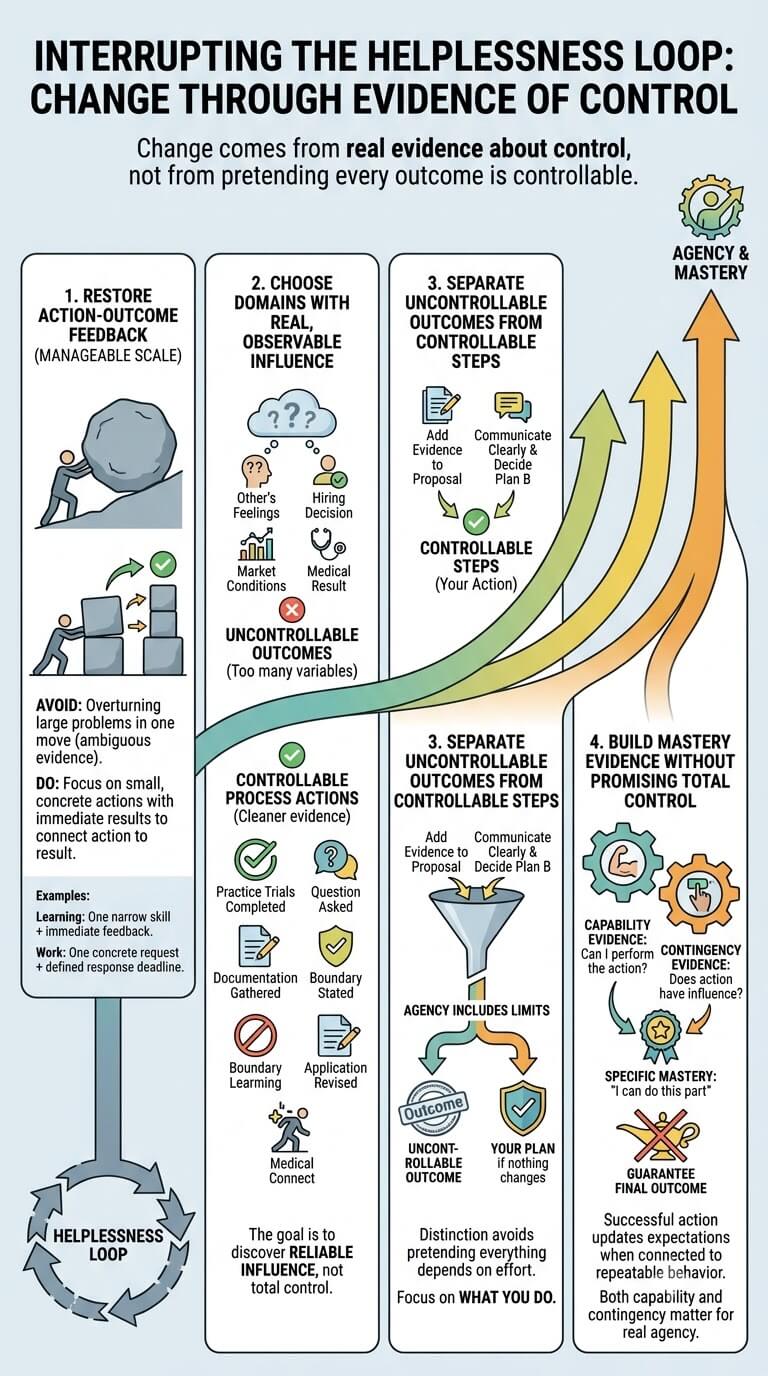
Change comes from evidence about control, not from pretending every outcome is controllable.
Restore action-outcome feedback at a manageable scale
Trying to overturn a large problem in one move often creates ambiguous evidence. Smaller actions are easier to connect with a result.
For learning, the test might be one narrow skill followed by immediate feedback. At work, it might be one concrete request with a defined response deadline. The goal is to discover whether reliable influence exists, not to prove total control.
Choose domains where influence is real and observable
Not every outcome is a good place to test control. Another person’s feelings, a hiring decision, market conditions, or a medical result involve many variables outside one person’s influence.
Process actions are often cleaner: number of practice trials completed, whether a question was asked, whether documentation was gathered, whether a boundary was stated, or whether an application was revised using specific feedback.
Separate uncontrollable outcomes from controllable process steps
You may not control whether a proposal is approved, but you may control whether the proposal includes the required evidence. You may not control whether someone agrees with you, but you may control whether you communicate your position clearly and decide what you will do if nothing changes.
This distinction avoids the opposite error of helplessness, which is pretending that everything depends on personal effort. Real agency includes accurate limits.
Build mastery evidence without promising control over everything
Successful action can update expectations when the result is clearly connected to a repeatable behavior. The evidence should stay specific: “I can do this part” is different from “I can guarantee the final outcome.”
This is where self-efficacy and control meet. Capability evidence answers whether you can perform an action. Contingency evidence answers whether that action has influence in the environment. Both matter, and neither substitutes for the other.
A First-Step Decision Guide
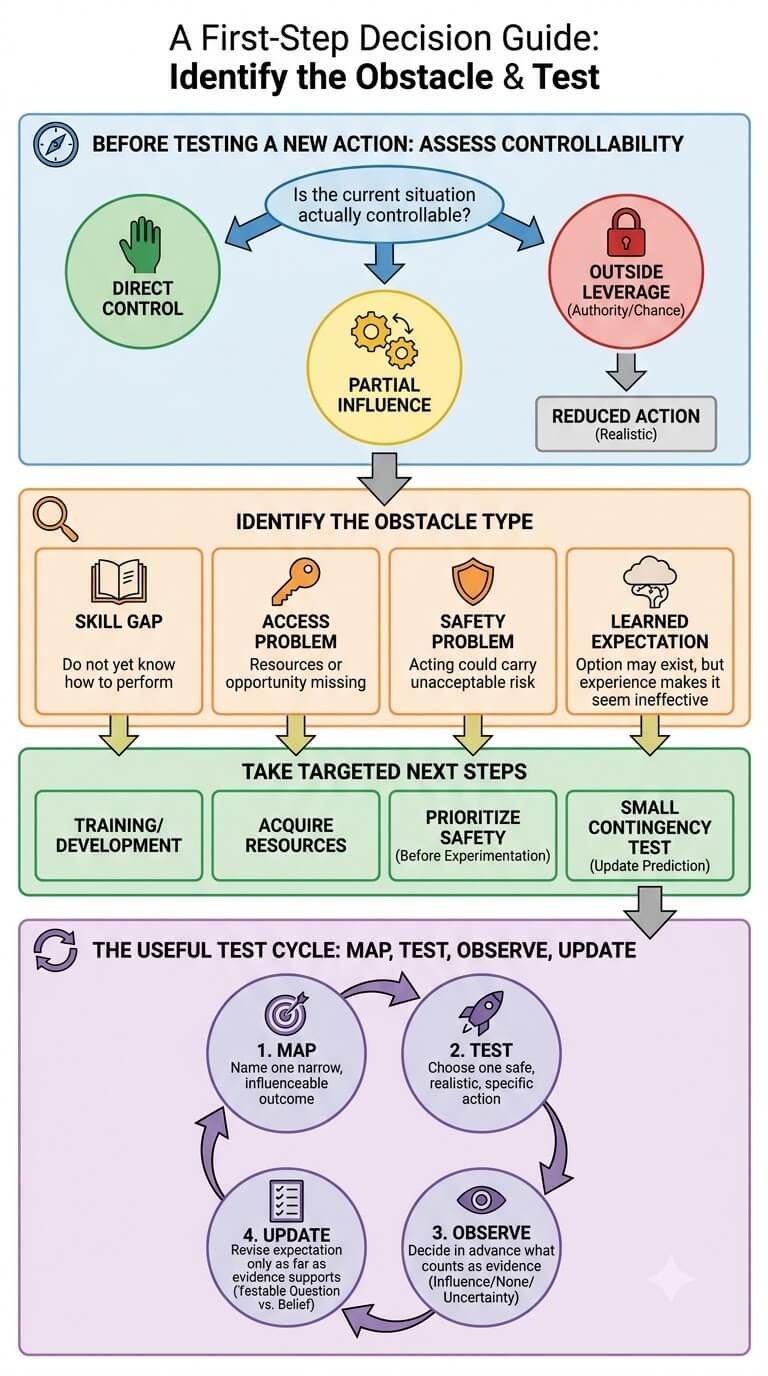
Before testing a new action, identify what kind of obstacle is actually stopping useful effort.
Is the current situation actually controllable?
Before changing a helpless expectation, check reality. Separate direct control, partial influence, and what sits outside your leverage. If the outcome depends almost entirely on authority or chance, reduced action may be realistic.
Is the problem skill, access, safety, or learned expectation?
Four problems can look similar. A skill gap means you do not yet know how to perform the action. An access problem means resources or opportunity are missing. A safety problem means acting could carry unacceptable risk. A learned expectation means an option may exist, but prior experience makes it seem ineffective.
The next step depends on the obstacle. Training may help a skill gap, resources may help an access problem, and safety comes before experimentation when harm is possible. A small contingency test fits when the old prediction itself needs updating.
What small action can test contingency without high cost?
A useful test has four parts: Map, Test, Observe, Update.
- Map: Name one narrow outcome that might be influenceable.
- Test: Choose one action that is safe, realistic, and specific.
- Observe: Decide in advance what result would count as evidence of influence, no influence, or uncertainty.
- Update: Revise the expectation only as far as the evidence supports. One success means this action mattered here, not that everything is controllable.
This replaces “I must believe in myself” with a testable question: “What happens when I do this particular thing under these conditions?”
When “Try Again” Is the Wrong Advice
Persistence is not automatically adaptive when leverage is absent or acting carries meaningful danger.
Ongoing coercion, threats, humiliation, or retaliation
Repeatedly trying harder is not appropriate when another person uses fear, threats, stalking, humiliation, financial control, violence, or retaliation to restrict choices. In such situations, low action may reflect protection rather than a distorted expectation.
Do not use learned helplessness language to imply that someone should simply communicate better with a person who may punish them for speaking up. A safer response may involve trusted support, professional services, local resources, or a plan that reduces exposure to risk.
Environments with genuinely absent leverage or unsafe consequences
Some systems provide little individual control. A person cannot reverse a company closure, force an agency to change policy, or guarantee another person’s cooperation. Persisting without leverage can waste effort without producing useful evidence.
Sometimes agency means redirecting effort toward another pathway, representation, documentation, a different environment, or acceptance that a particular outcome is not currently controllable.
Why safety and external support may come first
When helplessness is combined with isolation, severe hopelessness, or fear, outside support can add information, protection, options, or practical leverage.
Human control is often relational and structural. A supportive person, advocate, clinician, supervisor, legal resource, or community service may change the options that are actually available.
When to Get Professional Support
Some experiences need more than self-reflection, especially when hopelessness or daily impairment becomes severe.
Persistent hopelessness, severe distress, major functional decline, or thoughts of self-harm
Learned helplessness does not explain every period of hopelessness. If hopelessness is persistent, functioning has fallen sharply, or distress feels severe, a qualified mental health professional can help assess what support fits.
If you or someone you know is talking about wanting to die, feeling trapped or hopeless, researching ways to die, or showing other acute warning signs, seek immediate help. The National Institute of Mental Health guidance on suicide warning signs lists signs that warrant prompt attention and crisis resources in the United States. If you are elsewhere, use your local emergency or crisis service.
Educational explanation is not diagnosis or treatment
Reduced effort can appear alongside depression, anxiety, chronic stress, burnout, grief, disability, unsafe relationships, financial strain, or other experiences. An article cannot determine which explanation applies.
The value of the concept is narrower. It can help you ask whether past uncontrollability is influencing current expectations, and whether a safe present-day test could provide better information.
FAQ About Learned Helplessness Psychology
These questions address common points of confusion without turning the concept into a diagnosis.
Is learned helplessness the same as depression?
No. Learned helplessness has historically been used to model some features associated with depression, but the two are not interchangeable. Someone can show a helpless expectation in one domain without having depression, and depression cannot be reduced to one learning mechanism.
Can learned helplessness happen in only one area of life?
Yes. A person may expect low control in one context while showing strong persistence elsewhere. Someone might stop trying to influence workplace decisions after repeated failures but remain proactive in learning, parenting, friendships, or fitness. The more specific the expectation, the easier it is to test whether it still matches the current environment.
Can people unlearn helpless expectations?
Expectations can change when new experience provides credible evidence that action and outcome are connected. This is not forced optimism. Updating works best when safe, specific attempts produce feedback clear enough to interpret.
Does repeated failure always cause learned helplessness?
No. Failure can occur in situations where people still understand what they can change, receive useful feedback, or see a path to improvement. The critical issue is not failure alone but perceived uncontrollability and the expectation that responses are ineffective. People also differ in how they interpret setbacks, what resources they have, and whether later experiences provide evidence of control.
Key Takeaways
- Learned helplessness concerns repeated uncontrollability and an expectation that action will not affect outcomes, not a lack of character.
- The concept is most useful when a history of low control leads to fewer attempts even after new options become available.
- Low motivation, low perceived control, and feeling powerless can look similar but point to different problems and different first steps.
- Modern research has refined the original theory, especially by emphasizing how learning control can shape later responses to stress.
- Small, safe action-outcome tests can provide clearer evidence than pressure to “try harder” or simply think positively.
- When control is genuinely absent or action could trigger coercion, threats, humiliation, stalking, or retaliation, safety and outside support matter more than persistence.
Final Thoughts
If you have stopped trying in one area of life, the most useful first question may not be “How do I become more motivated?” Ask instead: “What did this situation teach me about whether my actions matter, and does that lesson still fit the conditions I am in now?”
Then make the question smaller. Identify one safe outcome, one action that could plausibly influence it, and one piece of feedback you can observe. Update your expectation only as far as that evidence supports. Accurate agency means learning where your actions matter, where they partly matter, and where they do not.
Author note: Michael Reed is Founder & Lead Writer at Psychology Exposed, explaining everyday psychology in clear, research-aware language.

Michael Reed is the Founder and Lead Writer at Psychology Exposed. He writes about human behavior, relationships, emotional patterns, self-awareness, and practical psychology topics using research-informed, easy-to-understand content.
Read More About Michael Reed: https://psychologyexposed.com/michael-reed/