
You can know what you want, feel capable of acting, and still hesitate if the situation seems unresponsive. A job application may depend on a hiring committee. A medical appointment may depend on access and timing. A difficult conversation may depend partly on another person being willing to engage. The key question becomes, “Will anything I do make a meaningful difference here?”
Psychologists often describe that judgment in terms of perceived control or perceived controllability. It matters because people do not respond only to objective circumstances. They also respond to their estimate of how much influence is available. That estimate can be accurate, too low, too high, or still uncertain. Learning to separate those possibilities can make action more realistic without pretending that every outcome is personally controllable.
Quick Answer
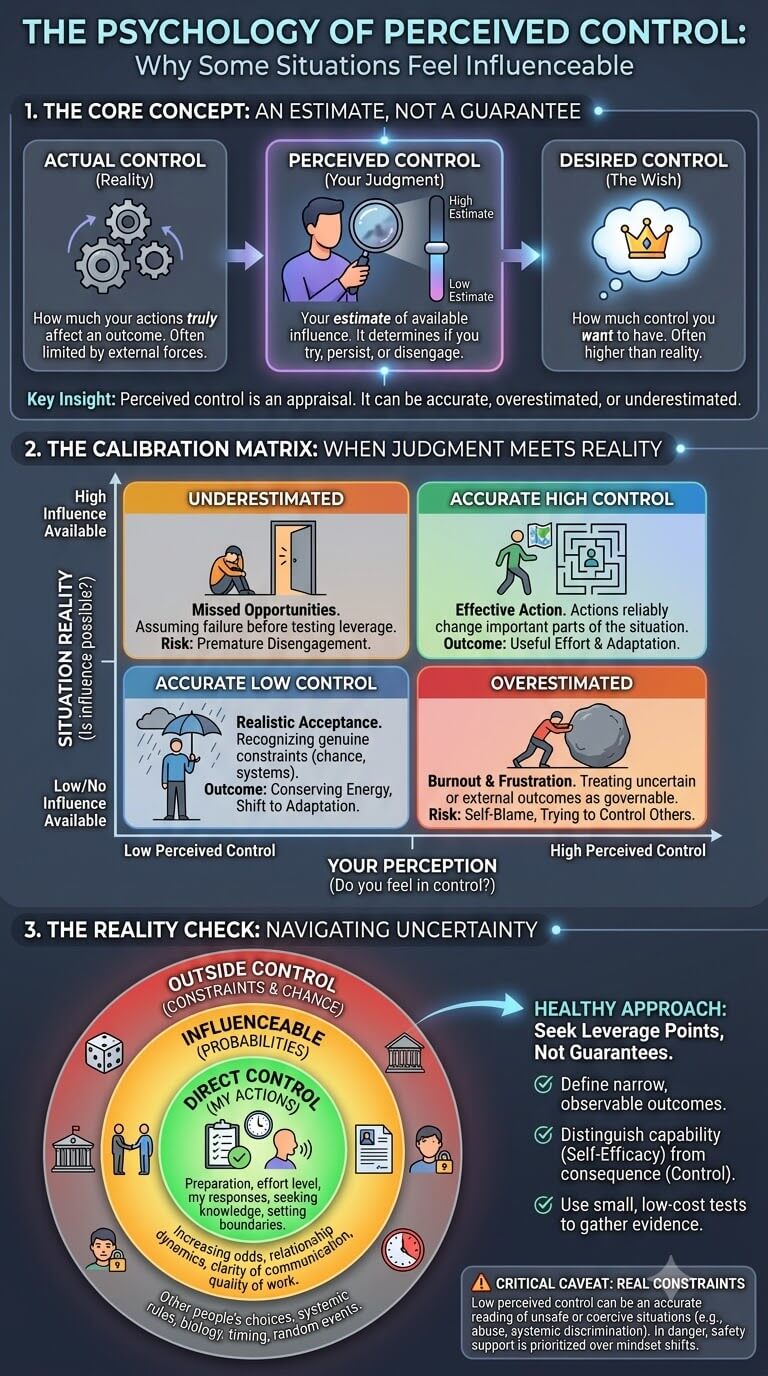
Perceived control is your judgment that your actions can influence what happens in a particular situation. It is not the same as having complete control, and it may not perfectly match reality. A useful question is not “Do I control this outcome?” but “Which parts respond to my actions, which parts are only influenceable, and which parts are outside my control?”
Perceived Control Is an Appraisal, Not a Guarantee
Perceived control is best understood as an estimate. You are looking at a situation and predicting whether your behavior has enough leverage to change its course. That prediction can shape whether you prepare, persist, ask for help, change strategy, or disengage.
Actual control, perceived control, and desired control
These three ideas are easy to mix together. Actual control refers to how much your actions truly affect an outcome. Perceived control is your current estimate of that influence. Desired control is how much control you would like to have.
Imagine waiting to hear whether a landlord accepts your rental application. You may strongly want control over the decision, but your actual control is limited. You can submit complete documents, respond quickly, and present accurate information. You cannot decide which applicant the landlord chooses. If you tell yourself, “There is nothing I can do at all,” you may underestimate the process variables you still control. If you tell yourself, “If I do everything perfectly, I can make them choose me,” you may overestimate your influence.
Why uncertainty makes control judgments harder
Control is easiest to judge when feedback is fast and consistent. If pressing a light switch turns on the light every time, the action-outcome relationship is obvious. Human situations are usually messier. Feedback is delayed, several causes operate at once, and the same action may work in one setting but not another.
A review in PubMed Central on perceived control describes choice opportunities, action-outcome contingency, and reward history as important inputs to perceived control. In ordinary life, those signals are rarely perfectly clean.
How the Mind Estimates Controllability
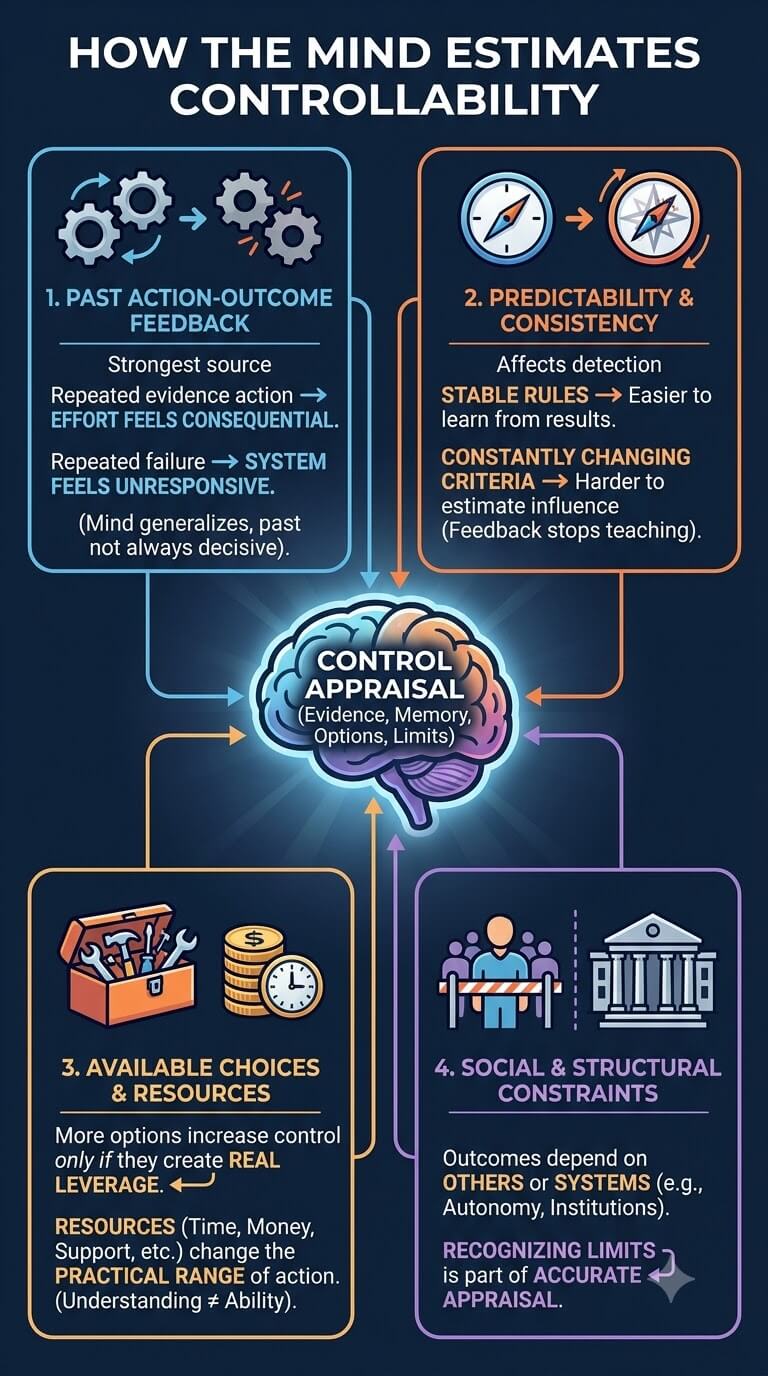
Your sense of control is not created from one thought. It is built from evidence, memory, current options, and the limits of the environment. Four inputs are especially useful to examine when a situation feels either highly controllable or completely fixed.
Past action-outcome feedback
One of the strongest sources of perceived control is repeated evidence that an action changes what happens next. If practicing a presentation makes your delivery noticeably smoother, effort begins to feel consequential. If every reasonable attempt to resolve a billing problem leads to the same automated rejection, the system may start to feel unresponsive.
The mind also generalizes. Repeated failure can lower control expectations even after circumstances change, so past experience is informative but not always decisive.
Predictability and consistency
Predictability is not identical to control, but it affects how easy control is to detect. When rules are stable, you can compare one action with another and learn from the results. When expectations constantly change, the same behavior produces different consequences, making the environment harder to read.
At work, stable criteria help you learn which actions improve your chances even when approval is not guaranteed. Constantly changing criteria make influence harder to estimate because feedback stops teaching you what works.
Available choices and resources
More options can increase perceived control, but only when they create real leverage. Access to a second provider, a different schedule, a new method, or someone who can clarify the process may genuinely expand what you can affect.
Resources matter too. Time, money, health, transportation, knowledge, authority, social support, and access can all change the practical range of available action. A person may understand a solution and still have little real ability to carry it out under current conditions.
Social and structural constraints
Many outcomes depend on other people or systems. A teacher can offer feedback, but cannot make a student practice. An employee can request clearer priorities, but cannot unilaterally redesign a company. A partner can communicate respectfully, but cannot control whether the other person responds honestly.
Recognizing constraints is part of accurate control appraisal. Realistic influence includes personal leverage as well as limits imposed by other people’s autonomy, institutions, health realities, chance, and timing.
High, Low, and Miscalibrated Perceived Control
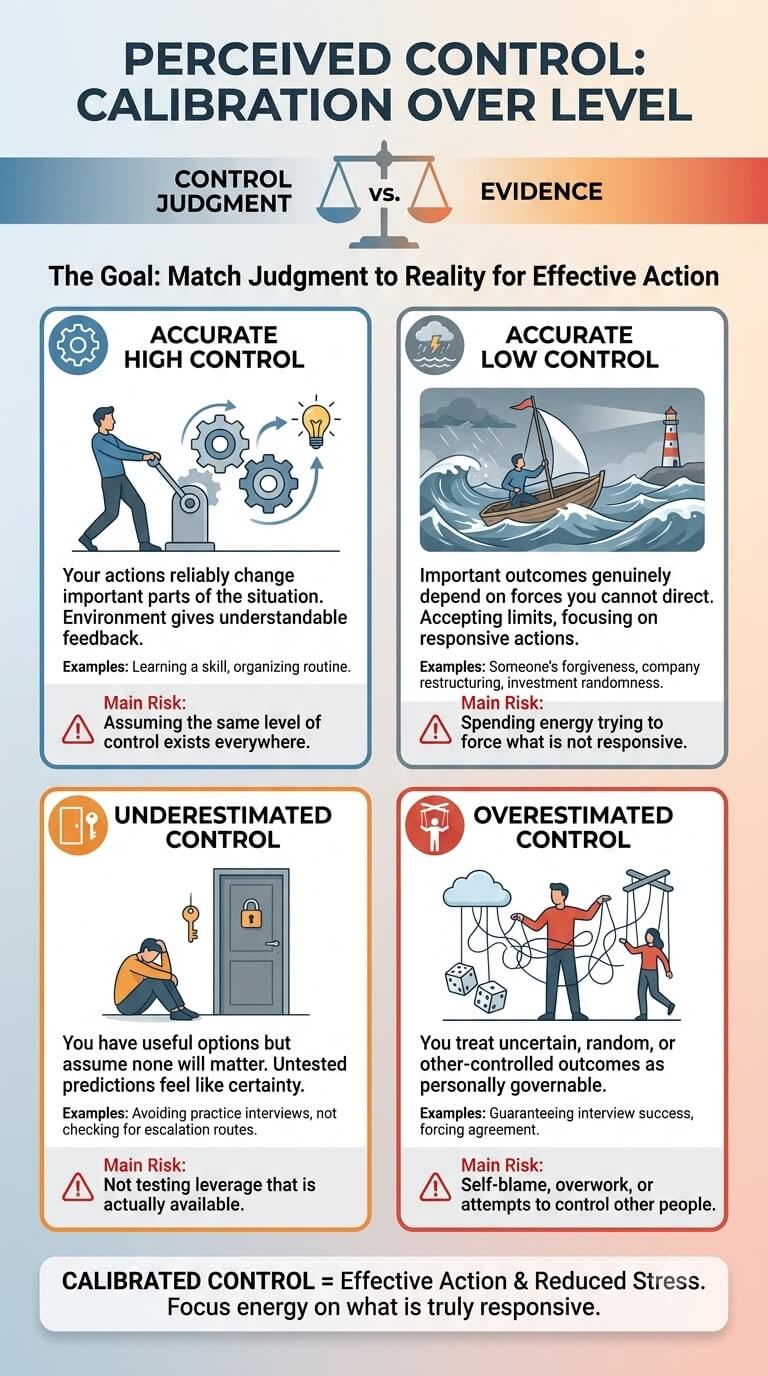
A high sense of control is not automatically good, and a low sense of control is not automatically unhealthy. The more useful question is whether the judgment fits the evidence well enough to guide effective action.
| Control judgment | What it may look like | Main risk |
|---|---|---|
| Accurate high control | Your actions reliably change important parts of the situation | Assuming the same level of control exists everywhere |
| Accurate low control | Important outcomes genuinely depend on forces you cannot direct | Spending energy trying to force what is not responsive |
| Underestimated control | You have useful options but assume none will matter | Not testing leverage that is actually available |
| Overestimated control | You treat uncertain, random, or other-controlled outcomes as personally governable | Self-blame, overwork, or attempts to control other people |
Accurate high control
High perceived control is well calibrated when your actions have a clear and repeatable effect. If you are learning a software skill, practice quality and repetition may strongly influence your performance. If you are organizing your morning, preparing the night before may reliably reduce rushing.
In these situations, action is useful because the environment gives understandable feedback. You can adjust and see whether the adjustment works.
Accurate low control
Sometimes the honest answer is that control is limited. You cannot make someone forgive you, guarantee a diagnosis will be simple, choose how a company restructures, or eliminate randomness from an investment. Accepting low outcome control does not require giving up on every meaningful action.
It means narrowing attention to what remains responsive: preparing questions, seeking another opinion, updating a résumé, setting a boundary, changing exposure, or choosing how much additional effort is worth investing.
Underestimating available influence
People can miss leverage when they assume a difficult outcome is fixed before testing the process. Someone may say, “I am terrible at interviews,” when they have never recorded a practice answer or asked for specific feedback. Another person may assume a service problem cannot be resolved without checking whether there is an escalation route.
Underestimation can feel like certainty even when it is an untested prediction. A small experiment may reveal more than continued speculation.
Overestimating control over chance or other people
The opposite error is treating influence as command. You may be able to improve the probability of a result without being able to guarantee it. Preparing well for an interview can increase your chances, but another applicant may still be selected. Explaining your needs clearly can improve a conversation, but it cannot force agreement.
Overestimating control becomes costly when every unwanted outcome is interpreted as proof that you failed to do enough. It can also slide into controlling behavior when another person’s independent choices are treated as something you should be able to manage.
Perceived Control vs Locus of Control
These ideas overlap, but they answer different questions. Keeping them separate helps explain why the same person may show a strong internal orientation in general while feeling very little control in a specific situation.
Situation-specific appraisal versus generalized outcome belief
Perceived control asks: “Can my actions influence this situation now?” Locus of control concerns broader expectations about whether outcomes tend to be shaped by one’s own behavior or by external forces such as chance, circumstances, or powerful others.
A person who generally believes effort matters may still accurately judge that a particular flight cancellation is outside their control. Someone who often sees outcomes as externally shaped may still recognize that they have substantial control over how thoroughly they prepare for tomorrow’s exam.
Examples where the two do not match
A founder may have a strong internal orientation about business performance but low perceived control during a sudden regulatory change. A patient may believe personal habits matter for health while also recognizing that a particular medical outcome is not fully controllable. A parent may believe their choices strongly affect family life while knowing they cannot directly control a teenager’s private thoughts or every decision.
Acknowledging an external constraint does not automatically mean someone has an external orientation. Sometimes it is simply an accurate reading of the current situation.
Perceived Control vs Personal Agency
Control is an important part of feeling able to act, but it is not the whole story. People may retain meaningful choice even when they have limited control over the final result.
Control is one ingredient of agency
Personal agency includes acting intentionally, making choices, selecting goals, adjusting strategies, and responding to feedback. Perceived control contributes to this because people are more likely to act when they expect action to matter.
Still, agency also includes deciding what to do when control is incomplete. You may not control whether a proposal is approved, but you can decide whether to submit it, improve it, ask for feedback, or redirect your effort elsewhere.
Agency can remain through choice and adaptation even when outcome control is limited
During uncertainty, a person may be unable to speed up a decision yet still choose how to prepare for several outcomes. Persistent constraints can also leave meaningful choices about support, pacing, boundaries, information, and where to invest limited energy.
Agency does not require pretending that constraints are smaller than they are. It is often strongest when action is matched to reality.
Perceived Control vs Self-Efficacy
These two concepts are easy to confuse because both influence whether people attempt difficult actions. The simplest distinction is between capability and consequence.
Can I do the action? versus Can the action matter?
Self-efficacy concerns your belief that you can perform a specific action or behavior. Perceived control concerns whether performing that action can influence the situation.
You might feel highly capable of writing a strong appeal letter but believe the decision process is rigid. That is high self-efficacy with low perceived control. Or you may know that regular practice would improve your speaking skill but doubt your ability to practice effectively. That is higher perceived control with lower self-efficacy.
Four combinations that predict different behavior
| Capability belief | Perceived control | Likely experience | Useful next question |
|---|---|---|---|
| High | High | “I can do this, and it should matter.” | What is the next effective action? |
| High | Low | “I can perform well, but the system may not respond.” | Where is there still leverage? |
| Low | High | “The action would matter, but I do not yet feel capable.” | What skill or support would increase capability? |
| Low | Low | “I doubt both my ability and the usefulness of trying.” | Which belief can be tested first at low cost? |
The remedy therefore differs. Training will not fix an environment that ignores the action, and optimism will not build a missing skill.
Why Low Perceived Control Changes Behavior
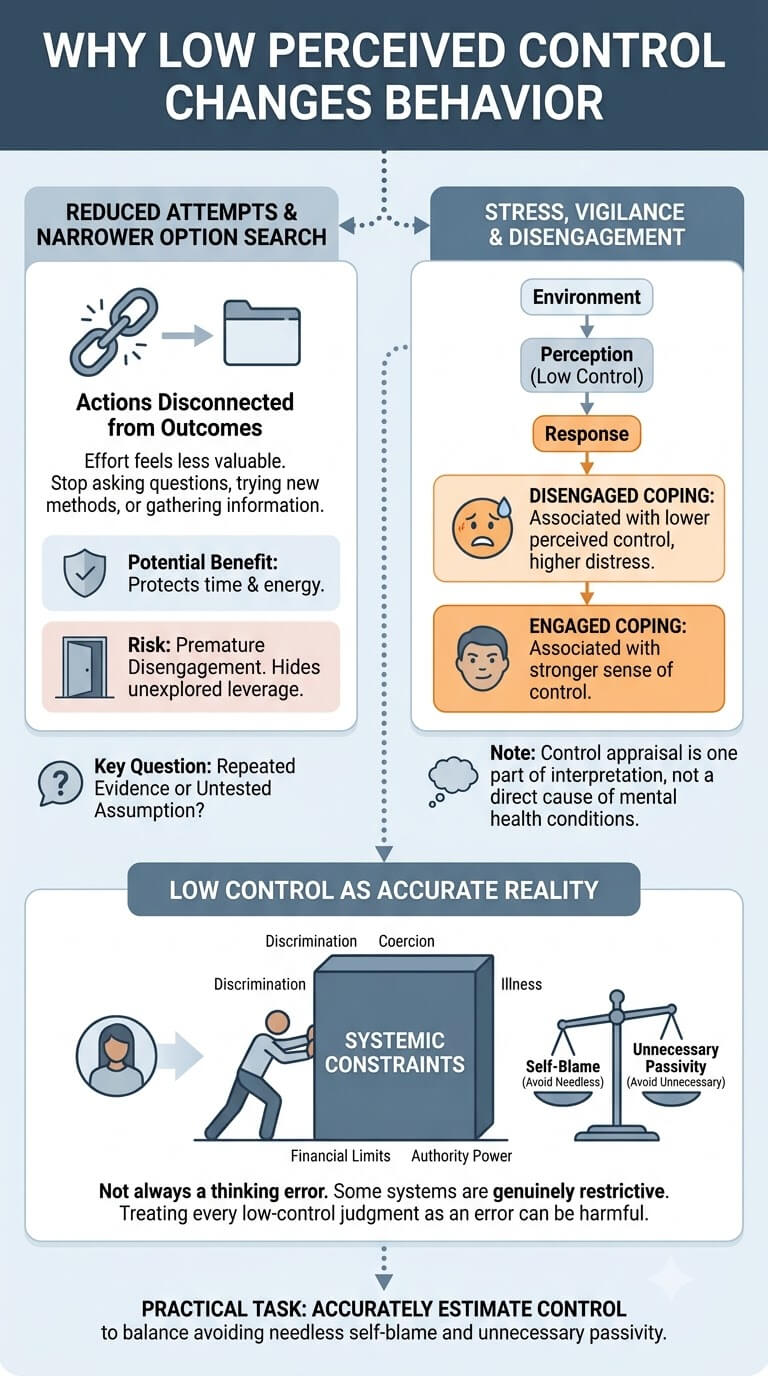
When actions seem disconnected from outcomes, effort starts to look less valuable. That can change attention, persistence, coping, and willingness to search for options.
Reduced attempts and narrower option search
If you expect your behavior to make no difference, experimenting with alternatives can feel wasteful. You may stop asking questions, trying another method, or gathering information. Sometimes that protects time and energy. Other times it closes the search too early.
The key question is whether low control comes from repeated evidence or an untested assumption. Premature disengagement can hide leverage that has not yet been explored.
Stress, vigilance, and disengagement when outcomes seem uncontrollable
Perceived control has long been studied in relation to stress and coping. One open-access study found that coping styles involving greater engagement were associated with a stronger perceived sense of control, while more disengaged coping was associated with lower perceived control in its sample. The authors describe stress as an environment-perception-response process rather than a simple property of the event itself. You can read the study in PubMed Central.
This does not mean that feeling in control prevents distress or that low control causes a mental health condition. Control appraisal is simply one part of how a difficult situation is interpreted and approached.
Why low control is sometimes an accurate reading of reality
Psychology advice becomes harmful when every low-control judgment is treated as a thinking error. Some systems are genuinely restrictive. Some outcomes depend on resources a person does not have. Some people face discrimination, coercion, illness, financial limits, or decisions made by authorities with far more power.
The practical task is to estimate control accurately enough to avoid both needless self-blame and unnecessary passivity.
A Control-Appraisal Self-Check
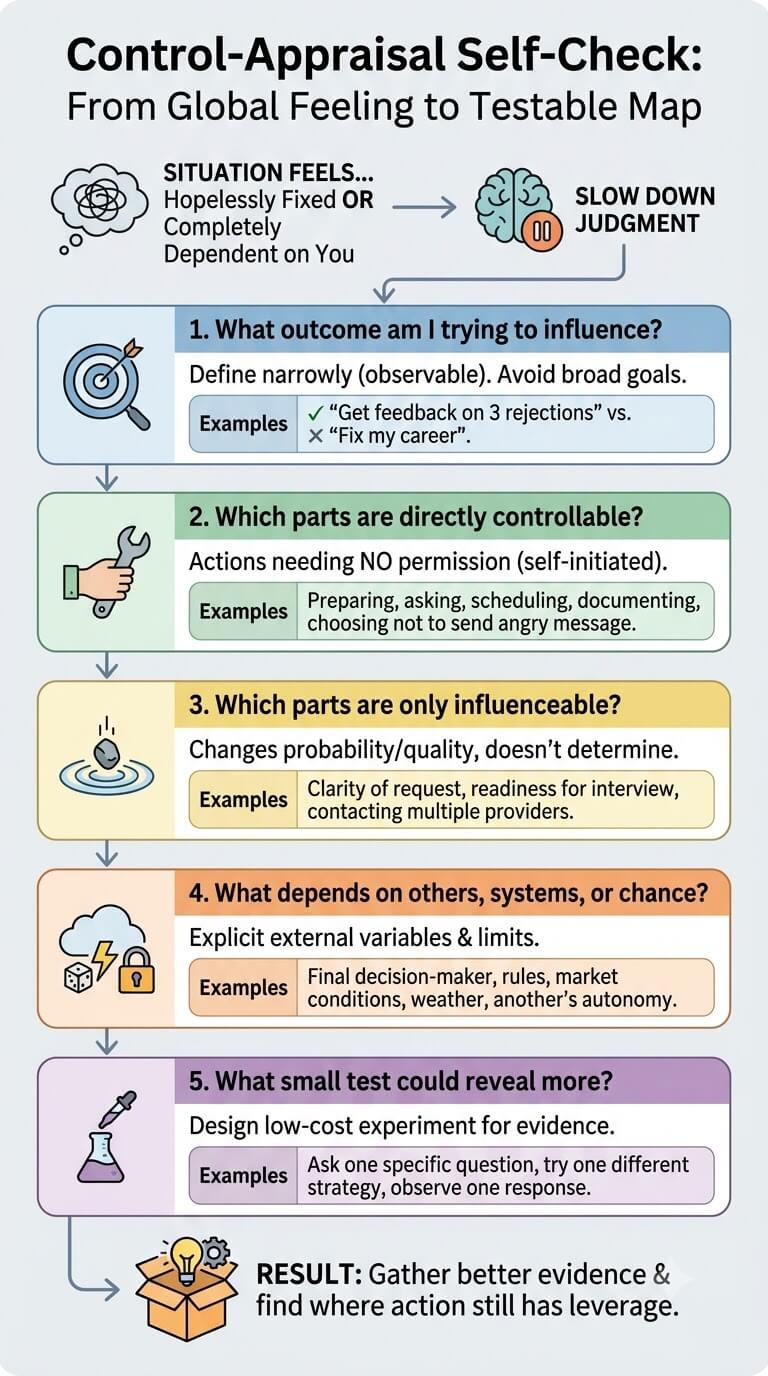
When a situation feels either hopelessly fixed or completely dependent on you, slow the judgment down. The following five questions turn a global feeling into a more testable map.
What outcome am I trying to influence?
Define the outcome narrowly. “Fix my career” is too broad. “Get useful feedback on why my last three applications were rejected” is observable. “Make this relationship work” is too broad. “Find out whether we can agree on one boundary around weekend plans” is more specific.
Which parts are directly controllable?
List actions that do not require someone else’s permission once you decide to do them. Examples include preparing, documenting, practicing, asking, leaving an optional situation, scheduling, seeking information, or choosing not to send a message while angry.
Which parts are only influenceable?
Influence means your action changes the probability or quality of an outcome without determining it. You can influence how clearly a request is understood. You can influence your readiness for an interview. You can influence the chance of finding an appointment by contacting several providers.
What depends on other people, systems, or chance?
Name the external variables explicitly. Who makes the final decision? Which rule limits options? What depends on timing, biology, market conditions, weather, or another person’s autonomy?
What small test could reveal more?
If control is uncertain, design a low-cost experiment. Ask one specific question. Try one different strategy. Request written criteria. Practice once and measure the result. Set one boundary and observe the response. Contact one additional resource.
The purpose is to gather better evidence about where action still has leverage.
First Steps When Control Feels Low
Low control often produces a wish for a dramatic solution. A more reliable approach is to reduce the problem to the smallest variables that still respond to action.
Move from total outcome control to controllable process variables
If you cannot control whether a company hires you, you may still control how many suitable roles you apply for, how well you tailor your materials, and whether you seek feedback. If you cannot control another person’s mood, you may still control whether you speak respectfully and whether you remain in a conversation that becomes demeaning.
Look for leverage points, not guarantees
A leverage point is an action that changes the odds, information, or options available. It may be small. Asking for the decision criteria can turn a vague problem into a specific one. Getting a second opinion can reveal an option you did not know existed. Practicing a weak subskill can improve a task even if the final outcome remains uncertain.
Stop spending effort where feedback repeatedly shows no influence
Persistence is useful only when the environment responds enough to teach you something. If repeated, reasonable attempts produce no change and no new information, continuing the same behavior may become expensive.
At that point, adaptation may be wiser than persistence: change the goal, change the route, seek outside help, or protect limited resources.
When Low Control Starts to Generalize
Feeling low control in one situation is not the same as learned helplessness. A person can accurately recognize that a specific outcome is not responsive to their effort and still stay active in other areas.
Low perceived control is not automatically helplessness
Helplessness involves a broader learned expectation that attempts will not matter, often after repeated experiences of uncontrollability. The important shift is from “I cannot change this particular outcome” to “Trying does not work, even when circumstances change.”
A 2025 open-access review on learned helplessness and learned controllability discusses how repeated experiences of uncontrollability can shape later expectations and behavior. That mechanism deserves separate attention because it goes beyond an accurate low-control judgment in a single situation.
Repeated uncontrollability can alter what people expect from new situations
Past failure can become a forecast. Someone who repeatedly had no voice in one environment may enter a new environment assuming requests will be ignored. A person whose attempts to solve a problem repeatedly failed may stop noticing when better options become available.
The corrective process is to separate old evidence from current evidence and test whether the new environment responds differently.
When Low Control Reflects an Unsafe or Coercive Situation
There are situations where low perceived control reflects a real power imbalance rather than a distorted appraisal. If someone uses threats, humiliation, stalking, intimidation, financial restriction, isolation, or retaliation to control another person, the central problem is not mindset.
Fear, threats, humiliation, retaliation, stalking, or coercion change the advice
In coercive situations, “communicate more clearly” or “take more responsibility” may be inappropriate and can increase risk. The National Domestic Violence Hotline describes abuse as involving patterns of power and control, including nonphysical tactics that restrict another person’s choices.
If you are afraid of what may happen when you disagree, leave, seek help, or set a boundary, treat that fear as important information. You do not need to prove that your perception is irrational before taking safety seriously.
Safety support can matter more than mindset work
A qualified local service, advocate, clinician, trusted support person, or emergency resource may help you think through options that account for real-world risk. If there is immediate danger, contact local emergency services where you live.
These ideas should never be used to blame someone for having limited options in an unsafe situation.
FAQ About Perceived Control Psychology
Can perceived control be wrong?
Yes. People may underestimate influence because of past failure, uncertainty, incomplete information, or a changed environment. They may also overestimate control when outcomes depend heavily on chance, systems, biology, or another person’s choices. The useful response is not to force a more positive belief. It is to compare the belief with evidence, feedback, and small tests.
Is feeling in control always beneficial?
No. A realistic sense of influence can support action, but excessive perceived control can create over-responsibility and self-blame. It can also encourage people to keep trying to manage outcomes that do not respond to them. Accurate low control can sometimes protect time, energy, and emotional resources by showing when adaptation is wiser than persistence.
How is perceived control different from locus of control?
Perceived control is usually about how influenceable a particular situation feels. Locus of control is a broader belief about whether outcomes tend to depend more on personal actions or external forces. The two can differ. Someone can generally believe effort matters while correctly recognizing that a specific decision is outside their control.
Can someone have strong self-efficacy but low perceived control?
Yes. You may believe you can perform an action well while also believing the action will not determine the outcome. A skilled employee may know they can produce excellent work but have little control over a company-wide layoff. A confident applicant may know they can interview well but cannot control who is ultimately selected.
Key Takeaways
- Perceived control is your estimate of whether your actions can influence a specific situation, not a guarantee that you can determine the outcome.
- Actual control, perceived control, and desired control can differ, especially when feedback is delayed or several forces shape the result.
- Low perceived control is not automatically irrational. Some situations genuinely involve limited options, structural constraints, chance, or another person’s autonomy.
- Self-efficacy asks whether you can perform an action; perceived control asks whether performing it can make a difference.
- A useful self-check separates direct control, partial influence, external constraints, and small tests that can provide better evidence.
- If low control is connected to fear, coercion, threats, stalking, humiliation, or retaliation, safety support is more important than trying to think your way into feeling more control.
Final Thoughts
When a situation feels uncontrollable, the next useful step is not necessarily to push harder. Define one specific outcome, separate what you control from what you merely influence, name the external limits, and choose one small action that can produce information. If the action changes nothing, that is evidence too. Good control appraisal is not about believing you are powerful in every situation. It is about putting effort where reality gives it somewhere to land.
Author note: Michael Reed, Founder & Lead Writer at Psychology Exposed, writes about human behavior, self-awareness, emotional patterns, and everyday psychology in clear, research-aware language. This article is educational and is not a substitute for individualized mental health, medical, legal, or safety advice.

Michael Reed is the Founder and Lead Writer at Psychology Exposed. He writes about human behavior, relationships, emotional patterns, self-awareness, and practical psychology topics using research-informed, easy-to-understand content.
Read More About Michael Reed: https://psychologyexposed.com/michael-reed/