
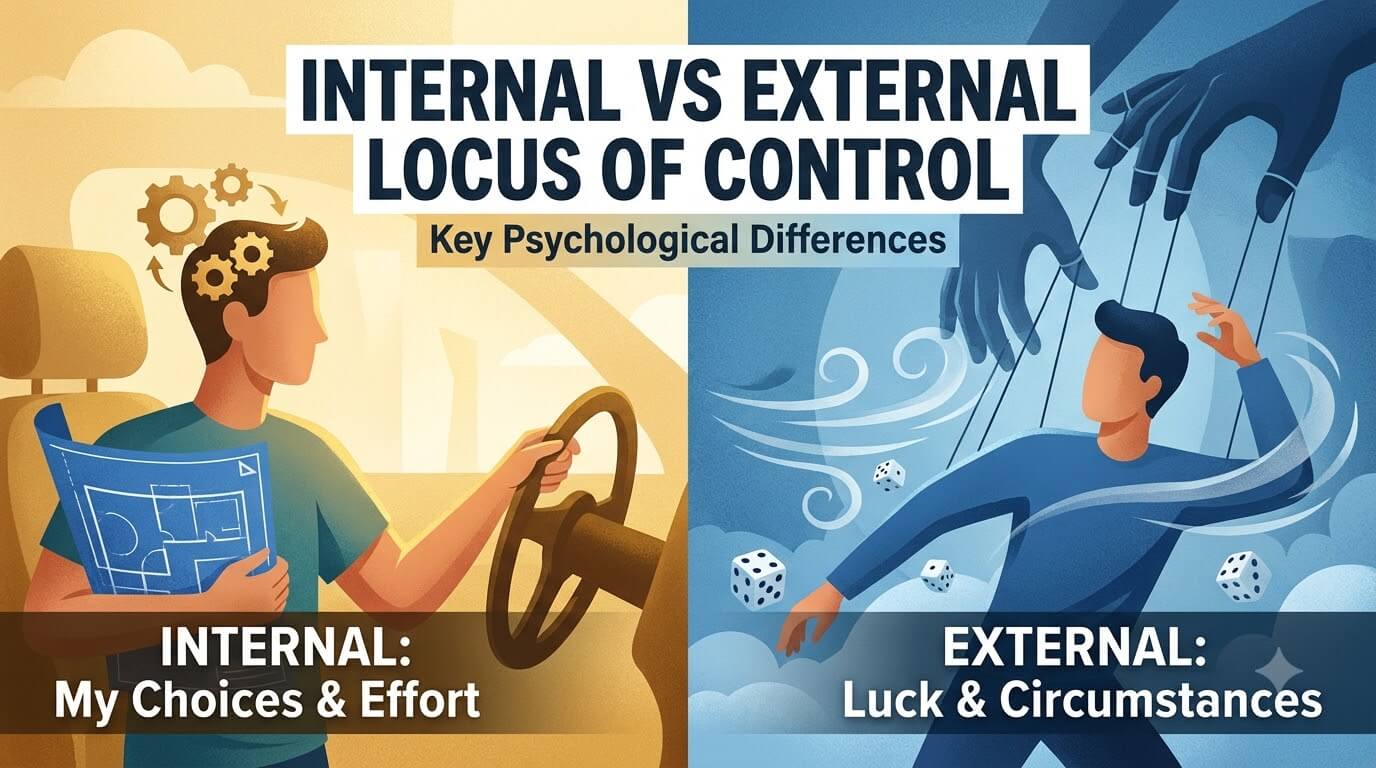
Two people can face the same setback and walk away with very different explanations. One thinks, “I need a better strategy next time.” The other thinks, “The decision was mostly in someone else’s hands.” Neither response is automatically accurate or inaccurate. The useful question is how closely the explanation matches what actually shaped the outcome.
This is the practical difference between an internal and external locus of control. An internal orientation gives more weight to personal actions, choices, effort, and strategy. An external orientation gives more weight to chance, systems, powerful other people, timing, and conditions outside personal control. Most people use both kinds of explanations, and the balance often changes from one area of life to another.
Understanding that balance matters because control beliefs influence what you try next. If you see influence where it really exists, you are more likely to test a new action. If you see control where none exists, you may blame yourself for outcomes you could not realistically produce. If you see only external forces, you may overlook small but meaningful ways to influence what happens next.
Quick Answer
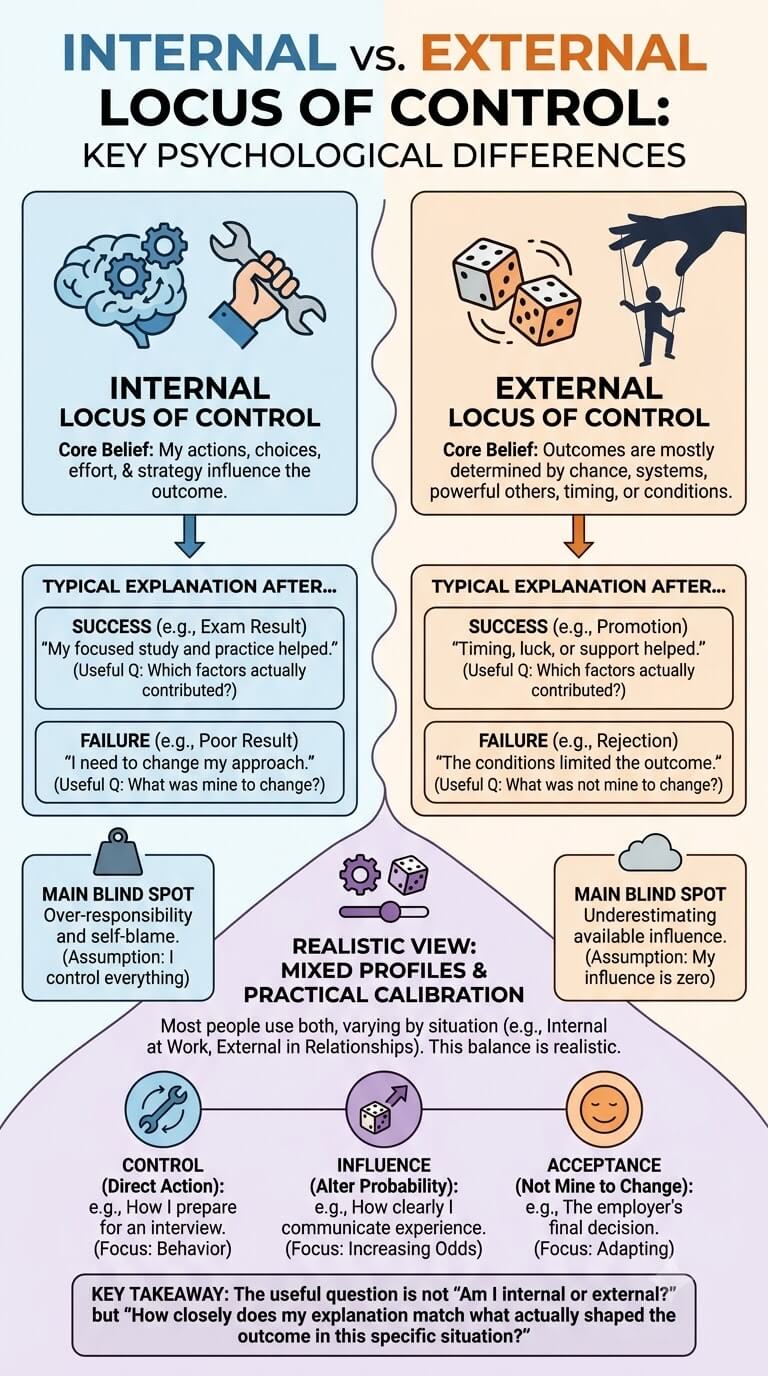
Internal locus of control means you tend to expect your actions, choices, effort, or abilities to influence outcomes. External locus of control means you give more weight to chance, circumstances, systems, or powerful others. People are rarely purely one or the other. A realistic pattern often changes by situation and reflects both personal influence and genuine external limits.
The Core Difference: Where Do You Expect Control to Come From?
The APA Dictionary of Psychology describes locus of control as a way of understanding how people perceive control over the conditions and outcomes of their lives. The internal-external distinction is therefore less about personality labels and more about expectations: when something important happens, what do you think usually made the difference?
Internal orientation: effort, decisions, strategy, and behavior matter
A more internal explanation emphasizes the connection between what you do and what follows. After a strong exam result, you might credit focused study and practice. After a poor result, you might examine how you prepared, whether you misunderstood the task, or whether your strategy needs to change.
This orientation can encourage experimentation because action feels worth testing. If you believe preparation matters, then changing preparation is a sensible next move. But internality is not the same as believing you control everything. A calibrated internal explanation leaves room for limits, uncertainty, and other people’s choices.
External orientation: chance, systems, powerful others, and circumstances matter
A more external explanation emphasizes forces that sit outside your direct action. You may see a promotion as heavily influenced by management preferences, an investment result as shaped by the market, or a travel delay as caused by weather. External control can also refer to powerful others, meaning people or institutions whose decisions affect your outcome.
Research in health psychology often separates external control into distinct forms such as chance and powerful others rather than treating every outside influence as one thing. A systematic review of health locus of control discusses these different external sources and shows why “outside me” is too broad to be a useful explanation on its own.
Side-by-Side Comparison of Internal and External Locus of Control
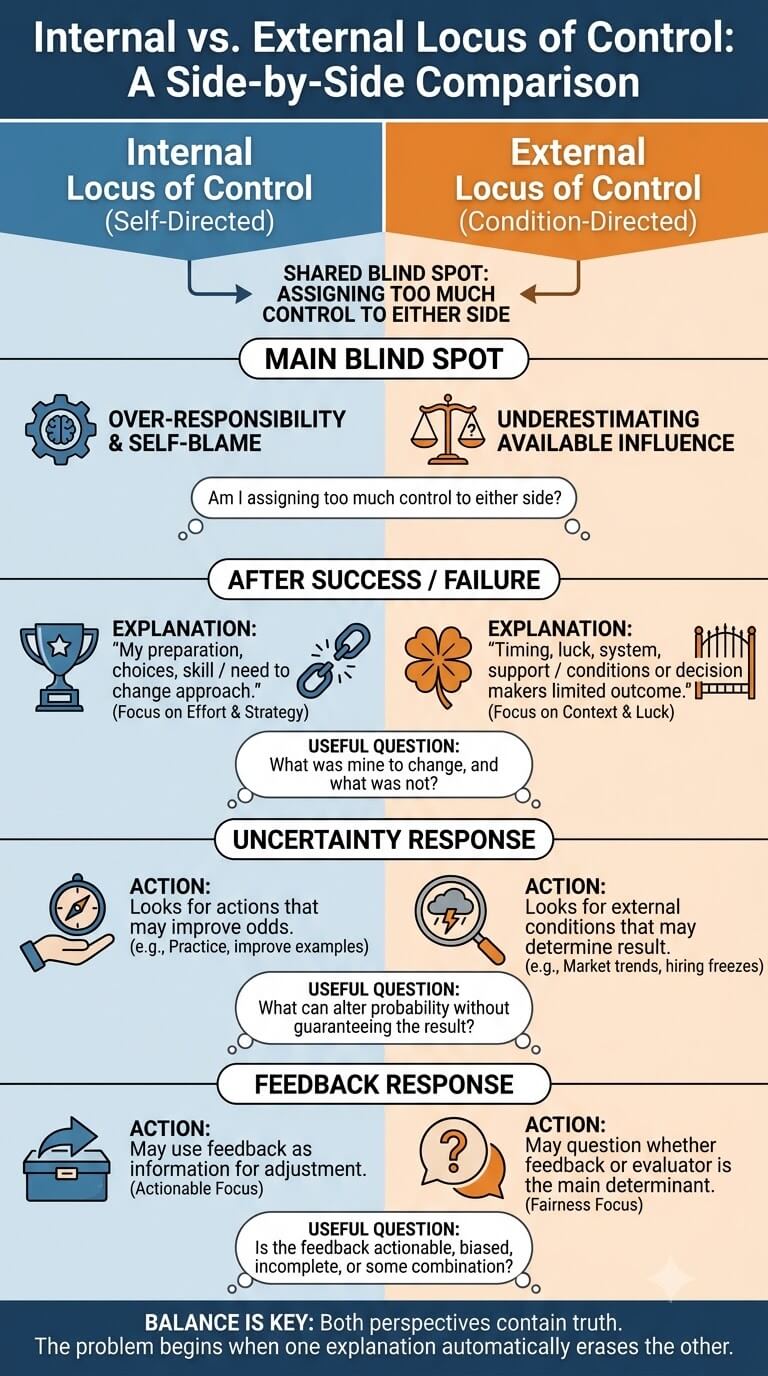
The clearest way to compare the two orientations is to look at what each one predicts after success, failure, uncertainty, and feedback. The table below shows common tendencies, not fixed rules.
| Situation | More internal explanation | More external explanation | Useful question |
|---|---|---|---|
| Success | “My preparation, choices, or skill helped.” | “Timing, luck, support, or the system helped.” | Which factors actually contributed? |
| Failure | “I need to change something in my approach.” | “The conditions or decision makers limited the outcome.” | What was mine to change, and what was not? |
| Uncertainty | Looks for actions that may improve odds. | Looks for external conditions that may determine the result. | What can alter probability without guaranteeing the result? |
| Feedback | May use feedback as information for adjustment. | May question whether feedback or the evaluator is the main determinant. | Is the feedback actionable, biased, incomplete, or some combination? |
| Main blind spot | Over-responsibility and self-blame. | Underestimating available influence. | Am I assigning too much control to either side? |
Typical explanation after success
Someone leaning internal may say, “The presentation went well because I rehearsed and simplified the slides.” Someone leaning external may say, “The audience happened to be interested in the topic and the questions were easy.” Both explanations could contain truth. The problem begins when one explanation automatically erases the other.
Typical explanation after failure
Internal explanations after failure often turn attention toward strategy: “What could I do differently?” External explanations turn attention toward conditions: “What blocked the result?” Both questions are valuable. The first becomes harmful when it implies that every loss proves a personal failure. The second becomes limiting when it becomes a reason not to test any available alternative.
Response to uncertainty
Under uncertainty, an internal orientation often searches for leverage. A job applicant may improve examples, practice interviews, and apply more selectively. An external orientation may pay closer attention to the labor market, hiring freezes, internal candidates, or the preferences of a particular employer.
Response to feedback
People who lean internal may be quicker to treat feedback as something they can act on. That can be useful, but only if the feedback is credible. People who lean external may be more likely to ask whether the evaluator, system, or context is fair. That question can also be useful, especially when standards are inconsistent.
Main blind spot of each orientation
The internal blind spot is assuming responsibility for too much. The external blind spot is assuming influence is too small. These errors can look very different emotionally, but both come from an inaccurate estimate of causality.
Everyday Examples by Domain
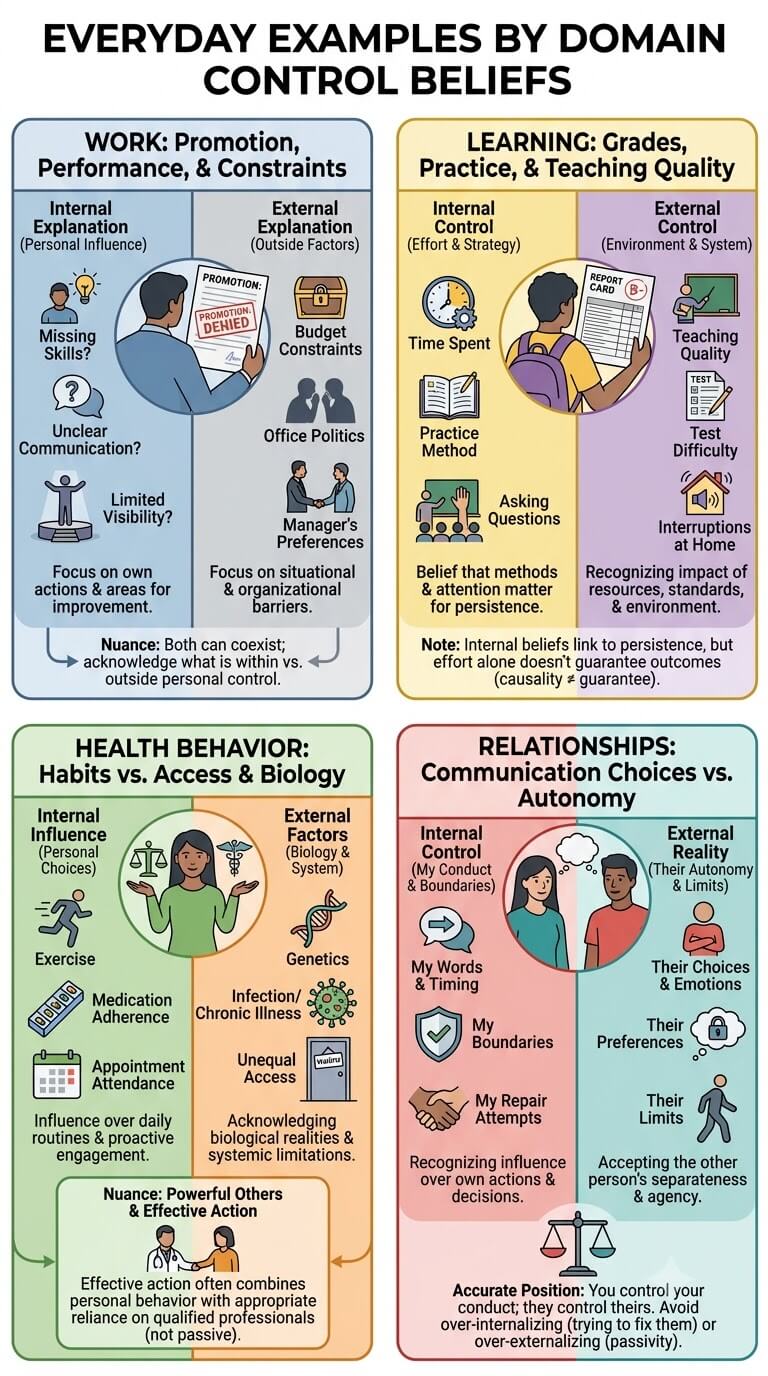
Control beliefs become easier to understand when you compare how the same person may reason differently across work, learning, health, and relationships.
Work: promotion, performance, and organizational constraints
Imagine you are passed over for a promotion. An internal explanation might focus on missing skills, unclear communication of achievements, or limited visibility. An external explanation might focus on budget constraints, office politics, a preselected candidate, or a manager’s preferences.
Learning: grades, practice, and teaching quality
In learning, internal control often appears as a belief that practice method, attention, asking questions, and time spent matter. External control may show up as attention to teaching quality, grading standards, test difficulty, access to tutoring, or interruptions at home.
Academic research has often found associations between more internal beliefs and persistence or learning behaviors, but that does not mean educational outcomes are created by effort alone. Even the APA description of the Rotter Internal-External Locus of Control Scale frames the construct around beliefs about causality, not a guarantee that personal effort will override every circumstance.
Health behavior: habits versus access and biology
Health is one of the clearest examples of why the internal-external comparison needs nuance. A person can influence sleep routines, appointment attendance, exercise, medication adherence, or whether they ask questions. They cannot simply choose away genetics, an infection, chronic illness, medication side effects, or unequal access to care.
Studies of health locus of control often examine internal beliefs, chance beliefs, and beliefs about powerful others such as clinicians as separate dimensions. This is a useful reminder that accepting medical expertise is not the same as passively believing nothing you do matters. In many health situations, effective action includes both personal behavior and appropriate reliance on qualified professionals.
Relationships: communication choices versus another person’s autonomy
In relationships, internal control means recognizing your influence over your words, timing, boundaries, repair attempts, and decisions about participation. External control means recognizing that the other person has their own preferences, emotions, choices, and limits.
Over-internalizing relationship outcomes can lead to thoughts such as, “If I just communicate perfectly, I can make them understand, stay, change, or treat me differently.” That is too much control. Over-externalizing can sound like, “Nothing I say matters, so there is no point being clear about what I need.” A more accurate position is that you control your conduct and decisions, while the other person controls theirs.
Mixed Profiles Are More Realistic Than Labels
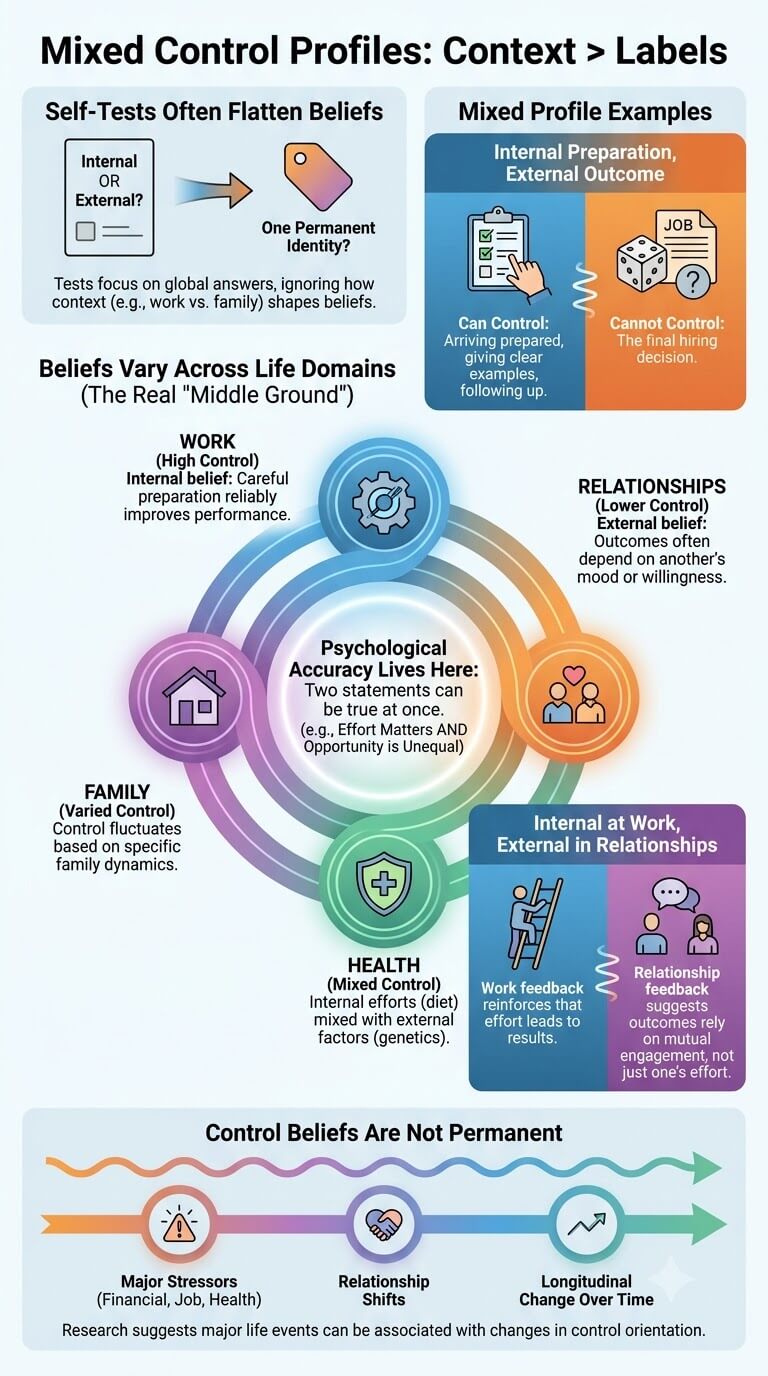
Simple self-tests can be useful conversation starters, but they often flatten a belief that is strongly shaped by context. A person who answers globally may think about work while taking the test, then behave very differently around health or family. Looking across domains gives you more useful information than forcing every answer into one permanent identity.
A mixed profile also lets two statements be true at once. You can believe that effort matters and that opportunity is unequal. You can believe that communication matters and that another person still has the right to say no. Psychological accuracy often lives in that middle ground.
People often want a single answer to “Am I internal or external?” Real control beliefs are usually more varied. Research on control beliefs has found that people can experience different levels of control across different life areas. One open-access study on across-domain differences in control beliefs describes how a person may feel high control in one area and low control in another.
Internal at work, external in relationships
You might believe that careful preparation reliably improves your work performance while feeling that relationship outcomes depend mostly on another person’s mood or willingness to engage. That does not make you inconsistent. It may reflect the kind of feedback each environment has given you.
External about outcome, internal about preparation
A particularly useful mixed profile is to separate outcome from preparation. You may believe the final outcome is partly external while still holding an internal view of your preparation. For example: “I cannot control whether I get the job, but I can control whether I arrive prepared, give clear examples, and follow up professionally.”
How life events can shift control expectations
Control beliefs are not carved permanently into personality. Longitudinal research suggests that major life events can be associated with changes in locus of control over time. A longitudinal study of adult locus-of-control change found that relationship, financial, job, and health-related stressors were associated with changes in control orientation for some participants.
When an Internal Orientation Helps
Internal control beliefs are most useful when there is a real and learnable connection between action and outcome.
Situations with clear action-outcome feedback
Skill practice is a good example. If changing your typing technique reliably increases speed, or repeated practice improves your ability to give a presentation, the environment is giving you clear evidence that behavior matters. An internal expectation is useful because it directs attention toward actions that can change the result.
Persistence, planning, and problem solving
When people expect their actions to make a difference, persistence has a reason. A setback becomes information rather than a verdict. You can change the plan, ask for help, practice another way, or try a different route.
When an Internal Orientation Becomes Unhelpful
Internality can become distorted when personal influence is mistaken for total responsibility.
Over-responsibility and self-blame
After a rejection, breakup, illness, or financial setback, a strongly internal explanation may become “I should have prevented this.” Sometimes there is something useful to learn. Sometimes the event involved another person’s decision, random timing, structural conditions, biology, or information you could not have known.
Treating uncertainty as personal failure
An uncertain result can tempt people to create a simple causal story. “If I were better, this would have worked” feels more orderly than “I did many things well and the result still depended on factors I could not control.” But psychological comfort and causal accuracy are not the same thing.
When an External Orientation Is Realistic or Protective
Accurate recognition of outside constraints can also reduce unproductive self-correction. If the main cause is a rule, shortage, another person’s refusal, or random timing, endlessly changing yourself may not improve the result. The more useful response may be adaptation, seeking a different environment, or choosing where your effort has a better chance of mattering.
External explanations are useful when they name real limits rather than serving as automatic excuses.
Structural constraints and genuine randomness
People encounter systems with unequal power, limited access, fixed eligibility rules, economic conditions, discrimination, medical realities, family obligations, and simple bad luck. Ignoring these factors does not create agency. It can create an inaccurate story in which every disadvantage is reframed as insufficient effort.
Recognizing limits before wasting effort
Persistence is not always wise. If the same action has been tried repeatedly under conditions that make success impossible, stepping back may be a rational update rather than “giving up.” External control awareness helps distinguish an obstacle you can work through from a constraint you need to work around or accept.
When an External Orientation Can Reduce Useful Action
The main risk of externality is not noticing that a situation contains more influence than your first explanation allows.
Assuming influence is zero when it is only partial
Many important situations are partly controllable rather than fully controllable. You cannot make another person hire you, but you can improve the quality and number of applications. You cannot guarantee that a difficult conversation goes well, but you can choose timing, wording, and boundaries. You cannot control traffic, but you can sometimes leave earlier.
Waiting for circumstances to change before testing options
An external orientation can also produce a waiting pattern. Someone may postpone applying, asking, practicing, or setting a limit until they feel more certain that conditions are favorable. The difficulty is that some information only becomes available after action.
A Calibration Exercise: Control, Influence, and Acceptance
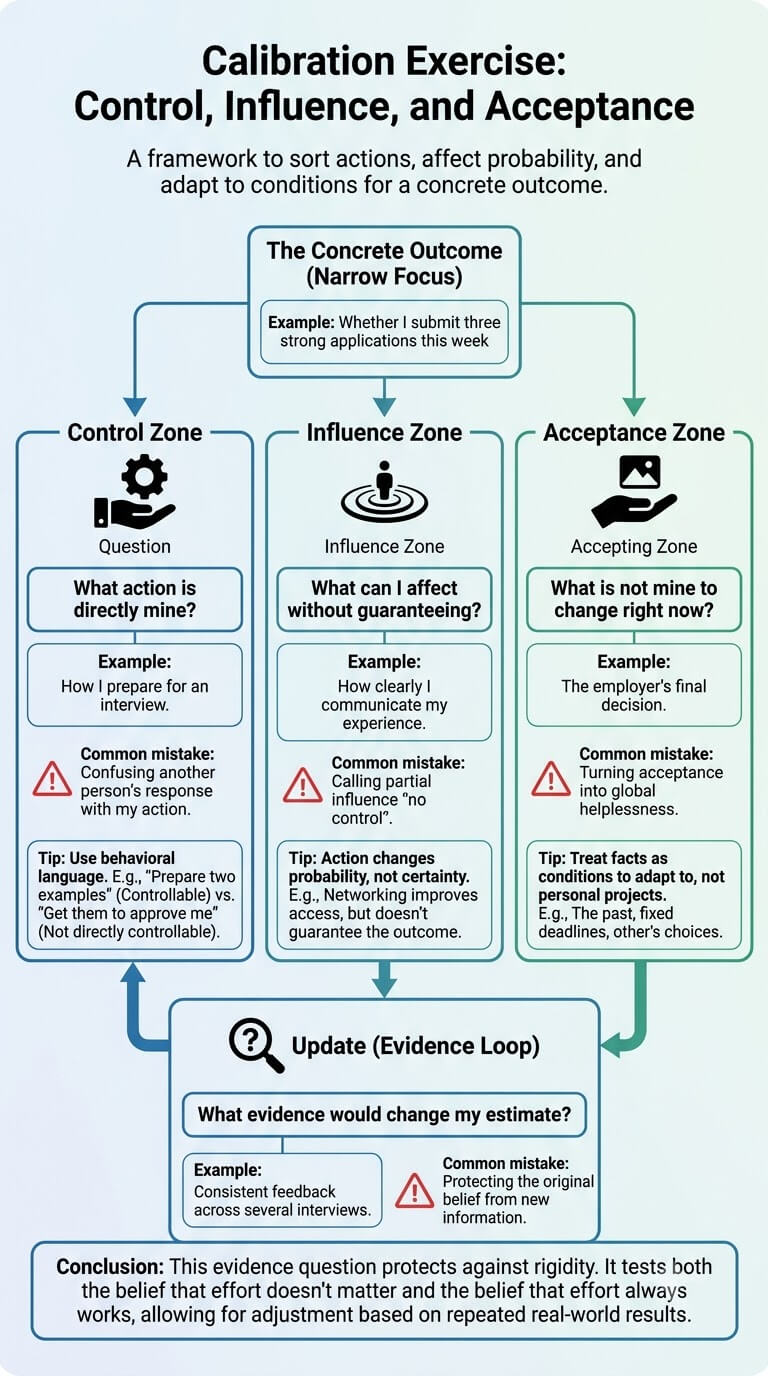
Use the exercise on one concrete outcome, not on your whole life. Define the outcome narrowly enough that you can name actual causes. “My career” is too broad; “whether I submit three strong applications this week” is workable. The narrower frame makes it easier to distinguish action from probability and probability from guarantee.
Instead of scoring yourself as internal or external, take one current problem and sort it into three zones. Then add an evidence question. This keeps the exercise tied to a real situation rather than a personality label.
| Zone | Question | Example | Common mistake |
|---|---|---|---|
| Control | What action is directly mine? | How I prepare for an interview. | Confusing another person’s response with my action. |
| Influence | What can I affect without guaranteeing? | How clearly I communicate my experience. | Calling partial influence “no control.” |
| Acceptance | What is not mine to change right now? | The employer’s final decision. | Turning acceptance into global helplessness. |
| Update | What evidence would change my estimate? | Consistent feedback across several interviews. | Protecting the original belief from new information. |
What can I directly control?
Use behavioral language. “Get them to approve me” is not directly controllable. “Prepare two examples that show the skill they asked about” is. “Make my partner understand” is not directly controllable. “Explain my concern clearly and decide what I will do if the issue continues” is.
What can I influence?
Influence is the middle zone people often miss. Your action changes probability but does not determine the result. Networking may improve access to opportunities. Sleep habits may affect energy. A thoughtful apology may make repair more possible. None of these guarantees the outcome because other causes remain active.
What must I adapt to?
Some facts have to be treated as conditions rather than personal projects. The past cannot be changed. Another adult’s choice is theirs. A fixed deadline may not move. A medical condition may require adaptation rather than positive thinking.
What evidence would change my conclusion?
This final question protects both orientations from becoming rigid. If you believe effort does not matter, what result would show that some influence exists? If you believe effort should always work, what repeated evidence would convince you that a constraint deserves more weight?
Internal vs External Locus of Control and Personal Agency
Internality and personal agency often appear together, but they are not interchangeable. Locus of control concerns what you believe shapes outcomes. Agency concerns your experience of being able to choose and act within the situation you actually have.
Why internal explanations do not automatically equal strong agency
A person can strongly blame themselves for outcomes and still feel unable to act effectively. “Everything is my fault” is internal in one sense, but it is not a healthy experience of choice, capability, or flexible action. Internal attribution alone does not tell you whether a person sees useful options.
Why external realities do not automatically erase agency
You can accurately recognize external limits and still act with agency. A company may control whether you are laid off, but you control whether you update your résumé, ask for references, seek benefits, or change the kind of role you pursue. Another person may control whether they respect a boundary, but you control whether you keep participating under the same conditions.
What to Do Next With Your Pattern
Pay attention to the time frame as well. A factor that is outside your control today may become influenceable later, and something you can influence now may disappear after a deadline passes. Control is not only about who has power, but also about when a lever is available.
If you recognize a strong internal or external tendency, the next step is not to force yourself toward the opposite side. Use the pattern as a hypothesis and test whether it improves your reading of real situations.
Replace labels with situation-specific predictions
Instead of “I am an external person,” try, “In hiring situations, I expect decision makers and market conditions to matter more than my individual effort.” Instead of “I am internal,” try, “When learning a technical skill, I expect practice quality to make a large difference.”
Run small tests where control is uncertain
Choose an action that is inexpensive enough to try and clear enough to evaluate. Ask for feedback, change one study method, make one more application, clarify one expectation, or alter one part of a routine. Then observe whether the result changes.
Update explanations from evidence rather than blame
After the test, ask three questions: What changed because of my action? What did not change because other factors dominated? What would I try differently next time? This keeps learning separate from self-judgment.
FAQ About Internal vs External Locus of Control
The most common questions about this comparison come from treating internal and external control as fixed opposites. These answers keep the distinction more realistic.
Can someone have both an internal and external locus of control?
Yes. People can hold different control beliefs across different situations and domains. You may feel highly internal about learning because practice gives clear feedback, but more external about organizational decisions because other people hold the authority. You can also hold mixed beliefs within one situation, such as believing your preparation matters while recognizing that the final decision is outside your control.
Is external locus of control always unhealthy?
No. An external explanation may be accurate when outcomes genuinely depend on chance, systems, medical realities, structural barriers, or another person’s decisions. The concern is not externality itself. The concern is applying it so broadly that you stop noticing influence that is still available.
Likewise, an internal orientation is not automatically healthy if it turns every difficult outcome into personal blame.
Does internal locus of control mean taking responsibility for everything?
No. Internal locus of control is about expecting your actions to influence outcomes, not assuming moral responsibility for every event. You can take responsibility for preparation, choices, and behavior while also recognizing that chance, other people, and circumstances helped shape the result.
A useful boundary is: own your contribution, not every cause.
Can locus of control change after major life events?
It can. Longitudinal research indicates that control orientation may shift in association with major stressors and life changes rather than remaining completely fixed across adulthood. More recent longitudinal panel research on life events and locus of control has also reported that some negative life events are followed by shifts toward greater externality for some people.
Key Takeaways
- Internal locus of control gives more weight to personal action, effort, strategy, and ability; external locus of control gives more weight to chance, circumstances, systems, and powerful others.
- Neither orientation is automatically good or bad. The useful question is whether the explanation fits the evidence in that specific situation.
- Mixed profiles are normal. You can be internal in one area, external in another, or internal about preparation while external about the final outcome.
- Internality becomes unhelpful when it turns uncertainty or genuine external constraints into self-blame.
- Externality becomes limiting when it treats partial influence as zero influence and stops useful experiments before they begin.
- A practical next step is to separate direct control, partial influence, necessary acceptance, and the evidence that would make you update your estimate.

Michael Reed is the Founder and Lead Writer at Psychology Exposed. He writes about human behavior, relationships, emotional patterns, self-awareness, and practical psychology topics using research-informed, easy-to-understand content.
Read More About Michael Reed: https://psychologyexposed.com/michael-reed/