

You can spend hours on a problem and still end the day with almost the same understanding you had at the beginning. You reread the same notes, search for one more explanation, adjust the same plan, or mentally replay why the obvious route should have worked. The effort is real, but the problem is no longer giving you much new information.
That is one useful way to understand why people get stuck on problems. Being stuck is not simply “not knowing the answer.” It is often a loop in which thinking and effort continue while learning slows down. The current approach becomes easier to defend than to question, uncertainty makes alternatives feel risky, and each repeated attempt gives too little fresh feedback to change the picture.
A useful reset changes what you can learn. It may restate the goal, expose an assumption, test evidence that could prove the current route wrong, or invite a different representation. The aim is not to abandon persistence, but to make it responsive to evidence again.
Quick Answer

People often get stuck on problems when they keep applying effort without changing the assumptions, representation, strategy, or evidence guiding that effort. Sunk effort, fear of being wrong, uncertainty, and repeated analysis can make the current route feel harder to leave. A useful reset pauses repetition, restates the real goal, identifies one key assumption, and runs a small test that can produce genuinely new information.
What Being Stuck Actually Means
The APA Dictionary of Psychology defines problem solving broadly as the process of overcoming difficulties that interfere with reaching a goal. In everyday life, however, a person can remain highly active inside that process without actually moving closer to a workable solution.
Effort continues but learning slows down
A useful attempt changes what you know. It may expose a wrong assumption, eliminate an explanation, reveal a condition under which a strategy fails, or uncover missing information. Even failure can be productive when it rules something out.
Stuck effort feels different. You may research for another evening but save versions of the same advice, or revise a proposal repeatedly without testing the objection that caused it to fail. Activity continues while the central assumption remains untouched.
The key signal is not frustration. It is that additional effort produces very little change in your understanding.
The same representation, assumptions, or strategy keep reproducing the same result
People work from a representation of the problem: what is happening, what matters, what is allowed, and what success would look like. If that representation stays fixed, many apparently different attempts may still be variations of the same move.
Research on real-world problem solving describes impasse as a point at which the current search no longer yields a solution and the solver may need to restructure the problem representation before searching again. A review in Frontiers in Human Neuroscience highlights this shift from continued search to changing how the problem is represented.
This is why “try harder” can be either excellent advice or terrible advice. If the route is sound and feedback is improving performance, more effort may help. If the route itself is built on the wrong model, more effort simply travels farther in the wrong direction.
The Stuck Loop: Repeat, Defend, Narrow, Repeat

A stuck loop often develops gradually. One reasonable attempt becomes a second, then a third, while the current route becomes more familiar and alternatives less visible.
Repeat the familiar move
The loop usually begins with repetition. You use the strategy you know best because it is available, understandable, and previously useful. A manager schedules another meeting. A student rereads the chapter. A creator keeps polishing the same concept. A homeowner keeps searching for a replacement part with the same specifications as the old one.
Repetition is not automatically a problem. It becomes one when results repeatedly show that the move is missing the bottleneck and the move still stays essentially unchanged.
Defend the invested approach
After substantial effort, changing direction can feel like admitting earlier work was wasted. The practical question, “What is most useful from here?” can quietly become, “How do I make the previous effort pay off?”
That second question changes the goal from solving the present problem to justifying the past. Long-running efforts may still deserve continuation, but prior investment should not be the main reason a weak strategy is protected from revision.
Narrow attention around confirming details
Once you become attached to a route, attention can become selective. Supporting evidence feels highly relevant, while contradictory evidence is easier to treat as an exception, bad timing, or poor execution.
Fixation research is useful here because it shows how prior knowledge or externally supplied examples can constrain the search for alternatives. A systematic review in Frontiers in Education found that overcoming fixation depends partly on what produced it and on the kind of problem being solved. There is no single universal “think outside the box” technique.
Receive too little new feedback to change
The loop closes when each new attempt is too similar to the last to teach much. If you change five small details but preserve the same underlying assumption, failure does not tell you whether the assumption was wrong. If you only collect information that fits your current explanation, research does not seriously challenge the explanation.
Ask: What did my last three attempts teach me that I did not know before? If the answer is almost nothing, the effort may no longer be informative.
Why More Thinking Can Stop Helping
Thinking is central to problem solving, but thinking and learning are not the same activity. A person can think intensely while staying inside an unchanged set of assumptions.
Repetition can feel like progress
Mental activity creates a strong sense of engagement. Yet reviewing, comparing, and imagining consequences can continue without any meaningful change in the problem model.
After a thinking session, write down what became newly knowable. If you cannot name a revised assumption, eliminated option, better question, or testable prediction, you may have mainly rehearsed what you already believed.
Analysis reuses the same assumptions
Suppose you are trying to reduce project delays and assume people need stronger reminders. You can analyze timing, wording, and channels in detail. If the true bottleneck is unclear ownership, sophisticated analysis still remains inside the wrong premise.
This is why a reset often begins one level above the current solution. Ask, “What must be true for my preferred explanation to be correct?” Then ask what evidence would make that statement less believable. The second question is harder because it invites the possibility that the route itself needs revision.
Information gathering becomes a substitute for testing
Research is valuable when it reduces an uncertainty that matters. It becomes less useful when more searching is unlikely to change what you do. Reading can then become safer than exposing an assumption to a real test.
A practical checkpoint is: If I found ten more sources saying roughly the same thing, would my next action change? If not, additional research may have low value. A small real-world test may now be more informative than more input.
Why Sunk Effort Makes Changing Course Hard

Time, money, energy, reputation, and identity can all become attached to a solution route. The more you have invested, the more psychologically costly it may feel to consider that the route needs major revision.
Time and energy become psychologically tied to the current route
The sunk-cost effect refers to allowing past investment to influence whether to continue an endeavor even though that investment cannot be recovered. Research summarized in Frontiers in Psychology describes sunk costs as previously spent resources, such as time, money, or effort, that can affect later persistence.
In problem solving, the subtle version sounds like, “I have already spent three weeks building this, so I need to make this version work.” Continuation may still be sensible, but not when past effort is doing most of the justification while current evidence points elsewhere.
A better question is forward-looking: If I inherited this problem today, what would I test next? Earlier work may still have revealed constraints, failures, or reusable pieces. Its value does not require continuing the same route.
Uncertainty and Fear of Being Wrong
Changing strategy creates uncertainty. The old path may be failing, but at least it is familiar. A new path removes that familiarity, and sometimes the discomfort of not knowing feels more threatening than the known frustration of repeating.
A new strategy creates new uncertainty
The current approach comes with a familiar story about why it should work and what to do next. Switching temporarily removes that structure. The alternative may be less predictable even when the current route is disappointing.
Goal-directed cognition depends on maintaining goals and integrating information across steps. An NCBI volume on cognitive control describes goal-directed integration in terms of accessing, combining, and sequencing information for goals and subgoals. A reset therefore needs enough structure to compare alternatives without losing track of what the problem requires.
Protecting identity or competence can make revision feel costly
Some problems become personal because you proposed the plan, defended the explanation, or taught the method. Revising it can then feel like a judgment about your competence rather than an update to a model.
When that happens, separate the claim from the self. “This explanation is not fitting the evidence” is different from “I am bad at solving problems.” Good problem solving requires revision precisely because initial models are incomplete. Updating is not proof that earlier thinking was foolish. It is evidence that new information is being allowed to matter.
Waiting for certainty delays informative tests
People often want enough confidence to guarantee that a new route will work before trying it. Difficult problems rarely provide that certainty in advance, so waiting can become another form of repetition.
Instead, ask what can be tested reversibly. A small prototype, limited sample, temporary process change, or deliberately different practice method can reduce uncertainty without requiring full commitment.
When the Problem Needs Reframing Instead of More Solutions
Sometimes you are not short of solutions. You are generating solutions to a question that is too narrow, poorly targeted, or already contains an assumed answer.
The question may be too narrow
“How do I make myself work two more hours every night?” assumes the answer must involve extending work. A broader question might be, “What is preventing the highest-value work from getting finished during the time I already have?” The second wording opens possibilities involving priorities, interruptions, task design, delegation, or expectations.
The goal may contain an assumed solution
Goals often smuggle in a method. “I need a better spreadsheet” may really mean “I need to know which projects are behind.” “I need more meetings” may mean “I need faster access to missing decisions.”
Strip the preferred method out of the goal and see what remains. That does not guarantee a better answer, but it gives alternatives permission to appear.
A new frame can expose different next moves
Reframing is not positive thinking and it is not denying constraints. The facts remain facts. The change is in the organizing question, boundary, or outcome.
Try three versions: “How do I make the current approach work?”, “What outcome am I actually trying to produce?”, and “What would I do if the current approach were unavailable?” The contrast can reveal what has been treated as fixed without sufficient reason.
When the Representation Needs to Change
Framing changes the question. Representation changes the model you are using to understand the situation. A problem can be framed reasonably and still be represented inaccurately.
Missing information
You may be stuck because the model contains a blank that has been filled with a guess. Before generating another solution, label what is known, estimated, assumed, and unknown. Then identify which unknown would most change your next action.
This prevents endless information gathering because you are not trying to eliminate every uncertainty. You are looking for the uncertainty with the highest practical value.
False constraints
A false constraint is a rule that feels mandatory but is not actually required: “We cannot change the sequence,” “the tool must be used this way,” or “I must solve every part at once.”
Do not delete constraints casually. Test their origin. Is it a safety requirement, a legal requirement, a physical limit, a deadline, a stakeholder need, or simply how the task has always been done?
A mental model that no longer fits the evidence
Representations need updating when observations repeatedly conflict with what the model predicts. Research available through PubMed Central discusses restructuring as an important route out of mental impasse in insight problem solving.
You do not need an Aha moment to use the same principle. If your model predicts one result and reality repeatedly gives another, treat the mismatch as information rather than as an annoyance to explain away.
Productive Persistence vs Being Stuck
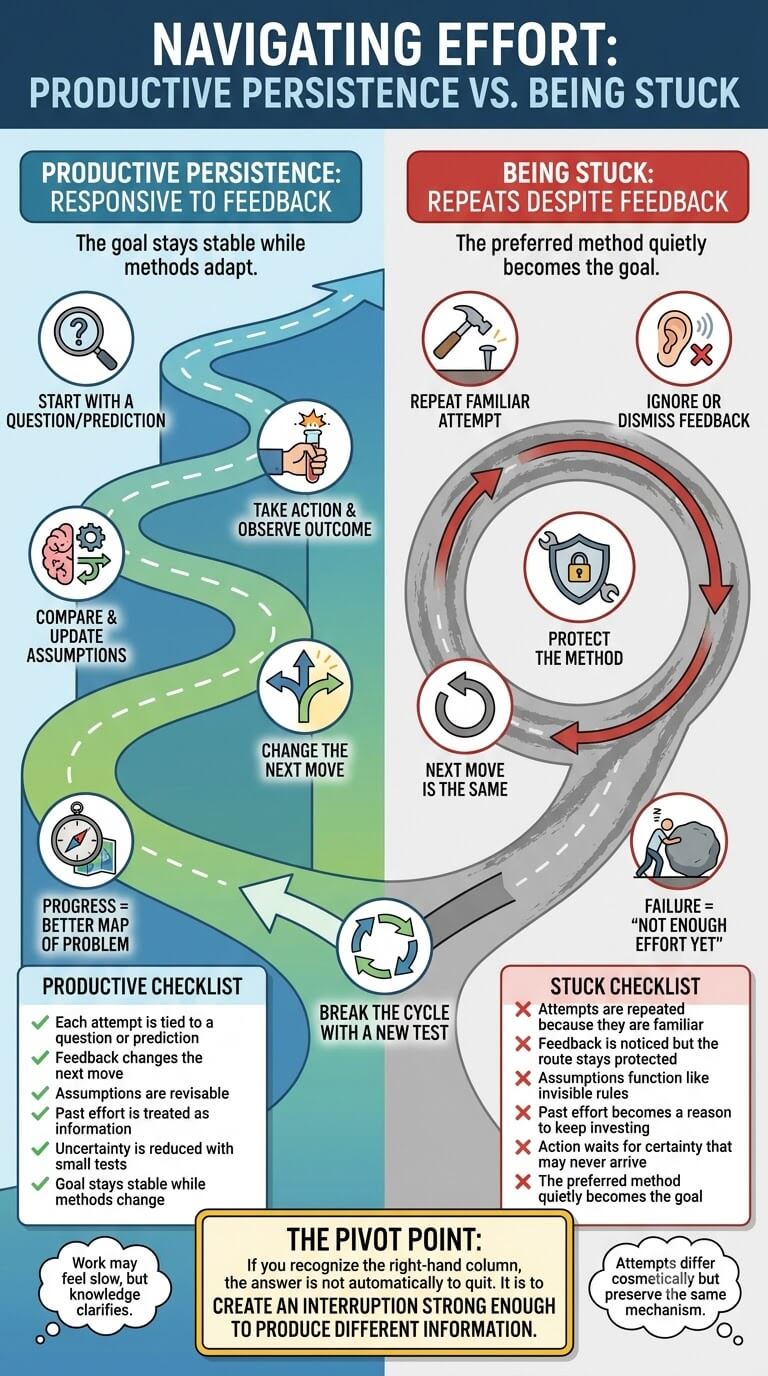
Persistence is useful when it stays responsive to feedback. Being stuck is more likely when effort repeats despite feedback that should have changed the route.
Productive persistence changes with feedback
Someone who is productively persistent may keep the same goal while changing methods. They compare outcomes, update assumptions, improve tests, and become more precise about what is not working.
The work may still feel slow. Progress can be a better map of the problem, fewer plausible explanations, or clearer knowledge of which constraint matters most.
Stuck persistence repeats despite feedback
Stuck persistence often protects the method rather than the goal. Attempts differ cosmetically but preserve the same mechanism, and feedback fails to change the next move. Every failure may be explained as “not enough effort yet.”
A practical comparison checklist
| Productive persistence | Being stuck |
|---|---|
| Each attempt is tied to a question or prediction | Attempts are repeated because they are familiar |
| Feedback changes the next move | Feedback is noticed but the route stays protected |
| Assumptions are revisable | Assumptions function like invisible rules |
| Past effort is treated as information | Past effort becomes a reason to keep investing |
| Uncertainty is reduced with small tests | Action waits for certainty that may never arrive |
| The goal stays stable while methods can change | The preferred method quietly becomes the goal |
If you recognize the right-hand column, the answer is not automatically to quit. It is to create an interruption strong enough to produce different information.
A Get-Unstuck Reset Protocol
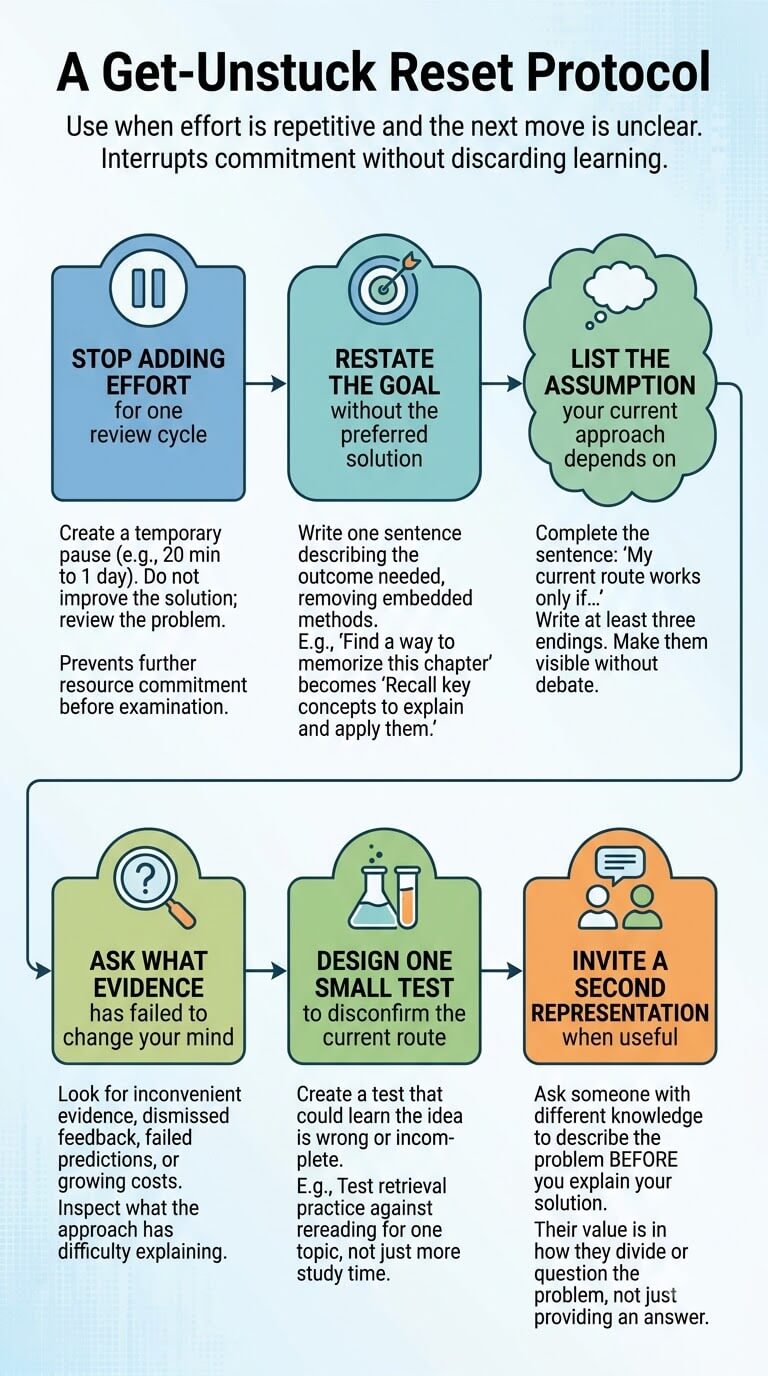
Use this reset when effort has become repetitive and the next move is unclear. It interrupts commitment to the current route without requiring you to discard what you have learned.
Stop adding effort for one review cycle
Create a temporary pause in execution. This may be 20 minutes for a small problem or a day for a larger one. During that period, do not improve the existing solution. Review the problem instead.
The pause does not abandon the route. It prevents more resources from being added before the route is examined.
Restate the goal without the preferred solution
Write one sentence describing the outcome you need, then remove any method embedded in it. “Make the new scheduling system work” might become “Reduce missed handoffs between shifts.” “Find a way to memorize this chapter” might become “Recall the key concepts accurately enough to explain and apply them.”
List the assumption your current approach depends on
Complete the sentence: “My current route works only if…” Write at least three endings. Examples might include “the delay is caused by poor reminders,” “customers understand the offer,” or “more repetition is the main thing my practice lacks.”
Do not debate them yet. Make them visible first.
Ask what evidence has failed to change your mind
Look for inconvenient evidence. Which result have you repeatedly explained away? Which person’s feedback have you discounted? Which prediction failed more than once? Which cost or delay keeps growing?
This reverses the normal search. Instead of asking what supports the approach, inspect what it has difficulty explaining.
Design one small test that could disconfirm the current route
A powerful test does not merely give your idea another chance to succeed. It creates a realistic possibility that you will learn the idea is wrong or incomplete.
If you think reminders are the problem, test whether clearer ownership changes completion without adding reminders. If you think you need more study time, test retrieval practice against rereading for one topic. If you think a household item must be replaced, test whether reorganizing the function removes the need for the same object.
Invite a second representation when useful
Ask someone to describe the problem before you explain your solution. If possible, choose someone with different knowledge or incentives. Their value is not that they will have the answer. Their value is that they may divide the problem differently, notice a constraint you missed, or question a relationship you assumed.
If you are working alone, change the form: draw a timeline, map causes and effects, take another person’s perspective, or explain the problem aloud without mentioning your current solution.
Examples of Getting Unstuck Without Starting Over
A reset does not always mean discarding the entire project. Often the most useful change is smaller: preserve what has been learned, but stop protecting the mechanism that is not working.
Work or project problem
Situation: A team has delayed a launch three times and responds by adding more status meetings. What the team may feel: pressure, embarrassment, and a sense that everyone needs tighter coordination. What it may mean: meetings are being used to manage symptoms while ownership of final decisions remains unclear. What to do next: pause the meeting expansion and map who can make each blocking decision, what information that person needs, and how long the decision is allowed to remain open.
The team has not “started over.” It has changed the representation from “we need more communication” to “our decision handoffs lack clear ownership.” That change produces a different test.
Learning or skill problem
Situation: A learner keeps rereading notes because an exam topic still feels unfamiliar. What the learner may feel: anxious that stopping review will expose how little they know. What it may mean: familiarity is being used as the measure of learning, while the actual requirement is recall and application. What to do next: close the notes, answer five questions from memory, and use the errors to decide what to review.
The reset preserves the notes and study time, but changes the feedback. Instead of asking “Does this look familiar?”, the learner asks “Can I retrieve and use it?”
Everyday logistics problem
Situation: A household keeps running out of a frequently used item and responds by buying larger quantities. What people may feel: annoyed that the obvious fix never seems to hold. What it may mean: the problem may be visibility or replenishment timing rather than quantity. What to do next: test a visible minimum-stock marker or a recurring reorder trigger before increasing storage again.
The important move is not the specific tactic. It is the shift from repeating the previous solution to asking what kind of information the failure is giving you.
Which Mechanism Is Most Likely Keeping You Stuck?
“Stuck” describes the experience, not necessarily the underlying mechanism. Once you interrupt the loop, these distinctions can help you decide what deserves closer attention.
Mental set if the strategy never changes
If you keep using the same class of method because it worked before, a mental set may be shaping the search. The reset is to identify a genuinely different strategy category, not merely a refined version of the old one.
Functional fixedness if resources look single-purpose
If the strategy could change but the available tools, materials, roles, or ideas seem usable only in their familiar ways, functional fixedness may be more relevant. Instead of asking what each resource is “for,” list its properties and what actions those properties could support.
Barrier diagnosis if several obstacles are stacking
Sometimes there is no single sticking point. Missing information, overload, weak feedback, emotional pressure, and a hidden assumption can coexist. In that case, diagnose where the process is breaking before choosing a remedy. Fix the earliest bottleneck that is contaminating the steps after it.
Insight if restructuring suddenly opens a route
Occasionally a new representation causes a solution to appear suddenly. That can feel like an Aha moment, especially after an impasse. Treat the insight as a candidate worth testing, not as proof. Sudden clarity still needs contact with evidence.
FAQ
These questions focus on the practical line between persistence that is still teaching you something and effort that has become repetitive.
Does being stuck mean I should quit?
No. Being stuck is a reason to review the route, not automatic evidence that the goal is wrong. You may discover that the approach needs a small adjustment, that an assumption needs testing, or that more persistence is justified because feedback is still improving. Quitting and persisting are both decisions that should respond to current evidence rather than frustration alone.
How long should I persist before changing strategy?
There is no universal number of attempts because problems differ in difficulty, feedback speed, cost, and reversibility. A better trigger is informational: change strategy when repeated attempts stop teaching you much, when evidence repeatedly contradicts a key assumption, or when the cost of another identical attempt is high relative to what it is likely to reveal. Set review points in advance when possible.
Why do I keep researching instead of testing a solution?
Research may feel safer because it keeps options open and delays the possibility of being wrong. It may also be necessary if a critical fact is genuinely missing. Ask whether the next piece of information could change your action. If ten more similar sources would leave your next move unchanged, a small test may now be more valuable than further reading.
Can fear of being wrong make problem solving worse?
It can make revision harder when being wrong feels tied to competence, reputation, or identity. The result may be excessive checking, reluctance to test uncertain alternatives, or protection of a preferred explanation. Try separating the quality of the person from the accuracy of the current model. If fear or distress is severe, persistent, or substantially interfering with daily functioning, professional support may be worth considering.
Key Takeaways
- Being stuck often means effort is continuing while the amount of new information produced by that effort is shrinking.
- The stuck loop tends to strengthen when people repeat a familiar move, defend invested effort, narrow attention, and receive weak feedback.
- More thinking is useful only when it changes the model, tests an assumption, eliminates an option, or improves the next experiment.
- Productive persistence responds to evidence; stuck persistence protects the current route despite evidence that should change it.
- A practical reset is to pause execution, restate the goal without the preferred method, expose assumptions, examine disconfirming evidence, and run one small informative test.
- You do not have to erase previous work to change direction. Earlier effort can become useful evidence even when the original route is no longer the best one.
If you have been circling the same problem, choose one next move that can teach you something you do not already know. The fastest way out of a stuck loop is often not more effort, but better feedback.

Michael Reed is the Founder and Lead Writer at Psychology Exposed. He writes about human behavior, relationships, emotional patterns, self-awareness, and practical psychology topics using research-informed, easy-to-understand content.
Read More About Michael Reed: https://psychologyexposed.com/michael-reed/