
You open a comparison page with twenty laptops, twelve insurance plans, thirty online courses, or a long list of possible jobs. At first, the variety feels useful. Then each option has slightly different strengths, the important differences become harder to track, and choosing one means giving up many plausible alternatives. More choice has created more opportunity, but it has also created more work.
This is the central idea behind choice overload psychology. The effect is not as simple as “too many choices are bad.” Large option sets can be helpful when you know what matters, can quickly eliminate poor fits, or have enough expertise to organize the alternatives. The difficulty rises when the options are complex, the task is demanding, your preferences are uncertain, or you are trying to minimize effort while still hoping to make a good choice.
Understanding that distinction matters because a crowded option set calls for a different response than anxiety-driven indecision. If the environment itself is creating comparison burden, the most useful move is often to make the choice easier to structure, not to analyze your personality or force yourself to feel more certain.
Quick Answer

Choice overload is the difficulty that can arise when a large or complex set of options becomes hard to compare and use. It may contribute to delaying a choice, lower confidence, regret, or switching, but it is not automatic. Research suggests that overload depends on factors such as option complexity, decision difficulty, preference uncertainty, and what the person is trying to accomplish.
What Choice Overload Means
Choice is usually valuable because it increases the chance that one option will fit your needs. Choice overload describes the point at which additional alternatives can add enough comparison cost that the extra variety becomes harder to use well. The key issue is not simply seeing a long list. It is whether the decision-maker can turn that list into a manageable evaluation.
More options can increase opportunity and comparison cost
Each extra option can improve the chance of finding a strong match while also adding features, trade-offs, and forgone alternatives to compare. Those forces can move in opposite directions.
Imagine choosing a hotel. Five options may omit the neighborhood or price point you want. Fifty may include a better fit, but they also add location, fees, cancellation rules, reviews, and many small differences to compare. The problem is not the number itself. It is whether the extra variety adds more useful fit than comparison work.
The APA Dictionary of Psychology describes decision making as selecting among alternatives. Choice overload becomes relevant when the structure of those alternatives makes selection harder rather than simply richer.
Overload is conditional, not automatic
One of the most important corrections to the popular “paradox of choice” story is that researchers have not found a universal rule in which larger assortments always produce worse outcomes. A 2010 meta-analysis in the Journal of Consumer Research found a near-zero average effect across the studies it examined, along with substantial variation between studies.
A later meta-analysis reached a more conditional conclusion. Rather than asking only whether more options are good or bad, it examined the situations in which overload is more likely. That approach is more useful in daily life because it shifts attention from a magic number of choices to the demands created by a particular decision.
Choice deferral, lower confidence, regret, and switching as possible outcomes
Choice overload does not have one single behavioral signature. A person might postpone choosing, feel less confident after choosing, regret the option more strongly, or keep switching between alternatives. The 2015 conceptual review and meta-analysis by Chernev, Böckenholt, and Goodman treated satisfaction or confidence, regret, choice deferral, and switching likelihood as common ways overload has been measured.
That variety matters. If you choose from a crowded menu and later wonder whether another item would have been better, that is different from never ordering at all. Both can be related to a difficult option set, but they involve different points in the decision process.
Why More Options Sometimes Help
Reducing choice is not always the answer. Variety can be useful when the additional options create meaningful differences that the decision-maker can recognize and evaluate.
Greater chance of finding a good fit
A larger set can contain options that better match unusual needs. Someone looking for a standard phone plan may be satisfied with a small menu. Someone who needs international roaming, hotspot data, family controls, and a narrow budget may benefit from more alternatives because a small menu may force an unnecessary compromise.
Choice also has motivational value. The original research that helped popularize choice overload did not argue that choice itself was harmful. In fact, Iyengar and Lepper’s experiments on extensive versus limited choice were framed against a broader background in which personal choice can be motivating and valuable. The question is when additional choice stops helping.
Expertise can make variety easier to navigate
Experts often see structure where beginners see a wall of detail. A photographer may sort twenty lenses by focal length, aperture, mount, and use case almost immediately. Expertise does not make unlimited choice effortless, but existing categories and elimination rules can make the same assortment far easier to navigate.
Clear preferences reduce comparison burden
Large sets are easier when you already know your non-negotiables. If you need a rental car that seats seven, fits a fixed budget, and allows a second driver, many options can disappear quickly. You do not have to rank every car against every other car.
Preference clarity turns a broad search into a filtering problem. Preference uncertainty turns it into a discovery problem, where each option may change your understanding of what you want. The latter usually requires more attention.
When More Options Become Harder to Use
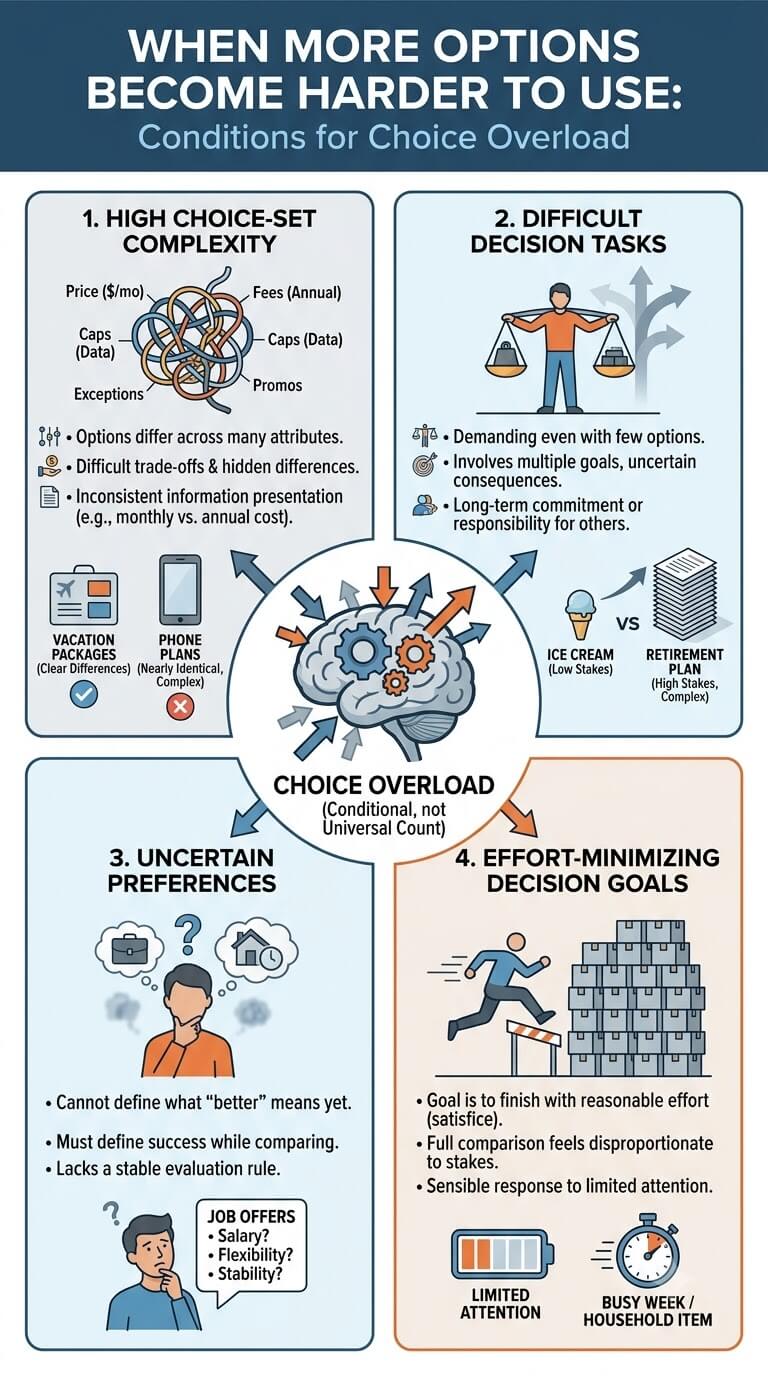
The strongest research on choice overload points to conditions rather than a universal option count. Four conditions are especially useful for understanding why one large assortment feels manageable while another feels exhausting.
High choice-set complexity
A choice set becomes more complex when options differ across many attributes, when trade-offs are difficult, or when the important differences are hard to identify. Ten clearly distinct vacation packages may be easier than ten nearly identical phone plans with different caps, fees, exceptions, and promotional periods.
Complexity also rises when information is presented inconsistently. If one service lists monthly cost, another emphasizes annual cost, and a third hides extra fees in notes, the decision-maker has to standardize the information before comparing it. That extra work is part of the burden.
Difficult decision tasks
Some decisions are demanding even with a small option set. A choice involving several goals, uncertain consequences, long-term commitment, or responsibility for other people requires more evaluation than a low-stakes preference such as choosing a snack.
The 2015 meta-analysis identified decision-task difficulty as one moderator of overload. This means the same number of options can have different effects depending on what the choice requires. Twelve ice-cream flavors and twelve retirement-plan configurations do not create equivalent decision problems.
Uncertain preferences
Choice becomes harder when you cannot yet say what “better” means. You may be comparing job offers without knowing whether salary, flexibility, learning, commute, title, or stability should matter most. Every new option then adds information and another possible definition of success.
A 2024 open-access review of choice overload and its moderators emphasizes both features of the decision environment and characteristics of the decision-maker. Preference uncertainty is especially important because a person without a stable evaluation rule has to work out the rule while also comparing options.
Effort-minimizing decision goals
Sometimes the goal is not to find the absolute best option. You may simply want to finish the task with reasonable effort. A very large assortment can conflict with that goal because doing the full comparison feels disproportionate to the stakes.
This can happen after work when you are choosing a basic household item, or during a busy week when you need to select a service provider. The desire to conserve effort is not laziness. It can be a sensible response to limited attention. Problems arise when the choice environment makes even a satisfactory decision unnecessarily difficult.
Option Count Is Not the Whole Story
Asking “How many choices are too many?” sounds practical, but it often points to the wrong variable. Two option sets of the same size can differ sharply in how easy they are to understand.
Similar options can be harder than distinct options
When alternatives are clearly different, elimination is easier. A compact car, a pickup truck, and a minivan represent different needs. Three nearly identical subscription tiers with subtle feature limits may require more careful comparison even though there are still only three options.
Similarity creates more close trade-offs. If several alternatives are all plausible, choosing one makes the forgone alternatives easier to imagine. That can increase second-guessing even when the final choice is objectively reasonable.
Too many attributes increase comparison work
Option count and attribute count interact. Comparing eight laptops on price and battery life is a different task from comparing the same eight across a dozen specifications. More information helps when it can change the ranking. If an attribute could not realistically change your finalist, it may not deserve equal attention.
Poor category structure makes searching harder
Categories can reduce complexity by turning one large comparison into several smaller ones. But categories only help when they match how the person thinks about the choice. A useful grouping might separate courses by skill level, cars by body type, or software by use case.
Research on online assortments suggests that categorization can change how difficult a large choice environment feels. A study in research in Computers in Human Behavior on categorization in an extensive course-choice environment and found that the way options were organized affected reported overload and browsing behavior. Organization matters because a large list is easier to use when it has a meaningful map.
Choice Overload vs Decision Paralysis
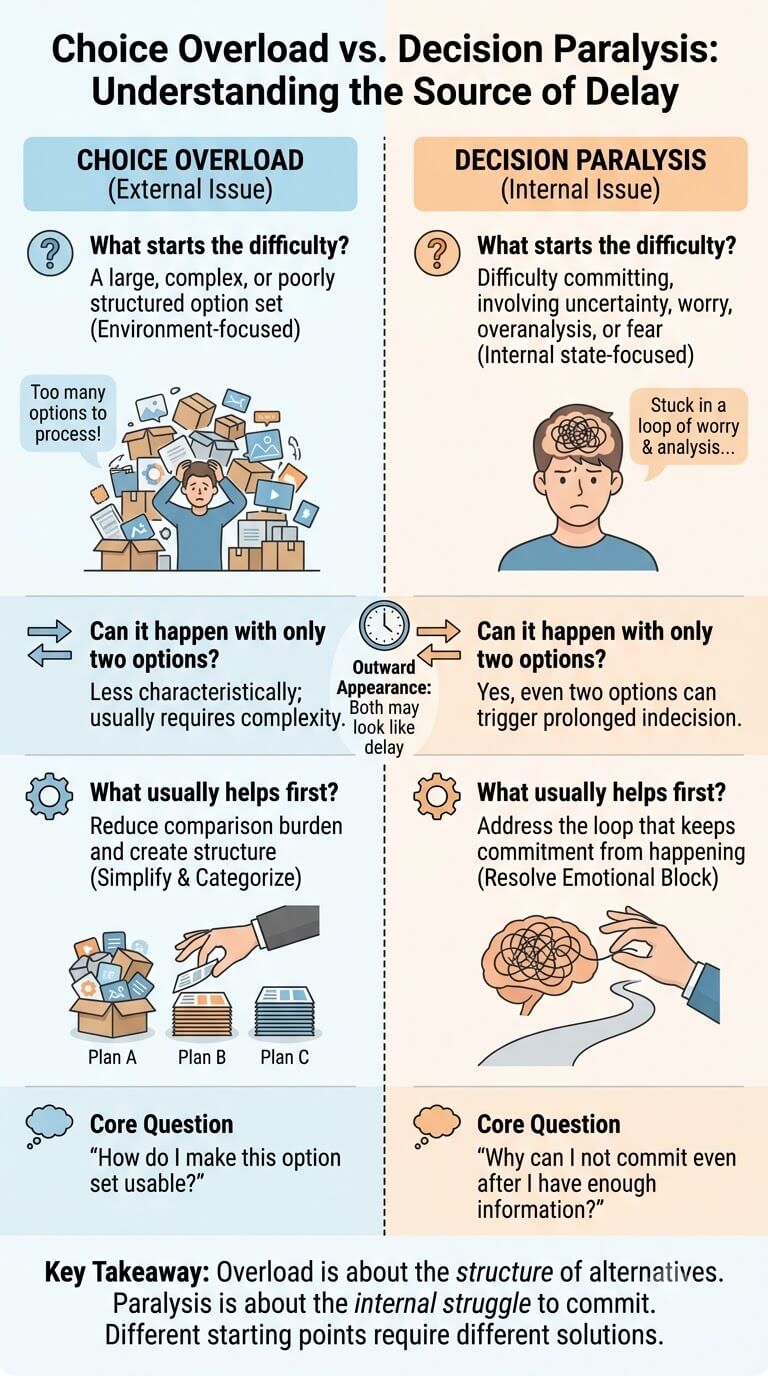
The two experiences can look similar from the outside because both may involve delay. Their starting points are different, and that difference changes what is likely to help.
| Question | Choice overload | Decision paralysis |
|---|---|---|
| What starts the difficulty? | A large, complex, or poorly structured option set | Difficulty committing, often involving uncertainty, worry, overanalysis, or fear of being wrong |
| Can it happen with only two options? | Less characteristically, though two highly complex options can still be difficult | Yes, even two options can trigger prolonged indecision |
| What usually helps first? | Reduce comparison burden and create structure | Address the loop that keeps commitment from happening |
| Core question | “How do I make this option set usable?” | “Why can I not commit even after I have enough information?” |
Overload starts with the option environment
In choice overload, the structure of the available alternatives is central. If twenty plans can be reduced to four meaningful categories and then to three finalists, the difficulty may drop sharply without changing the person’s emotional state.
Paralysis can happen with very few options
A person can be stuck between two job offers for weeks. That is not evidence of choice overload simply because choosing feels hard. The decision may involve identity, fear of regret, family consequences, uncertainty about the future, or repeated attempts to reach impossible certainty.
Worry and repetitive analysis belong elsewhere
Choice overload can trigger frustration or second-guessing, but those reactions are not its defining mechanism. If the option set is already small and well structured yet the person repeatedly reopens the same analysis without new information, reducing the assortment further may not solve the real problem.
Choice Overload vs Decision Fatigue
Another easy confusion is between too many options at one moment and too much decision effort across time. They can interact, but they are not interchangeable.
Simultaneous options versus repeated choices over time
Choice overload is primarily about the choice set in front of you. Decision fatigue concerns the possibility that accumulated decision effort changes how later choices are approached. You could face choice overload with your first decision of the morning, and you could feel worn down by a day of decisions even when each individual choice offered only two or three alternatives.
How overload can contribute to later fatigue
A complex assortment can consume time and attention. If you repeatedly face such assortments, that effort can become part of the broader burden of the day. The practical distinction is still useful: first simplify the option environment when the environment is the problem. Do not assume every difficult choice reflects a depleted mental resource.
Why Maximizers Can Feel Option Overload More Strongly
People differ in how much search they consider necessary. Trying to identify the best possible option creates a different task from finding one that meets a clear standard.
Searching for the best raises comparison demands
To identify the best option, you need a broad search and a way to compare close alternatives. As the set grows, each new candidate can make the search feel unfinished. That does not make maximizing irrational, especially for high-stakes choices, but a “best possible” goal makes a large assortment harder to close than a clear “meets my requirements” standard.
More alternatives create more counterfactuals
After choosing, every attractive alternative can become a comparison point: perhaps the other course had better projects, the other hotel was quieter, or the other laptop would have lasted longer. More counterfactuals do not prove the choice was poor. They simply create more plausible paths not taken.
Satisficing can reduce search depth without being careless
A satisfactory threshold can be rigorous. You might require a laptop under a fixed price, at least a certain battery life, a specific memory level, and a return policy you trust. Once an option clears those requirements, further search may have diminishing value.
The difference between maximizing and satisficing deserves its own deeper treatment. Here, the useful connection is narrower: a clear “good enough” threshold can reduce the amount of a large assortment that must be compared in detail.
A Choice-Reduction Framework
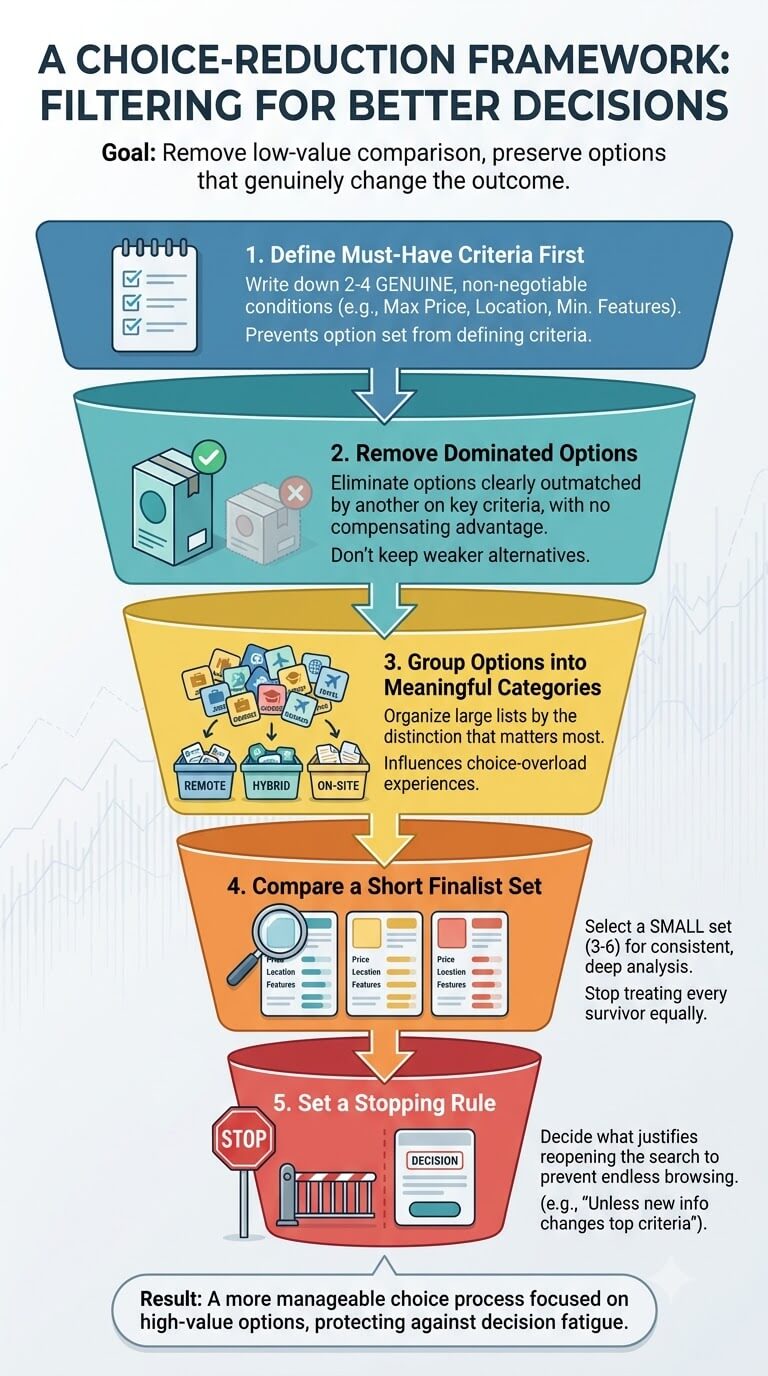
When the environment is creating the problem, the goal is not to make the choice smaller at random. It is to remove low-value comparison while preserving options that could genuinely change the outcome. A five-step filter works well for many everyday decisions.
Define must-have criteria first
Before browsing further, write down two to four conditions an option must meet. These should be genuine requirements, not every preference you can imagine. Examples include maximum price, location, compatibility, schedule, minimum feature level, or a non-negotiable policy.
This prevents the option set from defining your criteria for you. Without prior criteria, each attractive alternative can introduce another feature that suddenly seems essential.
Remove dominated options
An option is easy to eliminate when another available option is at least as good on the criteria that matter and clearly better on one of them, with no compensating advantage you value. You do not need to keep comparing a weaker alternative simply because it exists.
This is especially useful when websites or spreadsheets leave old candidates visible long after they have stopped being competitive.
Group options into meaningful categories
If the list is still large, organize it by the distinction that matters most. A job search might use remote, hybrid, and on-site roles. A course search might use beginner, intermediate, and advanced. A travel search might use neighborhood or total trip cost.
A 2023 study on assortment categorization found that the organization of options can influence choice-overload experiences, reinforcing the practical value of making a large set easier to navigate. The research on category structure and choice overload also cautions against assuming that any arbitrary grouping will work equally well.
Compare a short finalist set
Once the obvious mismatches are gone, choose a small finalist set for detailed comparison. The exact number is not universal. Three finalists may be enough for one decision and six for another. The point is to stop treating every surviving option as equally deserving of deep analysis.
At this stage, compare finalists using the same attributes in the same format. Consistency reduces the need to mentally translate one description into another.
Set a stopping rule
Decide what would justify reopening the search. A useful stopping rule might be: “I will choose among these finalists unless I learn new information that changes one of my top three criteria.”
Without a stopping rule, searching can continue simply because another option is available. The internet makes the search space effectively endless. A stopping rule protects the decision from becoming an open-ended browsing project.
When Not to Reduce the Option Set Too Early
Choice reduction is a tool, not a principle that fewer options are always better. Early filtering can be harmful when the decision is important and you still do not understand the space well enough to know what should be filtered.
High-stakes decisions may justify broader search
When a choice is costly, difficult to reverse, or has long-term consequences, broader exploration can be worth the effort. The practical goal is not minimal search. It is proportionate search.
For major medical, financial, or legal decisions, general decision frameworks cannot replace qualified professional guidance. Reducing options too aggressively may also remove alternatives that a professional would consider important.
Diverse options matter when preferences are still forming
Sometimes you need variety to learn what the dimensions of the choice actually are. Someone choosing a career path may benefit from exploring very different roles before narrowing the field. Someone furnishing a new home may need exposure to several styles before knowing which features matter.
In this phase, exploration is doing useful work. The mistake would be demanding a final ranking before you have learned enough to form preferences.
Early filtering can hide important alternatives
Filters are only as good as the criteria behind them. If you sort apartments only by monthly rent, you may exclude a slightly higher-rent option that saves enough commuting cost to be cheaper overall. If you filter jobs only by title, you may miss a role with a different title but a better fit.
Before applying a hard filter, ask whether the criterion is truly non-negotiable or merely convenient.
A Practical Example: From 20 Options to 3 Finalists
Suppose you are choosing an online professional course. Twenty courses look plausible, with overlapping curricula, mixed reviews, and different benefits. Reading every page in equal depth is likely to create more work than insight.
Filter by non-negotiables
You decide the course must fit your schedule, include project-based practice, stay below your budget, and provide at least six months of access. Nine options fail one of those conditions. You now have eleven rather than twenty, without making any fine-grained judgments.
Rank only the attributes that change the decision
Next, you identify three attributes that could realistically change your choice: instructor quality, project relevance, and depth of feedback. Decorative extras stop receiving equal weight. After comparing the eleven options on those dimensions, three emerge as serious finalists, making detailed reading more useful.
Stop reopening eliminated options without new evidence
You choose one finalist after checking the refund policy and schedule. Two days later, an advertisement shows an eliminated course. Visibility is not new evidence. Your stopping rule is that an option returns only if new information changes a must-have criterion or a top comparison attribute.
What to Do Next When You Have Too Many Options
If a decision feels crowded, do not begin by trying to “think harder.” First change the structure of the problem. Three moves are especially useful.
Reduce comparison dimensions before reducing options
Write down the few attributes that can actually change the decision. This often makes the option set smaller automatically because many alternatives become obvious mismatches. It also reduces the temptation to treat every advertised feature as equally important.
Create a finalist set
Separate exploration from selection. During exploration, allow yourself to scan broadly. During selection, move only the strongest candidates into a finalist set. Do not keep the full search space open while trying to make the final choice.
If a smaller, well-structured option set still feels difficult, unresolved uncertainty about the outcome may be doing more work than the number of choices.
Choose a satisfactory threshold
Define what an acceptable result must accomplish. A threshold is particularly useful for reversible, moderate-stakes decisions where the cost of finding the theoretical best option may exceed the benefit.
If you are still stuck after the option set is small, clearly structured, and evaluated against stable criteria, the remaining difficulty may not be choice overload. At that point, uncertainty, anticipated regret, competing values, or decision paralysis may deserve closer attention.
FAQ About Choice Overload Psychology
Choice overload is often summarized with simple rules that the evidence does not support. These questions clarify where the concept is useful and where it is easy to overstate.
How many choices are too many?
There is no universal number. Six options can be difficult if they are highly complex and your preferences are unclear, while dozens can be manageable if you have expertise and strong filters. The better questions are how difficult the options are to compare, how clear your preferences are, how demanding the task is, and what level of search the decision justifies.
Is the paradox of choice always true?
No. Research has found both overload effects and situations in which more choice has little negative effect or is beneficial. A 2024 systematic review covering more than two decades of choice-overload research highlights how broad and context-dependent the literature has become. Treat “more choice is worse” as a possible pattern, not a law.
Why do similar options feel harder to compare?
Similar options create close trade-offs. Clear differences make elimination easier, while near-equivalent alternatives require attention to smaller distinctions and create more plausible forgone choices. That can make the final commitment feel less obvious even when all of the options are reasonably good.
Is choice overload the same as decision paralysis?
No. Choice overload centers on an option set that is difficult to use because it is large, complex, or poorly structured. Decision paralysis can occur with very few options and may be driven by worry, repeated analysis, fear of regret, or difficulty tolerating uncertainty. The two can overlap, but they call for different first steps.
Can fewer options increase satisfaction?
Sometimes. A smaller, well-curated set can make comparison easier and reduce the number of attractive alternatives left behind. But fewer options can also reduce the chance of finding a good fit. The goal is not “fewest possible.” It is an option set large enough to contain meaningful alternatives and structured enough to evaluate without unnecessary work.
Key Takeaways
- Choice overload is context-dependent. More options do not automatically make decisions worse.
- Overload becomes more likely when the choice set is complex, the task is difficult, preferences are uncertain, or the person is trying to minimize decision effort.
- Option similarity, attribute count, and poor organization can matter as much as the raw number of alternatives.
- Choice overload differs from decision paralysis because the option environment is the central problem, and it differs from decision fatigue because the burden is simultaneous rather than accumulated across many choices.
- A practical response is to define must-haves, eliminate clearly weaker options, group the remainder, compare a short finalist set, and use a stopping rule.
- Do not narrow too early when the stakes are high or you are still learning what matters. Exploration has value when it helps preferences become clearer.

Michael Reed is the Founder and Lead Writer at Psychology Exposed. He writes about human behavior, relationships, emotional patterns, self-awareness, and practical psychology topics using research-informed, easy-to-understand content.
Read More About Michael Reed: https://psychologyexposed.com/michael-reed/