
By late afternoon, a decision that seemed manageable in the morning can suddenly feel expensive. You may choose the default, postpone a non-urgent choice, stop comparing options sooner, or say, “Whatever is easiest.” It is tempting to explain all of this with one simple story: you have used up your daily supply of decision-making power.
The research is not that simple. Repeated, effortful choices may be associated with changes in later decision behavior, but researchers do not yet agree on one definition, one mechanism, or one reliable effect that appears in every setting. Time on task, workload, sleep, emotional strain, incentives, task difficulty, and the structure of the choice can all matter.
That makes decision fatigue useful as a cautious description, not a universal law. The practical question is not whether you have crossed an invisible daily decision limit. It is whether repeated decision effort is making lower-effort responses more attractive, and whether the decisions that matter most still receive the attention they deserve.
Quick Answer
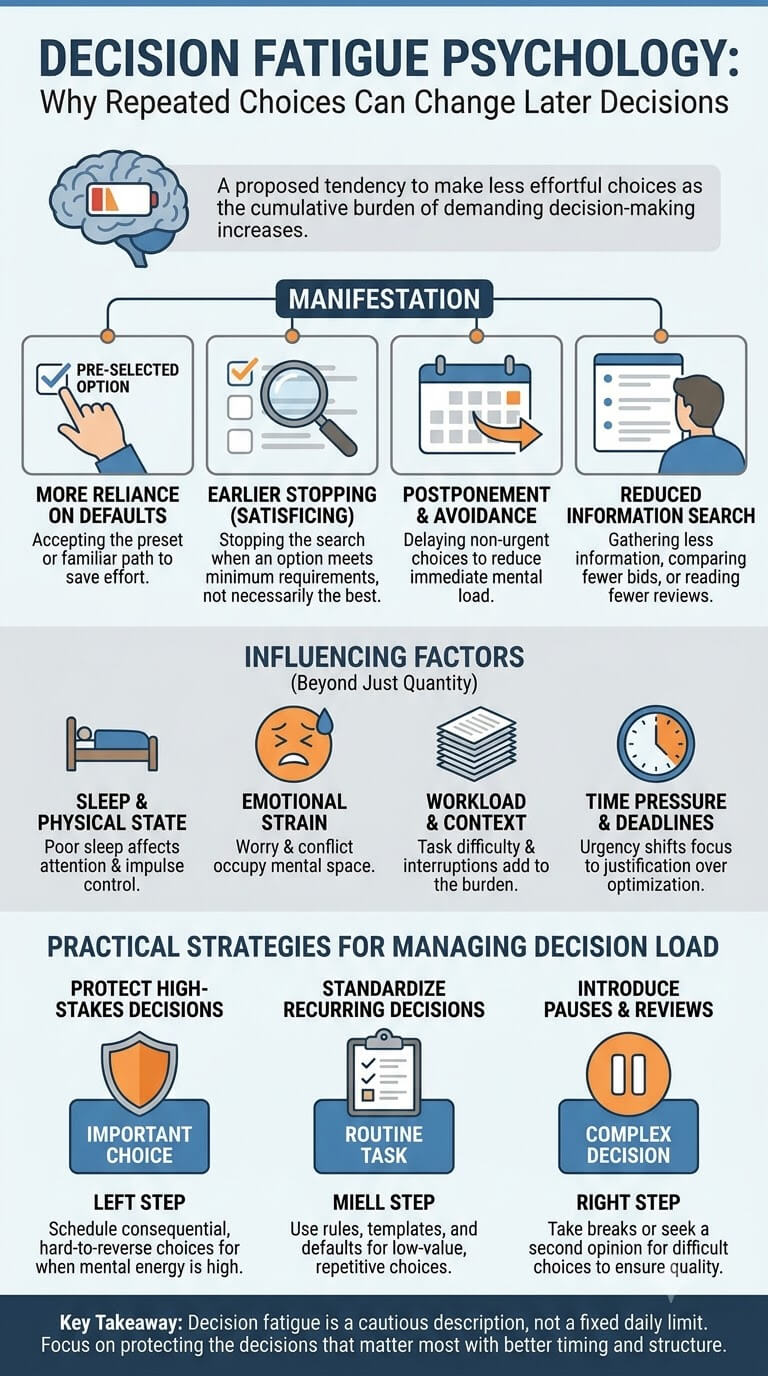
Decision fatigue is a proposed tendency to make less effortful choices as the cumulative burden of demanding decision-making increases. It may show up as relying more on defaults, stopping a search earlier, postponing a choice, or choosing an acceptable option rather than comparing everything. Evidence is mixed, definitions vary, and other factors such as cognitive load, time pressure, sleep, and emotional strain can produce similar changes.
What Researchers Mean by Decision Fatigue
The phrase sounds intuitive, but it has been used in several different ways. That matters because a concept is difficult to test when different studies treat different experiences as the same thing. A recent systematic review of healthcare decision-making proposed a narrower definition centered on a tendency toward less effortful decisions as the cumulative burden of effortful choice increases.
Accumulated decision effort
The core idea is not that every tiny choice drains the mind by an equal amount. Choosing which mug to use and deciding whether to approve a high-cost project are both decisions, but they do not demand the same level of attention, uncertainty management, comparison, or responsibility.
A better way to think about accumulated decision effort is to focus on choices that require active evaluation. These may involve conflicting goals, incomplete information, consequences for other people, switching between different kinds of problems, or the need to justify the outcome. A morning filled with such choices can feel different from a morning filled with routine actions that are already standardized.
The APA Dictionary of Psychology describes cognitive load as the mental-resource demand imposed by a task. Decision load is not identical to cognitive load, but the concepts overlap when choices require substantial working attention, comparison, updating, and rule use.
Less effortful later choices as a proposed pattern
When decision effort accumulates, one proposed outcome is a shift toward responses that require less deliberation. That might mean accepting the preset option, using a familiar rule, choosing the first option that clears a minimum threshold, or delaying the decision until later.
These responses are not automatically bad. A default can be well designed. A familiar rule can be appropriate. Stopping once an option is good enough can be rational when further search is costly. The concern appears when lower effort, rather than the needs of the decision, starts determining which strategy gets used.
Why the construct is not defined consistently across studies
Some studies infer decision fatigue from time of day. Others use the order of decisions, the number of prior cases, self-reported fatigue, workload, or changes in decision behavior. Those measures are not interchangeable. A late-day effect, for example, could reflect cumulative decisions, sleep pressure, hunger, shift length, changing case mix, or several factors at once.
A 2025 systematic review in Health Psychology Review found substantial inconsistency in how decision fatigue had been defined and operationalized in healthcare research. That is an important caution: a familiar subjective experience does not automatically establish one specific psychological mechanism.
What the Evidence Does and Does Not Show
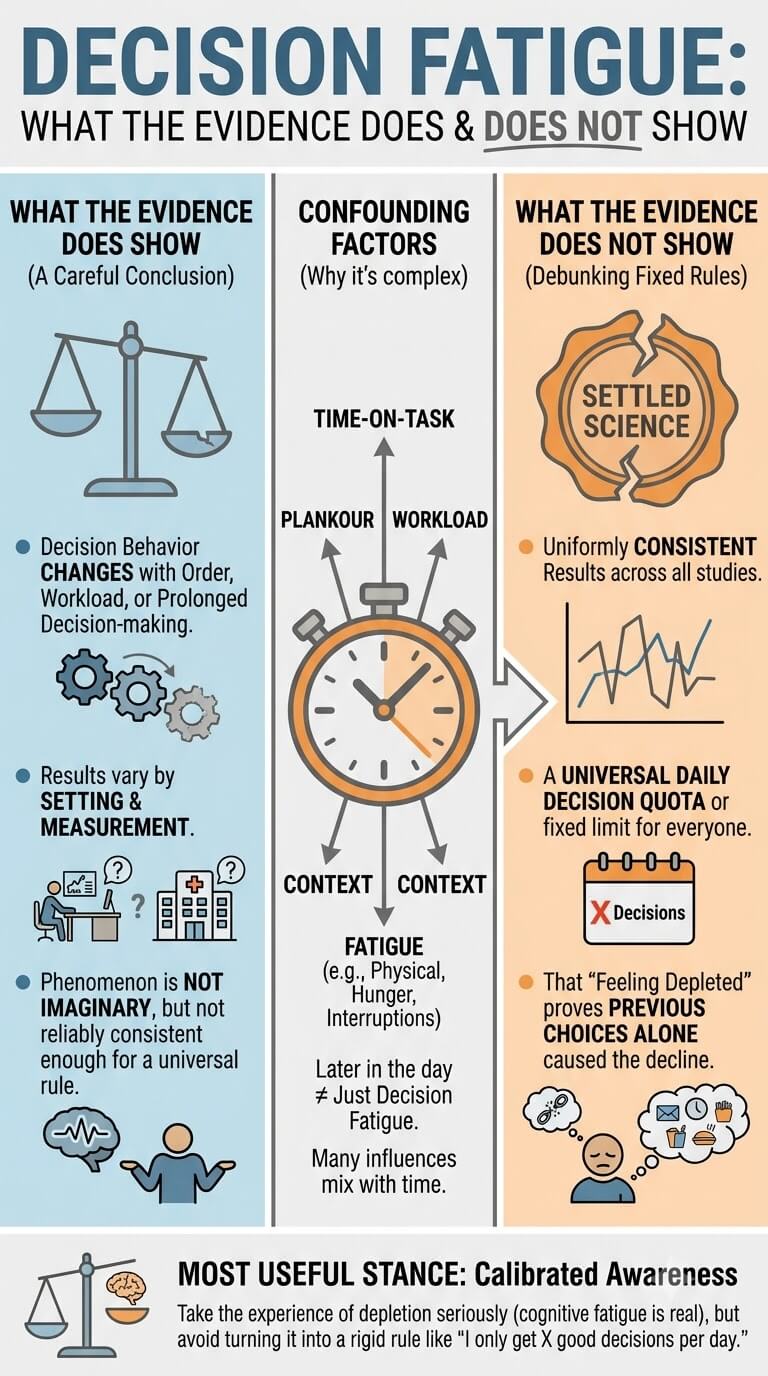
Decision fatigue is often presented online as settled science. The evidence supports a more careful conclusion. There are studies in which decision behavior changes with order, workload, or prolonged decision-making, but results are not uniformly consistent and many designs cannot isolate repeated choice from other forms of fatigue or context.
Findings vary by setting and measurement
In the 2025 healthcare review, less than half of the quantitative cases that directly assessed the decision-fatigue hypothesis showed clear significant effects. That does not mean the phenomenon is imaginary. It means the effect is not reliable enough to assume that every series of decisions produces the same decline in every person and setting.
A separate scoping review of hospital decision fatigue also reported inconsistent findings and noted that clinician, patient, and work-environment factors were often not fully accounted for. Evidence becomes difficult to interpret when the people, decisions, and contexts are changing at the same time.
Time-on-task, workload, context, and fatigue can be confounded
Imagine a manager who approves 30 requests over a day. Request number 30 occurs later, after more decisions, but also after more hours awake, more interruptions, more emails, and perhaps a missed meal. If the final choices are different, the order alone cannot tell us why.
This is why “later in the day” should not be treated as a synonym for “decision fatigued.” Time can carry many influences with it. The same problem appears in occupations where cases become harder or easier at different times, where staffing changes, or where decision-makers know a break or shift change is approaching.
Why a plausible experience is not the same as a universal law
Many people genuinely notice that choices feel harder after a demanding day. The APA Dictionary of Psychology defines cognitive fatigue as a state of mental tiredness and reduced cognitive efficiency during sustained demanding activity. That broader state can include slower processing, reduced attention, and impaired decision making.
But “I feel mentally depleted” does not prove that previous choices alone caused the change. The most useful stance is calibrated: take the experience seriously, but avoid turning it into a fixed rule such as “I only get a certain number of good decisions per day.” Research has not established a universal daily decision quota.
How Later Decisions May Become Simpler
If repeated decision effort is affecting behavior, the change may not look like obvious confusion. Often it looks like simplification. The mind reduces how much comparison, search, or justification it is willing to perform.
More reliance on defaults
Defaults reduce work because they let a person accept a preselected or familiar path without constructing a new answer from scratch. In many settings, this is efficient. Auto-renewing a useful subscription, reordering a standard supply, or following an established safety procedure can save unnecessary effort.
The question is whether the default still fits. If you notice yourself accepting a preset option mainly because changing it feels tiring, pause when the stakes are meaningful. Ask what you would choose if the option had not been preselected.
Earlier stopping and satisficing
Search has a cost. Every additional comparison requires time and attention, so people often stop when they find an option that meets their requirements rather than continuing until they prove it is the absolute best. This is called satisficing, and it can be a sensible response to limited resources.
Decision fatigue becomes relevant when the stopping point shifts because continued evaluation feels too effortful. You may accept a weaker option at 5 p.m. than you would have accepted at 10 a.m., not because your standards changed intentionally, but because continuing the search feels more expensive.
Deferring or avoiding a non-urgent choice
Postponement can also reduce immediate effort. Sometimes that is exactly the right move. A tired person may be better off delaying a reversible, non-urgent choice than forcing a poor decision.
Deferral becomes less useful when every difficult choice is repeatedly pushed forward or when a deadline is quietly approaching. A good test is to attach a return point: “I am not deciding this now. I will review it tomorrow at 10 a.m. with these three facts in front of me.” That turns avoidance into a planned pause.
Reducing information search
Another form of simplification is gathering less information. You may stop reading reviews, compare fewer bids, or ask fewer follow-up questions. That can save time when additional information has low value, but it can also make a high-stakes decision fragile if key facts remain unknown.
Instead of asking, “Do I have all the information?” ask, “What information could realistically change my choice?” That question limits unnecessary search without giving up on information that matters.
Decision Fatigue vs Choice Overload
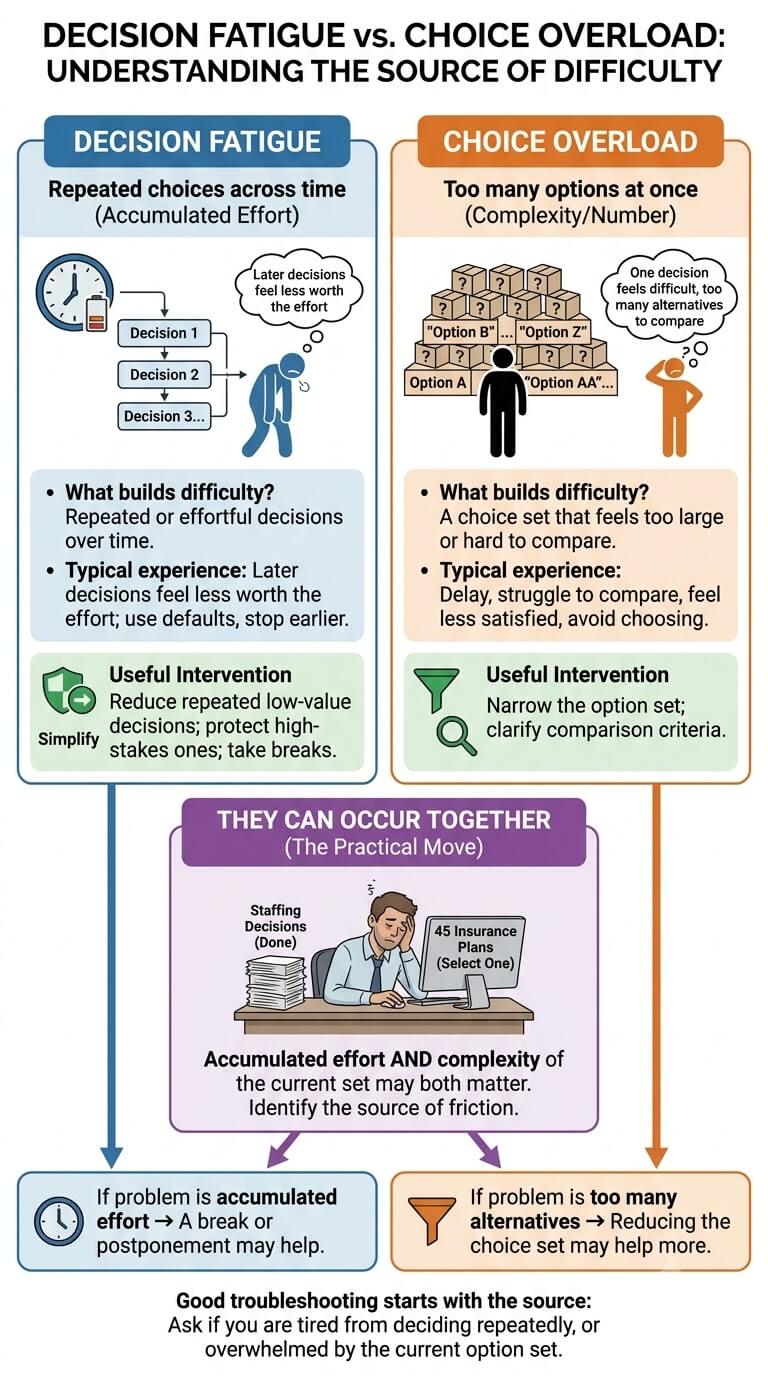
These two ideas are often blended together, but they point to different sources of difficulty. One concerns accumulated effort across decisions. The other concerns the number or complexity of options inside a choice.
Repeated choices across time versus too many options at once
| Question | Decision fatigue | Choice overload |
|---|---|---|
| What builds the difficulty? | Repeated or effortful decisions over time | A choice set that feels too large or hard to compare |
| Typical experience | Later decisions feel less worth the effort | One decision feels difficult because there are too many alternatives |
| Possible response | Use defaults, stop earlier, postpone, simplify | Delay, struggle to compare, feel less satisfied, avoid choosing |
| Useful intervention | Reduce repeated low-value decisions and protect high-stakes ones | Narrow the option set and clarify comparison criteria |
The two can occur together
Suppose you have spent the morning making staffing decisions, then open a page containing 45 insurance plans. The accumulated effort from earlier choices and the complexity of the current option set may both matter. It would be artificial to insist that only one explanation is operating.
The practical move is to identify which burden you can change. If the problem is accumulated effort, a break or postponement may help. If the problem is too many alternatives, reducing the choice set may help more.
Why they need different solutions
Reducing the number of choices across a day will not necessarily solve a single badly structured decision with 40 poorly differentiated options. Likewise, cutting a 40-option list to five may not restore attention after hours of demanding work.
Good troubleshooting starts with the source of friction. Ask whether you are tired from deciding repeatedly, overwhelmed by the current option set, or experiencing both.
Decision Fatigue vs Self-Control Depletion
Decision fatigue is also commonly explained through the idea that acts of self-control consume a limited inner resource. That explanation is more controversial than many popular accounts suggest.
Decision effort is not identical to resisting temptation
Choosing between two project plans is not the same task as resisting a dessert, suppressing an emotional reaction, or forcing yourself to keep exercising. These activities may all feel effortful, but that does not mean they rely on one identical fuel tank.
Keeping the constructs separate helps prevent a vague explanation in which every form of mental effort is treated as evidence for one depletion mechanism.
Avoid using ego depletion as the sole explanation
Older accounts often linked decision fatigue to ego depletion, the idea that self-control draws down a limited resource. Replication debates and alternative models have made that explanation less secure than it once appeared in popular writing.
For practical purposes, you do not need to settle that theoretical debate before organizing your day. If repeated high-effort choices appear to change how carefully you decide later, you can reduce unnecessary load without claiming that a specific biological or psychological resource has been exhausted.
Competing explanations should remain visible
Motivation, boredom, opportunity cost, task switching, sleep pressure, emotional strain, cognitive load, and time constraints can all change how much effort a person is willing or able to invest. A 2025 systematic and scoping review of clinical decision fatigue emphasized the intertwined cognitive, emotional, behavioral, social, and contextual determinants involved.
That complexity is not a weakness. It is a reminder to look at the whole decision environment instead of searching for one invisible cause.
What Else Can Look Like Decision Fatigue?
Before blaming repeated choices, check for simpler explanations. Several conditions can create the same subjective experience of “I cannot decide anymore.”
Sleep loss or physical fatigue
Poor sleep can affect attention, working memory, mood, and impulse control. Physical exhaustion can also make additional mental effort feel less appealing. If decision difficulty reliably follows sleep loss, long shifts, illness, or strenuous activity, those factors deserve attention in their own right.
Emotional strain
A difficult conversation, unresolved worry, grief, or ongoing conflict can occupy attention before a new choice even begins. You may have made only a few decisions, yet still feel unable to compare options because emotional processing is consuming mental space.
High cognitive load
Some decisions are demanding because they require holding many details in mind. A contract with multiple conditions, a complex schedule, or a technical purchase can create heavy cognitive load even if it is your first major decision of the day.
A systematic review of mental load and fatigue measurement highlights that these related states are measured in different ways and are not reducible to a single simple indicator. That is another reason to avoid labeling every difficult choice “decision fatigue.”
Poorly structured choices
Sometimes the problem is the decision itself. If the criteria are unclear, options are incomparable, or the real goal has not been defined, more energy may not solve the issue.
Try writing one sentence that describes what the decision must accomplish. Then choose three criteria that actually distinguish the options. Structure often reduces more friction than motivation does.
Time pressure
A deadline changes the cost of continued search. The same choice can feel manageable with a week to think and exhausting with 20 minutes left. Under pressure, stopping early or choosing a familiar option may reflect urgency rather than accumulated decision effort.
A Decision-Load Audit
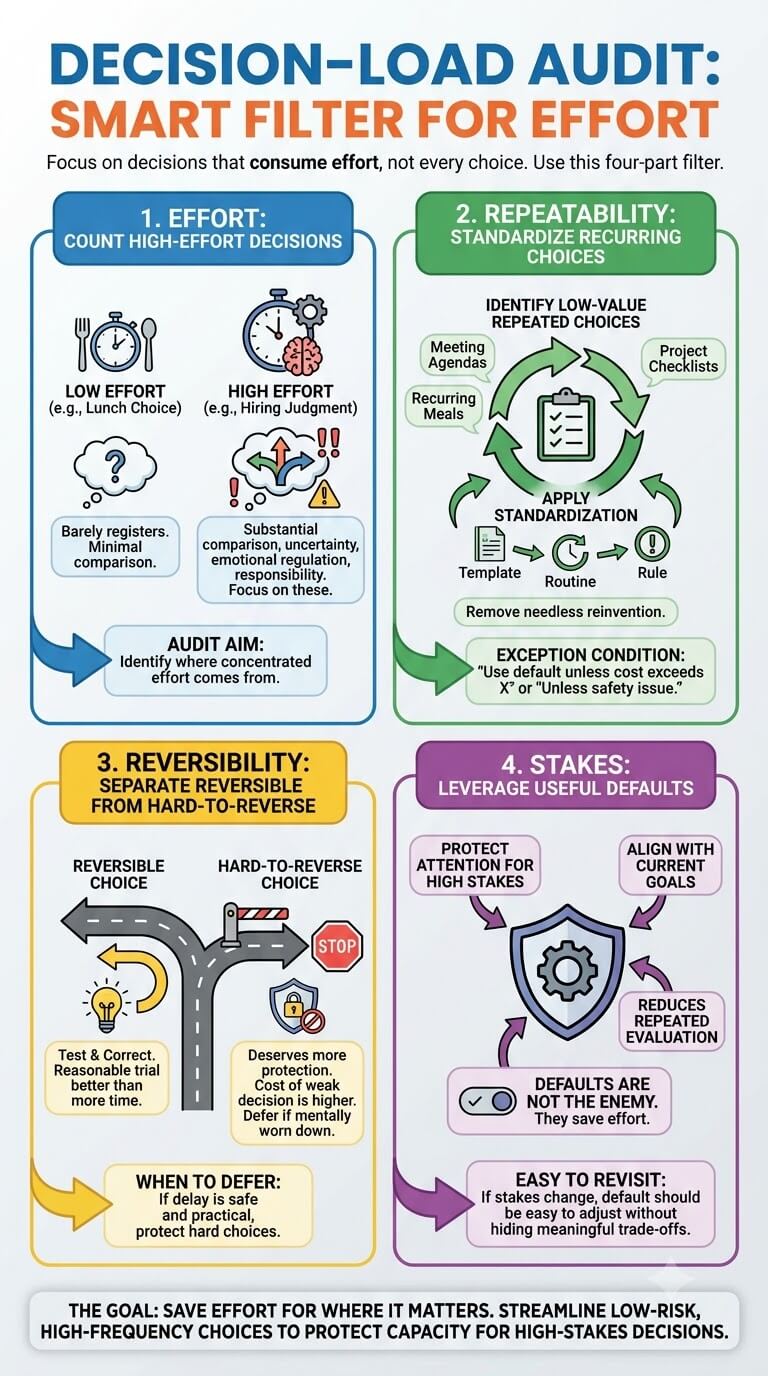
If you suspect repeated decisions are wearing down later choices, do not count every choice you make. Instead, audit the decisions that actually consume effort. A useful four-part filter is Effort, Repeatability, Reversibility, and Stakes.
Count high-effort decisions, not every tiny choice
For one or two days, note the choices that require substantial comparison, uncertainty management, emotional regulation, or responsibility. You do not need a precise score. The aim is to see where concentrated decision effort is coming from.
A five-minute lunch choice may barely register. A 20-minute hiring judgment with incomplete information may be far more costly. Treating those as equal obscures the real pattern.
Identify recurring decisions that can be standardized
Repeated low-value choices are candidates for rules, templates, or routines. A team might standardize which meetings require written agendas. A household might use a recurring meal list. A freelancer might create a checklist for accepting small projects.
Standardization should remove needless reinvention, not lock you into a rule when circumstances change. Build an exception condition: “Use the default unless the cost exceeds X,” or “Use the checklist unless this case has a safety issue.”
Separate reversible from hard-to-reverse choices
Not every decision deserves equal effort. A reversible choice can often be tested and corrected. A hard-to-reverse choice deserves more protection because the cost of a weak decision is higher.
When you are mentally worn down, defer a hard-to-reverse choice if a delay is safe and practical. For a reversible choice, a reasonable trial may be better than spending another hour searching for certainty.
Notice when defaults are doing useful work
Defaults are not the enemy. They can protect attention for decisions that deserve it. The audit should ask whether a default is aligned with your current goals, not whether you are using one.
A useful default reduces repeated evaluation without hiding meaningful trade-offs. If the stakes change, the default should be easy to revisit.
Reduce Decision Load Without Trying to Eliminate Choice
The goal is not to engineer a life with no decisions. Choice is part of autonomy, learning, and adaptation. The useful target is unnecessary decision effort.
Pre-commit routine low-stakes decisions
Pre-commitment means deciding a rule before the moment of choice. You might choose a regular grocery list, a standard workout schedule, or a fixed process for approving low-cost expenses. This prevents the same low-stakes problem from demanding fresh analysis each time.
Keep the rule easy to revise. A pre-commitment is a tool, not a contract with your past self.
Group similar decisions when that reduces switching
Some people find it easier to review similar requests together rather than repeatedly switching between unrelated tasks. Grouping them can make criteria more consistent and reduce the setup cost of entering a new decision context.
But grouping is not automatically better. A huge queue can create time pressure or monotony. Use this approach when similarity genuinely reduces switching, and split the queue when quality begins to drop.
Move high-stakes choices away from obvious fatigue when possible
If you know that you are depleted after a long shift or a recurring meeting block, avoid placing your most consequential decisions there when scheduling is under your control. This is not because morning decisions are universally superior. It is because you are using your own predictable pattern as information.
If timing cannot change, add structure instead: use written criteria, ask for a second review, or separate information gathering from final approval.
Use checklists for repeated complex decisions
A checklist reduces the need to reconstruct a process from memory. It can be especially useful when the same type of decision recurs but still requires several important checks.
The best checklist is short enough to use. Include the steps most likely to be skipped when attention is low, not every fact you could possibly consider.
Why Bounded Rationality Matters When Decisions Pile Up
Human decision-making already operates within limits. We rarely have unlimited time, complete information, or enough attention to evaluate every possible option. Repeated effort can make those limits more noticeable.
Capacity and time are already limited
Even on a good day, a person cannot compare every job, read every review, model every possible outcome, and continually update every decision. Practical choice requires selective attention and stopping rules.
This is why simplification is not automatically a failure. The real issue is whether the simplification matches the stakes.
Repeated effort can make simplification more attractive
After sustained demanding work, another round of analysis may carry a higher subjective cost. Choosing a satisfactory option, following a rule, or delaying the choice can become more attractive.
The solution is not to demand perfect optimization. It is to reserve deeper analysis for decisions where additional effort has enough expected value to justify its cost.
When Time Pressure Compounds Decision Load
Decision effort and urgency can interact. A person who is already mentally tired may face a deadline that makes extended comparison impossible.
Deadlines reduce search time
Under a deadline, the question changes from “What is the best option?” to “What can I justify before time runs out?” That shift can be appropriate, but it also increases the value of having criteria prepared in advance.
Fatigue plus urgency can change stopping thresholds
When both effort and time are scarce, people may accept the first option that seems workable. If the decision is reversible, that may be a practical strategy. If it is difficult to reverse, create a minimum review standard before acting.
For example, require one independent check, one downside review, and confirmation of the most important fact before finalizing. A small procedural safeguard can protect a high-stakes decision when extensive analysis is unrealistic.
What to Do Next: Protect the Decisions That Deserve More Effort
You do not need to optimize every choice. You need to notice which choices deserve more than the minimum effort you are currently able to give them.
Identify the day’s highest-stakes decisions
At the start of a demanding period, identify one to three choices that have meaningful consequences, are difficult to reverse, or affect other people. Protect time and attention for those decisions before low-value choices expand to fill the day.
Remove low-value repeated choice where practical
Look for decisions that recur but rarely benefit from fresh analysis. Standardize them, delegate them when appropriate, or create a narrow set of acceptable options.
This is not about becoming rigid. It is about spending deliberate thought where it changes the outcome.
Use a pause or second review for hard-to-reverse decisions
If a consequential choice arrives when you feel mentally spent, ask whether it can safely wait. If not, use a second person, written criteria, or a short break before finalizing. A second review is especially useful when you notice yourself saying, “I just want this off my plate.”
If persistent fatigue, concentration problems, sleep difficulties, or changes in daily functioning are affecting many areas of life, consider discussing them with a qualified health professional. Decision difficulty can have many causes, and a broad pattern should not be self-diagnosed as decision fatigue.
FAQ About Decision Fatigue
These questions address the parts of decision fatigue that are most often oversimplified.
Is decision fatigue scientifically proven?
There is evidence that decision behavior can change across sequences of demanding choices, but the research does not support treating decision fatigue as a universal, precisely measured law. Reviews have found inconsistent definitions, mixed findings, and many possible confounding factors. It is more accurate to describe decision fatigue as a plausible, actively studied pattern whose size, causes, and boundaries vary by context.
Does decision fatigue get worse later in the day?
Later decisions may sometimes differ from earlier ones, but time of day alone does not prove decision fatigue. Later hours also bring sleep pressure, accumulated workload, interruptions, hunger, changing incentives, and different kinds of tasks. Your own pattern can still be useful: if important decisions reliably deteriorate at a certain time, protect them with better timing or more structure.
Is decision fatigue the same as being tired?
No. General tiredness can come from sleep loss, physical exertion, illness, emotional strain, or sustained mental work without repeated choices. Decision fatigue refers more specifically to changes associated with cumulative decision effort. The experiences can overlap, which is one reason researchers need clearer measurement.
Can reducing small choices improve important decisions?
It may help when the small choices are genuinely repetitive and effortful, but there is no established rule that eliminating trivial decisions automatically creates a fixed amount of extra decision power. The stronger reason to standardize low-value choices is practical: it reduces interruptions, switching, and unnecessary analysis, leaving a cleaner environment for higher-stakes work.
How is decision fatigue different from choice overload?
Decision fatigue concerns accumulated effort across a sequence of choices. Choice overload concerns difficulty created by the number or complexity of alternatives in a particular choice. They can occur together, but they point to different solutions. Repeated decision load may call for rest, timing, or standardization, while choice overload is often better addressed by narrowing options and clarifying criteria.
Key Takeaways
- Decision fatigue is best treated as a cautious description of reduced willingness to invest effort after demanding choices, not as a fixed daily depletion law.
- Research findings are mixed, and time on task, workload, sleep, emotional strain, and context can look similar to decision fatigue.
- Possible signs include greater reliance on defaults, earlier stopping, less information search, and postponement, but none of these behaviors proves one cause by itself.
- Decision fatigue differs from choice overload: one concerns accumulated decision effort, while the other concerns an option set that is difficult to manage.
- A useful response is to standardize low-value recurring decisions and protect hard-to-reverse, high-stakes choices with better timing, criteria, or a second review.
- If fatigue or concentration problems are broad, persistent, or impair daily functioning, look beyond the label and consider professional evaluation rather than self-diagnosing.

Michael Reed is the Founder and Lead Writer at Psychology Exposed. He writes about human behavior, relationships, emotional patterns, self-awareness, and practical psychology topics using research-informed, easy-to-understand content.
Read More About Michael Reed: https://psychologyexposed.com/michael-reed/