
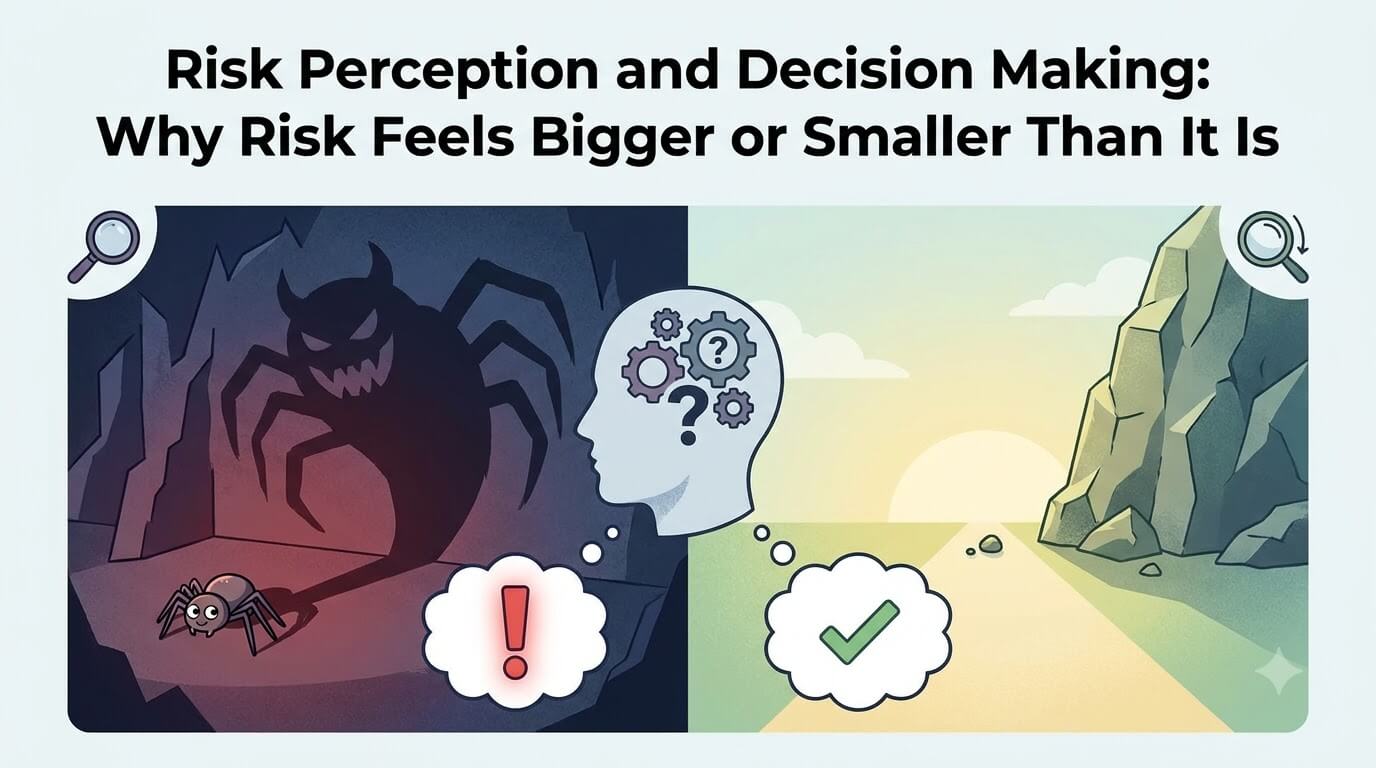
A choice can feel dangerous even when the odds of harm are low. Another choice can feel almost routine even when the downside deserves serious attention. That gap is not always irrationality. Human beings do not experience risk as a number alone. We also respond to how severe the outcome seems, whether we feel in control, how familiar the situation is, how vivid the danger looks, and whether we trust the information in front of us.
This matters because decisions are shaped by the risk we perceive, not only by the risk someone else has calculated. A person may avoid a rare but frightening outcome, tolerate a familiar hazard without much thought, or become more cautious after seeing one memorable example. The useful question is not, “Why am I so bad at judging risk?” It is, “What exactly is making this option feel risky, and how well does that feeling match the best information I have?”
Quick Answer
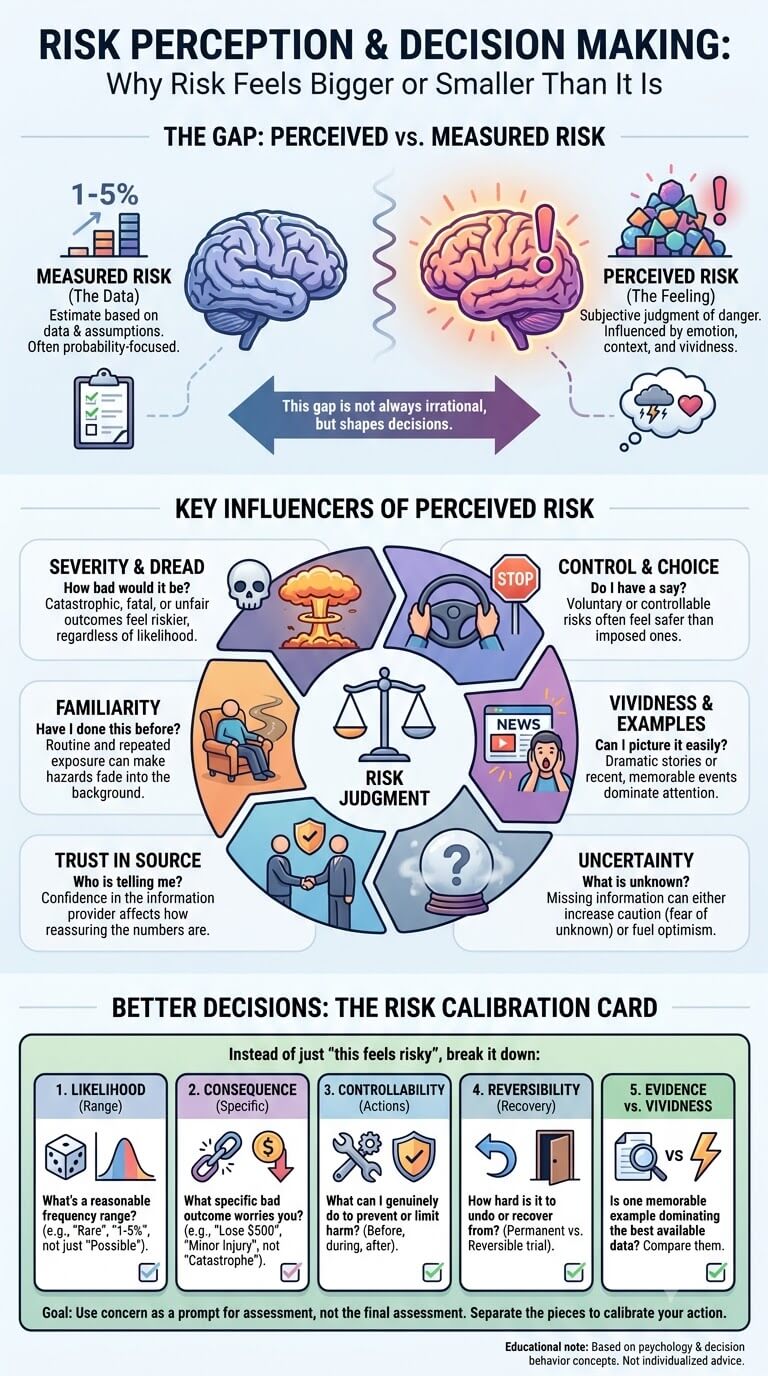
Risk perception is the way people judge how dangerous an option or outcome feels. It reflects probability, but also severity, dread, control, familiarity, trust, and vivid examples. Because these factors do not always move together, perceived risk can be higher or lower than measured risk. Better decisions come from separating likelihood, consequence, controllability, and uncertainty instead of treating “this feels risky” as one single fact.
What Risk Perception Means in a Decision
The APA Dictionary of Psychology defines risk in terms of the probability or likelihood of a negative event, loss, or harm. In everyday judgment, however, people rarely experience that probability in isolation. Risk becomes psychologically meaningful when a possible outcome is attached to something we value, fear, control, or cannot easily reverse.
Risk perception is therefore one component of the wider decision-making process, not a complete explanation for why an option is chosen.
Probability is only one part of perceived risk
Suppose two options each carry a small chance of an unwanted outcome. One possibility is familiar, gradual, and easy to recover from. The other is unfamiliar, dramatic, and potentially irreversible. The numerical likelihood may be similar, but most people will not experience the two options as equally risky.
This is one reason “How likely is it?” is necessary but incomplete. The mind also asks, often implicitly, “What would happen if it went wrong?” and “Would I be able to do anything about it?” Those questions change the psychological weight of the same probability.
Consequence severity changes the psychological weight
A 10 percent chance of a minor inconvenience and a 10 percent chance of a devastating loss are not equivalent decisions. Severity matters because outcomes differ in cost, recovery time, reversibility, and effect on other people. A small probability can deserve serious attention when the downside is severe enough.
At the same time, severity can dominate attention so strongly that probability almost disappears from the mental picture. When the imagined consequence is especially frightening, a person may react to the possibility as though it were likely. That is why likelihood and severity should be examined separately.
Subjective risk can differ from measured risk
Measured risk is an estimate based on available data, assumptions, and a defined population or situation. Subjective risk is the danger a person believes or feels is present. Neither should be treated carelessly. Subjective judgment can be distorted, but measured estimates also have limits, especially when the data are incomplete or the situation does not closely match the person’s circumstances.
The practical goal is calibration, not emotional suppression. If your concern is stronger than the evidence seems to justify, investigate why. If your concern is weaker than the evidence suggests, investigate that too.
Why Two Risks With Similar Probabilities Can Feel Very Different
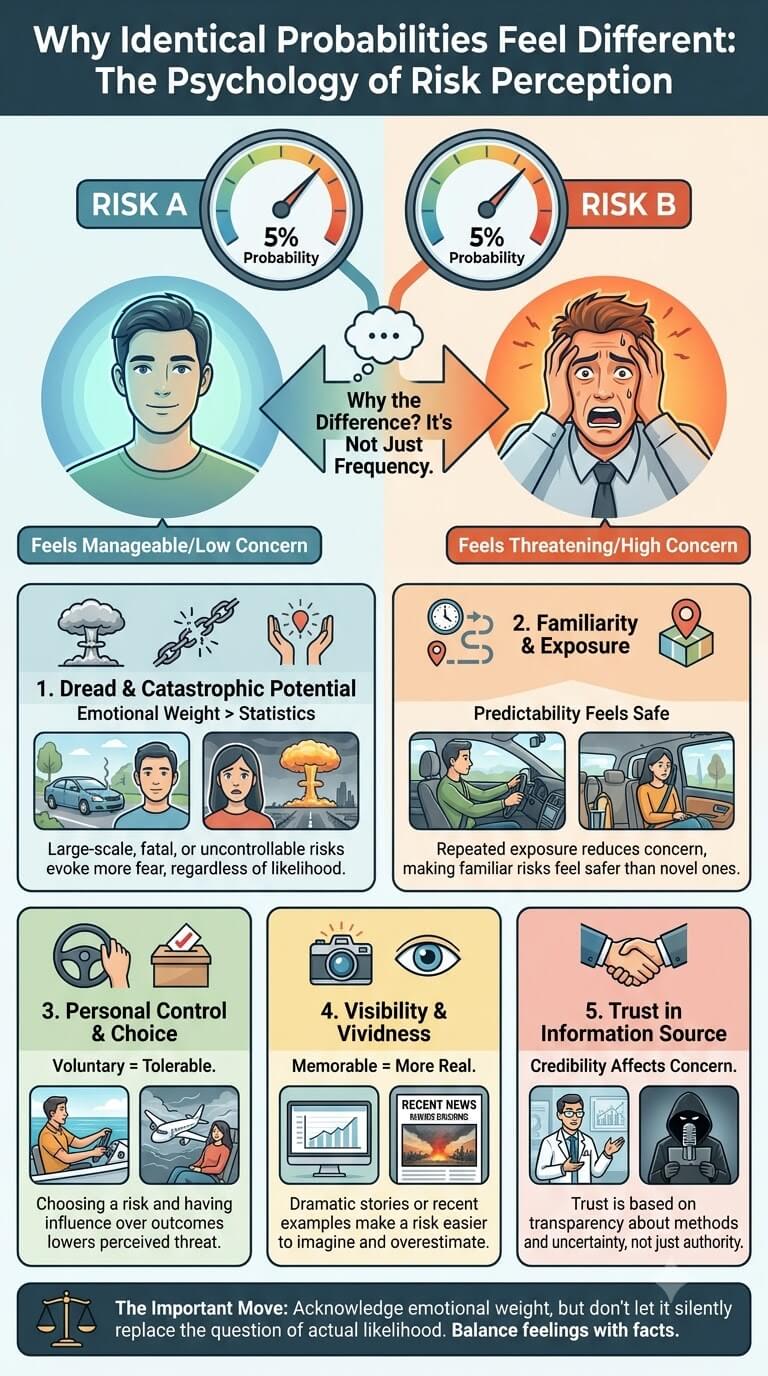
Research on risk perception has repeatedly found that people judge hazards using more than frequency. An open-access review of the psychometric tradition notes the importance of qualities such as dread, controllability, familiarity, catastrophic potential, and how well a risk is understood. These characteristics help explain why equal-looking probabilities can produce very different reactions.
Dread and catastrophic potential
Some outcomes carry a special sense of dread because they seem catastrophic, uncontrollable, fatal, unfair, or capable of affecting many people at once. A hazard that evokes images of a large-scale disaster may feel more threatening than a statistically comparable hazard whose harms are dispersed and familiar.
Dread is not evidence that the risk is imaginary. It is a clue that the consequence has strong emotional and moral weight. The important move is to keep that weight visible without letting it silently replace the question of likelihood.
Familiarity and repeated exposure
Familiar risks often feel safer because they no longer demand much attention. Someone who has driven the same route for years may barely register the risks of driving, while feeling uneasy about a rare form of transportation. Repetition creates predictability, and predictability can feel like safety.
But familiarity is not the same as low risk. Repeatedly getting away with something can reduce concern even when the underlying hazard remains. The reverse can also happen: unfamiliarity can make a low-probability situation feel unusually dangerous simply because the person lacks a stable mental model for it.
Personal control and voluntary choice
People often tolerate more risk when they believe they chose the exposure and can influence what happens next. Control changes the emotional meaning of uncertainty. An option may feel less threatening when you can slow down, stop, inspect, prepare, or change course.
Perceived control can be useful when it reflects real options. It becomes misleading when the feeling of control is much larger than the control actually available. A confident driver, for example, may feel protected by skill while underweighting hazards created by weather, other drivers, or simple bad luck.
Visibility, vividness, and recent examples
A risk becomes easier to imagine after a dramatic story, image, near miss, or recent personal experience. Vivid events supply the mind with concrete material. The danger no longer feels abstract, so it may receive more attention than a quieter risk that is more common but less memorable.
This effect does not mean vivid examples should be ignored. A personal experience may reveal a real hazard you previously underestimated. The check is whether one memorable case has become your entire estimate.
Trust in the source of information
Risk judgments also depend on who is delivering the numbers. The CDC’s guidance on risk perception and communication notes that concern can vary with factors such as voluntariness, control, familiarity, benefits, and trust in the source. A technically accurate estimate may fail to reassure someone who does not trust the institution providing it.
Trust should not be reduced to “believe the expert” or “trust your gut.” A better question is whether the source explains methods, uncertainty, limitations, and what could change the estimate.
Probability and Consequence Are Different Questions
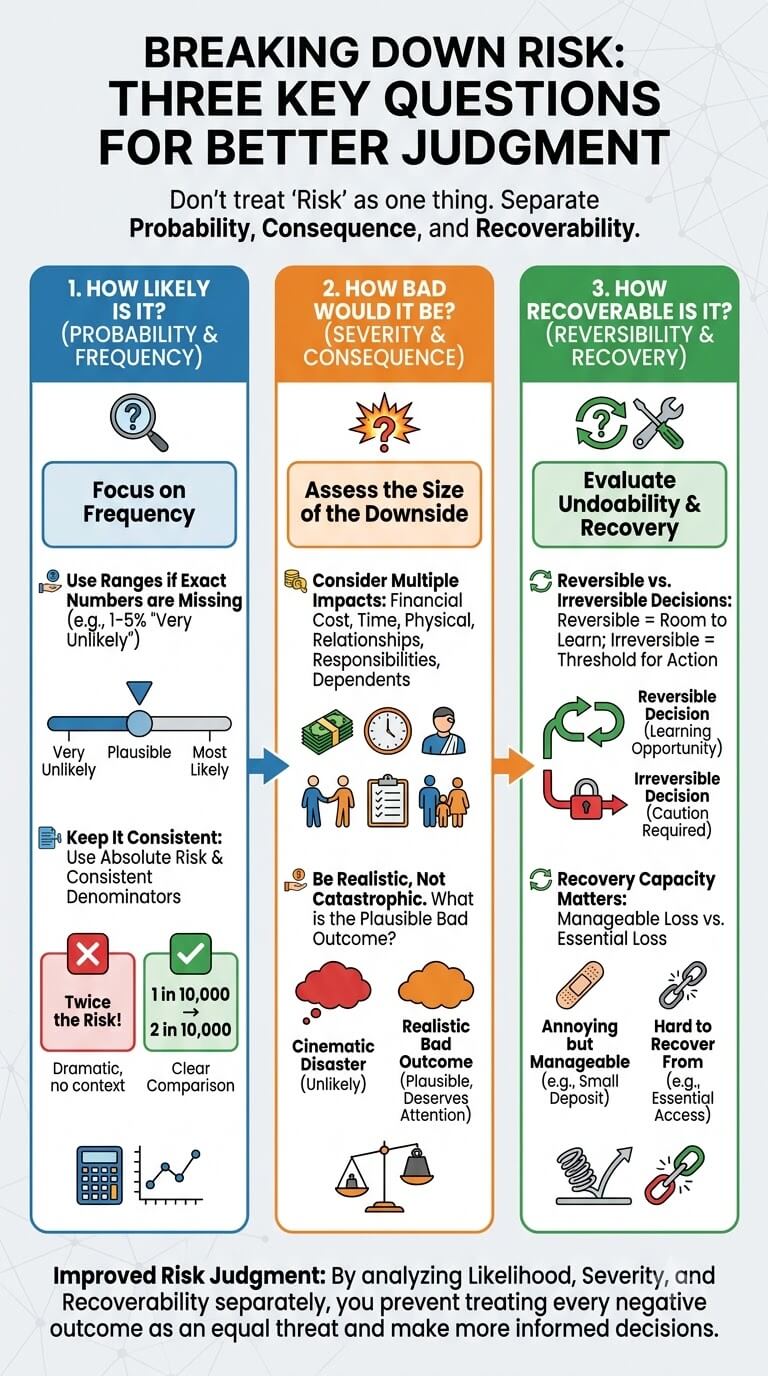
One of the simplest ways to improve risk judgment is to stop using the word “risk” as though it means only one thing. Break the problem into at least three questions: how likely is the unwanted outcome, how serious would it be, and how recoverable would the situation be if it occurred?
How likely is it?
Likelihood is about frequency or probability. In many real decisions, an exact number is unavailable, so a range may be more honest: very unlikely, perhaps 1 to 5 percent, or plausible but not the most likely outcome. When numbers are available, keep the time frame and denominator consistent.
The CDC recommends clear explanations of risks and numbers, including absolute risk and consistent denominators when comparing probabilities. That matters because “twice the risk” can sound dramatic without telling you whether the change is from 1 in 10 to 2 in 10 or from 1 in 10,000 to 2 in 10,000.
How bad would it be?
Severity asks about the size of the downside, not its chance of occurring. A useful assessment includes financial cost, time, physical consequences, effect on relationships, disruption to responsibilities, and impact on people who depend on you.
Do not inflate every downside into a catastrophe. Ask what the realistic bad outcome is, not the most cinematic one you can imagine. If the severe outcome is genuinely plausible, it deserves attention even if it is not the most likely result.
How reversible or recoverable is the outcome?
Two equally unpleasant outcomes can deserve different treatment if one is easy to undo and the other is not. A reversible decision gives you room to learn. An irreversible or difficult-to-repair decision justifies a higher threshold for action.
Recovery also matters. Losing a small deposit may be annoying but manageable. Losing access to something essential may be much harder to recover from. Thinking in terms of reversibility can prevent the mind from treating every negative outcome as equally threatening.
Perceived Risk vs Actual Risk
People often talk about “actual risk” as if there were always one perfect number. In practice, risk estimates depend on data quality, population, time frame, assumptions, and context. It is usually more accurate to compare perceived risk with the best available measured estimate, while acknowledging uncertainty in both.
When subjective concern is proportionate
Concern may be well calibrated when it rises with both likelihood and consequence. If a hazard is common, serious, and hard to control, strong concern can be appropriate. Likewise, a rare but catastrophic and irreversible outcome may reasonably receive more attention than its probability alone suggests.
Feeling worried is not proof that a danger is high, but it can direct attention toward something worth checking. The goal is to use concern as a prompt for assessment rather than as the final assessment.
When vividness can dominate probability
A recent accident, alarming headline, or frightening story can make a rare outcome feel close and immediate. The more easily you can picture the event, the easier it is to confuse “I can imagine this happening” with “this is likely to happen.”
A simple correction is to ask for a comparison class. Instead of focusing on the one example, ask how often the outcome occurs across many similar cases and whether your situation meaningfully differs from that group.
Why exact calibration is often impossible
Some choices do not come with trustworthy probabilities. A new project, a career move, a relationship decision, or a changing market may contain too many unknowns for precise calculation. In those cases, pretending to have exact odds can create false confidence.
Calibration can still improve. Use ranges, name assumptions, identify the most consequential unknowns, and distinguish evidence from imagination. You do not need perfect numbers to think more clearly about risk.
Risk Perception vs Uncertainty
Risk perception and uncertainty often travel together, but they are not identical. Keeping them separate helps explain why one person can feel calm in a highly uncertain situation while another feels alarmed even when the main probabilities are reasonably well understood.
Risk perception is the felt or judged danger
Risk perception is your assessment of how threatening an option seems. It includes thought and feeling: “How dangerous is this?” “How much could I lose?” “How exposed do I feel?”
That judgment influences whether you approach, avoid, delay, seek more information, or choose a safer alternative.
Uncertainty is what remains unknown
Uncertainty concerns missing knowledge. You may not know the probability, the future conditions, another person’s response, or whether your information is reliable. The uncertainty itself is not automatically dangerous. It means the outcome cannot be fully predicted from what you currently know.
A person can therefore face high uncertainty but low perceived danger, or low uncertainty but high perceived danger.
High uncertainty can raise or lower perceived risk
For some people, missing information increases caution because the unknown feels threatening. For others, uncertainty creates room for optimism. They may assume things will probably work out because no clear warning is visible.
This is why “I do not know” should not automatically become either “therefore it is dangerous” or “therefore it is probably fine.” Uncertainty deserves its own place in the decision.
How Emotion Changes Risk Perception
Emotion affects what receives attention and how strongly possible outcomes are weighted. An open-access meta-analysis on fear and risk taking found that fear was, on average, associated with less risky decision making and higher estimates of risk, while also showing substantial variation across studies. That variation is important because emotion does not produce one fixed response in every person or situation.
Fear can increase threat salience
Fear makes potential danger harder to ignore. That can be protective when a threat is real and easy to overlook. It can also narrow attention around a feared outcome so strongly that alternatives, base rates, and possible benefits receive less consideration.
If fear is high, first ask what it is pointing to. Is there new evidence? A severe consequence? A lack of control? Or is the feeling being carried over from another event?
Excitement can increase reward salience
Excitement can pull attention toward opportunity, novelty, status, speed, or possible gain. When the upside feels vivid, the downside may seem distant or manageable. That does not make excitement untrustworthy. It means the evaluation should include what is less emotionally visible.
A useful check is to ask, “If the reward were less exciting, what downside would I notice more?”
Feeling in control can reduce perceived danger
Control is psychologically powerful. A broad review of research on choice and control describes how perceived control can shape emotion, cognition, and behavior. In risk judgment, real control can justify lower concern because you have meaningful ways to prevent, detect, or limit harm.
But control should be specified, not merely felt. Name the actions you can actually take, what those actions influence, and what remains outside your control.
A Risk Calibration Card
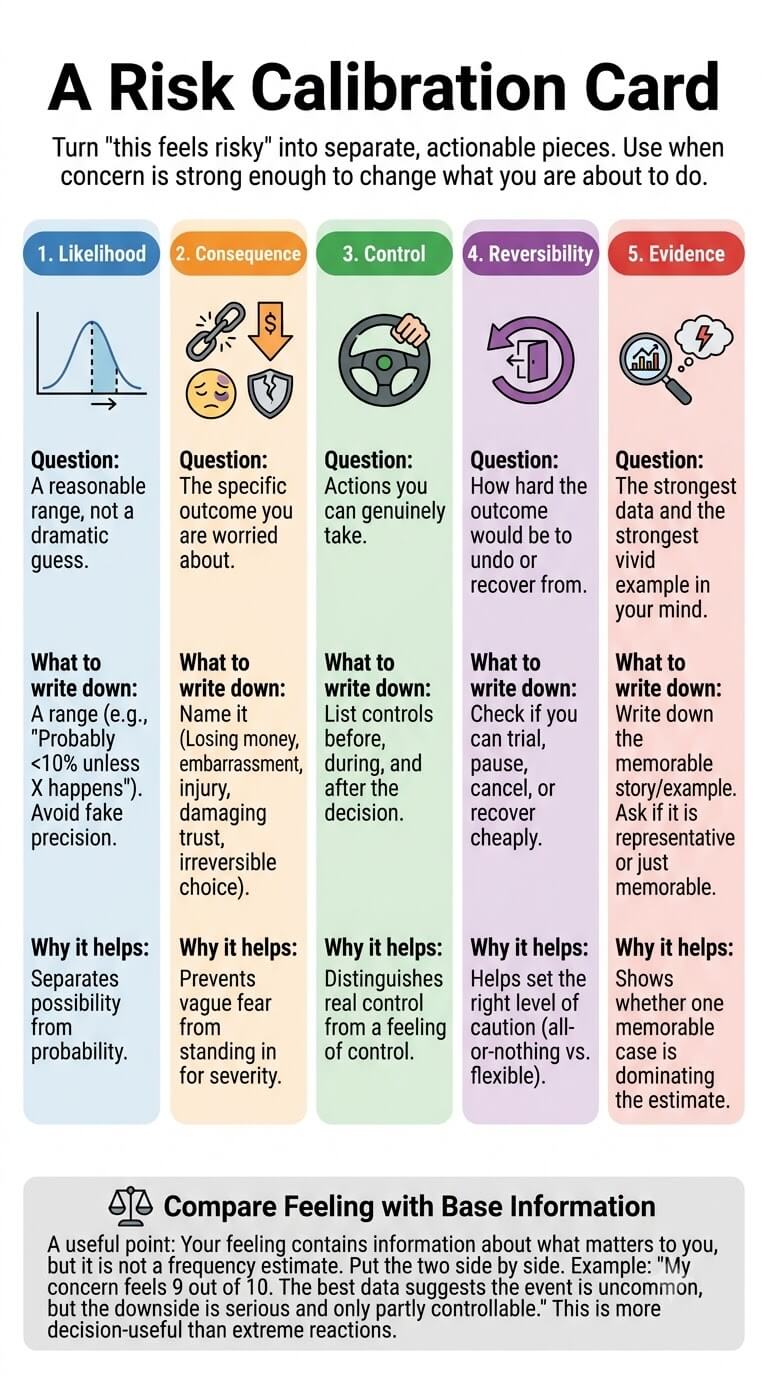
When “this feels risky” is too vague to guide a choice, turn the feeling into separate pieces. The following five-part card is designed to slow down neither every decision nor every emotion. It is most useful when concern is strong enough to change what you are about to do.
| Question | What to write down | Why it helps |
|---|---|---|
| Likelihood | A reasonable range, not a dramatic guess | Separates possibility from probability |
| Consequence | The specific outcome you are worried about | Prevents vague fear from standing in for severity |
| Control | Actions you can genuinely take | Distinguishes real control from a feeling of control |
| Reversibility | How hard the outcome would be to undo or recover from | Helps set the right level of caution |
| Evidence | The strongest data and the strongest vivid example in your mind | Shows whether one memorable case is dominating the estimate |
Estimate likelihood as a range
If an exact probability is not credible, do not manufacture one. Use a range and explain what would move it. “Probably below 10 percent unless X happens” is often more useful than pretending to know a precise 6.7 percent.
Name the consequence you are actually worried about
Replace “something could go wrong” with a concrete statement. Is the concern losing money, being embarrassed, getting injured, damaging trust, missing an opportunity, or being unable to reverse the choice? Different consequences call for different protections.
Check controllability and reversibility
List the controls that exist before, during, and after the decision. Then ask how reversible the choice is. If you can run a small trial, pause, cancel, insure against the downside, or recover cheaply, the decision may deserve less caution than an all-or-nothing commitment.
Identify the strongest vivid example influencing you
What story comes to mind first? Perhaps a friend had a bad experience, you saw a dramatic video, or something similar happened to you once. Write it down. Then ask whether the example is representative or simply memorable.
Compare feeling with the best available base information
An open-access study mapping the psychological landscape of risk perception found that judgments of risk reflect multiple dimensions, including benefits, dread, and perceived responsibility or control. That reinforces a useful point: your feeling contains information about what matters to you, but it is not the same thing as a frequency estimate.
Put the two side by side. “My concern feels 9 out of 10. The best data I can find suggest the event is uncommon, but the downside is serious and only partly controllable.” That sentence is more decision-useful than either “I am terrified, so it must be dangerous” or “the number is low, so my concern is stupid.”
Common Risk-Perception Mistakes Without Turning This Into a Bias List
Risk judgment can go wrong in several recurring ways. These are best treated as practical checks rather than labels to apply to yourself or other people.
Treating possibility as probability
If an outcome is possible, the mind can picture it. But possibility only answers “Could this happen?” Probability asks “How often does this happen under similar conditions?” Confusing the two can make every imaginable downside feel urgent.
Ignoring low-probability high-consequence outcomes
The opposite mistake is assuming that a small probability never deserves action. Some outcomes are severe enough that prevention, backup plans, or professional guidance make sense even when the chance is low. The right response depends on both likelihood and consequence.
Assuming familiarity means safety
Routine exposure can make a hazard fade into the background. Ask whether familiarity has changed the underlying risk or only your comfort with it.
Assuming fear proves high probability
Fear proves that your nervous system is treating something as important. It does not, by itself, tell you the frequency of the feared outcome. Use the feeling to identify the feared consequence, then check probability separately.
When Risk Perception Drives Anticipated Regret
Risk often becomes more emotionally powerful when you imagine not only a bad outcome, but also how you would feel about having chosen it. That future-looking regret can change the decision before anything has happened.
Imagined bad outcomes can dominate choice
Consider choosing between a familiar option and a new one. The new option may have a reasonable chance of working well, but you might vividly imagine saying, “I knew I should have stayed with the safe choice.” That imagined self-criticism can make the new option feel riskier than its evidence alone would suggest.
The same process can work in reverse. You might fear regretting a missed opportunity, so inaction begins to feel riskier than action.
Responsibility and reversibility change the emotional forecast
Regret often becomes stronger when you expect to feel personally responsible for the outcome or when the choice seems hard to undo. A reversible experiment may therefore feel much less risky than a permanent commitment, even if the short-term probabilities are similar.
When regret is driving the decision, ask two separate questions: “How risky is the outcome?” and “How much am I trying to avoid blaming myself later?” They are related, but not identical.
What to Do Next When Risk Is Hard to Calibrate
Good calibration is not about becoming fearless. It is about making concern more specific so it can guide proportionate action.
Separate likelihood, severity, and controllability
Write each on its own line. If one is high and the others are low, that tells you more than a single “high risk” label. A severe but very unlikely and highly controllable outcome is a different problem from a common, serious, uncontrollable one.
Seek higher-quality information, not merely more information
More searching can increase confidence without improving accuracy if every new source repeats the same weak claim. Prefer information that states the population, time frame, absolute numbers, uncertainty, and limitations. The CDC’s risk communication guidance emphasizes clarity about what is known and what remains unknown, which is useful far beyond public health emergencies.
Use professional guidance for genuinely high-stakes domains
When a decision involves significant medical, legal, financial, or personal safety consequences, general psychology concepts are not enough. Qualified professionals can help interpret evidence that depends on your individual circumstances.
If there is a real threat involving coercion, stalking, violence, retaliation, or intimidation, do not treat your fear as merely a calibration problem. Immediate safety information and specialized support deserve priority over trying to reason yourself into feeling less afraid.
FAQ About Risk Perception and Decision Making
These questions focus on the points that most often become confusing when probability, emotion, control, and uncertainty are all present in the same choice.
Why do rare risks sometimes feel more frightening than common ones?
Rare risks can feel especially frightening when the outcome is catastrophic, unfamiliar, vivid, involuntary, or difficult to control. A dramatic example may also make the danger easy to imagine. That does not mean the concern is irrational, but it helps to separate the severity of the outcome from how often it actually occurs.
Is perceived risk the same as actual risk?
No. Perceived risk is your subjective judgment of danger. Measured risk is an estimate based on data and assumptions. The two may differ, and neither should be treated as perfect. A useful decision compares your concern with the best available evidence while also noting uncertainty, context, severity, and your ability to respond.
Why does feeling in control change how risky something seems?
Control can reduce perceived danger because it creates options for preventing, detecting, or limiting harm. The key question is whether the control is real. Feeling skilled or familiar with a situation may lower concern even when important parts of the outcome still depend on outside forces or chance.
Can emotions improve risk judgments?
Yes. Emotions can draw attention to consequences that deserve consideration. Fear may alert you to threat, while unease may signal that something important has not been checked. Problems arise when the emotional signal is treated as a complete probability estimate. The most useful approach is to identify what the feeling is highlighting and then compare it with evidence.
How can I compare risks when the probabilities are uncertain?
Use ranges instead of false precision, then compare severity, reversibility, controllability, and the quality of the information behind each estimate. Ask what new information would genuinely change your choice. If the stakes are high and the uncertainty depends on specialized knowledge, getting qualified guidance is often more useful than continuing to search alone.
Key Takeaways
- Risk perception is shaped by more than probability. Severity, dread, familiarity, control, trust, and vivid examples all influence how dangerous an option feels.
- Perceived risk and measured risk can differ in either direction. Strong concern is not automatically an overreaction, and comfort is not automatically evidence of safety.
- Separate likelihood, consequence, controllability, reversibility, and uncertainty before deciding how much caution a situation deserves.
- Fear can increase attention to threat, while excitement can increase attention to reward. Neither feeling should be treated as a complete risk estimate.
- When one dramatic example dominates your thinking, compare it with broader information from similar cases.
- For genuinely high-stakes medical, legal, financial, or safety decisions, use qualified guidance rather than relying on a general psychological framework alone.
A useful next step is simple: take one decision that currently feels “too risky” or “probably fine” and write down four separate answers for likelihood, consequence, controllability, and reversibility. If your emotional reaction changes after those pieces are separated, you have learned something important about what was driving the original judgment.
Educational note: Michael Reed is Founder & Lead Writer at Psychology Exposed. This material is for general education about psychology and decision behavior. It is not a substitute for individualized medical, mental health, legal, financial, or safety advice.

Michael Reed is the Founder and Lead Writer at Psychology Exposed. He writes about human behavior, relationships, emotional patterns, self-awareness, and practical psychology topics using research-informed, easy-to-understand content.
Read More About Michael Reed: https://psychologyexposed.com/michael-reed/