
You can research a job change for weeks and still not know whether you will enjoy the new team. You can compare two travel plans and still not know which one will run into delays. You can gather reviews before buying something expensive and still be unable to guarantee that it will work well for you. Some choices stay uncertain because the future has not happened yet.
Decision making under uncertainty is the problem of choosing when outcomes, probabilities, or relevant facts are not fully known. The challenge is not to eliminate uncertainty. Often that is impossible. The more realistic task is to separate what can be learned from what cannot be known yet, compare the consequences that matter, and choose a next step that still makes sense across several plausible futures.
Quick Answer
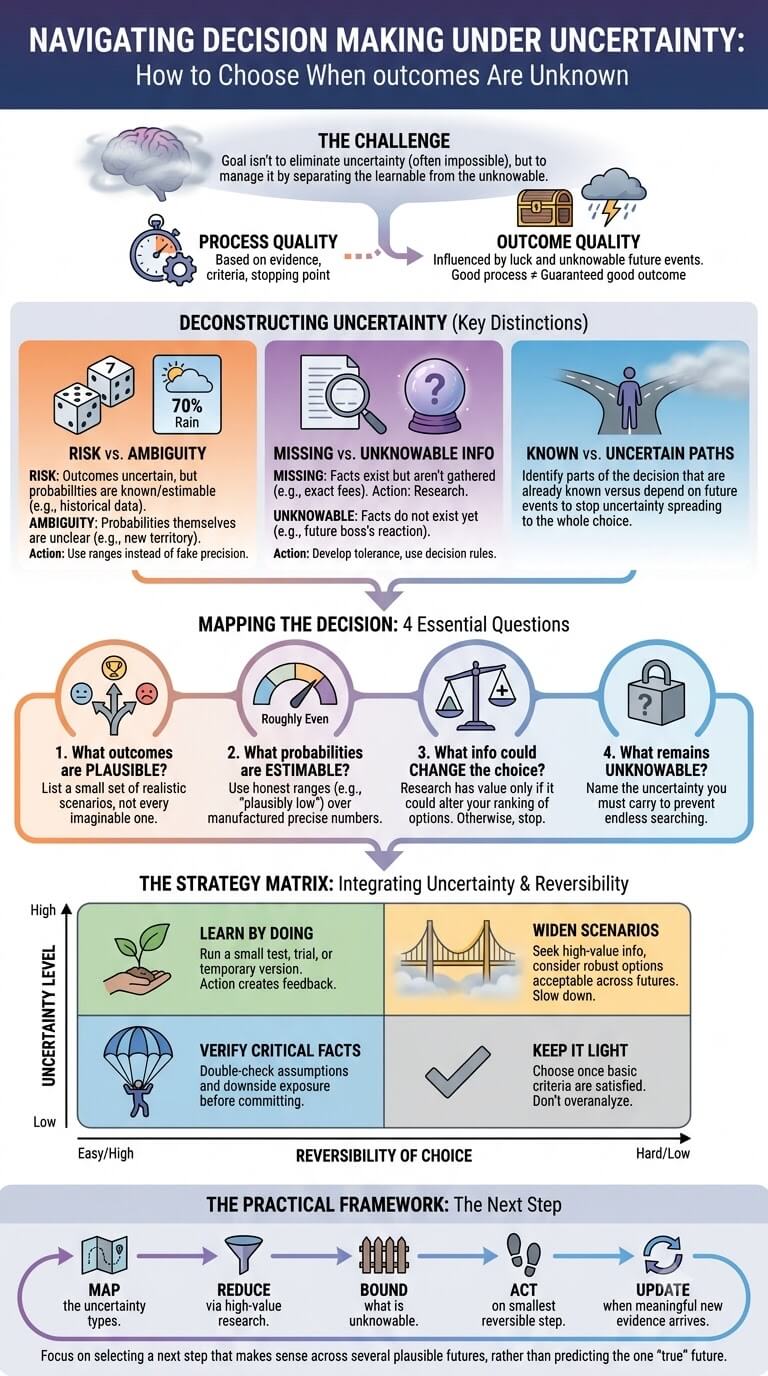
Decision making under uncertainty means choosing without complete knowledge of what will happen. A useful approach is to map possible outcomes, distinguish known probabilities from unclear ones, identify information that could genuinely change the choice, and accept a reasonable boundary around what remains unknowable. A good process can still produce a disappointing outcome, because process quality and outcome quality are not the same thing.
What Uncertainty Means in a Decision
The APA Dictionary of Psychology defines uncertainty partly as a condition in which the probability of an outcome is not accurately or precisely known. That is broader than simply feeling unsure. A person can feel calm while facing genuine uncertainty, or feel very uneasy about a situation whose probabilities are reasonably well understood.
Uncertainty is one part of the wider choice process, alongside option definition, trade-offs, emotional weighting, and commitment.
Known outcomes versus uncertain outcomes
Some decisions are close to certain. If you choose the blue notebook instead of the black one, you already know most of the relevant consequence. Other decisions contain branches that cannot be observed in advance. Accepting a new role might lead to better work, disappointing management, new skills, a longer commute, or a future opportunity that does not yet exist.
The first useful distinction is therefore simple: which parts of the decision are already known, and which depend on events that have not happened? This keeps uncertainty from spreading over the entire choice. Salary may be known while future team chemistry is uncertain. A cancellation policy may be known while the likelihood of needing it is uncertain.
Risk with estimable probabilities versus ambiguity with unclear probabilities
Decision research often distinguishes risk from ambiguity. Under risk, the possible outcomes are uncertain but their probabilities are known or can be estimated with some confidence. Under ambiguity, the probabilities themselves are unclear. An open-access review on decision making under risk and ambiguity uses this distinction to show why the two situations place different demands on judgment.
A weather forecast that gives a 70 percent chance of rain offers a probability, even though the outcome remains uncertain. Deciding whether a new local service will still be reliable a year from now may involve much more ambiguity because there is little track record from which to estimate the chance.
Missing information versus unknowable information
A third distinction is between facts you have not gathered and facts that do not yet exist. You may be missing the exact cancellation fee, the contract term, or the average commute time. Those can often be checked. You cannot research your way into knowing exactly how a new boss will respond to an unusual crisis next year.
This distinction matters because the two problems require different responses. Missing information may justify more research. Unknowable information requires a decision rule that can tolerate uncertainty rather than another hour of searching.
The need to act without complete knowledge also reflects practical limits on what a decision maker can know and compare.
Why the Mind Wants More Certainty Than the Situation Can Give
Uncertainty is uncomfortable partly because choosing closes some paths while leaving the result unresolved. More information can reduce that discomfort for a while, which makes continued searching feel productive even when it is no longer changing the decision.
Information reduces some uncertainty, not all uncertainty
Information is useful when it changes what you know about the options. It may reveal that one route is more expensive, one employer has a different policy than expected, or one product cannot do something you need. But even excellent information rarely converts an uncertain future into a guaranteed one.
Research on decision making under uncertainty emphasizes that uncertainty comes in different forms and that context changes how people respond to it. Treating all uncertainty as one problem can therefore lead to the wrong strategy. Sometimes the right move is to gather data. Sometimes it is to make the choice robust to several possible outcomes.
The emotional comfort of a definite answer
A definite answer has psychological appeal because it ends comparison. That does not make certainty-seeking irrational. If the cost of being wrong is high, extra checking may be sensible. The problem begins when the standard silently shifts from “I have enough evidence to choose” to “I must feel no doubt before I choose.”
Feeling certain is not proof that the future is predictable. Likewise, feeling uncertain is not proof that the decision process is poor. The feeling and the information environment are related, but they are not identical.
Why delay can feel safer even when it has costs
Not choosing preserves the fantasy that every option is still available. It can therefore feel safer than committing. Yet delay is itself a choice when deadlines, prices, opportunities, or other people continue moving.
For example, postponing a course enrollment because you are uncertain about your schedule may protect you from choosing the wrong time. It may also remove the preferred class entirely if it fills. A complete comparison should include the cost of waiting, not only the cost of choosing.
Four Questions to Map an Uncertain Decision
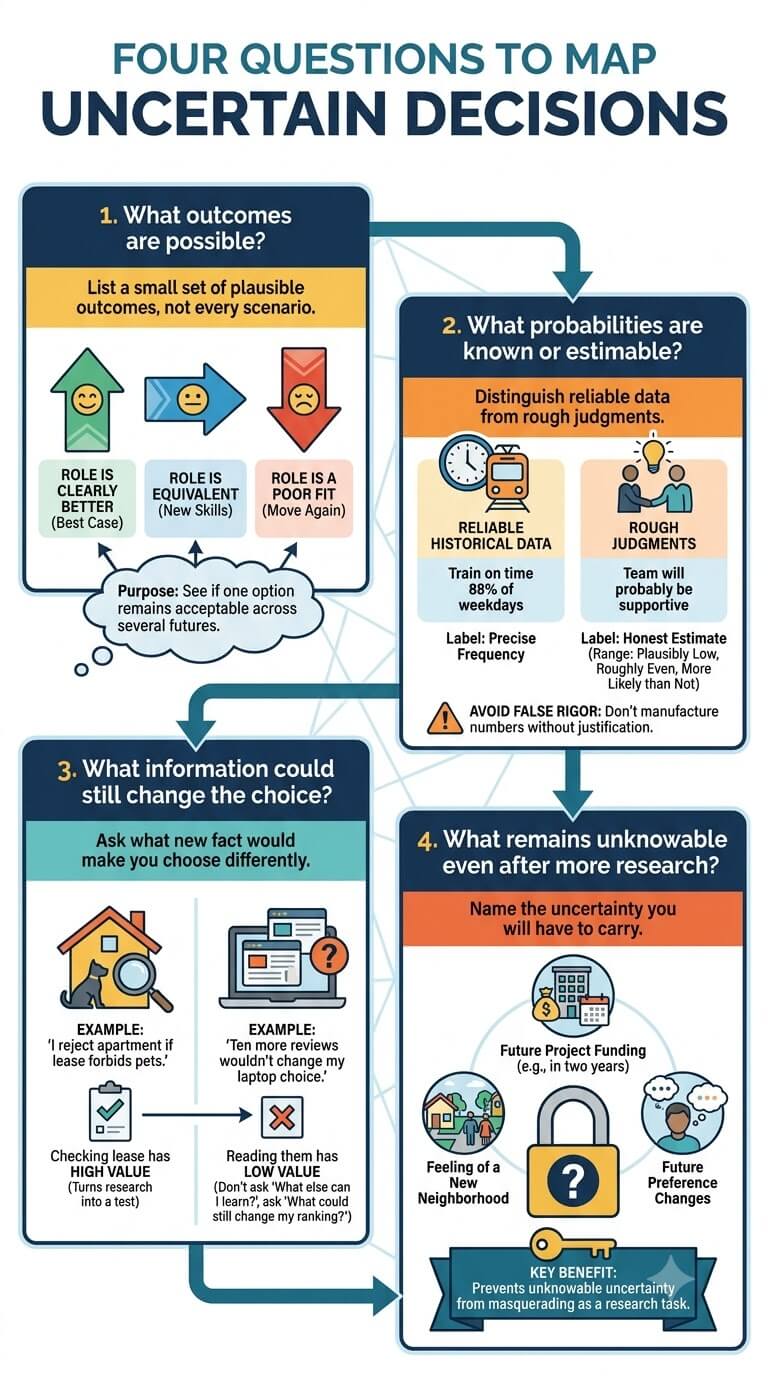
Before trying to solve uncertainty, map it. Four questions separate the parts of a choice that can be estimated, researched, or accepted as unresolved.
What outcomes are possible?
List a small set of plausible outcomes, not every imaginable scenario. For a job change, that might include: the role is clearly better, the role is roughly equivalent but offers new skills, or the role is a poor fit and you need to move again. The purpose is not to predict which will happen. It is to see whether one option remains acceptable across several futures.
What probabilities are known or estimable?
Some probabilities come from reliable historical data. Others are rough judgments based on limited evidence. Label them differently. “The train is on time 88 percent of weekdays” is not the same kind of statement as “I think this team will probably be supportive.”
When you cannot justify a precise number, do not manufacture one for the appearance of rigor. A range such as “plausibly low,” “roughly even,” or “more likely than not” may be more honest, provided you remain clear that it is an estimate rather than a measured frequency.
What information could still change the choice?
Ask what new fact would make you choose differently. If the answer is “I would reject the apartment if the lease forbids pets,” checking the lease has obvious value. If ten more reviews would not change which laptop you prefer, reading them has much less value.
This question turns research into a test. You are no longer asking, “What else can I learn?” You are asking, “What could still change the ranking of my options?”
What remains unknowable even after more research?
Name the uncertainty you will have to carry. Perhaps you cannot know whether a new project will still be funded in two years, whether a neighborhood will feel different after you move, or whether your preferences will change. Naming the unknowable part prevents it from masquerading as a research task.
Risk, Ambiguity, and Incomplete Information Are Not the Same Thing
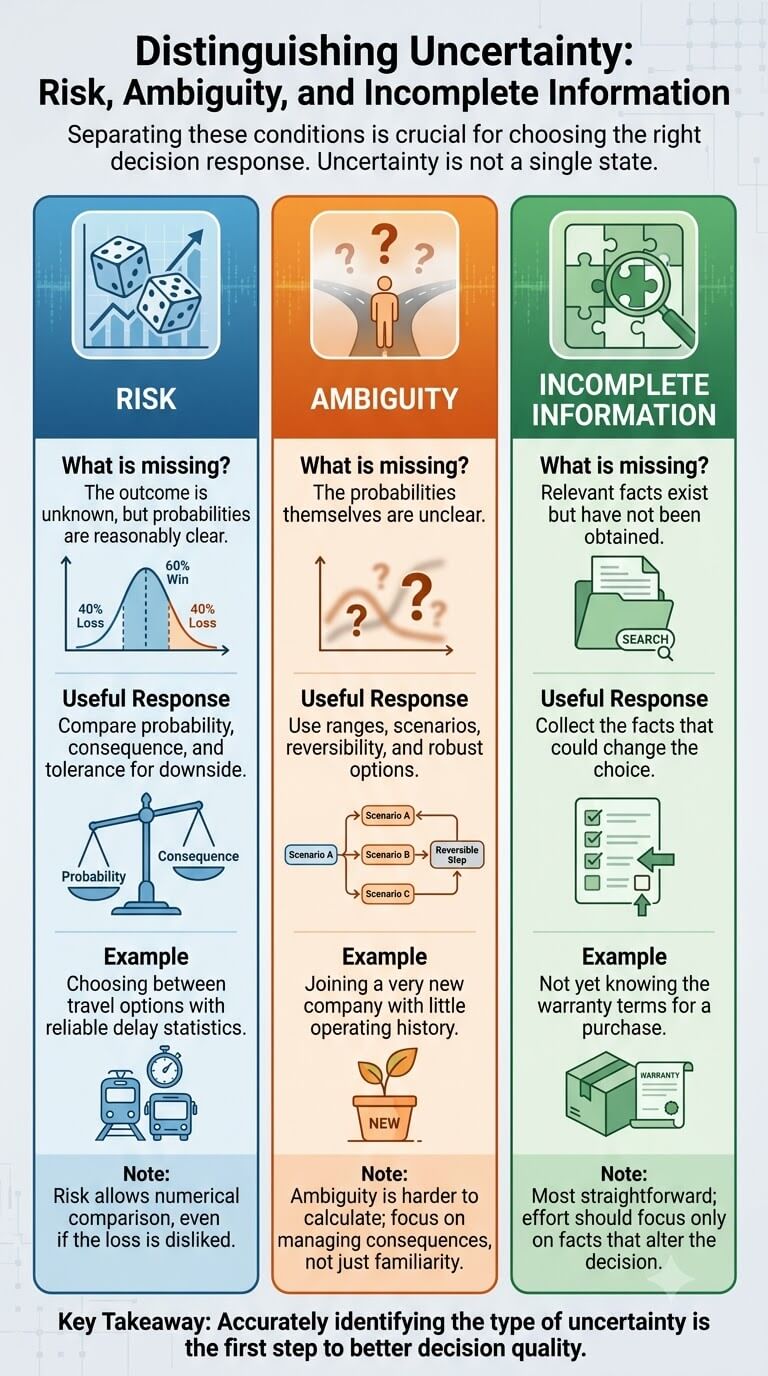
These three conditions can appear together, but separating them helps you choose the right response. A broad review of different varieties of uncertainty shows why treating uncertainty as a single undifferentiated state misses important differences in how people learn and choose.
| Decision condition | What is missing? | Useful response | Example |
|---|---|---|---|
| Risk | The outcome is unknown, but probabilities are reasonably clear | Compare probability, consequence, and tolerance for downside | Choosing between travel options with reliable delay statistics |
| Ambiguity | The probabilities themselves are unclear | Use ranges, scenarios, reversibility, and robust options | Joining a very new company with little operating history |
| Incomplete information | Relevant facts exist but have not been obtained | Collect the facts that could change the choice | Not yet knowing the warranty terms for a purchase |
Risk: the range is uncertain but probabilities are clearer
Risk does not mean danger in every psychological use of the term. In decision research, it often describes uncertainty where outcome probabilities are known or estimable. You may still dislike the possible loss, but at least you have a clearer numerical structure for comparing options.
Ambiguity: the probabilities themselves are unclear
Ambiguity is harder to calculate because there is no dependable probability to plug into the comparison. People often respond by preferring the better-known option, but familiarity is not automatically superior. The more useful question is whether the unknown probabilities create consequences you can tolerate or reduce through a reversible first step.
Incomplete information: evidence exists but has not been obtained
Incomplete information is the most straightforward of the three because additional evidence may resolve it. Yet even here, not every fact deserves equal effort. If a fact cannot change the choice, learning it may increase detail without increasing decision quality.
How People Choose When Probabilities Are Unclear
When probabilities are vague, a decision does not need to become guesswork. You can replace fake precision with ranges, test how options behave under different scenarios, and pay closer attention to reversibility.
Use ranges instead of fake precision
Suppose you are choosing whether to attend an outdoor event. You do not have a dependable probability of rain for the exact location and time. Rather than inventing “42 percent,” think in ranges: low chance, meaningful chance, high chance. Then ask how the choice changes across those ranges.
The same logic works with costs. If a repair could reasonably cost between $300 and $800, compare whether the decision still works at both ends. A range preserves uncertainty instead of hiding it behind an unjustified point estimate.
Compare downside, upside, and reversibility
Three questions often matter more than a shaky probability: What is the plausible downside? What is the plausible upside? How difficult would it be to reverse or revise the choice?
A reversible choice can justify acting with less information. Trying a monthly software plan is different from signing a five-year contract. Testing a class before committing to a long program is different from making an irreversible commitment based on the same amount of uncertainty.
Prefer robust options when forecasts are fragile
A robust option is not necessarily the one with the highest possible payoff. It is the one that remains acceptable across several plausible futures. If two plans depend on uncertain demand, the plan that works reasonably well under low, medium, and high demand may be more practical than one that excels only if a narrow forecast turns out exactly right.
This is especially useful when the environment is changing. The goal shifts from “Which forecast is correct?” to “Which option can survive if my forecast is somewhat wrong?”
The Value of More Information
More information is worth seeking when it has a realistic chance of changing the decision enough to justify the time, money, or delay involved. Decision analysis formalizes this as the value of information. A MIT OpenCourseWare unit on decision analysis highlights the idea that additional information can improve choices and that plans should be revised as uncertainty is updated.
Information worth seeking before a choice
Prioritize facts that could disqualify an option, change the ranking of options, or reveal a consequence you would not accept. Examples include a contractual restriction, a verified total cost, a required qualification, a return policy, or a schedule conflict.
Also prioritize information that is relatively cheap to obtain. A five-minute phone call that clarifies a major condition has a different value from three weeks of research that might shift your preference only slightly.
Information that is unlikely to change the decision
Some information adds confidence without adding much decision value. Reading the fiftieth review of a product after the first forty-nine already agree is one example. Another is comparing tiny feature differences when both options satisfy every requirement that matters to you.
A useful stopping question is: “If I learned the opposite of what I expect here, would I choose differently?” If the answer is no, that fact probably belongs lower on the research list.
When research becomes delay rather than learning
Research becomes delay when new information is no longer changing your understanding, criteria, or ranking. You may notice that you are rereading similar opinions, searching for one perfect prediction, or moving the stopping rule every time you reach it.
At that point, set an information deadline. Decide what you will check, when you will stop, and what choice rule you will use afterward. The purpose is not to rush. It is to prevent an impossible standard of certainty from becoming the default requirement for action.
Confidence Is Not Certainty
Confidence describes how strongly you believe in a judgment. Certainty describes the absence, or near absence, of uncertainty. Those are not interchangeable. A person can be very confident about a forecast that turns out wrong, and appropriately cautious about a choice that turns out well.
A person can be confident and still be wrong
Confidence is useful when it tracks the quality of evidence, but subjective confidence can exceed what the evidence supports. That is why a decision process should remain inspectable. What facts were known? Which assumptions mattered? Which outcomes were genuinely unpredictable?
This allows you to learn later without rewriting history around the result.
A reasonable decision can have a bad outcome
Suppose you choose a flight with a strong on-time record, a comfortable connection, and a reasonable price. A rare weather event cancels it. The outcome is bad, but that does not automatically mean the choice was bad.
Uncertain choices should be judged partly by what was knowable at the time. Otherwise every unlucky result becomes evidence of poor judgment and every lucky result becomes evidence of skill.
Separate process quality from outcome quality
After the result, review two columns. In the first, ask whether the process used relevant evidence, reasonable criteria, and an appropriate stopping point. In the second, note what happened. This separation protects learning from hindsight.
The APA Dictionary’s definition of decision making centers the act of choosing between alternatives. In uncertain settings, the quality of that choice process cannot be reduced to whether the future happened to cooperate.
A Simple Uncertainty Matrix
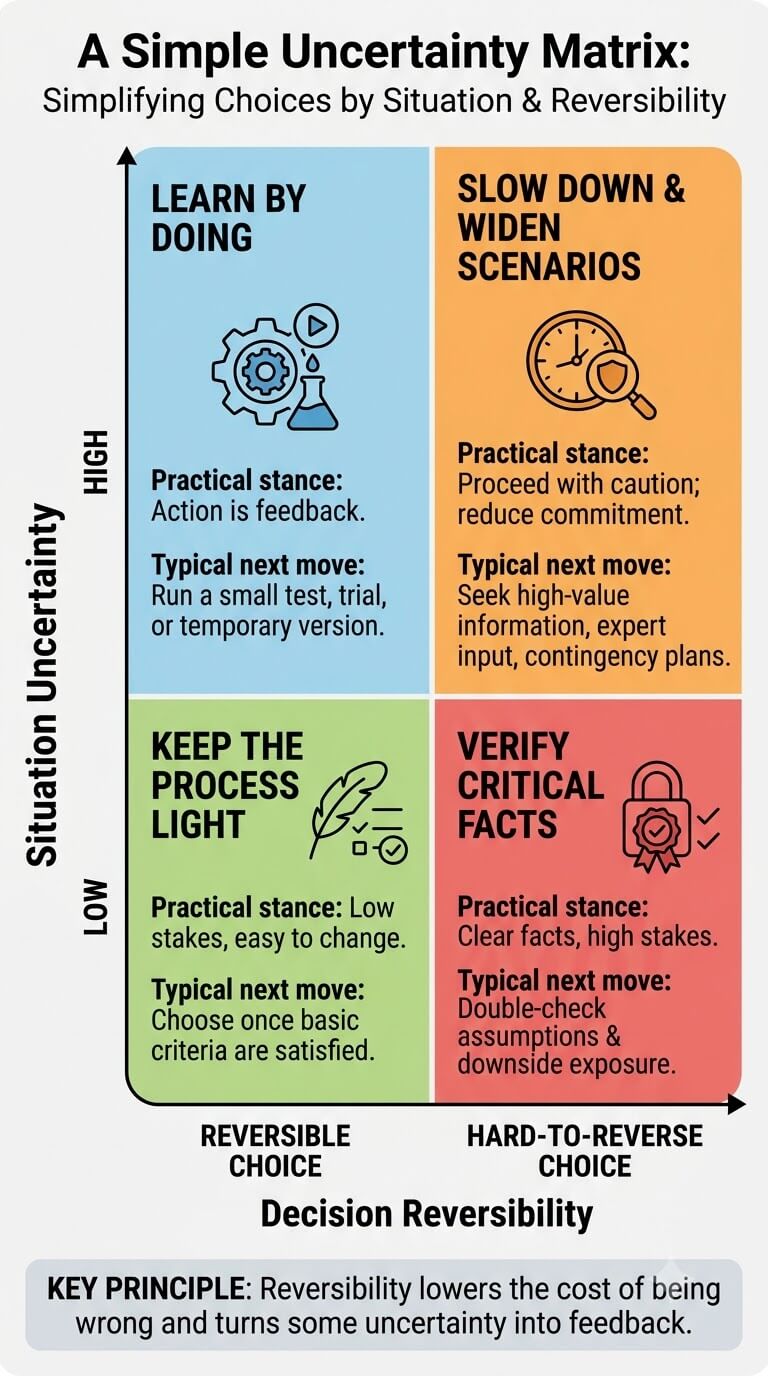
Two dimensions can simplify many choices: how uncertain the situation is and how difficult the decision is to reverse. Consequence matters too, but reversibility is especially useful because it changes how much information you need before acting.
| Situation | Practical stance | Typical next move |
|---|---|---|
| High uncertainty, reversible choice | Learn by doing | Run a small test, trial, or temporary version |
| High uncertainty, hard-to-reverse choice | Slow down and widen scenarios | Seek high-value information, expert input where appropriate, and contingency plans |
| Low uncertainty, high consequence | Verify critical facts | Double-check assumptions and downside exposure |
| Low uncertainty, low consequence | Keep the process light | Choose once basic criteria are satisfied |
High uncertainty and reversible choice
When a choice can be changed cheaply, action itself can become a way of learning. Try the service for a month. Take the introductory class. Test the route on a normal weekday. Reversibility lowers the cost of being wrong and turns some uncertainty into feedback.
High uncertainty and hard-to-reverse choice
This combination deserves more caution. Consider broader scenarios, verify critical facts, and ask whether there is a way to reduce commitment before making the full decision. In medical, legal, financial, or safety-sensitive situations, qualified professional guidance may be appropriate because the consequences can exceed what a general educational framework can responsibly address.
Low uncertainty and high consequence
When the main facts are clear but the stakes are high, verification matters. Check the important number twice. Confirm the policy in writing. Make sure the decision criterion reflects what actually matters, not what is easiest to measure.
Low uncertainty and low consequence
This is where a light process is usually enough. If the choice is easy to reverse and little is at stake, prolonged analysis may cost more attention than the decision deserves. Set a basic threshold and move on.
Uncertainty and Risk Perception Are Different
Uncertainty describes what is not known. Risk perception describes how threatening, dangerous, or costly a possible outcome feels. They can influence each other, but they are different questions.
Uncertainty describes what is unknown
You may have little information about a new restaurant and still see the decision as trivial because the downside is a disappointing meal. You may have excellent statistics about a rare hazard and still find it emotionally vivid. The amount of uncertainty is not the same as the intensity of perceived danger.
Risk perception describes how dangerous the situation feels
This distinction helps prevent one common error: treating fear as if it were a probability estimate. Feeling strongly about an outcome tells you that the consequence matters to you. It does not, by itself, tell you how likely that outcome is.
When the feeling is intense, first name the consequence you are trying to avoid. Then separately ask what evidence exists about its likelihood. Keeping consequence and probability in different mental boxes makes the decision easier to examine.
How Anticipated Regret Enters an Uncertain Choice
Before deciding, people often imagine future versions of themselves looking back. This can be useful because regret forecasts draw attention to values and irreversible consequences. It can also distort comparison if one vivid regret scenario dominates every other plausible outcome.
Regret can make one outcome feel disproportionately important
Imagine choosing between staying in a stable job and taking a more uncertain opportunity. You might picture regretting the leap if the new role fails. You might also picture regretting staying if the opportunity disappears. Both are forecasts, not facts.
Instead of asking which imagined regret feels strongest, ask what each regret is trying to protect: security, growth, money, belonging, reputation, or freedom. That turns an emotional forecast into information about priorities.
Reversibility can change regret forecasts
Regret often shrinks when a choice is not as final as it first appears. If you can test a direction, negotiate a trial period, keep a fallback option, or review the decision after a set interval, the future is not divided into one permanent right path and one permanent wrong path.
This does not remove uncertainty, but it can reduce the pressure to predict the entire future before taking the next step.
What to Do Next: Make the Smallest Decision That Reduces the Most Uncertainty
When the full decision feels too uncertain, look for a smaller decision that produces useful information. This is the core of a practical five-step framework: Map, Reduce, Bound, Act, Update.
- Map: separate known facts, estimable probabilities, missing facts, and genuinely unknowable outcomes.
- Reduce: gather only the information likely to change the choice.
- Bound: decide what uncertainty you will accept rather than pretending it can be eliminated.
- Act: choose the smallest useful step, especially when it is reversible.
- Update: revise the plan when meaningful new evidence arrives.
Identify the next reversible step
Ask what you could do that moves the decision forward without locking in the full commitment. Schedule the informational interview. Request the contract. Try the route. Use the free trial. Build the small prototype. A reversible step converts some uncertainty into experience.
Set an information deadline
Choose in advance when research will stop. The deadline should reflect stakes and reversibility, not impatience. A low-cost purchase may need ten minutes. A major commitment may deserve days or weeks. What matters is that “enough information” has a boundary.
Define what evidence would change course
Write down one or two signals that would make you revise the decision. This prevents every new detail from becoming equally important. It also makes updating easier because you already know which evidence matters.
For example: “I will continue with this service unless reliability drops below the level I need for two consecutive months.” The rule is not a guarantee. It is a way to stay responsive without constantly reopening the entire choice.
FAQ About Decision Making Under Uncertainty
These questions address the parts of uncertain choices that most often create confusion: risk, research, outcomes, and the use of probabilities when the numbers are incomplete.
What is the difference between risk and uncertainty?
In everyday language, the terms overlap. In decision research, risk often refers to situations where outcomes are uncertain but probabilities are known or can be estimated, while broader uncertainty can include ambiguity where probabilities themselves are unclear. The distinction matters because risk can be compared numerically more easily, while ambiguity often requires ranges, scenarios, and attention to reversibility.
How do I decide when I cannot know the outcome?
Focus on process rather than prediction. Identify plausible outcomes, learn the facts that could change your choice, compare downside and upside, consider how reversible each option is, and decide what uncertainty you are willing to accept. If possible, take a smaller step that creates information before making the larger commitment.
Should I keep researching until I feel certain?
Usually not, because emotional certainty and useful information are different. Keep researching while new evidence could materially change the decision. When new material is mostly repeating what you already know, set a stopping point and choose using the best available information. High-stakes choices may justify more checking or professional input, but even then certainty may remain impossible.
Can a good decision lead to a bad result?
Yes. Uncertainty means outcomes are not fully controlled by the decision process. A thoughtful choice can be followed by bad luck, unexpected events, or information that was genuinely unavailable. Review what was knowable at the time, not only what became obvious afterward.
How should I think about probabilities when the numbers are unclear?
Use broad ranges or scenarios rather than pretending to know a precise percentage. Ask whether your choice changes under a low, medium, or high estimate. Also compare consequence and reversibility. When the probability is unclear, an option that remains acceptable across several plausible estimates may be more useful than one that depends on a single fragile forecast.
Key Takeaways
- Uncertainty is not one thing. Risk, ambiguity, incomplete information, and unknowable future outcomes call for different responses.
- More research is valuable when it can change the choice, not simply when it makes you feel busier or more certain.
- Ranges and scenarios are often more honest than precise numbers that the evidence cannot support.
- Reversible choices can be made with less information because action itself can create feedback.
- A good decision process can still produce a bad outcome, so judge the process separately from luck.
- When certainty is impossible, make the smallest useful decision, define what would change your mind, and update when meaningful new evidence appears.

Michael Reed is the Founder and Lead Writer at Psychology Exposed. He writes about human behavior, relationships, emotional patterns, self-awareness, and practical psychology topics using research-informed, easy-to-understand content.
Read More About Michael Reed: https://psychologyexposed.com/michael-reed/