
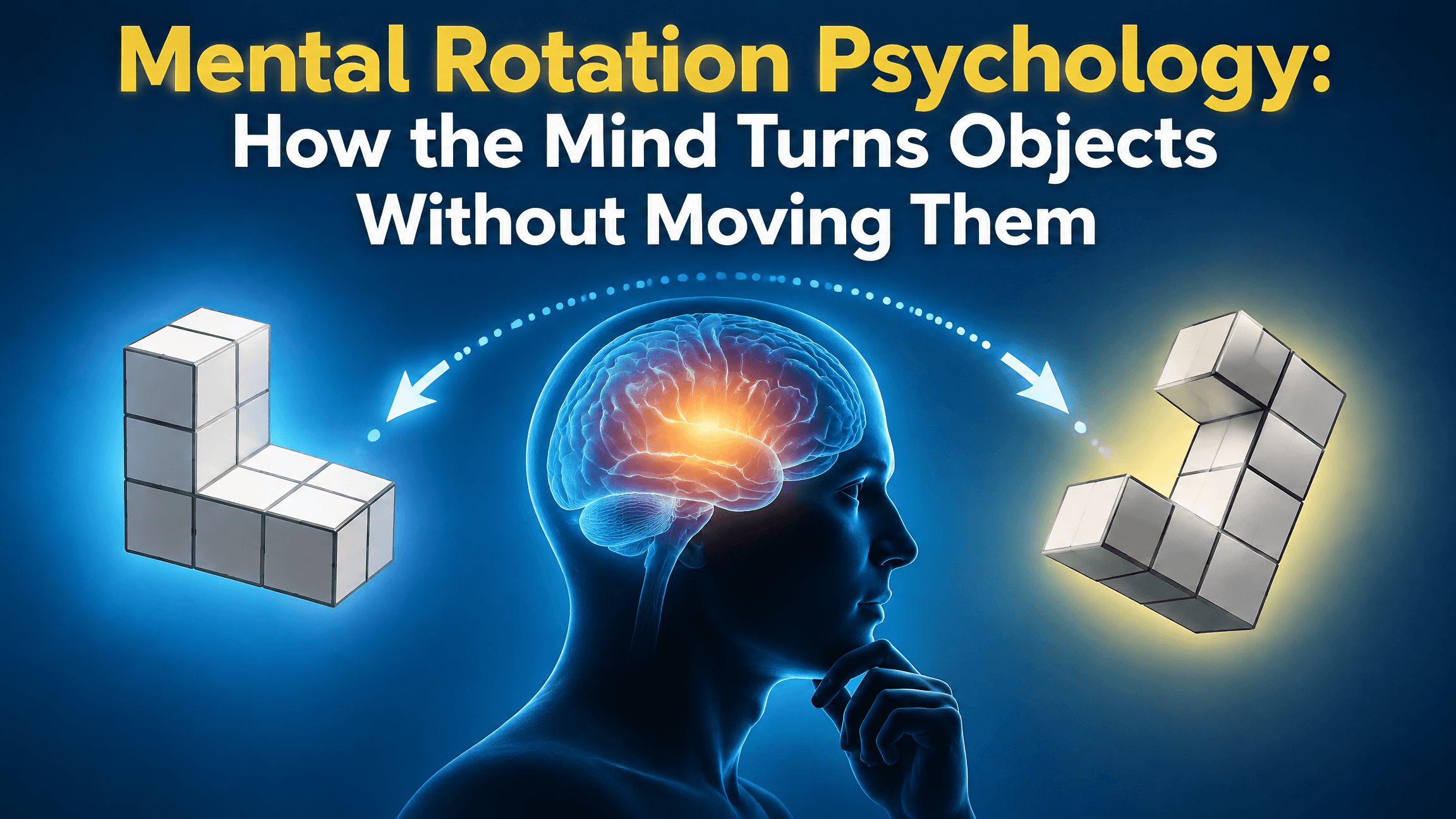
You look at a shape, then at the same shape turned sideways, and somehow your mind can test whether the two really match. Nothing in front of you physically moves. Yet you may experience a sense of turning, aligning, or checking the object until its orientation makes sense.
That process is called mental rotation. It is one of the best-known examples of spatial transformation in cognitive psychology because researchers can vary how far an object is rotated and measure how long people take to make a judgment. The classic finding is simple but easy to overinterpret: larger orientation differences often take longer to compare. That does not prove that every person literally watches an internal picture rotate at one fixed speed.
Mental rotation is also narrower than several nearby ideas. It is not the same as manipulating a complicated spatial arrangement through many steps, changing your imagined viewpoint, having vivid visual imagery, or possessing a single general level of spatial intelligence. Those distinctions matter because the same puzzle can sometimes be solved with different strategies.
Quick Answer
Mental rotation is the ability to transform the orientation of a represented object or shape so you can compare it with another orientation. In classic tasks, response time often increases as the angular difference between two objects grows. The effect is important, but it does not mean everyone uses one identical internal mechanism or that a mental rotation score measures overall intelligence.
What Mental Rotation Means
Mental rotation refers to a spatial transformation in which the orientation of an object is changed mentally rather than physically. A person might decide whether two block figures are the same object viewed at different angles, whether a rotated letter is normal or mirrored, or whether a tool would fit after being turned.
Orientation transformation without physically moving the object
Imagine a capital letter R printed upright beside another R turned 120 degrees. You can pick up neither image, yet you may mentally turn one until its top, stem, and curved section line up with the other. The transformation concerns orientation: which way the represented object is facing relative to a reference.
The same basic idea appears with abstract 3D block shapes. A research review of imagery measures describes the classic mental rotation task as comparing rotated forms and notes that variants have used three-dimensional objects, two-dimensional shapes, letters, and other patterns. A review of mental imagery assessment methods summarizes these common task formats and the historical Shepard and Metzler paradigm.
What the task asks the mind to compare
The task is not simply, “Can you picture this object?” The crucial question is whether an orientation-transformed representation can support a judgment. Depending on the experiment, the judgment may be same versus different, normal versus mirror-reversed, left versus right, or whether two configurations correspond after rotation.
That distinction explains why mental rotation is treated as a transformation process rather than just a perception task. Perception supplies the objects currently on the screen. Mental rotation concerns what happens when their spatial orientation must be changed in representation before the comparison becomes easy.
Core Model: OBJECT A → MENTAL ORIENTATION CHANGE → ALIGNMENT → COMPARE WITH OBJECT B
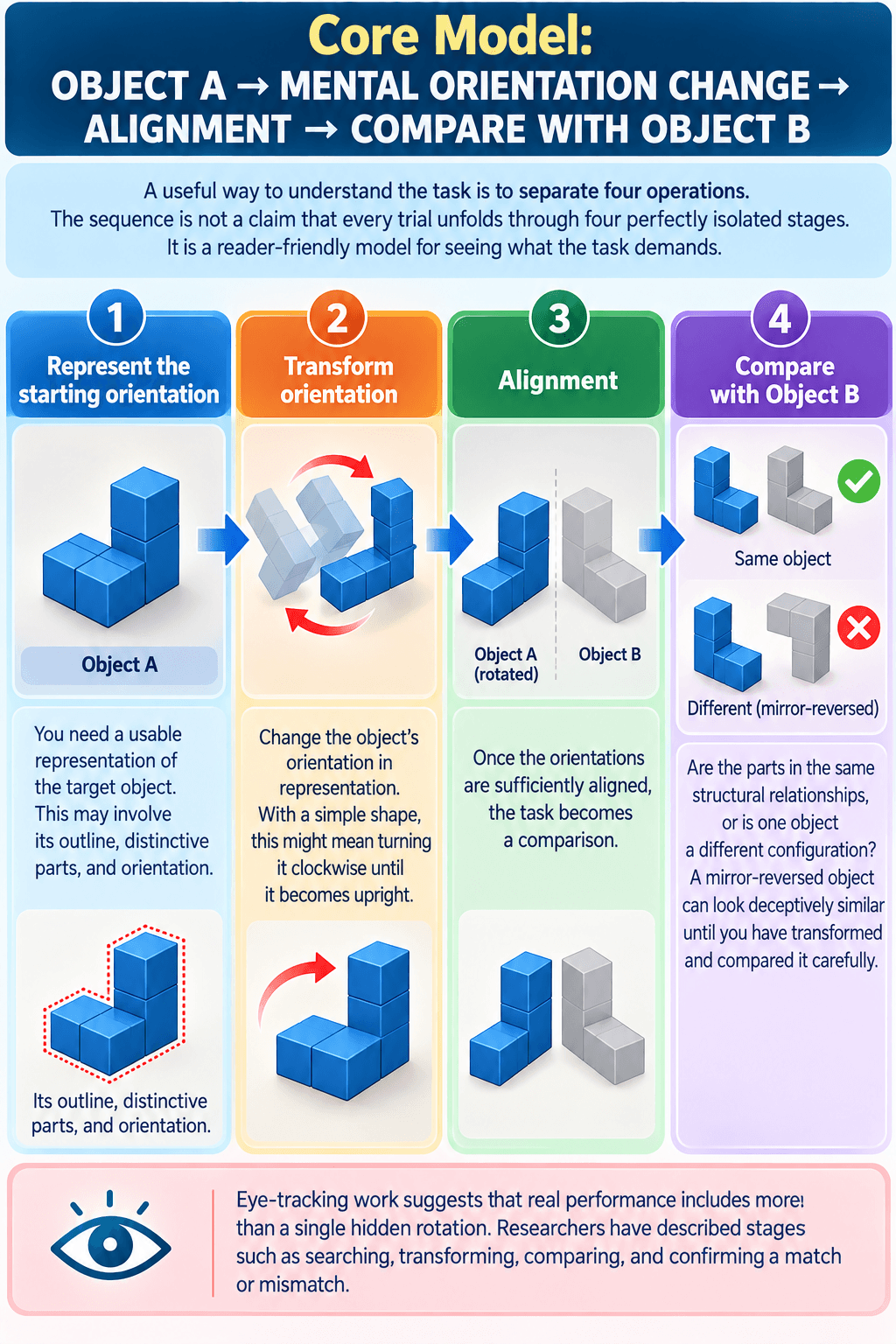
A useful way to understand the task is to separate four operations. The sequence is not a claim that every trial unfolds through four perfectly isolated stages. It is a reader-friendly model for seeing what the task demands.
Represent the starting orientation
First, you need a usable representation of the target object. For a simple shape, that may involve its outline, distinctive parts, and orientation. For a 3D block figure, it may include which segments connect, which parts project forward or backward, and how those relations are arranged.
If the object is poorly encoded, later rotation will not rescue the comparison. You may rotate the wrong relation or lose track of a feature that distinguishes an actual match from a mirror image.
Transform orientation
Next comes the defining operation: changing the object’s orientation in representation. With a simple letter, this might mean turning it clockwise until it becomes upright. With a 3D object, the transformation may involve rotation around an axis that changes which surfaces or branches appear closest.
The important point is that the object is treated as the thing being transformed. You are not primarily imagining yourself walking to another side of the object. That alternative belongs more naturally to spatial perspective taking.
Judge whether the objects match
Once the orientations are sufficiently aligned, the task becomes a comparison. Are the parts in the same structural relationships, or is one object actually different? In many experiments, a mirror-reversed object is designed to look deceptively similar until the person has transformed and compared the configuration carefully.
Eye-tracking work suggests that real performance includes more than a single hidden rotation. Researchers have described stages such as searching, transforming, comparing, and confirming a match or mismatch. An eye-movement study of mental rotation discusses these component processes and the long-running debate over whether rotation is always a single holistic operation.
The Classic Mental-Rotation Research Paradigm
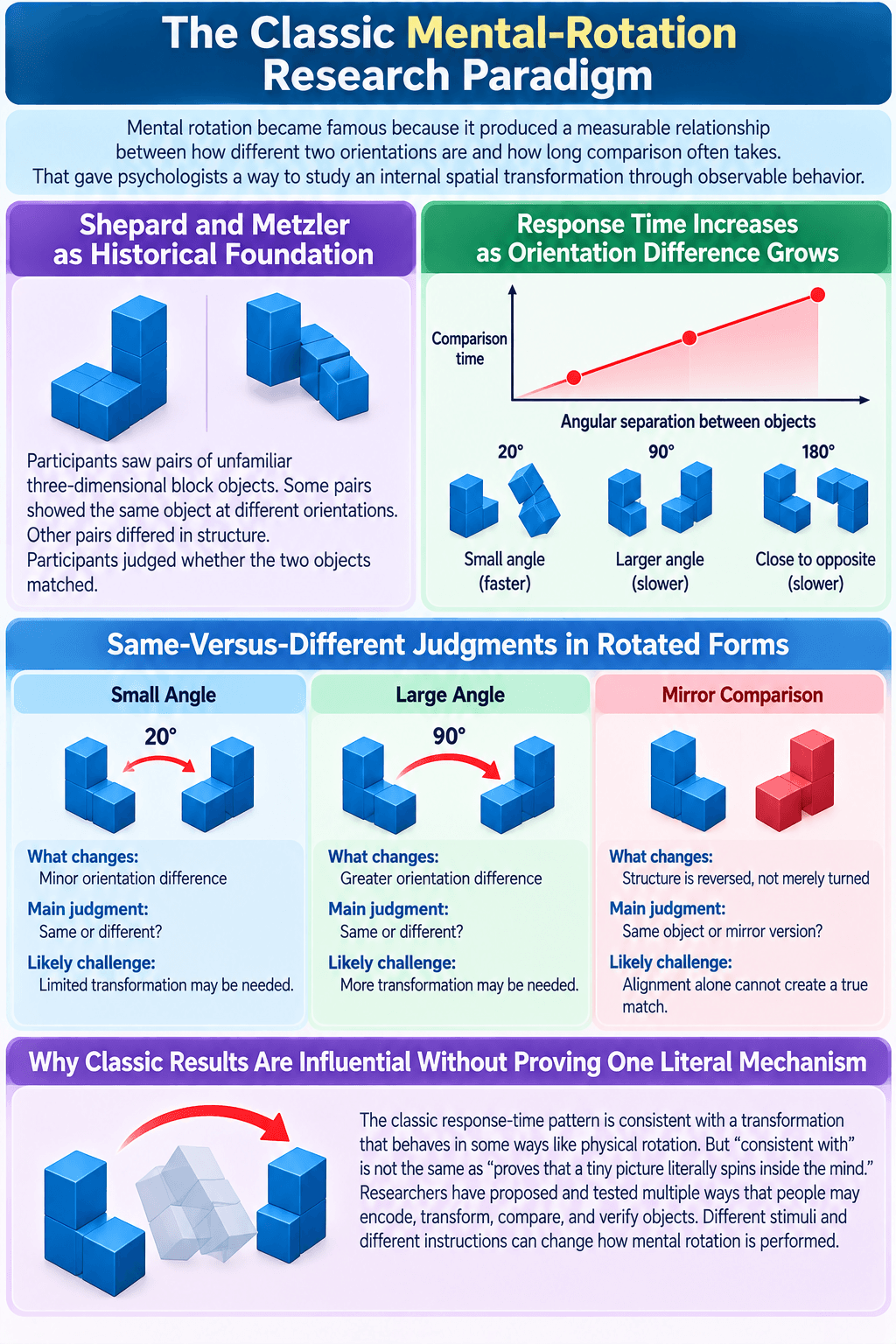
Mental rotation became famous because it produced a measurable relationship between how different two orientations are and how long comparison often takes. That gave psychologists a way to study an internal spatial transformation through observable behavior.
Shepard and Metzler as historical foundation
In the classic work associated with Roger Shepard and Jacqueline Metzler, participants saw pairs of unfamiliar three-dimensional block objects. Some pairs showed the same object at different orientations. Other pairs differed in structure. Participants judged whether the two objects matched.
The striking result was that comparison time generally increased as the angular separation between matching objects increased. Small orientation differences tended to be resolved faster than large ones. This pattern became one of the most recognizable findings in the study of spatial cognition.
Same-versus-different judgments in rotated forms
Consider three trials. On the first, two shapes differ by only 20 degrees. On the second, they differ by 90 degrees. On the third, they are close to opposite orientations. If the person uses a rotation-like transformation, the third comparison may require more transformation before alignment than the first.
| Trial type | What changes | Main judgment | Likely challenge |
|---|---|---|---|
| Small angle | Minor orientation difference | Same or different? | Limited transformation may be needed |
| Large angle | Greater orientation difference | Same or different? | More transformation may be needed |
| Mirror comparison | Structure is reversed, not merely turned | Same object or mirror version? | Alignment alone cannot create a true match |
Why classic results are influential without proving one literal mechanism
The classic response-time pattern is consistent with a transformation that behaves in some ways like physical rotation. But “consistent with” is not the same as “proves that a tiny picture literally spins inside the mind.” Researchers have proposed and tested multiple ways that people may encode, transform, compare, and verify objects.
Modern evidence also shows that task instructions and stimulus type can change how mental rotation is performed. A meta-analysis of mental rotation studies found that different stimuli and different instructions were associated with different patterns of processing. For a general reader, the practical lesson is that the task is stable enough to study, while the strategy behind performance is not necessarily identical in every situation.
Angular Disparity and Response Time
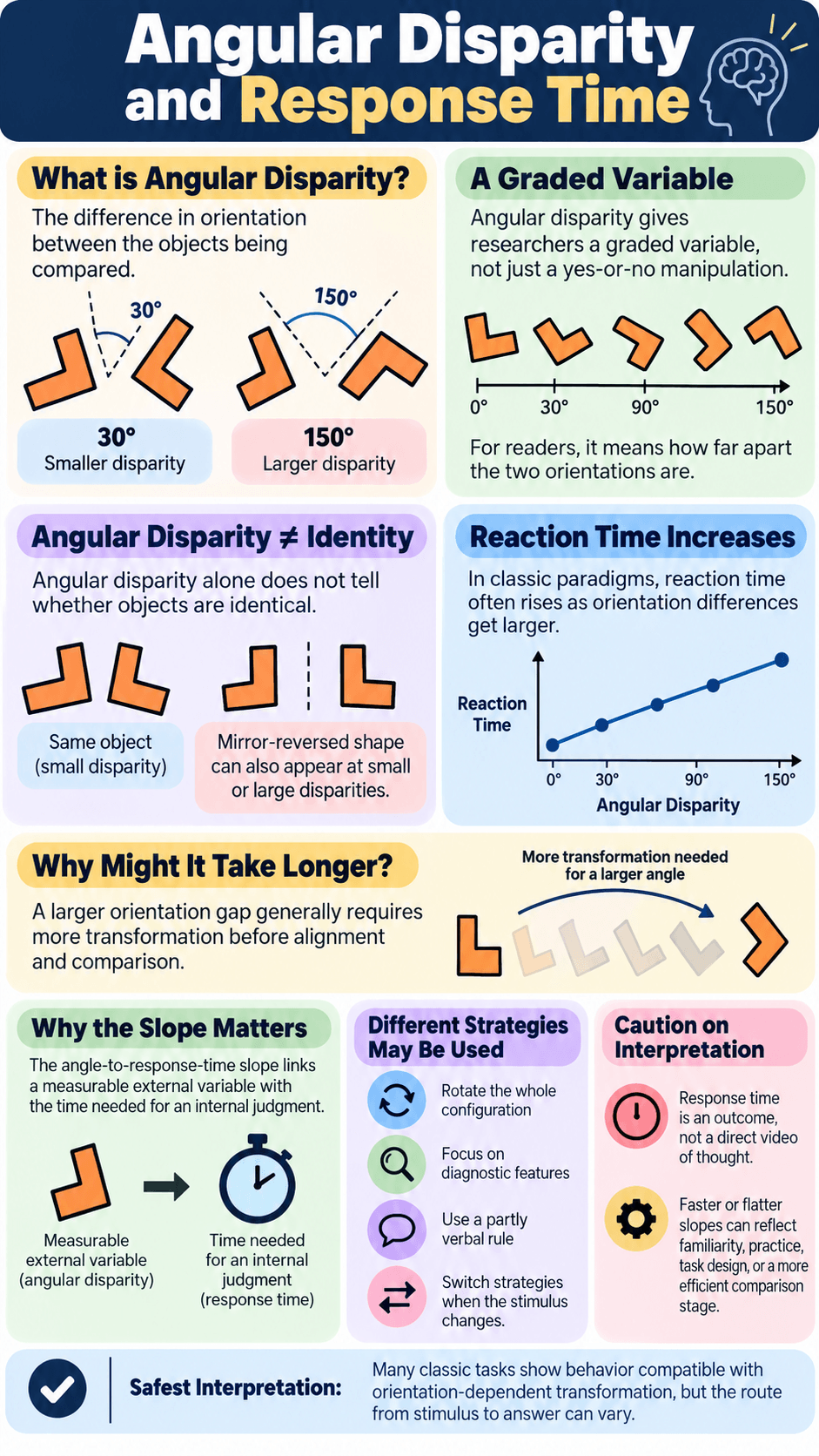
Angular disparity is the difference in orientation between the objects being compared. If one figure is upright and another is turned 30 degrees, the disparity is smaller than if the second figure is turned 150 degrees.
What angular disparity means
Angular disparity matters because it gives researchers a graded variable rather than a simple yes-or-no manipulation. They can compare performance at several orientation differences and ask whether reaction time changes systematically.
For the reader, think of it as “how far apart the two orientations are.” It does not tell you whether the objects are identical. A mirror-reversed shape can be presented at a small or large angular disparity too.
Why reaction time often rises with larger orientation differences in classic paradigms
If a person gradually transforms one representation toward the other, a larger orientation gap generally requires more transformation before the two are aligned enough to compare. That is the intuitive explanation for the familiar slope between angle and response time.
The slope is informative because it connects a measurable external variable, angular difference, with the time needed for an internal judgment. It is one reason mental rotation became such a powerful experimental paradigm.
Research caution: not every person or task uses one identical strategy
Response time is an outcome, not a direct video of thought. A person might rotate a whole configuration, focus on a few diagnostic features, use a partly verbal rule, or switch strategies when the stimulus changes. Faster or flatter response-time slopes can also reflect familiarity, practice, task design, or a more efficient comparison stage.
So the safest interpretation is not “the mind always rotates at a fixed speed.” It is that many classic tasks show behavior compatible with orientation-dependent transformation, while the route from stimulus to answer can vary.
Mental Rotation With 2D and 3D Objects
Mental rotation is not tied to one type of stimulus. Researchers have used flat shapes, letters, hands, body forms, cubes, block figures, and objects rendered with depth. Changing the stimulus changes the information a participant must preserve during transformation.
What changes across task formats
A 2D letter rotated in the picture plane mainly changes its orientation on the page. A 3D block figure may be rotated in depth, so some parts become visually nearer while others recede. Both can require orientation transformation, but the representational demands are not identical.
This is why it is risky to talk about “the mental rotation test” as though every version measures the same process in precisely the same way. Tasks can differ in dimension, number of alternatives, time limits, mirror judgments, stimulus complexity, and required response.
Familiarity and object complexity as contextual factors
Familiarity can change what information is easiest to use. A rotated letter has a highly learned identity and an expected upright orientation. An unfamiliar block object offers fewer semantic shortcuts, so structural relations among its parts become more important.
Complexity matters too. A shape with many similar branches can make it harder to identify the features that remain stable across rotation. That added difficulty may affect encoding and comparison, not just the rotation operation itself.
Strategy Differences in Mental Rotation
People may reach a correct answer through different combinations of spatial, visual, motor, and analytic strategies. The existence of strategy differences is one reason a single score should be interpreted cautiously.
Spatial transformation versus possible visual strategies
One person may experience the task as visually turning an object. Another may focus on the relation between two distinctive parts and track how that relation changes. With body-related stimuli, some people may recruit more embodied or motor-like representations than they do with abstract objects.
These alternatives are not merely theoretical. Experimental work finds that the kind of stimulus and the instructions given to participants can influence the processing used during mental rotation. This makes strategy part of the phenomenon, not just noise around a single universal method.
Practice, familiarity, and individual variability
Repeated exposure can make a particular test easier. People may learn the stimulus set, recognize common orientations faster, or become more efficient at the comparison. Training can improve performance on the practiced task, but improvement does not guarantee broad transfer to every other spatial task.
A 2024 registered report reviewing Tetris-based training found clear gains on the training activity but did not find convincing transfer to the tested 3D mental rotation measures. The review and registered report on mental rotation transfer is a useful reminder that practice effects and general spatial improvement are different claims.
Why vivid imagery is not required for every successful rotation task
Some people report extremely vivid internal pictures. Others report little or no voluntary visual imagery. Mental rotation performance does not map perfectly onto that subjective vividness. A recent systematic review of aphantasia research notes that participants with very weak voluntary visual imagery can still perform mental rotation tasks, sometimes with similar accuracy but different response times or strategies.
That does not mean imagery is irrelevant. It means “I do not see a crisp picture in my mind” and “I cannot transform spatial relations” are not equivalent statements. Spatial information can be represented and manipulated in ways that do not feel like watching a vivid internal movie.
Mental Rotation vs Spatial Visualization
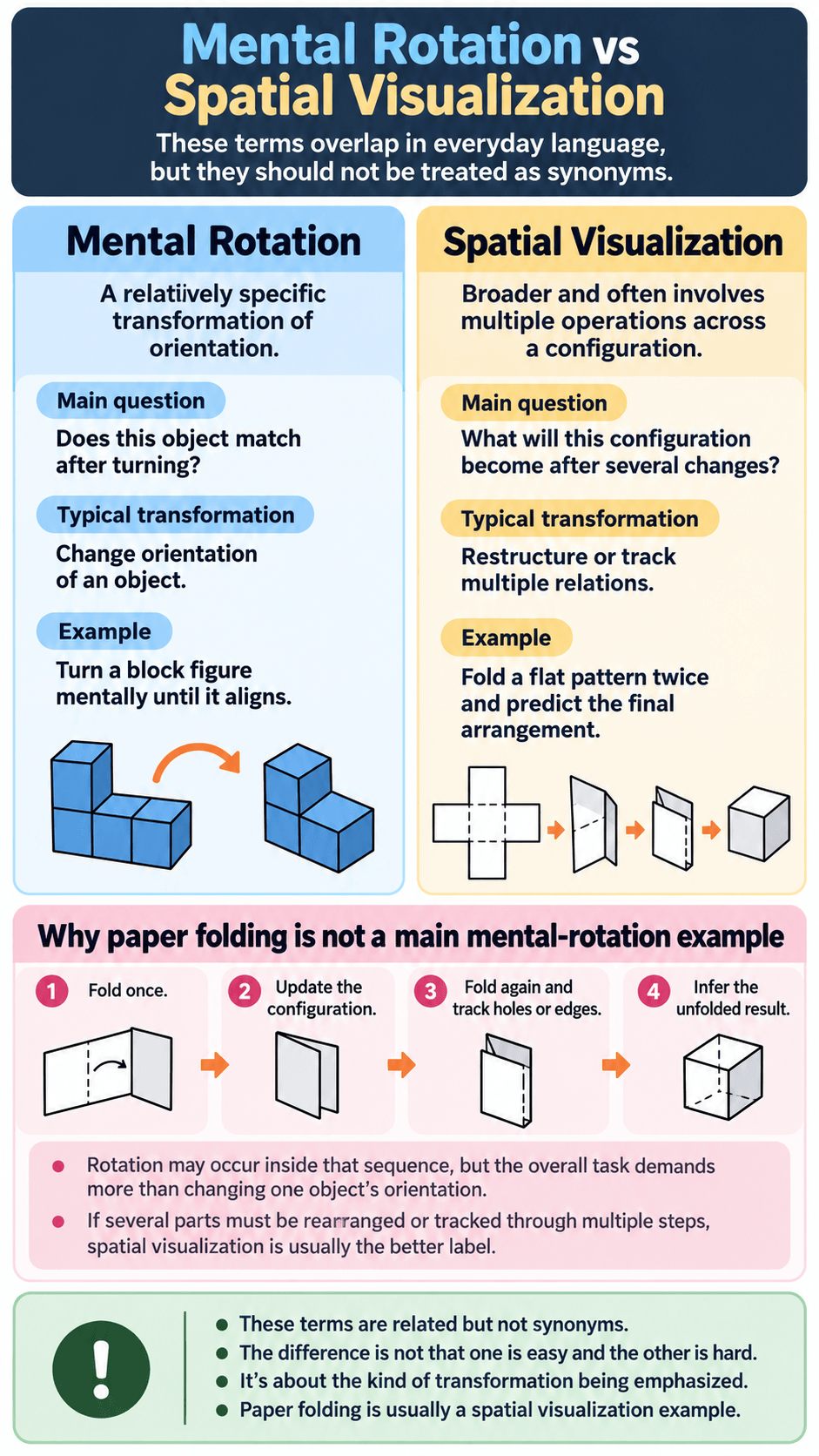
These terms overlap in everyday language, but they should not be treated as synonyms. Mental rotation is a relatively specific transformation of orientation. Spatial visualization is broader and often involves multiple operations across a configuration.
Direct orientation change versus broader multi-step restructuring
| Process | Main question | Typical transformation | Simple example |
|---|---|---|---|
| Mental rotation | Does this object match after turning? | Change orientation of an object | Turn a block figure mentally until it aligns |
| Spatial visualization | What will this configuration become after several changes? | Restructure or track multiple relations | Fold a flat pattern twice and predict the final arrangement |
The difference is not that one is easy and the other is hard. A mental rotation task can be very difficult. The distinction is about the kind of transformation being emphasized.
Why paper-folding should not become the main mental-rotation example
Paper folding often requires a sequence: fold once, update the configuration, fold again, track holes or edges, then infer the unfolded result. Rotation may occur inside that sequence, but the overall task demands more than changing one object’s orientation.
Keeping that boundary clear prevents mental rotation from swallowing every task that happens to involve space. If several parts must be rearranged or tracked through multiple steps, spatial visualization is usually the better label for the broader operation.
Mental Rotation vs Spatial Perspective Taking
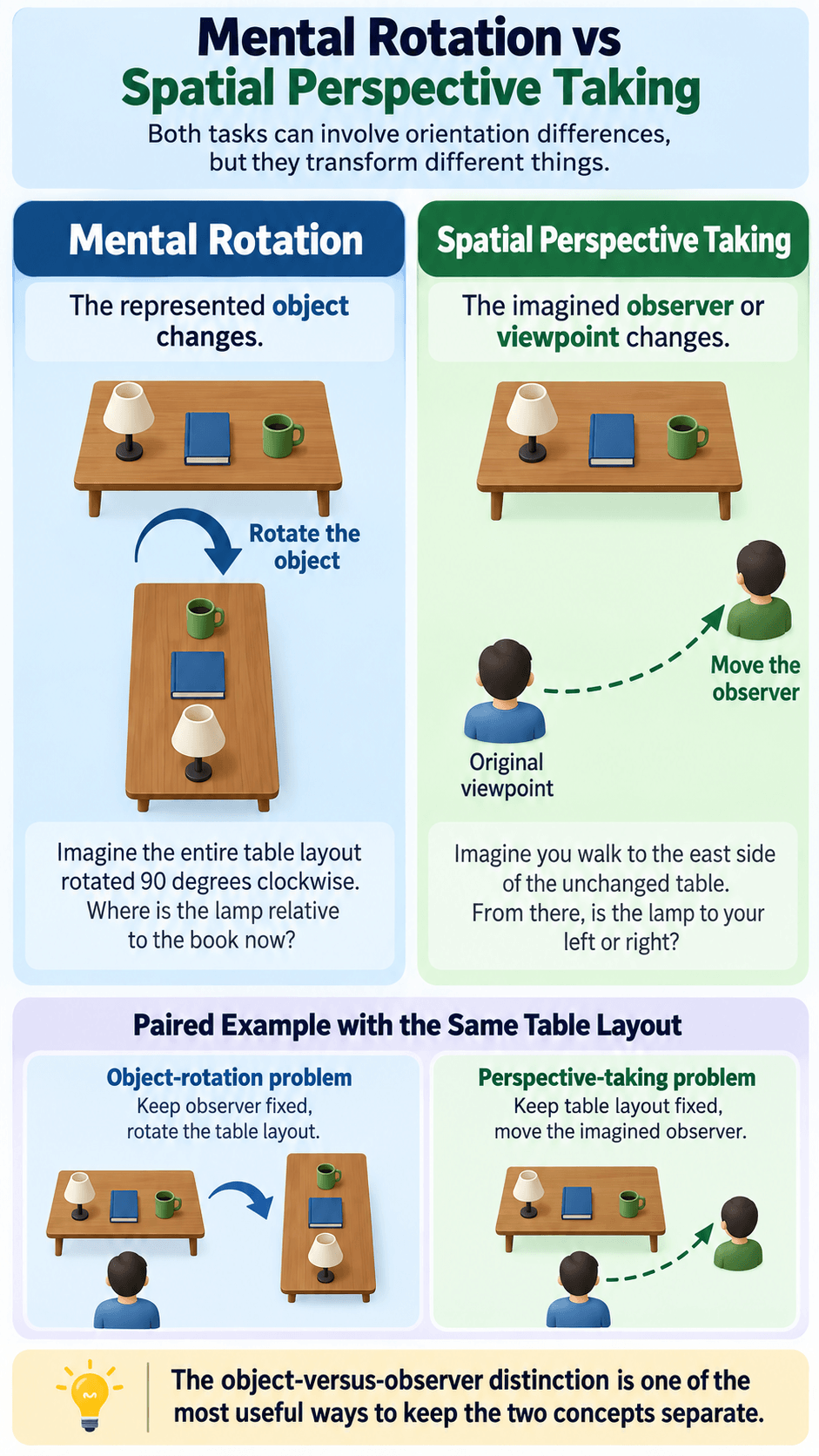
Both tasks can involve orientation differences, yet they transform different things. Mental rotation changes the represented object. Spatial perspective taking changes the imagined observer or viewpoint.
Rotate the object versus move the imagined observer
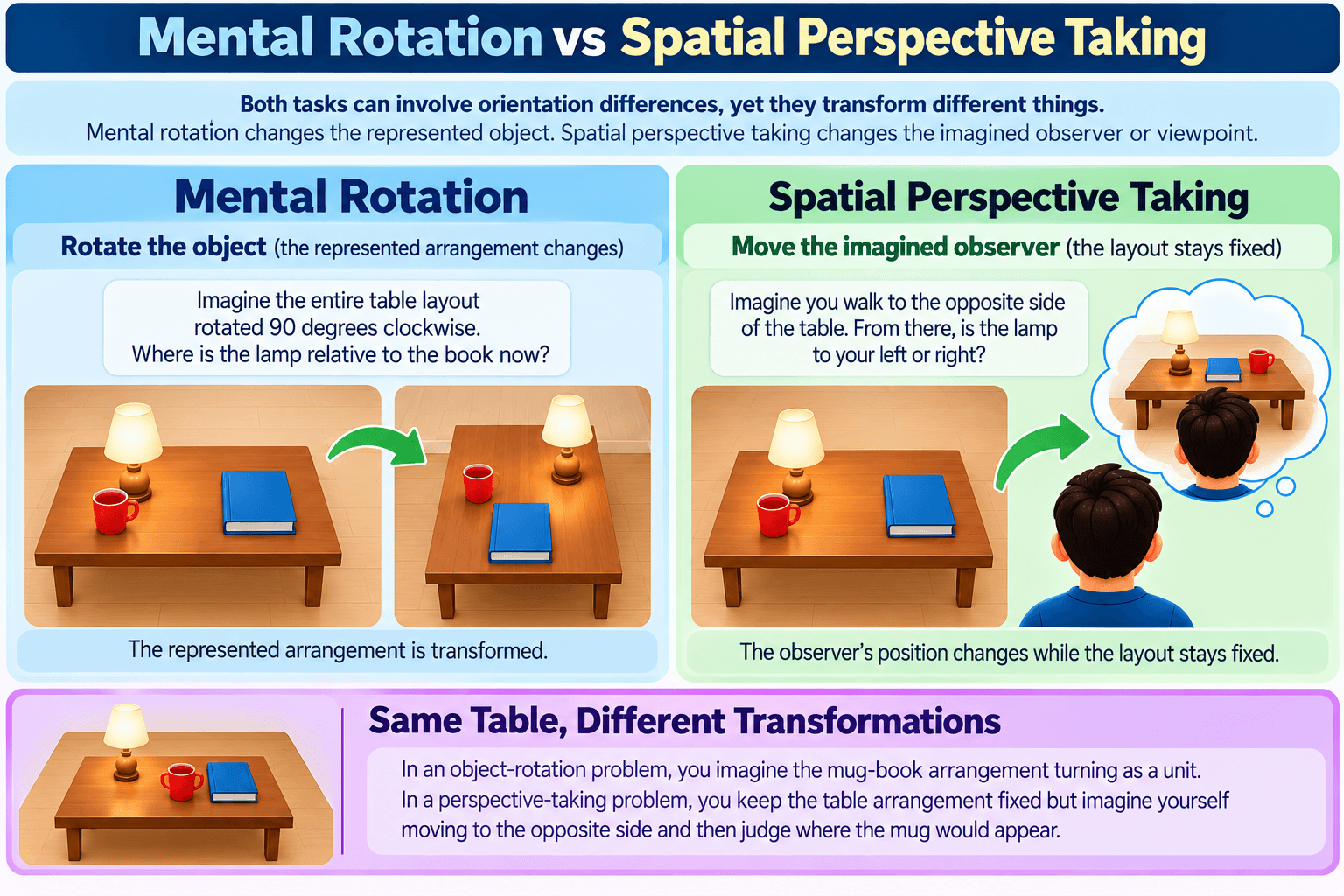
Suppose a mug sits to the left of a book on a table. In an object-rotation problem, you might imagine the mug-book arrangement turning as a unit. In a perspective-taking problem, you keep the table arrangement fixed but imagine yourself moving to the opposite side and then judge where the mug would appear from that new position.
A review of visuospatial perspective taking describes object or array rotation and embodied perspective transformation as cognitively distinct strategies, even when they can lead to the same final spatial answer.
Paired example using the same table-and-object layout
Mental rotation version: “Imagine the entire table layout rotated 90 degrees clockwise. Where is the lamp relative to the book now?” The represented arrangement is transformed.
Perspective-taking version: “Imagine you walk to the east side of the unchanged table. From there, is the lamp to your left or right?” The observer’s position changes while the layout stays put.
That object-versus-observer distinction is one of the most useful ways to keep the two concepts separate.
Mental Rotation vs Imagination and Spatial Ability
Mental rotation belongs within the broader family of mental simulation and spatial cognition, but it should not stand in for either one. A person can imagine scenes that contain no rotation at all, and spatial ability includes more than a single orientation-comparison task.
Specific transformation task versus general simulation
Imagination can involve sounds, stories, emotions, future events, impossible scenes, or visual images. Mental rotation asks a much narrower question: can a represented spatial orientation be transformed well enough to support a judgment?
That is why vivid fantasy, creative visualization, or rich visual imagery should not be used as substitutes for mental rotation performance. They may relate in some people or tasks, but they are not the same construct.
Why one rotation score is not a complete measure of spatial ability or intelligence
A score on one mental rotation test reflects performance under that test’s specific rules: its stimuli, time pressure, scoring method, response choices, familiarity, and transformation demands. Broader spatial functioning can also involve navigation, perspective taking, remembering locations, understanding layouts, and multi-step visualization.
It is therefore a mistake to turn one score into a label such as “good at spatial thinking” or “bad at intelligence.” A mental rotation measure can be informative about a specific task without defining the person’s overall cognitive capacity.
Common Misreadings of Mental-Rotation Findings
Mental rotation is memorable partly because the classic data make an intuitive story possible. The danger is treating the story as more literal or more general than the evidence supports.
The mind is not proven to contain a literal spinning picture
The response-time pattern resembles what we might expect if a representation were transformed continuously through intermediate orientations. That analogy is scientifically useful. It does not require a claim that a conscious picture physically spins somewhere inside the head.
Component-process and strategy research gives a more cautious view: encoding, search, transformation, comparison, and verification may contribute differently depending on the task. The phrase “mental rotation” names the functional transformation being studied, not a microscopic animation that researchers can directly watch.
Faster performance does not automatically imply greater general intelligence
Reaction time can reflect many things besides a single underlying ability. A participant may be more familiar with the stimulus, more practiced at the test format, more willing to respond before checking, or using a strategy that happens to fit the task well.
Accuracy matters too. A fast answer with many mistakes is not equivalent to a fast and accurate transformation. Meaningful interpretation looks at the task, the speed-accuracy tradeoff, and the specific spatial operation rather than converting a single number into a global judgment about the person.
FAQ About Mental Rotation Psychology
These questions address the points that most often blur the boundary between mental rotation and nearby spatial processes.
Is mental rotation the same as visual imagery?
No. Mental rotation can involve visual imagery, but visual imagery is broader. You can imagine a color, face, landscape, or scene without rotating anything. Mental rotation specifically involves changing spatial orientation in representation. People also differ in how vivid their imagery feels, and successful task performance does not require the same subjective visual experience for everyone.
Why does angle difference matter in many mental-rotation tasks?
In classic paradigms, larger angular disparities often take longer because more orientation transformation may be required before two objects are aligned well enough to compare. The effect is useful evidence for an orientation-dependent process, but the exact slope can also be influenced by task design, stimulus type, familiarity, strategy, and the comparison stage.
Is rotating a viewpoint the same as rotating an object?
No. Rotating an object mentally changes the represented object or array. Changing viewpoint means imagining the observer in a new position or heading while the environment may remain fixed. Both can solve related spatial questions, but research treats them as distinguishable transformations.
Can practice change performance on rotation tasks?
Yes, practice can improve performance on a particular task or stimulus set. What should not be assumed is that improvement automatically transfers to every kind of spatial thinking. Repeated testing, familiarity, learned strategies, and task-specific training can all contribute, so claims about broad cognitive improvement require stronger evidence than a better score on one practiced test.
Key Takeaways
- Mental rotation is a specific spatial transformation in which the orientation of a represented object is changed to support comparison.
- Classic tasks often show longer response times as angular disparity increases, but that pattern does not prove one literal or universal internal rotation mechanism.
- Different stimuli, instructions, experience, and strategies can change how people solve mental rotation problems.
- Mental rotation differs from spatial visualization because the latter often requires multi-step restructuring, and it differs from spatial perspective taking because perspective taking transforms the observer’s viewpoint.
- Vivid visual imagery is not identical to mental rotation ability, and one rotation score should not be treated as a complete measure of spatial ability or general intelligence.
Author note: Michael Reed is Founder & Lead Writer at Psychology Exposed. He writes about psychology and human behavior in clear, research-aware language for general readers. This page is educational and does not assess intelligence, diagnose cognitive conditions, or substitute for professional evaluation.

Michael Reed is the Founder and Lead Writer at Psychology Exposed. He writes about human behavior, relationships, emotional patterns, self-awareness, and practical psychology topics using research-informed, easy-to-understand content.
Read More About Michael Reed: https://psychologyexposed.com/michael-reed/