
People routinely understand combinations they may never have encountered before. “Stone lion,” “sports car,” “emergency meeting,” and “coffee cup” each join familiar concepts, yet the result is more specific than either word alone. A stone lion is not simply everything associated with stone plus everything associated with lions. A coffee cup is not any cup that somehow resembles coffee. The concepts interact to produce an integrated interpretation.
Conceptual combination psychology studies how familiar concepts are joined to create a new or more specific meaning. The process matters because human thought is productive. We do not need a separate stored concept for every possible combination. Instead, existing knowledge can be reorganized, constrained, and enriched in context. Some properties are inherited from the original concepts, some become less important, and some new properties can emerge because the combination suggests relationships that neither concept strongly carries by itself.
Quick Answer: What Is Conceptual Combination?
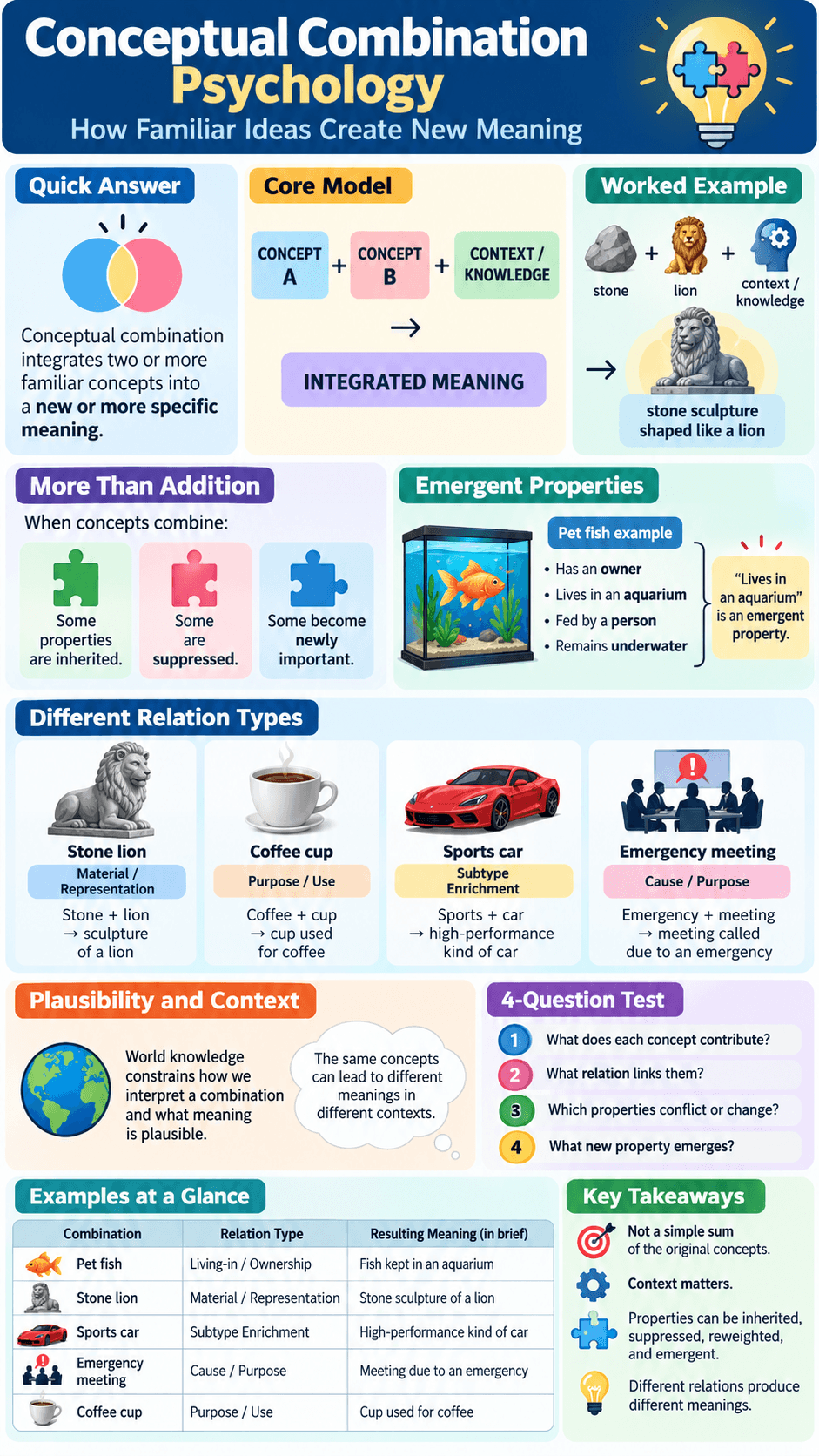
Conceptual combination is the process of integrating two or more familiar concepts into a new or more specific meaning. The resulting concept can inherit properties from its components, suppress incompatible properties, select a relation between them, and gain emergent properties. Context and prior knowledge help determine the interpretation, so combination is more than simply adding two lists of features together.
Core Model: Familiar Concepts to Integrated Meaning
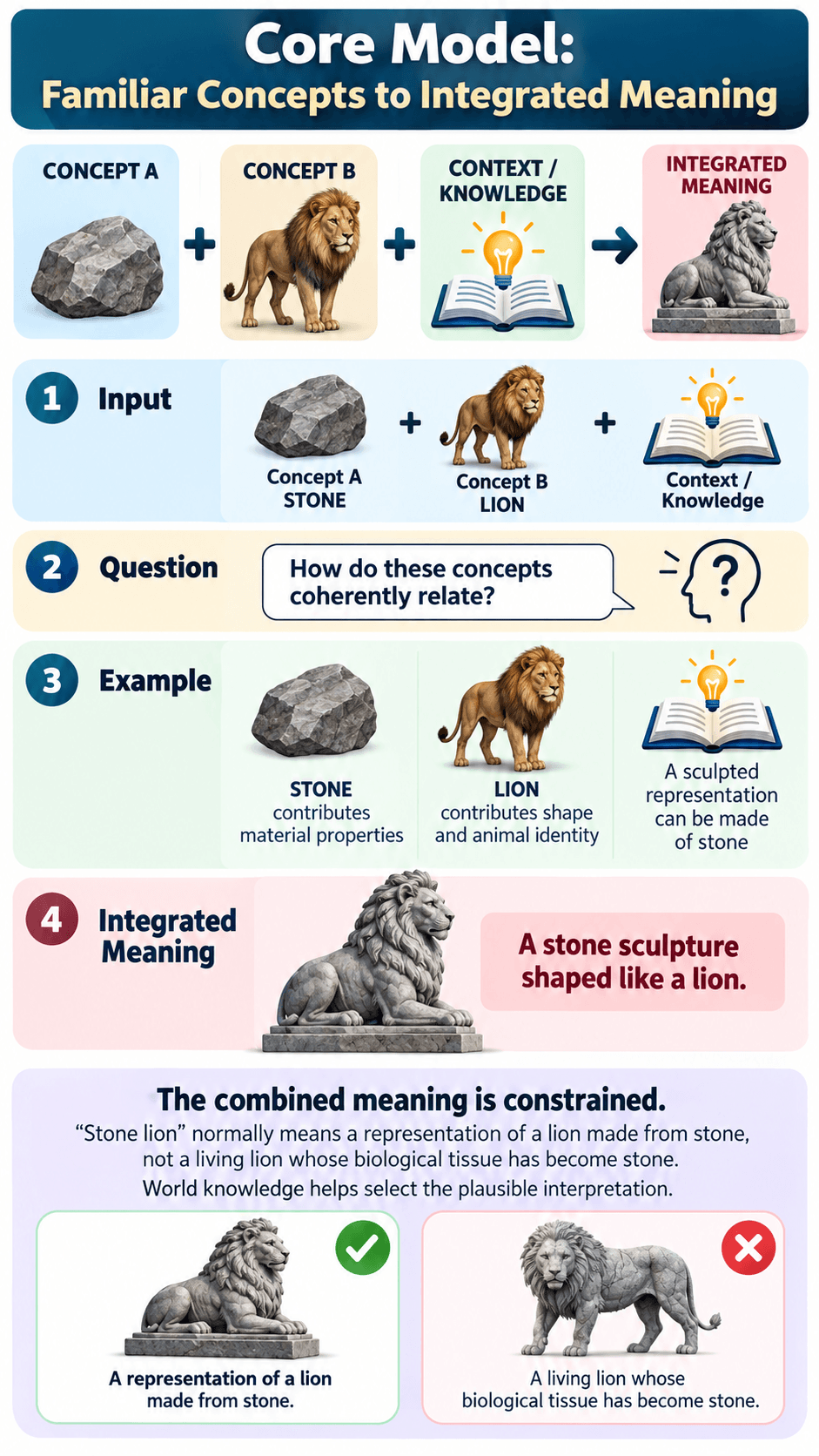
A practical model is:
CONCEPT A + CONCEPT B + CONTEXT/KNOWLEDGE → INTEGRATED MEANING
| Input | Question | Example |
|---|---|---|
| Concept A | What knowledge does the first concept contribute? | STONE contributes material properties |
| Concept B | What knowledge does the second concept contribute? | LION contributes shape and animal identity |
| Context and knowledge | How can the concepts coherently relate? | A sculpted representation can be made of stone |
| Integrated meaning | What combined concept results? | A stone sculpture shaped like a lion |
The crucial point is that the combined meaning is constrained. “Stone lion” normally means a representation of a lion made from stone, not a living lion whose biological tissue has become stone. World knowledge helps select the plausible interpretation.
Why Conceptual Combination Is More Than Addition
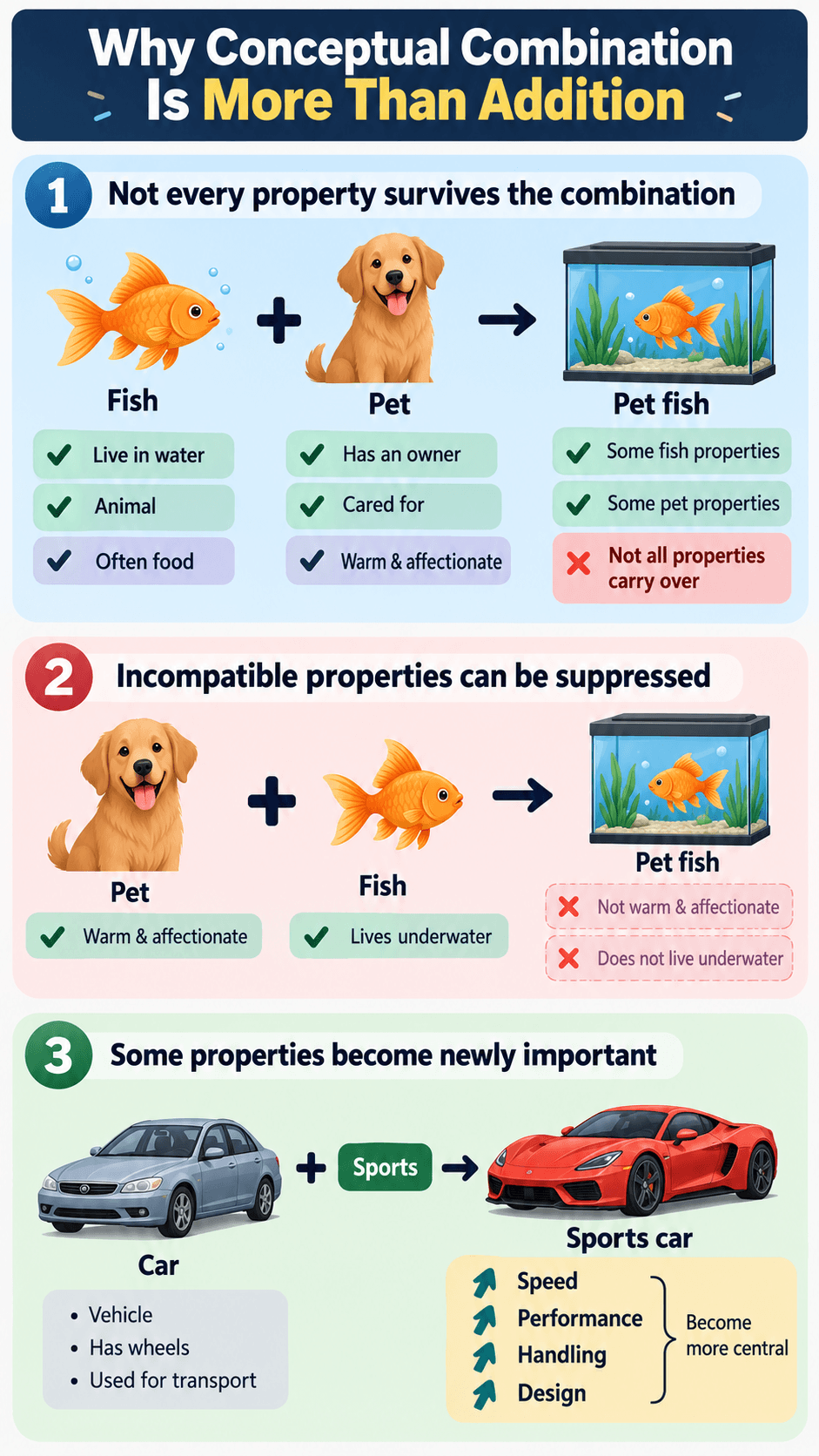
Not every property survives the combination
Concepts contain many properties, but a combination does not preserve all of them unchanged. Fish are often thought of as living in natural bodies of water and sometimes as food. Pets are often thought of as animals with owners that are cared for. In “pet fish,” some fish properties and some pet properties remain useful, while others become less appropriate.
James Hampton’s work on combined concepts emphasized this non-additive structure. His account of conceptual combination and feature inheritance explains that generic properties of each constituent need not all carry into the conjunction when they conflict with the combined meaning.
Incompatible properties can be suppressed
Suppose a broad concept of pets includes being warm and affectionate, while a broad concept of fish includes living underwater. The combined concept “pet fish” cannot simply inherit every typical property from both sources. Some properties are incompatible with what fish can be.
The combination therefore requires constraint. A property that makes sense for one concept alone may become irrelevant or impossible once the second concept is introduced.
Some properties become newly important
Combination can also change the importance of an inherited property. “Sports car” retains the broad structure of a car, but speed, performance, handling, and design become more central than they are for the category “car” in general.
This is not merely a longer label. The modifier changes which parts of the existing concept receive greater weight.
Emergent Properties: New Meaning From the Combination
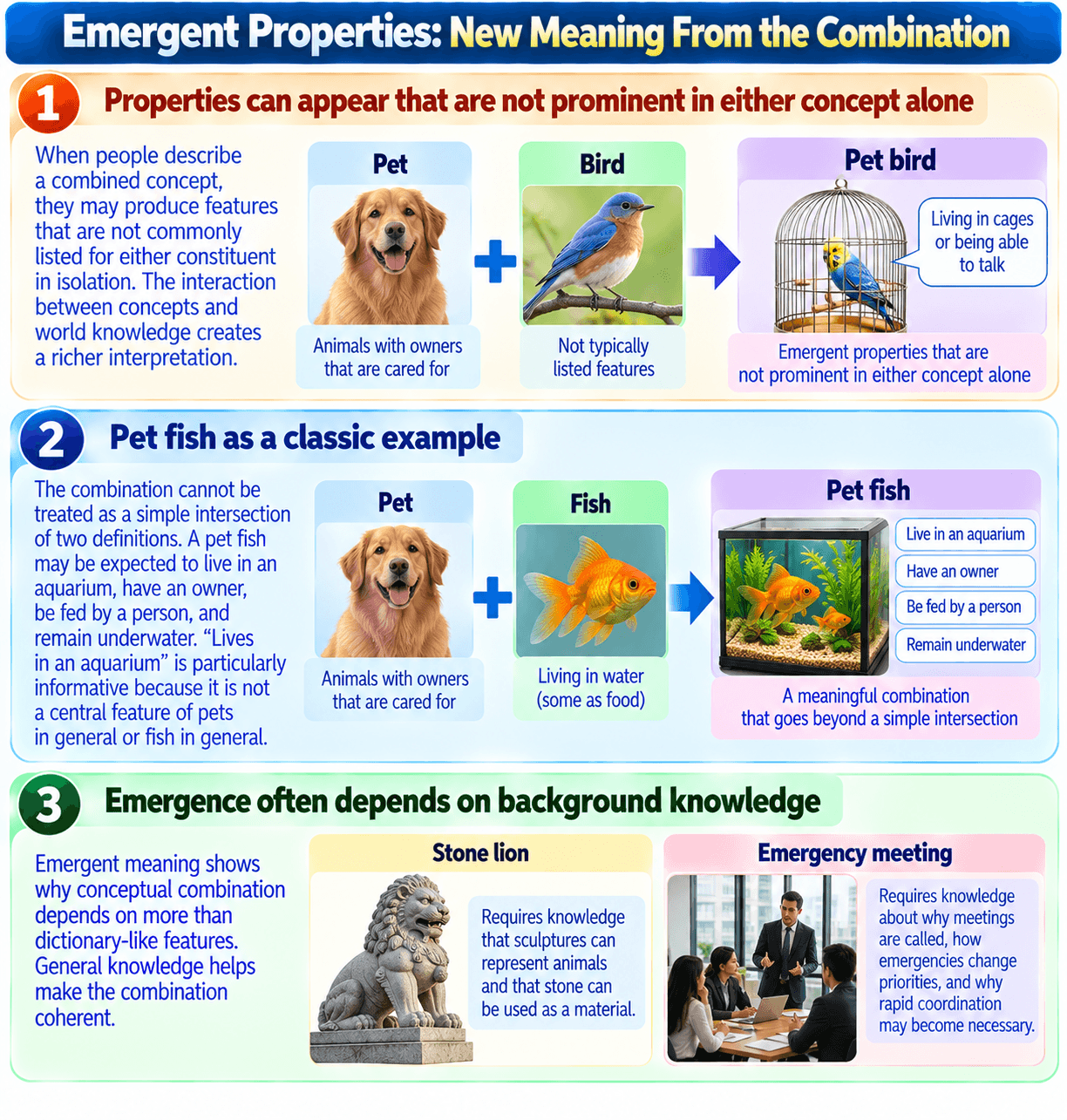
Properties can appear that are not prominent in either concept alone
One of the most interesting findings in conceptual combination research is the appearance of emergent properties. When people describe a combined concept, they may produce features that are not commonly listed for either constituent in isolation.
A review of embodied conceptual combination gives a classic example: people may describe pet birds as living in cages or being able to talk even though those features are not typically listed for “pet” or “bird” alone. The interaction between concepts and world knowledge creates a richer interpretation.
Pet fish as a classic example
“Pet fish” illustrates why the combination cannot be treated as a simple intersection of two definitions. A pet fish may be expected to live in an aquarium, have an owner, be fed by a person, and remain underwater.
“Lives in an aquarium” is particularly informative because it is not a central feature of pets in general or fish in general. It emerges from understanding what normally happens when a fish functions as a pet.
Emergence often depends on background knowledge
To interpret “stone lion,” you need knowledge that sculptures can represent animals and that stone can be used as a material. To understand “emergency meeting,” you need knowledge about why meetings are called, how emergencies change priorities, and why rapid coordination may become necessary.
Emergent meaning therefore shows why conceptual combination depends on more than dictionary-like features. General knowledge helps make the combination coherent.
Different Ways Two Concepts Can Relate
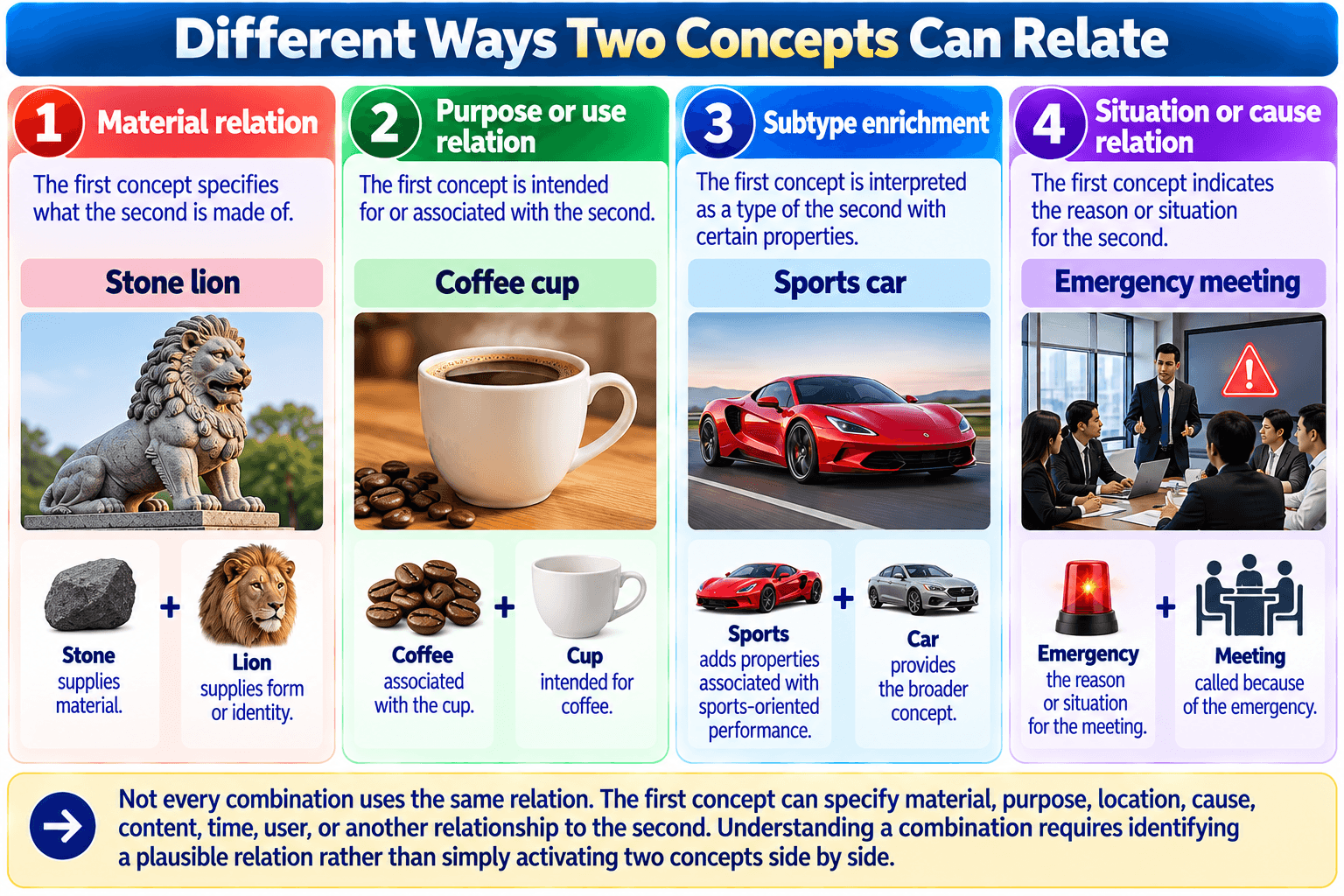
Not every combination uses the same relation. The first concept can specify material, purpose, location, cause, content, time, user, or another relationship to the second.
Material relation: stone lion
In “stone lion,” stone most naturally specifies what the lion representation is made of. The head concept, lion, supplies the form or identity being represented, while stone supplies material.
Purpose or use relation: coffee cup
“Coffee cup” usually means a cup intended for or associated with coffee. Coffee is not necessarily the material, owner, or location of the cup. The relation is functional.
Subtype enrichment: sports car
“Sports car” is interpreted as a type of car with properties associated with sports-oriented performance. The modifier narrows and reorganizes the car concept rather than supplying a simple physical relation such as material.
Situation or cause relation: emergency meeting
“Emergency meeting” is a meeting called because of or in response to an emergency. The emergency changes expectations about urgency, timing, agenda, and decision pressure.
These examples show why understanding a combination requires identifying a plausible relation rather than merely activating two concepts side by side.
Relation Selection in Noun-Noun Combinations
One influential research tradition focuses on how people select the relation linking two nouns. Christina Gagné’s Competition Among Relations in Nominals theory proposes that familiar thematic relations compete during interpretation.
Research describing the CARIN approach explains conceptual combination in terms of selecting a thematic relation such as “made of,” “used for,” or another learned relation between modifier and noun.
Why the same modifier can support different relations
Consider “chocolate bar,” “chocolate stain,” and “chocolate gift.” Chocolate plays different roles. A bar can be made of chocolate, a stain can be caused by chocolate, and a gift can consist of or involve chocolate.
The modifier alone does not determine one universal relation. The head noun and prior experience constrain which interpretation is plausible.
Relation frequency can influence interpretation
If a modifier has often appeared in combinations using one relation, that history may make the relation easier to consider in a new combination. However, relation frequency is not the whole story.
Gregory Murphy and Edward Wisniewski argued that familiarity, plausibility, and prior knowledge are also important constraints on conceptual combination. Their discussion shows why a mechanically frequent relation should not override an interpretation that makes little sense.
Plausibility Constrains the Meaning
Possible interpretations compete
A novel phrase can permit several grammatical relations, but only some interpretations fit world knowledge. “Mountain magazine” might mean a magazine about mountains, a magazine published by a mountain organization, or a magazine found on a mountain. Context usually makes one interpretation more plausible.
World knowledge eliminates incoherent readings
People know what objects, events, and materials can realistically do. That knowledge blocks interpretations that are grammatically imaginable but conceptually implausible.
“Glass hammer” can mean a hammer made from glass, perhaps as an art object or specialized tool, because objects can be made of materials. But if the context is construction work, knowledge about fragility may make that interpretation less plausible than it would be in a museum context.
Context can rescue an unusual combination
A phrase that seems strange in isolation can become clear in a suitable situation. “Paper shoes” may sound impractical until the context is a disposable protective covering, costume, prototype, or art project.
Conceptual combination is therefore context-sensitive without being unconstrained. Context works together with concept knowledge to select a coherent interpretation.
Structural Alignment and Emergent Meaning
Similar concepts can align shared structure
When two concepts have compatible structures, their properties can be aligned relatively easily. A combination may then be interpreted by projecting a property from one concept onto the other.
For example, if two artifact concepts share related parts or functions, the modifier may specify which property of the head noun should change.
Dissimilar concepts may require a relation or new property
When the concepts are less structurally similar, direct feature alignment becomes harder. People may instead search for a thematic relation or construct a new property that makes the combination coherent.
Research on similarity and emergence in conceptual combination found that dissimilar concept pairs produced more emergent features and more relational interpretations than similar pairs. This supports the idea that combinations can be solved through more than one route.
Conceptual Combination and Property Inheritance
Some parent properties are retained
A “coffee cup” is still expected to share many properties with cups. A “sports car” still has properties central to cars. A “stone lion” still preserves enough lion structure to be recognized as representing a lion.
Some properties are weakened or overridden
The combination can make a typical parent property less relevant. A pet may often be imagined as furry and warm, but those properties are inappropriate for a pet fish. A lion is normally living tissue, but a stone lion is not alive.
Some inherited properties interact
Properties do not always enter the combination independently. The material of a stone lion affects weight, texture, movement, and durability together. The emergency in an emergency meeting affects time pressure, attendance expectations, and agenda structure together.
This interaction is one reason combined meanings can feel richer than a list of inherited features.
Why Conceptual Combination Is Productive
People can understand many novel combinations
Language and thought constantly produce combinations that have never been memorized as fixed expressions. “Solar backpack charger,” “robot gardening assistant,” or “quiet work café” can be interpreted because their familiar components constrain one another.
This productivity reduces the need to store a separate concept for every possible phrase. Existing concepts provide reusable building blocks.
Novel combinations still rely on familiar knowledge
Novel does not mean unconstrained creativity. A person interprets a new combination by using known concepts, familiar relations, causal knowledge, functions, and context.
This is why an unfamiliar combination can be understandable while a random sequence of words remains confusing. Conceptual productivity depends on structured prior knowledge.
Why Familiarity Changes the Work Required
Familiar combinations can become easy to retrieve
Some combinations are encountered so often that their integrated meaning becomes highly accessible. “Coffee cup,” “school bus,” or “office chair” rarely feels like a puzzle because experience has repeatedly reinforced the same interpretation.
This does not mean the constituent concepts have disappeared. The phrase still has internal structure, and that structure becomes visible if one part changes. “Coffee cup” and “coffee machine” both contain coffee, but the relation to cup and machine is different.
Novel combinations require more active constraint
An unfamiliar phrase such as “garden laptop” offers less practiced guidance. A reader may consider several possibilities: a laptop designed for outdoor garden work, a laptop-themed garden object, or a device used to manage garden systems. Context is needed to stabilize one interpretation.
Novelty therefore increases the importance of plausibility, relation selection, and background knowledge. The mind has fewer stored phrase-level expectations to rely on.
Familiarity should not be confused with conceptual necessity
A familiar interpretation can feel inevitable simply because it is well practiced. Yet another context can sometimes support a different meaning. A “chicken house” normally refers to a structure for chickens, while an unusual fictional context could make it the name of a restaurant or a house shaped like a chicken.
Conceptual combination remains constrained by knowledge and context even when one interpretation is strongly conventional.
Conceptual Combination vs Simple Association
Association activates related ideas
Hearing “coffee” may activate café, morning, caffeine, mug, or breakfast. These concepts are associated because they often occur together or are linked in experience.
Combination builds one integrated interpretation
“Coffee cup” does more than activate coffee and cup near each other. It produces a specific object concept: a cup used for coffee. The relation between the concepts matters.
An association can exist without producing a new combined category. Conceptual combination requires integration.
Conceptual Combination vs Prototype or Exemplar Categorization
Prototype and exemplar theories classify a new instance
Prototype theory asks whether a new item resembles an abstract central representation. Exemplar theory asks whether it resembles specific represented instances. Both primarily address how a current item is assigned to a category.
Conceptual combination constructs a new or narrower meaning
Conceptual combination begins with concepts and asks how they interact. “Pet fish” creates a combined concept before a particular animal is classified as one.
Prototype or exemplar processes may later help classify examples of pet fish, but they do not by themselves explain how “pet” and “fish” were integrated into the combined meaning.
Conceptual Combination vs Schema
Schema supplies structured prior knowledge
A schema can help interpret a combination by providing expectations about situations, roles, and relations. Understanding “emergency meeting” is easier if you already know how meetings work and how emergencies alter priorities.
Combination is the act of integrating concepts
The schema contributes background structure, while conceptual combination produces the specific integrated meaning. The two processes can cooperate without being identical.
Conceptual Combination vs Metaphor
Literal combination usually preserves a plausible relation between concepts
“Stone lion” and “coffee cup” can be understood literally through material and purpose relations. No cross-domain figurative mapping is required.
Metaphor maps structure across domains
A metaphor such as “time is a river” invites a figurative mapping in which features or relations from one domain help structure another. Conceptual combination can contribute to metaphor comprehension, but not every combination is metaphorical.
This distinction prevents the topic from becoming a general article about figurative language.
Conceptual Combination vs Conceptual Blending
Combination is the broader cognitive problem addressed here
Conceptual combination asks how multiple existing concepts contribute to an integrated representation. Much classic research studies noun-noun phrases, conjunctions, property inheritance, and emergent features.
Conceptual blending is a specific theoretical framework
Conceptual blending theory analyzes how information from mental spaces can be projected into an integrated space with emergent structure. It is a richer theoretical framework with its own terminology and research tradition.
The concepts are related, but treating every ordinary combination as an example of blending would erase useful theoretical distinctions.
Conceptual Combination vs Language Composition
Grammar constrains how words combine
Language composition concerns how lexical meanings and syntactic structure contribute to the meaning of a phrase or sentence. Word order and grammar clearly matter for interpretation.
Conceptual knowledge contributes beyond syntax
Knowing the grammar of “stone lion” does not by itself tell you that the most plausible interpretation is a lion-shaped representation made of stone. World knowledge supplies the material relation and the expected properties of sculptures.
A review of concepts, compositionality, and conceptual combination places conceptual combination within the broader problem of how the mind constructs structured representations from familiar parts. This is why conceptual combination touches language while remaining a cognitive problem in its own right.
A Practical Four-Question Test for a Combined Concept
When a phrase combines familiar ideas, ask four questions:
- What does each concept contribute? Identify the important knowledge associated with each constituent.
- What relation links them? Is it material, purpose, location, cause, content, subtype, or something else?
- Which properties conflict or change? Do not assume every typical property survives unchanged.
- What new property emerges? Ask whether the combined concept supports an expectation that is not central to either constituent alone.
Apply the test to “emergency meeting.” Meeting contributes a coordinated event with participants and discussion. Emergency contributes urgency and a problem requiring response. The linking relation is roughly “meeting caused by or focused on an emergency.” The combination increases the expected importance of rapid scheduling, priority, focused agenda, and immediate decisions.
Five Examples, Five Different Integrations
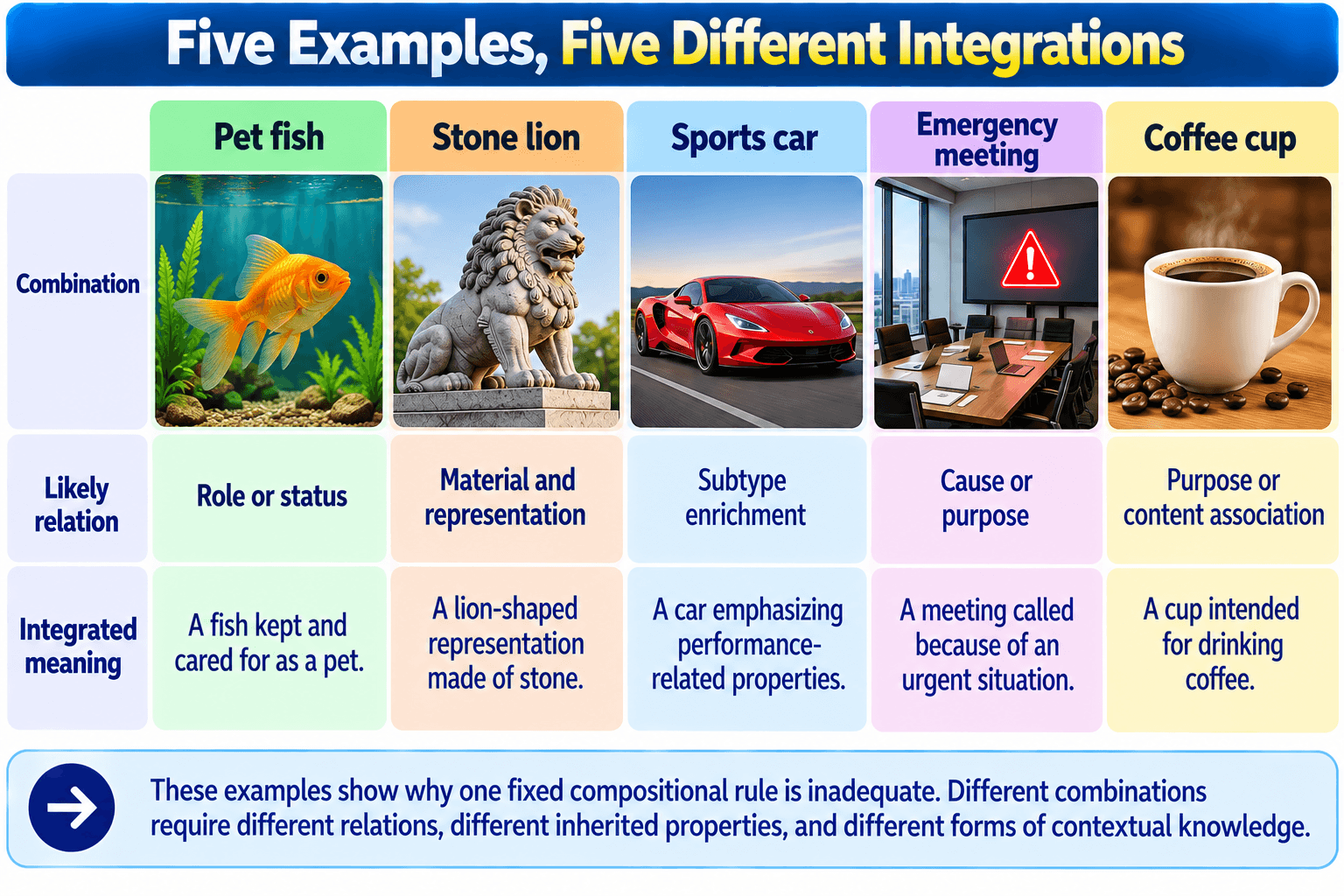
| Combination | Likely relation | Integrated meaning |
|---|---|---|
| Pet fish | Role or status | A fish kept and cared for as a pet |
| Stone lion | Material and representation | A lion-shaped representation made of stone |
| Sports car | Subtype enrichment | A car emphasizing performance-related properties |
| Emergency meeting | Cause or purpose | A meeting called because of an urgent situation |
| Coffee cup | Purpose or content association | A cup intended for drinking coffee |
The table shows why one fixed compositional rule is inadequate. Different combinations require different relations, different inherited properties, and different forms of contextual knowledge.
What Conceptual Combination Does Not Prove
It does not prove that concepts are only feature lists
Feature inheritance is useful for studying combinations, but concepts can also include relations, functions, causal knowledge, situational information, and embodied experience.
It does not mean every combined meaning is calculated from scratch
Some combinations become familiar expressions with well-practiced meanings. “Coffee cup” is common enough that its interpretation may be retrieved rapidly. Familiarity and online composition can coexist.
It does not require one universal combination mechanism
Research has produced relation-selection, property-based, alignment-based, embodied, and other approaches. Different combinations may emphasize different mechanisms.
The responsible conclusion is that conceptual combination is a family of processes by which existing conceptual knowledge is integrated, constrained, and extended.
FAQ About Conceptual Combination Psychology
What is an emergent property in conceptual combination?
An emergent property is a feature that becomes relevant to the combined concept even though it is not a central property of either constituent considered alone. “Lives in an aquarium” is a classic example for pet fish. The property emerges from integrating the concepts with background knowledge.
Why does “stone lion” not mean a living lion made of stone?
World knowledge constrains interpretation. People know that lions are living animals and that stone is commonly used to create sculptures. A lion-shaped stone representation is therefore far more plausible than a biological lion literally made from stone.
Is conceptual combination the same as conceptual blending?
No. They are related, but conceptual blending is a specific theoretical framework involving mental spaces and an integrated blend. Conceptual combination is the broader problem of how familiar concepts are integrated into a new or more specific representation.
Can familiar phrases still involve conceptual combination?
Yes. A familiar phrase may have a highly practiced interpretation, but its meaning still reflects relations between constituent concepts. Familiarity can make the result easier to retrieve without erasing the conceptual structure that gives the phrase meaning.
Key Takeaways
- Conceptual combination integrates familiar concepts into a new or more specific meaning.
- The combined meaning is not a simple sum of every property associated with each constituent.
- Some properties are inherited, some are suppressed or reweighted, and some emergent properties arise from interaction with prior knowledge.
- Different combinations can rely on different relations, such as material, purpose, cause, role, or subtype enrichment.
- Context, plausibility, familiarity, structural alignment, and world knowledge can all constrain interpretation.
- Conceptual combination differs from simple association, categorization by prototype or exemplar, schema, metaphor, conceptual blending, and language composition.
Final Thought: New Meaning Comes From Constraint as Much as Creativity
Conceptual combination shows how thought can be productive without becoming arbitrary. Familiar concepts provide reusable knowledge, but the mind does not simply pile their properties together. It searches for a coherent relationship, suppresses incompatible expectations, preserves useful structure, and sometimes derives new properties from the interaction. That balance between reuse and revision is what makes a novel phrase understandable rather than merely new.
Educational note: Conceptual combination is a normal cognitive process involved in understanding and creating complex meanings. Difficulty interpreting an unusual phrase in isolation is not, by itself, evidence of a language disorder, memory problem, low intelligence, or neurological condition.

Michael Reed is the Founder and Lead Writer at Psychology Exposed. He writes about human behavior, relationships, emotional patterns, self-awareness, and practical psychology topics using research-informed, easy-to-understand content.
Read More About Michael Reed: https://psychologyexposed.com/michael-reed/