
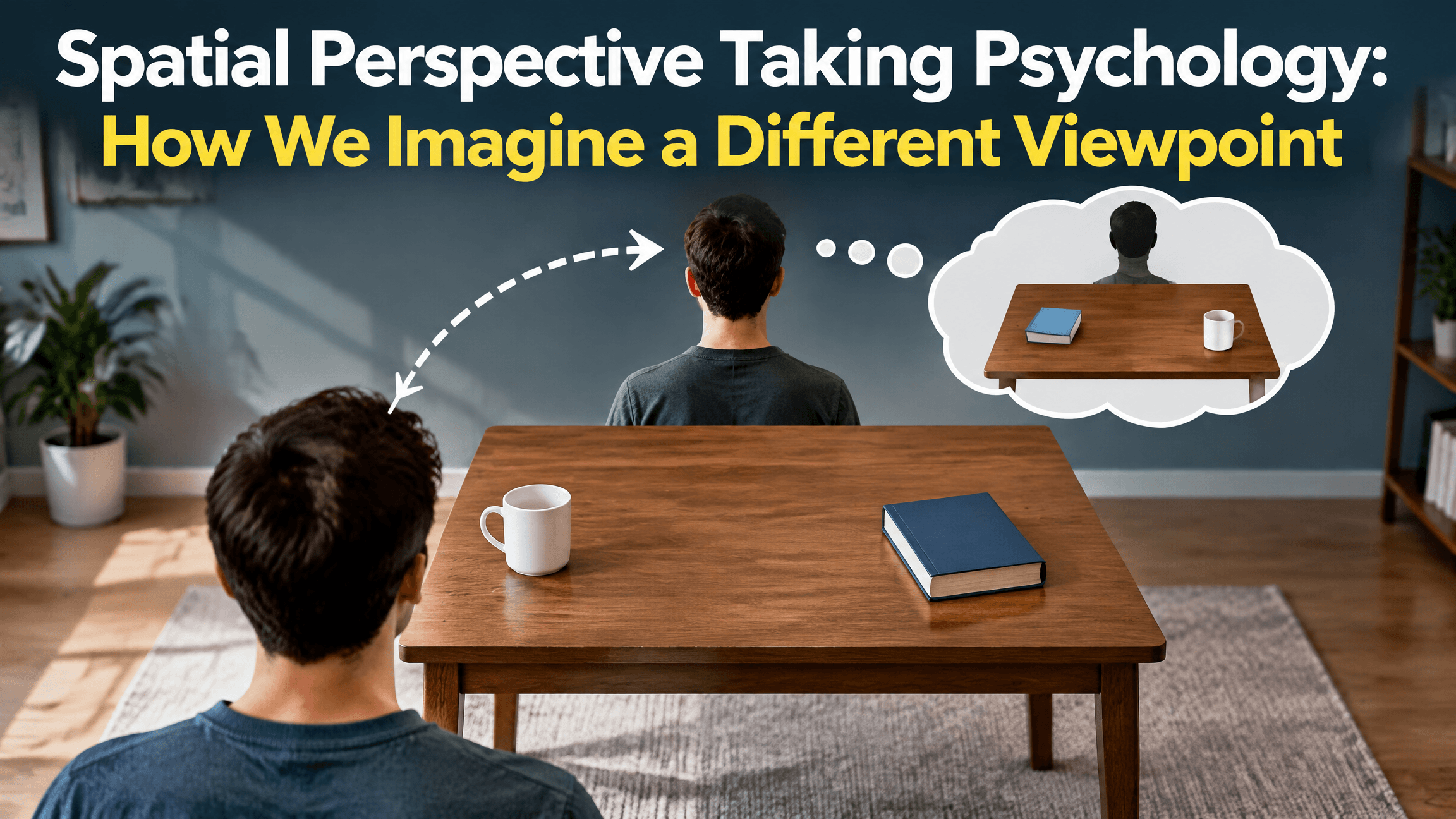
Imagine standing on the south side of a table. A cup is near the left edge and a book is near the right edge. Now imagine that you move to the north side of the table and face back toward it. Without touching the objects, where would the cup appear relative to the book from that new position?
That is a spatial perspective-taking problem. The challenge is not to rotate the cup or the table. It is to mentally change the observer’s position or heading and then judge the same arrangement from that imagined viewpoint.
This sounds simple until the new viewpoint is far from your current one. Left and right can reverse. Front and behind can change. A relation that feels obvious from your own position must be recomputed from somewhere else in space. This is why spatial perspective taking is different from ordinary visual recognition, mental rotation of an object, or social perspective taking about what another person thinks or feels.
Quick Answer
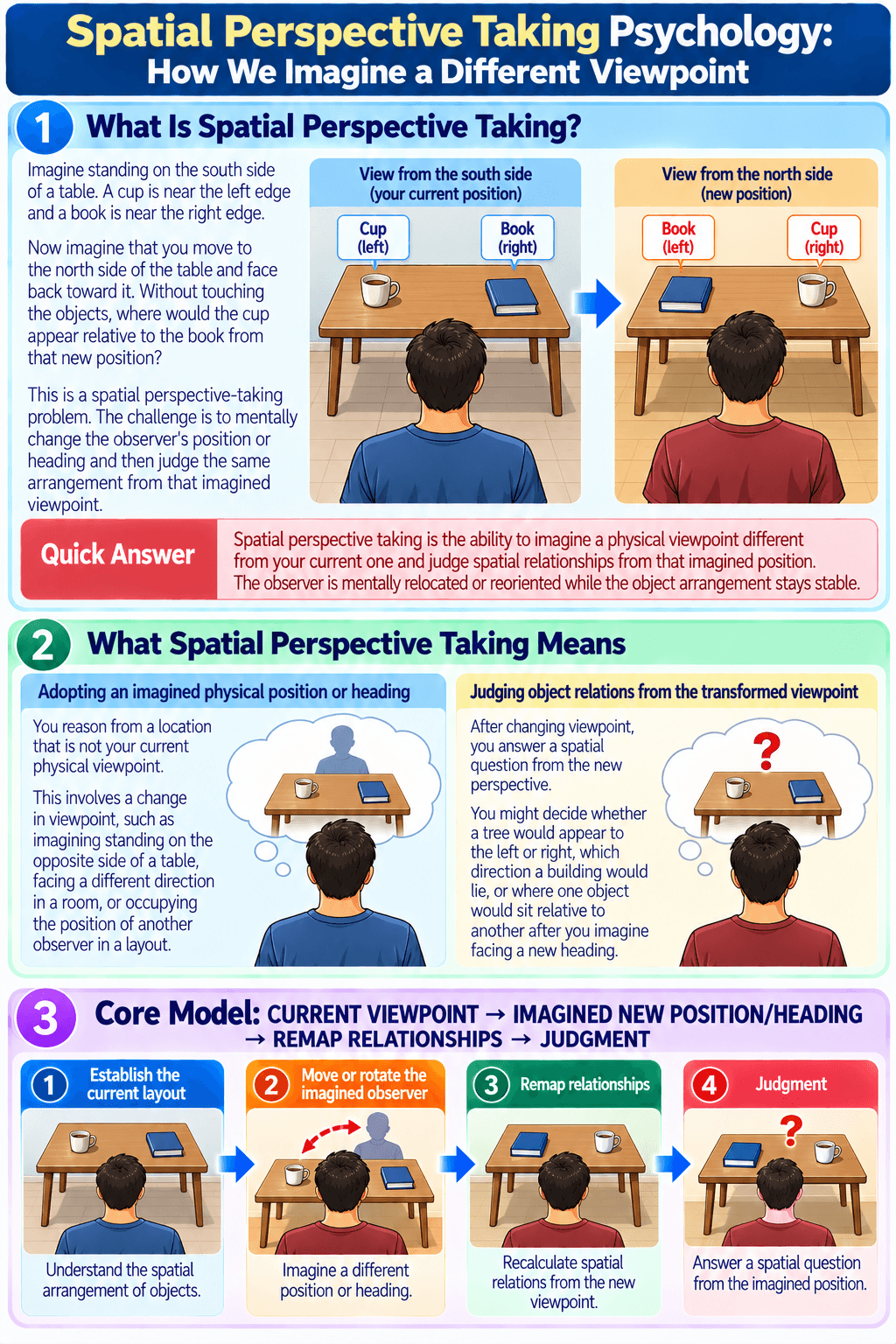
Spatial perspective taking is the ability to imagine a physical viewpoint different from your current one and judge spatial relationships from that imagined position. The observer is mentally relocated or reoriented while the object arrangement stays stable. This differs from mental rotation, where the object is transformed, and from social perspective taking, which concerns another person’s thoughts, knowledge, or feelings rather than geometry.
What Spatial Perspective Taking Means
Adopting an imagined physical position or heading
Spatial perspective taking asks you to reason from a location that is not your current physical viewpoint. You may be asked to imagine standing on the opposite side of a table, facing a different direction in a room, or occupying the position of another observer in a layout.
The key psychological operation is a change in viewpoint. A 2017 study of spatial perspective-taking transformations describes the process as updating a representation of space around the body to reason from another viewpoint. The important idea for a general reader is that the spatial relationships are being recoded relative to a different observer position.
That new viewpoint can be real, imagined, or represented by another person or object in a diagram. The task remains spatial as long as the question is about where things would appear from that physical position.
Judging object relations from the transformed viewpoint
Changing viewpoint is only the first half of the problem. The person must then answer a spatial question from the new perspective.
You might need to decide whether a tree would appear to the left or right, which direction a building would lie, or where one object would sit relative to another after you imagine facing a new heading.
The Perspective-Taking/Spatial Orientation Test developed by Kozhevnikov, Hegarty, and Waller illustrates this structure. The Spatial Orientation Test resources from UC Santa Barbara describe tasks in which a person imagines standing at one object, facing another, and then indicates the direction of a third object from that imagined orientation.
Core Model: CURRENT VIEWPOINT → IMAGINED NEW POSITION/HEADING → REMAP RELATIONSHIPS → JUDGMENT
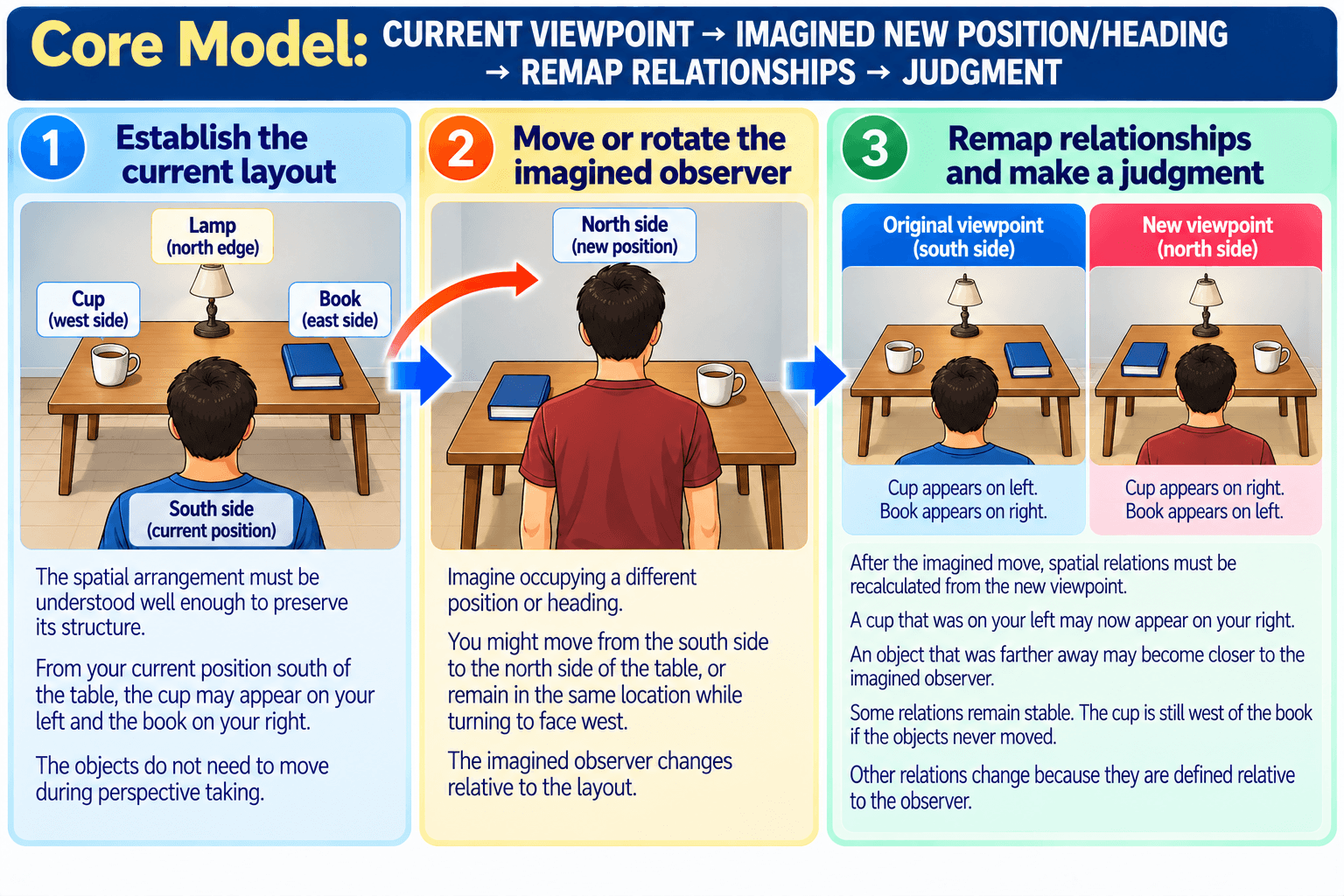
Establish the current layout
Before changing perspective, the spatial arrangement must be understood well enough to preserve its structure. Where are the relevant objects? Which ones are near, far, left, right, north, south, or aligned?
Suppose a table has a cup on the west side, a book on the east side, and a lamp at the north edge. From your current position south of the table, the cup may appear on your left and the book on your right.
The physical arrangement is the reference structure. The objects do not need to move during perspective taking.
Move or rotate the imagined observer
Next, you imagine occupying a different position or heading. You might move from the south side to the north side of the table, or remain in the same location while turning to face west.
This is the defining transformation. The imagined observer changes relative to the layout.
Research on visuospatial perspective taking frequently distinguishes this viewer-centered transformation from rotating the objects themselves. A recent review of individual differences in visuospatial perspective taking describes perspective transformation, viewer rotation, and embodied perspective taking as distinct from array or object rotation strategies.
Recode left-right, front-behind, or directional relationships
After the imagined move, spatial relations must be recalculated from the new viewpoint. A cup that was on your left may now appear on your right. An object that was farther away may become closer to the imagined observer.
Some relations remain stable. The cup is still west of the book if the objects never moved. Other relations change because they are defined relative to the observer. “Left of me” and “in front of me” depend on where the observer stands and faces.
This mix of stable and changing relationships is what makes perspective-taking tasks cognitively interesting.
A Concrete Table Example
Start south of the table
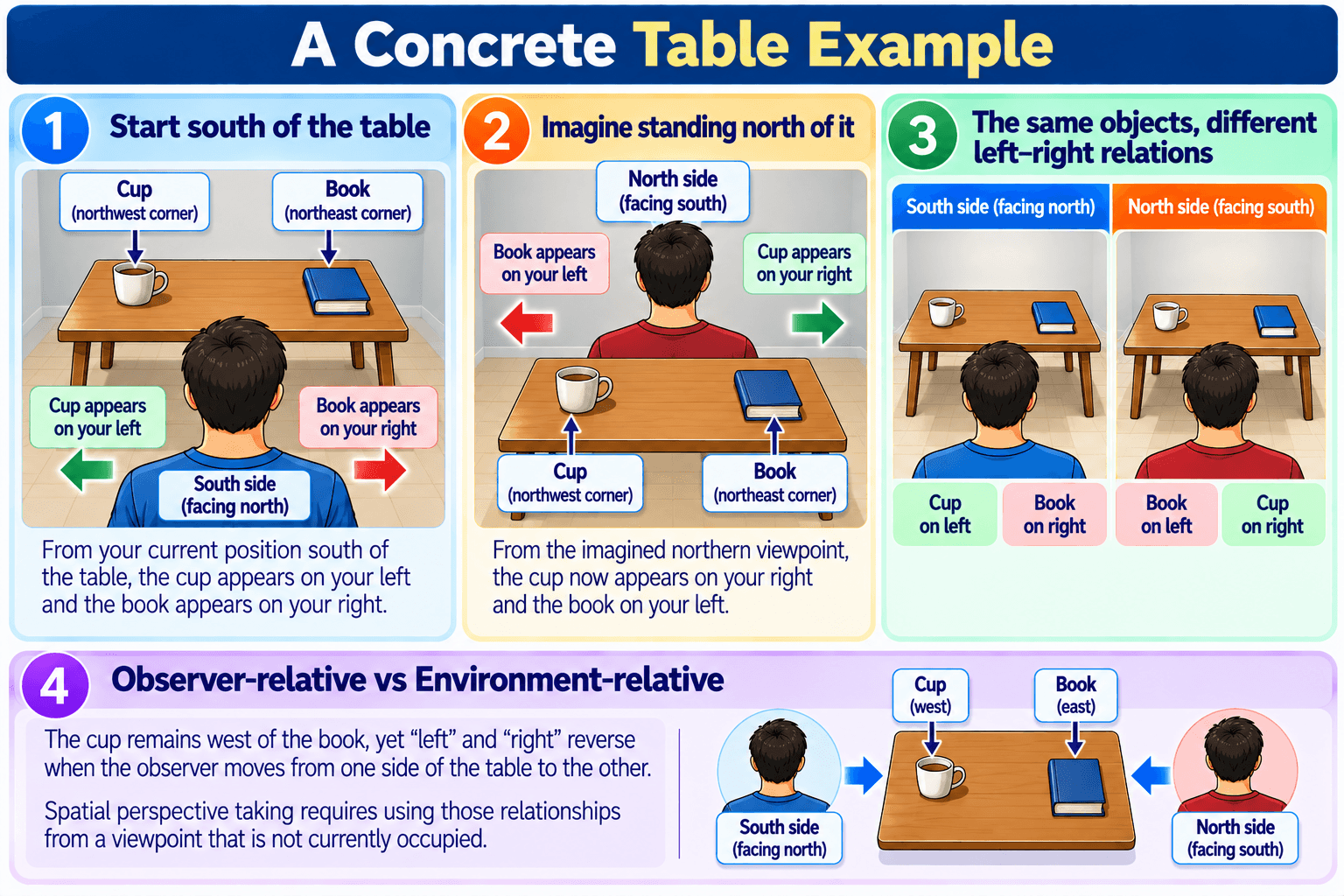
Picture a rectangular table. A cup sits near the northwest corner. A book sits near the northeast corner. You are standing south of the table and facing north.
From your current viewpoint, the cup appears on your left and the book appears on your right.
If the question asks, “Where is the cup relative to the book from your current position?” the answer is straightforward because the judgment matches your actual viewpoint.
Imagine standing north of it
Now imagine moving to the north side of the table and facing south. The cup and book remain physically where they were.
Your body-centered coordinates have changed. From the imagined northern viewpoint, the cup now appears on your right and the book on your left.
The challenge is to avoid answering from your actual southern viewpoint. You must suppress the immediately available relation and use the imagined relation instead.
Judge the cup relative to the book from the new viewpoint
The correct judgment follows from the transformed observer position. Nothing about the objects has changed relative to the table, but their position relative to the observer has changed.
This example reveals the core distinction between observer-relative and environment-relative information. The cup remains west of the book, yet “left” and “right” reverse when the observer moves from one side of the table to the other.
Spatial perspective taking therefore requires more than memorizing where objects are. It requires using those relationships from a viewpoint that is not currently occupied.
What Changes During a Viewpoint Transformation?
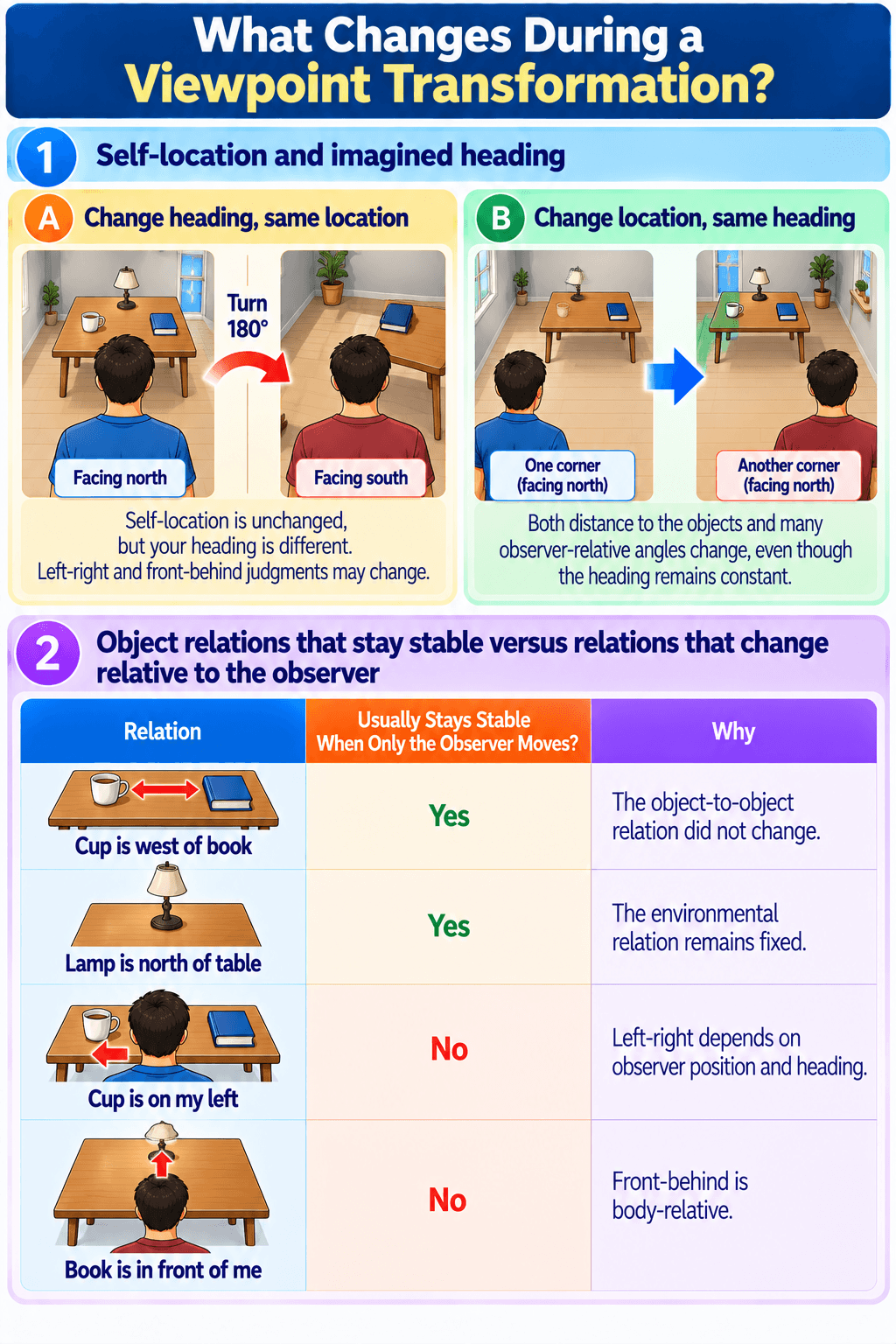
Self-location and imagined heading
A viewpoint has at least two important components: where the observer is located and which direction the observer faces.
You can change one without changing the other. Imagine remaining in the center of a room but turning 180 degrees. Your self-location is unchanged, but your heading is different. Left-right and front-behind judgments may therefore change.
Alternatively, imagine moving from one corner of a room to another while continuing to face north. Both distance to the objects and many observer-relative angles change, even though the heading remains constant.
Perspective-taking problems can therefore differ depending on whether they require a location change, a heading change, or both.
Object relations that stay stable versus relations that change relative to the observer
One useful way to solve a perspective problem is to separate invariant relations from viewpoint-dependent relations.
If the lamp is north of the table and the cup is west of the book, those environment-centered relations can remain true regardless of where you stand. But “the lamp is in front of me” depends on heading, and “the cup is on my left” depends on the relationship between your body and the layout.
| Relation | Usually Stays Stable When Only the Observer Moves? | Why |
|---|---|---|
| Cup is west of book | Yes | The object-to-object relation did not change |
| Lamp is north of table | Yes | The environmental relation remains fixed |
| Cup is on my left | No | Left-right depends on observer position and heading |
| Book is in front of me | No | Front-behind is body-relative |
Angular Difference and Task Difficulty
Why larger viewpoint changes can increase transformation demands
Imagine adopting a viewpoint 30 degrees away from your current heading. Now compare that with imagining a viewpoint 150 degrees away. The second transformation often requires a larger reorientation of the observer-centered frame.
Research has repeatedly found that performance can become slower or less accurate as the angular disparity between the current and target viewpoint grows, although the exact pattern depends on task and strategy. Work on the embodied nature of spatial perspective taking found evidence that body-related transformations influence perspective-taking performance in ways that differ from ordinary object rotation.
This does not mean the mind literally spins a miniature body at a fixed speed. Response-time patterns are evidence about task demands, not direct pictures of one internal mechanism.
Why strategy differences matter
Two people can answer the same item correctly using different approaches. One may imagine moving into the new position. Another may keep the observer fixed and mentally transform the scene. A third may use learned geometric rules.
A critical review of visual perspective-taking and laterality tasks warns that some common task designs do not uniquely prove one transformation strategy. Increased reaction time can be consistent with observer-based transformation, but alternative processes can sometimes produce similar behavioral patterns.
For that reason, it is safer to say that perspective-taking tasks can encourage particular transformations rather than claiming that every participant must use one identical internal strategy.
Strategies People May Use
Embodied or self-movement style strategies
Some people report solving perspective problems by imagining themselves moving around the scene. They may mentally “walk” to the other side of the table or feel as though they turn their body toward the target heading.
Experimental findings support the idea that bodily orientation can influence some perspective-taking tasks. The review on individual differences in visuospatial perspective taking describes studies in which actual body posture or physical rotation affected performance when the task required adopting another viewpoint.
This does not mean a person needs to physically move. The relevant point is that body-centered spatial organization can contribute to the imagined transformation.
Alternative spatial strategies and individual variability
Other people may rely less on an imagined body movement. They might use object-to-object relationships, cardinal directions, geometric rules, or a mentally reoriented diagram.
For example, instead of imagining standing north of the table, a person might reason: “If I face south, west will be on my right.” The judgment is still spatial, but the route to the answer is more analytic.
Research distinguishes perspective-taking ability from mental rotation ability even though the two can correlate. The classic Hegarty and Waller work supports treating these as related but separable spatial abilities rather than two names for one identical process.
Spatial Perspective Taking vs Mental Rotation
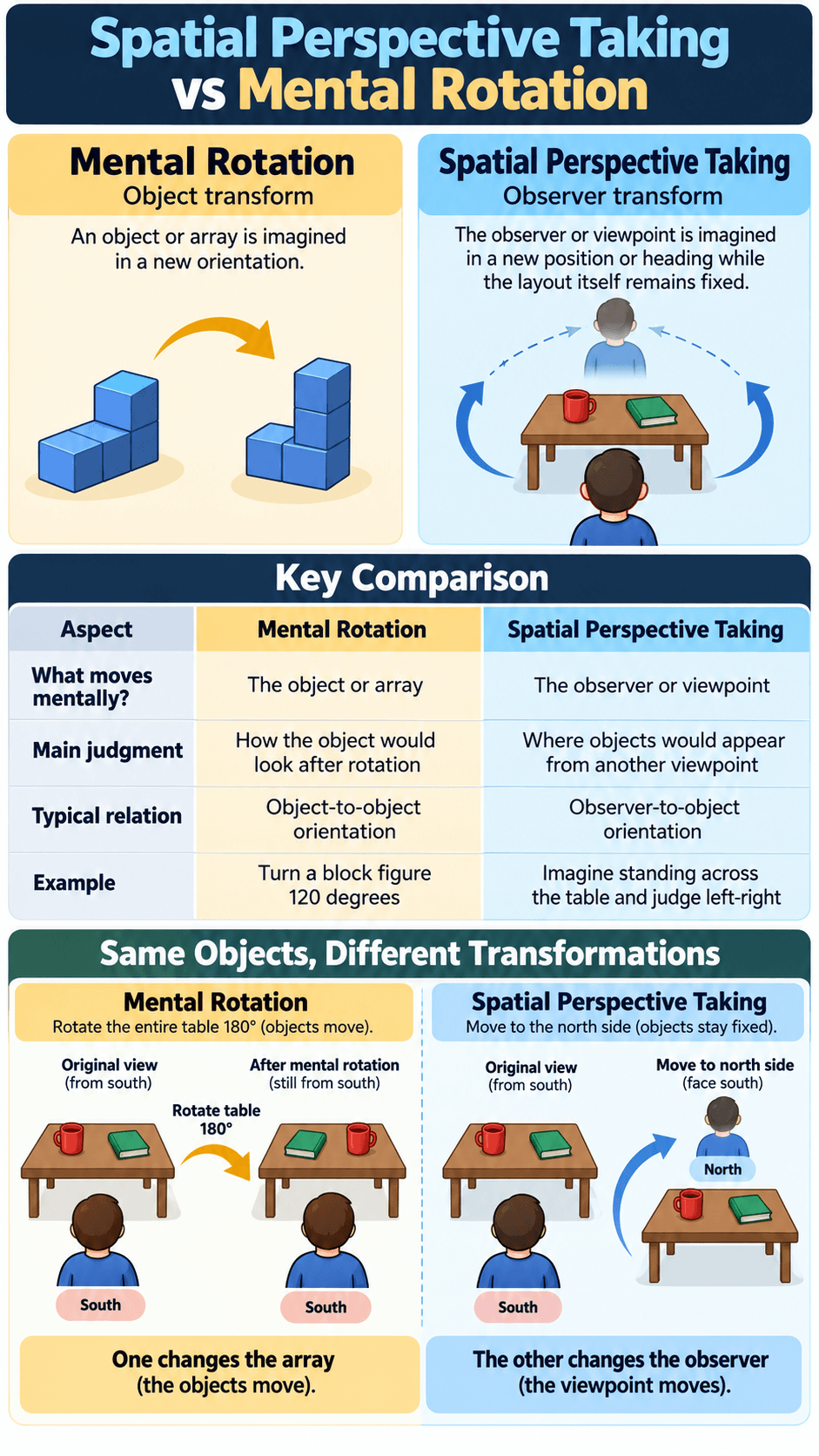
Observer transforms versus object transforms
The cleanest distinction is to ask: What is being transformed?
In mental rotation, an object or array is imagined in a new orientation. In spatial perspective taking, the observer or viewpoint is imagined in a new position or heading while the layout itself remains fixed.
| Question | Mental Rotation | Spatial Perspective Taking |
|---|---|---|
| What moves mentally? | The object or array | The observer or viewpoint |
| Main judgment | How the object would look after rotation | Where objects would appear from another viewpoint |
| Typical relation | Object-to-object orientation | Observer-to-object orientation |
| Example | Turn a block figure 120 degrees | Imagine standing across the table and judge left-right |
This distinction was central to research by Kozhevnikov, Hegarty, and Waller, which found evidence that object-manipulation and perspective-taking tasks are not simply the same spatial ability with different pictures.
Side-by-side example using the same objects
Return to the cup and book on the table.
Mental rotation version: stay south of the table, but imagine rotating the entire table 180 degrees. The cup and book move with the table.
Perspective-taking version: keep the table and objects fixed, but imagine yourself moving to the north side and facing south.
The final left-right answer may sometimes look similar, but the transformation being represented is different. One changes the array. The other changes the observer.
Spatial Perspective Taking vs Egocentric and Allocentric Reference Frames
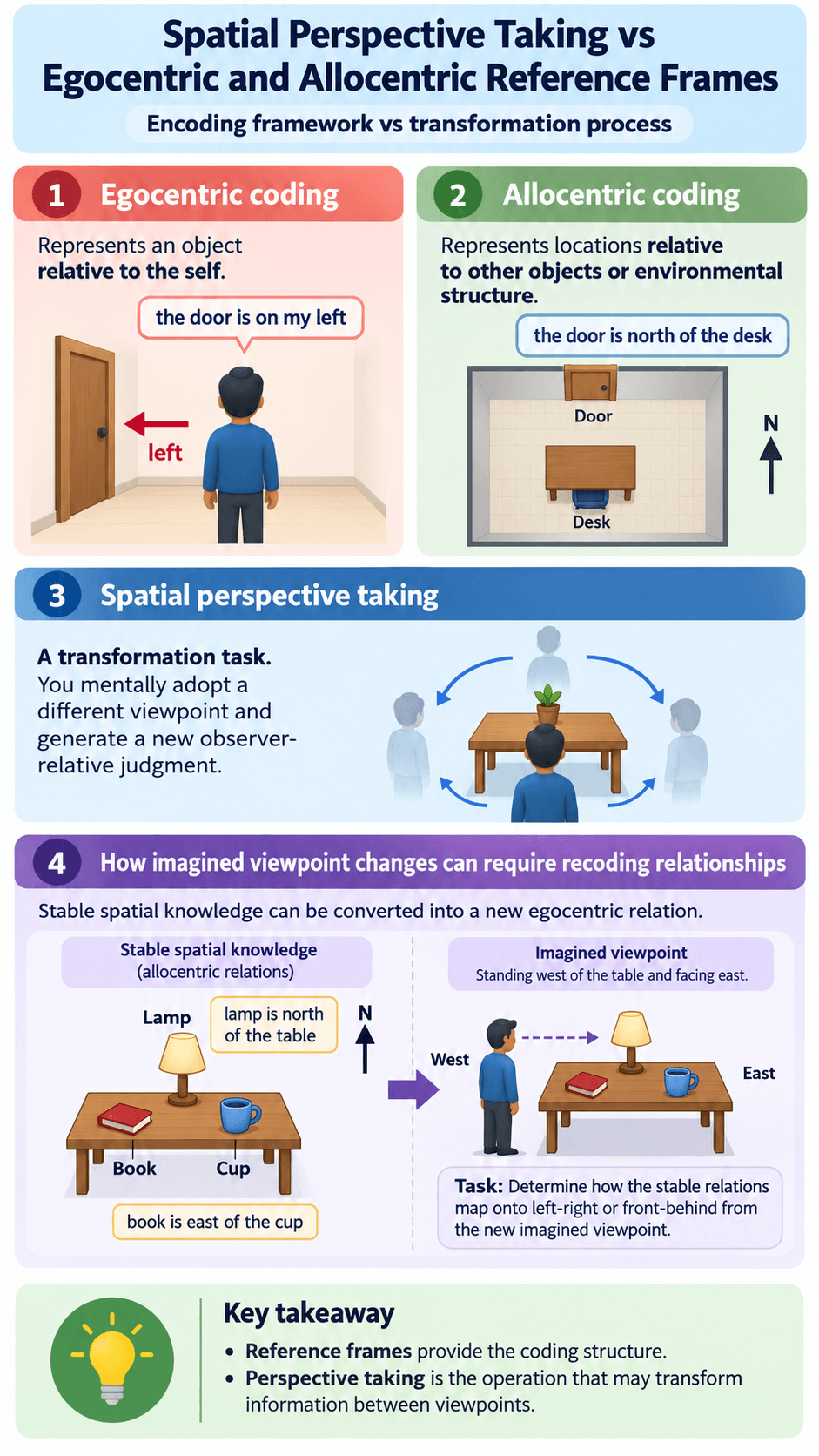
Encoding framework versus transformation process
Egocentric and allocentric representation describe how spatial relationships are coded.
Egocentric coding represents an object relative to the self, such as “the door is on my left.” Allocentric coding represents locations relative to other objects or environmental structure, such as “the door is north of the desk.”
Spatial perspective taking is different because it is a transformation task. You mentally adopt a different viewpoint and then generate a new observer-relative judgment.
A review of spatial perspective taking and spatial reference frames explicitly distinguishes allocentric representation from decentered perspective taking. Allocentric coding describes environment-based relations, while perspective taking involves adopting a viewpoint outside one’s current bodily position.
How imagined viewpoint changes can require recoding relationships
Perspective taking often requires converting stable spatial knowledge into a new egocentric relation.
You may know allocentrically that the lamp is north of the table and the book is east of the cup. Then you imagine standing west of the table and facing east. The task is to determine how those stable relations would map onto left-right or front-behind coordinates from the new imagined viewpoint.
Reference frames therefore provide the coding structure. Perspective taking is the operation that may transform information between viewpoints.
Spatial Perspective Taking vs Social Perspective Taking
Physical geometry versus another person’s thoughts or feelings
The word perspective is used in more than one area of psychology. Social perspective taking concerns what another person might know, believe, intend, feel, or interpret.
Spatial perspective taking concerns geometry. If another person is standing on the opposite side of a table, the question is where the cup appears from that physical viewpoint, not what the person thinks about the cup.
A task can involve another human figure while remaining spatial. If you judge whether an object is to the person’s left or right, the core problem is coordinate transformation.
Why empathy language should not define this concept
It can be tempting to explain spatial perspective taking with phrases such as “put yourself in someone else’s shoes.” That metaphor is too broad for this topic because it usually implies understanding another person’s experience.
Here, “put yourself there” should be interpreted literally in spatial terms: imagine occupying another physical location and heading.
Research on visuospatial perspective taking sometimes uses avatars or other people as target viewpoints, but the defining outcome is still a spatial judgment. The task does not require emotional understanding or inference about beliefs.
Spatial Perspective Taking and Imagination
Imagination as a broad simulation capacity
Spatial perspective taking obviously involves representing a situation that is not currently experienced from your actual viewpoint. In that broad sense, imagination can support the task.
But imagination covers far more than spatial geometry. A person can imagine future events, sounds, conversations, fictional scenes, emotional possibilities, or outcomes that have little to do with viewpoint transformation.
Calling spatial perspective taking “imagination” therefore does not explain what makes the task distinctive.
Why this process stays specific to structured spatial relations
The defining content is structured spatial relationship information: positions, headings, directions, left-right relations, object-to-object relations, and observer-to-object relations.
You do not need an especially vivid mental picture to answer correctly. A person may solve the task through geometric or relational reasoning without experiencing a detailed visual scene.
This is similar to reading a simple diagram. The diagram may be visually plain, but it preserves the relationships needed to make the judgment.
Common Misunderstandings
Perspective taking is not always social
In everyday language, perspective taking often means considering another person’s point of view. In spatial cognition, the phrase can refer specifically to adopting another physical viewpoint.
The same words therefore describe different psychological questions. One asks, “What would this layout look like from over there?” The other asks, “What might this person think or feel?”
Keeping those questions separate prevents empathy, Theory of Mind, and social inference from overtaking a spatial article.
Rotating yourself mentally is not the same as rotating the object
A perspective-taking task can sometimes be solved by rotating the scene instead of transforming the observer, which is one reason researchers are cautious when interpreting reaction times. But conceptually, the intended task distinction remains useful.
If the problem says, “Imagine you are standing at the tree facing the house,” the target operation is an observer-viewpoint transformation. If it says, “Imagine the shape rotated 90 degrees clockwise,” the target operation is object rotation.
The wording of the task tells you which transformation is supposed to be represented, even if individuals sometimes find alternative strategies.
Difficulty does not reveal one fixed spatial ability
Struggling with one perspective-taking item does not mean someone lacks spatial intelligence. Performance can depend on angular disparity, layout complexity, task instructions, strategy, familiarity, and how clearly the relations are represented.
A person may be strong at mental rotation but less comfortable with observer transformations, or the reverse. Related spatial abilities can dissociate rather than forming one single ranking.
The useful question is not “Am I good or bad at spatial thinking?” but “Which transformation is this task asking me to perform?”
FAQ About Spatial Perspective Taking
These questions focus on the distinctions that matter most when perspective-taking tasks are confused with object rotation, empathy, or reference-frame coding.
Is spatial perspective taking the same as empathy?
No. Empathy and social perspective taking concern another person’s emotional or mental experience. Spatial perspective taking concerns where objects would appear from another physical position or heading. A person may be represented in the task, but the required judgment can still be purely geometric.
Is spatial perspective taking the same as mental rotation?
No. Mental rotation typically transforms the object or array. Spatial perspective taking transforms the observer or viewpoint. The two abilities are related and can correlate, but classic research has found that they can be distinguished behaviorally and psychometrically.
Why do left-right judgments change with viewpoint?
Left and right are defined relative to an observer’s orientation. If you move to the opposite side of a table and face back toward it, an object that was to your left from the original viewpoint may now be to your right. The object did not move. The observer-centered coordinate system changed.
Do people all use the same strategy?
No. Some people may imagine moving their body into the target viewpoint. Others may transform the scene or use geometric rules. Task design can encourage one strategy more than another, which is why research should be cautious about inferring a single internal mechanism from reaction time alone.
Key Takeaways
- Spatial perspective taking means adopting an imagined physical viewpoint and judging spatial relationships from that position.
- The core transformation changes the observer or viewpoint rather than moving the objects themselves.
- Left-right and front-behind relations can change after a viewpoint transformation even when object-to-object relations remain stable.
- Mental rotation and spatial perspective taking are related but separable because they transform different parts of the spatial representation.
- Egocentric and allocentric reference frames describe how relations are coded, while perspective taking describes a transformation between viewpoints.
- Spatial perspective taking is about geometry, not empathy, social understanding, or general imagination.
A useful way to practice the distinction is to hold the scene still and ask only what changes when the observer moves. Identify the imagined position, identify the imagined heading, preserve the object-to-object relationships, and then recode left-right or front-behind from the new viewpoint. That sequence keeps the problem spatial and prevents it from turning into an object-rotation task.
Educational note: Performance on perspective-taking tasks varies with task demands and strategy. Difficulty with these tasks should not be used by itself to infer low intelligence, a neurological disorder, or a fixed limitation in spatial ability.
Michael Reed, Founder & Lead Writer at Psychology Exposed, writes accessible explanations of cognitive processes that shape everyday perception, reasoning, and behavior.

Michael Reed is the Founder and Lead Writer at Psychology Exposed. He writes about human behavior, relationships, emotional patterns, self-awareness, and practical psychology topics using research-informed, easy-to-understand content.
Read More About Michael Reed: https://psychologyexposed.com/michael-reed/