
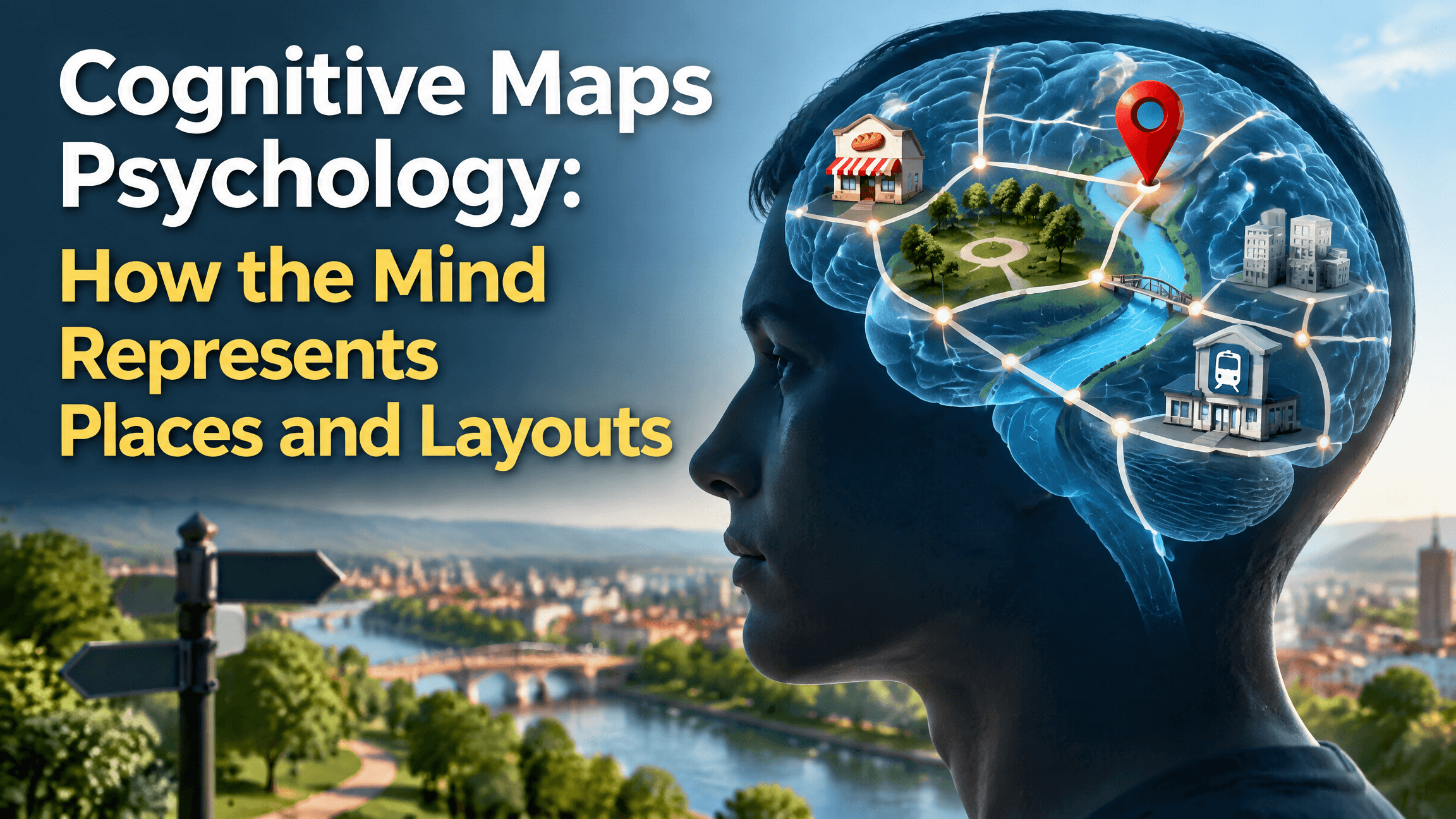
You can know that a bakery is two blocks beyond a park, that the train station sits on the other side of the river, and that a shortcut connects two streets even when none of those places is visible. Somehow, separate encounters with landmarks, turns, routes, and regions become organized enough for you to think about where places are relative to one another.
Psychologists often use the idea of a cognitive map to describe this kind of environmental representation. The phrase sounds as if the mind stores a tiny street map, but that picture is too literal. Human spatial knowledge may preserve useful relationships while remaining incomplete, selective, distorted, viewpoint-dependent, or partly organized as connections between places rather than exact coordinates.
That distinction matters when someone can follow a familiar route but cannot point directly toward the destination, knows two neighborhoods separately but struggles to connect them, or suddenly understands a shortcut after exploring a new street. These experiences are not simply about seeing, remembering, or choosing a route. They reveal how environmental relationships can be represented and updated over time.
Quick Answer
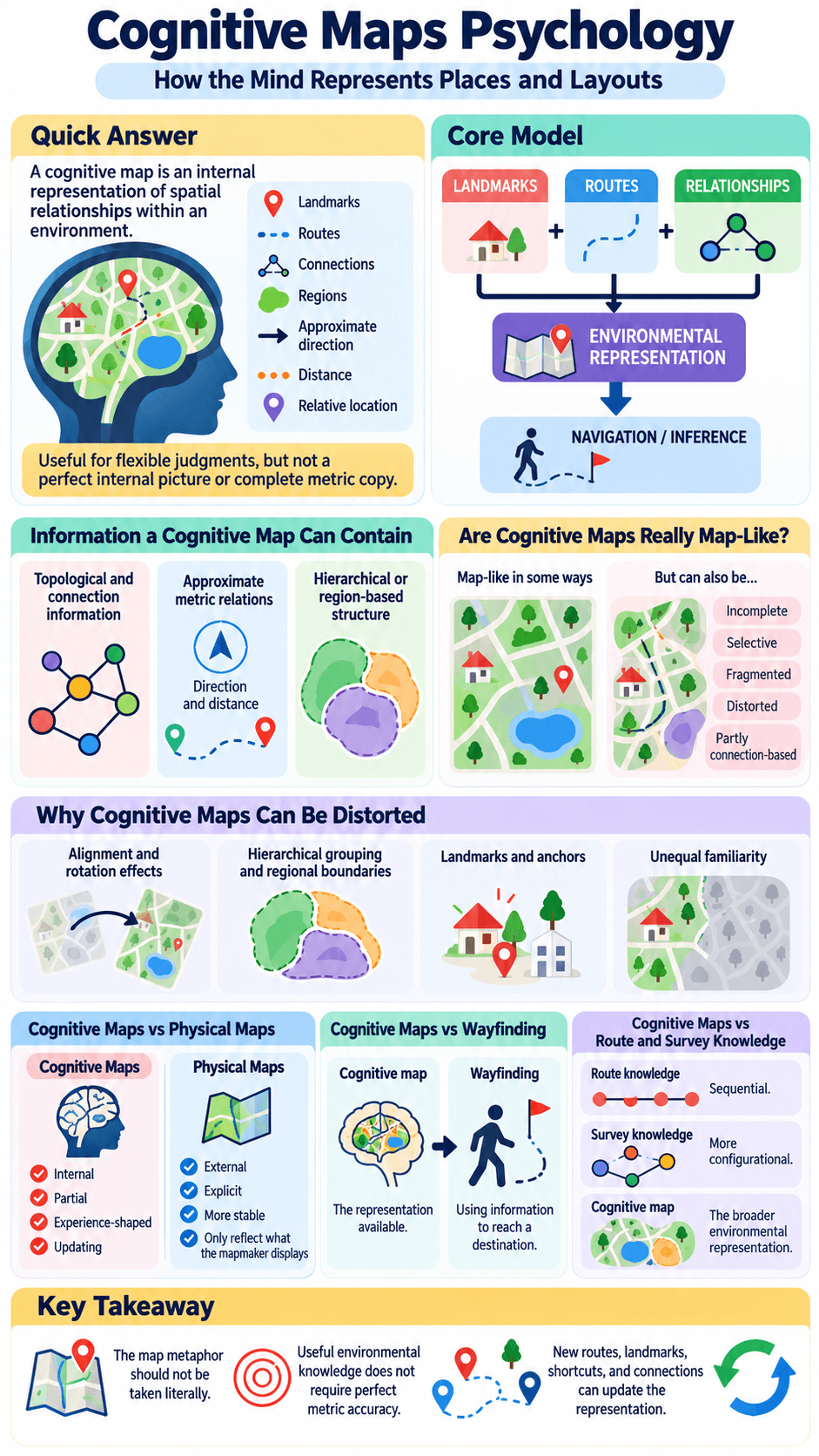
In psychology, a cognitive map is an internal representation of spatial relationships within an environment. It can include landmarks, routes, connections, regions, approximate direction, distance, and relative location. A cognitive map is useful because it supports flexible judgments about places, but it should not be understood as a perfectly accurate internal picture or a complete metric copy of the physical world.
What a Cognitive Map Means in Psychology
Internal representation of environmental spatial structure
A cognitive map is about the structure of an environment rather than a single visible scene. When you stand in one room, perception gives you information about what is currently around you. A cognitive map becomes relevant when you represent relationships that extend beyond what you can see from that position.
Suppose you are inside a library and know that the parking garage is behind the building, the cafe is across the square, and the bus stop is on the street connecting them. You may have learned these places at different times and from different viewpoints. Yet you can still relate them as parts of one environment.
A major modern review of human cognitive maps describes spatial coding, anchoring to environmental landmarks, and route planning as important components of map-based navigation. The review of cognitive maps in humans also makes clear that the cognitive-map idea is a scientific model for how spatial knowledge can support flexible behavior, not proof that the mind contains a literal miniature map.
Tolman as historical context
The term became influential through Edward Tolman’s work in the 1940s. Tolman was interested in behavior that seemed difficult to explain as the repetition of one learned chain of turns. If an organism could take a new route when a familiar path was blocked, perhaps it had learned something about the broader spatial relationships in the environment.
His 1948 paper, Cognitive Maps in Rats and Men, helped establish the cognitive-map idea as an alternative to explanations based only on fixed stimulus-response chains. The historical experiments do not settle every modern question about spatial representation, but they introduced a powerful distinction between memorizing a path and representing a larger spatial structure.
That distinction still matters. Knowing “left, right, straight, left” is not the same as understanding where the destination lies relative to the starting point. A cognitive map becomes especially useful as a concept when spatial knowledge supports detours, shortcuts, direction judgments, or relationships among places that were not learned as one single sequence.
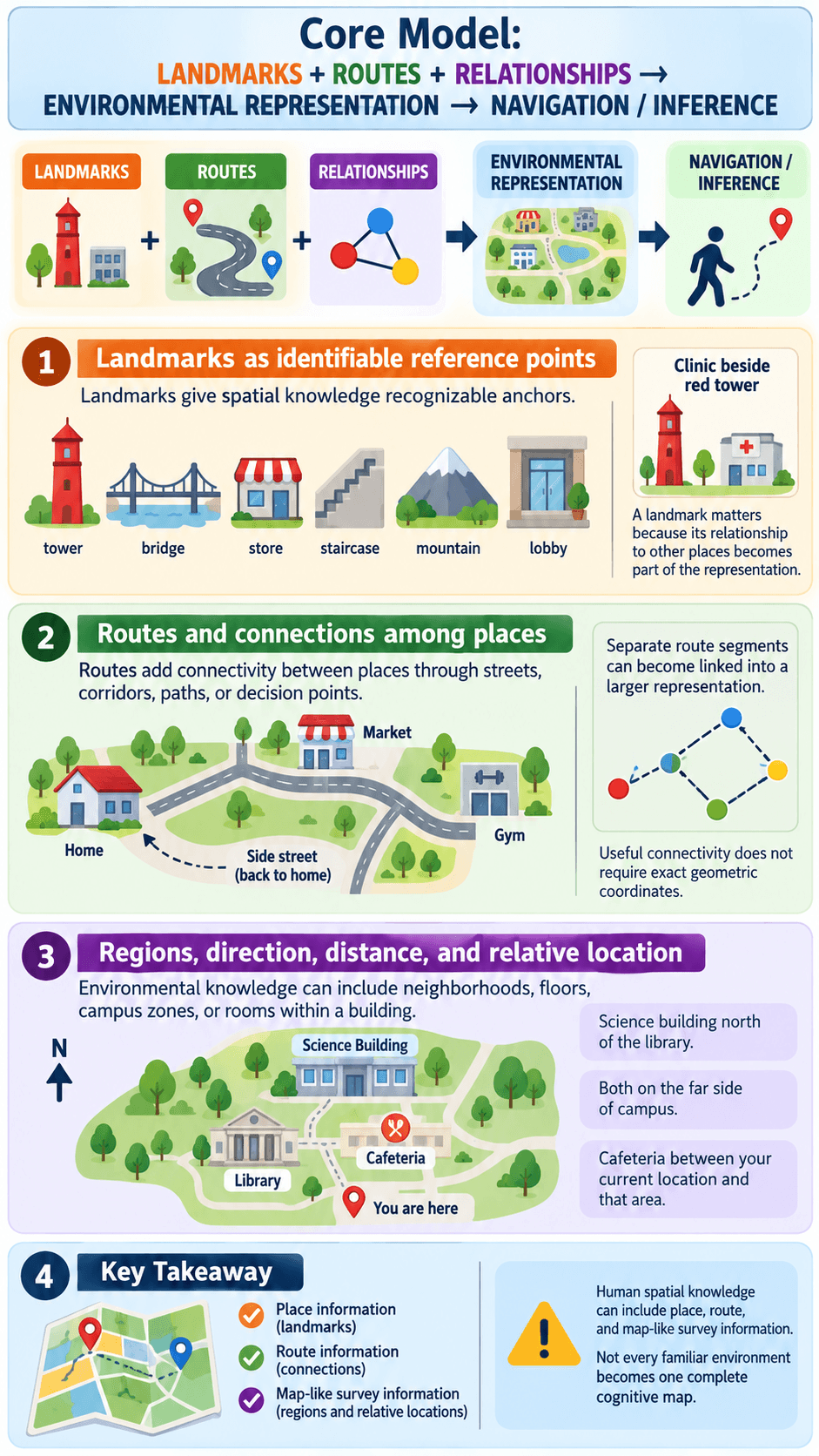
Core Model: LANDMARKS + ROUTES + RELATIONSHIPS → ENVIRONMENTAL REPRESENTATION → NAVIGATION/INFERENCE
Landmarks as identifiable reference points
Landmarks give spatial knowledge recognizable anchors. A distinctive tower, bridge, store, staircase, mountain, or lobby can help organize where other locations lie. A landmark is useful not merely because it is memorable, but because its relationship to other places can become part of the representation.
For example, “the clinic is beside the red tower” carries more spatial structure than simply recognizing the tower. If you also know the station is south of the tower and the park is east of the clinic, those relationships begin to form a connected environmental model.
Routes and connections among places
Routes add connectivity. They tell you that one place can be reached from another through a sequence of streets, corridors, paths, or decision points. With repeated experience, separate route segments may become linked into a larger representation.
Imagine that you know one route from home to a market and another from the market to a gym. Later, you discover a side street connecting the gym area back toward home. The environment is no longer represented as two isolated chains. The new connection changes what journeys become possible and how the whole area fits together.
This does not mean the mind needs exact geometric coordinates for every place. A person may know that two streets connect and still be poor at estimating the precise angle between them. Connectivity itself can carry useful spatial information.
Regions, direction, distance, and relative location
Environmental knowledge can also include larger groupings such as neighborhoods, floors, campus zones, or rooms within a building. Within and between those regions, people may remember approximate directions and distances.
You might know that the science building is north of the library, that both are on the far side of campus, and that the cafeteria lies between your current location and that area. Those relations allow more flexible judgments than a memorized route alone.
A 2025 review in Nature Reviews Psychology on place locations and orientations emphasizes that human spatial knowledge can include place, route, and map-like survey information, and that the conditions supporting map-like knowledge differ across environments and tasks. That is a useful caution against assuming that every familiar environment automatically becomes one complete cognitive map.
What Information Can a Cognitive Map Contain?
Topological and connection information
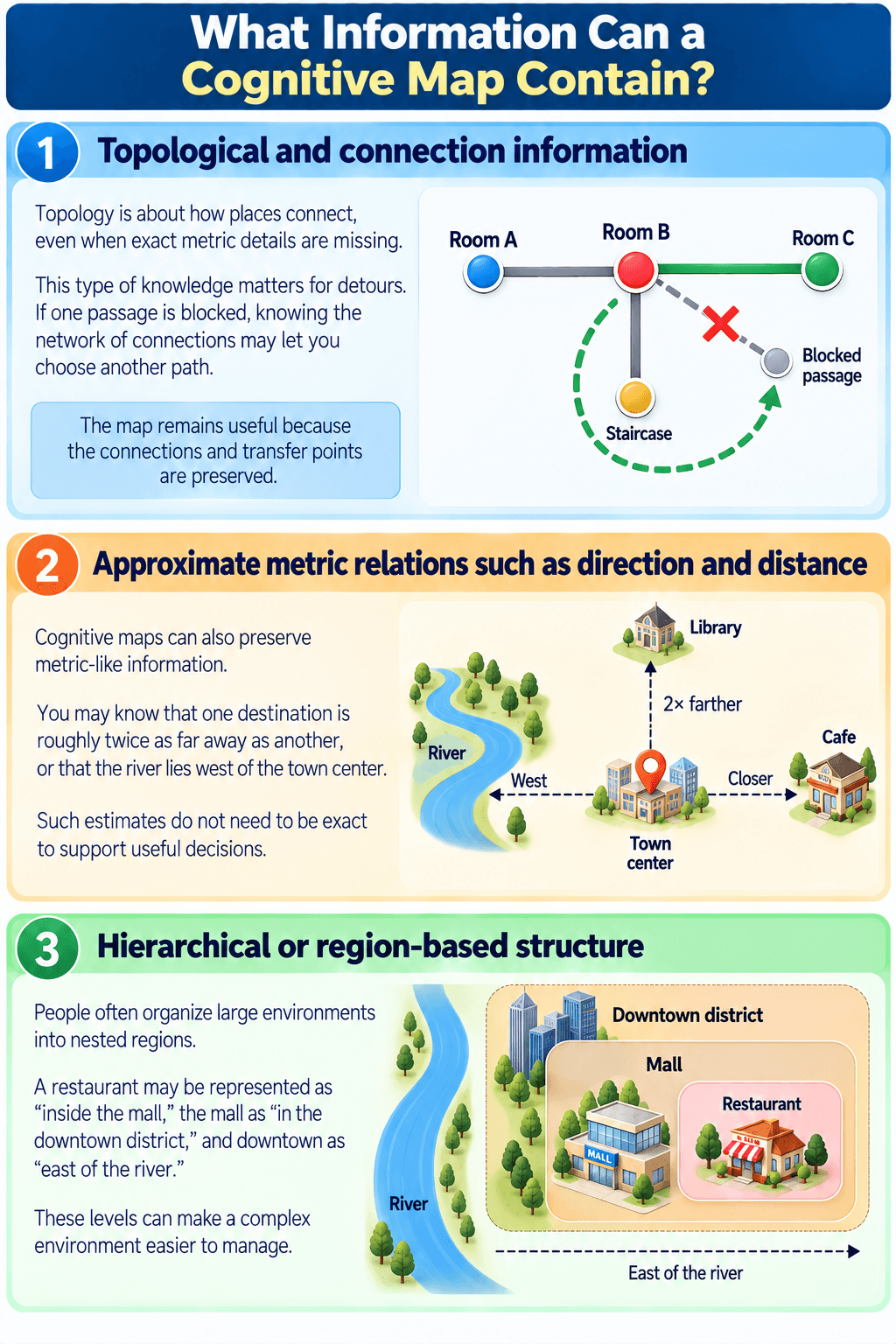
Topology is about how places connect, even when exact metric details are missing. If a hallway links room A to room B, and room B connects to a staircase, that structure can be useful even if you cannot estimate the exact length of either corridor.
This type of knowledge matters for detours. If one passage is blocked, knowing the network of connections may let you choose another path. The answer depends less on exact distance and more on which routes connect which locations.
Think of a subway diagram. The spacing on the diagram often does not match real-world distance, yet the map remains useful because the connections and transfer points are preserved. Some internal environmental representations may likewise prioritize useful connectivity over perfect geometry.
Approximate metric relations such as direction and distance
Cognitive maps can also preserve metric-like information. You may know that one destination is roughly twice as far away as another, or that the river lies west of the town center. Such estimates do not need to be exact to support useful decisions.
Metric knowledge becomes especially valuable when the question requires a straight-line judgment rather than following a learned path. If you can point toward a hidden destination from a new location, your representation must support some relationship beyond “which turn comes next.”
However, approximate metric knowledge should not be confused with surveyor-level accuracy. The internal representation may be sufficient for direction and planning while still compressing, stretching, rotating, or simplifying parts of the environment.
Hierarchical or region-based structure
People often organize large environments into nested regions. A restaurant may be represented as “inside the mall,” the mall as “in the downtown district,” and downtown as “east of the river.” These levels can make a complex environment easier to manage.
Hierarchy is useful because it reduces the number of individual relationships that must be considered at once. Instead of comparing every shop with every other shop in a city, you can first reason about districts, then focus on locations within the relevant district.
The tradeoff is that grouping can also bias judgments. Two places within the same region may feel closer than equally distant places separated by a meaningful boundary. The organization that makes spatial knowledge efficient can therefore also make it systematically imperfect.
Are Cognitive Maps Really Map-Like?
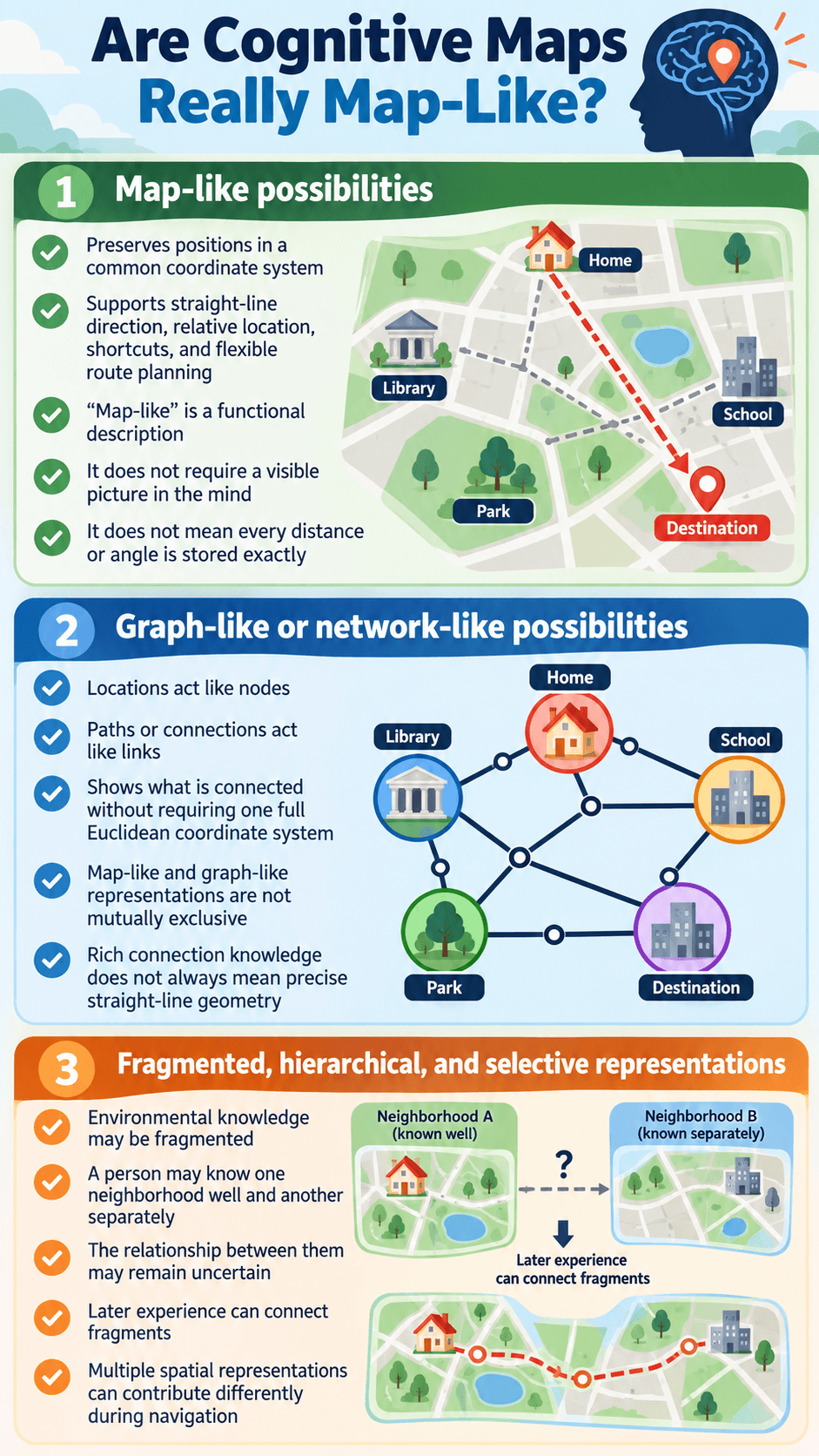
Map-like possibilities
The strongest version of the map metaphor suggests a representation that preserves positions in something like a common coordinate system. Such a representation could support straight-line direction estimates, relative location judgments, novel shortcuts, and flexible route planning.
There is evidence that humans can behave as if they possess map-like knowledge in at least some conditions. For example, a person who has learned several routes may later estimate the direction between locations that were never experienced together on one route.
But “map-like” is a functional description. It does not require a consciously visible picture in the mind, and it does not mean every distance or angle is stored exactly.
Graph-like or network-like possibilities
An alternative way to represent space is as a network. Locations act like nodes, and paths or connections act like links. Such a representation tells you what is connected without necessarily encoding every location in a single Euclidean coordinate system.
A review of cognitive maps and cognitive graphs argues that map-like and graph-like spatial representations should not automatically be treated as mutually exclusive. Both may be available, and their usefulness may depend on the structure of the environment and what the person is trying to do.
This helps explain why someone may know a transport network extremely well but still misjudge straight-line direction. The person can possess rich knowledge of connections without having equally precise metric knowledge of where every station lies in geometric space.
Fragmented, hierarchical, and selective representations
Real environmental knowledge may also be fragmented. You can know one neighborhood well, another neighborhood well, and still have an uncertain representation of the relationship between them. Later experience may connect those fragments.
Research reviews of human spatial representation likewise emphasize flexible use of multiple kinds of information rather than one universal representational format. An overview of spatial representations in the human brain summarizes behavioral evidence for multiple spatial representations that can contribute differently during navigation.
Why Cognitive Maps Can Be Distorted
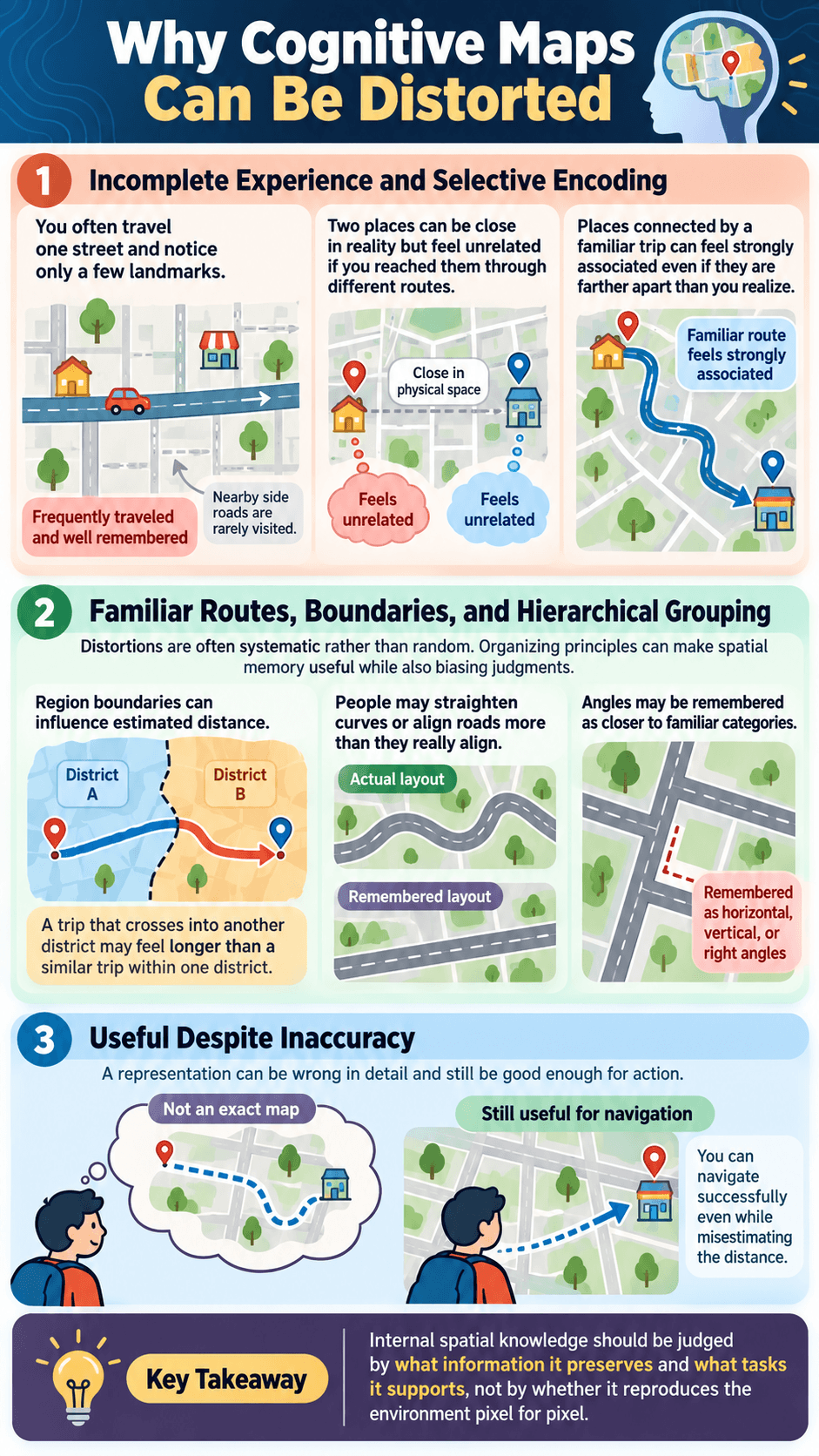
Incomplete experience and selective encoding
No one experiences every part of an environment equally. You may repeatedly travel one street, notice only a few landmarks, and rarely enter nearby side roads. Your representation reflects that history.
Selective experience can produce gaps. Two places may be close in physical space but feel unrelated because you reached them through different routes. Conversely, two places connected by a familiar trip may feel strongly associated even when they are farther apart than you realize.
Familiar routes, boundaries, and hierarchical grouping
Distortions are often systematic rather than random. Barbara Tversky’s classic review of distortions in cognitive maps described how reference points, perspective, hierarchical organization, and other organizing principles can make spatial memory useful while also biasing judgments.
For example, region boundaries can influence estimated distance. A trip that crosses from one meaningful district into another may feel longer than a similar trip within one district. People may also straighten curves, align roads more than they really align, or remember angles as closer to familiar categories such as horizontal, vertical, or right angles.
These effects do not mean the cognitive map is “broken.” They show that environmental representation is organized for usable cognition rather than exact cartography.
Why useful representation does not require perfect accuracy
A representation can be wrong in detail and still be good enough for action. If you know which streets connect and roughly where the destination lies, you may successfully navigate even while misestimating the total distance.
This is one of the most important lessons of cognitive-map research. Internal spatial knowledge should be judged by what information it preserves and what tasks it supports, not by whether it reproduces the environment pixel for pixel.
How Cognitive Maps Change With Experience
Familiarity, exploration, and route experience
Early knowledge of a place may be narrow. On the first day in a large office building, you might know only the elevator, your desk, and the route between them. After several days, you learn a kitchen, an emergency stairwell, two meeting rooms, and a second elevator bank.
As experiences overlap, previously separate routes can become integrated. A hallway first learned as part of the “meeting room route” may later connect with the “kitchen route,” changing how the floor is represented. You may suddenly realize that two locations approached from different directions are actually adjacent.
Updating when new landmarks or connections are learned
Cognitive maps are not necessarily static after they form. New information can correct, extend, or reorganize the representation.
Suppose you believe two streets run parallel because you have only traveled along them separately. One day, you follow a connecting alley and discover that they converge. Your spatial model must now change. The new connection does more than add one path. It may alter your estimates of direction and distance across the whole local area.
Updating is one reason the map metaphor should remain flexible. The representation is constructed through experience and can be revised when the environment, the person’s knowledge, or the available cues change.
Cognitive Maps vs Physical Maps
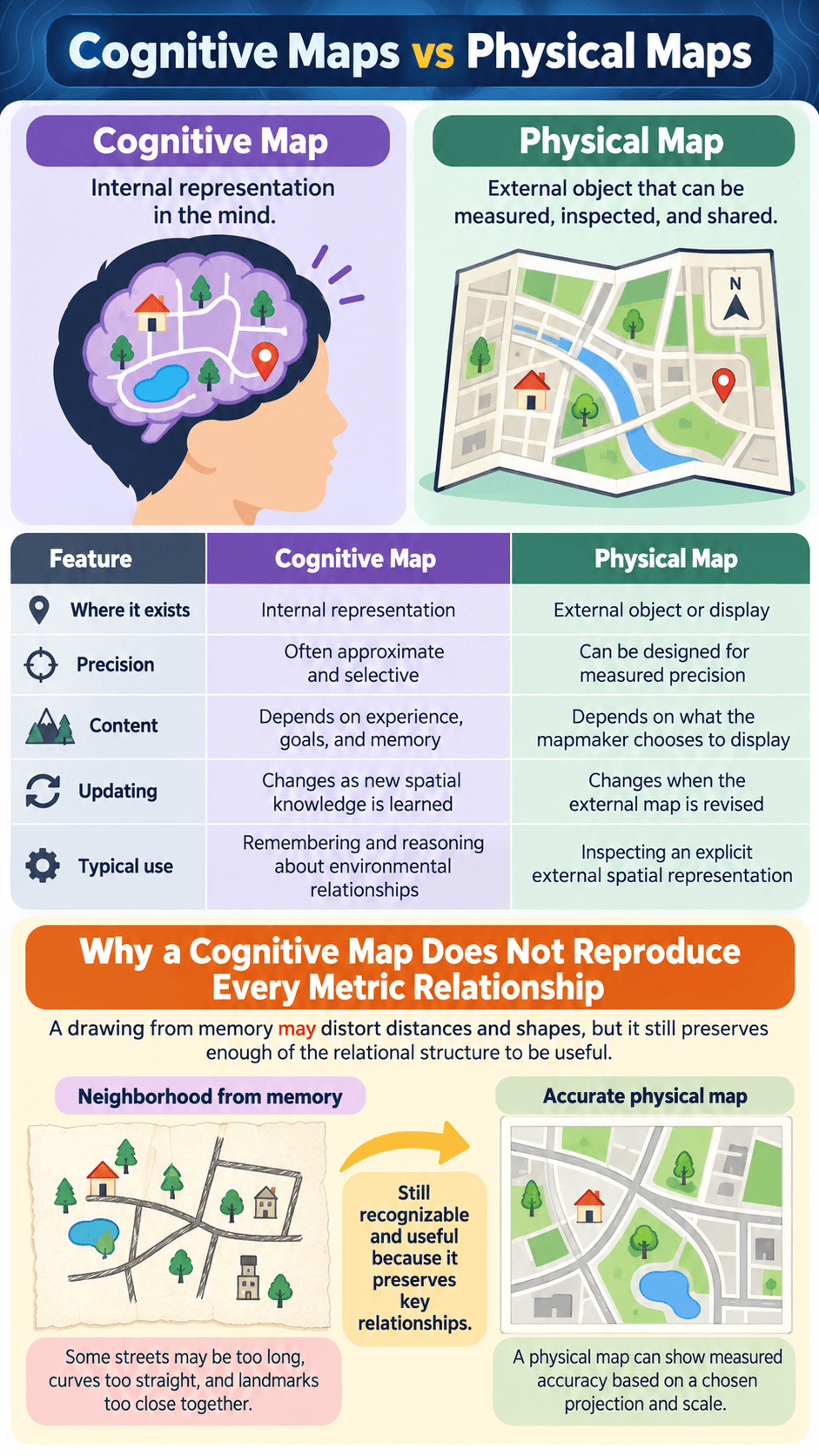
Internal representation versus external representation
A physical map is an artifact outside the mind. It can be measured, inspected repeatedly, shared with other people, and designed to preserve specific geometric relations according to a chosen projection and scale.
A cognitive map is internal knowledge. It is inferred from judgments and behavior such as pointing, estimating distances, choosing routes, drawing remembered layouts, recognizing shortcuts, or navigating around obstacles.
| Feature | Cognitive Map | Physical Map |
|---|---|---|
| Where it exists | Internal representation | External object or display |
| Precision | Often approximate and selective | Can be designed for measured precision |
| Content | Depends on experience, goals, and memory | Depends on what the mapmaker chooses to display |
| Updating | Changes as new spatial knowledge is learned | Changes when the external map is revised |
| Typical use | Remembering and reasoning about environmental relationships | Inspecting an explicit external spatial representation |
Why a cognitive map does not reproduce every metric relationship
If you draw your neighborhood from memory, some streets may be too long, curves too straight, and landmarks too close together. Yet another person might still recognize the area immediately. The drawing preserves enough relational structure to be useful while revealing the simplifications in memory.
That is a better model for cognitive maps than imagining an invisible satellite map stored in the head. The representation can contain direction, connectivity, regions, and approximate distance without encoding every centimeter accurately.
Cognitive Maps vs Wayfinding
What spatial representation do I have, versus how do I use it to reach somewhere?
Cognitive maps and wayfinding are closely related, but they answer different questions. A cognitive map concerns the environmental representation available to you. Wayfinding concerns the activity of getting from where you are to a destination.
If you know that the museum is north of the river and connected to your area by two bridges, that knowledge belongs to the representation. When you decide which bridge to take, monitor landmarks, notice a wrong turn, and correct the route, you are engaged in wayfinding.
Why wayfinding can use a cognitive map without being the same process
Wayfinding may draw on a cognitive map, but it can also rely on route instructions, signs, landmarks, or other information. A traveler can reach a hotel by following “exit the station, turn right at the pharmacy, then walk two blocks” without understanding the larger layout of the district.
Conversely, someone may have a good overall representation of an area but still make a poor route choice because of construction, traffic, a locked entrance, or a mistaken assumption about what is currently accessible.
Keeping representation and use separate prevents the cognitive-map concept from becoming a label for every navigation behavior.
Cognitive Maps vs Route and Survey Knowledge
Broad environmental representation versus specific knowledge formats
Route knowledge is usually sequential. It tells you what comes next along a path: pass the library, turn left at the fountain, cross the courtyard, then enter the second building.
Survey knowledge is more configurational. It supports judgments about how multiple places relate within a larger layout, including directions or possible shortcuts that may not follow the learned route.
A cognitive map is a broader theoretical idea about environmental representation. Route and survey knowledge help describe forms that spatial knowledge can take, but the terms should not simply be swapped as if they were identical.
Survey knowledge as a bridge, not a synonym
Survey knowledge is often the closest everyday example of map-like environmental understanding. If you know the general arrangement of several streets, you may infer a shortcut between two places even if you have never walked that exact path.
Still, research does not require assuming that everyone progresses through one fixed sequence from landmarks to routes to survey knowledge. Different environments, maps, direct exploration, task demands, and prior experience can shape what type of knowledge develops.
Cognitive Maps vs Spatial Memory and General Knowledge Structures
Structured environmental representation versus broader spatial retention
Spatial memory is the broader ability to retain and retrieve information about where things are and how spatial relationships were arranged. Remembering where you parked, where a cup was placed on a desk, or which hallway contained a meeting room can all involve spatial memory.
A cognitive map is more specifically about organized environmental relationships among places. Spatial memory can provide the information from which a cognitive map is built, but not every remembered location forms part of a broad environmental representation.
For example, remembering that your keys were beside the sink is spatial memory. It does not require a cognitive map of the entire house. Remembering how several rooms, staircases, doors, and exits connect is much closer to environmental mapping.
Spatial maps versus general organized prior knowledge
Psychology also studies broad knowledge structures that capture regularities across experiences. You may know what a typical airport, supermarket, classroom, or restaurant is usually like even when you have never visited a particular one.
That kind of generalized prior knowledge is different from a cognitive map of a specific environment. Knowing that airports often contain check-in areas, security, gates, and baggage claim does not tell you where Gate 22 is relative to the train station in one particular airport.
The distinction protects the cognitive-map concept from becoming a synonym for any organized knowledge. Here, the defining content is spatial or environmental relationship information.
Common Misunderstandings
The brain is not being described as a perfect internal Google Map
“Map” is a metaphor for organized spatial representation, not a claim that the mind contains a complete photographic or cartographic copy of the world. Human spatial knowledge can be approximate, task-dependent, locally detailed, globally incomplete, and sometimes internally inconsistent.
Modern work also leaves room for more than one representational format. Exact coordinate-like relations may be useful for some judgments, while network connections or route-based knowledge may be sufficient for others.
So a person who cannot draw an accurate street map from memory may still possess highly functional spatial knowledge, and a person who navigates familiar routes effortlessly may still have poor straight-line estimates between locations.
Cognitive maps need not be fully visual or consciously inspectable
The word “map” can also suggest that a person should be able to close their eyes and see the whole layout. That is not required. Someone may know spatial relations without experiencing a vivid panoramic mental picture.
You may know that your office is two floors above reception and that the stairwell is east of both without picturing the entire building at once. The knowledge can guide a judgment even if the subjective experience is relational rather than strongly visual.
FAQ About Cognitive Maps Psychology
These questions address the points that most often become blurred when “mental map” is used casually to describe any kind of spatial knowledge.
Are cognitive maps always accurate?
No. Cognitive maps can preserve useful structure while distorting distance, direction, alignment, boundaries, or regional relationships. Some distortions arise because people organize complex environments around reference points and meaningful regions. Accuracy also varies with familiarity, experience, task, and which part of the environment is being judged.
Are cognitive maps the same as route memory?
No. Route memory can preserve a sequence such as landmark, turn, landmark, turn, destination. A cognitive map refers more broadly to relationships among places in an environment. Route knowledge can contribute to a cognitive map, but someone may follow a familiar route without having flexible knowledge of the surrounding layout.
Can a cognitive map include places never seen from one viewpoint?
Yes. Large environments often cannot be seen all at once. People can integrate information learned from separate routes, viewpoints, maps, or episodes and use the combined knowledge to judge relationships among locations. The resulting representation may still be incomplete or distorted, but it can extend beyond any single visual scene.
Is a cognitive map just general organized knowledge?
No. General prior knowledge can describe regularities that apply across many situations, such as what airports or supermarkets are typically like. A cognitive map, in the spatial sense used here, represents relationships among particular locations or environmental features. The two kinds of representation may interact, but they answer different questions.
Key Takeaways
- A cognitive map represents relationships among places, landmarks, routes, regions, directions, distances, and connections within an environment.
- The map metaphor should not be taken literally. Spatial knowledge can be approximate, fragmented, hierarchical, selective, or partly network-like.
- Useful environmental knowledge does not require perfect metric accuracy. Connectivity and relative location may be enough for many judgments.
- Cognitive maps differ from wayfinding: one concerns the representation available, while the other concerns using information to reach a destination.
- Route knowledge, survey knowledge, and spatial memory overlap with cognitive mapping but describe different aspects of spatial knowledge.
- New routes, landmarks, shortcuts, and connections can update how an environment is represented over time.
A useful way to examine your own environmental knowledge is to compare what you can follow with what you can infer. You may be able to repeat a familiar route but not point toward the destination from a different street, or you may understand the broad layout well enough to invent a shortcut. That difference reveals something important about how your knowledge of the environment is structured.
Educational note: Cognitive-map research explains ordinary spatial representation and navigation. Difficulty drawing a map, estimating direction, or learning a route is not by itself evidence of a neurological disorder or low intelligence.
Michael Reed, Founder & Lead Writer at Psychology Exposed, writes about how everyday cognitive processes shape the way people understand environments, behavior, and experience.

Michael Reed is the Founder and Lead Writer at Psychology Exposed. He writes about human behavior, relationships, emotional patterns, self-awareness, and practical psychology topics using research-informed, easy-to-understand content.
Read More About Michael Reed: https://psychologyexposed.com/michael-reed/