
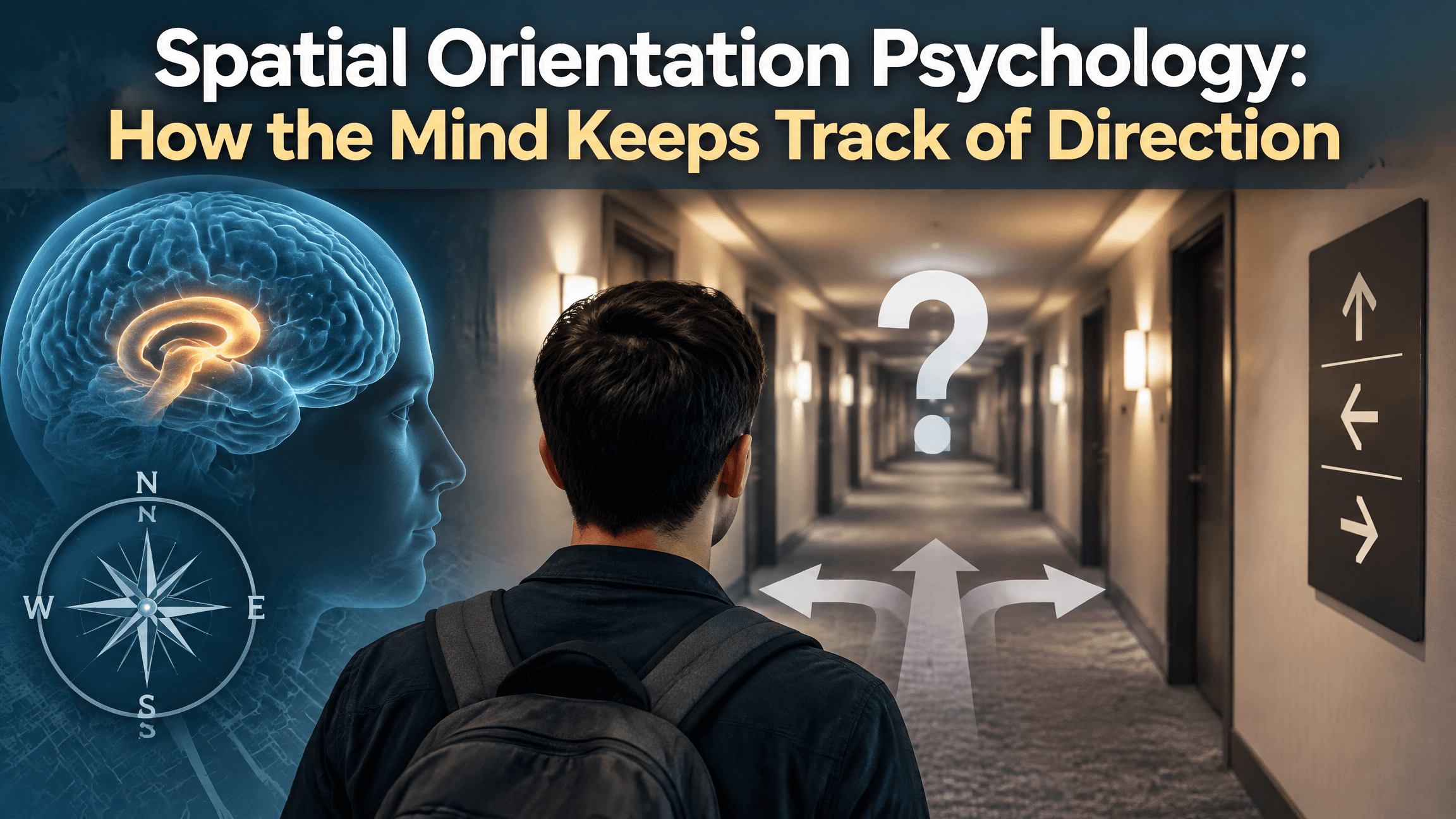
You leave a hotel elevator, turn twice through nearly identical corridors, and suddenly realize you are no longer sure which direction the lobby is. You may still know the route in a general sense. What has become uncertain is something more basic: your current position and heading relative to the surrounding space.
This is the core problem of spatial orientation. Spatial orientation is the ability to maintain or recover an estimate of where you are and which way you are facing. It can operate while you are navigating toward a goal, but it can also exist without any destination at all. You can stand in a parking garage and know that you are on the east side facing south even if you have not yet decided where to go.
The concept is closely connected to wayfinding, path integration, cognitive maps, and spatial reference frames, but it is not identical to any of them. Wayfinding asks how to reach a destination. Path integration is one way movement can update location and heading. Cognitive maps concern broader environmental representation. Spatial orientation focuses on the current self-to-environment relationship.
Quick Answer
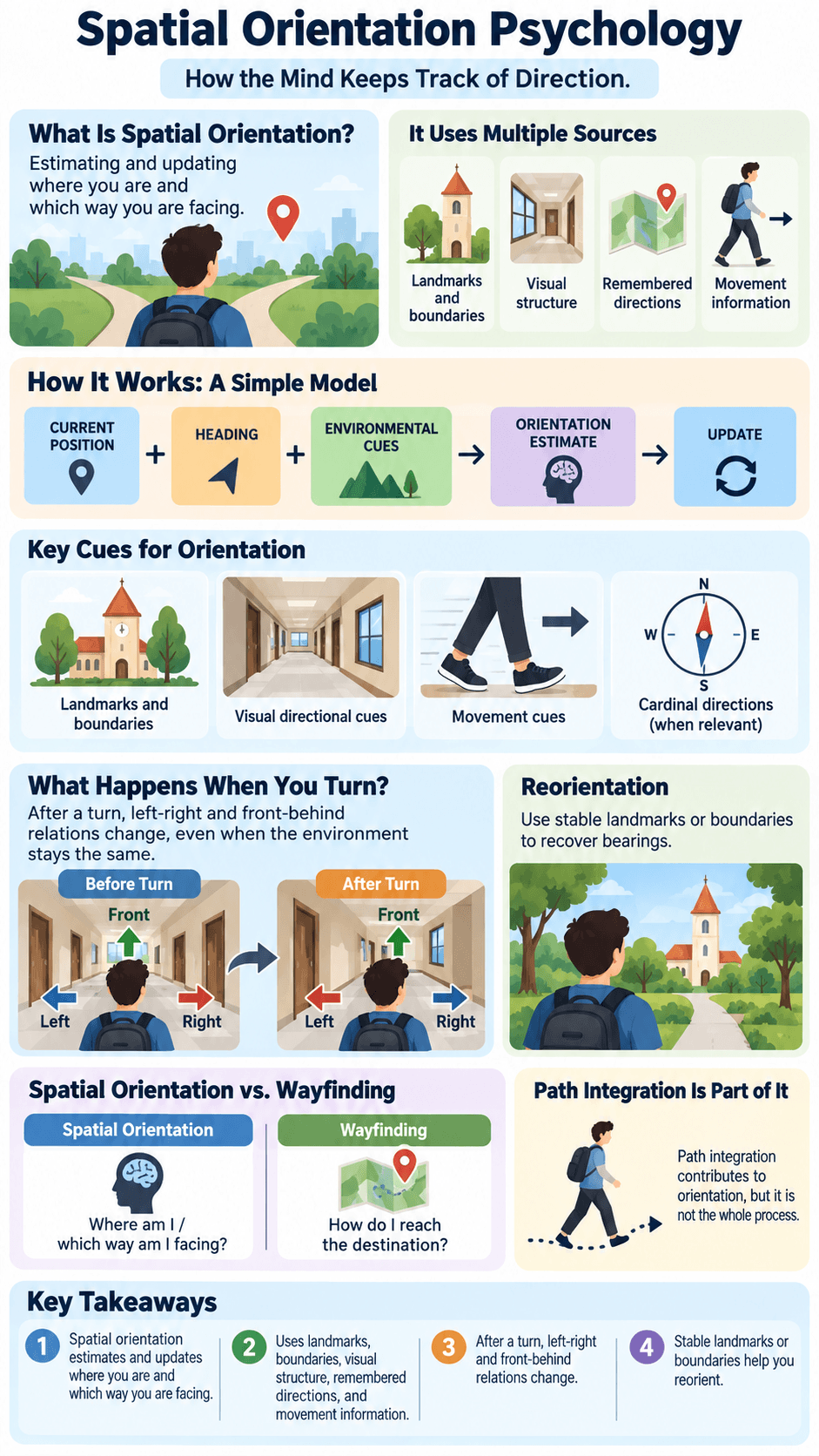
Spatial orientation is the ability to estimate and update your current position and heading relative to the surrounding environment. It uses cues such as landmarks, boundaries, visual structure, remembered directions, and information generated by movement. A person can know a familiar route yet still become briefly disoriented after an unexpected turn because route knowledge and current orientation are different kinds of spatial information.
What Spatial Orientation Means
Self-location and heading relative to surroundings
Two questions capture most of spatial orientation: Where am I? and Which way am I facing?
Self-location refers to the estimated position of the observer within the surrounding space. Heading refers to the direction the observer is facing. These two estimates are related, but they are not the same. A person can know where they are while being unsure which way they face, or know their heading while being uncertain about their exact location within a larger environment.
A major review of the cognitive basis of spatial reorientation separates reorientation into recovering an appropriate spatial reference frame and determining one’s location and heading within it. That distinction is useful in everyday situations because it explains why simply recognizing a place does not always restore a sense of direction.
Why “sense of direction” is an everyday label rather than a diagnosis
People often describe themselves as having a “good” or “bad” sense of direction. The phrase can be useful casually, but it bundles together several processes: recognizing landmarks, learning routes, maintaining heading, understanding layouts, updating after turns, and recovering after disorientation.
Someone may be excellent at memorizing routes but poor at estimating cardinal direction. Another person may understand a neighborhood layout well but become temporarily confused after leaving an elevator through an unfamiliar exit. A third may orient well outdoors but struggle in repetitive indoor corridors.
Those differences should not be treated as diagnoses or as evidence of general intelligence. The useful question is more specific: what information is difficult to maintain or recover in this particular situation?
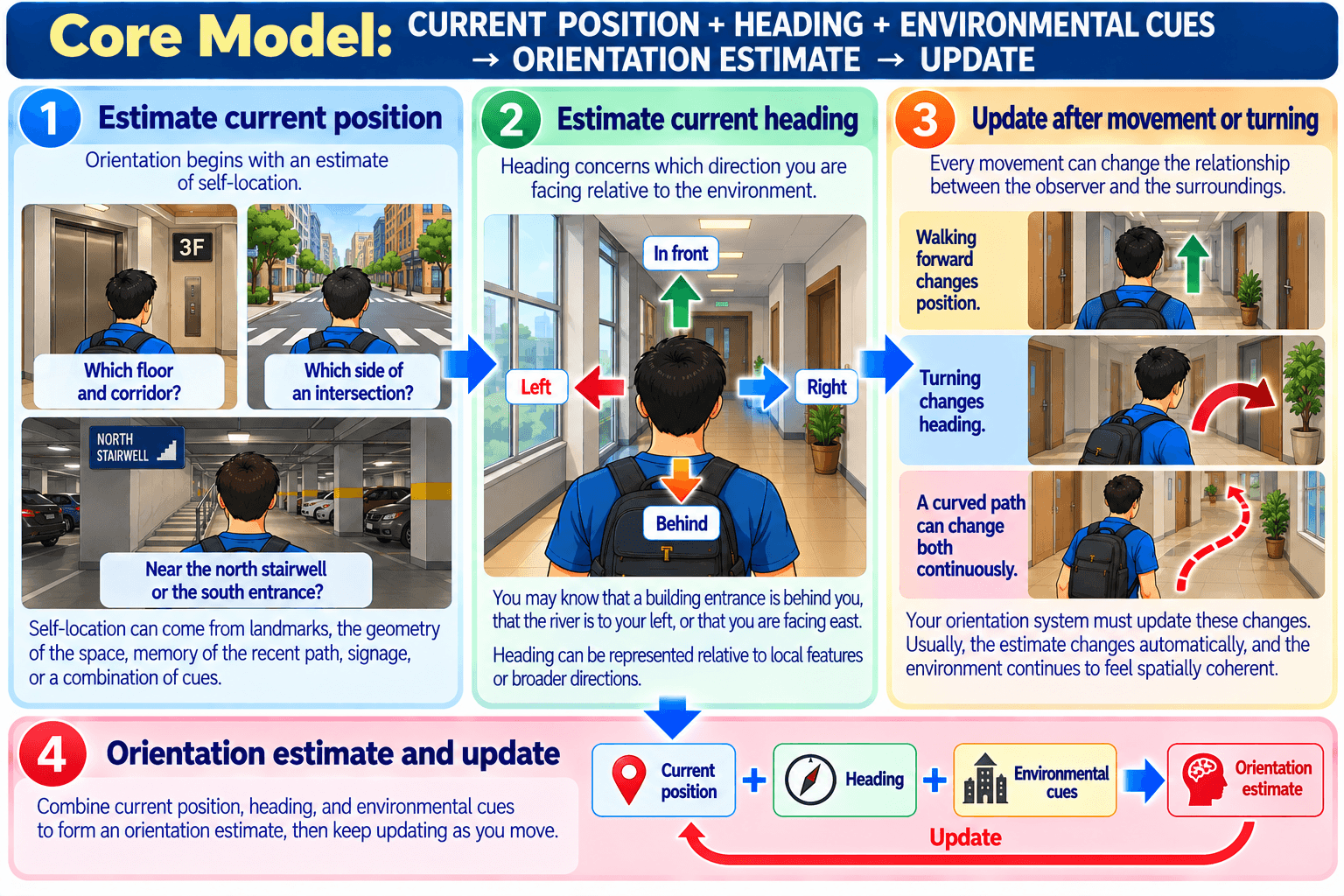
Core Model: CURRENT POSITION + HEADING + ENVIRONMENTAL CUES → ORIENTATION ESTIMATE → UPDATE
Estimate current position
Orientation begins with an estimate of self-location. In a hotel, that might mean knowing which floor and corridor you are in. On a street, it may mean identifying which side of an intersection you occupy. In a parking structure, it may mean knowing that you are near the north stairwell rather than the south entrance.
Self-location can come from recognition of a landmark, the geometry of the surrounding space, memory of the recent path, signage, or a combination of cues. The estimate does not need to be exact. Often, a workable approximation is enough to support the next spatial judgment.
Estimate current heading
Heading concerns orientation around the body’s vertical axis: which direction you are facing relative to the environment. You may know that a building entrance is behind you, that the river is to your left, or that you are facing east.
Heading can be represented relative to local features or broader directions. In one setting, “toward the windows” may be sufficient. In another, north, south, east, and west may be more useful.
Research by Avraamides, Klatzky, Loomis, and Golledge on cognitive and perceptual heading shows that people can update a mentally represented heading during imagined movement, although the way they respond can affect performance. This supports the idea that heading is a cognitive estimate, not simply whatever direction the physical body happens to face at one moment.
Update after movement or turning
Every movement can change the relationship between the observer and the surroundings. Walking forward changes position. Turning changes heading. A curved path can change both continuously.
If you leave a room facing north, turn right into a corridor, then turn left at the end, your orientation system must update those changes if you want to preserve a useful estimate of where you now face.
Updating does not need to be consciously verbalized. Most of the time, people do not narrate every turn. The estimate changes automatically enough that the environment continues to feel spatially coherent. Disorientation becomes noticeable when that updating loses precision or conflicts with other cues.
The Information That Supports Orientation
Landmarks and boundaries
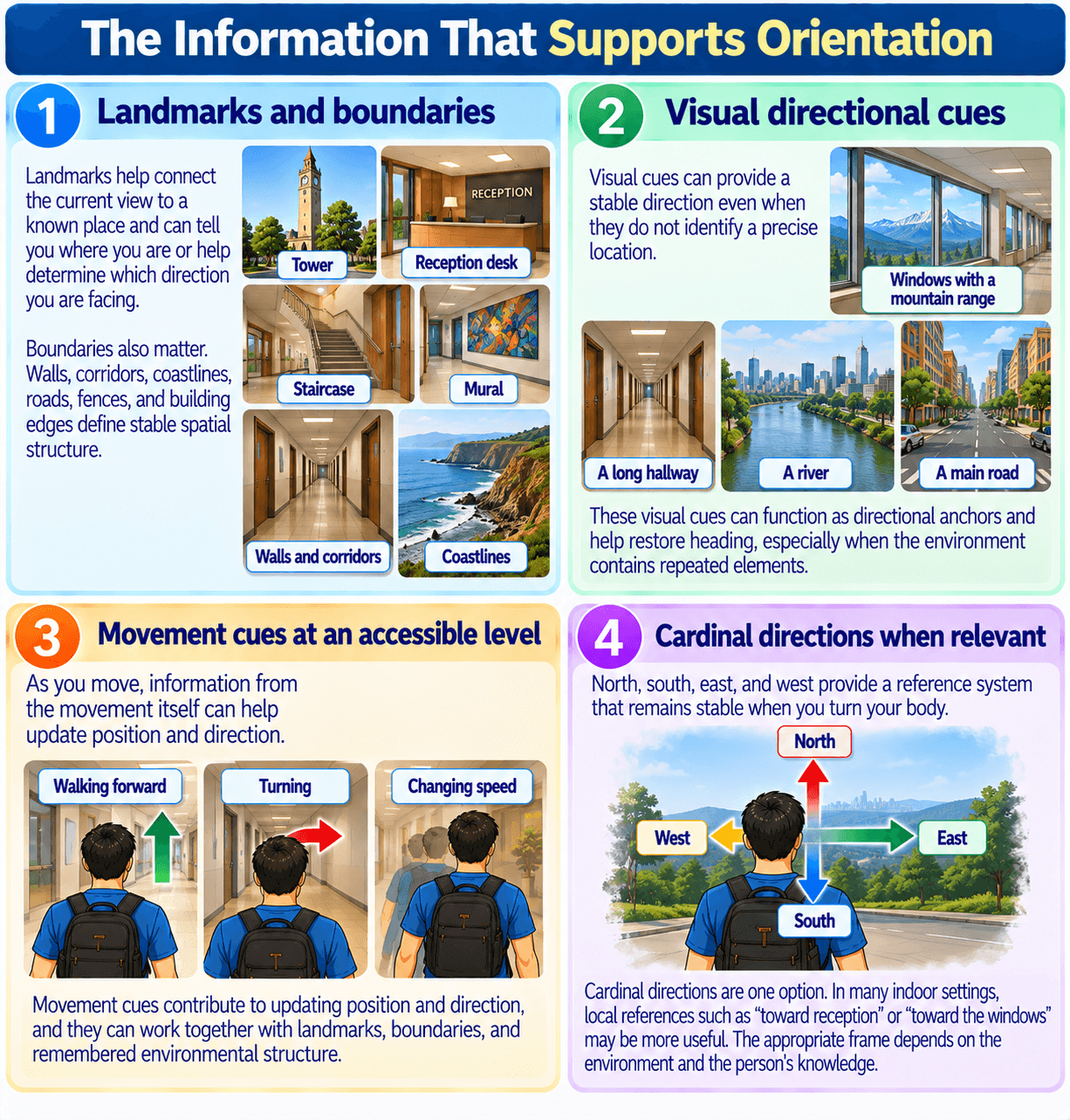
Landmarks help connect the current view to a known place. A distinctive tower, reception desk, mural, staircase, mountain ridge, or store can tell you where you are or help determine which direction you are facing.
Boundaries also matter. Walls, corridors, coastlines, roads, fences, and building edges define stable spatial structure. A long wall may help you recognize an axis of a room even when individual objects have moved.
Environmental geometry can contribute directly to maintaining orientation. In a study of how environmental shape supports human spatial orientation, performance was influenced by the remembered geometry and symmetry of the surrounding space. The finding is useful because it shows that orientation can depend on structural relationships, not only on isolated landmarks.
Visual directional cues
Visual cues can provide a stable direction even when they do not identify a precise location. Windows showing a mountain range, a long hallway, a river, a row of buildings, or a bright atrium can function as directional anchors.
Suppose you know that the hotel lobby lies on the side facing the main road. If the road is visible through windows, that view can restore heading even when the corridor itself looks unfamiliar.
Directional cues are especially helpful when the environment contains repeated elements. A corridor may have ten similar doors, but only one end opens toward a large window. That asymmetry can reduce uncertainty.
Movement cues at an accessible level
As you move, information from the movement itself can help update position and direction. Walking forward, turning, and changing speed all provide information about how the self has changed relative to the starting point.
This contribution is real, but it should not be confused with the whole concept of spatial orientation. Path integration studies the movement-based updating mechanism in more depth. Spatial orientation is the broader current estimate that may combine movement information with landmarks, boundaries, and remembered environmental structure.
Research on angular self-motion updating found that remembered spatial information about the surrounding environment improved the precision of orientation estimates during body rotation. This illustrates an important principle: movement cues and stored environmental information can work together rather than operating as isolated systems.
Cardinal directions when relevant
North, south, east, and west provide a reference system that remains stable when you turn your body. If you know that a street runs north-south, then turning around does not change the street’s direction even though left and right reverse relative to your body.
Not everyone routinely uses cardinal directions. In many indoor settings, local references such as “toward reception” or “toward the windows” are more useful. The appropriate frame depends on the environment and the person’s knowledge.
The important point is that orientation requires some stable way to relate the current body position to the surrounding space. Cardinal directions are one option, not a universal requirement.
How Orientation Changes After a Turn
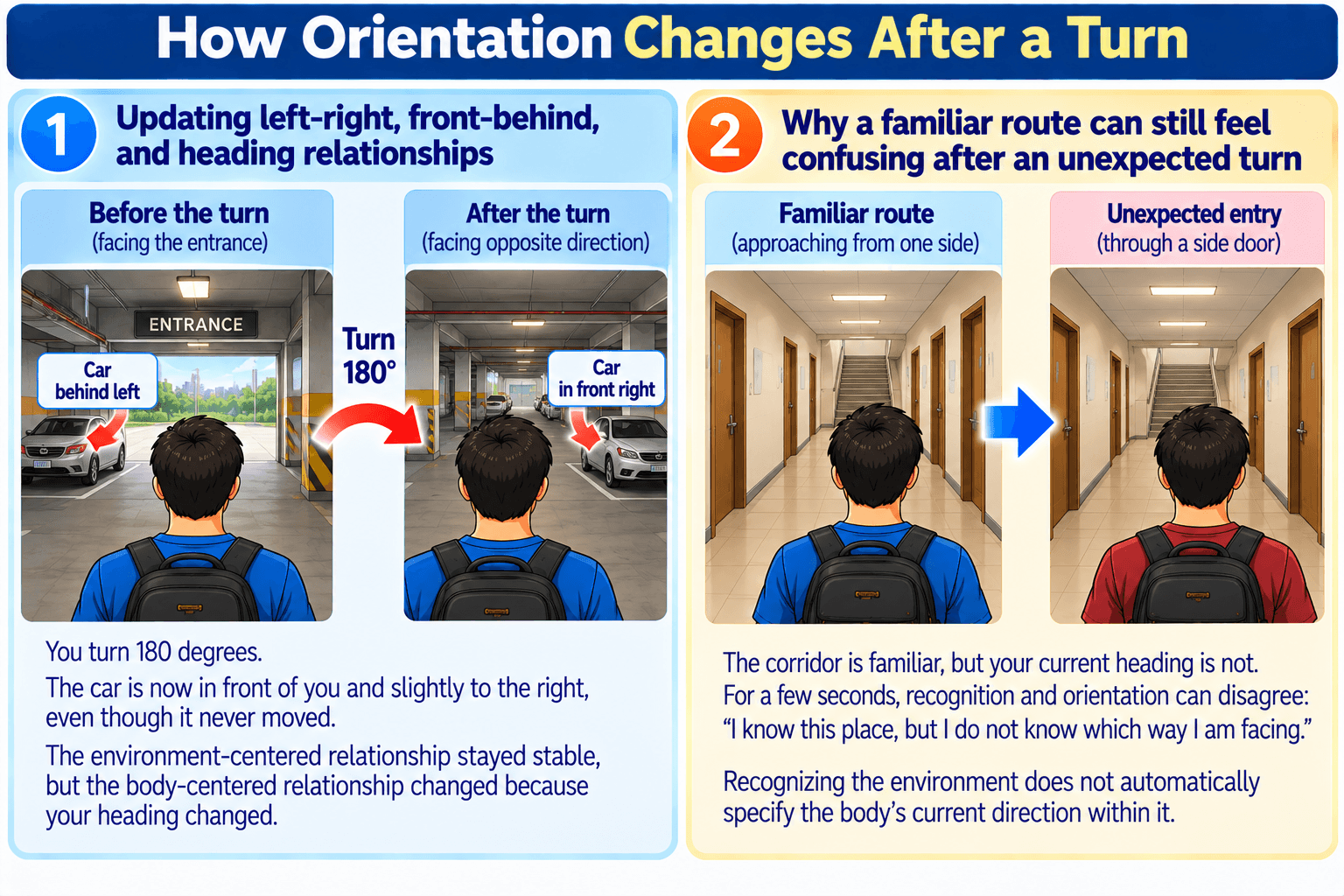
Updating left-right, front-behind, and heading relationships
Imagine facing the entrance of a parking garage. Your car is behind you and slightly to the left. You turn 180 degrees. The car is now in front of you and slightly to the right, even though it never moved.
The environment-centered relationship stayed stable. The body-centered relationship changed because your heading changed.
This is why turns can be cognitively demanding. The mind must preserve useful relationships while recoding which objects are now left, right, front, or behind relative to the body’s new orientation.
Why a familiar route can still feel confusing after an unexpected turn
A familiar route is often learned from a familiar heading. You know what the hallway looks like when approaching from one side, where the staircase appears, and which way you normally turn.
Now imagine being brought to the same hallway through a side door. The corridor is familiar, but your current heading is not. For a few seconds, recognition and orientation can disagree: “I know this place, but I do not know which way I am facing.”
This moment illustrates the difference between place recognition and orientation. Recognizing the environment does not automatically specify the body’s current direction within it.
Reorientation When You Lose Track
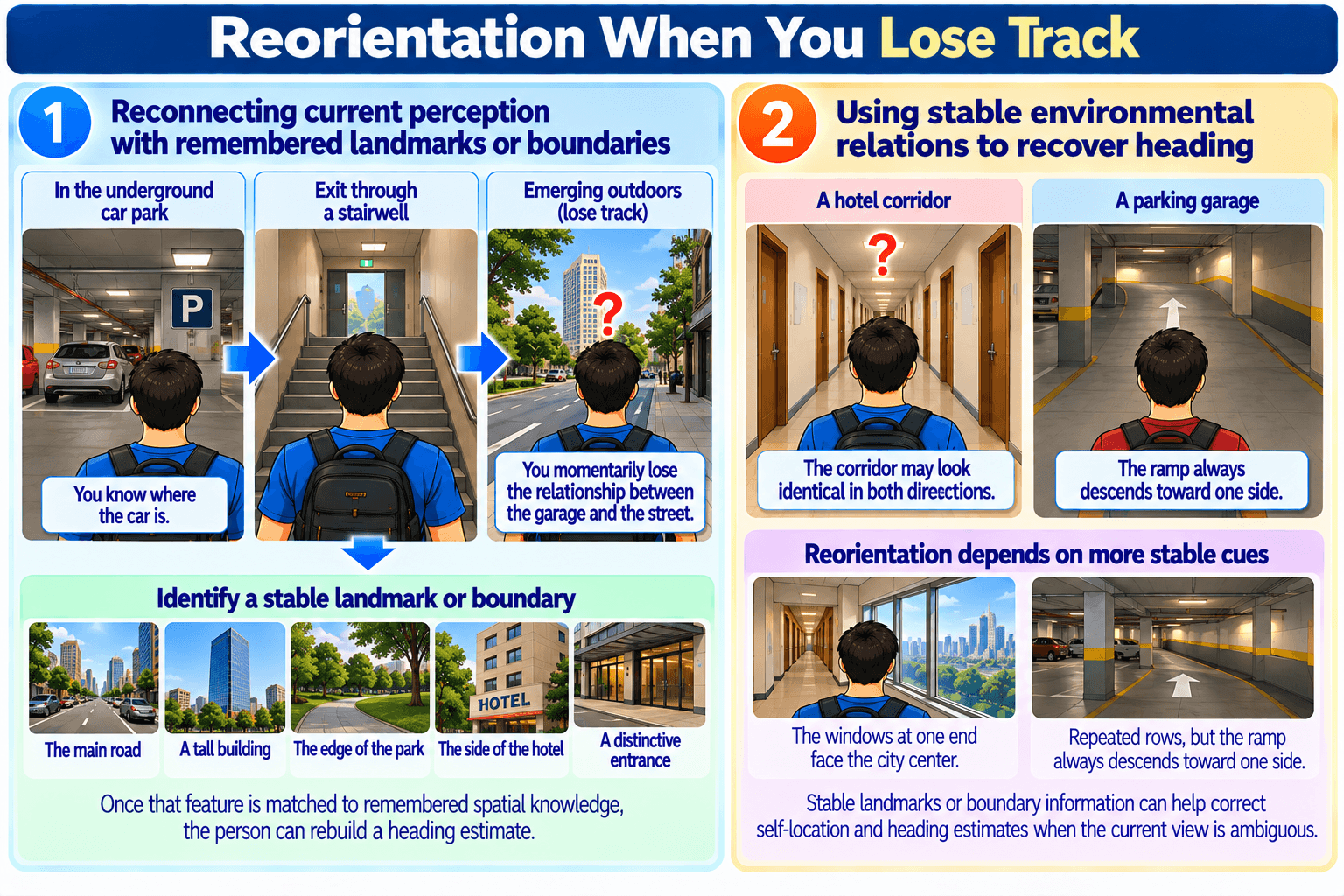
Reconnecting current perception with remembered landmarks or boundaries
Reorientation is what happens when the current estimate becomes unreliable and the person tries to recover their bearings.
A practical example is exiting an underground car park through a stairwell. You know where the car is within the garage, but after climbing and emerging outdoors, you momentarily lose the relationship between the garage and the street.
One way to recover is to identify a stable landmark or boundary: the main road, a tall building, the edge of the park, the side of the hotel, or a distinctive entrance. Once that feature is matched to remembered spatial knowledge, the person can rebuild a heading estimate.
Using stable environmental relations to recover heading
Reorientation often depends on cues that are less ambiguous than the current local view. A hotel corridor may look identical in both directions, but the windows at one end face the city center. A parking garage may have repeated rows, but the ramp always descends toward one side.
Research on human navigation suggests that orientation is best understood as an estimate under uncertainty. A recent account of spatial uncertainty and navigation errors emphasizes that self-location and heading estimates can drift and that stable landmarks or boundary information can help correct them.
This makes reorientation less mysterious. You are not recovering a lost internal compass in one step. You are combining current perception with stored spatial relations until one position-and-heading interpretation becomes more plausible than the alternatives.
Familiar vs Unfamiliar Environments
Why familiar landmarks can stabilize orientation
Familiar environments contain many redundant cues. You may know the shape of the street, the position of the sun at a particular time, which side of the building has large windows, where the stairs connect, and what landmark should appear after a turn.
If one cue becomes ambiguous, another can compensate. A closed shop may no longer identify a corner, but the road direction and nearby park still do.
Repeated experience also makes it easier to notice when something does not fit. In your own neighborhood, an unexpected orientation feels wrong quickly because you have strong expectations about how views and directions should relate.
Why unfamiliar or repetitive layouts can increase uncertainty
Unfamiliar environments provide fewer stored relationships to compare against the current view. Repetitive environments create a second problem: several locations may look plausible.
Hotel floors, apartment corridors, underground parking levels, office complexes, and hospitals often contain repeated doors, junctions, colors, and architectural patterns. When several places look nearly identical, visual recognition alone may not uniquely specify position or heading.
The result can be temporary uncertainty even when attention and memory are functioning normally. The environment simply does not provide enough distinctive information to constrain the orientation estimate quickly.
Conflicting or Ambiguous Cues
Environmental symmetry and look-alike corridors
Symmetry creates ambiguity because more than one orientation can produce a similar view. A perfectly circular room has no obvious directional axis. A square room can look similar after several different rotations. A long identical corridor may provide little information about which end is which.
Research on environmental geometry shows that rotational symmetry can make reorientation harder because multiple headings remain consistent with the same visual structure.
Distinctive asymmetries help resolve the ambiguity. A single window, differently colored wall, unique doorway, or known landmark can break the symmetry and make one heading more likely than the others.
When visual and movement cues do not line up cleanly
Conflicts can occur when movement suggests one orientation but the environment suggests another. Imagine walking through several turns in a windowless building, then entering an atrium that looks as if it should face a direction different from what you expected.
The discrepancy may arise because you misestimated a turn, because the building itself is angled, or because your remembered layout is simplified. Orientation must then be revised.
This is why a sense of direction can feel uncertain rather than simply correct or incorrect. Multiple imperfect cues may point toward different interpretations until additional information resolves the conflict.
Spatial Orientation vs Wayfinding
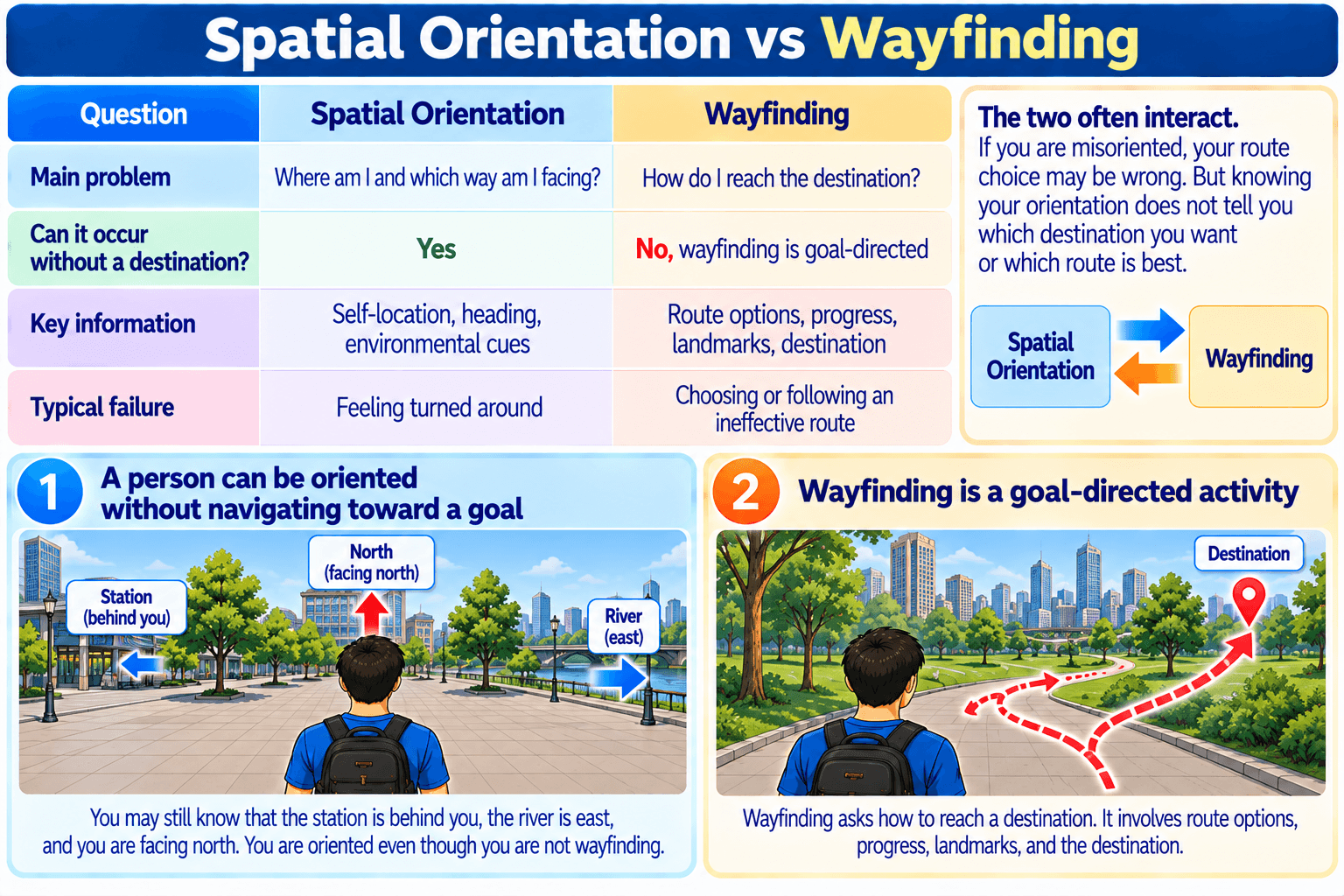
Where am I and which way am I facing? versus where should I go?
Spatial orientation asks about the current state of the observer within the environment. Wayfinding asks how to reach a destination.
| Question | Spatial Orientation | Wayfinding |
|---|---|---|
| Main problem | Where am I and which way am I facing? | How do I reach the destination? |
| Can it occur without a destination? | Yes | No, wayfinding is goal-directed |
| Key information | Self-location, heading, environmental cues | Route options, progress, landmarks, destination |
| Typical failure | Feeling turned around | Choosing or following an ineffective route |
The two often interact. If you are misoriented, your route choice may be wrong. But knowing your orientation does not tell you which destination you want or which route is best.
A person can be oriented without navigating toward a goal
Stand in the middle of a plaza with no destination in mind. You may still know that the station is behind you, the river is east, and you are facing north. You are oriented even though you are not wayfinding.
This simple example protects the distinction. Orientation is a spatial state. Wayfinding is a goal-directed activity that can use that state.
Spatial Orientation vs Path Integration
Broad orientation state versus self-motion updating mechanism
Path integration uses information generated by self-motion to update location and heading as movement unfolds. If you walk forward, turn, then continue without useful landmarks, path integration can help estimate where you are relative to the starting point.
Spatial orientation is broader because it can combine that movement-based estimate with visual landmarks, boundaries, remembered layout, signs, and other environmental information.
A person can therefore regain orientation after path-integration error by using a landmark, or remain oriented largely from stable environmental cues without relying heavily on movement-based updating.
How path integration can contribute to orientation without defining it
Consider walking through a dark corridor and making two turns before entering a lit room. During the dark segment, self-motion information may help maintain an estimate of heading. Once the room becomes visible, landmarks and boundaries can confirm or correct that estimate.
The final orientation state reflects the combined result. Path integration contributed, but it did not define the whole process.
This is why the concepts should be linked but not merged. The mechanism of updating from motion is narrower than the broader question of how people know their current position and direction.
Spatial Orientation vs Cognitive Maps
Current self-location and heading versus broader environmental representation
A cognitive map represents relationships among places, routes, landmarks, regions, and other environmental structure. Spatial orientation specifies where the self is currently located within some reference structure and which direction the self faces.
You can possess a detailed representation of a shopping center but still become temporarily misoriented after exiting an elevator on an unfamiliar floor. The map-like knowledge remains available, but your current position or heading within it is uncertain.
Conversely, you can be well oriented in a simple room without possessing a rich cognitive map of the entire building.
How map knowledge can help reorientation
Broader environmental knowledge becomes useful when a local cue identifies a known part of the layout. Recognizing the river, central atrium, main road, or building facade may allow you to place yourself back into a familiar spatial structure.
Once self-location is recovered, heading can be aligned with stable relations in that structure. The map does not perform the reorientation automatically. It provides the framework in which current position and direction can be estimated.
Ordinary Disorientation vs When a Medical Evaluation May Matter
Common moments of getting turned around
Brief disorientation can happen for ordinary reasons. You may exit a lift through an unexpected door, walk through several similar corridors, emerge from an underground station at a different entrance, or lose track of direction after concentrating on a conversation.
These moments are common enough that one episode should not be treated as evidence of neurological illness. Environment, attention, fatigue, familiarity, cue quality, and recent movement can all affect orientation.
What matters is the broader context, especially whether the difficulty is sudden, severe, clearly different from usual, or accompanied by other concerning symptoms.
Sudden severe new disorientation with confusion or neurological symptoms
Sudden new confusion or severe difficulty orienting can sometimes occur alongside urgent neurological symptoms. If a person suddenly becomes disoriented and also has trouble speaking, one-sided weakness or numbness, trouble walking, major balance problems, altered awareness, vision changes, or a sudden severe headache, seeking emergency medical care is appropriate.
The Mayo Clinic’s stroke guidance lists sudden confusion, speech problems, weakness or numbness, vision changes, trouble walking, balance problems, and sudden severe headache among warning signs that require urgent attention.
This safety note is not meant to turn ordinary directional mistakes into medical alarms. Its purpose is to distinguish routine moments of getting turned around from abrupt neurological change accompanied by other warning signs.
FAQ About Spatial Orientation Psychology
These questions focus on the boundaries between orientation and the related spatial processes that often operate alongside it.
Is spatial orientation the same as wayfinding?
No. Spatial orientation concerns your current self-location and heading relative to the environment. Wayfinding is the goal-directed process of reaching a destination. Orientation can support wayfinding, but you can be fully oriented without trying to go anywhere.
Why can I know a route but not know which direction I am facing?
Route knowledge can be stored as a sequence of landmarks and actions, such as turn left at the lobby and right at the stairs. That sequence does not necessarily preserve a global heading. After an unexpected entry point or turn, you may recognize the route while temporarily losing the body-to-environment orientation needed to say which direction you face.
Is a poor sense of direction a neurological problem?
Not by itself. “Sense of direction” is an informal label that covers several different spatial abilities, and ordinary variation is common. Temporary disorientation can occur in unfamiliar, repetitive, or confusing environments. Sudden severe change, especially with other neurological symptoms, is a different situation and may warrant urgent medical evaluation.
How do landmarks help reorientation?
A distinctive landmark can connect the current view with a known environmental relationship. If you recognize a tower as north of the square or a hotel lobby as facing the main road, that relation can help recover both self-location and heading. Landmarks are most useful when their position or direction within the environment is already known.
Key Takeaways
- Spatial orientation is the current estimate of where you are and which way you are facing relative to the environment.
- Position and heading are related but separable. You can know one more clearly than the other.
- Landmarks, boundaries, visual structure, remembered relations, movement cues, and sometimes cardinal directions can all support orientation.
- Turns require left-right, front-behind, and heading relations to be updated even when the environment itself stays unchanged.
- Wayfinding uses orientation to reach a goal, while path integration is one movement-based mechanism that can contribute to orientation.
- Brief ordinary disorientation is not a diagnosis. Sudden severe new disorientation with other neurological warning signs calls for medical attention.
A practical way to understand a moment of being “turned around” is to separate three questions: Do I recognize this place? Do I know where I am within it? and Do I know which way I am facing? The answers can differ. Identifying which estimate is missing makes the experience easier to understand and shows why recognizing a route, knowing a map, and being oriented are related but distinct achievements.
Educational note: This article explains ordinary spatial orientation in cognitive psychology. It does not diagnose neurological conditions or replace medical evaluation when a person has sudden or severe new disorientation.
Michael Reed, Founder & Lead Writer at Psychology Exposed, explains cognitive processes in practical, research-aware language for readers interested in everyday human behavior.

Michael Reed is the Founder and Lead Writer at Psychology Exposed. He writes about human behavior, relationships, emotional patterns, self-awareness, and practical psychology topics using research-informed, easy-to-understand content.
Read More About Michael Reed: https://psychologyexposed.com/michael-reed/