
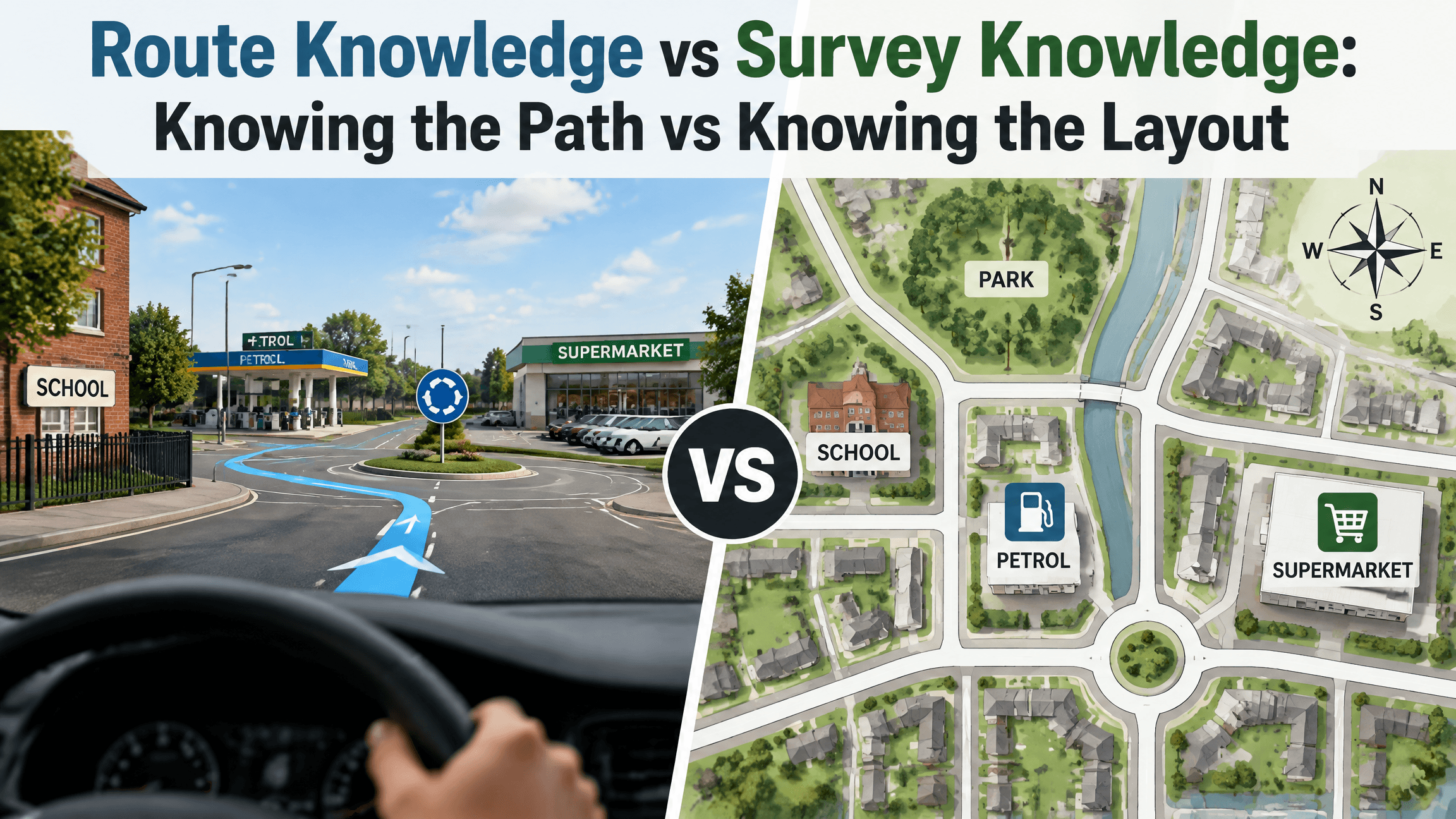
You may know exactly how to drive from home to a familiar supermarket: turn right at the school, pass the petrol station, take the second left, and look for the car park after the roundabout. Yet if someone asks which direction the supermarket lies from your house, you may hesitate. You know the path, but not necessarily the broader layout.
That difference is central to the distinction between route knowledge and survey knowledge. Route knowledge is organized around sequences, actions, landmarks, and decision points along a path. Survey knowledge is more configurational. It represents how multiple locations relate within a wider spatial layout, making judgments such as direction, relative position, shortcuts, and detours more flexible.
The two forms of knowledge often work together, but one should not be treated as a simple upgraded version of the other. People can develop them through different kinds of experience, at different rates, and with different strengths. Repeatedly traveling a route can improve familiarity without automatically producing a complete bird’s-eye understanding of the environment.
Quick Answer
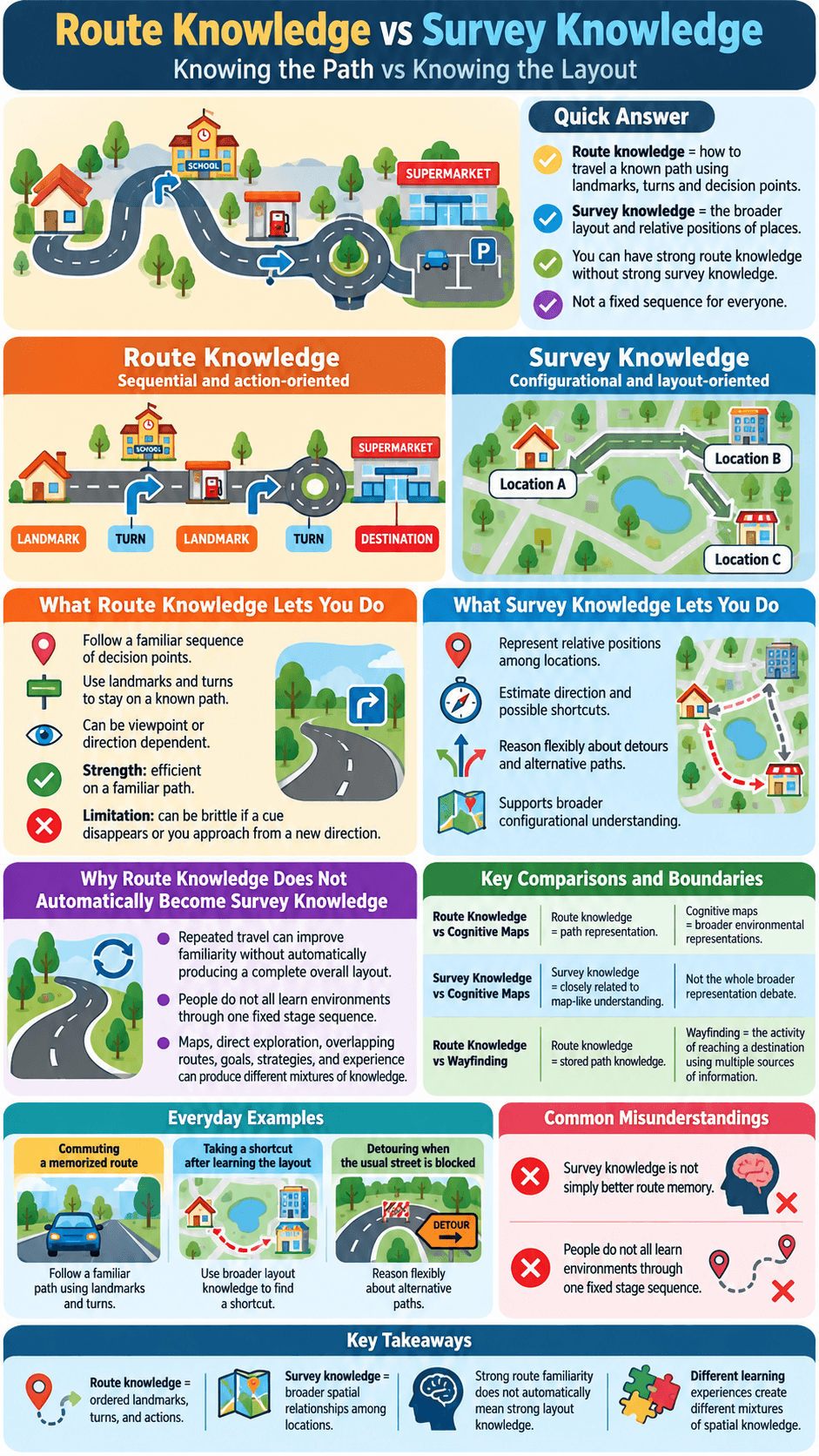
Route knowledge tells you how to travel a known path, usually through ordered landmarks, turns, and decision points. Survey knowledge represents the broader configuration of places, including their relative positions and directions. Someone can have strong route knowledge without strong survey knowledge, and research does not support treating landmark → route → survey knowledge as one fixed sequence that everyone must follow.
The Core Difference Between Route and Survey Knowledge
Route knowledge as sequential and action-oriented
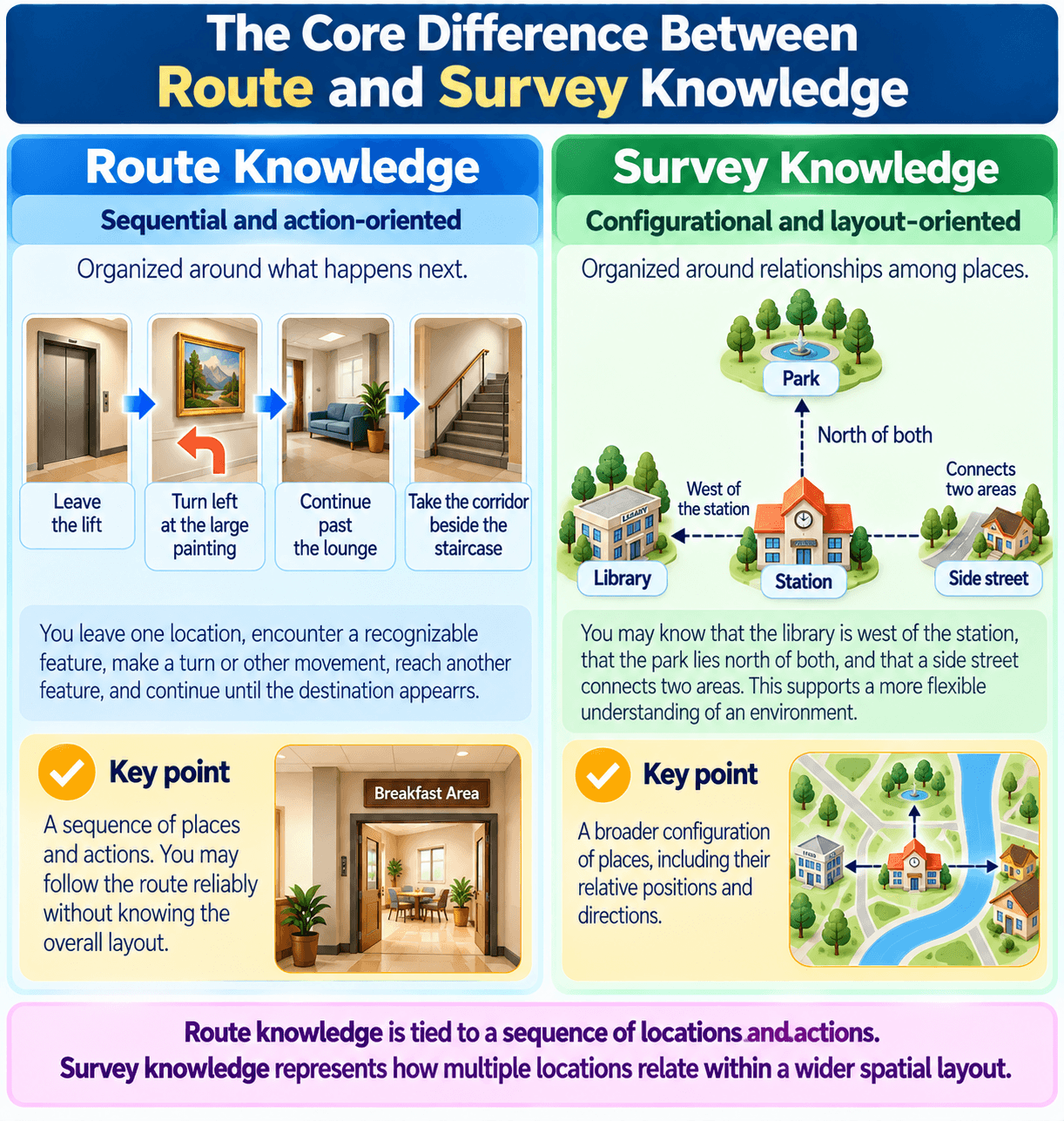
Route knowledge is organized around what happens next. You leave one location, encounter a recognizable feature, make a turn or other movement, reach another feature, and continue until the destination appears. The representation is closely tied to a sequence of places and actions.
Imagine walking from a hotel room to the breakfast area. Your remembered instructions might be: leave the lift, turn left at the large painting, continue past the lounge, then take the corridor beside the staircase. You may follow that route reliably without knowing whether the breakfast room is north, east, or directly behind your room in the building’s overall layout.
A classic distinction in environmental psychology describes route knowledge as knowledge of sequential locations without full knowledge of their general interrelationships. Research on the acquisition of spatial knowledge for routes contrasted this with configurational knowledge, which allows people to generalize beyond the specific path they learned.
Survey knowledge as configurational and layout-oriented
Survey knowledge is organized around relationships among places rather than only the order in which they are encountered. You may know that the library is west of the station, that the park lies north of both, and that a side street connects two areas that are usually reached by separate routes.
This kind of knowledge supports a more flexible understanding of an environment. Instead of asking only, “What do I do after the bank?” you can ask, “Where is the destination relative to me?” or “Could I reach it from this different street?”
A recent review of place, route, and survey knowledge describes survey knowledge as map-like knowledge of straight-line spatial relationships among places. The review also emphasizes that such knowledge depends on environmental and cognitive conditions, which is one reason it should not be assumed to emerge identically for everyone.
Core Models
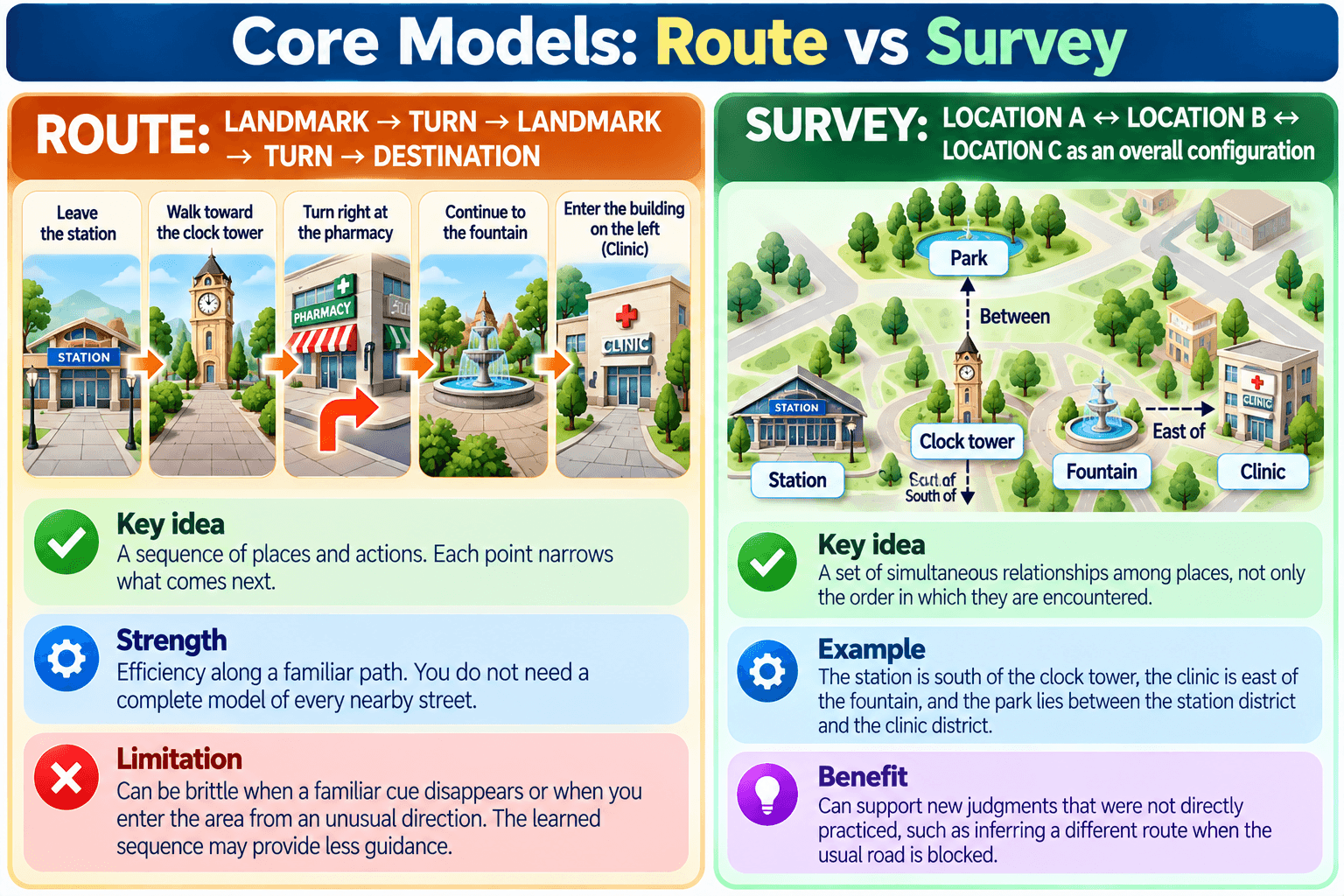
ROUTE: LANDMARK → TURN → LANDMARK → TURN → DESTINATION
A simple route representation can be pictured as a chain. Each important place or decision point cues the next action:
LANDMARK → TURN → LANDMARK → TURN → DESTINATION
Suppose your route to a clinic is: leave the station, walk toward the clock tower, turn right at the pharmacy, continue to the fountain, then enter the building on the left. The sequence is useful because each point narrows what comes next.
The strength of this format is efficiency along a familiar path. You do not need a complete model of every nearby street. The limitation is that the route can be brittle when a familiar cue disappears or when you enter the area from an unusual direction. If the pharmacy is closed and its sign is gone, or you approach the fountain from another street, the learned sequence may provide less guidance.
SURVEY: LOCATION A ↔ LOCATION B ↔ LOCATION C as an overall configuration
A survey representation is better pictured as a set of simultaneous relationships:
LOCATION A ↔ LOCATION B ↔ LOCATION C
Instead of remembering only the order in which places appear, you understand that the station is south of the clock tower, the clinic is east of the fountain, and the park lies between the station district and the clinic district. This arrangement can support new judgments that were not directly practiced.
For example, if the usual road is blocked, you may infer that walking north to the park and then east should still bring you toward the clinic. That inference depends on broader configuration, not merely repeating the original route.
What Route Knowledge Lets You Do
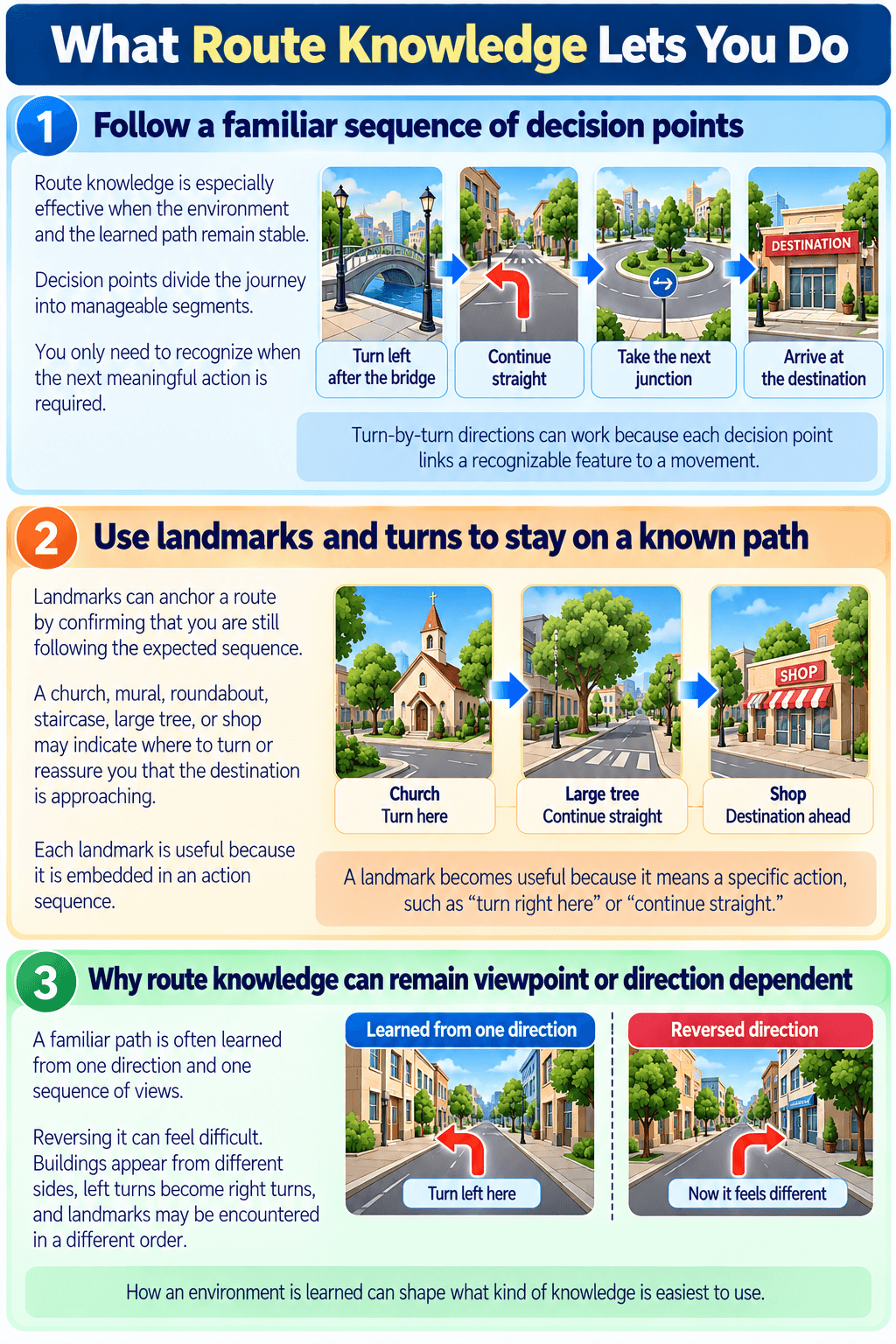
Follow a familiar sequence of decision points
Route knowledge is especially effective when the environment and the learned path remain stable. Decision points divide the journey into manageable segments. Instead of tracking the entire environment at once, you only need to recognize when the next meaningful action is required.
This is why turn-by-turn directions can work even for someone who has little sense of the surrounding layout. “Turn left after the bridge” is actionable. It ties a recognizable feature to a movement and reduces the amount of spatial information that must be considered at that moment.
Repeated travel can make such sequences highly fluent. A commute may eventually feel automatic because familiar streets and landmarks trigger well-practiced actions. Fluency, however, does not by itself show that the person has built precise knowledge of unseen spatial relationships.
Use landmarks and turns to stay on a known path
Landmarks can anchor a route by confirming that the traveler is still following the expected sequence. A church, mural, roundabout, staircase, large tree, or shop may indicate where to turn or reassure you that the destination is approaching.
The important point is not simply that the landmark is memorable. In route knowledge, it is embedded in an action sequence. “The red building” becomes useful because it means “turn right here,” while “the bridge” may mean “continue straight until the next junction.”
This coupling of place and action makes route knowledge practical. It also helps explain why losing one landmark can be disruptive. If the representation depends strongly on a sequence of cues, a missing cue can break the chain even though the destination is physically close.
Why route knowledge can remain viewpoint or direction dependent
A familiar path is often learned from one direction and one sequence of views. Reversing it can feel surprisingly difficult. Buildings appear from different sides, left turns become right turns, and landmarks may be encountered in a different order.
Research comparing map learning with navigation has long shown that different learning experiences can produce different strengths. In a classic study of spatial knowledge acquired from maps and navigation, map learning initially supported some global spatial judgments better, while direct navigation supported route-related and orientation judgments differently. The result is not that one method is always superior. It shows that how an environment is learned can shape what kind of knowledge is easiest to use.
What Survey Knowledge Lets You Do
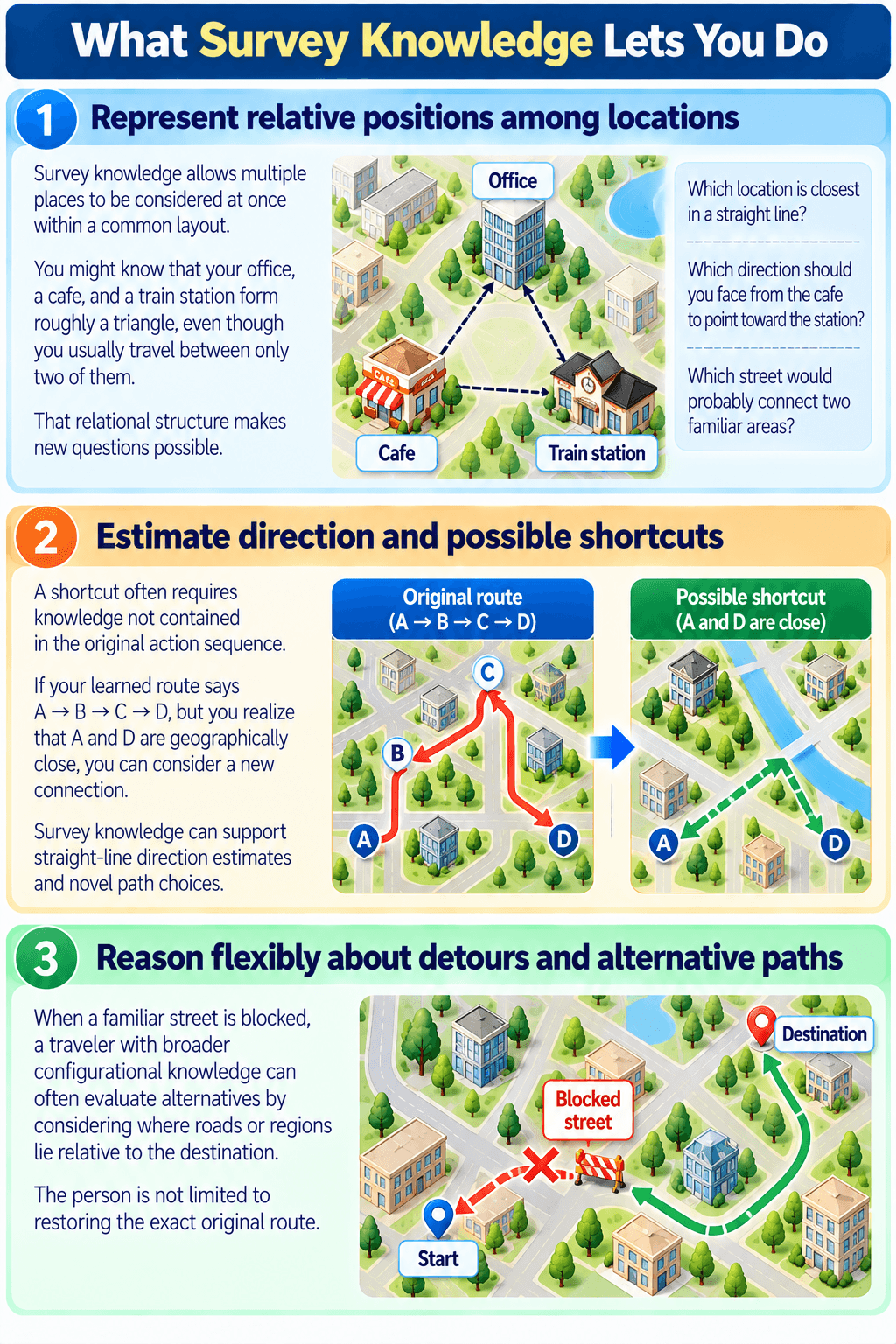
Represent relative positions among locations
Survey knowledge allows multiple places to be considered at once within a common layout. You might know that your office, a cafe, and a train station form roughly a triangle, even though you usually travel between only two of them.
That relational structure makes new questions possible. Which location is closest in a straight line? Which direction should you face from the cafe to point toward the station? Which street would probably connect two familiar areas?
These judgments do not require perfect metric accuracy. A person’s survey knowledge can still contain distortions. What matters is that the representation supports relationships beyond one memorized path.
Estimate direction and possible shortcuts
A shortcut is revealing because it often requires knowledge not contained in the original action sequence. If your learned route says A → B → C → D, but you realize that A and D are geographically close, you can consider a new connection.
Someone with only route knowledge may not see that possibility. The sequence tells them what worked before, not necessarily where each point lies in relation to all the others.
Survey knowledge can therefore support straight-line direction estimates and novel path choices. It does not guarantee that every shortcut is accessible or practical, but it makes the spatial possibility easier to represent.
Reason flexibly about detours and alternative paths
When a familiar street is blocked, a traveler with broader configurational knowledge can often evaluate alternatives by considering where roads or regions lie relative to the destination. The person is not limited to restoring the exact original route.
Human route selection can draw on multiple forms of spatial knowledge rather than one rigid level of representation. Later accounts therefore emphasize partial knowledge, multiple strategies, and gradual refinement instead of assuming that a complete survey representation must already be available.
Flexible detouring is therefore useful evidence of broader environmental knowledge, but it should not be treated as proof that the person possesses one complete and perfectly accurate internal map.
Where Landmark Knowledge Fits
Recognizing important places without knowing full relations
Landmark knowledge can exist before or without detailed route or survey knowledge. You may recognize a tower, entrance, statue, or station immediately while knowing very little about how it connects to the rest of the area.
Imagine visiting a large university campus for the first time. You quickly recognize the main library because of its unusual glass front. That recognition is useful, but it does not yet tell you the route from the library to the sports centre or where either lies relative to the north entrance.
Landmarks can later become integrated into routes and larger configurations, but recognition alone is a narrower form of spatial knowledge.
Why landmark knowledge is related but not a mandatory first stage for everyone
The familiar landmark → route → survey sequence is best treated as a historically important model, not a universal developmental law. People can encounter environmental information in very different ways.
Someone studying a clear map before walking may acquire broad configurational relationships early. Someone exploring a dense old city may accumulate several route fragments without ever forming precise survey knowledge. Another person may learn a prominent landmark and its approximate direction at the same time.
The ordering of knowledge depends partly on what information is available, how the person explores, what they are trying to learn, and which strategy they use.
Does Route Knowledge Always Become Survey Knowledge?
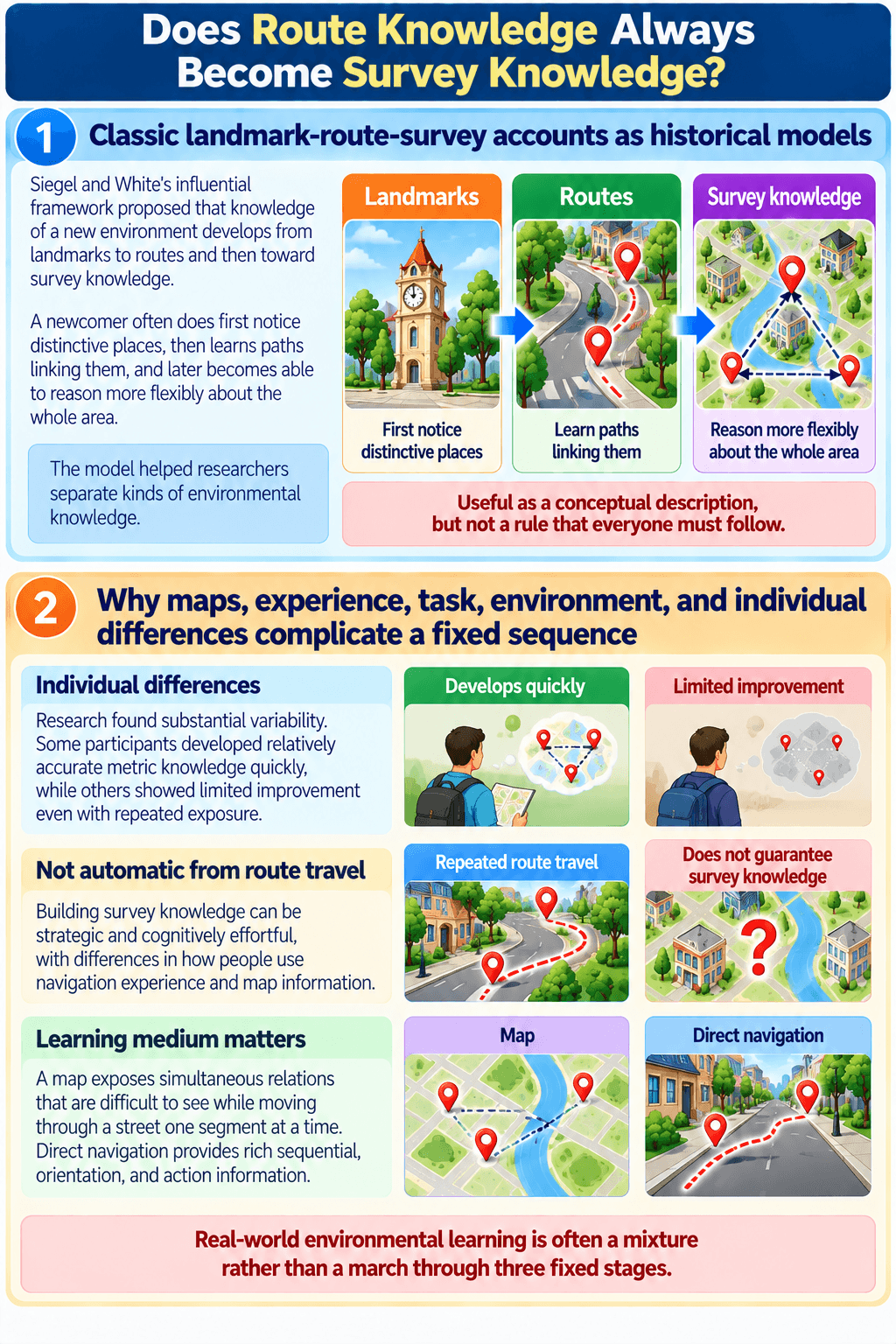
Classic landmark-route-survey accounts as historical models
Siegel and White’s influential framework proposed that knowledge of a new environment develops from landmarks to routes and then toward survey knowledge. The model helped researchers separate kinds of environmental knowledge that might otherwise be treated as one undifferentiated “sense of place.”
It remains useful as a conceptual description. A newcomer often does first notice distinctive places, then learns paths linking them, and later becomes able to reason more flexibly about the whole area.
The problem arises when this pattern is turned into a rule that everyone must follow. Later research has repeatedly found that environmental learning is more variable.
Why maps, experience, task, environment, and individual differences complicate a fixed sequence
Ishikawa and Montello tested the idea that environmental knowledge gradually progresses toward accurate survey knowledge through direct experience. Their work on individual differences in the acquisition of spatial knowledge found substantial variability. Some participants developed relatively accurate metric knowledge quickly, while others showed limited improvement even with repeated exposure.
Other research suggests that survey knowledge is not an automatic by-product of repeated route travel. A study of computer-assisted navigation and route versus survey knowledge notes that building survey knowledge can be strategic and cognitively effortful, with differences in how people use navigation experience and map information.
Learning medium matters too. A map exposes simultaneous relations that are difficult to see while moving through a street one segment at a time. Direct navigation provides rich sequential, orientation, and action information. Neither format guarantees complete knowledge. Each makes different relationships easier to acquire.
A review of map use and environment learning emphasizes that people can switch strategically between route and survey perspectives. Real-world environmental learning is therefore often a mixture rather than a march through three fixed stages.
Route Knowledge vs Cognitive Maps
One path format versus broader environmental representation
Route knowledge is narrower than the broader idea of a cognitive map. A route may contain a sequence of landmarks and actions needed to travel between two places. A cognitive map concerns the representation of environmental relationships more generally.
For example, knowing how to walk from a station to a museum is route knowledge. Knowing how the museum, station, park, river, and shopping district relate to one another involves a broader environmental representation.
The difference is one of scope. Route knowledge can exist as a useful path representation even when the larger environment is poorly integrated.
How route information can contribute to a larger cognitive map
Routes can still provide raw material for broader knowledge. If several familiar routes overlap, the shared landmarks and connections may reveal relationships that were not obvious when each path was learned separately.
Suppose you know home → school, school → market, and market → park. Later, a new street links the park area back toward home. Those connections may help you understand the neighborhood as a network rather than four unrelated journeys.
But integration is not guaranteed. Someone can accumulate many routes and still maintain them as partly separate sequences. The existence of route experience alone does not tell us how completely those experiences have been combined.
Survey Knowledge vs Cognitive Maps
Configurational knowledge as an important component without becoming the whole theory
Survey knowledge is closely associated with map-like understanding because it supports relationships among multiple locations in a common frame. This can include approximate direction, relative position, straight-line distance, and possibilities for alternative routes.
For that reason, researchers sometimes use survey knowledge and cognitive-map language closely together. Still, it is useful to keep them conceptually distinct. Survey knowledge describes a kind of spatial knowledge or capability, while the cognitive-map concept addresses broader questions about how environmental relationships are internally represented.
Why the broader representation question remains separate
An article about survey knowledge asks what someone knows about the configuration of locations. A broader representation account can ask whether that knowledge is map-like, graph-like, hierarchical, fragmented, anchored to landmarks, or distributed across several formats.
That broader debate should not be collapsed into this comparison. Here, the practical distinction is simpler: route knowledge preserves a path sequence, while survey knowledge provides a more flexible view of the layout.
Route Knowledge vs Wayfinding
Stored path knowledge versus the activity of reaching a destination
Wayfinding is an activity. It involves orienting, choosing where to go, monitoring progress, using environmental cues, recognizing mistakes, and correcting course. Route knowledge is one kind of information that can support that activity.
If you remember “turn left at the post office,” that is part of your stored route knowledge. When you actually notice the post office, decide whether the left turn is still open, continue, and check that the next landmark appears, you are engaged in wayfinding.
This separation matters because successful wayfinding can use more than one knowledge source.
How wayfinding can use route, survey, landmark, and current orientation information together
A traveler may begin with a known route, use a landmark to confirm location, use survey knowledge to judge a detour, and rely on current orientation to decide which direction to turn. These forms of information are complementary.
That combination also explains why a person can sometimes reach a destination successfully despite weak survey knowledge. Signs, route instructions, and recognizable landmarks may be enough. In another situation, a blocked street may make survey knowledge much more valuable.
Knowing the distinction helps avoid using “wayfinding,” “route memory,” and “cognitive map” as interchangeable labels for the same thing.
Everyday Examples: Known Path vs Flexible Layout
Commuting a memorized route
You drive to work every morning using the same sequence of streets. You know where traffic usually slows, which lane you need before a junction, and which building appears just before your turn. The route is deeply familiar.
Then someone asks you to drive from your workplace to a restaurant located near one of the earlier streets, but without retracing the commute. You are unsure which direction to begin. Strong familiarity with one sequence has not necessarily produced equally strong knowledge of the wider layout.
Taking a shortcut after learning the neighborhood layout
After several weeks of walking around a neighborhood, you realize that two roads you learned on separate trips are connected by a short lane. You can now move between them without returning to the original junction.
That shortcut suggests a more integrated configuration. Your knowledge is no longer limited to reproducing two independent route sequences. You can use their spatial relationship to create a new path.
Detouring when the usual street is blocked
A construction barrier closes the street you normally use to reach a station. If your knowledge is mainly route-based, you may need signs, a map, or outside directions to recover. If you understand the surrounding street relationships, you may infer that moving one block west and then north will reconnect with the destination area.
This does not make survey knowledge “better” in every situation. The familiar route may be faster and easier when nothing changes. Survey knowledge becomes especially useful when flexibility is required.
Common Misunderstandings
Survey knowledge is not simply better route memory
Knowing a route extremely well can make the sequence faster, smoother, and more detailed without transforming it into broad configurational knowledge. You might remember every junction, shop, crossing, and slope while still being unable to estimate the straight-line direction to the destination.
Survey knowledge adds a different kind of relationship. It is not merely “more details” along the same path. It allows several places to be related within a wider frame.
Likewise, survey knowledge is not automatically superior. For repeating a familiar journey, precise route knowledge can be efficient and sufficient. The value of each format depends on what the person needs to do.
People do not all learn environments through one fixed stage sequence
The landmark-route-survey model remains useful because it names three recognizable forms of environmental knowledge. It becomes misleading only when presented as a mandatory staircase that every learner climbs in the same order.
Maps can provide configurational relations early. Direct exploration can create mixtures of landmark, route, and survey information. Some people actively seek global layout knowledge, while others focus on reliable action sequences. Familiarity, environmental complexity, goals, strategies, and learning media all matter.
A better question than “Which stage is this person in?” is “What spatial relationships can this person currently use?” That keeps attention on the actual knowledge available rather than forcing every learner into one developmental template.
FAQ About Route and Survey Knowledge
The most useful questions concern what each knowledge format allows a person to do, rather than treating one as a simple score of navigational ability.
Can you know a route without knowing the wider layout?
Yes. A person can learn a reliable sequence of landmarks, turns, and decision points without being able to estimate straight-line direction or understand how nearby places relate outside that path. This is common when an environment is learned through repeated travel along the same route.
Does repeated travel automatically create survey knowledge?
No. Repeated experience can improve familiarity and may contribute to broader environmental knowledge, but the change is not automatic or identical across people. Research shows substantial individual differences, and some forms of map-like knowledge can remain weak even after considerable route experience.
Are maps the only way to build survey knowledge?
No. Direct exploration can produce configurational knowledge, especially when routes overlap, viewpoints change, and the traveler attends to relationships among locations. Maps can make simultaneous spatial relations easier to see, but they are one learning source among several.
Is survey knowledge the same as a cognitive map?
They are closely related but not perfectly interchangeable. Survey knowledge refers to configurational understanding of where multiple places lie relative to one another. A cognitive map is a broader theoretical concept concerning how environmental relationships are represented, which may include map-like, route-based, landmark-based, hierarchical, or other structures.
Key Takeaways
- Route knowledge is organized around ordered landmarks, turns, and actions along a path.
- Survey knowledge represents broader spatial relationships among multiple locations and supports flexible direction, shortcut, and detour judgments.
- Strong familiarity with one route does not automatically mean someone understands the surrounding layout.
- The classic landmark → route → survey model is historically important, but later research shows that environmental learning is more variable than a fixed universal sequence.
- Maps, direct navigation, repeated experience, goals, strategies, and environmental structure can produce different mixtures of spatial knowledge.
- Route knowledge, survey knowledge, cognitive maps, and wayfinding overlap, but they answer different psychological questions.
One practical way to notice the difference is to ask yourself two questions about a familiar place: Can I reproduce the path? and Can I explain where the places lie relative to one another? If the first answer is easy and the second is difficult, your knowledge may be stronger as a route sequence than as a broader configuration. That is a difference in spatial representation, not a verdict on intelligence or overall navigation ability.
Michael Reed is Founder & Lead Writer at Psychology Exposed. His work translates research on cognition and human behavior into practical explanations for everyday readers.

Michael Reed is the Founder and Lead Writer at Psychology Exposed. He writes about human behavior, relationships, emotional patterns, self-awareness, and practical psychology topics using research-informed, easy-to-understand content.
Read More About Michael Reed: https://psychologyexposed.com/michael-reed/