
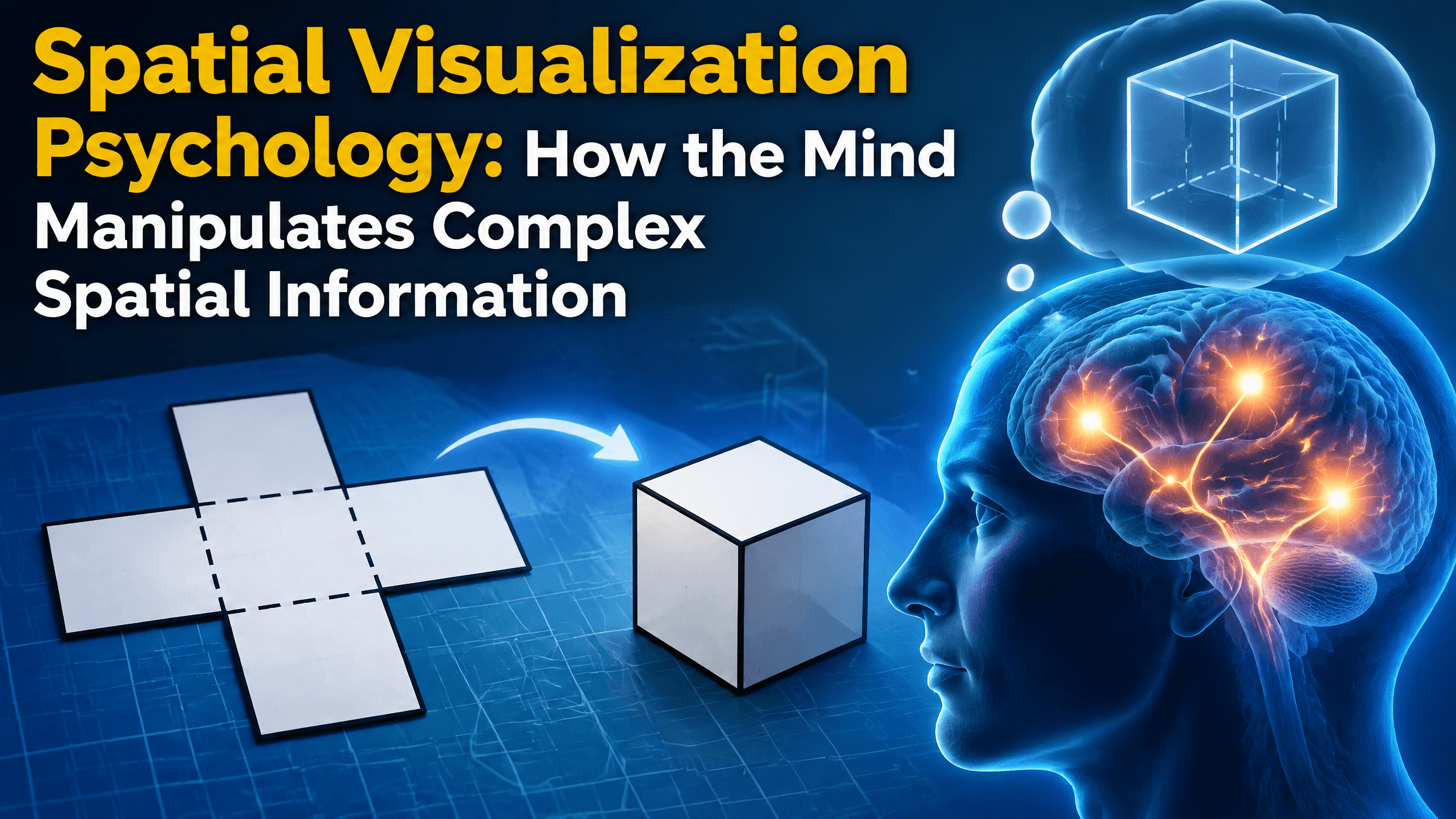
Imagine seeing a flat diagram of a box, mentally folding its sides upward, keeping track of which edges meet, and then deciding where a marked corner will end up. Nothing in front of you actually moves, yet your answer depends on preserving several spatial relationships while the configuration changes step by step.
That kind of task captures the heart of spatial visualization. It is not simply noticing where something is, and it is not just turning one object to a new orientation. The challenge is to maintain a structured arrangement while parts are folded, combined, rearranged, unfolded, or otherwise transformed across more than one mental step.
This distinction matters because several nearby abilities can look similar on the surface. Mental rotation usually asks what an object would look like after an orientation change. Working memory helps keep temporary information active. Problem solving helps search for a route to a goal. Visual imagery concerns the experience of representing something visually in the mind. Spatial visualization overlaps with some of these processes, but it is defined by the manipulation of spatial structure itself.
Quick Answer
Spatial visualization psychology examines how people mentally transform complex spatial arrangements while keeping track of relationships among their parts. A task may require folding, unfolding, combining, rearranging, or updating a configuration across several steps. It differs from simple mental rotation because the spatial structure itself may change, and it differs from working memory because temporary storage supports the transformation rather than defining it.
What Spatial Visualization Means
Maintaining relationships while a configuration changes
Spatial visualization involves more than forming a picture. What matters is preserving useful spatial relationships while an imagined arrangement changes. If one side of a shape folds inward, the mind has to update where that side now lies relative to the other sides. If a second fold follows, the earlier change must still be represented while the new change is applied.
A useful everyday analogy is assembling flat-pack furniture from a diagram. You might study the drawing, imagine how one panel turns, see where a bracket will face after the turn, and then anticipate how the next panel will attach. The mental work is not only visual. It is relational: which side touches which, what becomes hidden, what changes orientation, and what remains connected.
Modern reviews of spatial ability describe spatial visualization as one of several distinguishable forms of spatial thinking, although definitions have varied across research traditions. A recent review of spatial ability frameworks highlights the value of separating complex visualization tasks from mental rotation and perspective-taking tasks rather than treating all spatial performance as one undifferentiated skill.
Why multi-step transformation is central
The word visualization can make the process sound like passive picture formation. In many spatial visualization tasks, however, the important feature is transformation over time. The starting arrangement is changed, the result of that change becomes the new state, and another transformation may follow.
Consider a sheet of paper folded once from left to right and then again from bottom to top. If a hole is punched through the folded paper, predicting the final pattern after unfolding requires reversing both folds in the correct order. Each operation changes the relationships among surfaces and hole positions. A single snapshot is not enough.
This is why spatial visualization is often useful to think of as structured mental manipulation. The mind must maintain enough of the current configuration to apply the next transformation without losing the relationships created by earlier steps.
Core Model: STARTING CONFIGURATION → TRANSFORMATION 1 → TRANSFORMATION 2 → UPDATED RELATIONSHIPS → RESULT

Represent the starting configuration
Every multi-step spatial transformation begins with some representation of the current arrangement. That might be a flat pattern, a set of blocks, a mechanical diagram, a room layout, or several parts that need to be mentally combined.
The representation does not need to be a perfectly vivid mental picture. What matters is that the relationships needed for the task are available. You may need to know that edge A touches edge B, that a marked point is near one corner, or that one panel is currently above another. Some details can be ignored if they do not affect the transformation.
Apply sequential spatial changes
The next step is to transform the represented structure. One part may fold, slide, rotate, combine with another part, or change position relative to the rest. In a complex task, this happens more than once.
The sequence matters. Folding the top panel and then the side panel may produce a different imagined state from folding them in the opposite order. Likewise, mentally assembling three parts often requires knowing which connection is established first because later relationships depend on it.
Research on mental folding shows why spatial transformation tasks should not all be collapsed into simple rotation. A review comparing mental rotation with mental folding concluded that the two share important features but can differ in the kind of transformation required, including the distinction between rigid orientation changes and changes that alter an object’s internal configuration. The review of mental rotation and mental folding is a useful reminder that similar-looking spatial tasks can place different demands on representation.
Track which relationships remain and which change
Successful visualization depends on knowing what should update and what should stay invariant. If a paper is folded, a corner may move relative to the page, but it remains the same corner. If blocks are rearranged, their positions can change while their shapes and connection rules remain constant.
This creates a practical mental question: after this step, what is still true, and what is different? That question is often more useful than trying to maintain a perfectly detailed internal scene. The task becomes a controlled update of relationships rather than an attempt to “see everything” at once.
What Makes a Spatial Transformation Complex?
Multiple parts, multiple steps, and changing relations
Complexity increases when the task contains more elements, more transformations, or more relationships that must be updated. A single cube turned 90 degrees is comparatively simple because the object’s internal structure stays intact. A net folded into a cube is harder because several panels change position relative to one another and some faces become hidden.
Another source of difficulty is dependency between steps. If the second transformation depends on the result of the first, losing track of an intermediate state can derail the final judgment. This is one reason two tasks that look equally “visual” may feel very different.
Complexity also depends on what the question asks. You may be able to imagine the general shape after folding but still struggle to identify where a particular mark ends up. The relevant relationship must be maintained at the right level of detail.
Restructuring, combining, folding, and unfolding
Spatial visualization includes several kinds of mental restructuring. Folding changes how surfaces relate. Unfolding requires reversing a sequence of transformations. Combining parts asks whether separate pieces can produce a target whole. Rearranging a configuration asks how local moves change the larger structure.
These operations can occur in practical settings. An architect may interpret how a two-dimensional plan corresponds to a three-dimensional space. Someone packing a suitcase may imagine whether several objects will fit after being repositioned. A person following an assembly diagram may predict how a bracket will face once a panel is turned and attached.
Those examples should not be treated as identical psychological tasks. They simply show the shared idea: the person must transform spatial relationships rather than merely recognize a static arrangement.
Research Tasks That Illustrate Spatial Visualization
Paper-folding style tasks as examples
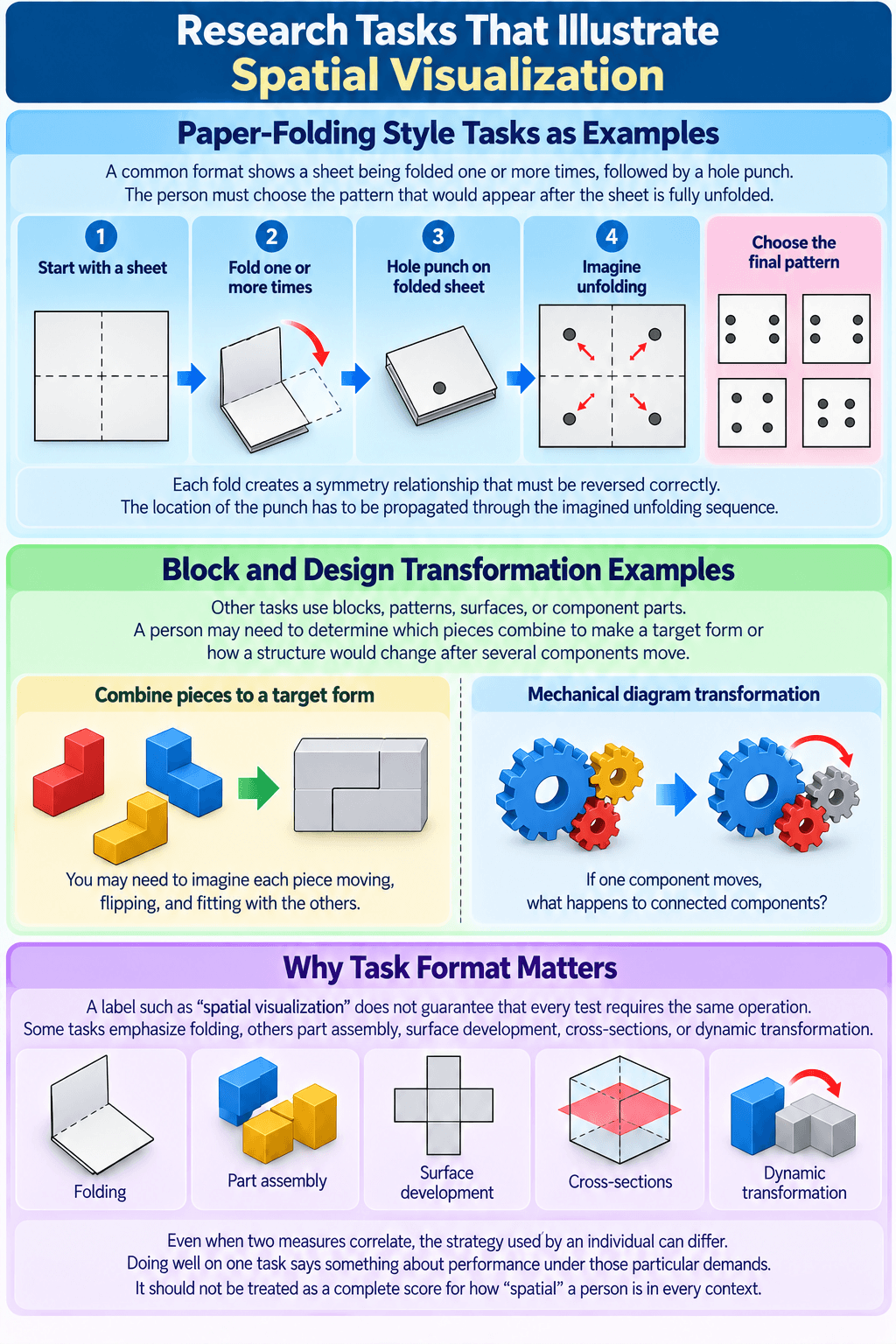
Paper-folding tasks are a classic way to study complex spatial transformation. A common format shows a sheet being folded one or more times, followed by a hole punch. The person must choose the pattern that would appear after the sheet is fully unfolded.
This requires more than remembering the final folded square. Each fold creates a symmetry relationship that must be reversed correctly. The location of the punch has to be propagated through the imagined unfolding sequence.
Open-access research using paper-folding measures describes the task as requiring participants to mentally track the effects of successive folds and then predict the unfolded configuration. One example appears in a large study of different dimensions of spatial cognition, where paper folding, mental rotation, perspective taking, cross-sections, and other tasks were measured separately rather than treated as interchangeable.
Block and design transformation examples
Other tasks use blocks, patterns, surfaces, or component parts. A person may need to determine which pieces combine to make a target form or how a three-dimensional structure would change after several components move.
Suppose three oddly shaped pieces can be arranged into a rectangle. Instead of rotating one piece and stopping, you may need to imagine piece A moving, piece B flipping, and piece C filling the remaining space. The goal is to preserve part-to-whole relations across a sequence.
Mechanical diagrams can create a similar demand. If one component moves, what happens to connected components? Research on mental animation found that such transformation tasks interfere especially with concurrent visuospatial memory demands, which supports the idea that active spatial maintenance can contribute to complex transformation. The classic dual-task study of mental animation is useful here because it shows support from working memory without making working memory identical to spatial visualization.
Why task format matters
A label such as “spatial visualization” does not guarantee that every test requires the same operation. Some tasks emphasize folding, others part assembly, surface development, cross-sections, or dynamic transformation. Even when two measures correlate, the strategy used by an individual can differ.
This is important when interpreting results. Doing well on one task says something about performance under those particular demands. It should not be treated as a complete score for how “spatial” a person is in every context.
One-Step Rotation vs Multi-Step Spatial Visualization

Mental Rotation as a narrower orientation transformation
Mental rotation usually asks the mind to change the orientation of an object while preserving its internal structure. A block figure may be turned 60 or 120 degrees, but its parts remain connected in the same way. The main judgment is often whether two differently oriented objects are actually the same.
Spatial visualization often goes further. It may require a sequence of transformations, and the relationship among parts may change during the process. Folding a flat pattern into a solid, unfolding a punched sheet, or combining several components involves more than changing orientation.
| Question | Mental Rotation | Spatial Visualization |
|---|---|---|
| What is transformed? | Primarily the orientation of an object | A configuration or relationships among multiple parts |
| Typical structure | One relatively direct transformation | Often several sequential transformations |
| Example | Turn a 3D block figure and compare it with another | Fold a net, track several faces, and predict the final arrangement |
| Main challenge | Orientation alignment | Maintaining and updating spatial structure |
Research syntheses often note that the boundary is not absolute because some classification systems historically grouped rotation under spatial visualization. A broader review of spatial ability factors shows why terminology can vary across traditions. For everyday explanation, the useful distinction is operational: direct object rotation versus more complex restructuring across steps.
Why rotating one object and transforming a configuration are not the same
Picture a flat cardboard cross that will fold into a cube. First, imagine turning the entire flat cross 90 degrees on the table. That is mainly an orientation change. Now imagine folding four arms upward, closing the final face, and deciding which face ends up opposite a marked square. The second task requires multiple relationship updates.
The visual material is similar, but the operations are different. This is exactly why treating every spatial task as “rotation” can hide useful psychological distinctions.
How People Track Relationships Across Steps
Updating the internal configuration after each change
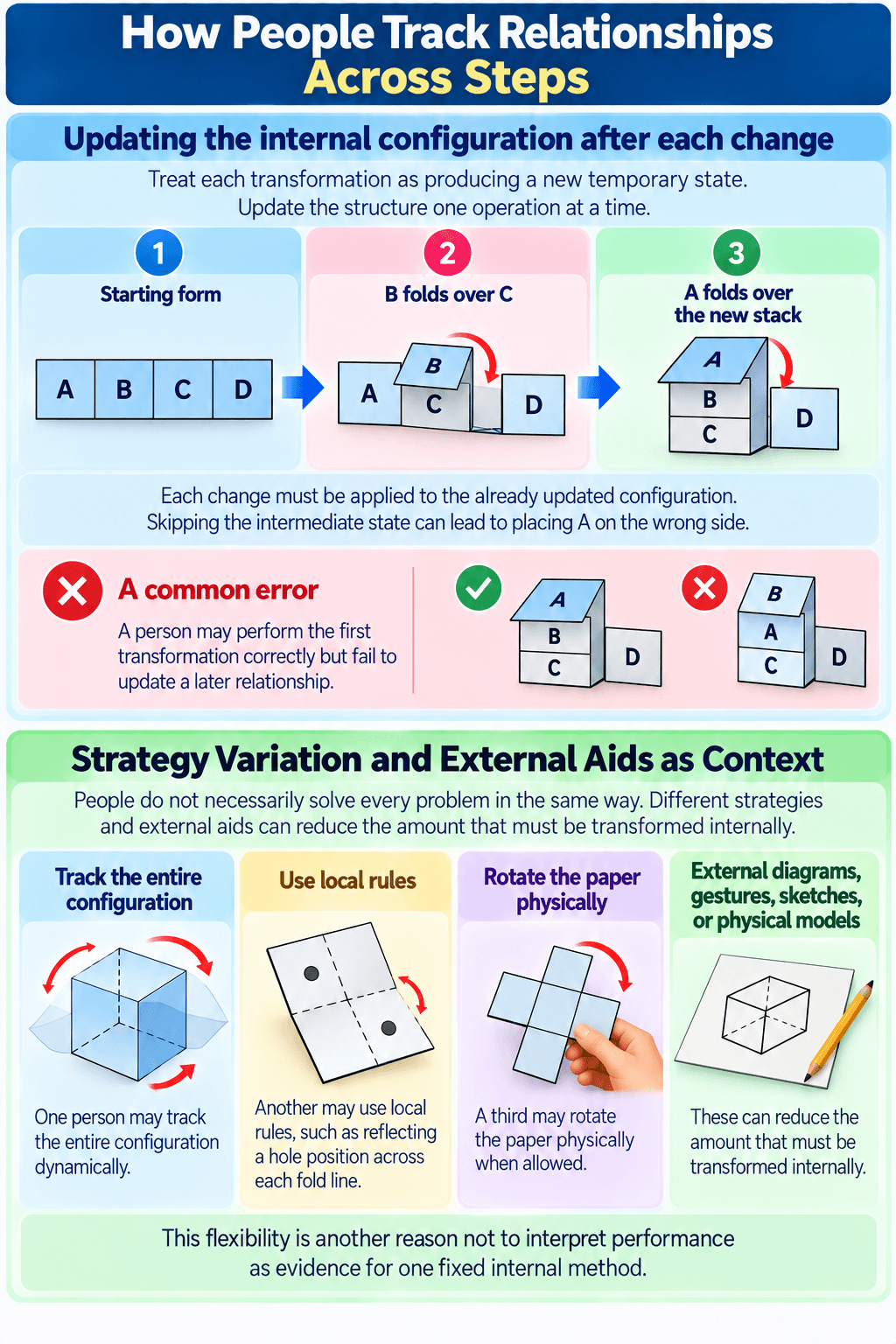
A workable strategy is to treat each transformation as producing a new temporary state. Instead of attempting to jump from the starting form straight to the answer, the person updates the structure one operation at a time.
For example, imagine a strip of four squares labeled A, B, C, and D. If B folds over C, the relation between B and C changes first. If A then folds over the new stack, the second change must be applied to the already updated configuration. Skipping the intermediate state makes it easy to place A on the wrong side.
This stepwise view also helps explain errors. A person may perform the first transformation correctly but fail to update a later relationship. The final response can therefore be wrong even though the initial representation was accurate.
Strategy variation and external aids as context
People do not necessarily solve every spatial visualization problem in the same way. One person may track the entire configuration dynamically. Another may use local rules, such as reflecting a hole position across each fold line. A third may rotate the paper physically when allowed.
External diagrams, gestures, sketches, or physical models can reduce the amount that must be transformed internally. That does not make the underlying spatial relationship unimportant. It simply changes where part of the representation is carried, in the mind or in the environment.
This flexibility is another reason not to interpret performance as evidence for one fixed internal method.
Spatial Visualization and Working Memory
Temporary maintenance can support the task
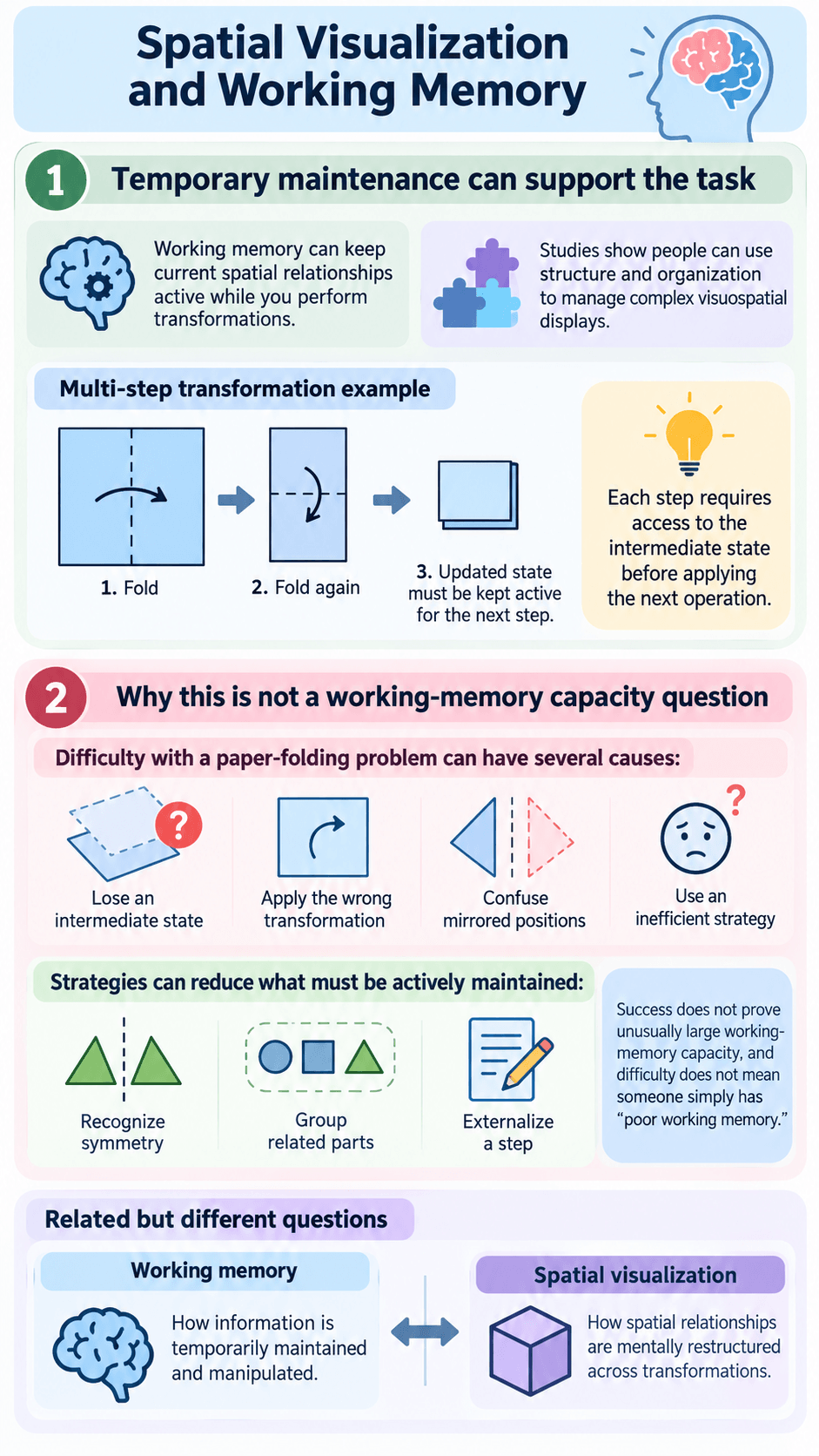
Multi-step transformation requires intermediate information to remain available long enough for the next operation. If you mentally fold a shape, you need access to the updated state before applying the next fold. That makes temporary maintenance relevant.
Studies of complex visuospatial displays also show that people can use structure to manage information that would otherwise appear to exceed simple capacity limits. Research in Memory & Cognition on visuospatial structure illustrates how organization and spatial ability can affect performance on complex displays.
Working memory can therefore support spatial visualization by keeping current relationships active. But support is not identity. The defining question in spatial visualization is what transformation is being performed on spatial structure, not how much information can be held temporarily in general.
Why this is not a working-memory capacity question
If someone struggles with a paper-folding problem, several things could contribute. The person might lose an intermediate state, apply the wrong transformation, confuse mirrored positions, or use an inefficient strategy. It would be too strong to conclude that the person simply has “poor working memory.”
Likewise, success does not prove unusually large working-memory capacity. A good strategy can reduce what must be actively maintained. Recognizing symmetry, grouping related parts, or externalizing a step can change the task substantially.
The two concepts are connected, but they answer different questions. Working memory asks how information is temporarily maintained and manipulated. Spatial visualization asks how spatial relationships are mentally restructured across transformations.
Spatial Visualization vs Problem Solving
Transforming a representation versus searching for a solution path
Problem solving is broader. It involves moving from a current state toward a goal when the path is not immediately obvious. A problem can be verbal, numerical, social, logical, mechanical, or spatial.
Spatial visualization is one operation that may appear inside a problem. If a furniture assembly puzzle asks which orientation allows a shelf to pass through a narrow frame, you may use spatial visualization to test possible transformations. But the larger task also involves choosing actions, evaluating constraints, and deciding which solution to try.
The distinction is useful because it prevents every difficult spatial task from being described as “spatial problem solving.” Difficulty alone does not define the construct. The important question is whether the central mental operation is transforming a spatial representation.
When a spatial visualization operation occurs inside a larger problem
Imagine fitting several boxes into a car trunk. You might mentally rotate one box, visualize moving another, and estimate how the remaining space changes. Those transformations are spatial. Deciding the packing order, balancing priorities, and revising the plan after something does not fit are broader problem-solving activities.
The same separation can appear in technical work. An engineer may mentally transform a component to understand how it fits, then use calculations and design constraints to decide whether the proposed configuration is acceptable. Spatial visualization contributes to the reasoning, but it is not the entire reasoning process.
Spatial Visualization vs Mental Imagery
Vivid pictures are not the same as structured spatial manipulation
People often assume that someone with vivid mental pictures must automatically be strong at spatial visualization. The concepts are not equivalent. Vividness concerns how clear, detailed, or picture-like an internal experience feels. Spatial visualization concerns whether the person can preserve and transform relevant spatial relationships.
A person might report a very vivid image of a folded paper but still misplace the holes after unfolding it. Another person might describe little subjective vividness yet accurately track fold lines and reflections using a more abstract spatial strategy.
This is similar to using a subway diagram. The diagram can be visually simple and not resemble the physical city, yet still preserve the relationships needed to plan a route. For spatial visualization, useful structure can matter more than pictorial richness.
Why successful performance does not require one specific imagery experience
The safest interpretation is that people can reach correct spatial judgments through different combinations of representation and strategy. Some may experience a strong visual transformation. Others may rely more on relational, analytic, or rule-based methods.
That does not mean imagery is irrelevant. It means subjective vividness should not be used as a substitute for actual spatial performance, and task performance should not be used to make assumptions about what a person’s inner experience must feel like.
Common Errors in Explaining Spatial Visualization
Treating it as simple rotation
The first mistake is using mental rotation as the model for every dynamic spatial task. Rotation is important, but a folding, assembly, or restructuring problem may change internal relationships in ways a rigid rotation does not.
When the configuration itself changes, the explanation should focus on updating relations across steps rather than simply “turning the picture in your head.”
Treating it as visual creativity
Spatial visualization is also not the same as being visually artistic or creative. Designing an imaginative room, drawing an expressive picture, and inventing novel visual forms involve goals that go beyond spatial transformation.
A person may be highly creative while finding paper-folding tasks difficult, or highly accurate at structured spatial transformations without enjoying visual art. These are different kinds of performance.
Treating task performance as a full intelligence score
A paper-folding or spatial transformation score reflects performance on a particular set of demands. It does not provide a complete measure of intelligence, practical competence, learning potential, or career ability.
Spatial research often studies individual differences, but responsible interpretation requires keeping the inference narrow. Strategy, familiarity, instruction, task format, time limits, and experience can all affect performance. Group averages also do not determine what any individual can do.
A useful personal question is not “Am I a spatial person?” but “Which part of this transformation is difficult for me?” It may be representing the starting configuration, preserving an intermediate state, applying the correct operation, or checking the final relation.
FAQ About Spatial Visualization Psychology
Spatial tasks are easy to group together because they often use similar shapes and diagrams. These questions focus on the operations that make spatial visualization distinct.
Is spatial visualization the same as mental rotation?
No. The terms have sometimes overlapped in older classification systems, but they can be separated usefully. Mental rotation usually focuses on changing an object’s orientation while preserving its internal structure. Spatial visualization often involves multi-step transformations such as folding, unfolding, combining parts, or restructuring a configuration. A task may use both, but one does not have to be treated as identical to the other.
Does spatial visualization require vivid mental pictures?
Not necessarily. A person needs a representation that preserves the spatial relationships required for the task, but that representation does not have to feel like a vivid internal photograph. People may use visual, relational, analytic, or mixed strategies. Subjective image vividness and successful spatial transformation should therefore be kept conceptually separate.
Why do multi-step tasks feel harder than one-step rotations?
Each step creates an updated configuration that must remain available for the next transformation. More steps can mean more opportunities to lose an intermediate relationship, apply a transformation incorrectly, or confuse what changed with what stayed fixed. Strategy can reduce this burden, but sequential dependency still makes many multi-step tasks demanding.
Is spatial visualization just working memory?
No. Working memory can help maintain intermediate states, but spatial visualization is defined by the transformation of spatial structure. A person can make a spatial error because the transformation rule was applied incorrectly even if temporary information was maintained adequately. Conversely, external aids or efficient grouping can reduce memory demands while the same spatial transformation still has to be understood.
Key Takeaways
- Spatial visualization involves mentally restructuring spatial relationships, often across several sequential steps.
- Folding, unfolding, combining parts, and tracking changing configurations are stronger examples than a single rigid orientation change.
- Mental rotation is narrower when the main operation is turning an object while preserving its internal structure.
- Working memory can support multi-step transformation, but temporary storage is not the same construct as spatial visualization.
- Vivid mental imagery is not required to preserve and manipulate spatial relationships successfully.
- Performance on one spatial visualization task should not be treated as a complete measure of intelligence or general spatial competence.
A Useful Next Step
When a spatial task feels difficult, separate the transformations instead of trying to leap directly to the final answer. Identify the starting relationships, apply one change, state what moved and what stayed fixed, then update the configuration before continuing. That approach will not solve every task automatically, but it makes the underlying demand visible: maintaining spatial structure while it changes.
Educational note: Spatial visualization is one part of human spatial cognition. Differences in performance on paper folding, block assembly, or similar tasks are not diagnoses and should not be used to rank a person’s overall intelligence or potential.
Michael Reed is the Founder & Lead Writer at Psychology Exposed, where he explains human behavior and cognitive processes in clear, research-aware language for general readers.

Michael Reed is the Founder and Lead Writer at Psychology Exposed. He writes about human behavior, relationships, emotional patterns, self-awareness, and practical psychology topics using research-informed, easy-to-understand content.
Read More About Michael Reed: https://psychologyexposed.com/michael-reed/