
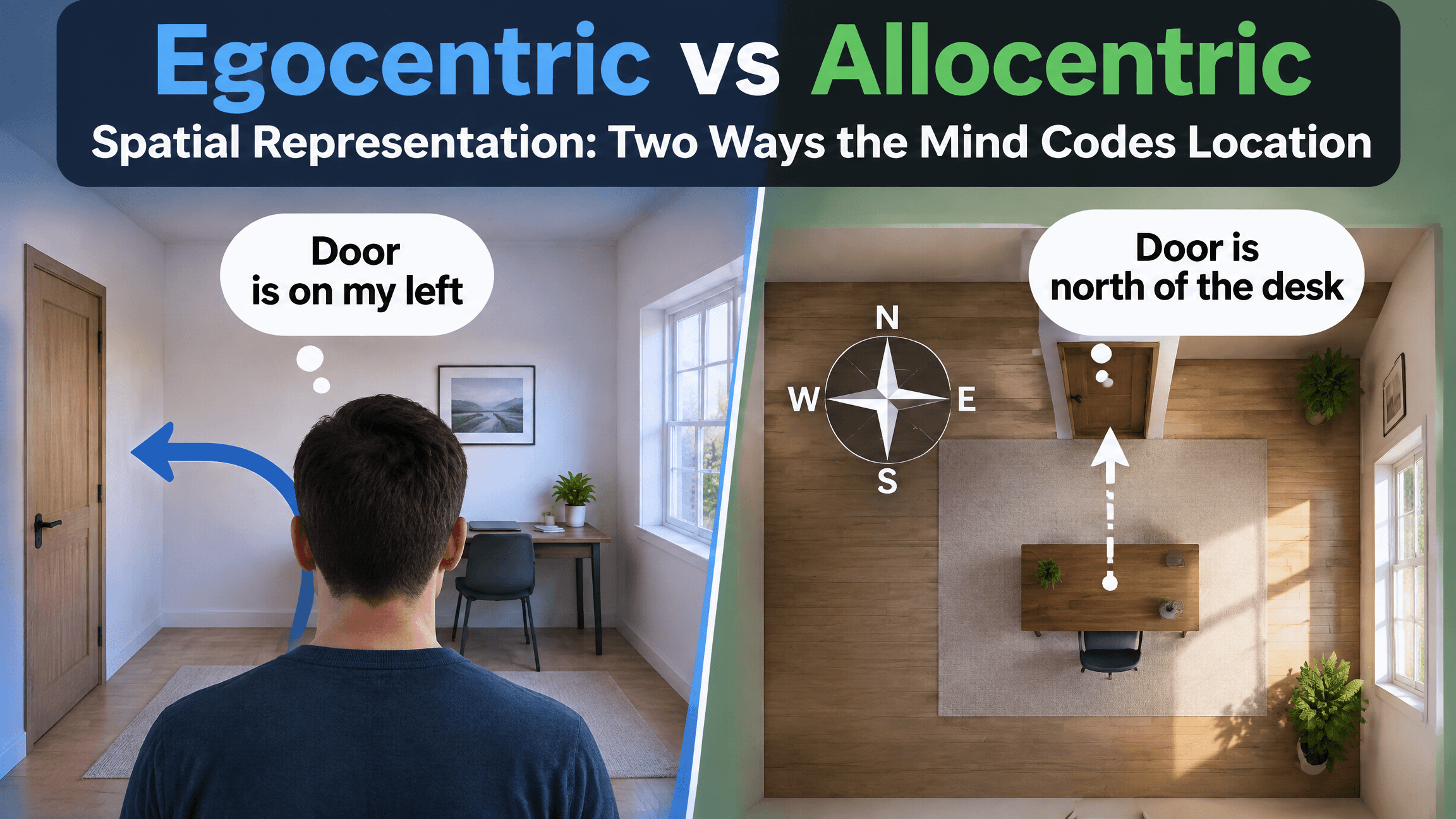
You are standing in a room with a desk, a window, and a door. From where you stand, the door is to your left. Now turn around. The same door may be to your right, even though the door itself has not moved. But if the door is north of the desk, that relationship can stay the same when you turn.
That simple contrast captures an important idea in spatial cognition. A location can be represented relative to you, or relative to other objects and the environment. Psychologists often describe these broad approaches as egocentric and allocentric spatial reference frames. The terms sound abstract, and “egocentric” can sound like a personality judgment, but here they are strictly about how spatial relationships are coded. Understanding the difference helps explain everyday direction language, orientation, navigation, perspective changes, and why the same place can be described correctly in more than one way.
Quick Answer
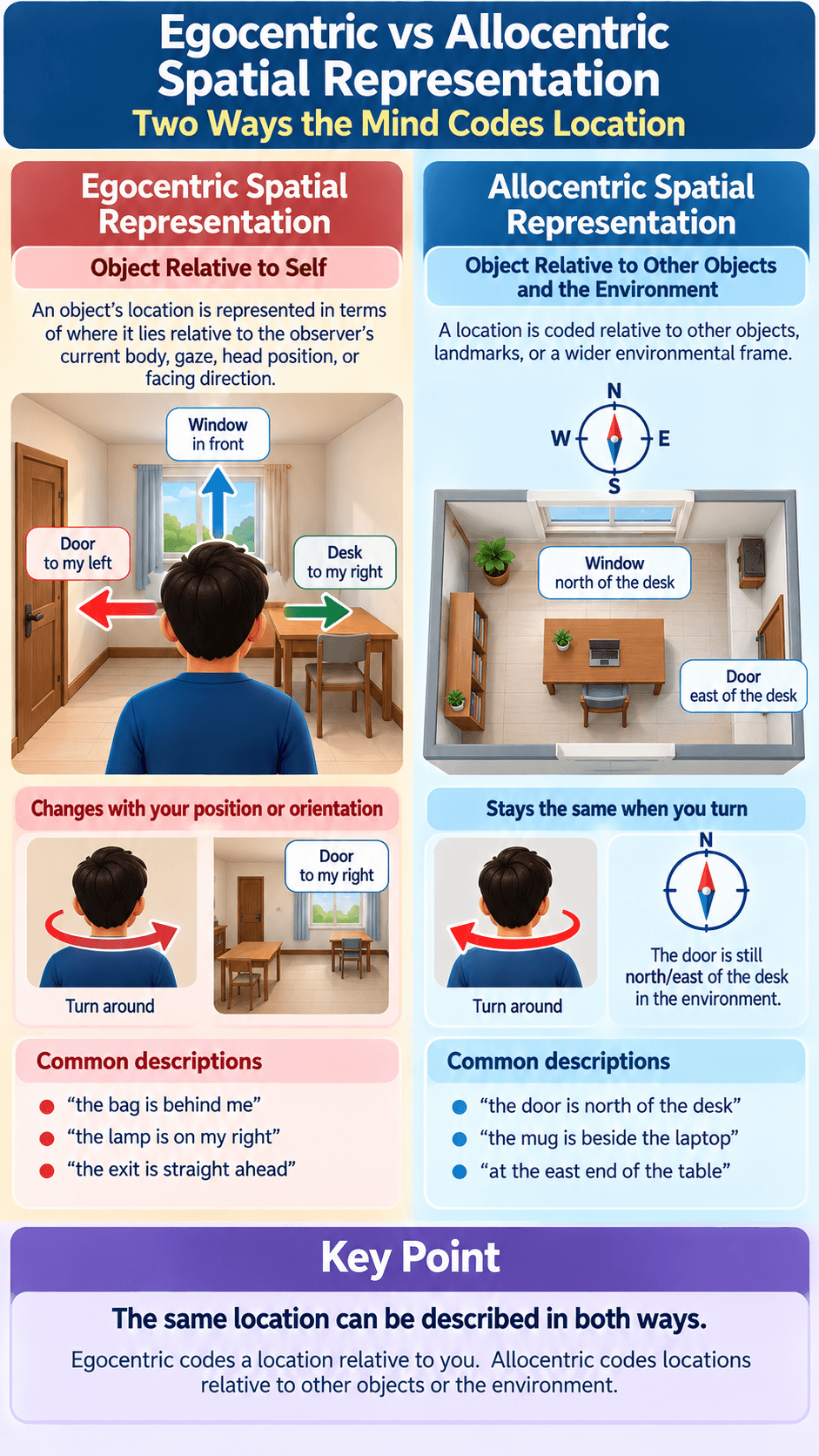
Egocentric spatial representation codes a location relative to the observer, such as “the door is on my left.” Allocentric spatial representation codes locations relative to other objects, landmarks, or a wider environmental frame, such as “the door is north of the desk.” People can use both forms, and neither one is inherently more advanced or better.
Why Spatial Reference Frames Matter
A spatial description needs an anchor. Without one, “left,” “near,” “behind,” or “north” may be incomplete. The anchor tells you what the relationship is measured from. In spatial cognition, a reference frame is a way of organizing those relationships so locations can be represented, remembered, compared, or used for action.
A review of egocentric and allocentric reference frames in humans describes the distinction in terms of where the coordinate system is anchored: egocentric coding uses the observer as a reference, while allocentric coding uses relations among objects or landmarks that are external to the observer.
The same location can be described from different anchors
Imagine a coffee mug on a meeting table. From your chair, the mug may be “in front of me and slightly to the right.” That is self-relative information. A coworker sitting across from you will have a different self-relative description of the same mug.
Now describe the mug as “beside the laptop” or “at the east end of the table.” Those descriptions use something outside the observer as the anchor. The first uses another object. The second uses a more stable environmental direction. Both descriptions can identify the same physical location, but they organize the relationship differently.
Reference frame is about coding relationships, not personality
In this context, egocentric does not mean selfish, self-absorbed, or unable to consider other people. It means that the spatial coordinates are centered on the observer, the observer’s body, or the observer’s current viewpoint. Likewise, allocentric does not mean generous or socially other-focused.
The same words are sometimes used in other areas of psychology with different meanings, which is why context matters. Here, the useful question is simply: What is the location being represented relative to?
Egocentric Spatial Representation: Object Relative to Self
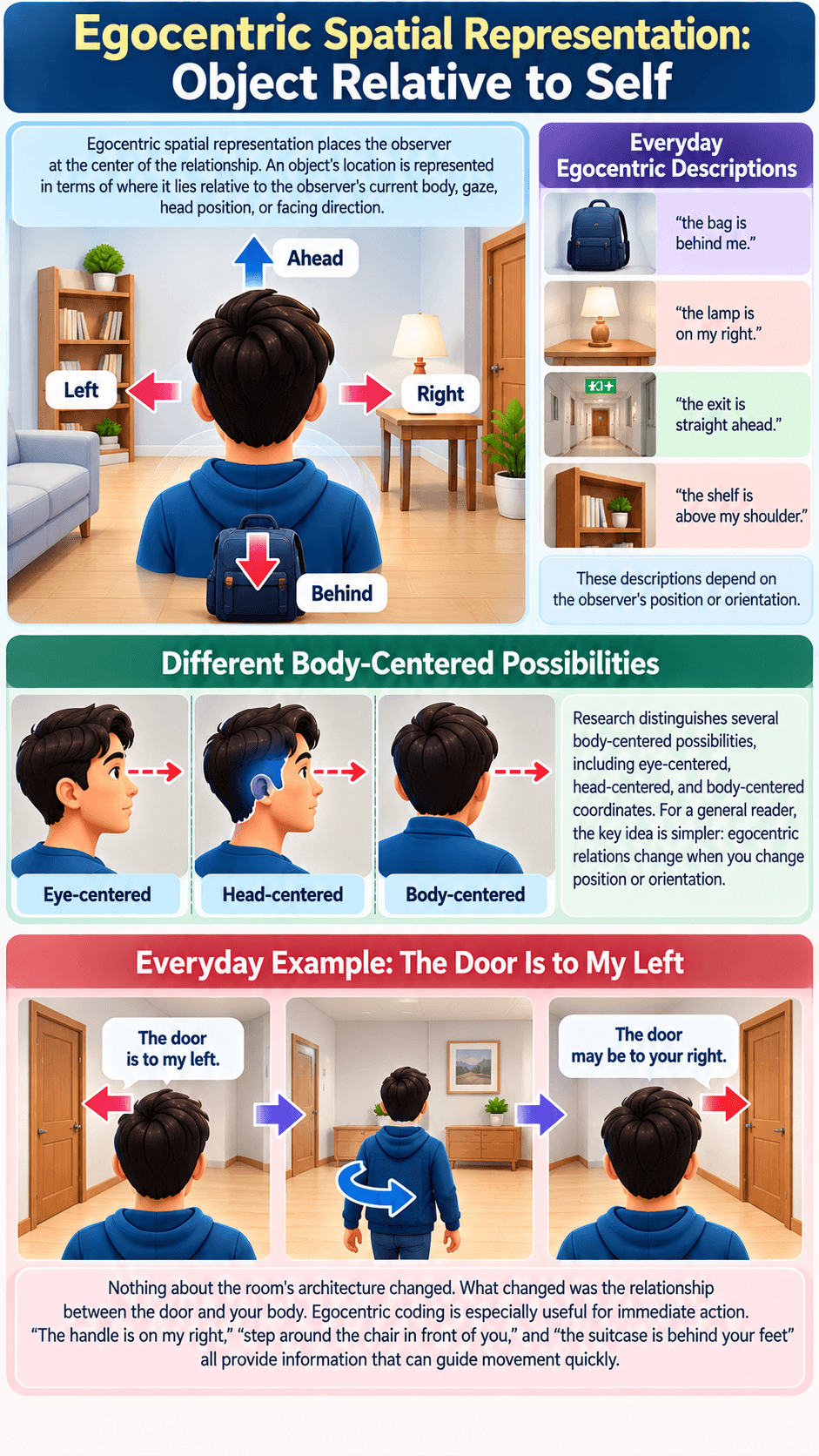
Egocentric spatial representation places the observer at the center of the relationship. An object’s location is represented in terms of where it lies relative to the observer’s current body, gaze, head position, or facing direction.
Body, viewpoint, left-right, front-behind, and current heading
Everyday language is full of egocentric spatial descriptions: “the bag is behind me,” “the lamp is on my right,” “the exit is straight ahead,” or “the shelf is above my shoulder.” These descriptions depend on the observer’s position or orientation.
Egocentric coding is not necessarily tied to one single point in the body. Research distinguishes several body-centered possibilities, including eye-centered, head-centered, and body-centered coordinates. A study of head and torso contributions to spatial reference frames illustrates why self-centered spatial judgments can depend on more than one bodily anchor.
For a general reader, the key idea is simpler: egocentric relations change when you change position or orientation. If an object stays still while you turn, its left-right or front-behind relation to you may change immediately.
Everyday example: the door is to my left
Suppose you enter a hotel room and say, “The bathroom door is to my left.” Walk to the opposite side of the room and turn around. The door may now be to your right. Nothing about the room’s architecture changed. What changed was the relationship between the door and your body.
This makes egocentric coding especially useful for immediate action. “The handle is on my right,” “step around the chair in front of you,” and “the suitcase is behind your feet” all provide information that can guide movement quickly without requiring a complete representation of the wider environment.
Allocentric Spatial Representation: Object Relative to Other Objects or the Environment

Allocentric spatial representation uses an anchor outside the observer. A location may be represented relative to another object, a landmark, a room, a boundary, a map-like layout, or a stable environmental direction.
Landmark, object, and environmental coordinates
Examples include “the pharmacy is beside the station,” “the chair is between the desk and the window,” or “the library is north of the park.” In each case, the relationship does not require your current body position to define it.
Human navigation research often describes allocentric representations as relatively independent of the navigator’s current view or direction. A broad review of human spatial navigation contrasts self-centered representations with externally referenced relationships among landmarks, while also emphasizing that people can use multiple forms of spatial information flexibly.
“Independent of the observer” should not be read too literally. People still learn about environments through perception and movement, and researchers debate how purely allocentric a given task or representation really is. The important distinction is that the coded relationship itself is anchored to external spatial structure rather than only to the observer’s current position.
Everyday example: the door is north of the desk
Imagine that the door is on the north wall and the desk sits near the center of the room. If you turn around, “the door is to my left” may become false, but “the door is north of the desk” can remain true.
The same logic works at larger scales. A train station may be east of a park whether you approach from the north, south, or west. The direction from you to the station changes as you move, while the station-to-park relation can remain stable.
Core Comparison: SELF → OBJECT versus OBJECT ↔ OBJECT / ENVIRONMENT
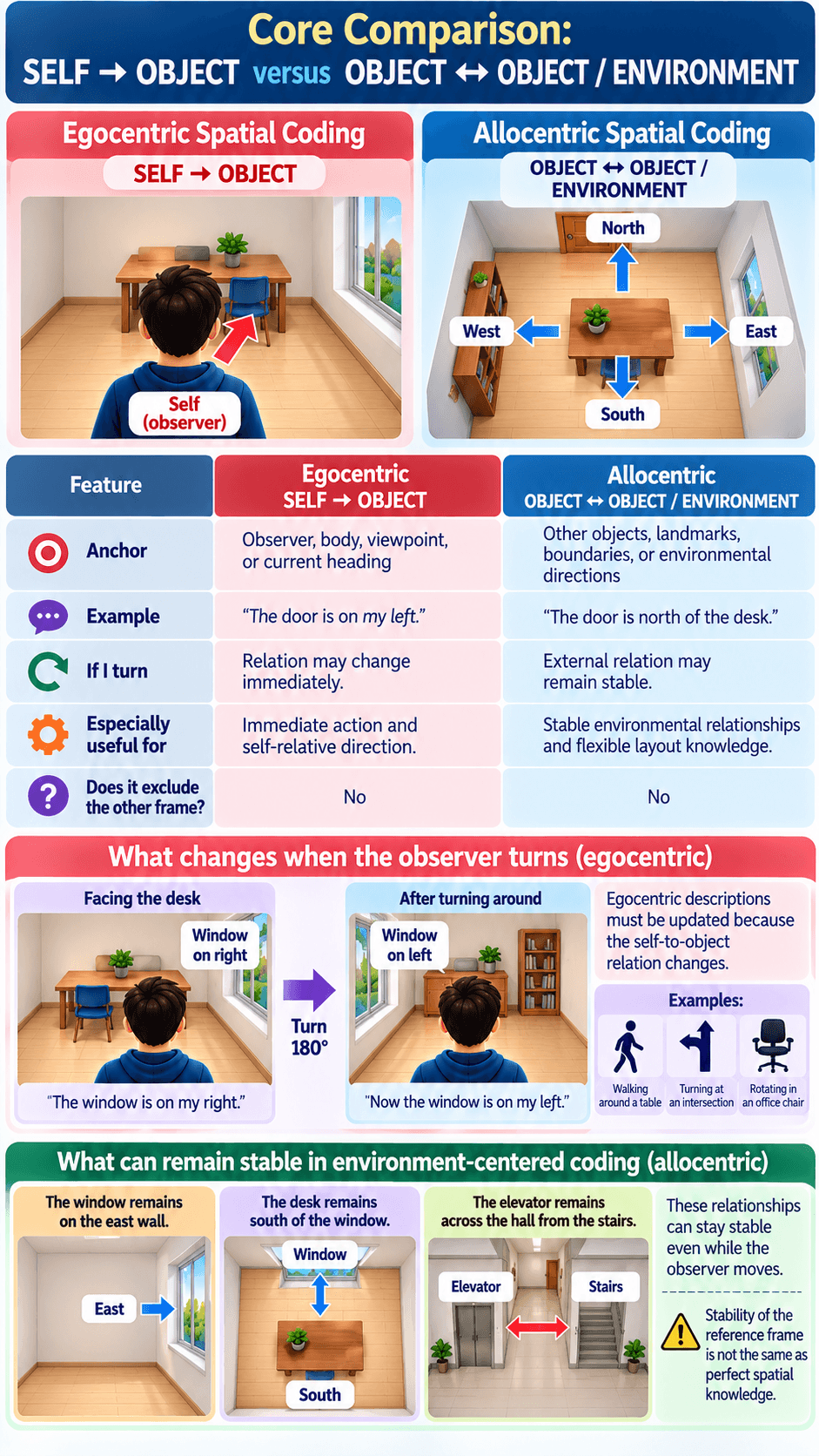
A useful mental model is to separate the two questions:
Egocentric: SELF → OBJECT
Allocentric: OBJECT ↔ OBJECT / ENVIRONMENT
This model is intentionally simple. Real spatial behavior often uses several frames together, but the contrast makes it easier to identify what a particular statement or task is asking you to represent.
| Question | Egocentric coding | Allocentric coding |
|---|---|---|
| What is the anchor? | The observer, body, viewpoint, or current heading | Other objects, landmarks, boundaries, or environmental directions |
| Example | “The door is on my left.” | “The door is north of the desk.” |
| What happens if I turn? | The relation may change immediately | The external relation may remain stable |
| Especially useful for | Immediate action and self-relative direction | Stable environmental relationships and flexible layout knowledge |
| Does it exclude the other frame? | No | No |
What changes when the observer turns
Stand facing a desk with a window on your right. Turn 180 degrees. The window is now on your left. An egocentric description must be updated because the self-to-object relation has changed.
This updating happens constantly in everyday movement. Walking around a table, turning at an intersection, or rotating in an office chair changes which objects are ahead, behind, left, or right of you. Self-relative coding therefore has to stay responsive to movement.
What can remain stable in environment-centered coding
External relationships can provide continuity across those changes. The window can remain on the east wall. The desk can remain south of the window. The elevator can remain across the hall from the stairs. These relations may support a more stable description of the layout even while your own position changes.
That does not mean allocentric knowledge is perfectly accurate. Distances and directions can be estimated poorly, landmarks can be misremembered, and environmental knowledge may be incomplete. Stability of the reference frame is not the same thing as perfect spatial knowledge.
When Egocentric Coding Is Especially Useful
Self-relative coordinates are closely connected to what you can do from where you are now. When you reach, step, turn, avoid an obstacle, or follow an instruction such as “take the door on your right,” the relation between your body and the relevant object matters directly.
Immediate action and self-relative direction
Imagine carrying a box through a narrow doorway. You do not need a full map of the building to avoid the chair near your left knee. What matters is the chair’s position relative to your current body and movement. The same principle applies when reaching for a cup, stepping around luggage, or lining yourself up with a doorway.
Research on navigation also describes egocentric representations as particularly relevant to immediate, viewpoint-linked spatial information. That does not make egocentric coding a crude fallback. It solves a different problem: how to connect current spatial relationships to the observer’s present position and possible action.
Updating relations as the body moves
Because the origin moves with you, egocentric relations need frequent updating. Walk past a bench and it changes from “ahead of me” to “beside me” and then “behind me.” Turn around at the end of a hallway and the side containing the elevators may reverse relative to your body.
This constant updating is one reason self-relative and environmental information can work well together. Egocentric coding tells you what the scene means from here. More stable external relations can help you understand how “here” fits into the larger layout.
When Allocentric Coding Is Especially Useful
Allocentric coding becomes especially useful when the goal depends on relationships that should remain meaningful across changes in your own viewpoint. This can include understanding a room layout, relating landmarks across a neighborhood, or thinking about where two places sit relative to each other when neither is directly in front of you.
Stable relations among landmarks and places
Suppose you know that the bank is west of the park and the station is north of the bank. Those relations can help organize the area even after you walk several blocks and your own facing direction changes repeatedly.
This kind of externally anchored structure is important in many accounts of environmental representation. However, allocentric representation should not automatically be equated with a complete cognitive map. A person may know several stable object-to-object relationships without possessing a detailed, unified representation of the entire environment.
Using environmental structure beyond the current viewpoint
Allocentric relations are particularly helpful when the relevant places cannot all be seen at once. You might know that a restaurant is behind a hotel from the perspective of a street map, even when the hotel blocks it from view. Or you may know that two hallways meet at the same lobby despite never seeing both hallways from one position.
A critical review of allocentric spatial representation warns against treating allocentric knowledge as a single pure, perfectly map-like system. Many experimental tasks appear to involve combinations of egocentric and allocentric information, which is a useful caution for everyday explanations too.
How the Two Reference Frames Can Cooperate

The most useful contrast is not “Which system do people use?” but “Which relationship matters at this moment, and how are different relationships being combined?” Human spatial behavior is often flexible rather than exclusive.
Translating between self-relative and environment-relative information
Imagine reading a map that shows a cafe east of the town square. The map gives you an externally organized relation. When you stand in the square, you still have to turn that information into an action: perhaps “walk straight ahead,” “turn right,” or “the cafe is behind me.”
That conversion is a practical example of reference-frame translation. Information that is stable in the environment has to become meaningful from your current position, and information gathered from your current viewpoint may later contribute to a more stable understanding of the environment.
Research reviews of human navigation repeatedly emphasize that egocentric and allocentric information can coexist. One review of interacting systems in spatial navigation notes substantial overlap and argues that the two forms are not always easy to isolate in real tasks.
Why neither system is inherently superior
Calling one frame “better” misses the purpose of having multiple ways to represent space. If you are reaching for a glass, self-relative coordinates may be exactly what matters. If you are planning how two streets connect across a neighborhood, stable relations among landmarks may be more useful.
Even within navigation, the best information depends on the task, scale, environment, familiarity, and available cues. A route through a small room may rely heavily on immediate self-relative relationships. A detour across a familiar town may benefit from broader environmental structure. People can shift emphasis without one mode replacing the other permanently.
Egocentric vs Allocentric vs Spatial Perspective Taking

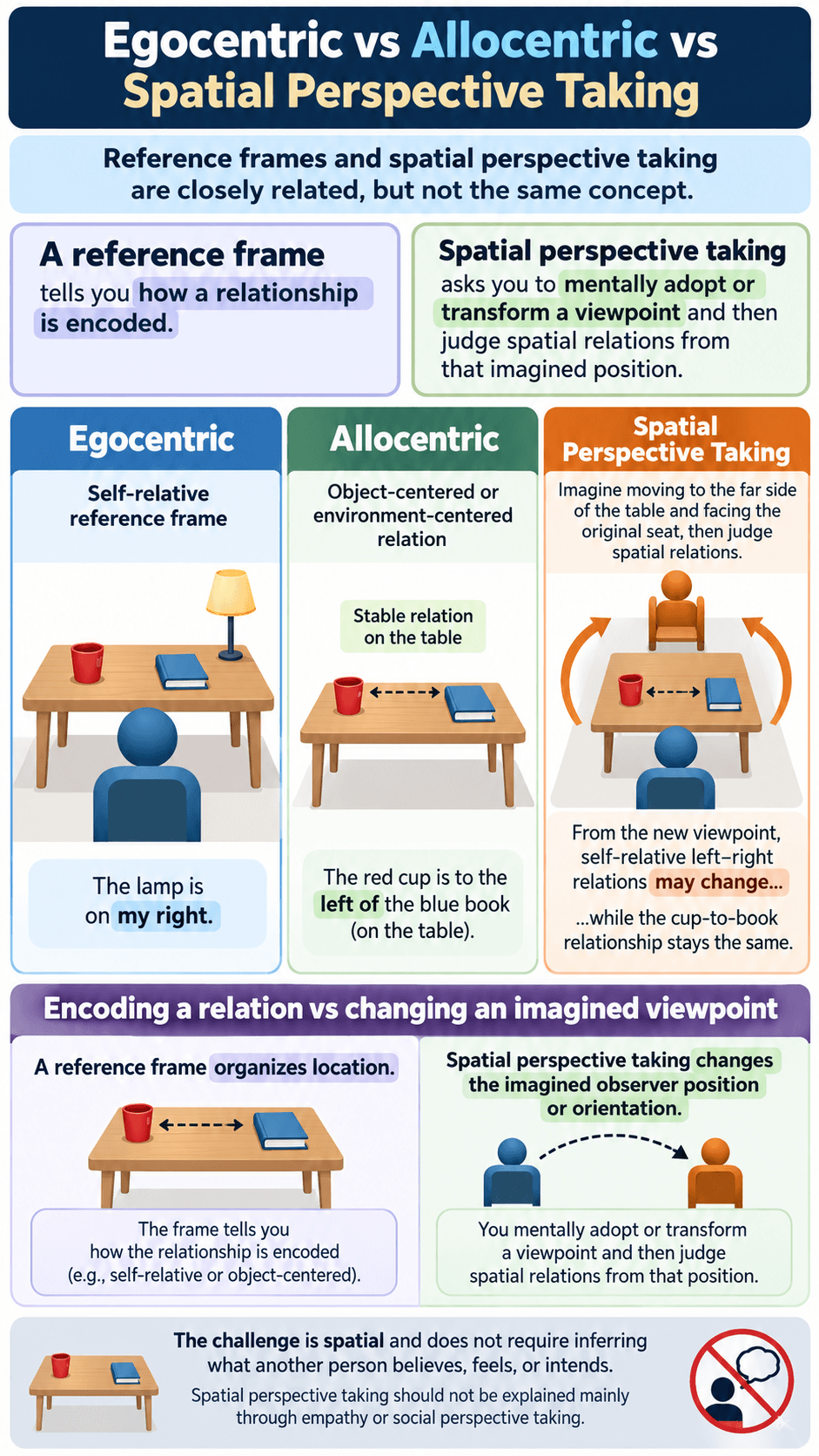
Reference frames and perspective taking are closely related, but they are not the same concept. A reference frame tells you how a relationship is encoded. Spatial perspective taking asks you to mentally adopt or transform a viewpoint and then judge spatial relations from that imagined position.
Encoding a relation versus changing an imagined viewpoint
If you say, “The lamp is on my right,” you are using a self-relative reference frame. You do not have to imagine standing somewhere else. If you then ask, “If I were standing on the opposite side of the table, where would the lamp appear?” you have added a viewpoint-transformation problem.
A review of spatial perspective taking describes egocentric, object-centered, and environment-centered representations while treating viewpoint transformation as an additional operation. This is a useful way to keep the concepts separate: the frame organizes location, while perspective taking changes the imagined observer position or orientation.
Example showing frame conversion without empathy language
Place a red cup to the left of a blue book on a table. From your current chair, both objects may be in front of you. Now imagine moving to the far side of the table and facing your original seat. Your self-relative left-right relationships may change, even though the cup-to-book relationship on the table remains the same.
The challenge is spatial. It does not require inferring what another person believes, feels, or intends. That is why spatial perspective taking should not be explained mainly through empathy or social perspective taking.
Egocentric vs Allocentric in Wayfinding and Orientation
Navigation gives both frames a practical job. To move through an environment, you may need to know where a destination lies in the larger layout and what direction it lies from your current position. These are connected questions, but not identical ones.
How reference frames contribute to spatial orientation
Spatial orientation concerns your current location and heading relative to your surroundings. Egocentric information can tell you that the exit is behind you. Environmental information may tell you that the exit is on the north wall. Together, those relations can help you interpret a turn, recover after becoming disoriented, or align yourself with a remembered layout.
Orientation therefore uses reference-frame information without being reducible to the reference-frame distinction itself. The broader question is not simply whether a location is self-centered or environment-centered, but how those relations help establish where you are and which way you face.
How reference frames contribute to broader environmental knowledge
A cognitive map is a broader representation of environmental structure. Egocentric and allocentric information may contribute to building or using that representation, but neither term should be treated as a synonym for “cognitive map.”
Similarly, wayfinding is the activity of getting to a destination. It can draw on self-relative turns, remembered landmarks, route sequences, environmental relations, current heading, and other information. Saying that a person is “using an allocentric frame” identifies one kind of spatial relation, not the entire navigation process.
Common Misunderstandings
The vocabulary is easy to misread because the same words appear in different areas of psychology and because simplified diagrams can make two flexible systems look like mutually exclusive boxes.
Egocentric spatial representation is not selfishness
“Egocentric” here is a coordinate term. A person can be considerate, empathic, and socially attentive while using egocentric spatial coding every few seconds. Reaching for a cup to your right or stepping around a suitcase in front of you says nothing about personality.
Allocentric does not mean less self-centered socially
Allocentric spatial coding refers to external spatial anchors. It does not mean that a person is more generous, cooperative, mature, or socially skilled. The terms may resemble personality language, but the spatial distinction is about geometry and reference.
People do not necessarily use only one frame at a time
Real tasks often mix information. You may know that the museum is east of the park while also tracking that the museum entrance is currently to your right. One description is environment-relative and the other is self-relative, and both can be useful at once.
Experimental studies also have difficulty creating completely “pure” tasks that isolate one frame from all others. That uncertainty is a reason to avoid statements such as “this person is an egocentric navigator” as if it were a fixed cognitive type.
A Simple Self-Check for Identifying the Reference Frame
When a spatial statement feels confusing, two questions usually reveal the frame being used.
Ask what the location is relative to
- If the answer is me, my body, my gaze, my current heading, my left, or my right, the relation is primarily egocentric.
- If the answer is another object, a landmark, a boundary, a room, a map direction, or the wider environment, the relation is primarily allocentric or externally referenced.
For example, “the elevator is behind me” is self-relative. “The elevator is across from the stairs” is externally referenced. The same elevator can be represented both ways.
Ask whether the relation changes when the observer turns
This is a useful second test. If you rotate in place and the relationship changes from left to right or front to behind, the description is probably tied to your current orientation. If the relationship remains “the cafe is north of the fountain” after you turn, it is anchored more strongly to the external environment.
There are edge cases. Words such as “left of the building” may depend on whether the building has an agreed intrinsic front, whether the speaker is using their own viewpoint, or whether a shared convention exists. Spatial language is flexible, so the self-check is a guide, not a rigid linguistic rule.
FAQ About Egocentric and Allocentric Spatial Representation
These questions clarify the places where spatial terminology is most easily confused with social concepts, navigation strategies, or viewpoint transformations.
Is egocentric spatial coding the same as egocentric bias?
No. Egocentric spatial coding means representing location relative to the observer’s body or viewpoint. Egocentric bias is a broader social or cognitive term used in other contexts. A spatial statement such as “the door is on my left” does not imply selfishness, poor empathy, or a personality trait.
Is allocentric representation always map-like?
No. Allocentric information can include stable object-to-object or landmark-to-landmark relationships without forming a complete, precise internal map. Environmental representations may be partial, approximate, hierarchical, or task-specific. Researchers also debate how often apparently allocentric tasks still depend partly on egocentric information.
Can both reference frames be active during navigation?
Yes. You might know that your destination lies east of a park while simultaneously tracking that the next doorway is on your right. Research on human navigation supports flexible use of self-centered and externally referenced information rather than a strict either-or model.
Is perspective taking the same as switching reference frames?
Not exactly. Spatial perspective taking requires imagining a different physical viewpoint or heading and judging the scene from there. That operation may involve recoding relationships, but the concept of a reference frame is broader. You can use an egocentric or allocentric description without performing an imagined viewpoint transformation.
Key Takeaways
- Egocentric spatial representation codes locations relative to the observer, body, viewpoint, or current heading.
- Allocentric spatial representation codes locations relative to other objects, landmarks, boundaries, or environmental structure.
- A self-relative relation may change when you turn, while an externally anchored relation can remain stable.
- People often combine both frames rather than relying exclusively on one.
- Egocentric and allocentric are spatial terms here, not judgments about selfishness, empathy, maturity, or social behavior.
- Reference frames describe how spatial relationships are encoded; spatial perspective taking adds the process of mentally changing the observer’s viewpoint.

Michael Reed is the Founder and Lead Writer at Psychology Exposed. He writes about human behavior, relationships, emotional patterns, self-awareness, and practical psychology topics using research-informed, easy-to-understand content.
Read More About Michael Reed: https://psychologyexposed.com/michael-reed/