

You can compare five laptops, read twenty reviews, check prices across several stores, and still feel as though you have not researched enough. The same problem appears with job offers, service providers, schools, travel plans, and major purchases. There is almost always another option or another piece of information to inspect.
Bounded rationality psychology starts from a practical fact: decisions are made with limited knowledge, mental capacity, time, and access to the future. It asks a better question than “Did I find the perfect option?” Namely, “Did I use my limited resources reasonably for this decision?”
Quick Answer
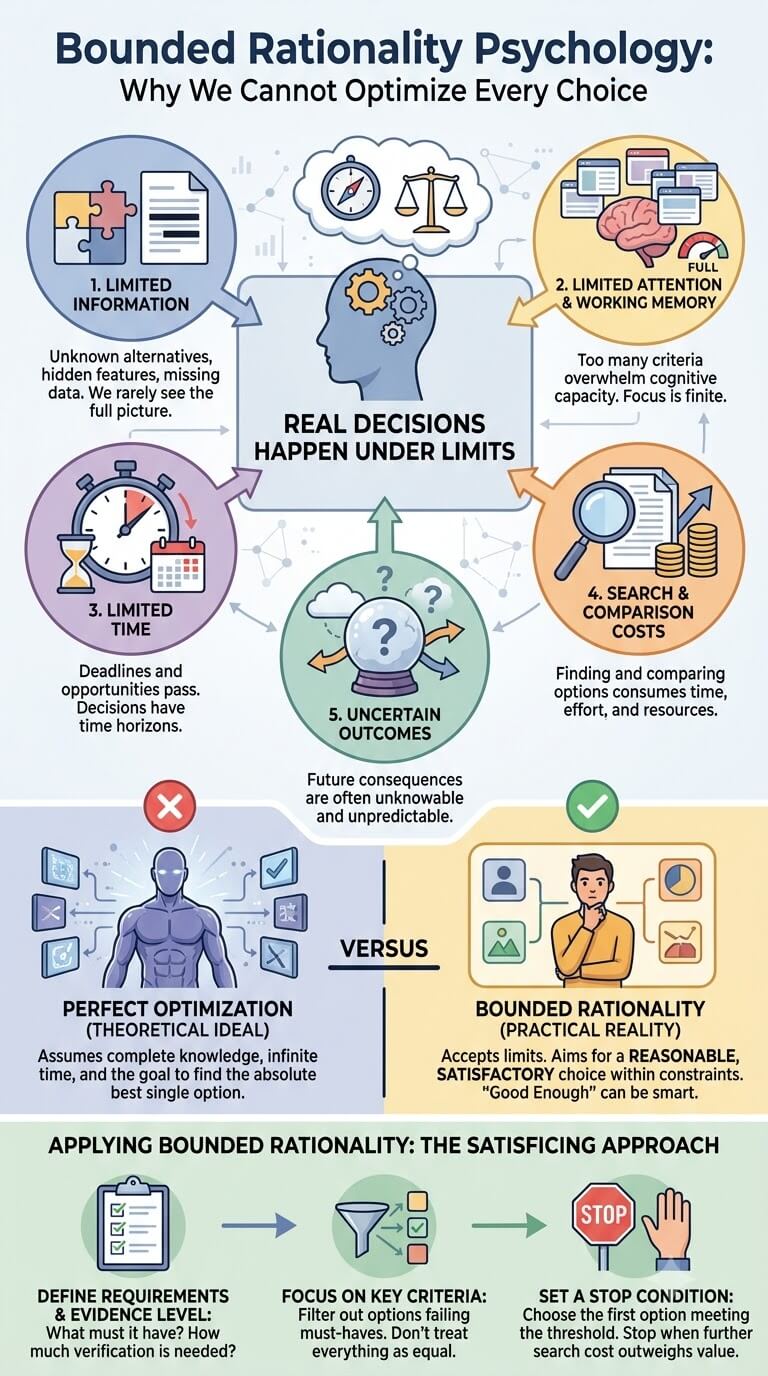
Bounded rationality is the idea that people try to make reasonable choices within limits such as incomplete information, limited attention and memory, time constraints, comparison costs, and uncertain outcomes. According to the APA Dictionary of Psychology, a decision can be rational within these constraints even when the person cannot identify the theoretically best possible option.
What Bounded Rationality Means in Psychology
Models of perfect rationality can be useful ideals. They assume a decision maker knows the relevant alternatives, can evaluate their consequences, and can select the option that best serves a stable goal.
Real choices are messier. We rarely know every option or every future consequence, and even available information takes time and effort to find. Bounded rationality treats those limits as part of the decision itself.
Rational goals inside real-world limits
Suppose you need to hire someone for a small team. You can review applications, interview candidates, check references, and compare relevant experience. You cannot observe how every candidate would perform for the next three years. You also cannot interview every qualified person in the labor market.
A reasonable process therefore uses a manageable set of criteria and stops after enough evidence has been gathered. The final hire might not turn out to be the best person who could theoretically have been found. That does not automatically make the process irrational. The process has to be judged in relation to what was knowable and feasible at the time.
Why bounded does not mean irrational
The word bounded can sound like a polite way of saying flawed. That misses the point. A person may make a disciplined, evidence-based choice while still operating inside hard limits. In fact, refusing to acknowledge those limits can produce its own problems, such as endless searching, unnecessary comparison, or spending more resources on a decision than the decision is worth.
Bounded rationality is best understood as a descriptive model of decision making under constraints. It is not a diagnosis, and it is not an excuse for ignoring information that is readily available and clearly important.
Herbert Simon and the shift away from perfect optimization
Herbert A. Simon helped establish this way of thinking by challenging the assumption that real decision makers routinely maximize across all possible alternatives. His work on decision processes in organizations was recognized with the 1978 Sveriges Riksbank Prize in Economic Sciences. The Nobel Prize overview of Simon’s contribution describes his argument that people often search for satisfactory solutions rather than a single mathematically best alternative.
That shift is powerful because it puts the decision environment back into the picture. How much time do you have? Which options are visible? What does it cost to keep searching? How much can you realistically compare at once? These questions are not side issues. They help define what a sensible choice process looks like.
The Five Limits That Bound a Decision
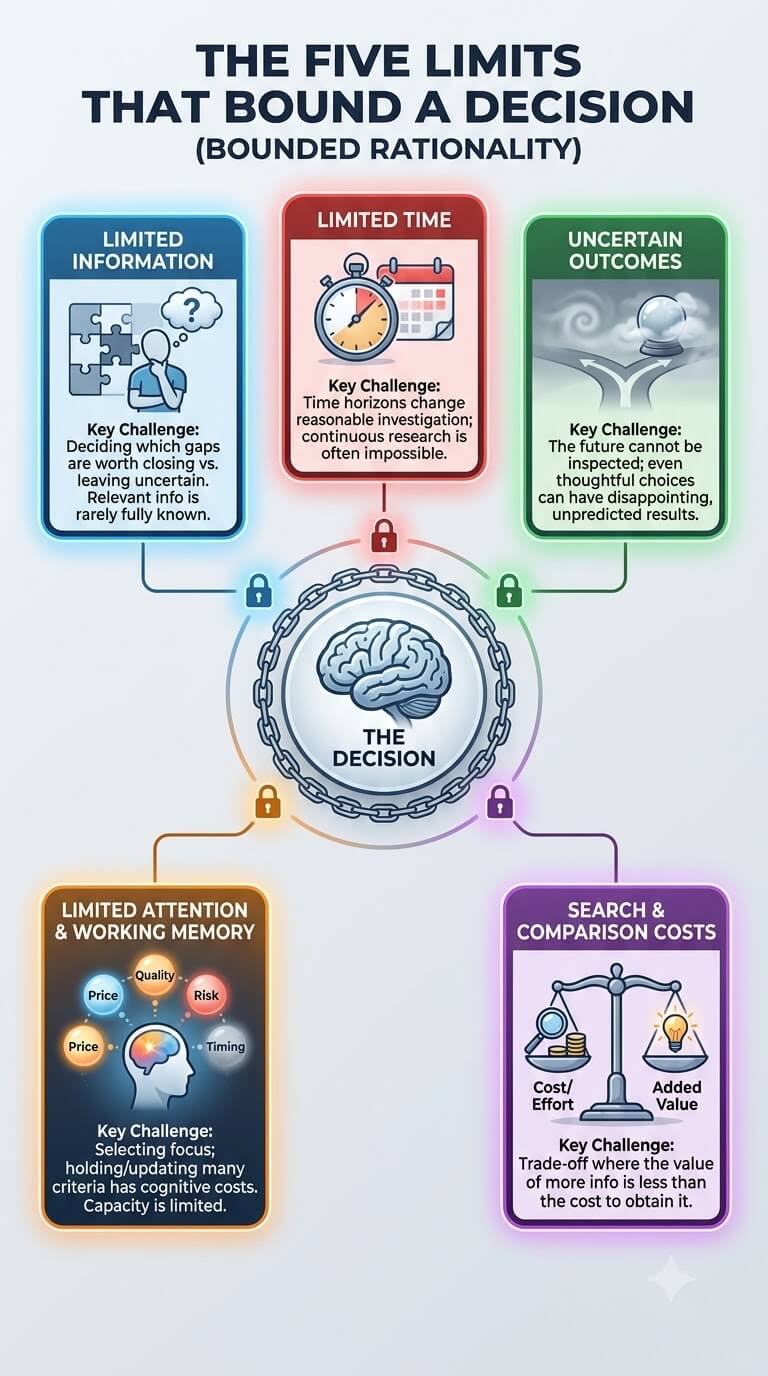
Bounded rationality becomes easier to use when you stop treating “limited thinking” as one vague problem. Different limits create different decision difficulties. Five are especially useful to separate.
Limited information
You rarely know everything that would be relevant to a choice. A job description does not reveal every future assignment. A product page does not tell you exactly how long the product will last. A first conversation with a service provider does not reveal how responsive that person will be six months later.
Sometimes the missing information can be obtained. Sometimes it cannot. The practical challenge is deciding which gaps are worth closing before you act and which must remain uncertain.
Limited attention and working memory
Complex choices ask you to hold several things in mind at once: price, quality, timing, compatibility, risk, convenience, and future consequences. The APA Dictionary’s explanation of working memory describes a system used to keep and manipulate information during demanding mental tasks, with a limited-capacity control component.
A decision with twelve interacting criteria can therefore be much harder than one with two. The task requires selecting what deserves attention and what can be temporarily ignored. Research on working-memory control in decision making also shows that maintaining and updating relevant information can carry measurable costs in speed and performance.
Limited time
Every decision has a time horizon, even when no formal deadline is printed on a calendar. The apartment may be rented to someone else. The sale may end. The project needs to start. The candidate may accept another job. A health or safety decision may need action sooner rather than later.
Time changes what can reasonably be investigated. A one-week decision cannot use the same search process as a six-month decision. This does not mean rushing is always wise. It means that “keep researching until nothing is uncertain” is often impossible.
Search and comparison costs
Information is not free simply because it is available online. Reviews, calls, comparisons, and conflicting opinions all consume time and attention. At some point, the expected value of more information can become smaller than the cost of obtaining it. Bounded rationality makes that trade-off visible.
Uncertain outcomes
Even perfect information about the present would not give you perfect information about the future. A company can change leadership. A neighborhood can change. A project can encounter an unexpected constraint. A person can make a thoughtful choice and still receive a disappointing outcome.
Open-access work on bounded rationality and real-world problem solving continues to emphasize that decision behavior has to be understood in relation to both cognitive limits and the environments in which people act. The future is one of those environmental limits because it cannot be completely inspected before a choice is made.
Why Perfect Optimization Is Often Impossible
Optimization asks a demanding question: which available option produces the best result? In simple, well-defined problems, that can be answerable. In many everyday choices, the ingredients required for a true optimum are missing.
The option set may be unknown
You cannot choose the best option from a set whose boundaries you do not know. When looking for a contractor, apartment, job, or software service, you usually see only part of the market. A better alternative might appear next week, exist in another city, or never show up in your search.
This makes “best possible” a slippery goal. The person is not merely comparing alternatives. They are also deciding how long to keep looking for alternatives that have not yet been found.
Future consequences cannot be fully predicted
Optimization also assumes that outcomes can be evaluated accurately. But many decisions have delayed consequences. A higher-paying job may offer less autonomy. A cheaper product may require more maintenance. A convenient short-term solution may create a long-term cost that is difficult to estimate in advance.
Prediction improves with relevant evidence, but uncertainty does not disappear simply because a decision feels important.
Criteria can conflict
Many hard choices are not hard because the information is missing. They are hard because the values conflict. One apartment is cheaper but farther from work. Another is quieter but smaller. A third has more space but a less flexible lease.
There may be no option that wins on every dimension. A decision then becomes a trade-off problem rather than a search for an objectively dominant answer.
New information has a cost
Imagine researching a $40 household purchase for four hours to save a possible $3. The search itself has consumed resources. For a low-stakes, reversible choice, that effort may not be proportionate. A useful process therefore considers whether the resources spent deciding fit the stakes.
Satisficing: Choosing an Option That Meets a Threshold
One response to bounded rationality is satisficing. Instead of searching until the best imaginable option has been identified, a person defines what counts as acceptable and chooses an option that meets that standard.
What an aspiration level or threshold does
A threshold turns an open-ended search into a decision rule. For example, someone choosing a hotel might require a safe location, a maximum price, reliable Wi-Fi, and a commute under thirty minutes. Once an option clears those conditions, it becomes eligible for selection.
The threshold does not need to be crude. It can include several must-haves and a small number of preferences. Its purpose is to prevent the search from expanding indefinitely simply because another option might be marginally better.
Why good-enough can be adaptive
“Good enough” is often misunderstood as settling carelessly. In bounded rationality, it can mean matching effort to reality. If you have enough evidence to meet the decision’s important requirements, continuing the search may produce very little additional value.
Reviews of rationality in applied decision settings have described satisficing as a response to the fact that optimization can be computationally and resource intensive. One open-access discussion of satisficing and context-sensitive rationality highlights the importance of adapting a decision process to the demands of the environment rather than treating one ideal procedure as appropriate everywhere.
When a threshold should be stricter
A threshold should rise when the stakes rise, consequences are hard to reverse, or avoidable harm is possible. Choosing a lunch spot can tolerate a loose standard. Hiring a contractor for major structural work deserves a stricter evidence threshold. Decisions involving health, legal obligations, financial commitments, or safety may require qualified professional input rather than a simple personal rule.
Satisficing is not a reason to lower standards indiscriminately. It is a way to define standards before unlimited search takes over.
Bounded Rationality vs Maximizing
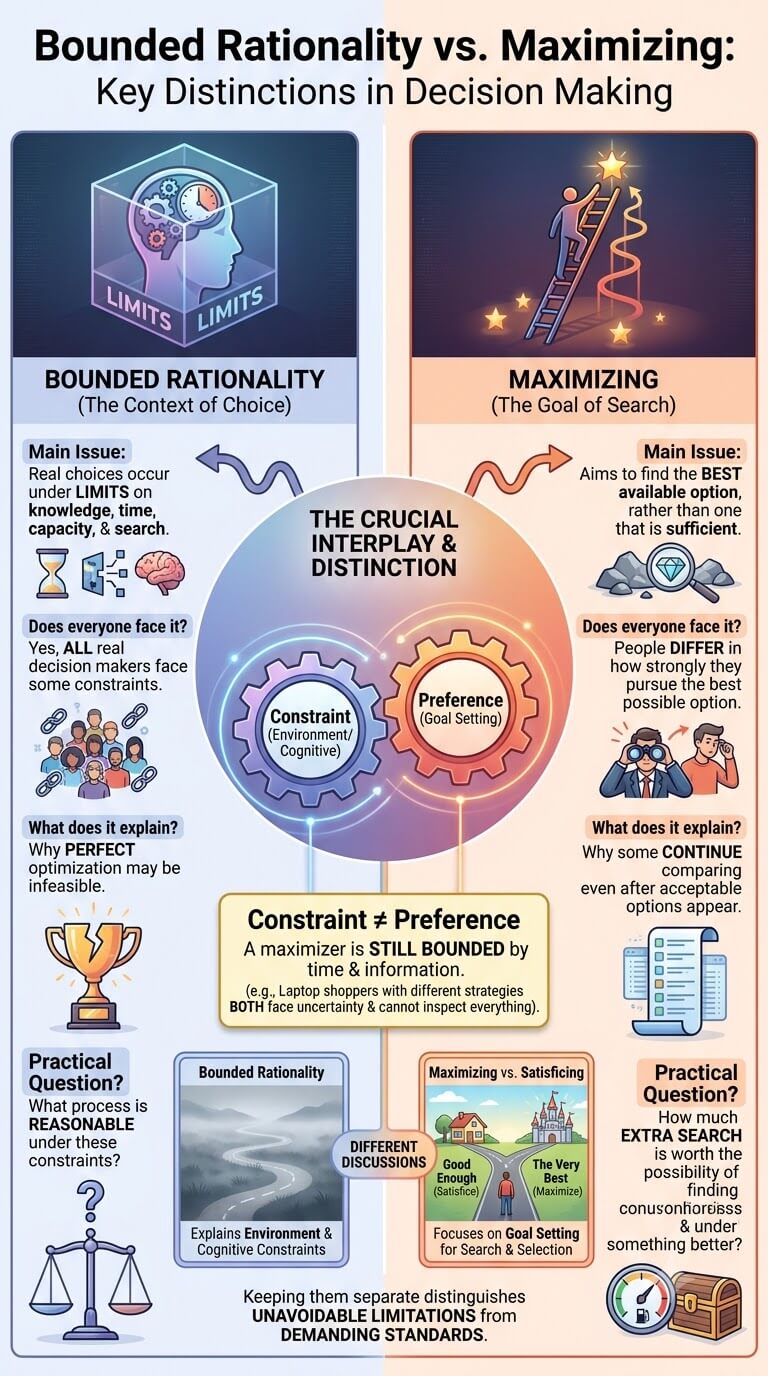
These ideas are related but not interchangeable. Confusing them can make a person think bounded rationality is simply a personality preference for “good enough.” It is broader than that.
| Question | Bounded rationality | Maximizing |
|---|---|---|
| What is the main issue? | Real choices occur under limits on knowledge, time, capacity, and search. | The person aims to find the best available option rather than one that is sufficient. |
| Does everyone face it? | Yes, all real decision makers face some constraints. | People can differ in how strongly they pursue the best possible option. |
| What does it explain? | Why perfect optimization may be infeasible. | Why some people continue comparing even after acceptable options appear. |
| What is the practical question? | What process is reasonable under these constraints? | How much extra search is worth the possibility of finding something better? |
Constraint is not the same as preference for the best possible option
A person can strongly prefer the best option and still be bounded by time, information, and attention. Likewise, someone who is comfortable choosing an acceptable option still faces uncertainty about whether that option will work as expected.
A maximizer is still bounded by time and information
Imagine two people shopping for a laptop. One stops after finding a model that meets six defined requirements. The other keeps comparing because they want the best balance of performance, price, battery life, and build quality. Their search strategies differ, but neither can inspect every laptop in the world or know exactly how each machine will perform over five years.
Why the two concepts belong in different discussions
Bounded rationality explains the environment and cognitive constraints surrounding choice. Maximizing versus satisficing focuses more closely on how people set goals for search and selection. Keeping them separate makes it easier to ask whether the problem is unavoidable limitation or an unusually demanding standard for what counts as “enough.”
Bounded Rationality vs Choice Overload
Choice overload is another nearby idea, but it has a narrower center of gravity. It asks what happens when the number or complexity of options makes choosing more difficult. Bounded rationality exists even when the menu is small.
Too many options are one possible constraint
If you have fifty nearly similar insurance plans, the comparison burden can become substantial. More options mean more attributes to inspect, more combinations to consider, and more chances to wonder whether an overlooked alternative is better.
Those limits become especially visible when too many options make comparison harder, because each additional alternative can add more work than useful information.
Bounded rationality also exists with only two options
Consider two job offers. There are only two alternatives, yet you still do not know future managers, promotion opportunities, team stability, or how your priorities may change. The number of options is small, but the information and future remain bounded.
This is why reducing the option count can make a decision easier without removing the deeper limits on what can be known.
How People Simplify a Complex Choice
Simplification is not automatically a mistake. When it is deliberate and aligned with what matters, it can make a decision more usable. The key is to simplify the problem without accidentally removing the criteria that should carry the most weight.
Eliminate options that fail must-have criteria
If an option fails a true requirement, continuing to compare its minor advantages wastes attention. A renter who needs public transit access can remove properties outside a realistic commute range. A business owner who needs a tool to integrate with a specific system can eliminate products that do not support that integration.
This works best when “must-have” means genuinely necessary, not “everything I would ideally like.”
Focus on a few high-value attributes
Some decisions become unmanageable because every feature is treated as equally important. Instead, identify the attributes that would meaningfully change the outcome. For a phone, that might be battery life, camera quality, price, and software support. Color options may matter, but not enough to dominate the decision.
Stop searching when the expected value of more information is low
The hardest simplification is often knowing when to stop. Ask what one more hour of searching is realistically likely to change. If it could reveal a safety issue, major hidden fee, or crucial incompatibility, keep looking. If it is likely to produce ten more versions of information you already have, stopping becomes more reasonable.
A Constraint Audit Before You Decide

A useful way to apply bounded rationality is to audit the limits before trying to solve the choice. This shifts attention away from the fantasy of unlimited research and toward the conditions that actually shape the decision.
What information is actually available?
List what you know, what you could reasonably find out, and what cannot be known in advance. This prevents unknowable questions from masquerading as research tasks.
For example, you may be able to verify a company’s current benefits and turnover data. You cannot verify exactly how fulfilled you will feel there in eighteen months.
What is the true deadline?
Separate a real deadline from self-imposed urgency. If an offer expires Friday, that is a constraint. If you simply feel uncomfortable leaving the question open, that is different. Knowing the actual window helps you allocate research time without pretending you have forever or rushing unnecessarily.
Time is itself one of the boundaries on rational choice, which is why decisions made under a deadline often use narrower search and earlier stopping rules.
What can be reversed later?
Reversibility changes the amount of analysis a choice deserves. Trying a monthly software subscription is different from signing a five-year contract. A reversible decision can often be made with less evidence because correction remains available.
Which criteria deserve attention?
Choose a small number of criteria tied to the purpose of the decision. If everything is important, nothing has a clear role in the comparison. Rank the must-haves first, then the preferences.
What search cost is reasonable?
Decide how much time, money, and mental effort the decision deserves before you start. This creates a budget for deciding. A $20 purchase and a career move should not consume the same amount of research, but neither should a career move automatically consume unlimited research.
Examples of Bounded Rationality Without Calling the Choice Bad
Examples are useful because bounded rationality is easiest to see when a choice looks reasonable even though the person clearly lacks complete information.
Hiring with incomplete information
Situation: A manager has eighty applications and two weeks to hire. Reading every application for an hour, interviewing every qualified candidate, and testing every relevant skill would exceed the available time.
What the decision maker may feel: Concern that narrowing the pool early means missing a better candidate.
What it may mean: The hiring task has search costs and unknown future performance. A structured shortlist based on job-relevant criteria is a response to those limits, not proof that the manager does not care about quality.
What to do next: Define the evidence that matters most, use the same core criteria across candidates, and reserve deeper investigation for the smaller group that clears the initial threshold.
Choosing a service provider
Situation: A homeowner needs a plumber. There are dozens of listings, uneven reviews, different prices, and no way to test long-term workmanship before hiring.
What the decision maker may feel: Pressure to keep searching until one provider looks unquestionably best.
What it may mean: The market is only partly visible, and reviews are incomplete signals. More searching may improve confidence for a while, then produce diminishing returns.
What to do next: Check licensing or qualifications where relevant, recent credible reviews, availability, price range, and a small number of direct questions. Once a provider meets the threshold, decide whether more search is likely to reveal something important.
Planning with an uncertain future
Situation: Someone chooses whether to move closer to family. They can estimate housing costs, commute changes, and current relationships, but they cannot know future job changes, health needs, or how the neighborhood will feel years later.
What the decision maker may feel: Frustration that such an important choice cannot be made with certainty.
What it may mean: Importance does not remove uncertainty. Some major decisions remain partly irreversible and partly unknowable even after careful research.
What to do next: Separate present facts from forecasts, test the most consequential assumptions, identify what could be adjusted later, and judge the process by the quality of the reasoning rather than demanding a guaranteed outcome.
When Limits Become Overload or Urgency
Bounded rationality provides the background for several other decision problems. Those problems deserve separate attention because each changes the decision environment in a different way.
More options can increase comparison cost
As the number of relevant alternatives grows, it may take more effort to inspect and compare them. The practical response can include filtering, grouping, or reducing the active set. The important point here is that option count affects the amount of processing required, rather than proving that more choice is always harmful.
Time pressure can force earlier stopping
A deadline may require you to stop searching before you would prefer. That changes the balance between information quality and speed. Under genuine urgency, the best available process may involve identifying the most decision-changing facts rather than trying to complete a full comparison.
Uncertainty can make information search open-ended
When outcomes are unclear, each answer can generate another question. Research can continue because the person is trying to remove uncertainty that the environment cannot fully remove. A stopping rule is especially helpful here because it distinguishes “I need one more critical fact” from “I want certainty before I act.”
Some limits come from information that is unavailable now, while others come from uncertainty that cannot be removed before the choice.
What to Do Next: Set a Decision Threshold Before You Search
The most practical use of bounded rationality is not lowering your standards. It is deciding what adequate evidence and adequate performance mean before endless comparison begins.
Define must-haves
Write two to four requirements that an acceptable option must satisfy. These should connect directly to the purpose of the decision. If an option misses one, remove it unless the requirement itself deserves revision.
Define a reasonable evidence level
Ask what you need to verify before acting. A low-stakes purchase may need basic specifications and a few reliable reviews. A major contract may need written terms, references, cost comparisons, and professional advice. The evidence level should rise with stakes and irreversibility.
Define a stop condition
Choose in advance what will tell you the search is complete. For example: “I will compare four qualified providers, ask the same five questions, and choose among those that meet my requirements.” A stop condition protects you from changing the rules every time a new possibility appears.
A simple version is:
- Requirements: What must be true?
- Evidence: What must I verify?
- Budget: How much time and effort is reasonable?
- Stop: What will tell me I have enough to choose?
This is not a formula for guaranteeing the best outcome. It is a way to make the decision process proportionate to the problem.
FAQ About Bounded Rationality
These questions clarify where bounded rationality differs from poor reasoning, cognitive bias, or simply having too little information.
Is bounded rationality the same as irrational decision making?
No. Bounded rationality specifically recognizes that a person can reason sensibly while facing limits on knowledge, attention, time, computational capacity, and access to future outcomes. An irrational choice may violate the person’s own goals or ignore clearly relevant information, but a bounded choice simply acknowledges that no real person can process everything.
What is a simple example of bounded rationality?
Choosing a restaurant from a short list is a simple example. You may use distance, price, dietary needs, current ratings, and whether a table is available. You do not inspect every restaurant in the city or predict the exact quality of tonight’s meal. You make a reasonable choice using the information and time available.
Why does satisficing make sense under bounded rationality?
Satisficing gives the search a stopping point. If an option meets a well-chosen set of requirements, continuing to search has to justify its extra cost. This can be adaptive when additional comparison is unlikely to change the decision enough to repay the time and attention it consumes.
Can more information remove bounded rationality?
More useful information can improve a decision, but it cannot remove all bounds. New information takes time to process, some facts remain unavailable, and future consequences cannot be known with certainty. The better question is whether the next piece of information is likely to change the decision in a meaningful way.
Is bounded rationality a cognitive bias?
No. Bounded rationality is a broad model of decision making under constraints. A cognitive bias refers to a more specific systematic tendency in judgment or reasoning. Biases can occur within bounded decision processes, but the existence of limits does not mean every simplified choice is biased or mistaken.
Key Takeaways
- Bounded rationality describes reasonable decision making under limits, not a failure to think rationally.
- Five common bounds are incomplete information, limited attention and working memory, limited time, search costs, and uncertain outcomes.
- Perfect optimization is often impossible because the full option set and future consequences are not knowable.
- Satisficing can be sensible when a clearly defined option meets an appropriate threshold and more search has little expected value.
- Bounded rationality is broader than maximizing, choice overload, or time pressure, even though those topics can interact with it.
- A practical next step is to define requirements, evidence needs, a decision budget, and a stop condition before you search.

Michael Reed is the Founder and Lead Writer at Psychology Exposed. He writes about human behavior, relationships, emotional patterns, self-awareness, and practical psychology topics using research-informed, easy-to-understand content.
Read More About Michael Reed: https://psychologyexposed.com/michael-reed/