
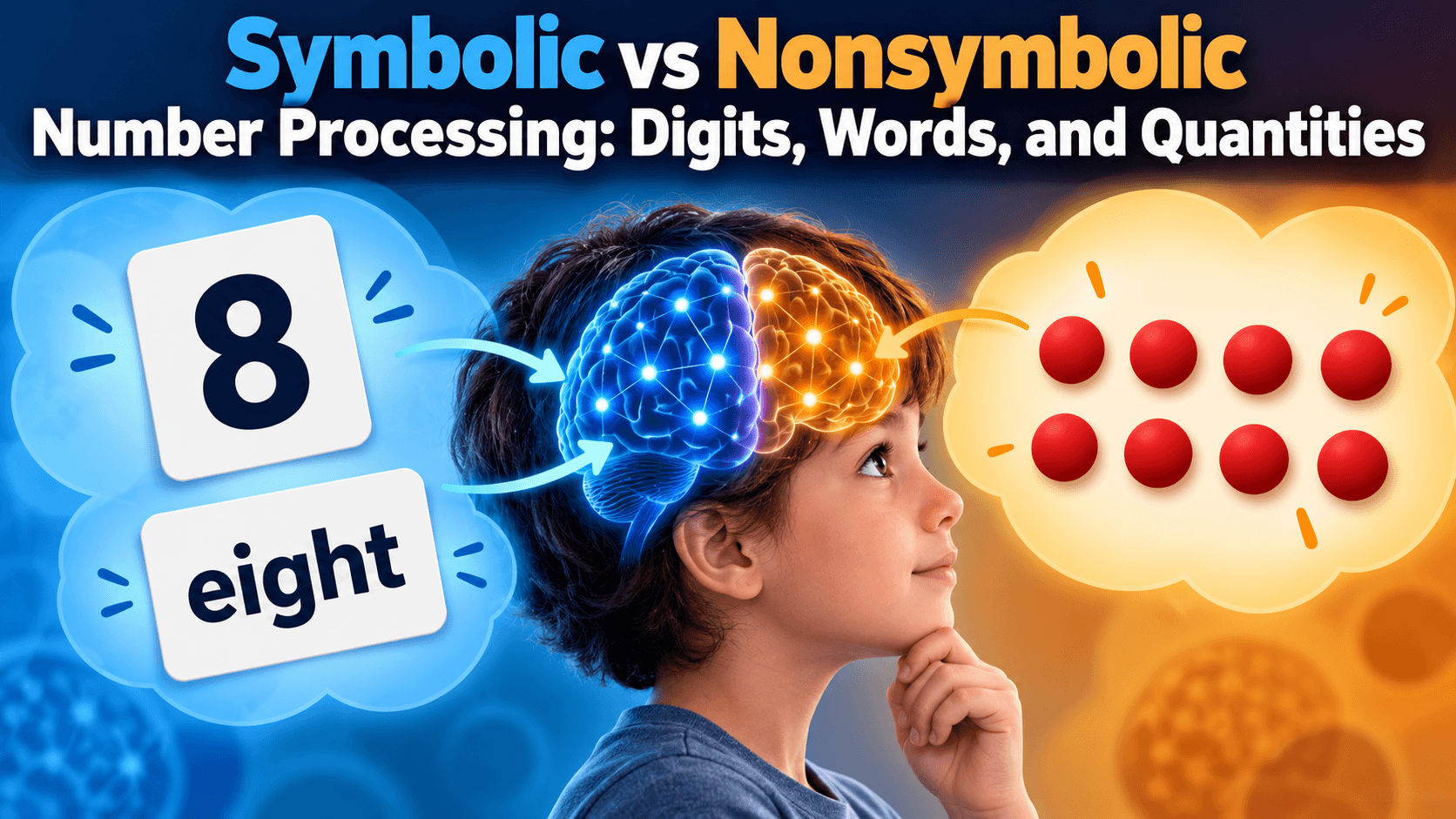
The digit 8, the word eight, and a display containing eight dots can all point to the same numerical quantity. Psychologically, however, they are not identical inputs. The digit is a learned visual symbol. The word is a learned linguistic symbol. The dots are a perceptual set whose numerosity must be extracted from the display.
This distinction is the heart of symbolic versus nonsymbolic number processing. Symbolic processing deals with culturally learned representations such as Arabic digits and number words. Nonsymbolic processing deals with quantities presented without conventional number symbols, such as dot arrays or collections of objects.
The interesting question is not merely whether both formats can represent “eight.” It is how numerical meaning becomes available from each format, whether the formats share one common magnitude representation, and how learned symbols acquire meaning in the first place. Those questions remain active areas of research, so a careful explanation needs to separate what is well established from what is still theoretically debated.
Quick Answer
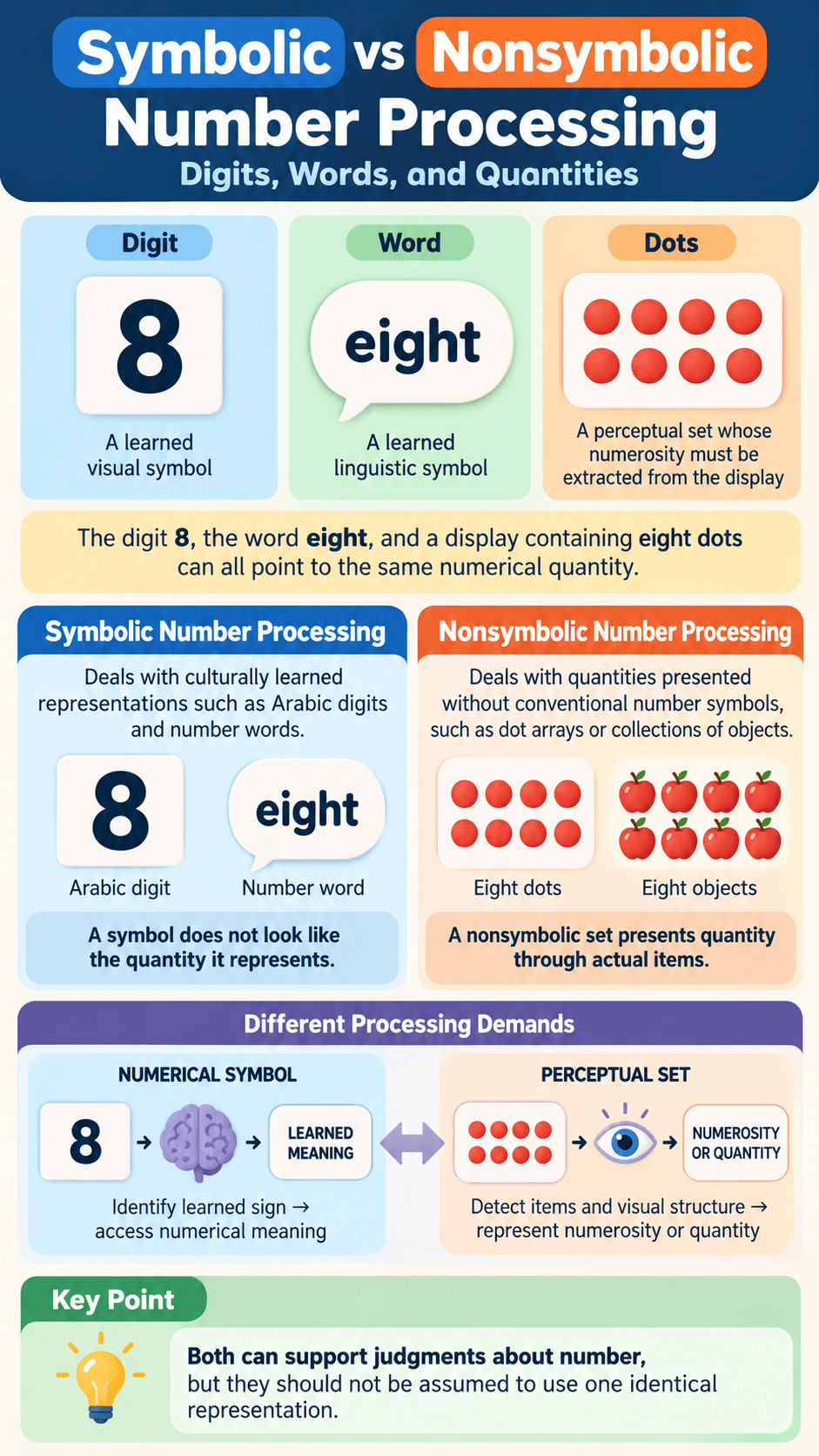
Symbolic number processing involves learned numerical symbols such as digits and number words, while nonsymbolic number processing involves quantities presented directly as sets of objects or dots. Both can support judgments about number, but they should not be assumed to use one identical representation. Researchers continue to debate how symbols acquire numerical meaning and how closely symbolic magnitude is tied to nonsymbolic quantity representations.
The Basic Difference: Symbols vs Presented Quantities
Symbolic examples: 8 and “eight”
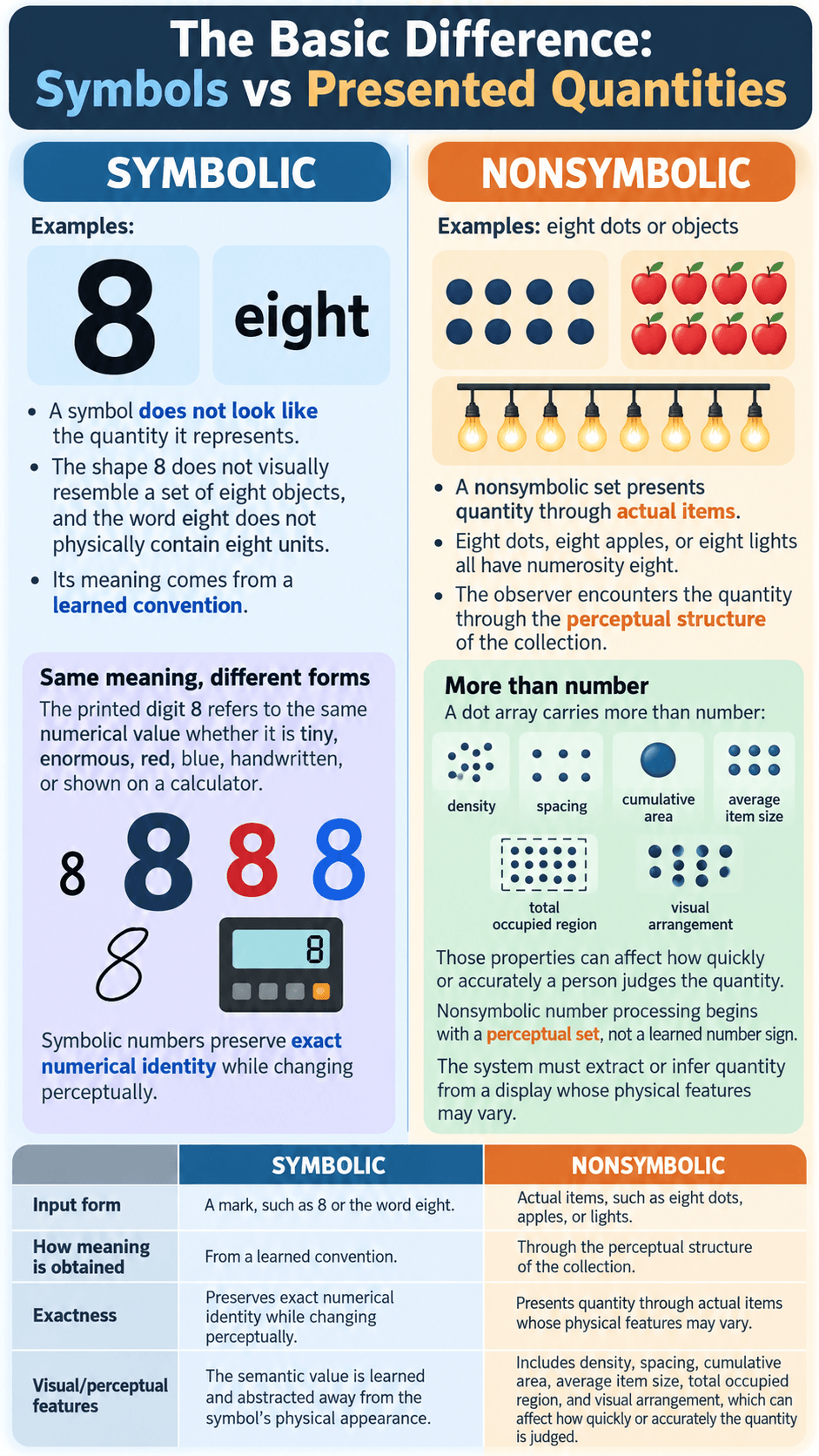
A symbol does not look like the quantity it represents. The shape 8 does not visually resemble a set of eight objects, and the spoken or written word eight does not physically contain eight units. Its meaning comes from a learned convention.
This arbitrary relationship is what makes numerical symbols powerful. Once learned, a compact mark can represent an exact value regardless of the size, color, arrangement, or physical identity of the objects being counted. The printed digit 8 still refers to the same numerical value whether it is tiny, enormous, red, blue, handwritten, or shown on a calculator.
Symbolic numbers can therefore preserve exact numerical identity while changing perceptually. The semantic value is learned and abstracted away from the symbol’s physical appearance.
Nonsymbolic example: eight dots or objects
A nonsymbolic set presents quantity through actual items. Eight dots, eight apples, or eight lights all have numerosity eight, but the observer encounters the quantity through the perceptual structure of the collection.
That matters because a dot array carries more than number. It also has density, spacing, cumulative area, average item size, total occupied region, and visual arrangement. Those properties can affect how quickly or accurately a person judges the quantity.
Nonsymbolic number processing therefore begins with a perceptual set, not a learned number sign. The system must extract or infer quantity from a display whose physical features may vary.
What Symbolic Number Processing Involves
Culturally learned digits
Arabic digits are highly efficient numerical symbols because they give exact values in a compact visual format. A person who knows the symbol system does not need to see seven objects to understand the numerical value of 7.
Processing a familiar digit can involve identifying the visual symbol, accessing its numerical meaning, comparing it with another number, recognizing its position in an ordered sequence, or using it in arithmetic. These operations are related but not identical.
Research on symbolic number processing shows that symbolic numerical meaning has properties that go beyond a simple copy of nonsymbolic quantity. For example, symbolic numbers participate strongly in ordinal relationships such as 2, 3, 4. An open-access study of ordinality and symbolic numbers found important distinctions between processing the order of symbolic numbers and processing their cardinal magnitude.
Number words
Number words are symbolic too. “Seven” represents a numerical value even when no seven-item set is visible. Unlike Arabic digits, number words are embedded in language, so their processing also involves lexical and phonological knowledge.
Digits and number words can point to the same exact value while arriving through different perceptual formats. The symbol “5” is visual and compact. The word “five” is linguistic and can be heard or read. Both are learned representations rather than direct perceptual quantities.
This is one reason symbolic number processing should not be reduced to visual digit recognition. The numerical meaning can be carried by several symbol systems.
Learned associations and numerical meaning
When children or new learners first encounter a digit, the mark itself has no built-in quantity. Meaning has to be acquired. The learner gradually connects number words, counting routines, exact cardinal values, symbolic order, and written digits.
The question of how these connections become stable is often called the numerical symbol-grounding problem. One influential view proposes that symbols gain meaning by being mapped onto pre-existing nonsymbolic approximate magnitude representations. Other accounts argue that direct relationships among symbols, such as their learned order and arithmetic relationships, become increasingly important.
A detailed evaluation of the numerical symbol-grounding problem argues that evidence for a simple one-way ANS mapping account is not decisive and develops an alternative account based more strongly on symbol-to-symbol associations.
What Nonsymbolic Number Processing Involves
Dot arrays and object sets
Nonsymbolic number tasks often use dot arrays because dots are easy to manipulate experimentally. A participant might see two arrays and choose which contains more dots, or briefly view one array and estimate its quantity.
Everyday examples are less artificial. You may notice that one plate contains more cookies than another, that one checkout line has fewer people, or that one patch of flowers is denser with blossoms. These judgments can occur without conventional number symbols appearing at all.
Numerosity and approximate quantity
The numerosity of a set is its number of discrete items. When sets become too large to subitize and are shown too briefly to count, quantity judgments are often approximate. The observer can distinguish “more” from “less” without knowing the exact cardinal value.
This kind of processing is often studied in connection with the Approximate Number System. However, nonsymbolic processing is broader than the ANS label alone. Small-set enumeration, exact counting when enough time is available, grouped quantity judgments, and other perceptual number tasks also involve nonsymbolic input.
Why visual variables must be considered
If one dot array contains more items, it may also cover more area, look denser, or extend across a larger region. Participants can use those features consciously or unconsciously.
That means a nonsymbolic task does not automatically provide a pure measure of numerosity. Researchers must design stimuli so that nonnumerical features do not consistently reveal the correct answer. This methodological issue is one reason comparisons between symbolic and nonsymbolic performance need careful interpretation.
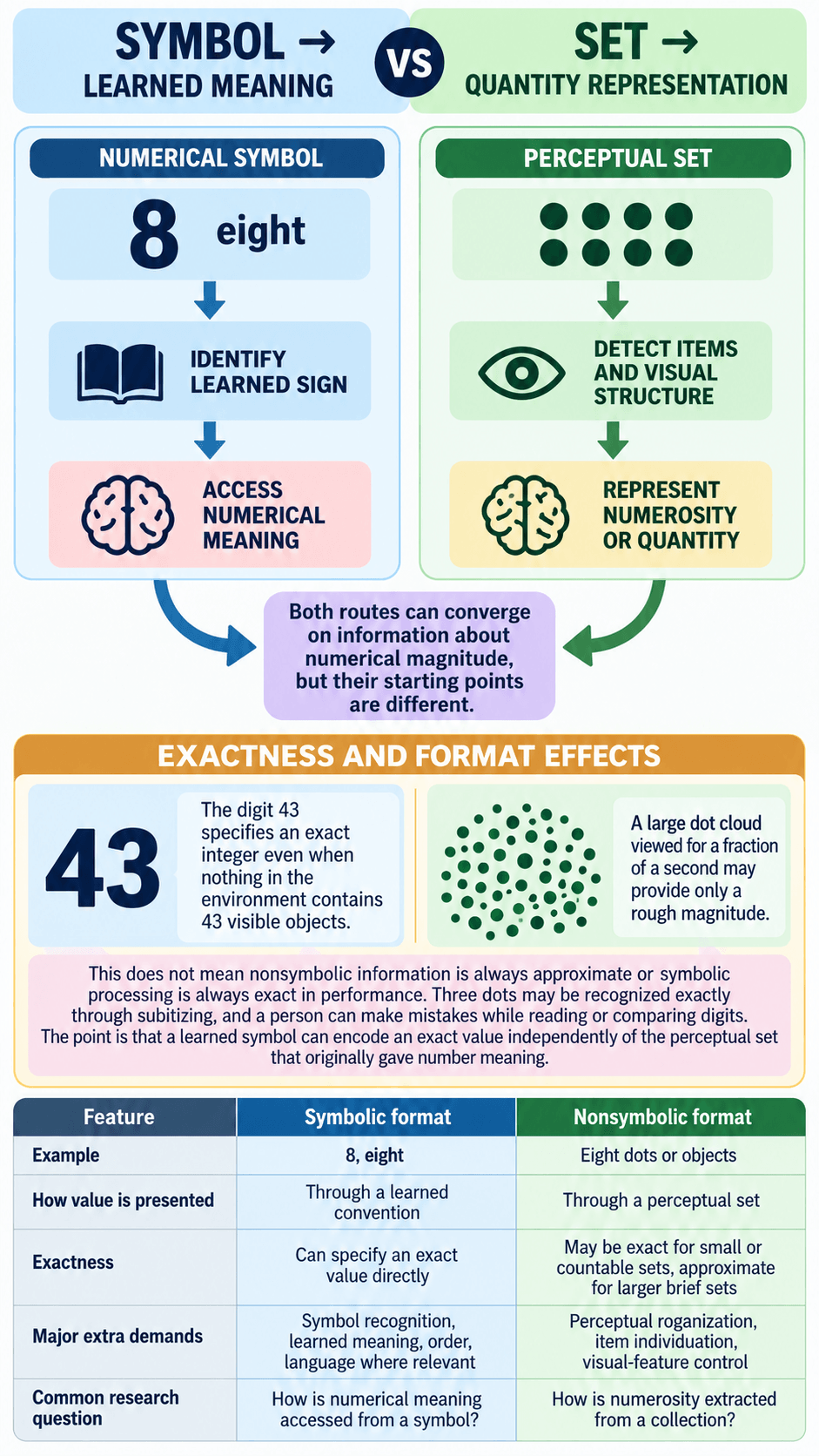
SYMBOL → LEARNED MEANING vs SET → QUANTITY REPRESENTATION
Why the two formats create different processing demands
A useful contrast is:
NUMERICAL SYMBOL → IDENTIFY LEARNED SIGN → ACCESS NUMERICAL MEANING
PERCEPTUAL SET → DETECT ITEMS AND VISUAL STRUCTURE → REPRESENT NUMEROSITY OR QUANTITY
These routes can converge on information about numerical magnitude, but their starting points are different. A symbolic task requires knowing a convention. A nonsymbolic task requires processing a physical collection.
Cross-format comparisons can therefore be harder than they appear. Comparing “8” with an eight-dot array requires the mind to relate two representational formats, not simply compare two visually similar stimuli.
Exactness and format effects
Symbols are especially useful for exactness. The digit 43 specifies an exact integer even when nothing in the environment contains 43 visible objects. A large dot cloud viewed for a fraction of a second may provide only a rough magnitude.
This does not mean nonsymbolic information is always approximate or symbolic processing is always exact in performance. Three dots may be recognized exactly through subitizing, and a person can make mistakes while reading or comparing digits. The point is that a learned symbol can encode an exact value independently of the perceptual set that originally gave number meaning.
| Feature | Symbolic format | Nonsymbolic format |
|---|---|---|
| Example | 8, eight | Eight dots or objects |
| How value is presented | Through a learned convention | Through a perceptual set |
| Exactness | Can specify an exact value directly | May be exact for small or countable sets, approximate for larger brief sets |
| Major extra demands | Symbol recognition, learned meaning, order, language where relevant | Perceptual organization, item individuation, visual-feature control |
| Common research question | How is numerical meaning accessed from a symbol? | How is numerosity extracted from a collection? |
The Symbol-Grounding Question
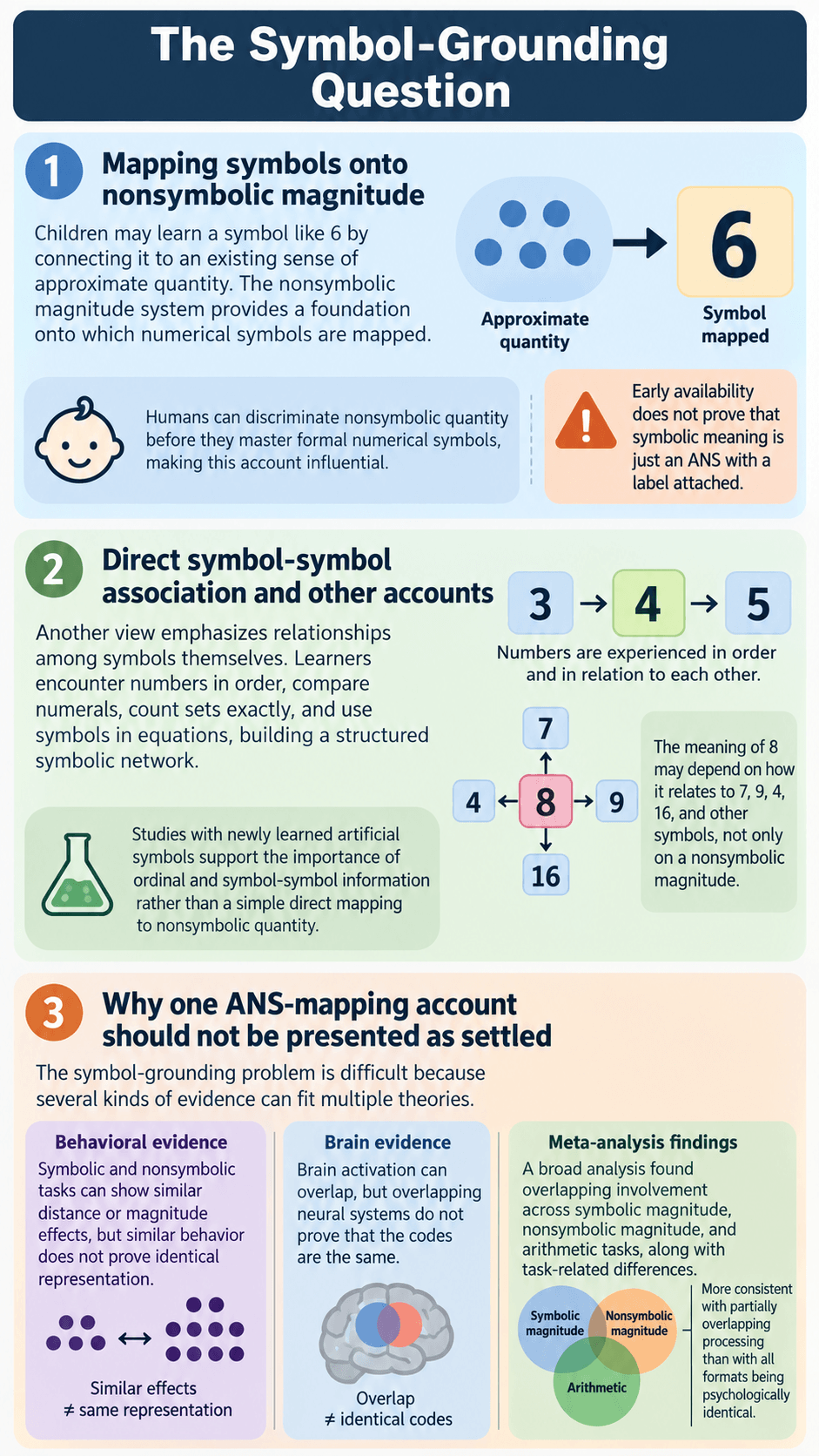
Mapping symbols onto nonsymbolic magnitude as one influential account
A natural hypothesis is that children learn a symbol such as 6 by connecting it to an already available sense of approximate quantity. On this account, the nonsymbolic magnitude system provides a semantic foundation onto which numerical symbols are mapped.
This ANS mapping account has been influential because humans can discriminate nonsymbolic quantity before they master formal numerical symbols. It also fits the intuition that the symbol “6” needs to connect somehow with collections containing approximately or exactly six items.
However, early availability does not by itself prove that mature symbolic meaning is simply an ANS representation with a label attached. Symbolic mathematics becomes much more exact and relational than approximate dot-array discrimination.
Direct symbol-symbol association and other accounts
An alternative view emphasizes relationships among symbols themselves. Learners encounter 4 between 3 and 5, hear number words in an ordered sequence, compare written numerals, count sets exactly, and use symbols in arithmetic equations. These experiences can build a structured symbolic network.
Under this view, the meaning of 8 may depend partly on knowing how it relates to 7, 9, 4, 16, and other symbols, not only on activating a fuzzy nonsymbolic magnitude.
Experimental work with newly learned artificial symbols provides a useful test because researchers can control what information is taught. An open-access study of artificial numerical symbols found evidence consistent with the importance of ordinal and symbol-symbol information rather than a simple direct mapping from symbols to nonsymbolic quantity.
Why one ANS-mapping account should not be presented as settled
The symbol-grounding problem is difficult because several kinds of evidence can appear compatible with multiple theories. Symbolic and nonsymbolic number tasks can show similar distance or magnitude effects, but similar behavior does not prove identical representation. Brain activation can overlap, but overlapping neural systems do not prove that the codes are the same.
A broad meta-analysis of numerical cognition studies found overlapping involvement across symbolic magnitude, nonsymbolic magnitude, and arithmetic tasks while also identifying task-related differences. This is more consistent with partially overlapping numerical processing than with an oversimplified claim that all formats are psychologically identical.
Magnitude Access and Semantic Access
What it means to access numerical meaning
Suppose you see the digit 9. Identifying its visual shape is not yet the same as using its numerical meaning. To decide whether 9 is larger than 4, the system must access information relevant to numerical magnitude or learned numerical relations.
Semantic access refers to moving beyond the physical form of a sign to the concept it represents. With numbers, that may include cardinal magnitude, ordinal position, parity, arithmetic relations, or learned associations depending on the task.
This is why “number meaning” should not be treated as one single property. Different tasks ask for different aspects of what a numerical symbol means.
Symbolic comparison versus nonsymbolic comparison
In a symbolic comparison, the observer might choose which digit is larger: 3 or 8. The perceptual size of the printed characters can be held constant, so the relevant difference is their learned numerical value.
In a nonsymbolic comparison, the observer might choose between three dots and eight dots. Now numerical magnitude is embedded in two visual collections, and continuous visual features must be considered.
Both tasks can be described as “which is more?”, yet the route to the answer differs. This distinction becomes especially important when researchers compare speed or accuracy across formats.
Symbolic vs Nonsymbolic vs ANS vs Magnitude Representation
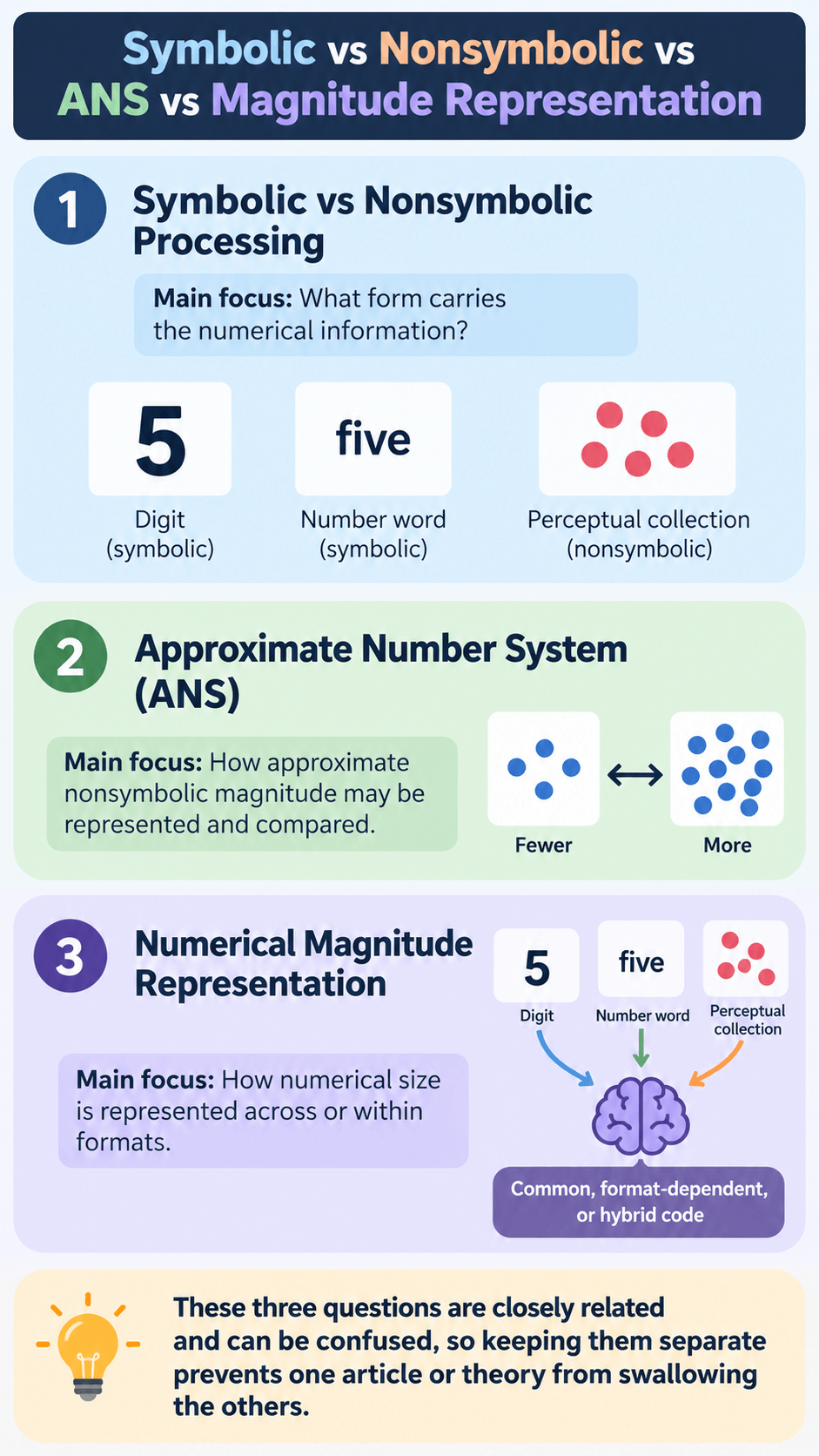
Format comparison
Symbolic versus nonsymbolic processing asks what form carries the numerical information? Is the input a digit, a number word, or a perceptual collection?
Specific approximate nonsymbolic system
The Approximate Number System asks a narrower question about how approximate nonsymbolic magnitude may be represented and compared. It is one proposed account within the broader world of nonsymbolic numerical processing.
Broader representation of numerical size
Numerical magnitude representation asks how numerical size itself is represented, including whether different formats converge on a common code, remain partly format-dependent, or use a hybrid arrangement.
These three questions are close enough to be confused, so keeping them separate prevents one article or theory from swallowing the others.
| Question | Main focus |
|---|---|
| Symbolic vs nonsymbolic processing | Representation format |
| Approximate Number System | Approximate nonsymbolic magnitude |
| Numerical magnitude representation | How numerical size is coded across or within formats |
Why Symbols and Quantities Should Not Be Treated as Interchangeable
Cultural learning
Nonsymbolic quantity discrimination can occur without formal education. Conventional digits and written number words, by contrast, must be learned within a cultural symbol system.
That learning changes what humans can do with number. Symbols make it possible to represent exact large values, preserve them over time, write multi-step calculations, communicate precise quantities, and build relationships that are difficult to express with perceptual sets alone.
Research on numerical cognition therefore distinguishes evolutionary older quantity-processing abilities from culturally acquired symbolic systems without assuming that one simply replaces the other.
Task effects
A person can look excellent at symbolic comparison but less accurate on a noisy dot-array task, or the reverse. That difference can reflect familiarity, visual processing, task reliability, symbolic knowledge, attention, or strategy.
Performance gaps do not automatically reveal a single underlying ability. They may show that the two tasks place different demands on the observer.
Exact and approximate distinctions
Learned symbols allow exact values to remain stable even when no matching set is present. Nonsymbolic large-set representations are often approximate, particularly under brief viewing conditions.
This exactness difference is one reason symbolic mathematics cannot be reduced to ANS acuity. The symbol system supports numerical structures that go well beyond rough quantity discrimination.
How Counting Connects Symbols With Exact Sets
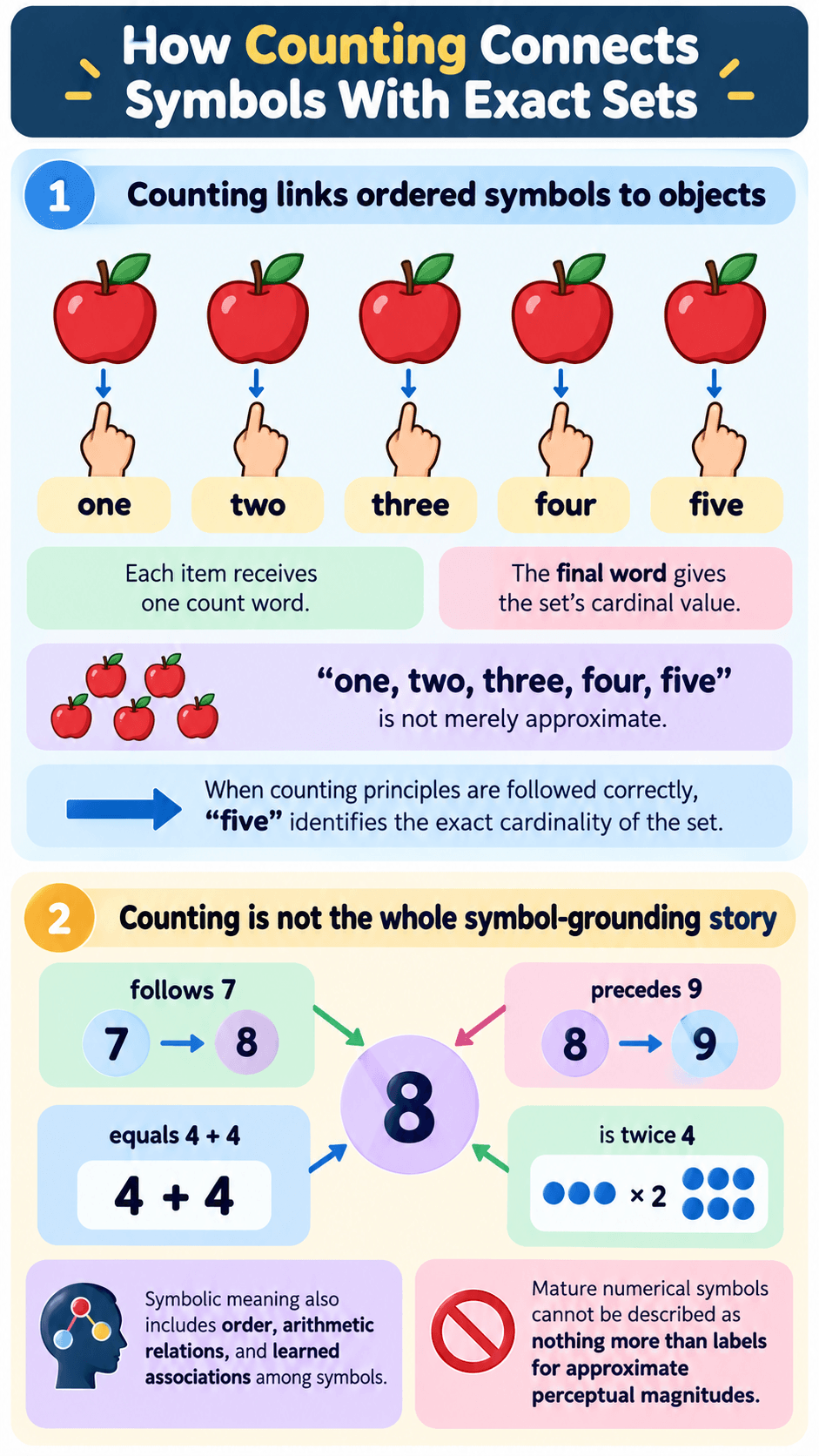
Counting links ordered symbols to objects
Counting is one important bridge between symbolic and nonsymbolic number. A child or adult can point to objects while producing an ordered sequence of number words. Each item receives one count word, and the final word gives the set’s cardinal value.
This creates a relationship between a perceptual collection and an exact symbolic label. The sequence “one, two, three, four, five” is not merely approximate. When counting principles are followed correctly, “five” identifies the exact cardinality of the set.
Counting is not the whole symbol-grounding story
Exact counting is clearly important, but symbolic meaning also includes order, arithmetic relations, and learned associations among symbols. Knowing that 8 follows 7, precedes 9, equals 4 + 4, and is twice 4 gives the symbol a rich relational position within the number system.
This is another reason mature numerical symbols cannot be described as nothing more than labels for approximate perceptual magnitudes.
A Practical Test: What Kind of Numerical Input Are You Using?
When a numerical task feels confusing, first ask what form the information takes:
- You see “27.” The quantity arrives through a learned symbolic digit sequence.
- You hear “twenty-seven.” The quantity arrives through a linguistic symbol.
- You see a brief cloud of dots. The quantity arrives through a perceptual set and may be represented approximately.
- You count 27 objects one by one. Nonsymbolic objects are being mapped onto an exact symbolic sequence.
- You compare 27 with 31. Learned symbols are being used to access numerical relations or magnitude.
This simple classification does not tell you the full mechanism, but it prevents a common conceptual error: treating all numerical information as though it enters the mind in the same form.
FAQ
Is the digit 8 processed the same way as eight dots?
Not necessarily. The digit 8 is a learned symbol whose numerical meaning must be accessed from a conventional visual sign. Eight dots present a perceptual set whose numerosity can be extracted from the display. The two formats can converge on related numerical information, but research does not justify assuming that their processing is identical.
Are number words symbolic numbers?
Yes. Number words such as “three,” “eight,” and “twenty” are conventional linguistic symbols for numerical values. They differ perceptually from Arabic digits, but both are learned symbolic formats rather than direct perceptual collections of items.
Is all nonsymbolic number processing the Approximate Number System?
No. The ANS is specifically associated with approximate nonsymbolic magnitude representation. Nonsymbolic input also appears in small-set subitizing, exact counting of visible objects, grouped enumeration, and other quantity tasks. Nonsymbolic processing is therefore broader than the ANS.
Do digits get meaning only by mapping onto the ANS?
That is one influential account, but it is not settled. Other theories emphasize ordinal relations, exact counting, arithmetic relationships, and direct associations among symbols. Current evidence supports treating symbol grounding as an open theoretical problem rather than assuming one exclusive route.
Can symbols represent exact values when nonsymbolic estimates are approximate?
Yes. A digit such as 57 can specify an exact value even when no set of 57 items is visible. A briefly shown large dot array may support only a rough estimate. Nonsymbolic quantities can also be exact when they are small enough to subitize or when they are counted, so the distinction depends on both format and task.
Key Takeaways
- Symbolic number processing deals with learned representations such as digits and number words, while nonsymbolic processing begins with perceptual quantities such as dot arrays or object sets.
- The digit 8 and eight dots can refer to the same numerical value without being psychologically identical inputs.
- Symbol grounding remains theoretically debated. Direct mapping from symbols to the ANS is influential but is not the only account supported in the literature.
- Nonsymbolic processing is broader than the Approximate Number System and also includes tasks such as subitizing and exact counting of visible sets.
- Symbolic versus nonsymbolic processing asks about format, while numerical magnitude representation asks how numerical size itself is represented.
- Counting provides one important route for connecting perceptual sets to exact symbolic values, but mature symbolic meaning also includes order and relationships among symbols.

Michael Reed is the Founder and Lead Writer at Psychology Exposed. He writes about human behavior, relationships, emotional patterns, self-awareness, and practical psychology topics using research-informed, easy-to-understand content.
Read More About Michael Reed: https://psychologyexposed.com/michael-reed/