

Place three coins on a table and you can usually tell that there are three without pointing to each coin and counting “one, two, three.” Add several more coins, especially in an irregular arrangement, and the experience changes. You may need to count, group them, or settle for a rough estimate.
Psychologists use the term subitizing for the rapid and relatively accurate enumeration of a small set of items without obvious serial counting. The effect is easy to experience, but the mechanism is not as simple as the familiar claim that the mind can “instantly see four things.” Performance depends on the display, attention, arrangement, task, and individual differences. Researchers also continue to debate how small-number processing relates to the Approximate Number System.
Understanding subitizing is useful because it separates three experiences that can feel similar in everyday life: recognizing a small exact quantity, counting an exact quantity step by step, and estimating an approximate quantity. Those processes can overlap in practice, but they are not interchangeable.
Quick Answer
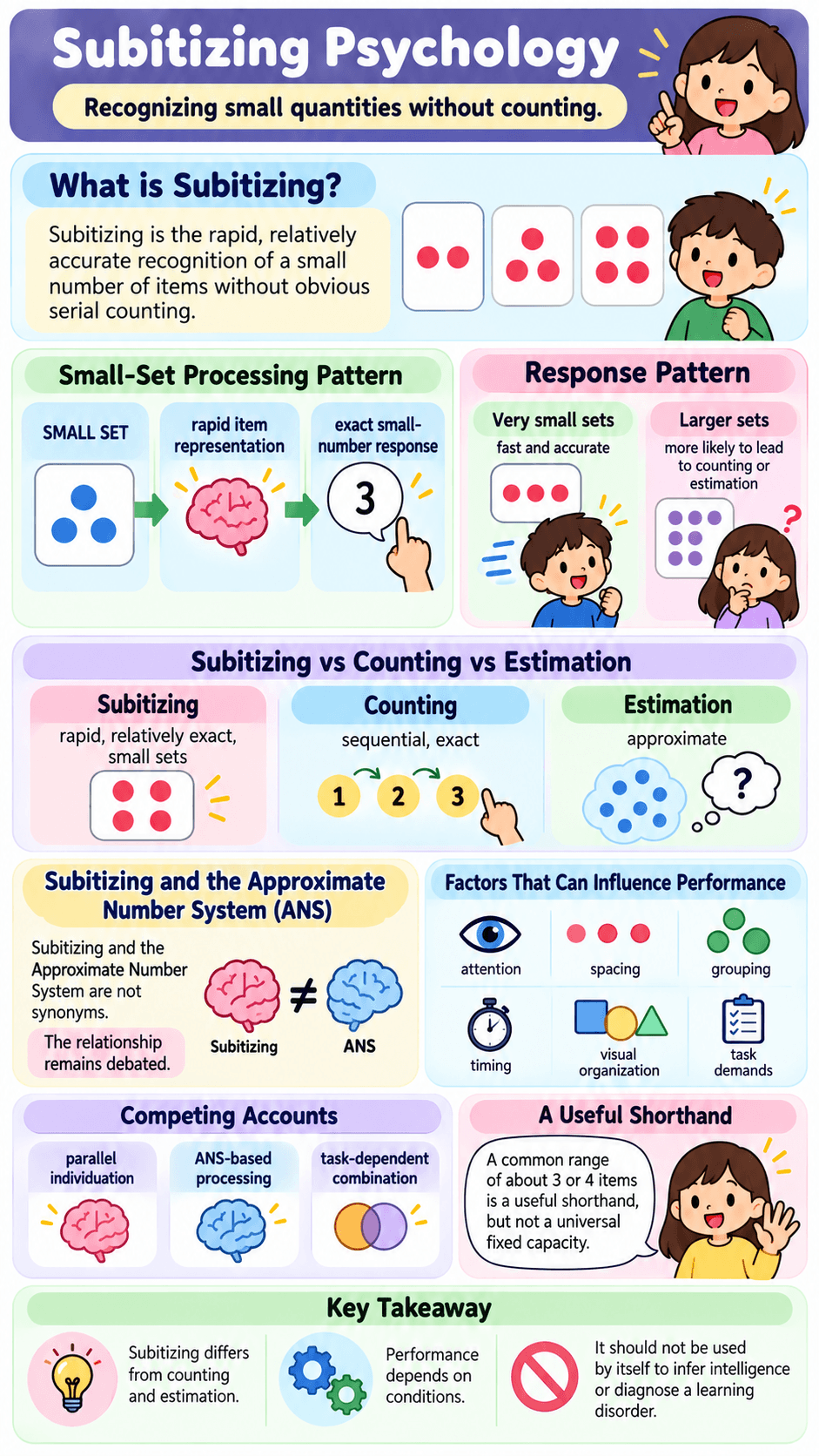
Subitizing is the rapid, relatively accurate recognition of a small number of items without serially counting them one by one. It is usually easiest with very small sets, but there is no universal fixed capacity that applies to every person and every display. Attention, grouping, spacing, task demands, and visual organization can change performance, and researchers still debate how subitizing relates to other number-processing systems.
What Subitizing Means in Numerical Cognition
Rapid and relatively accurate enumeration of small sets
The defining feature of subitizing is not simply speed. It is the combination of speed and relatively exact small-set enumeration. If you glance at two cups and know there are two, you have not necessarily counted the first cup and then the second in a visible sequence. The quantity may become available almost immediately.
The term was introduced in the mid-twentieth century to distinguish this kind of small-set performance from slower counting. A modern review of nonsymbolic number processing describes the historical contrast between rapid small-set enumeration and more approximate processing of larger sets, while also emphasizing that the exact relationship between the underlying systems remains debated. You can see that broader debate in an open-access review of small- and large-number processing.
“Relatively exact” is an important phrase. Subitizing is often highly accurate under simple laboratory conditions, but real displays may contain overlapping objects, distractions, uneven spacing, motion, or competing visual features. A person may also be tired, divided in attention, or asked to perform another task at the same time. The psychological process is better understood as a characteristic performance pattern than as a magical visual counter.
Why subitizing is not simply “fast counting”
Counting is serial in a way subitizing usually is not. When counting seven scattered objects, you typically keep track of which items have already been assigned a number word, move through an ordered sequence, and use the final number word as the total. Each additional item creates another step.
With a tiny set, response time tends to rise much less steeply as items are added. That different performance pattern is one reason researchers have treated subitizing as more than merely counting at high speed. It suggests that several small-set items may be represented at once, or that the mind can access the set’s numerosity without a fully serial item-by-item routine.
That does not mean every response to a small set must arise from one dedicated mechanism. A display can invite different strategies, and an observer may shift methods without consciously noticing the shift.
The Small-Set Processing Pattern
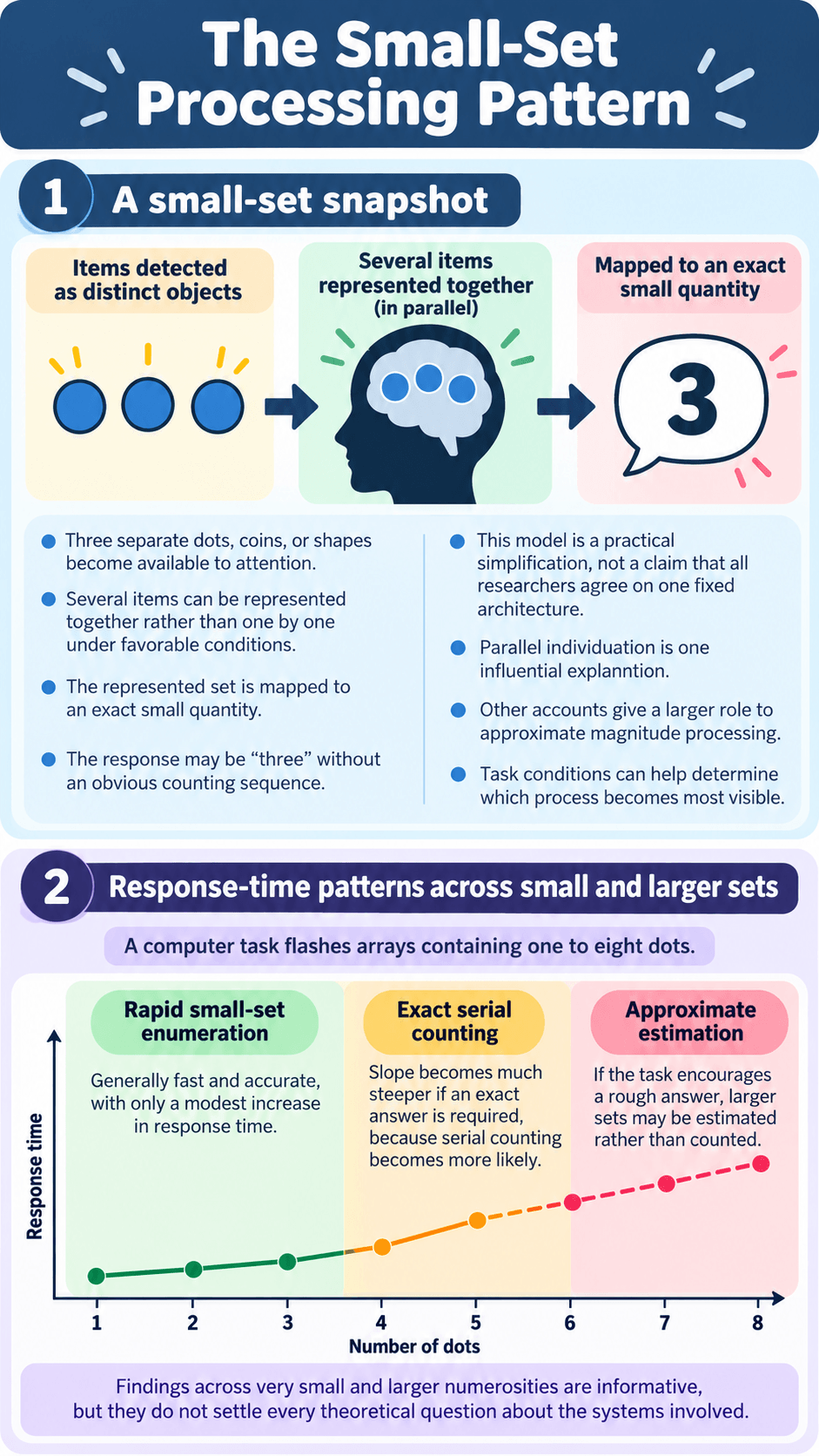
SMALL SET → rapid item representation → exact small-number response
A useful way to picture subitizing is as a small-set snapshot:
- The items are detected as distinct objects. Three separate dots, coins, or shapes become available to attention.
- Several items can be represented together. Instead of stepping through them one by one, the system can maintain their individuality in parallel under favorable conditions.
- The represented set is mapped to an exact small quantity. The response may be “three” without an obvious counting sequence.
This model is a practical simplification, not a claim that all researchers agree on one fixed architecture. Parallel individuation is one influential explanation. Other accounts give a larger role to approximate magnitude processing, and some evidence suggests that task conditions help determine which process becomes most visible.
Response-time patterns across small and larger sets
Imagine a computer task that flashes arrays containing one to eight dots. You say the number of dots as quickly as possible. For very small sets, responses are generally fast and accurate, with only a modest increase in response time as another item is added. Once the set becomes larger, the slope often becomes much steeper if an exact answer is required, because serial counting becomes more likely.
If the task instead encourages a rough answer, larger sets may be estimated rather than counted. This creates three recognizable zones of behavior rather than one smooth everyday strategy: rapid small-set enumeration, exact serial counting, and approximate estimation.
Research comparing very small and larger numerosities has reported different signatures across these ranges. An open-access study of very small and very large numerosities is one example of work examining whether the two ranges show distinguishable patterns. Such findings are informative, but they do not settle every theoretical question about the systems involved.
Subitizing vs Counting vs Estimation

| Process | Typical question | Typical output | Characteristic pattern |
|---|---|---|---|
| Subitizing | “How many are in this very small set?” | Relatively exact | Rapid small-set enumeration without obvious serial counting |
| Counting | “Exactly how many items are here?” | Exact | Sequential tracking and assignment of number words or symbols |
| Estimation | “About how many are here?” | Approximate | Rough magnitude judgment that may use visual cues, grouping, and strategy |
The easiest way to see the distinction is to change the display while keeping the general task the same. Three widely spaced dots can often be recognized almost immediately. Twelve scattered dots may be estimated quickly but not exactly. If an exact answer of twelve is required and the display remains visible, you may count them.
The output matters. Subitizing and counting can both produce exact answers, but they reach them differently. Estimation is designed to trade exactness for speed or practicality when a precise count is unnecessary or unavailable.
Subitizing: small and relatively exact
Subitizing is especially associated with small sets because a limited number of individual objects can be represented distinctly at once. Under favorable conditions, the set may feel immediately countable without an overt count.
Counting: sequential and exact
Counting solves a different problem. It can scale to larger sets because the observer does not need to represent every object simultaneously. Instead, items are visited in sequence and connected to an ordered number series.
Estimation: approximate quantity judgment
Estimation becomes useful when there are too many items to enumerate instantly and exact counting would be slow or impossible. A glance at a crowded auditorium might support “about 80 people,” not an exact cardinal value. Visual density, arrangement, grouping, and prior reference points can all influence that judgment.
Subitizing and the Approximate Number System Are Not Synonyms

Small-set processing versus approximate magnitude
The Approximate Number System, often shortened to ANS, is a proposed system for representing approximate numerical magnitude without exact symbolic counting. Its hallmark is imprecision. Discriminating two large nonsymbolic sets often becomes easier when their ratio is more different, such as comparing 10 with 20 rather than 18 with 20.
Subitizing has a different behavioral profile. The small set is typically identified with much greater exactness. That contrast motivated theories in which small quantities are handled through parallel individuation while larger quantities are represented as approximate magnitudes.
It is tempting to turn that distinction into a rigid rule: one to four equals subitizing, five and above equals ANS. The evidence is not that clean. A 2026 study reviewing the issue in its theoretical discussion notes that research has not always found a sharp discontinuity between small- and large-number processing, and that task demands, attentional load, and response requirements may affect the apparent boundary. That caution is reflected in recent work on numerical representation and subitizing.
Why the theoretical relation remains debated
There are at least three broad possibilities worth keeping separate.
- Distinct-system view: small sets are represented through an object-based individuation system, while larger nonsymbolic quantities rely more strongly on approximate magnitude.
- ANS-across-ranges view: approximate magnitude processing can contribute across both small and larger numerosities.
- Task-dependent or multiple-process view: the process that dominates can change with attention, display structure, timing, response requirements, and what the observer is trying to do.
These accounts make different predictions, and experiments do not always isolate them perfectly. For a general reader, the safest conclusion is not that “subitizing and the ANS are definitely separate” or “they are definitely one system.” It is that rapid small-set enumeration has a distinctive behavioral profile, while its relationship to approximate number processing remains an active theoretical question.
What Can Change Subitizing Performance?

Attention and attentional limits
Subitizing feels effortless, but that does not make it independent of attention. If attention is heavily occupied elsewhere, performance with small sets can change. This fits theories in which individual objects must be selected or individuated before an exact small-set response becomes available.
Consider two displays that both contain three targets. In one, the three targets are isolated on an empty background. In the other, they are mixed among distractors that must first be filtered out. The number is the same, but the attentional problem is not.
Spatial arrangement and clustering
Arrangement can change how easily items are organized. A regular pattern may provide structure that supports rapid recognition. Larger sets can also become easier to enumerate when objects are grouped into small, easily perceived clusters.
This does not mean the mind suddenly gains unlimited subitizing capacity. Grouping can create a different strategy. Instead of representing twelve independent items at once, a person may perceive three groups of four and combine those groups. Research on “groupitizing” shows that grouping cues can improve enumeration precision, including both intrinsic cues such as proximity and extrinsic cues such as connected regions. An open-access study of grouping cues in numerosity perception illustrates how organization of a display can change performance.
Visual salience
Items that are easy to distinguish from the background are easier to individuate than items that overlap, blend together, or compete strongly for attention. Color, contrast, spacing, and other visual properties can therefore influence the task even though the target concept is numerical quantity.
This is one reason a subitizing experiment must be interpreted in light of its stimulus design. A slow response does not necessarily indicate weak numerical processing. It may reflect a difficult visual selection problem.
Object individuation
Parallel-individuation theories emphasize representing individual objects as distinct entities. If three items can be maintained as three separate tokens, the set may support an exact small-number response. When there are too many objects, when objects are crowded, or when attention is constrained, maintaining distinct item representations becomes harder.
The key idea is that subitizing is about more than sensing “amount.” It may depend on keeping track of individual objects well enough for the small set to be represented exactly.
Task demands and individual differences
People are not always asked the same question. “How many?” can mean give an exact verbal response, press one of several keys, decide whether a set matches a target, or compare two sets. Each task adds its own demands.
Individuals also differ in visual attention, familiarity with the task, strategy, and speed of responding. Those differences are reasons to avoid treating a single subitizing score as a fixed trait or a measure of intelligence.
Competing Accounts of Small-Number Processing
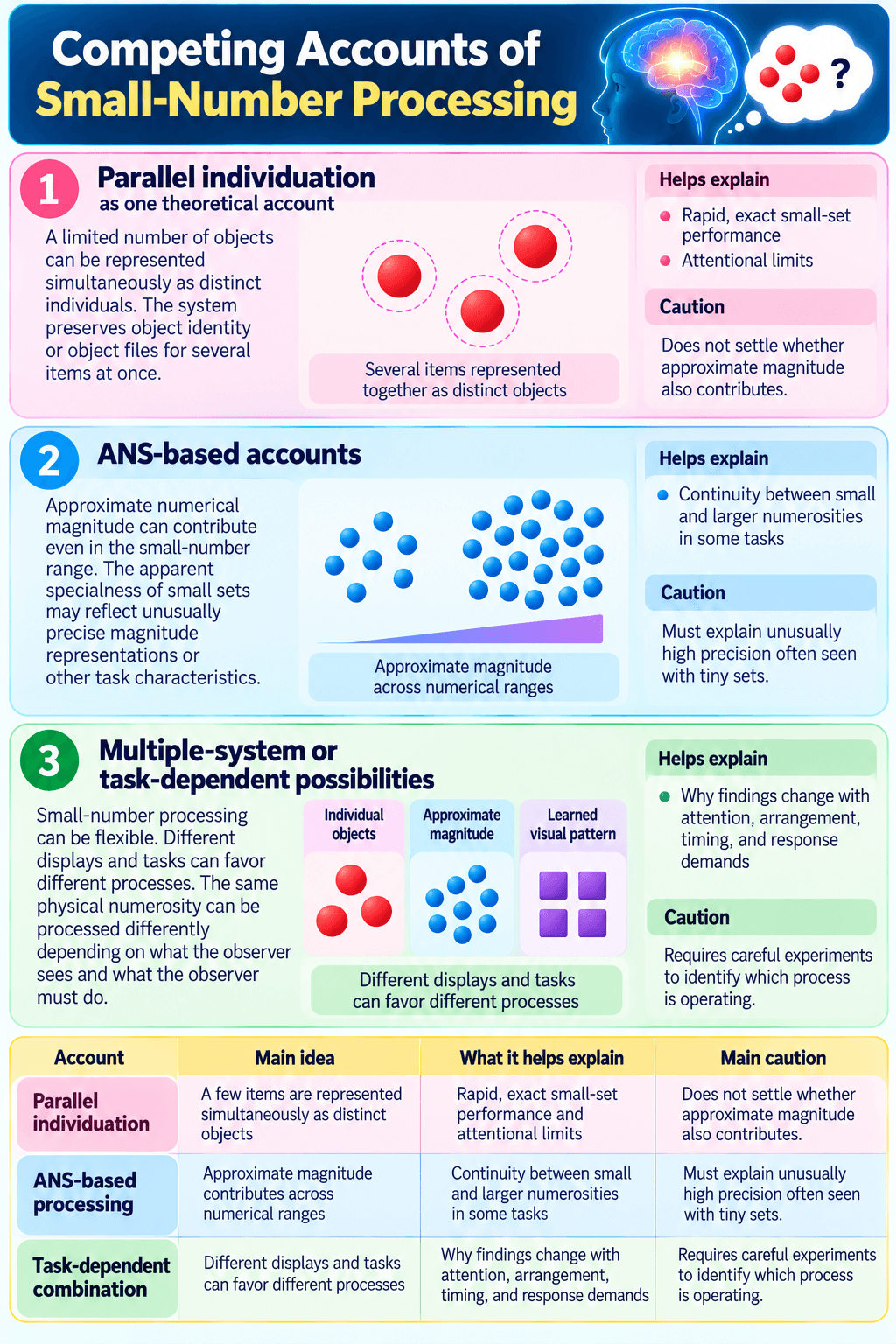
Parallel individuation as one theoretical account
Parallel individuation proposes that a limited number of objects can be represented simultaneously as distinct individuals. Instead of compressing the display into one approximate sense of “how much,” the system preserves object identity or object files for several items at once.
This account explains why very small sets can be enumerated exactly and rapidly. It also explains why attentional constraints matter: if separate items cannot be selected and maintained, the advantage should weaken.
ANS-based accounts
Other accounts argue that approximate numerical magnitude contributes even in the small-number range. Under this view, the apparent specialness of small sets may partly reflect unusually precise magnitude representations or other task characteristics rather than a completely separate number system.
This matters because two experiments can produce similar accuracy while relying on different processes. Behavioral speed alone cannot always reveal the representational format underneath.
Multiple-system or task-dependent possibilities
A third possibility is that small-number processing is flexible. One task may encourage individual-object representation; another may encourage approximate magnitude; another may allow a learned visual pattern to be recognized quickly. The same physical numerosity can therefore be processed differently depending on what the observer sees and what the observer must do.
A broad meta-analysis of numerical cognition research also underscores that numerical tasks are not psychologically interchangeable. Different task formats can recruit overlapping but distinguishable processes, which is another reason to avoid one-mechanism explanations for every numerical judgment.
| Account | Main idea | What it helps explain | Main caution |
|---|---|---|---|
| Parallel individuation | A few items are represented simultaneously as distinct objects | Rapid, exact small-set performance and attentional limits | Does not settle whether approximate magnitude also contributes |
| ANS-based processing | Approximate magnitude contributes across numerical ranges | Continuity between small and larger numerosities in some tasks | Must explain unusually high precision often seen with tiny sets |
| Task-dependent combination | Different displays and tasks can favor different processes | Why findings change with attention, arrangement, timing, and response demands | Requires careful experiments to identify which process is operating |
Why “Humans Can Always Subitize Exactly Four” Is Too Strong
Capacity is not a universal fixed boundary
Textbook summaries often describe a subitizing range of about three or four items. That is a useful shorthand for many classic findings, but it becomes misleading when turned into an absolute biological limit.
There is no guarantee that every person will identify every four-item display instantly and exactly. Nor does a five-item display automatically force one specific alternative mechanism. Performance varies continuously with stimulus quality, attention, organization, exposure time, and response requirements.
The word about does real work here. The traditional small-number range describes a common experimental pattern, not a universal personal capacity test.
Display, arrangement, attention, and task matter
Compare four large black circles spaced evenly on a white screen with four tiny overlapping shapes embedded among distractors. The numerical quantity is identical, but the second display is much harder to individuate. A fixed-capacity statement ignores that difference.
Now compare six randomly scattered dots with six dots arranged as two obvious groups of three. The grouped version may be handled through rapid group recognition plus a simple combining strategy. That does not prove the observer directly subitized all six independent items.
Even presentation time matters. A very brief display can prevent counting and place more weight on rapid representation. A longer display gives the observer opportunities to switch strategies. For this reason, subitizing is best understood in relation to the conditions under which it is measured.
When Another Numerical Process Fits Better
Larger approximate sets: approximate magnitude or estimation
If you glance at a jar containing dozens of marbles and answer “around 40,” the task is no longer small-set exact enumeration. You are making an approximate judgment. That judgment may draw on approximate magnitude, visual density, grouping, and learned reference points.
Likewise, if you choose which of two large dot arrays contains more items without counting, approximate quantity representation is a better fit than subitizing. The answer is about relative or rough magnitude, not immediate exact identification of a tiny set.
Exact sequential enumeration: counting
If you need an exact answer for nine scattered objects and you deliberately move item by item while saying or thinking a number sequence, you are counting. The response may be just as exact as a subitized response, but the route is different.
This distinction becomes especially clear when items are added. Counting time grows because each extra object needs to be tracked. Subitizing does not scale indefinitely in the same way.
A Practical Way to Tell What You Are Doing
You do not need laboratory equipment to notice the difference among these processes. Try three simple observations:
- Ask whether the answer feels exact immediately. If three objects register as “three” with no sense of stepping through them, that resembles subitizing.
- Notice whether your attention travels item by item. If you need to mark objects mentally or with your eyes, you are probably counting.
- Notice whether you would be comfortable saying “about.” If the response is a rough range, estimation is doing more of the work.
The purpose is not to classify every glance perfectly. Everyday numerical behavior is flexible. A person can start with a quick impression, use grouping, and then count to verify the result. The categories are most useful for understanding which cognitive demand is dominant at a given moment.
FAQ
Is subitizing the same as counting?
No. Both can produce an exact number, but counting ordinarily involves sequentially tracking items and assigning them positions in an ordered number sequence. Subitizing refers to rapid small-set enumeration without obvious serial counting. The difference shows up especially in response-time patterns as set size increases.
Is subitizing the same as estimating?
No. Subitizing is typically relatively exact for very small sets, while estimation is approximate. Seeing three dots and immediately answering “three” differs from seeing a crowded group and answering “about thirty.” Estimation may use approximate magnitude, grouping, density, and other cues.
Is subitizing part of the Approximate Number System?
Researchers do not all give the same answer. One influential view treats subitizing as relying on parallel individuation that is distinct from the ANS. Other accounts propose more continuity between small- and large-number processing. Current evidence supports treating the relationship as a theoretical question rather than a settled fact.
Can everyone subitize the same number of objects?
No fixed number applies universally across people and situations. A range of roughly three or four is a common shorthand in classic research, but actual performance depends on attention, arrangement, visual clarity, task demands, and individual differences. “Exactly four in every circumstance” is too rigid.
Does weak subitizing mean low intelligence or dyscalculia?
No. A single subitizing task cannot diagnose dyscalculia, intellectual ability, ADHD, or another condition. Performance can be influenced by visual attention, task design, fatigue, familiarity, and many other factors. Persistent difficulty with number concepts or arithmetic that meaningfully affects schooling or daily functioning may warrant professional educational or clinical assessment, but subitizing performance alone does not identify the cause.
Key Takeaways
- Subitizing is rapid, relatively accurate enumeration of a very small set without obvious item-by-item counting.
- It differs from counting because counting is sequential, and it differs from estimation because estimation is approximate.
- A typical small-number range of about three or four items is a useful research shorthand, not a universal fixed capacity for every person and display.
- Attention, visual organization, spacing, grouping, timing, and task demands can all change small-set performance.
- Researchers continue to debate whether subitizing reflects parallel individuation, approximate magnitude processing, or a task-dependent combination of processes.
- Subitizing performance should not be used by itself to infer intelligence or diagnose a learning disorder.

Michael Reed is the Founder and Lead Writer at Psychology Exposed. He writes about human behavior, relationships, emotional patterns, self-awareness, and practical psychology topics using research-informed, easy-to-understand content.
Read More About Michael Reed: https://psychologyexposed.com/michael-reed/