

You walk into a car park after shopping and pause. You remember the car, you remember entering through the west doors, and you vaguely remember parking near a concrete parking column, but the exact location is not immediately available. Or you reach for your keys and can picture the kitchen counter where you last saw them, even though the keys are no longer in view.
These ordinary moments rely on spatial memory: memory for where objects, landmarks, routes, and places are located and how they relate to one another. Spatial memory helps you remember that a phone was beside a notebook, that a pharmacy was two streets beyond a station, that a meeting room was past the second staircase, or that a familiar road bends toward a river.
Spatial memory is not one single storage box. Remembering an object’s location, recalling a route, recognizing a landmark, and reconstructing a larger layout can place different demands on memory. The useful common thread is that the remembered information contains a spatial relationship: what was where, what was next to what, which direction a place lay, or how locations were connected.
Quick Answer

Spatial memory is the ability to retain and retrieve information about locations and spatial relationships. It includes remembering where objects were placed, where landmarks appeared, how routes unfolded, and how parts of an environment were arranged. It differs from spatial working memory, which keeps information temporarily available for an ongoing task, and from a cognitive map, which is a broader representation of environmental structure.
What Spatial Memory Means
Remembering locations, positions, routes, and layouts
Spatial memory becomes relevant whenever the remembered content answers a “where” question. Where was the mug? Which side of the building contained the lift? Which turn came after the bridge? Where does the park sit relative to the train station?
A review of spatial memory and reorientation describes spatial memory as memory for information about the three-dimensional environment, including the positions of objects relative to other environmental features. The review of spatial memory and reorientation uses everyday examples such as finding keys, locating a parked car, and navigating through an unfamiliar neighborhood to illustrate the range of spatial-memory demands.
The examples differ in scale, but they share one feature: retrieval must preserve some relation between a remembered item or place and a spatial context.
Why “where” memory is not the same as remembering an object
Recognizing an object does not guarantee that you remember where it was. You may clearly remember a blue folder yet place it on the wrong shelf. Conversely, you may remember that “something important” was on the upper-left corner of a desk before recalling exactly what the object was.
This distinction is especially clear in object-location research. A major review of object-location memory separates at least three components: processing the object, processing its location, and binding the object to that location. Remembering what and remembering where therefore interact without becoming the same operation.
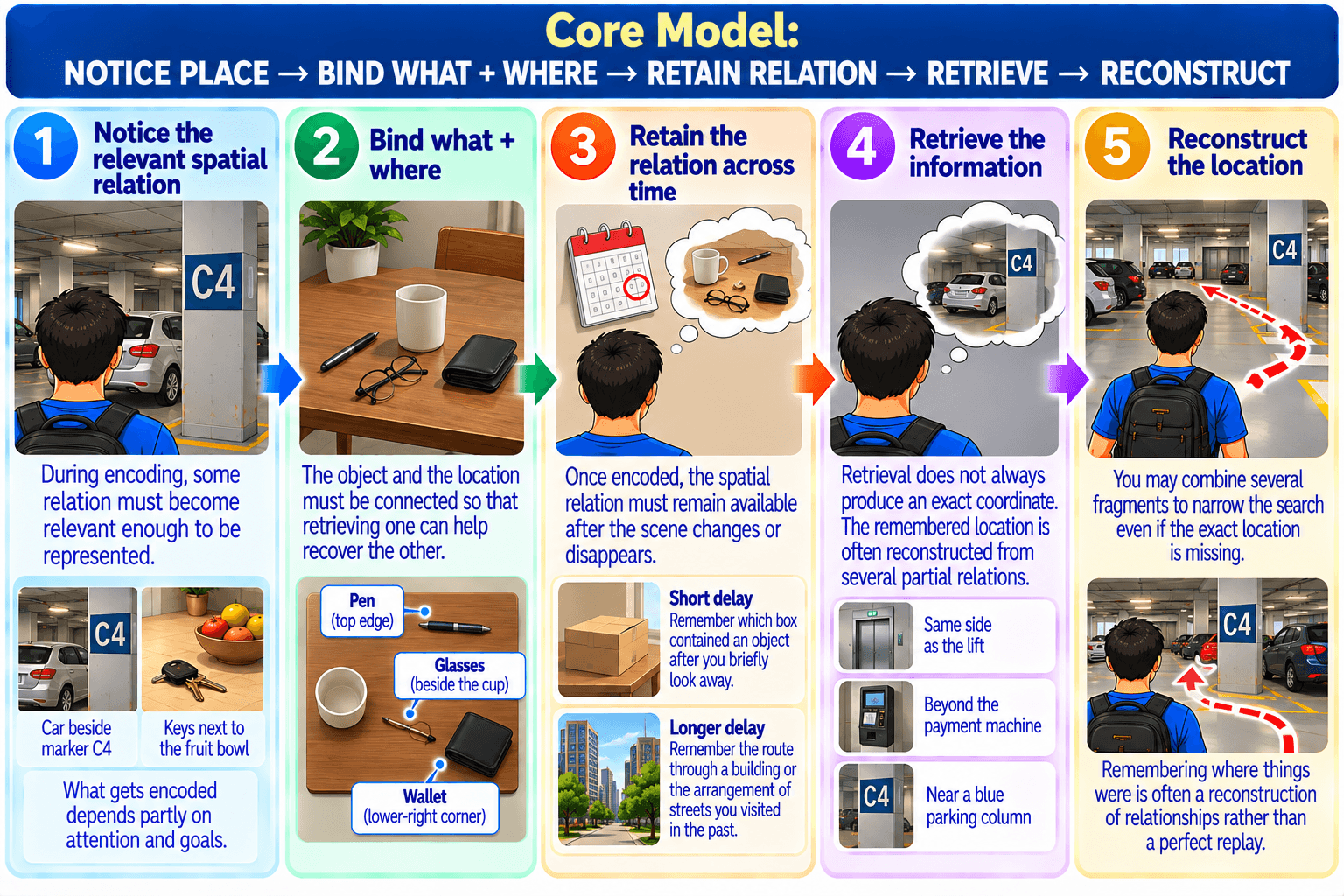
Core Model: NOTICE PLACE → BIND WHAT + WHERE → RETAIN RELATION → RETRIEVE → RECONSTRUCT
Notice the relevant spatial relation
Memory cannot preserve every spatial detail equally. During encoding, some relation must become relevant enough to be represented. You may notice that your car is beside marker C4, that the keys are next to the fruit bowl, or that the cafe is opposite the library.
What gets encoded depends partly on attention and goals. If you are rushing through a car park while answering a phone call, you may remember the general floor but fail to encode the nearby marker number. Later forgetting can therefore begin with weak encoding rather than with a failure of storage.
Bind an item or place to its location
Spatial memory often requires binding. The object and the location must be connected so that retrieving one can help recover the other.
Imagine seeing four objects on a table: a pen, cup, wallet, and pair of glasses. Remembering the four objects is not enough if the later question is where each one was placed. You need the correct pairings: wallet near the lower-right corner, glasses beside the cup, pen near the top edge.
Object-location binding is why a memory can feel frustratingly incomplete. You may know that the missing item was present, and you may remember several places you were, yet the exact item-place connection fails to return.
Retain the relation across time
Once encoded, the spatial relation must remain available after the scene changes or disappears. The delay might last seconds, hours, days, or years depending on the task.
A short delay could involve remembering which box contained an object after you briefly look away. A longer delay could involve remembering the route through a building you visited last week or the arrangement of streets in a neighborhood you lived in years ago.
Different delays and tasks place different demands on memory. That is one reason “spatial memory” should not be treated as one perfectly uniform ability.
Retrieve and reconstruct the location
Retrieval does not always produce an exact coordinate. Often, the remembered location is reconstructed from several partial relations.
You may remember that the car was on the same side as the lift, beyond the payment machine, and near a blue parking column. Combining those fragments can narrow the search even if the exact bay number is missing.
A recent review of spatial reconstruction memory emphasizes that reconstructing studied object-location configurations can reveal several different kinds of spatial error. This fits the broader idea that remembering where things were is often a reconstruction of relationships rather than a perfect replay.
Object-Location Memory: Remembering What Was Where
Location alone versus object-location binding
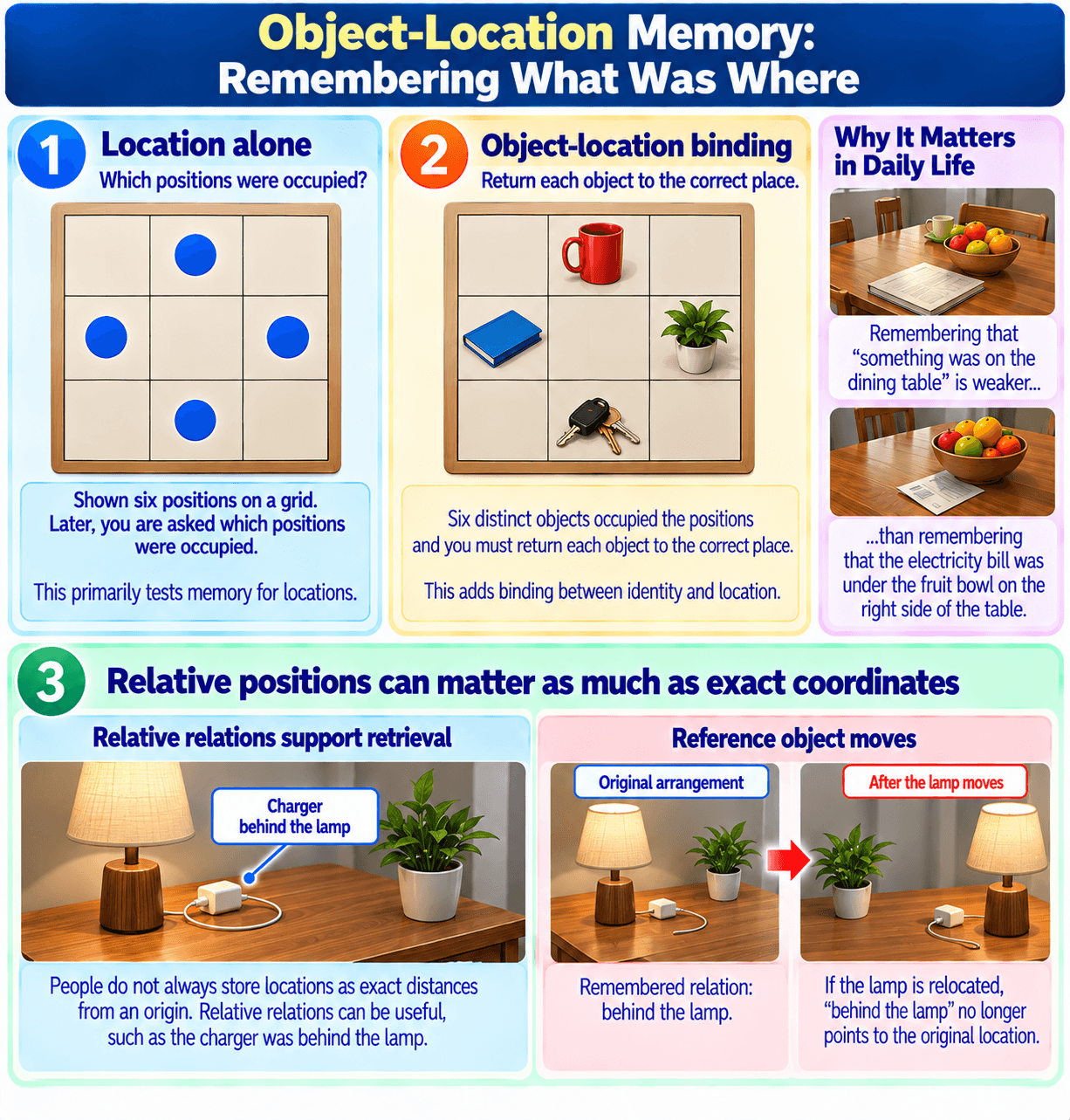
Suppose you are shown six positions on a grid. Later, you are asked which positions were occupied. That primarily tests memory for locations. Now suppose six distinct objects occupied those positions and you must return each object to the correct place. The second task adds binding between identity and location.
This difference matters in daily life. Remembering that “something was on the dining table” is weaker than remembering that the electricity bill was under the fruit bowl on the right side of the table.
The 2025 systematic review of navigational object-location memory describes object-location memory as a form of spatial memory concerned with repositioning previously encoded objects within an environment. It also shows that performance varies with task design, environmental cues, delay, and other contextual factors, so one test should not be treated as a complete measure of a person’s spatial memory.
Relative positions can matter as much as exact coordinates
People do not always store locations as exact distances from an origin. Relative relations can be useful: the keys were beside the bag, the printer is beyond the meeting room, the pharmacy is across from the station.
These relations can support retrieval when exact metric information is weak. If the furniture in a room has not moved, remembering that the charger was behind the lamp may be enough to find it.
Relative memory can also be distorted when the reference object moves. If someone relocates the lamp, the remembered relation “behind the lamp” no longer points to the original physical location. What was accurate in the encoded arrangement may be misleading after the environment changes.
Landmark Memory

Remembering recognizable features of a place
Landmarks give places memorable identity. A distinctive tower, mural, tree, staircase, store, or building facade can later help you recognize where you are or recall what happened nearby.
Landmark memory includes more than recognizing that you have seen the feature before. The feature becomes spatially useful when it is connected to a location, route, direction, or region: “the turn is after the tower,” “the station entrance is opposite the mural,” or “the car park lift is beside the red wall.”
This is why a memorable object can fail to help navigation if its spatial relation was never learned. Recognition alone does not tell you what the landmark means for the surrounding layout.
How landmark memory supports other spatial tasks
A remembered landmark can support orientation, route following, wayfinding, and cognitive mapping. Those later uses should not be confused with the memory itself.
For example, remembering that a glass atrium exists at the center of a hospital is spatial memory. Using it to decide which corridor will reach radiology is wayfinding. Using it to determine that you are currently on the east side of the building contributes to orientation.
The same remembered cue can therefore feed several spatial processes depending on the current question.
Route Memory

Remembering an ordered sequence of places and actions
Route memory preserves how a journey unfolded. A familiar route may be remembered as station → bridge → pharmacy → left turn → office entrance.
Order matters. Recalling all the landmarks but mixing their sequence can produce a wrong route. A turn may also be tied to a specific landmark: “right at the pharmacy” rather than simply “turn right somewhere after the bridge.”
Route memory can become strong through repetition. A commute may eventually be recalled with little deliberate effort because the same places and actions are encountered in the same order.
Route memory does not guarantee knowledge of the wider layout
You can remember a route perfectly and still struggle to say where the destination lies in straight-line direction from the start. Sequential knowledge and configurational layout knowledge are related but not identical.
This distinction prevents spatial memory from collapsing into one vague concept. A person can have excellent memory for a learned path but less precise memory for how several routes relate to one another.
That difference also explains why a blocked familiar route can be difficult. The stored sequence remains available, but it may not provide enough information to create a detour.
Layout Memory

Remembering relationships among several places
Layout memory concerns how multiple locations fit together. You may remember that the kitchen is behind the lobby, the stairs are beside the lift, and the conference rooms form a row along the north corridor.
Unlike a single route, a layout can support comparisons among locations that were not encountered in one sequence. You may infer that two rooms are probably close because both sit near the same central atrium.
Spatial long-term memory and navigation are often studied together because both involve stored representations of places and environmental relationships. A large meta-analysis of spatial cognition treats spatial working memory, long-term spatial memory, navigation, attention, and mental rotation as distinguishable spatial functions rather than one undifferentiated system.
Layouts can be remembered approximately
Remembering a layout does not require surveyor-level precision. A person may correctly remember which rooms connect while misjudging distance, angle, or scale.
Suppose you sketch your neighborhood from memory. The main roads and landmarks may appear in the right relative arrangement, yet one block is too short and a curved road becomes straighter than it really is. The memory can still be useful despite those distortions.
This is one reason spatial memory should be evaluated in terms of the information needed for a task rather than an unrealistic expectation of perfect geometric reproduction.
Spatial Memory vs Spatial Working Memory
Temporary active maintenance versus retained spatial knowledge
Spatial working memory keeps spatial information temporarily active so it can guide an ongoing task. If you glance at a parking-space number, walk toward a payment machine, and keep the number in mind for the next minute, working memory is heavily involved.
Spatial memory in the broader sense includes information retained beyond that immediate online period. Remembering tomorrow where the car had been parked, or remembering a building layout learned last month, involves longer-term retention and retrieval.
The boundary is not always defined by a precise number of seconds. The more useful distinction is functional: working memory maintains and manipulates information for current processing, while long-term spatial memory preserves spatial knowledge that can be retrieved later.
Why the two systems can cooperate
A spatial task can use both. Imagine learning a new office floor. Working memory helps hold the last few turns and room numbers active as you move. Longer-term spatial memory gradually preserves landmarks, routes, and layout relations for future visits.
Because the systems interact, difficulty in one task cannot automatically be assigned to one type of memory. The problem could involve weak initial encoding, temporary maintenance, object-location binding, retrieval, or confusion between similar places.
| Question | Spatial Working Memory | Spatial Long-Term Memory | Cognitive Map |
|---|---|---|---|
| Main focus | Keep spatial information active for a current task | Retain and retrieve spatial information over time | Represent relationships across an environment |
| Example | Hold three recent turns in mind | Remember the route next week | Know how several routes and places fit together |
| Typical content | Temporary positions, sequences, transformations | Object locations, landmarks, routes, layouts | Connections, regions, directions, relative locations |
| Relationship | Can support encoding and current use | Can supply stored spatial knowledge | Can be built from and accessed through spatial memory |
Spatial Memory vs Cognitive Maps
Remembered spatial information versus organized environmental representation
Spatial memory is broader than a cognitive map. Remembering where a pair of glasses sat on a desk is spatial memory, but it does not require a cognitive map of the whole room or house.
A cognitive map concerns organized relationships among places within an environment. It may include landmarks, routes, regions, connectivity, approximate distance, and direction.
Spatial memory provides much of the information that such an environmental representation depends on, but the terms should not be treated as synonyms.
Why remembering one location does not require a map of the whole environment
If you remember that your phone is charging beside the sofa, the useful relation is local. You do not need to represent every room, doorway, or route in the home.
Similarly, remembering which shelf held a book or which parking bay held a car can be solved with a local cue and location association.
Cognitive maps become more relevant when the task asks how multiple places fit together or supports flexible judgments beyond one remembered location.
Why Spatial Memories Can Be Incomplete or Wrong
Weak encoding
Many “memory failures” begin before storage. If you place your keys down while thinking about something else, the location may never be strongly encoded.
Later, the experience feels like forgetting, but there may be little detailed location information to retrieve. This is why searching can produce a vague familiarity without a clear memory of placing the keys there.
Interference from similar locations
Repeatedly parking in similar rows, staying in similar hotel rooms, or placing an object in several habitual locations creates competition among memories.
You may remember “near the lift” accurately but confuse today’s location with yesterday’s. The problem is not absence of spatial memory. It is that several similar item-location associations compete during retrieval.
Reconstruction and changed environments
Spatial memory can also rely on reconstruction. When details are missing, people use familiar structure and surviving relations to rebuild the likely arrangement.
This is usually useful, but it can introduce error. A desk that is normally against the left wall may be remembered there even after it was temporarily moved. A route may be recalled as straighter because that simplified relation is easier to reconstruct.
Memory therefore preserves useful structure without acting as a photographic recording of space.
Everyday Spatial Memory Examples
Remembering where you parked
Finding a parked car can use several memory layers at once: floor number, row, nearby parking column, relation to the entrance, and the direction you walked after leaving the car.
If one detail is missing, another may recover the location. Remembering “same level as the cinema entrance, two rows beyond the lift” can be enough even when the bay number is forgotten.
Finding keys or a phone
Object-location memory often depends on habitual contexts. Keys may usually be near the door, a phone may often be on a desk, and glasses may usually sit beside a bed.
Habit helps search because likely locations are checked first. It can also create false confidence when the object was placed somewhere unusual. The habitual place is easy to retrieve even if it is wrong today.
Remembering a route through a building
A route through a hospital or office can be remembered as ordered landmarks and turns. With repetition, the path may become easier to follow even if the larger floor plan remains unclear.
This example shows why route memory and layout memory should be kept separate. One preserves a traveled sequence. The other preserves broader relationships among places.
Ordinary Forgetting vs a More Concerning Change
Occasional location mistakes are common
Forgetting where you parked, putting keys in an unusual place, or briefly losing track of a route in an unfamiliar building can happen for ordinary reasons. Attention, fatigue, stress, interruption, weak encoding, similar environments, and long delays can all affect retrieval.
One isolated mistake does not establish a memory disorder. Context and change from a person’s usual functioning matter far more than a single everyday lapse.
Sudden major loss of familiar navigation with neurological symptoms
A sudden substantial inability to navigate a familiar environment is different from occasionally misplacing an object. If abrupt spatial confusion occurs together with sudden weakness or numbness, trouble speaking or understanding, vision problems, severe dizziness or loss of balance, or a sudden severe headache, emergency medical evaluation is appropriate.
The CDC summary of common stroke warning signs includes sudden confusion, trouble speaking, vision problems, trouble walking or loss of balance, one-sided weakness or numbness, and sudden severe headache. This safety distinction is meant for sudden neurological change, not ordinary forgetfulness about keys or parking locations.
FAQ About Spatial Memory Psychology
These questions clarify where spatial memory ends and nearby concepts such as working memory, cognitive maps, and navigation begin.
Is spatial memory the same as visual memory?
No. Visual memory can preserve what something looked like, including shape, color, or visual detail. Spatial memory preserves where things were or how locations related. A person can remember the appearance of an object while forgetting its location, or remember a location while being uncertain about the object’s visual details.
Is spatial memory the same as working memory?
No. Spatial working memory keeps spatial information temporarily available for an ongoing task, such as holding several recent turns in mind. Spatial memory more broadly includes information retained and retrieved over longer periods, such as object locations, familiar routes, landmarks, and layouts learned earlier.
Is a cognitive map just another name for spatial memory?
No. A cognitive map is an organized representation of environmental relationships. Spatial memory is broader and includes local item-location memories that do not require a representation of the wider environment. Cognitive maps depend on remembered spatial information, but the two concepts answer different questions.
Does forgetting where I parked mean my spatial memory is poor?
Not necessarily. Parking locations are easy to forget when many rows look alike, the location was weakly encoded, attention was divided, or similar recent parking memories interfere. A single lapse says little about overall spatial memory. A sudden or marked change in familiar navigation, especially with other neurological symptoms, is a different situation.
Key Takeaways
- Spatial memory preserves information about object locations, landmarks, routes, layouts, and relative positions.
- Remembering what an object is and remembering where it was can rely on separable processes that must be bound together.
- Route memory preserves an ordered path, while layout memory preserves broader relationships among locations.
- Spatial working memory keeps information active for current processing, while longer-term spatial memory supports later retrieval.
- Cognitive maps depend on spatial memory but are broader organized representations of environmental structure.
- Occasional location mistakes are common; sudden major familiar-navigation difficulty with other neurological warning signs requires a different level of concern.
When a spatial memory fails, the most useful question is not simply “Why did I forget?” Ask what had to be remembered: the object, the exact location, the relation between several items, a sequence of turns, or the structure of a larger layout. Different failures can occur at encoding, binding, retention, or retrieval. Identifying the missing relation makes the memory problem much more specific.
Educational note: This article explains ordinary spatial memory processes. Everyday mistakes such as misplacing keys or forgetting a parking location are not diagnoses, and spatial-memory performance should not be used by itself to infer intelligence or neurological health.
Michael Reed, Founder & Lead Writer at Psychology Exposed, writes clear, research-aware explanations of memory, spatial cognition, and everyday human behavior.

Michael Reed is the Founder and Lead Writer at Psychology Exposed. He writes about human behavior, relationships, emotional patterns, self-awareness, and practical psychology topics using research-informed, easy-to-understand content.
Read More About Michael Reed: https://psychologyexposed.com/michael-reed/