
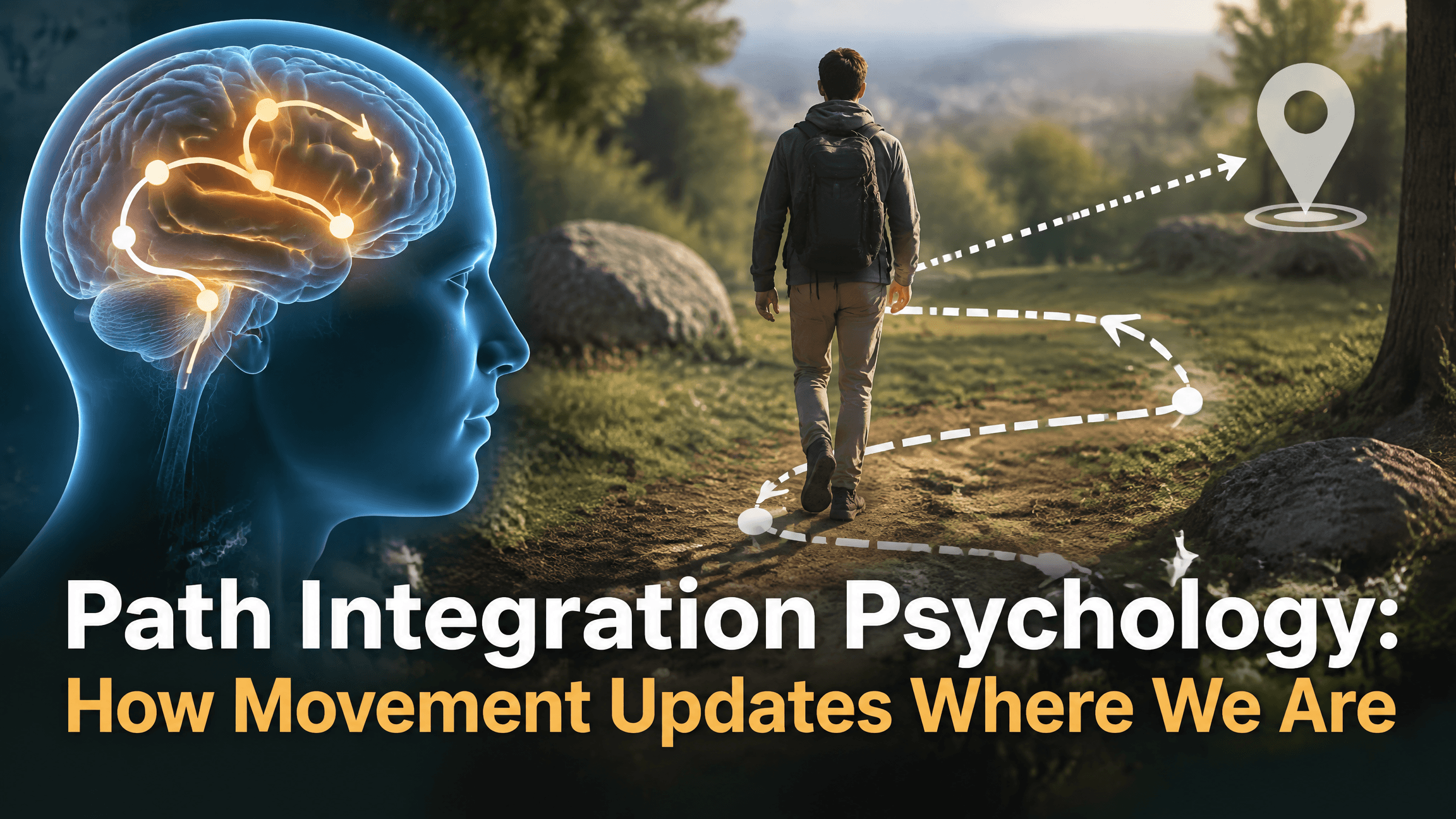
Imagine closing your eyes, walking forward several steps, turning right, walking again, and then trying to point back to where you started. You may not know the exact distance or angle, but your movement gives you enough information to form an estimate of your current position relative to the starting point.
This is the basic problem studied in path integration psychology. Path integration is the process of updating an estimate of position and direction by integrating information generated during movement. Instead of relying only on visible landmarks, the mind keeps track of how far and in what direction the body has moved, then uses those updates to estimate where the starting point or another known location now lies.
Path integration is closely related to spatial orientation and wayfinding, but it is narrower than either one. Spatial orientation concerns the current position and heading estimate more broadly. Wayfinding concerns reaching a destination. Path integration specifically focuses on how self-motion contributes to updating location as movement unfolds.
Quick Answer
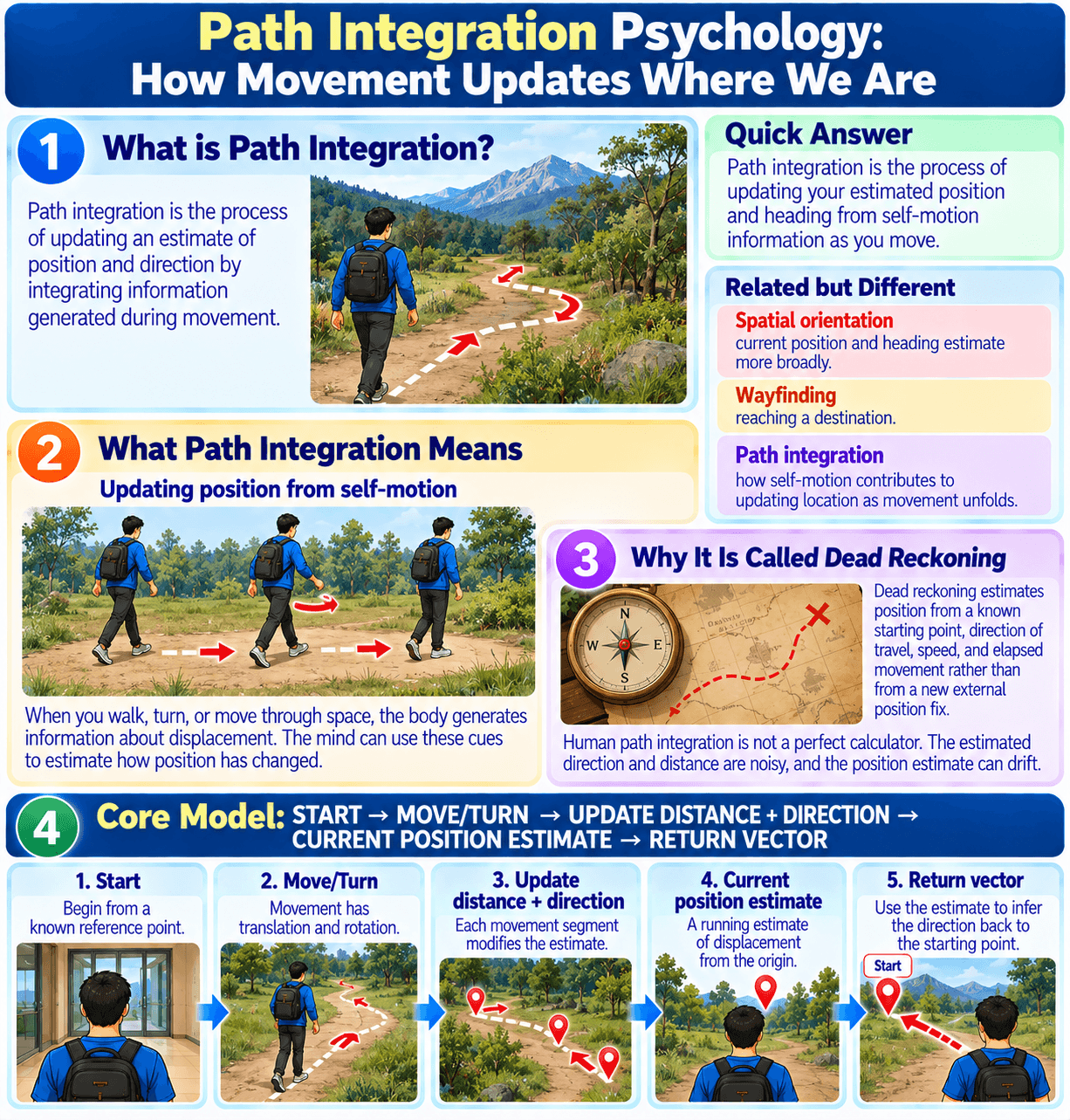
Path integration is the process of updating your estimated position and heading from self-motion information as you move. Distance traveled and changes in direction are combined into a running estimate of where you are relative to a known starting point. Because small errors accumulate over time, landmarks and boundaries can help recalibrate that estimate when reliable external cues become available.
What Path Integration Means
Updating position from self-motion
When you walk, turn, or move through space, the body generates information about displacement. The nervous system can use cues related to movement, including visual motion, body-based movement signals, and changes in orientation, to estimate how position has changed.
A review of path integration in large-scale human navigation describes path integration as estimating position and orientation relative to a known location by using body-based sensory cues that arise during movement. The review also emphasizes that human path integration can contribute to navigation even though it is imperfect and vulnerable to accumulated error.
The important psychological idea is continuous updating. The mind does not need to wait until movement stops. Each segment can modify the current estimate.
Why path integration is sometimes called dead reckoning
The term dead reckoning comes from navigation traditions in which position is estimated from a known starting point, direction of travel, speed, and elapsed movement rather than from a new external position fix.
The analogy is useful as long as it is not taken too literally. Human path integration is not a perfectly calibrated mechanical calculator. The estimated direction and distance are noisy, and the resulting position estimate can drift away from the actual location.
Still, the core logic is similar: start from a known point, update displacement as movement occurs, and use the accumulated estimate to infer the current relationship to the starting point.
Core Model: START → MOVE/TURN → UPDATE DISTANCE + DIRECTION → CURRENT POSITION ESTIMATE → RETURN VECTOR
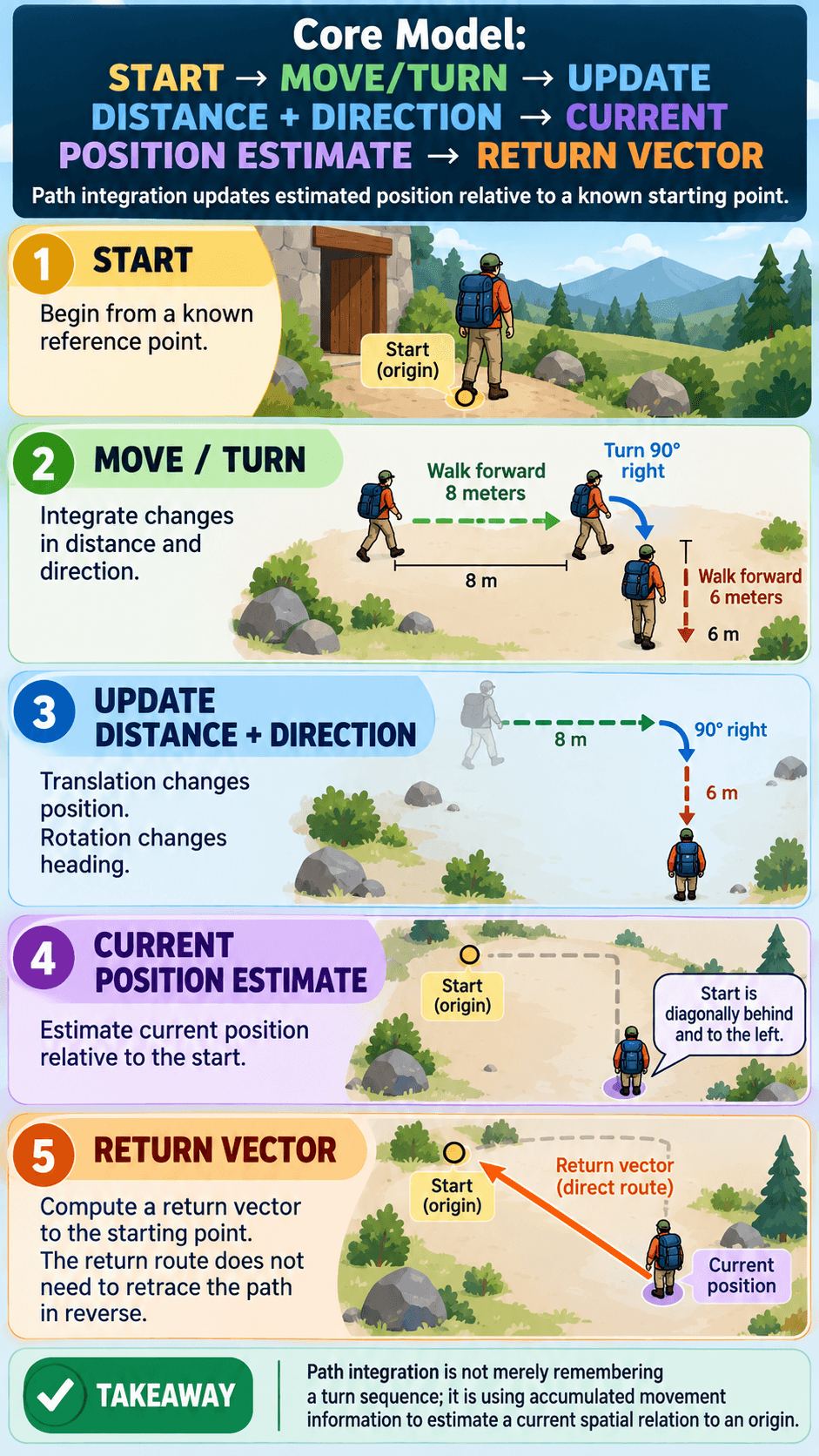
Begin from a known reference point
Path integration requires a reference location. That could be the entrance to a room, the starting point of a walking path, a campsite, a doorway, or a location established moments earlier.
The starting point acts as the origin for subsequent updating. If you walk ten steps forward and then five steps right, the question is not merely “where am I?” in an absolute sense. It is “where am I now relative to where I began?”
Integrate changes in distance and direction
Movement has at least two important components: translation and rotation. Translation changes position. Rotation changes heading.
Suppose you walk forward eight meters, turn 90 degrees to the right, then walk six meters. A path integrator must update the first displacement, account for the change in heading, and then add the second displacement in the new direction.
A classic study by Loomis and colleagues on nonvisual navigation and path integration asked blind and sighted participants to perform tasks such as returning directly to an origin after being guided along multi-segment paths. Participants responded systematically to route structure, showing that movement information can support spatial updating even without continuous visual guidance, although performance was far from perfect.
Estimate current position relative to the start
After several movement segments, the mind has a running estimate of displacement from the origin. This estimate does not need to preserve every turn as an explicit verbal list.
For example, after walking around two sides of a rectangle, you may feel that the starting point is diagonally behind and to your left. That directional relation is the result of integrating the path rather than simply remembering the most recent turn.
The estimate can then support a direct response, such as pointing toward the origin or choosing the direction that would return you there.
Compute a return vector
A return vector represents the direction and distance needed to travel from the current estimated position back to the reference point.
If you move along an L-shaped path, the return route does not need to retrace the two segments in reverse. Path integration can support a more direct homing response because it represents the net displacement from the start.
This is one of the defining features of path integration. The process is not merely remembering the sequence of turns. It is using accumulated movement information to estimate a current spatial relation to an origin.
A Simple Triangle Example
Walk the first two sides
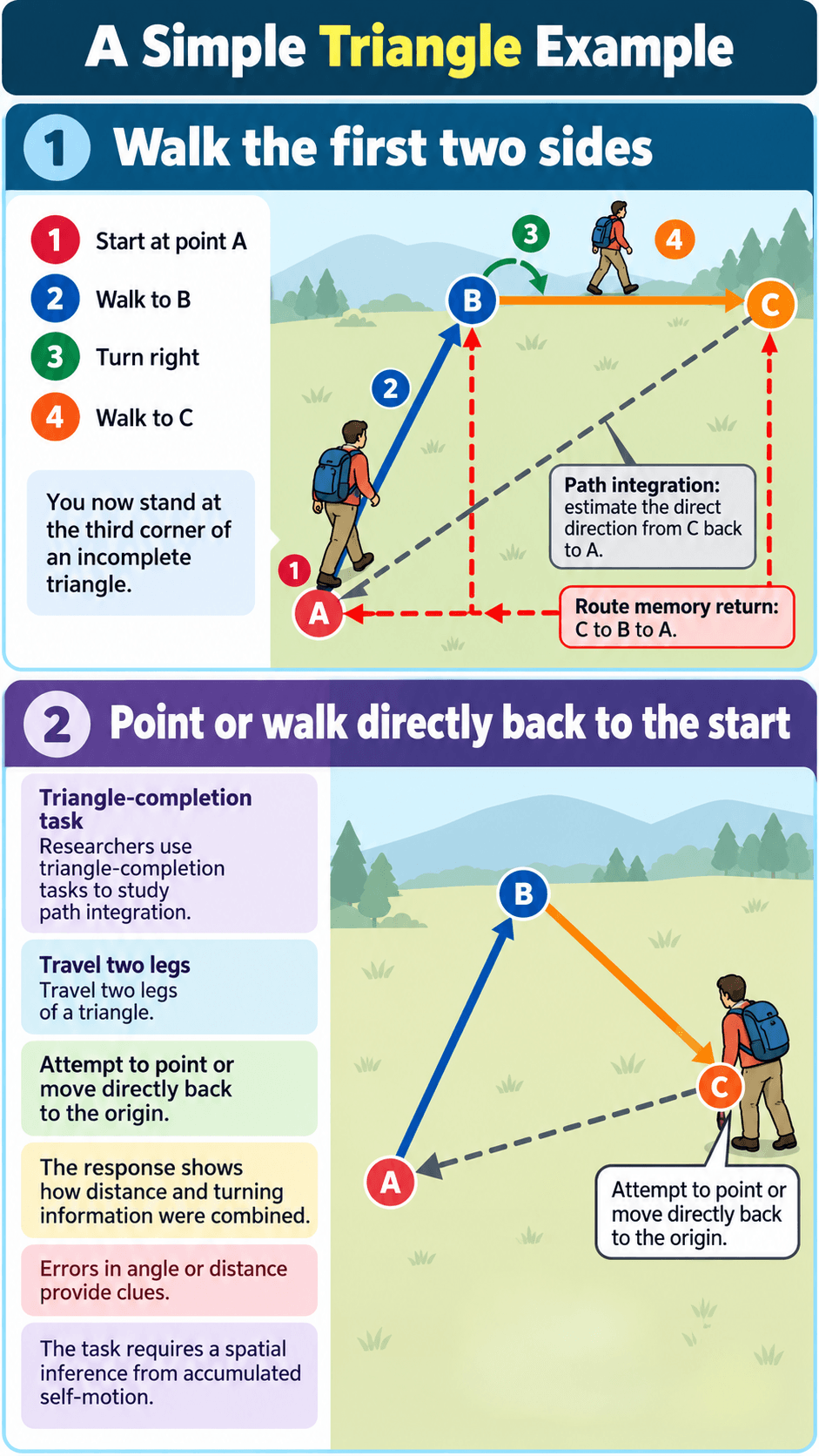
Imagine starting at point A. You walk straight to point B, turn right, then walk to point C. You now stand at the third corner of an incomplete triangle.
If you had to return by route memory alone, you could turn around, walk back to B, then retrace the first segment to A.
Path integration creates another possibility. You can estimate the direct direction from C back to A even though you never walked that diagonal before.
Point or walk directly back to the start
Researchers often use triangle-completion tasks to study path integration. Participants travel two legs of a triangle and then attempt to point or move directly back to the origin.
The response reveals how the person combined distance and turning information. If the estimated return angle is too small, too large, too short, or too long, the error provides clues about how the path was internally updated.
The task is useful precisely because the final response is not a repetition of a learned route. It requires a spatial inference from accumulated self-motion.
What Information Can Support Path Integration?
Proprioceptive and motor-related movement cues
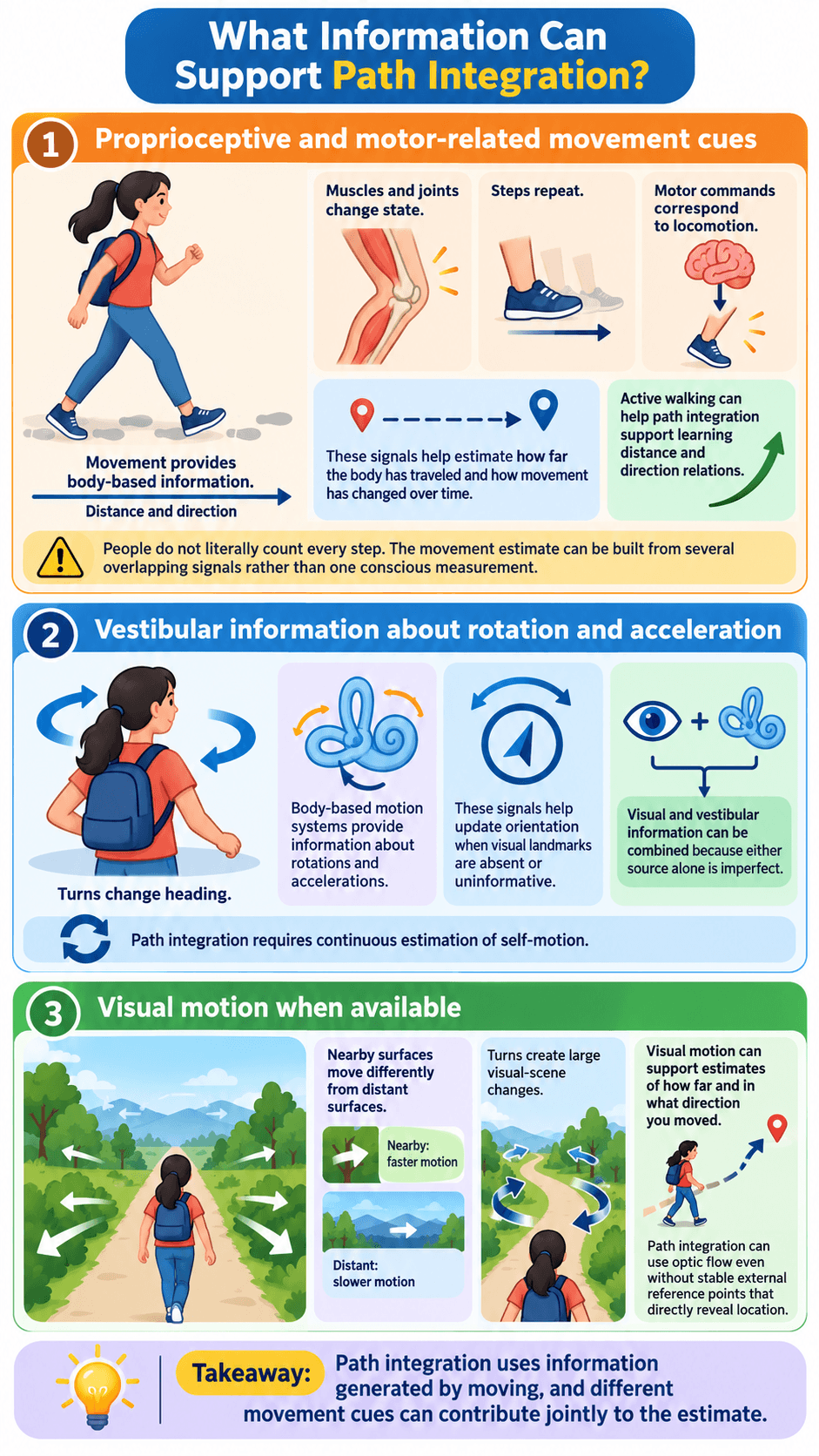
Walking provides body-based information about movement. Muscles and joints change state, steps repeat, and the body produces motor commands that correspond to locomotion.
These signals can contribute to estimating how far the body has traveled and how movement has changed over time. The large-scale navigation review cited earlier reports that proprioceptive cues associated with active walking can make path integration particularly useful for learning distance and direction relations.
This does not mean people literally count every step. The movement estimate can be built from several overlapping signals rather than one conscious measurement.
Vestibular information about rotation and acceleration
Turns change heading, and body-based motion systems provide information about those rotations and accelerations. These signals help update orientation when visual landmarks are absent or uninformative.
A broad review of self-motion and human spatial updating explains that path integration requires continuous estimation of self-motion and that visual and vestibular information can be combined because either source alone is imperfect.
For a general psychological explanation, the important point is simple: path integration uses information generated by moving, and different movement cues can contribute jointly to the estimate.
Visual motion when available
Seeing the visual world flow past you also provides information about movement. As you walk forward, nearby surfaces move across the visual field differently from distant surfaces. Turns produce large changes in the visual scene.
Visual motion can therefore support estimates of how far and in what direction you have moved, especially in environments where body-based cues are limited or ambiguous.
Path integration is often studied without landmarks to isolate self-motion updating, but this does not require removing all visual motion. A person can use optic flow while still lacking stable external reference points that would directly reveal location.
Why Error Accumulates
Each movement estimate contains some uncertainty
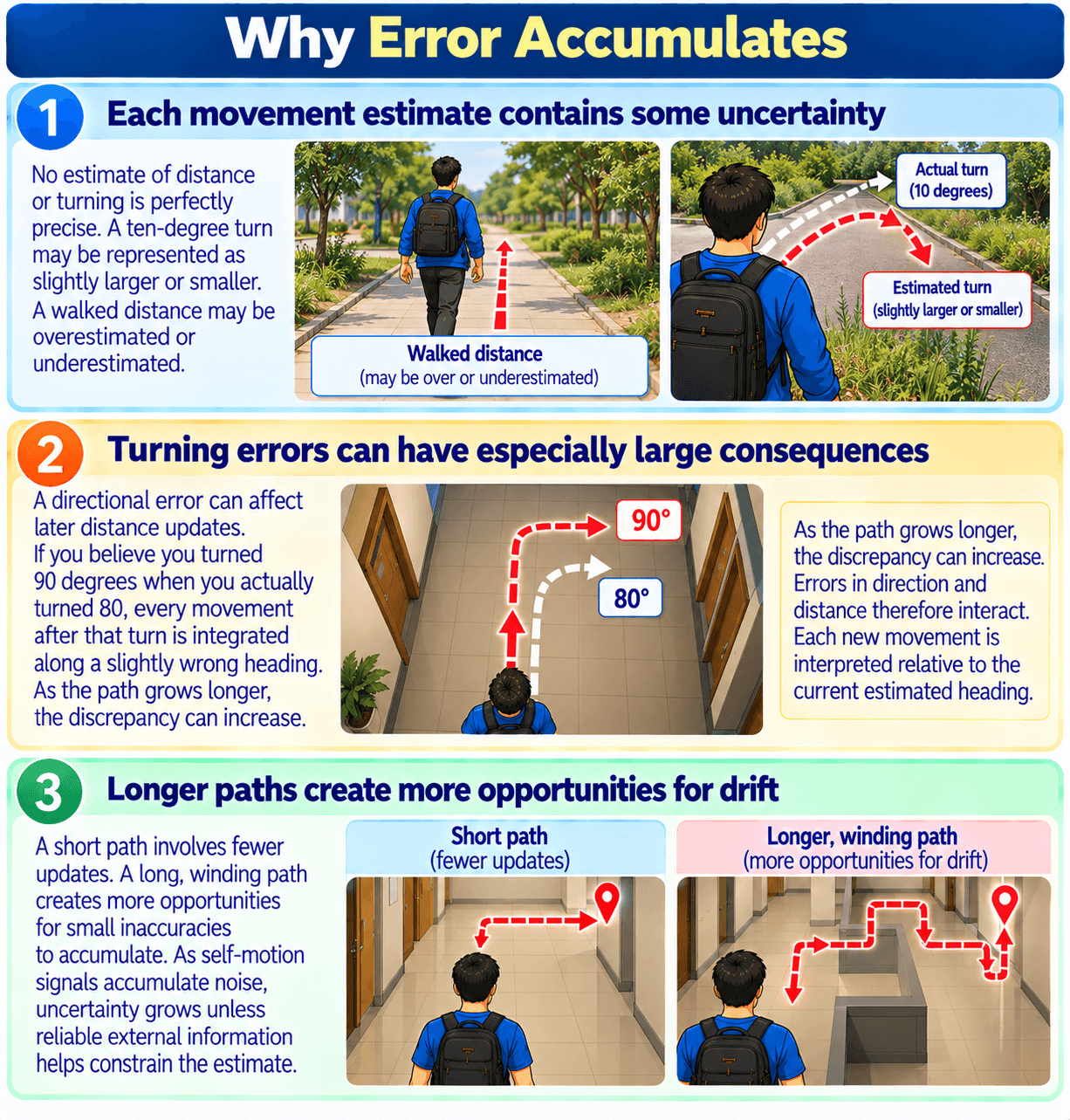
No estimate of distance or turning is perfectly precise. A ten-degree turn may be represented as slightly larger or smaller. A walked distance may be overestimated or underestimated.
One small error may not matter much. The problem appears when many updates are added together. If each segment is based on an imperfect estimate, the final position estimate can gradually diverge from the true position.
The review of spatial reorientation and path integration describes path integration as continuously updating position and heading from self-motion cues while also noting that accumulated error makes recalibration necessary.
Turning errors can have especially large consequences
A directional error can affect later distance updates. If you believe you turned 90 degrees when you actually turned 80, every movement after that turn is integrated along a slightly wrong heading.
As the path grows longer, the discrepancy can increase. This is one reason complicated multi-turn routes are more difficult than short straight paths.
Errors in direction and distance therefore interact. Path integration is not a simple sum of independent step lengths. Each new movement is interpreted relative to the current estimated heading.
Longer paths create more opportunities for drift
Imagine estimating the location of your starting point after one short turn versus after twelve turns through a winding corridor. The second task creates more opportunities for small inaccuracies to accumulate.
Recent work on spatial uncertainty in human navigation frames this problem as an evolving belief about position and heading. As self-motion signals accumulate noise, uncertainty grows unless reliable external information helps constrain the estimate.
This uncertainty is not evidence that path integration has failed completely. It is a normal property of integrating noisy information over time.
How Landmarks Correct Drift
External cues can recalibrate a movement-based estimate
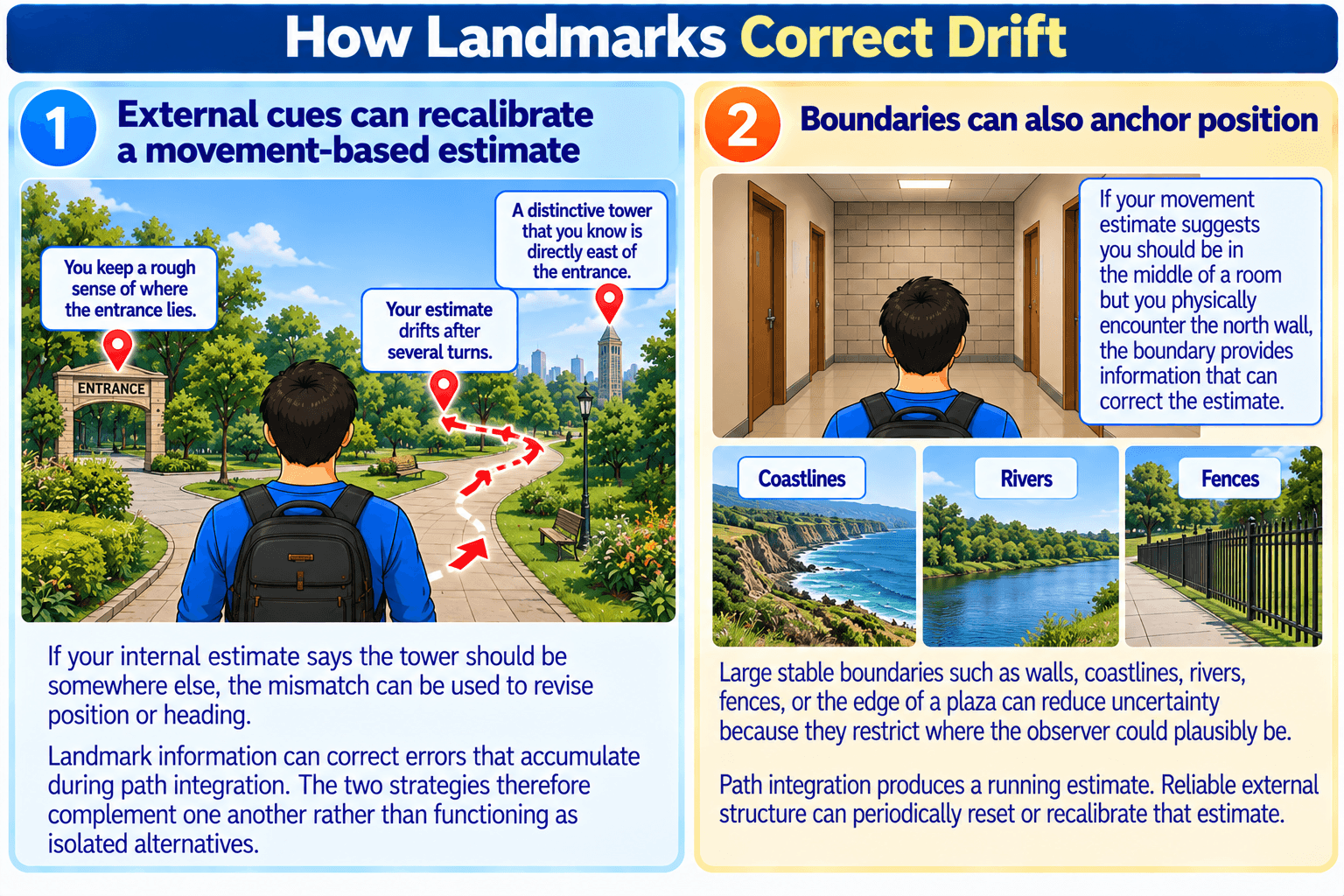
Suppose you walk through a large park while keeping a rough sense of where the entrance lies. After several turns, your estimate drifts. Then you see a distinctive tower that you know is directly east of the entrance.
That landmark provides an external spatial constraint. If your internal estimate says the tower should be somewhere else, the mismatch can be used to revise position or heading.
A review of landmark-based navigation and path integration describes how landmark information can correct errors that accumulate during path integration. The two strategies therefore complement one another rather than functioning as isolated alternatives.
Boundaries can also anchor position
Large stable boundaries such as walls, coastlines, rivers, fences, or the edge of a plaza can reduce uncertainty because they restrict where the observer could plausibly be.
If your movement estimate suggests you should be in the middle of a room but you physically encounter the north wall, the boundary provides information that can correct the estimate.
The principle is broader than any particular cue. Path integration produces a running estimate. Reliable external structure can periodically reset or recalibrate that estimate.
Path Integration Is Not an Internal GPS
The estimate is approximate and continuously revised
The GPS metaphor is tempting because both involve location updating. But human path integration is not a hidden satellite system producing exact coordinates.
It is better understood as a noisy, continuously updated estimate. The estimate can be useful enough to support pointing, homing, orientation, and layout learning while still containing systematic errors.
In ordinary life, the system also rarely operates alone. Visual landmarks, route knowledge, signs, boundaries, maps, and remembered environmental structure can all contribute to navigation.
Successful homing does not prove perfect metric tracking
A person may point roughly toward the starting point without representing every traveled meter accurately. The response can be directionally useful even when distance estimates are compressed or turns are misestimated.
Likewise, a poor return response does not show that no path integration occurred. It may reflect accumulated error, an inaccurate turn estimate, a misunderstood instruction, or competition between movement and environmental cues.
Performance should therefore be interpreted as an estimate under uncertainty rather than a simple pass-fail test of an internal navigation device.
Path Integration vs Spatial Orientation
One updating mechanism versus the broader current orientation state
Spatial orientation concerns where you are and which way you are facing relative to the environment. Path integration is one mechanism that can contribute to that estimate.
| Question | Path Integration | Spatial Orientation |
|---|---|---|
| Main focus | How self-motion updates position and direction | Current estimate of self-location and heading |
| Primary information | Movement-related cues | Movement plus landmarks, boundaries, layout, and other cues |
| Typical output | Updated displacement or return direction | Where am I and which way am I facing? |
| Main limitation | Error accumulates over movement | Can become uncertain when cues conflict or are ambiguous |
The distinction is useful because orientation can be restored from a landmark even when path integration has drifted. The broader orientation state can therefore incorporate information beyond self-motion.
Path Integration vs Wayfinding
Updating where you are versus choosing how to reach a destination
Wayfinding includes route choice, monitoring, landmark recognition, correction, and movement toward a goal. Path integration is only one possible input to that broader activity.
You can perform path integration without having a destination other than the starting point. In a laboratory triangle-completion task, the main question is whether self-motion supports an estimate of the return direction.
You can also perform wayfinding with little reliance on path integration by following clear signs or visible landmarks from one decision point to the next.
How path integration can support wayfinding without defining it
During real navigation, path integration can help maintain a running estimate between landmarks. This can be useful in a long corridor, open field, dark passage, or unfamiliar space where stable external cues are temporarily limited.
When a reliable landmark reappears, the broader wayfinding process can use it to confirm or revise the movement-based estimate.
This makes path integration a supporting process inside navigation, not a synonym for navigation itself.
Path Integration vs Cognitive Maps
Movement-based updating versus stored environmental relationships
A cognitive map concerns the represented relationships among locations, routes, landmarks, regions, and other environmental features. Path integration concerns how movement changes the estimated relationship between the self and a known reference point.
You can path-integrate in a nearly featureless environment where you know very little about the larger layout. Conversely, you can have rich cognitive-map knowledge of a city while relying heavily on landmarks and routes rather than continuously integrating every turn.
The processes interact, but their core questions are different.
How movement can contribute to learning larger layouts
Active movement can help people learn distance and directional relations between locations. The 2022 review of large-scale human path integration reports that walking with body-based self-motion cues can improve survey knowledge compared with more passive exposure in some settings.
This does not mean a cognitive map is simply the accumulated output of path integration. Environmental landmarks, maps, route experience, and other forms of spatial learning can also shape broader layout knowledge.
Path integration is therefore one contributor to environmental representation rather than a complete theory of cognitive mapping.
Everyday Examples of Path Integration
Walking through a dark or feature-poor space
Imagine walking through a dim corridor during a power outage. You remember starting near the entrance, then walk forward, turn left, continue, and stop.
Even without distinctive landmarks, you may have a rough idea that the entrance is behind and to the right. That estimate is a path-integration-like use of recent movement information.
If emergency safety is involved, however, a rough internal estimate should never replace official evacuation guidance, emergency lighting, signage, trained instructions, or other reliable safety procedures.
Moving around a room and pointing back to the start
Start beside a chair, walk around a table, turn twice, and then point toward the chair without looking directly at it. The pointing response depends partly on updating the relationship between the moving self and the original location.
If the path is short, performance may be fairly good. As the path becomes longer and more complex, the estimate usually becomes less precise.
Temporarily losing landmarks and then seeing one again
Imagine walking along a trail that briefly enters dense trees. For several minutes, visible distant landmarks disappear. You continue using the direction and distance of your movement to maintain a rough estimate of where the trailhead lies.
When a familiar hill becomes visible again, the landmark can either confirm the estimate or reveal that drift has occurred.
This sequence captures the interaction between movement-based updating and external correction in an intuitive way.
Common Misunderstandings
Path integration does not require perfect awareness of every movement
People do not usually count every degree of turning or every centimeter traveled. The process can operate using combined movement information without a detailed conscious record.
You may only become aware of the estimate when asked to point back to the origin or when a landmark appears somewhere other than expected.
Path integration is not the same as remembering a route
Route memory can preserve a sequence such as left, right, straight, left. Path integration uses those movements to update net displacement relative to a reference point.
The difference becomes obvious in triangle completion. Retracing the route requires remembering the sequence. Returning directly across the unseen third side requires an estimate of the overall spatial displacement.
Poor accuracy does not imply low intelligence or a disorder
Path integration is inherently error-prone because movement estimates contain noise and because uncertainty accumulates over longer paths. Performance also depends on task design, available cues, movement type, and strategy.
An inaccurate pointing response in a laboratory-style task should not be treated as a diagnosis or as a measure of general intelligence.
FAQ About Path Integration Psychology
These questions clarify the most common boundaries between path integration and the broader spatial processes around it.
Is path integration the same as dead reckoning?
The terms are often used closely. Both refer to estimating current position from a known starting point by updating displacement during movement rather than depending continuously on landmarks. In psychology, path integration emphasizes the cognitive and sensory processes involved in that self-motion-based updating.
Why does path integration become less accurate over time?
Each estimate of distance and turning contains some uncertainty. Because later updates build on earlier estimates, small errors can accumulate across a long or complex path. Reliable landmarks and boundaries can help recalibrate position and heading when they become available again.
Can landmarks be used during path integration?
Researchers often reduce landmark information when they want to isolate path integration, but real navigation usually combines both. Path integration can maintain an estimate between landmarks, while external cues can periodically correct drift. Using both does not make the path-integration contribution disappear.
Is path integration the same as spatial orientation?
No. Path integration is a self-motion-based updating process. Spatial orientation is the broader current estimate of position and heading, which can also use landmarks, boundaries, remembered layouts, and other external information. Path integration can contribute to orientation without defining all of it.
Key Takeaways
- Path integration updates estimated position and heading by integrating self-motion across movement.
- The basic logic is start from a known point, update distance and direction, estimate current displacement, and infer a return direction.
- Triangle-completion tasks reveal path integration because the direct return path was not previously traveled.
- Small distance and turning errors accumulate, so estimates become less precise as paths grow longer or more complex.
- Landmarks and boundaries can recalibrate movement-based estimates when reliable external information becomes available.
- Path integration supports spatial orientation, wayfinding, and layout learning but is not identical to any of them.
A practical way to recognize path integration is to ask whether the judgment depends on how your own movement changed your position relative to a known start. If the answer comes mainly from integrating distance and turning rather than from recognizing a landmark or replaying a route sequence, path integration is doing much of the work.
Educational note: Path integration is a normal spatial updating process, not a clinical test. In safety-critical navigation such as wilderness travel, driving, boating, aviation, or emergency evacuation, rely on official navigation tools, signage, trained guidance, and established procedures rather than an unaided internal estimate.
At Psychology Exposed, Michael Reed turns research on cognition and behavior into plain-English explanations of everyday mental processes.

Michael Reed is the Founder and Lead Writer at Psychology Exposed. He writes about human behavior, relationships, emotional patterns, self-awareness, and practical psychology topics using research-informed, easy-to-understand content.
Read More About Michael Reed: https://psychologyexposed.com/michael-reed/