
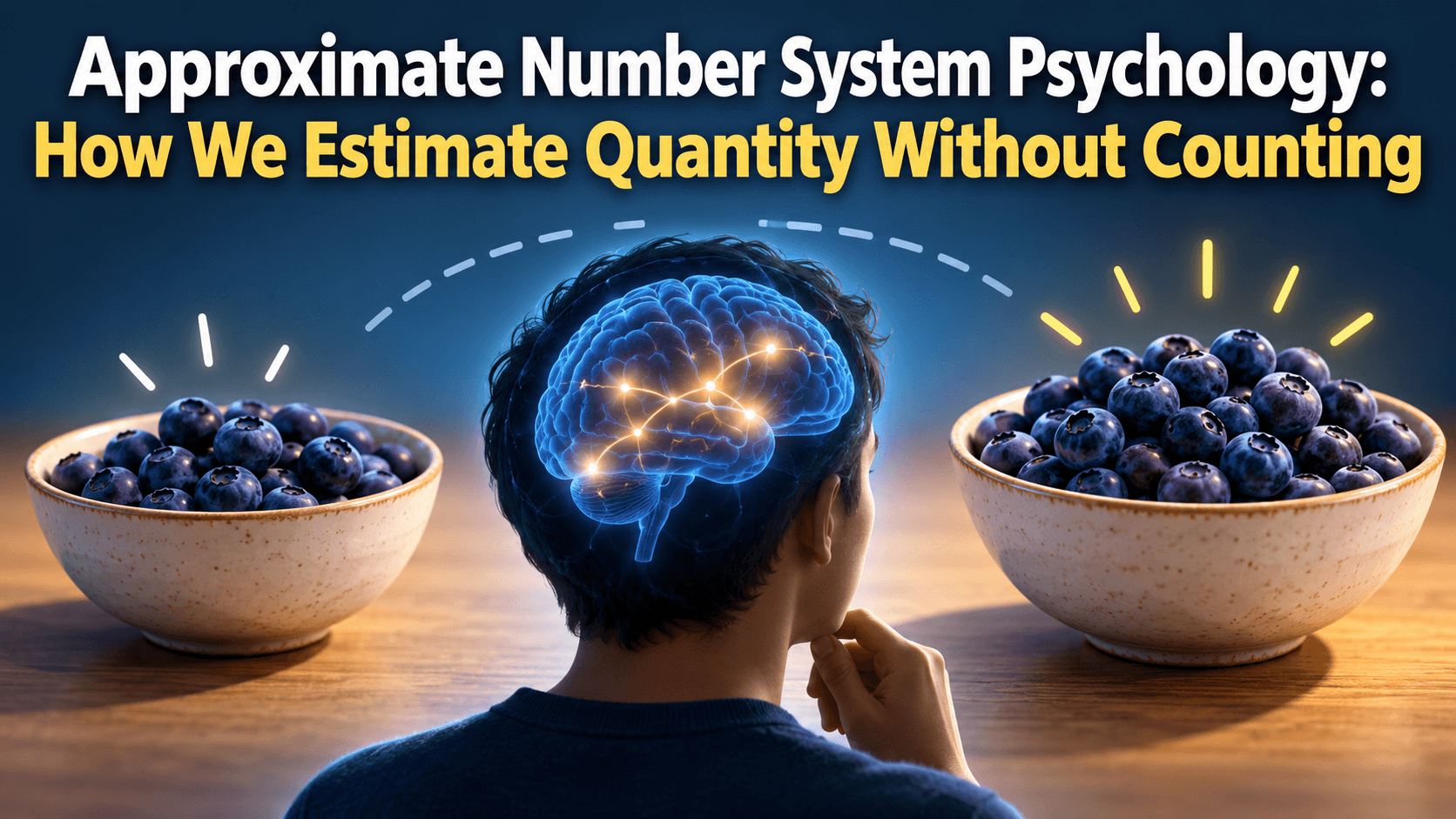
Imagine seeing two bowls of berries for only a moment. One contains roughly twice as many berries as the other. You may be able to choose the fuller bowl without counting a single berry. Now make the two quantities much closer, such as 18 berries versus 20. The judgment becomes harder.
This kind of approximate quantity discrimination is central to research on the Approximate Number System, usually shortened to ANS. The ANS is a proposed cognitive system for representing nonsymbolic numerical magnitude approximately. Its representations are imprecise rather than exact, and performance often depends on the ratio between two quantities.
The idea is influential, but it should not be stretched too far. A dot-array task does not measure number in a vacuum. Dot size, density, total area, spacing, display duration, instructions, and scoring method can affect performance. Researchers also continue to debate how strongly ANS acuity relates to learned symbolic mathematics. The most useful way to understand the ANS is therefore as a research model of approximate number representation, not as a hidden “math talent meter.”
Quick Answer

The Approximate Number System is a proposed cognitive system that supports rough representation and comparison of nonsymbolic quantities without exact counting. Its judgments are typically ratio-dependent, so widely separated quantities are easier to distinguish than similar ones. ANS tasks can also be influenced by visual features and measurement choices, and ANS performance should not be treated as a direct measure of intelligence or formal mathematical ability.
What the Approximate Number System Is Proposed to Do
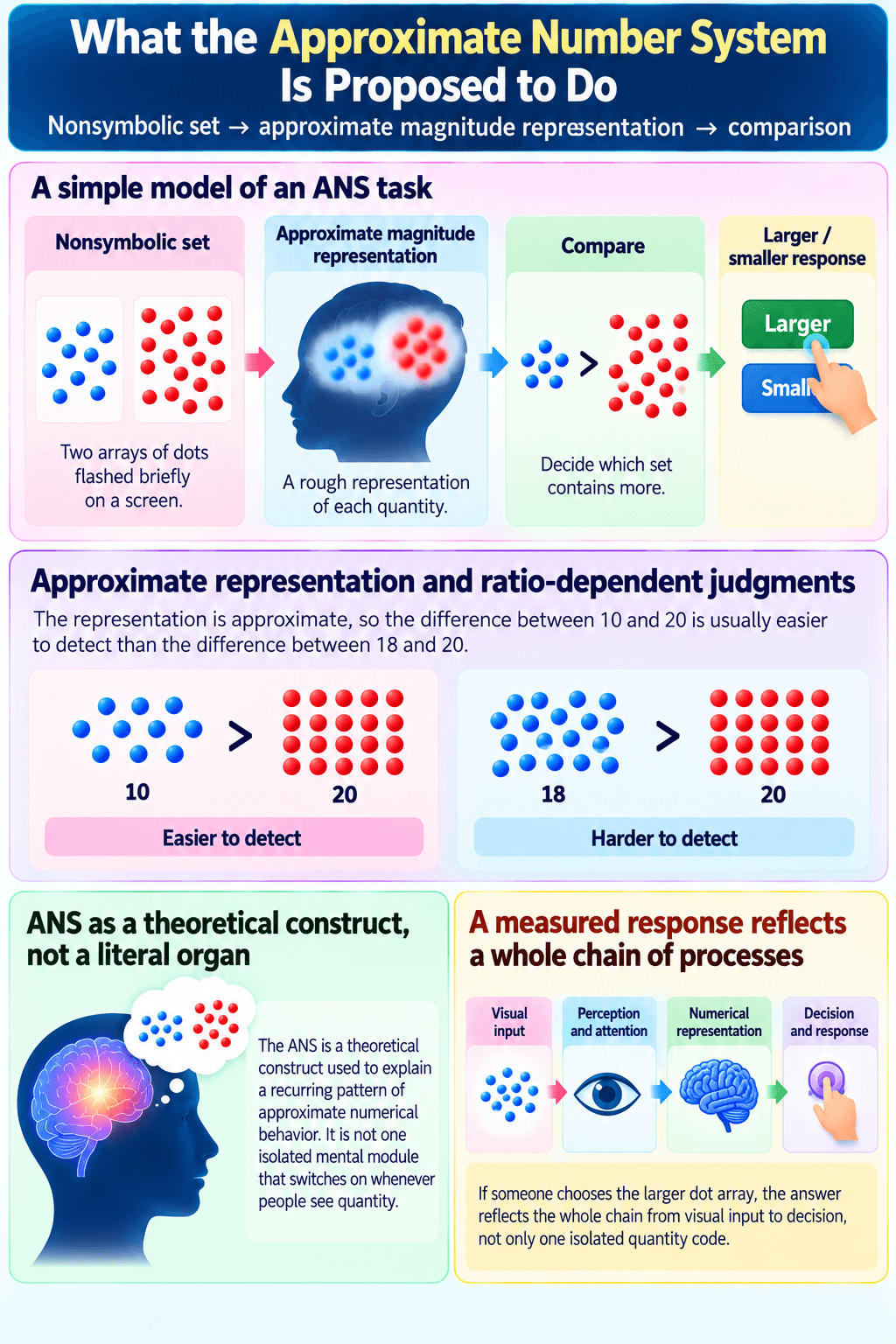
Nonsymbolic set → approximate magnitude representation → comparison
A simple model of an ANS task looks like this:
NONSYMBOLIC SET → APPROXIMATE MAGNITUDE REPRESENTATION → COMPARE → LARGER / SMALLER RESPONSE
The input might be two arrays of dots flashed briefly on a screen. Instead of counting each dot, the observer forms a rough representation of each quantity and decides which set contains more. The representation is approximate, so the difference between 10 and 20 is usually easier to detect than the difference between 18 and 20.
This pattern is consistent with a large body of psychophysical work on nonsymbolic number. An open-access review of the ANS and symbolic mathematics describes the ANS as supporting fuzzy, ratio-dependent magnitude representations while also emphasizing that links between those representations and formal mathematics remain complex.
ANS as a theoretical construct, not a literal organ
The phrase “number system” can sound as if psychologists have identified one isolated mental module that switches on whenever people see quantity. That is too literal. The ANS is a theoretical construct used to explain a recurring pattern of approximate numerical behavior.
Researchers infer properties of the system from performance: accuracy, reaction time, ratio effects, error patterns, and sensitivity to stimulus design. Different theories may explain parts of that behavior differently, and a task can recruit perceptual, attentional, decision, and response processes in addition to numerical representation.
That distinction matters because a measured response is not identical to the underlying representation. If someone chooses the larger dot array, the answer reflects the whole chain from visual input to decision, not only one isolated quantity code.
Numerosity and Approximate Magnitude
What numerosity means
Numerosity is the number of discrete items in a set. If a display contains 16 dots, its numerosity is 16. Numerosity is not the same thing as total occupied area, density, average item size, brightness, or how spread out the items are.
This separation sounds straightforward until a visual display is constructed. If a researcher adds more dots to an array, the display may automatically become denser, cover a larger region, or contain more total surface area. Those visual properties can provide clues about which set has more items even when the participant is supposed to judge number.
For that reason, ANS research often manipulates or controls nonnumerical visual properties. The goal is not to pretend perception is irrelevant. It is to determine how much of the response is attributable to numerical quantity rather than to correlated visual information.
Approximate rather than exact cardinal value
The ANS is usually described as approximate because its representations do not behave like exact symbolic integers. A person can know that one briefly shown set contains substantially more objects than another without knowing whether the exact counts were 31 and 47.
The distinction between exact and approximate number is especially clear when the arrays are presented too briefly to count. The observer can still make a useful magnitude judgment, but uncertainty increases as the quantities become harder to distinguish.
This is different from exact symbolic knowledge. The digit “47” specifies an exact numerical value within a learned symbol system. A brief visual cloud that feels like “roughly fifty” provides useful quantity information without guaranteeing exact cardinality.
Why Ratio Matters
Easier and harder quantity ratios
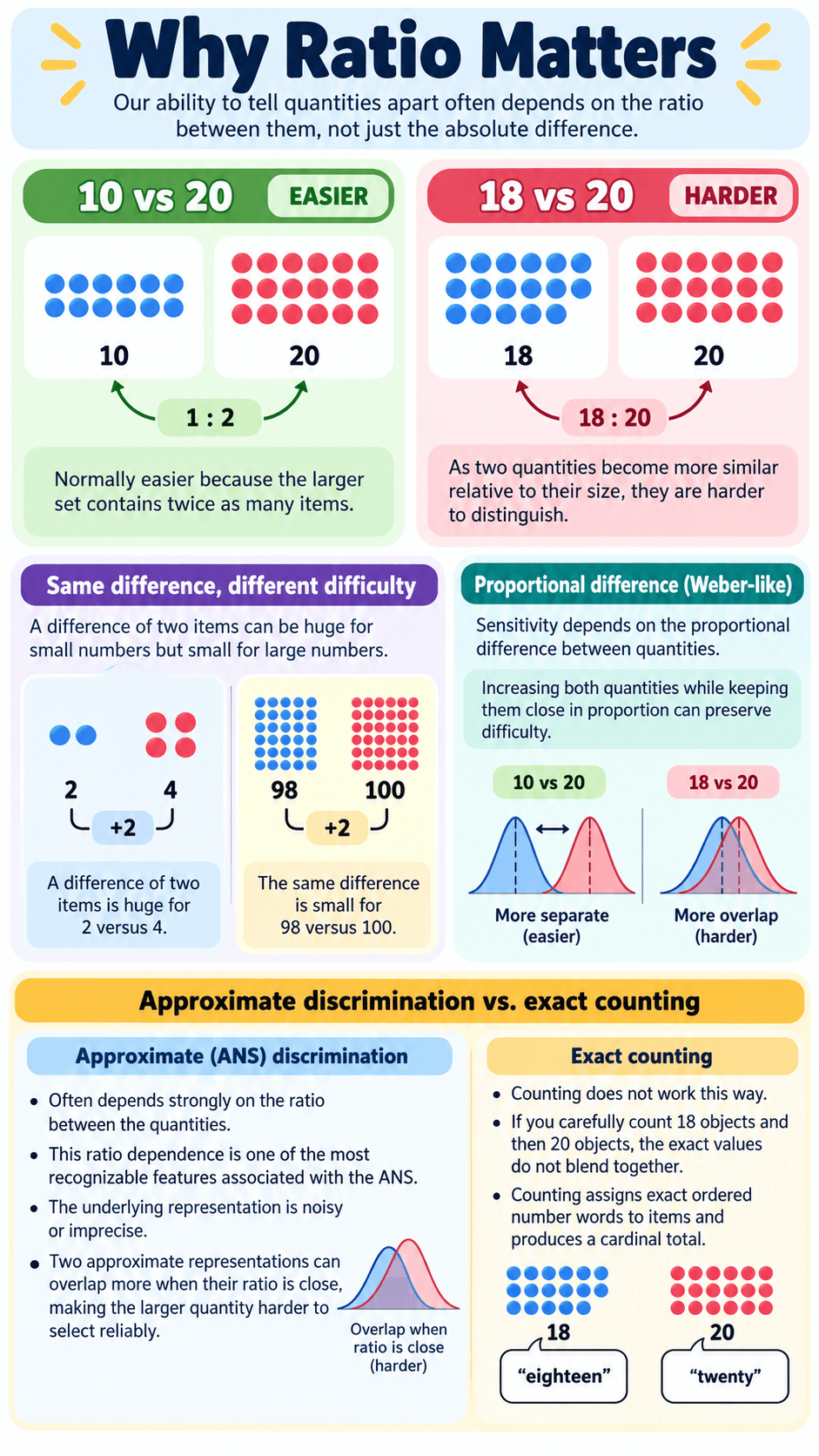
Consider two comparisons:
- 10 dots versus 20 dots: the larger set contains twice as many items.
- 18 dots versus 20 dots: the quantities are much closer.
The first comparison is normally easier. The relevant idea is not simply the absolute difference in item count. Approximate discrimination often depends strongly on the ratio between the quantities.
This ratio dependence is one of the most recognizable features associated with the ANS. It explains why increasing both quantities while keeping them close in proportion can preserve difficulty. A difference of two items is huge for 2 versus 4 but small for 98 versus 100.
Weber-like discrimination in plain language
Psychophysical research often describes approximate number discrimination in Weber-like terms. The practical meaning is that sensitivity depends on proportional difference. As two quantities become more similar relative to their size, their approximate representations become harder to distinguish.
A review of ANS methodology notes that dot-comparison tasks are commonly interpreted through ratio-dependent performance, while also stressing that the exact task setup changes the measurement. That review of methodological issues in ANS measurement is useful precisely because it separates the theoretical idea from the many practical decisions involved in measuring it.
Ratio dependence versus exact counting
Counting does not work this way. If you carefully count 18 objects and then 20 objects, the fact that the quantities are close does not make the final exact values blend together. The process assigns exact ordered number words to items and produces a cardinal total.
ANS discrimination is different because the underlying representation is noisy or imprecise. Two approximate magnitude representations can overlap more when their ratio is close, making the larger quantity harder to select reliably.
How ANS Research Commonly Uses Dot Arrays
Comparing two nonsymbolic sets
A common ANS task shows two dot arrays and asks which contains more dots. The arrays may appear side by side or in quick succession. Participants are usually prevented from counting by limiting presentation time or using quantities large enough that serial enumeration would be impractical.
Researchers then examine accuracy, response time, or a calculated index of acuity. If performance systematically improves as the ratio becomes easier, that pattern is consistent with approximate magnitude discrimination.
The task looks simple, but its interpretation is not. A participant might use numerical information, continuous visual features, or a combination of both. This is why stimulus construction matters so much.
Presentation duration and task demands
A 200-millisecond display creates a different cognitive problem from a display that stays visible for several seconds. Brief presentation limits counting and encourages a rapid judgment. Longer exposure may allow grouping, partial counting, or strategic checking.
Instructions matter too. “Which side has more dots?” is not identical to “Are these two arrays equal?” or “Estimate how many dots are present.” Each task changes what information is useful and how the observer maps a perceptual impression to a response.
Even the response format can matter. A keypress, verbal answer, or slider estimate introduces different decision and motor demands. The ANS is therefore inferred through tasks rather than directly observed.
What researchers mean by ANS acuity
ANS acuity refers to the precision with which a person discriminates approximate numerical magnitudes. Someone with finer discrimination might distinguish relatively close ratios more accurately than someone whose approximate representations overlap more strongly.
However, an acuity score is only as clean as the task used to estimate it. Test reliability, visual controls, trial count, ratio range, scoring method, and participant strategy can all affect the result. This is one reason two studies can report different relationships between ANS performance and formal mathematics.
The Visual-Control Problem
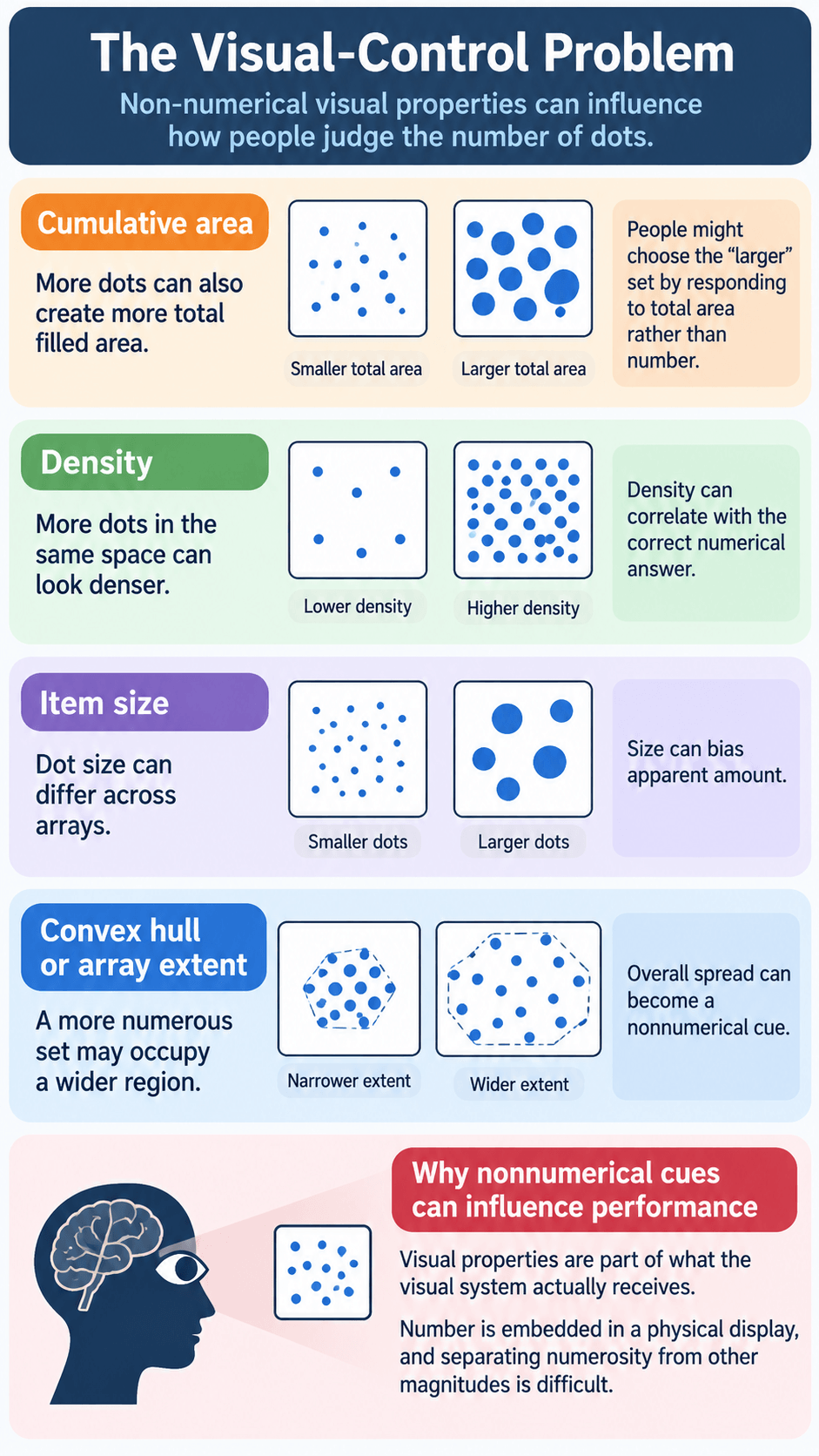
Cumulative area
If one array has twice as many dots and also twice as much total filled area, a person could choose the “larger” set by responding to total area instead of number. Researchers therefore vary or control cumulative surface area so that it cannot consistently reveal the correct answer.
Density
More numerous arrays often look denser when the same space contains more items. Density itself can become a useful cue. If density and numerosity always point to the same side, it becomes difficult to know whether the participant compared number, density, or both.
Item size
Average dot size can also co-vary with number. Larger dots may create a stronger impression of “more,” while smaller dots can sometimes influence responses in unexpected directions. Careful stimulus design varies item size so it cannot serve as a reliable shortcut.
Why nonnumerical cues can influence performance
Visual properties are not merely experimental annoyances. They are part of what the visual system actually receives. Number is embedded in a physical display, and separating numerosity from other magnitudes is difficult.
An analysis of dot comparison as an ANS measure highlights how convex hull, surface area, density, and related visual dimensions can bias performance. Another modeling study showed that visual stimulus features can contribute substantially to judgments that are often summarized as ANS acuity. These findings do not make ANS research meaningless. They show why a good numerical task must take perceptual information seriously.
| Feature | How it can change with numerosity | Why researchers care |
|---|---|---|
| Total surface area | More dots may create more filled area | Participants might choose by total area rather than number |
| Density | More dots in the same region may look denser | Density can correlate with the correct numerical answer |
| Average item size | Dot size may differ across arrays | Size can bias apparent amount |
| Convex hull or array extent | A more numerous set may occupy a wider region | Overall spread can become a nonnumerical cue |
ANS vs Subitizing vs Numerical Estimation
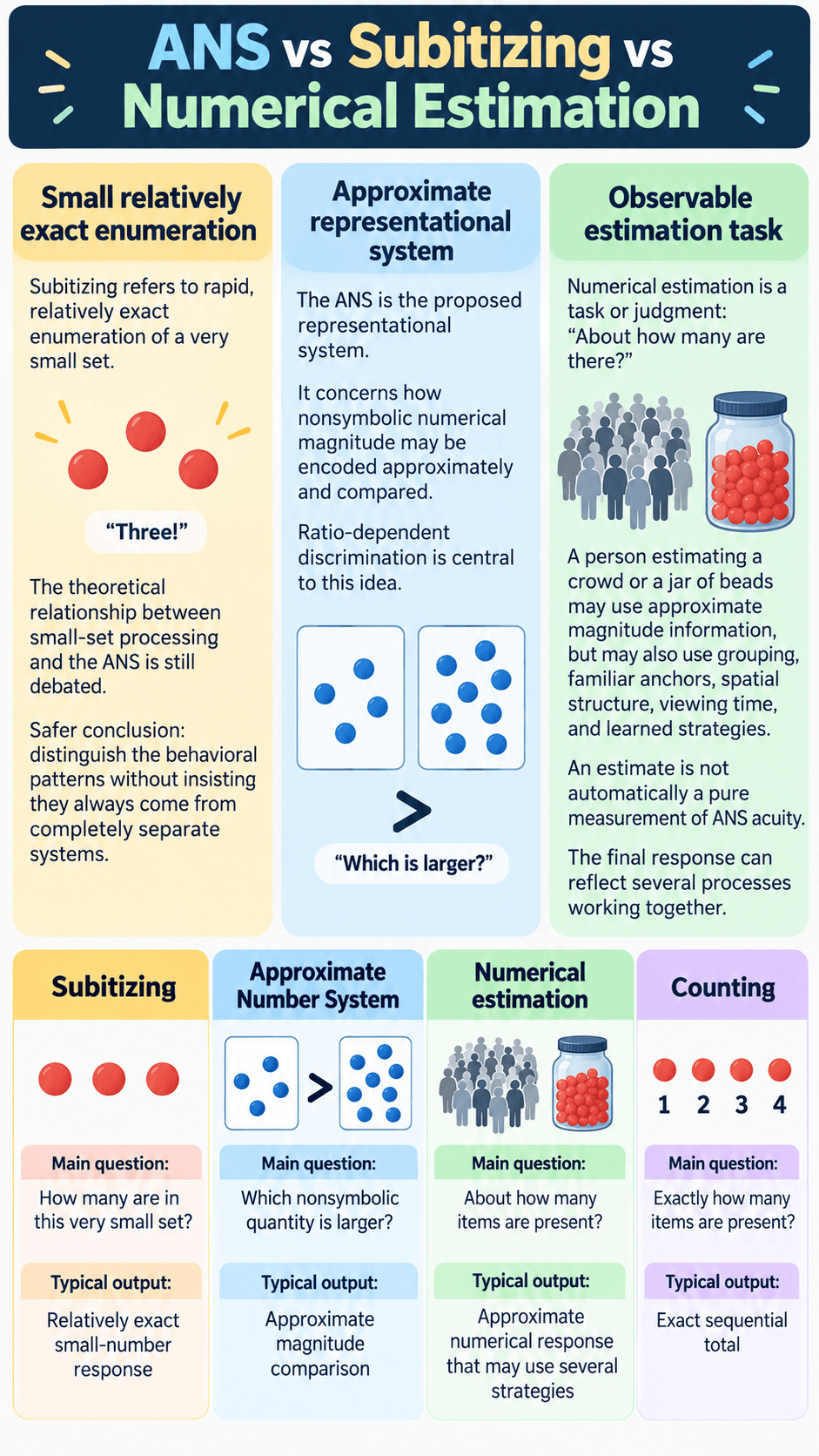
Small relatively exact enumeration
Subitizing refers to rapid, relatively exact enumeration of a very small set. When three clearly separated objects register immediately as “three,” the response has a different profile from a rough comparison between two large arrays.
The theoretical relationship between small-set processing and the ANS is still debated. It is therefore safer to distinguish the behavioral patterns without insisting that they must always come from completely separate systems.
Approximate representational system
The ANS is the proposed representational system. It concerns how nonsymbolic numerical magnitude may be encoded approximately and compared. Ratio-dependent discrimination is central to this idea.
Observable estimation task
Numerical estimation is a task or judgment: “About how many are there?” A person estimating a crowd or a jar of beads may use approximate magnitude information, but may also use grouping, familiar anchors, spatial structure, viewing time, and learned strategies.
This distinction prevents a common mistake. An estimate is not automatically a pure measurement of ANS acuity. The final response can reflect several processes working together.
| Concept | Main question | Typical output |
|---|---|---|
| Subitizing | How many are in this very small set? | Relatively exact small-number response |
| Approximate Number System | Which nonsymbolic quantity is larger? | Approximate magnitude comparison |
| Numerical estimation | About how many items are present? | Approximate numerical response that may use several strategies |
| Counting | Exactly how many items are present? | Exact sequential total |
ANS and Symbolic Number Knowledge
Learned symbols are not automatically direct copies of ANS representations
Digits such as 4 and 9 are culturally learned symbols. Their exact meanings are taught through language, counting, comparison, and use. Nonsymbolic dot arrays provide perceptual quantities rather than conventional symbols.
One influential proposal is that symbolic number meanings become grounded by mapping onto pre-existing approximate magnitude representations. That idea is plausible and has substantial research history, but it is not the only account. Symbolic numbers may develop increasingly precise relationships with one another that cannot be reduced to approximate dot-array representations alone.
This is why symbolic and nonsymbolic number processing should not be treated as interchangeable. The digit 8 specifies an exact conventional value. Eight briefly shown dots may support an exact response under some conditions, but larger dot arrays are often represented approximately.
Why links with symbolic mathematics are studied but not settled
Researchers have repeatedly asked whether people with more precise ANS representations also perform better in formal mathematics. Some meta-analyses and studies report positive associations. Other studies find weak, inconsistent, task-dependent, or absent relationships. A research overview on the ANS and mathematics summarizes both supportive findings and evidence challenging a simple foundational account.
The disagreement does not necessarily mean that one side must be wrong. The measured association can change with age, the particular ANS task, visual controls, reliability, the kind of math outcome being tested, and sample size. A review asking whether the ANS serves as a foundation for symbolic mathematics discusses both supportive evidence and the reasons results can conflict.
Why ANS-Math Correlations Need Caution

Measurement reliability
If a task gives a person noticeably different acuity scores on different occasions, correlations with other abilities become difficult to interpret. Reliability places an upper limit on how strongly a measure can relate to another variable.
Research comparing ANS assessments has found that reliability differs across task designs. One study of reliability across ANS assessments emphasizes that there is no universally accepted single best way to generate or score nonsymbolic comparison tasks.
Task design and visual controls
Two studies can both claim to measure ANS acuity while using different dot-generation algorithms, ratio ranges, exposure durations, response methods, and controls for visual features. Those differences can change what the task actually demands.
A correlation found with one task may therefore fail to appear with another. This does not automatically invalidate the construct, but it does make broad claims such as “ANS acuity predicts math ability” too crude unless the task and population are specified.
Participant age and choice of mathematics measure
Formal mathematics is not one ability. Arithmetic fluency, symbolic comparison, calculation, geometry, algebra, and word problems draw on overlapping but different knowledge and skills. The strength of an ANS relationship can therefore depend on what researchers call “math performance.”
Age matters as well because symbolic number knowledge changes with learning and experience. Evidence from children cannot simply be treated as a direct description of adult numerical processing.
Correlation does not establish a causal foundation
Even a reliable correlation would not by itself show that ANS acuity causes stronger mathematics. A third factor could influence both, symbolic learning could sharpen some nonsymbolic performance, or the relationship could be bidirectional.
Claims about training require even stronger evidence. A temporary improvement on approximate quantity tasks does not automatically imply durable gains in formal mathematics. The methodological review cited earlier specifically warns that inconsistent measurement and task differences complicate claims about ANS-math relationships.
What ANS Research Does Not Show
ANS training is not established as a reliable way to improve formal mathematics
Some studies have explored whether practicing approximate arithmetic or nonsymbolic quantity tasks transfers to symbolic mathematics. Findings have attracted attention because the educational implication would be substantial if the transfer were robust.
However, the literature does not justify a simple promise that “training your ANS makes you better at math.” Effects vary by task and study design, and theoretical disagreement remains about what is actually being trained.
Low task performance is not a diagnosis or intelligence score
A person can perform poorly on a dot-comparison task for many reasons, including distraction, visual strategy, unfamiliarity with the task, response speed, or the particular stimulus controls used. One score cannot diagnose dyscalculia, ADHD, intellectual disability, or another condition.
Likewise, ANS acuity should not be treated as a measure of general intelligence or “number brain” quality. Numerical cognition contains many component processes, and formal mathematics depends on learned symbolic knowledge, procedures, language, memory, reasoning, and education in addition to approximate quantity processing.
A Better Way to Interpret an ANS Task
When you see a claim based on a dot-comparison experiment, four questions make the result easier to evaluate:
- What was the numerical ratio? A 1:2 comparison is not equivalent to a near-equal comparison such as 9:10.
- Which visual features were controlled? Look for information about area, density, dot size, and array extent.
- How reliable was the measure? A noisy task makes individual differences harder to interpret.
- What conclusion is being drawn? Showing that two abilities correlate is different from showing that one causes the other.
This four-question check keeps the ANS useful without turning it into more than the evidence supports. It also highlights a broader lesson in psychology: a simple experimental response often sits on top of several perceptual and cognitive processes.
FAQ
Is the Approximate Number System the same as “number sense”?
Not exactly. “Number sense” is used broadly and inconsistently. It can refer to intuitive numerical understanding, flexible number use, approximate quantity, or a mixture of numerical skills. The ANS is a more specific theoretical construct involving approximate nonsymbolic magnitude representation. Using the terms as perfect synonyms can hide important distinctions.
Is the ANS the same as numerical estimation?
No. The ANS is proposed as an underlying approximate representation system. Numerical estimation is a task or judgment, such as deciding that a jar contains “about 40” objects. Estimation can draw on approximate magnitude, but it can also use grouping, visual cues, learned anchors, and other strategies.
Does the ANS process exact numbers?
The ANS is generally characterized as approximate rather than exact. Its representations become harder to distinguish as quantities approach one another in ratio. Exact number knowledge can instead come from processes such as counting and learned symbolic systems, although interactions among these systems remain an active research topic.
Does better ANS acuity mean better mathematics?
Not in a simple one-to-one way. Some studies and meta-analyses report associations between ANS measures and symbolic mathematics, while others report weak or inconsistent relationships. Task reliability, visual controls, age, sample size, and the chosen math measure can all influence the result. ANS acuity should not be treated as a standalone measure of mathematical ability.
Can dot-array tasks be affected by visual features?
Yes. Total area, average dot size, density, spacing, and array extent can co-vary with numerosity. Researchers use stimulus controls to reduce these confounds, but no design makes perception disappear entirely. Careful interpretation therefore considers both numerical ratio and nonnumerical visual information.
Key Takeaways
- The Approximate Number System is a proposed system for rough nonsymbolic magnitude representation, not a literal brain organ or a measure of global math talent.
- ANS discrimination is typically ratio-dependent, so 10 versus 20 is easier than 18 versus 20 even though both comparisons involve numerical quantities.
- Dot-array performance can be influenced by cumulative area, density, item size, array extent, presentation time, and task design.
- Subitizing, ANS processing, numerical estimation, and counting answer different numerical questions and should not be collapsed into one mechanism.
- Links between ANS acuity and symbolic mathematics have been reported, but their strength and interpretation depend on measurement reliability, methodology, age, and the mathematical outcome being studied.
- A low ANS-task score does not diagnose a learning disorder or indicate low intelligence, and current evidence does not justify promising that ANS training will reliably improve formal mathematics.

Michael Reed is the Founder and Lead Writer at Psychology Exposed. He writes about human behavior, relationships, emotional patterns, self-awareness, and practical psychology topics using research-informed, easy-to-understand content.
Read More About Michael Reed: https://psychologyexposed.com/michael-reed/