
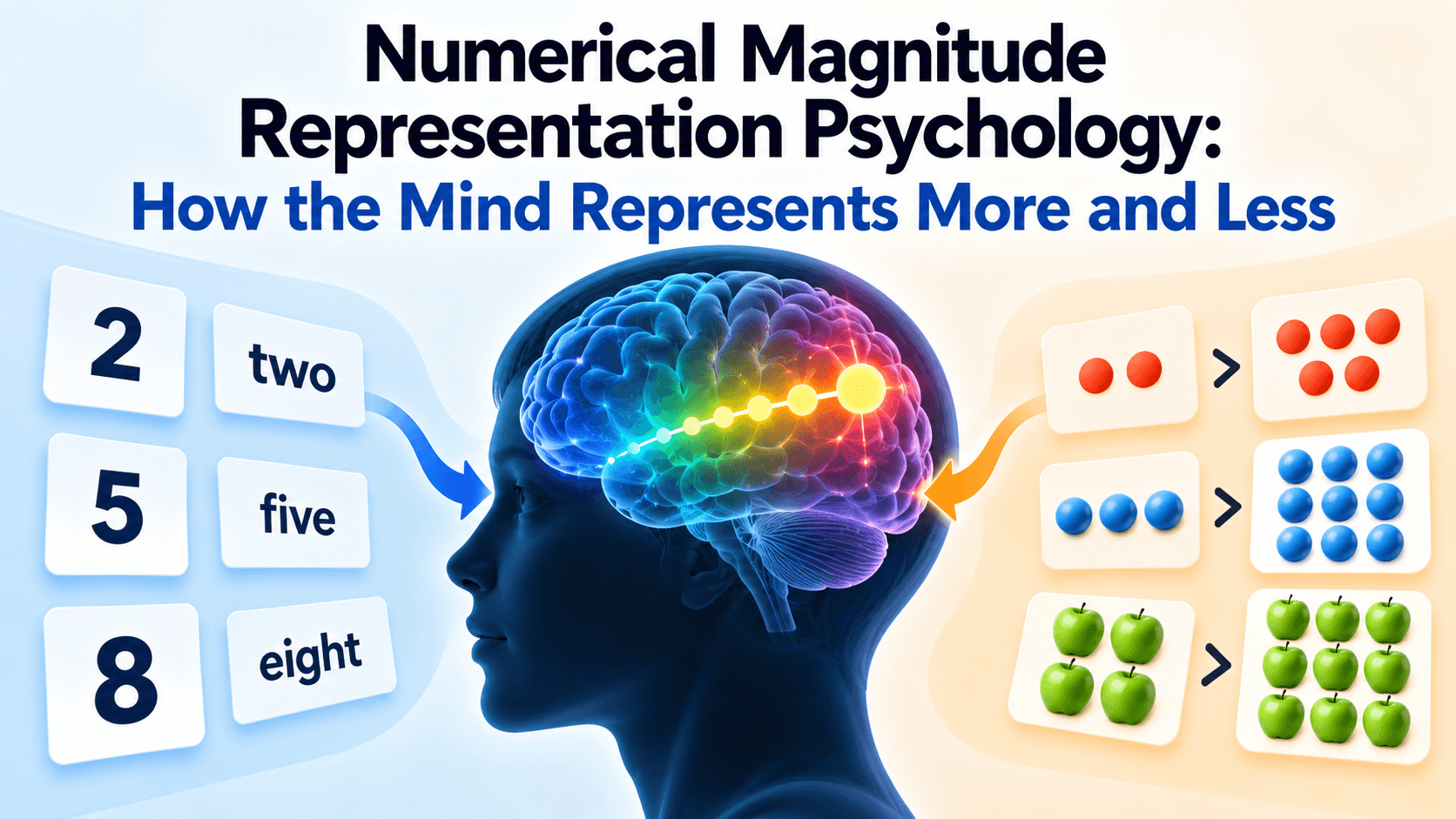
The digit 9 can be printed smaller than the digit 3 and still represent the larger number. A group of nine dots can be spread widely or packed tightly and still have the same numerosity. The word “nine” can be spoken, written, or imagined while preserving the same numerical value.
These examples point to a central question in numerical cognition: how does the mind represent numerical magnitude? Numerical magnitude refers to quantitative numerical size, the information that lets us understand that 9 is more than 4, that 20 is farther from 3 than 5 is, or that two differently presented quantities can refer to the same numerical value.
The question sounds simple until different formats are compared. Does the mind convert digits, number words, and dot arrays into one shared magnitude code? Are symbolic and nonsymbolic magnitudes represented partly differently? Or do several format-sensitive representations eventually interact with a more abstract level? Research supports pieces of more than one view, so the most accurate answer is not a single settled model.
Quick Answer
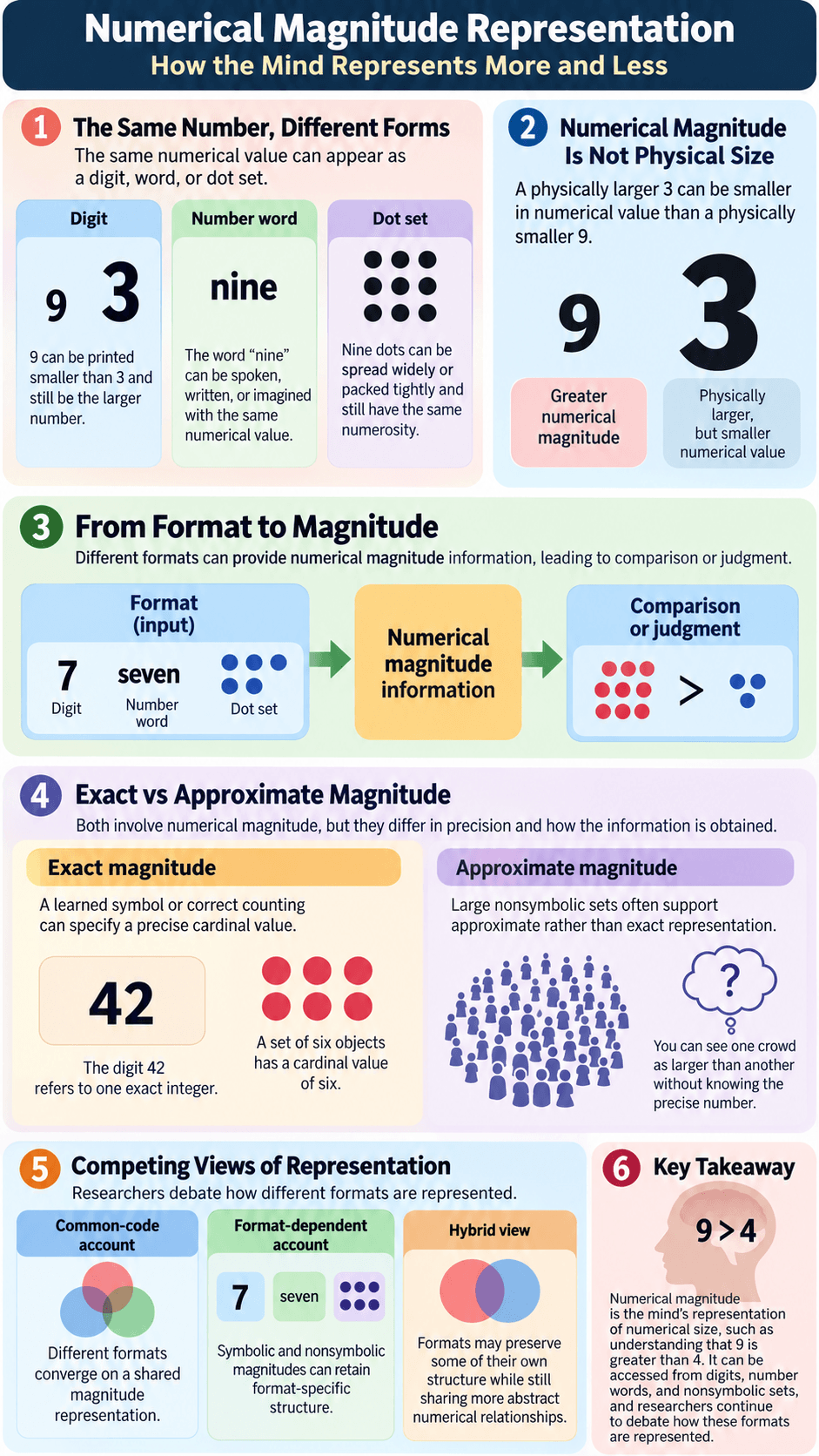
Numerical magnitude representation is the way the mind encodes numerical size, such as understanding that 9 is greater than 4. Magnitude can be accessed from digits, number words, and nonsymbolic sets, but researchers still debate whether these formats share one abstract code, rely on partly format-specific representations, or combine both. Numerical magnitude is also different from physical size, approximate number processing, spatial number mapping, and specific comparison effects.
What Numerical Magnitude Means
Cardinal magnitude and numerical size
Numerical magnitude is the quantitative value associated with a number. In a simple comparison, the magnitude of 8 is greater than the magnitude of 5. The difference concerns number, not the physical appearance of the symbols.
Cardinal magnitude is closely tied to the idea of “how many.” A set of six objects has a cardinal value of six. The symbol 6 can represent that exact value even when no six-item set is visible.
Magnitude is therefore one aspect of numerical meaning. It allows comparison, ordering, estimation, and many arithmetic operations, but it is not the only thing a number can represent. Numbers can also carry ordinal information, labels, dates, ranks, identifiers, or positions in learned sequences.
Numerical magnitude is not physical print size
Consider the following pair:
9 versus 3
The printed 3 is physically larger, but 9 has the greater numerical magnitude. This separation between physical size and numerical value is basic to symbolic number understanding.
Psychologists sometimes exploit this mismatch experimentally. A task may present a numerically larger digit in a physically smaller font, creating conflict between numerical and perceptual dimensions. The important point is that numerical magnitude is conceptual or semantic. It cannot be reduced to the physical size of the mark on the screen.
From Format to Magnitude
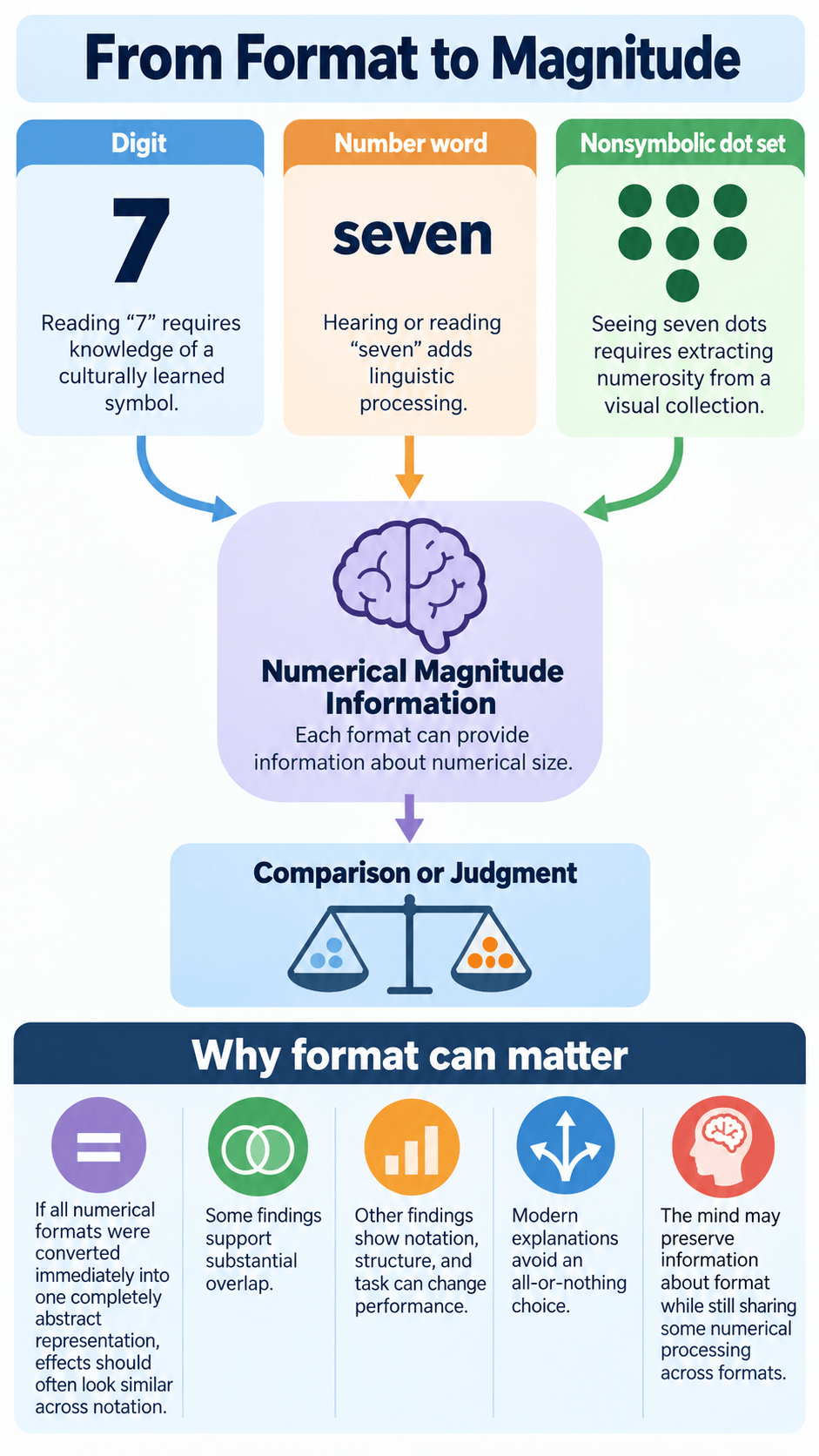
DIGIT / WORD / DOT SET → numerical magnitude information → comparison or judgment
A useful reader-friendly model is:
FORMAT → NUMERICAL MAGNITUDE INFORMATION → COMPARISON OR JUDGMENT
The format might be a digit such as 7, a number word such as “seven,” or a nonsymbolic set containing seven objects. Each can provide information about numerical size, but the path from input to magnitude does not have to be identical.
That distinction matters because the same numerical value can arrive through different perceptual and learned systems. Reading “7” requires knowledge of a culturally learned symbol. Seeing seven dots requires extracting numerosity from a visual collection. Hearing “seven” adds linguistic processing.
Why format can matter
If all numerical formats were converted immediately into one completely abstract representation, behavioral effects should often look similar across notation. Some findings support substantial overlap. Other findings show that notation, structure, and task can change performance.
A study directly comparing symbolic Arabic numbers with structured and unstructured nonsymbolic quantities found evidence difficult to reconcile with a purely unitary magnitude representation. The authors argued that symbolic and nonsymbolic magnitudes can retain format-dependent structure, while also allowing the possibility that different representations converge at a more abstract level.
This is why modern explanations often avoid an all-or-nothing choice. The mind may preserve information about format while still sharing some numerical processing across formats.
Exact and Approximate Magnitude
Precise cardinal value
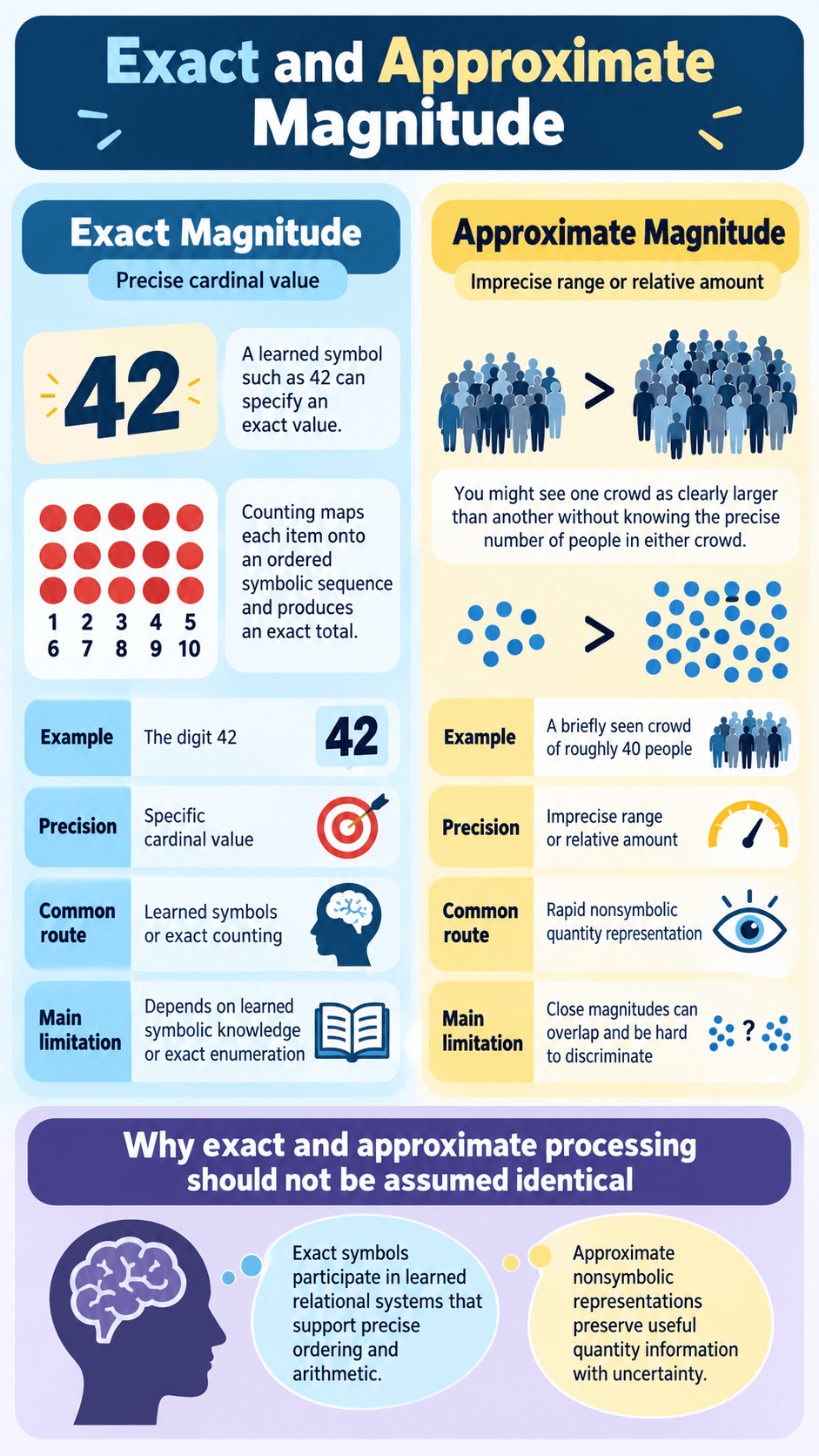
A learned symbol such as 42 can specify an exact value. If you understand the decimal number system, 42 does not mean “roughly forty-something.” It refers to one exact integer.
Exactness also appears when a visible set is counted correctly. A collection may begin as a nonsymbolic perceptual input, but counting maps each item onto an ordered symbolic sequence and produces an exact cardinal total.
Exact numerical magnitude therefore does not belong only to one input format. What matters is whether the process provides a precise cardinal value.
Approximate magnitude
Large nonsymbolic sets presented briefly often support approximate rather than exact representation. You might see one crowd as clearly larger than another without knowing the precise number of people in either crowd.
Approximate magnitude is useful because it allows fast discrimination when counting would be impossible or unnecessary. Its precision is limited, and close quantities can be harder to distinguish than widely separated ones.
Why exact and approximate processing should not be assumed identical
The fact that exact symbolic numbers and approximate dot arrays both carry numerical magnitude does not mean the internal representation must be identical. Exact symbols participate in learned relational systems that support precise ordering and arithmetic. Approximate nonsymbolic representations preserve useful quantity information with uncertainty.
An open-access study of symbolic and nonsymbolic quantity representations summarizes why research has produced competing evidence for shared versus independent systems. Methodological differences can influence whether a task appears to show integration or separation.
| Feature | Exact magnitude | Approximate magnitude |
|---|---|---|
| Example | The digit 42 | A briefly seen crowd of roughly 40 people |
| Precision | Specific cardinal value | Imprecise range or relative amount |
| Common route | Learned symbols or exact counting | Rapid nonsymbolic quantity representation |
| Main limitation | Depends on learned symbolic knowledge or exact enumeration | Close magnitudes can overlap and be hard to discriminate |
The Common-Code Question
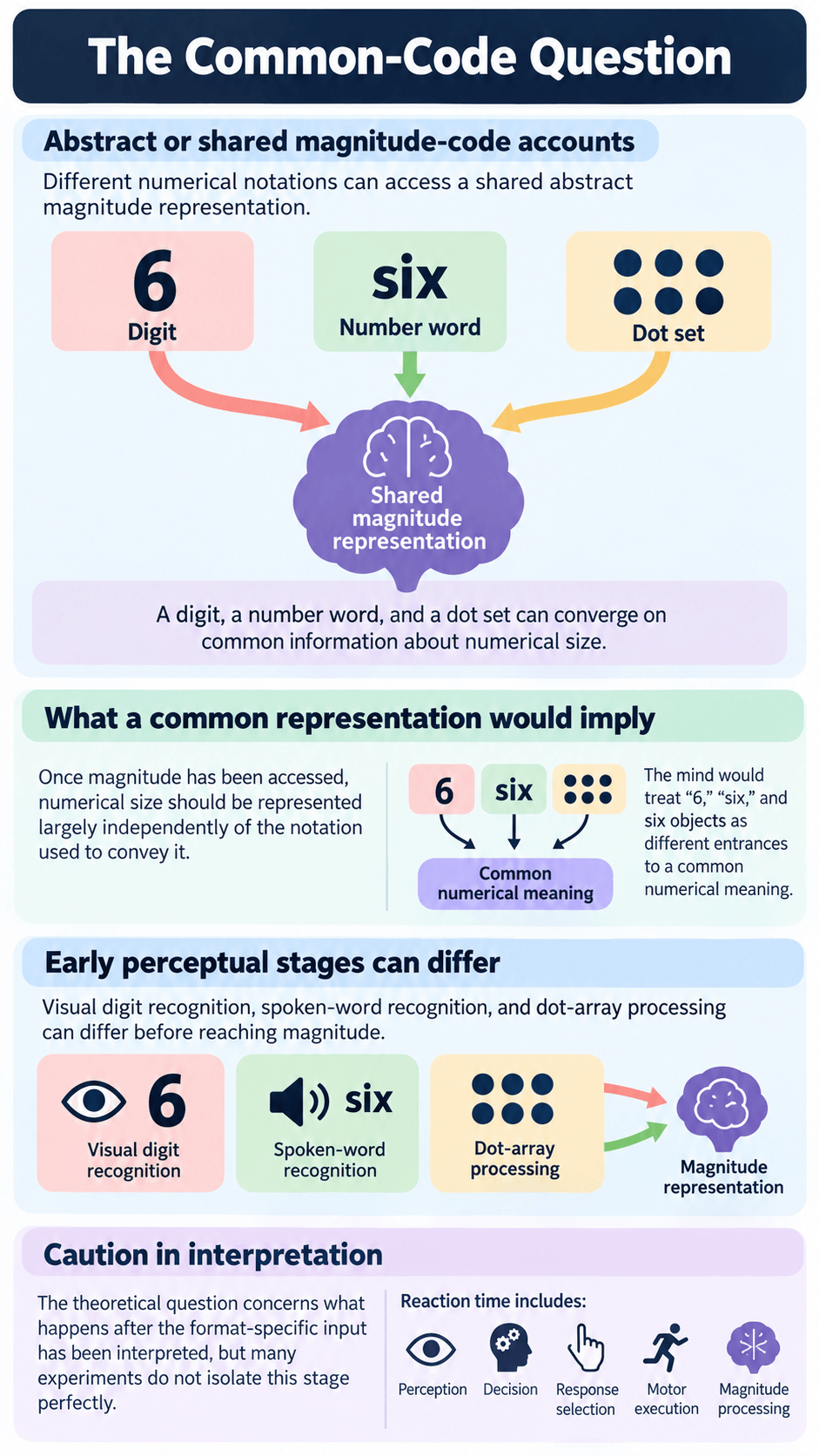
Abstract or shared magnitude-code accounts
One influential idea is that different numerical notations ultimately access a shared abstract magnitude representation. Under this view, a digit, a number word, and a dot set can converge on common information about numerical size.
The appeal is clear. If 8 written as a digit and eight objects are both understood as the same quantity, some commonality in meaning must exist somewhere in the system. Similar comparison effects across formats have also been interpreted as evidence that different inputs reach shared numerical magnitude processing.
A large meta-analysis of numerical cognition research found substantial overlap in systems engaged by symbolic and nonsymbolic magnitude tasks, while also reporting patterns suggesting that refinements to simple format-independent accounts may be needed.
What a common representation would imply
A strong abstract-code account predicts that once magnitude has been accessed, numerical size should be represented largely independently of the notation used to convey it. The mind would treat “6,” “six,” and six objects as different entrances to a common numerical meaning.
This does not require the perceptual stages to be identical. Visual digit recognition, spoken-word recognition, and dot-array processing can differ before reaching magnitude. The theoretical question concerns what happens after the format-specific input has been interpreted.
The difficulty is that many experiments do not isolate this stage perfectly. Reaction time includes perception, decision, response selection, and motor execution as well as magnitude processing.
Format-Dependent and Hybrid Accounts

Symbolic-specific and nonsymbolic-specific processing
Evidence for notation effects suggests that numerical magnitude may retain information about how it was presented. Symbolic numbers belong to structured cultural systems. Nonsymbolic quantities are embedded in perceptual arrays. Those differences can influence the route to magnitude and perhaps the representation itself.
For example, multi-digit Arabic numbers contain place-value structure. The number 47 encodes tens and units in a way an unstructured collection of 47 dots does not. A purely format-free representation would have to explain why some effects depend specifically on symbolic structure.
Developmental mapping accounts
Another possibility is that the relationship changes with learning. Early nonsymbolic quantity representations may provide one source of numerical meaning, while symbolic knowledge gradually develops its own precise relational structure.
This would allow partial overlap without requiring mature symbolic magnitudes to be simple copies of approximate nonsymbolic magnitudes. Development is relevant here as context, but the main question remains representational: how exact learned numerical forms and perceptual quantities relate.
Hybrid possibilities
A hybrid account allows both shared and format-sensitive representation. Different notations may activate distinct early codes, preserve some notation-specific information, and still converge on common magnitude relationships when the task requires comparison.
This kind of model fits a familiar pattern in cognition. Two inputs can remain distinguishable while contributing to a shared judgment. The mind does not have to choose between complete independence and complete identity.
| Account | Core idea | Main strength | Main caution |
|---|---|---|---|
| Common-code | Different formats converge on an abstract magnitude representation | Explains cross-format similarities | Can underestimate notation-specific effects |
| Format-dependent | Magnitude representations retain information about notation | Explains symbolic versus nonsymbolic differences | Must explain how equivalent quantities are related across formats |
| Hybrid | Format-sensitive processes interact with shared numerical information | Allows both overlap and specialization | Exact architecture remains theoretically debated |
Magnitude Access in Numerical Tasks
Symbolic magnitude access
Suppose you see 4 and 9 and must choose the larger number. The task requires visual recognition of the digits and access to learned numerical information that supports the comparison.
The comparison can become very fast in familiar adults, but familiarity should not be mistaken for simplicity. Symbolic numbers carry exact magnitude, order, arithmetic relations, and other learned properties.
Nonsymbolic magnitude access
Now replace the digits with two dot arrays. The observer must extract quantity from visual sets. If counting is prevented, the comparison may rely on approximate numerosity together with perceptual information.
The final question, “which is more?”, looks the same, but the input demands are different. This is why performance differences between symbolic and nonsymbolic tasks cannot automatically be assigned to magnitude representation alone.
Comparison, ordering, and reference values
Magnitude becomes especially visible when a task requires comparison. “Is 8 larger than 5?” directly asks about numerical size. Ordering tasks such as placing 3, 7, and 9 from smallest to largest also rely on magnitude relationships, although order itself contains additional structure.
Reference values can change judgments too. Deciding whether 58 is greater than 50 is different from comparing 58 with 59. The numerical value has not changed, but the decision context has.
Research on symbolic ordinality shows that learned number order cannot always be reduced to cardinal magnitude alone. An open-access study of symbolic number ordinality found important distinctions between ordinal and cardinal processing, reminding us that numerical meaning includes more than “how much.”
Ratio, Distance, and Context
Ratio information
Approximate nonsymbolic comparisons are often strongly influenced by ratio. Ten versus twenty is easier than eighteen versus twenty because the proportional separation is greater.
Ratio is therefore especially informative when studying approximate magnitude. It should not, however, be assumed to describe every symbolic comparison in exactly the same way.
Numerical distance
In symbolic number comparison, close values such as 7 and 8 are often slower or more error-prone to compare than values farther apart, such as 2 and 9. This is known as the Numerical Distance Effect.
The effect has historically been used as evidence about magnitude representation, but it does not uniquely identify one representational model. Alternative explanations include learned associations, response competition, and task structure.
Work discussing symbolic magnitude comparison notes that a distance effect does not by itself prove overlapping analog representations. A review of alternative interpretations of symbolic comparison effects describes why distance and size effects can have more than one explanation.
Context and reference values
Magnitude is relational. The number 60 can feel “large” in one comparison and “small” in another. Against 5 it is very large; against 10,000 it is tiny.
This does not change the exact cardinal value of 60. It changes the decision context in which the value is being evaluated. Relative magnitude judgments therefore depend on both stored numerical information and the comparison environment.
Numerical Magnitude vs Nearby Concepts
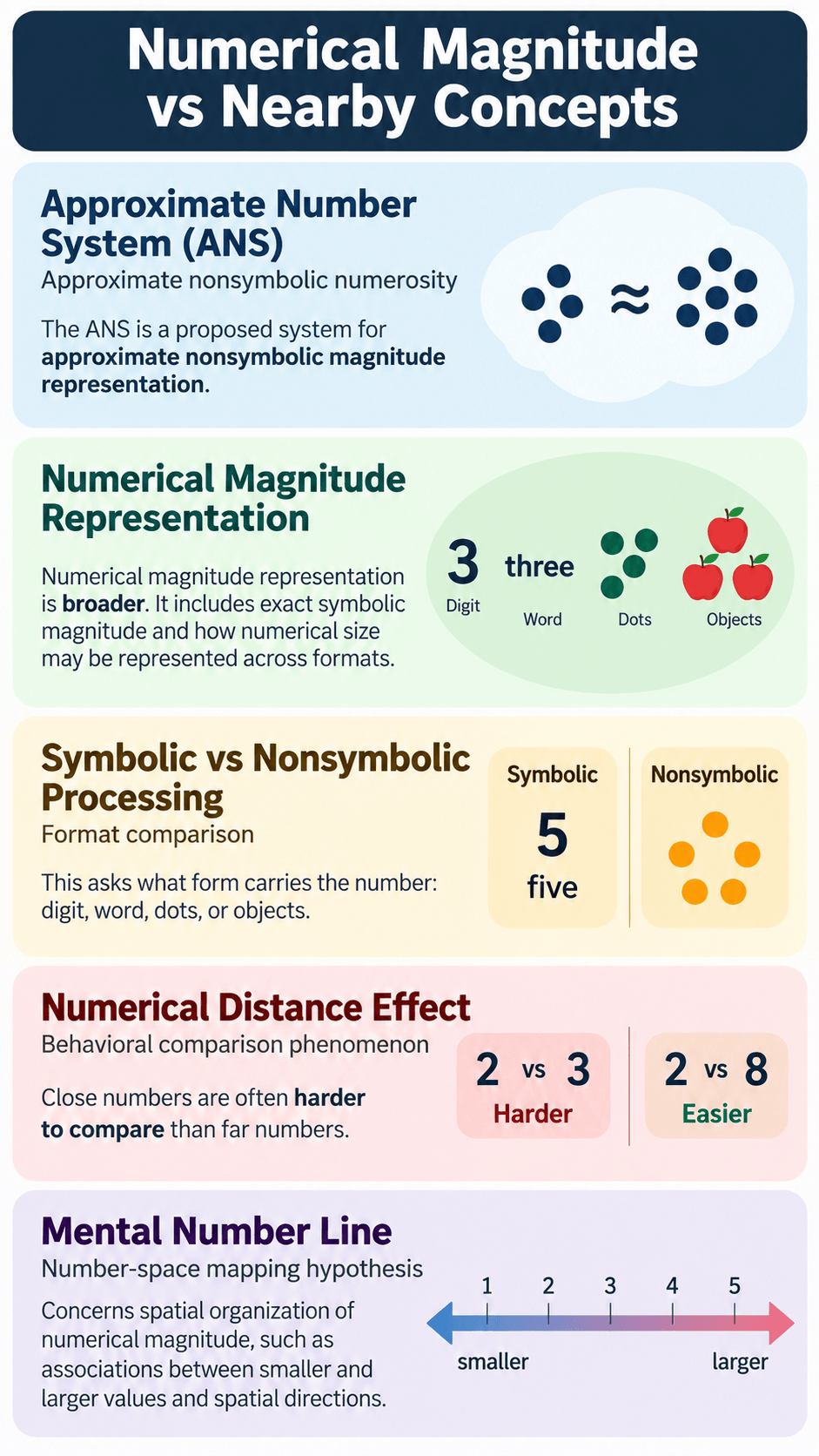
Approximate Number System: approximate nonsymbolic numerosity
The ANS is a proposed system for approximate nonsymbolic magnitude representation. Numerical magnitude representation is broader. It includes questions about exact symbolic magnitude and how numerical size may be represented across formats.
Calling every magnitude representation “the ANS” would erase important differences between learned exact symbols and approximate perceptual quantity.
Symbolic vs nonsymbolic processing: format comparison
Symbolic versus nonsymbolic processing asks what form carries the number: digit, word, dots, or objects. Numerical magnitude representation asks what happens to the quantitative information those forms convey.
The two topics are tightly related, but one focuses on format while the other focuses on numerical size.
Numerical Distance Effect: behavioral comparison phenomenon
The Numerical Distance Effect is a measurable pattern: close numbers are often harder to compare than far numbers. It provides evidence relevant to magnitude processing, but it is not a complete theory of magnitude representation.
Mental Number Line: number-space mapping hypothesis
The Mental Number Line concerns spatial organization of numerical magnitude, such as associations between smaller and larger values and spatial directions. Numerical magnitude itself does not require a spatial explanation.
A number can have a greater or smaller value without being assumed to occupy a literal position on an internal line.
Why Magnitude Is Not Automatically Spatial
Distance effects do not require a literal spatial line
The phrase “numerical distance” can encourage a spatial interpretation because distance is normally a spatial word. But numerical distance simply refers to the difference between values. The distance between 7 and 8 is one; the distance between 2 and 9 is seven.
A slower comparison for close numbers may be consistent with overlapping magnitude representations, but it does not prove that 7 and 8 are stored physically closer together on a mental line.
Spatial coding is a separate theoretical question
Numbers can become associated with space through learned conventions, task structure, reading direction, counting habits, and other processes. Those associations are important enough to study separately.
Keeping magnitude and space distinct makes both topics clearer. Magnitude answers “how much or how many?” Spatial-number research asks “how does numerical information interact with spatial organization or response location?”
A Four-Layer Way to Think About Numerical Magnitude
When different number tasks seem contradictory, it helps to separate four layers:
- Input format: Is the information a digit, word, dot array, or object set?
- Precision: Is the magnitude exact or approximate?
- Numerical relation: Is the task asking about larger, smaller, equal, ordered, or another relation?
- Decision context: Which comparison partner, reference value, response rule, or task demand is active?
This framework explains why two tasks can both involve numerical magnitude yet behave differently. A symbolic exact comparison and a brief nonsymbolic approximate comparison share a concern with quantity, but they differ at multiple processing layers.
Common Misunderstandings About Numerical Magnitude
“Numerical magnitude is just the ANS”
Too narrow. The ANS is one proposed account of approximate nonsymbolic magnitude. Numerical magnitude also includes exact symbolic values and theories about how magnitude is represented across notations.
“If two formats show the same effect, they must use the same representation”
Not necessarily. Similar behavior can arise from partially shared processing, different processes that produce similar outputs, or multiple stages in which some are shared and others are format-specific.
“If symbolic and nonsymbolic numbers differ, they must be completely separate”
This conclusion is also too strong. Differences can coexist with substantial overlap. Hybrid models are attractive precisely because cognitive systems can preserve format information while sharing higher-level numerical relationships.
“Magnitude must be represented spatially”
Spatial-number associations are real research phenomena, but numerical size and spatial coding are not synonyms. A magnitude representation can support greater-than or less-than judgments without requiring a literal internal line.
FAQ
Is numerical magnitude the same as the Approximate Number System?
No. The ANS is a proposed system for approximate nonsymbolic numerical magnitude. Numerical magnitude representation is a broader topic that includes exact symbolic values, nonsymbolic quantities, and the question of whether different formats share one magnitude code or rely on partly distinct representations.
Do digits and dot arrays share one proven magnitude code?
No single account has been proven as the complete explanation. Some evidence supports substantial overlap or common magnitude processing, while other findings show notation-sensitive differences. Current theories include common-code, format-dependent, and hybrid possibilities.
Is numerical magnitude the same as physical size?
No. A physically small printed 9 still has greater numerical magnitude than a physically large printed 3. Numerical magnitude concerns numerical value, while physical size concerns perceptual dimensions such as height, width, and area.
Does the Numerical Distance Effect prove spatial representation?
No. The distance effect shows that close numerical values are often harder to compare than values farther apart. This finding is relevant to theories of magnitude, but it does not by itself prove that numbers are stored on a literal spatial line or in a fixed left-to-right arrangement.
Can context change magnitude judgments?
Yes, especially when the task asks for a relative judgment. The exact value of 60 does not change, but whether it feels large or small depends on the comparison set and reference point. Task instructions and response requirements can also change how numerical information is used.
Key Takeaways
- Numerical magnitude is the quantitative value that supports judgments such as more, less, larger, and smaller.
- The mind can access magnitude from digits, number words, and nonsymbolic sets, but the representations behind those formats should not be assumed to be identical.
- Research supports common-code, format-dependent, and hybrid accounts, and no single account should be presented as fully settled.
- Exact symbolic magnitude and approximate nonsymbolic magnitude both concern number, but they differ in precision and processing demands.
- The Numerical Distance Effect is evidence relevant to magnitude processing, not a complete theory and not proof of a literal Mental Number Line.
- Numerical magnitude is conceptual rather than physical, so the printed size of a symbol does not determine its numerical value.

Michael Reed is the Founder and Lead Writer at Psychology Exposed. He writes about human behavior, relationships, emotional patterns, self-awareness, and practical psychology topics using research-informed, easy-to-understand content.
Read More About Michael Reed: https://psychologyexposed.com/michael-reed/