

You have probably had decisions where the answer seemed to arrive before you could explain it. A job offer feels wrong even though the salary looks good. A familiar work problem appears and you immediately know what to try. Then there are choices that refuse to settle until you compare prices, probabilities, consequences, and competing priorities.
These experiences are often described as intuition versus logic, but that framing is too simple. Intuitive and analytical decision making are better understood as different ways of processing information. One is often rapid, pattern-based, and difficult to verbalize. The other makes criteria, evidence, and trade-offs more explicit. Neither is automatically smarter, and most real choices use some combination of both.
The practical question is not, “Should I trust my gut or trust logic?” It is, “What kind of thinking does this particular decision deserve?”
Quick Answer
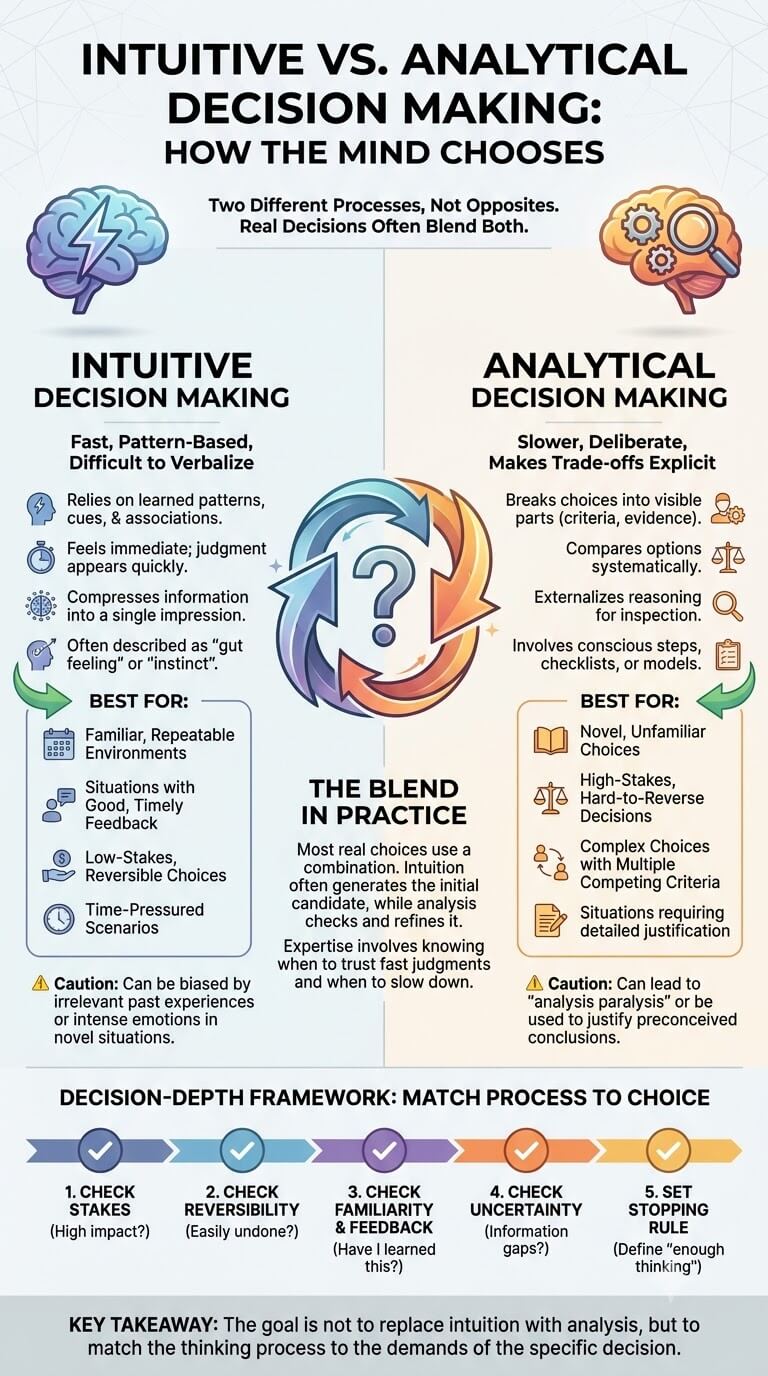
Intuitive decision making relies on fast judgments shaped by learned patterns, cues, associations, and prior experience. Analytical decision making is slower and more deliberate, keeping criteria and trade-offs visible so they can be compared. Intuition tends to be more dependable in familiar, learnable environments with good feedback. Analysis becomes especially useful when a choice is novel, consequential, hard to reverse, or dependent on information that intuition may not represent well.
Intuitive and Analytical Decision Making Are Different Processes, Not Opposites
The APA Dictionary of Psychology defines decision making as the cognitive process of choosing among alternatives. That broad definition matters because people can arrive at a choice through several kinds of mental work, not one single method.
What intuitive decision making looks like
Intuitive decision making usually feels immediate. You notice a situation, an option seems promising or wrong, and a judgment appears with little visible step-by-step reasoning. The APA definition of intuition emphasizes this contrast with conscious reasoning or reflection.
That does not mean the judgment came from nowhere. A project manager may sense that a timeline is unrealistic because the current plan resembles several past projects that slipped. A parent may recognize a familiar tone in a child’s voice and infer that something is off before knowing exactly why. A buyer may feel that a product page looks unreliable because small cues resemble previous bad experiences.
The mind may have registered more information than the person can immediately put into words.
What analytical decision making looks like
Analytical thinking makes more of the decision visible. Instead of only asking what feels right, you might list the options, define the most important criteria, compare evidence, estimate costs, or test a prediction. You can often explain how you reached the conclusion because the reasoning was more explicit.
Imagine choosing between two apartments. Analysis might involve commute time, total monthly cost, lease terms, noise, safety, and how long you expect to stay. The choice becomes a structured comparison rather than a single overall impression.
Why real decisions often blend both
Fast and deliberate thinking are useful labels, but they should not be treated as two literal switches in the brain. A recent open-access review of dual-system approaches argues for a more nuanced picture in which intuitive and deliberate characteristics can coexist and interact.
A thinking style is only one part of the broader decision-making process, which also includes defining options, weighing trade-offs, handling uncertainty, and deciding when enough information is enough.
In practice, intuition may generate the first candidate answer while analysis checks it. Analysis may narrow a field to three good options, after which an intuitive preference breaks the tie. You may even move back and forth several times as new information arrives.
How Intuition Reaches a Judgment So Quickly
Intuition often feels mysterious because the intermediate steps are not consciously available. A useful explanation is that the mind has learned to recognize patterns and weight cues through experience, then produces a compressed judgment.
Pattern recognition from prior experience
Repeated exposure teaches you what tends to go together. An experienced designer may glance at a page and sense that the visual hierarchy is off. A skilled driver may slow down before being able to explain which subtle traffic cues suggested danger. A longtime manager may hear a proposal and recognize a familiar implementation problem.
The important word is relevant experience. Ten years of repetition does not guarantee ten years of useful learning if the environment provides weak feedback or the task keeps changing in unpredictable ways.
Automatic cue weighting
Not every detail receives equal attention. With practice, some cues become more informative than others. A person may stop consciously checking every feature and instead respond to a smaller set of signals that have repeatedly mattered.
This is one reason experts can sometimes look unusually fast. They are not necessarily processing every possible fact more quickly. They may be better at identifying which facts deserve attention and which can be ignored.
Why a feeling of rightness can arrive before an explanation
The judgment may be accessible before the reasons are. You can know that a sentence sounds grammatically wrong without remembering the formal rule. You can recognize a familiar face before naming where you met the person.
That feeling of rightness is useful information, but it is not proof. Sometimes it reflects real learning. Other times it reflects familiarity, preference, fear, wishful thinking, or a pattern that does not actually apply to the current situation. The key is learning when the feeling deserves trust and when it deserves checking.
How Analytical Thinking Builds a Choice
Analytical thinking becomes valuable when the decision needs to be inspected rather than merely felt. It slows the process enough to separate criteria, assumptions, and trade-offs that might otherwise remain blended together.
Making criteria explicit
A vague question such as “Which option is better?” is difficult to answer well. Better according to what? Cost, speed, reliability, comfort, growth potential, risk, or something else?
Writing down two or three important criteria can change the quality of a decision because it forces you to define what you are optimizing. For a new job, those criteria might be manager quality, learning opportunity, compensation, schedule flexibility, and commute. Two attractive offers may look very different once the actual priorities are visible.
Comparing options one attribute at a time
Overall impressions are hard to compare. Analysis can break an option into parts and compare like with like. Instead of asking which laptop “seems best,” you compare battery life with battery life, price with price, and repairability with repairability.
This method is especially useful when one option is emotionally appealing but weak on a criterion that matters in daily use.
Checking assumptions and trade-offs
Analysis also creates room for questions such as: What am I assuming? What would have to be true for this option to work? What do I gain, and what do I give up?
Those questions do not guarantee the correct choice. They simply make the reasoning easier to inspect. A detailed spreadsheet built on unrealistic assumptions can still produce a poor decision.
The Biggest Difference: What Each Mode Does With Information
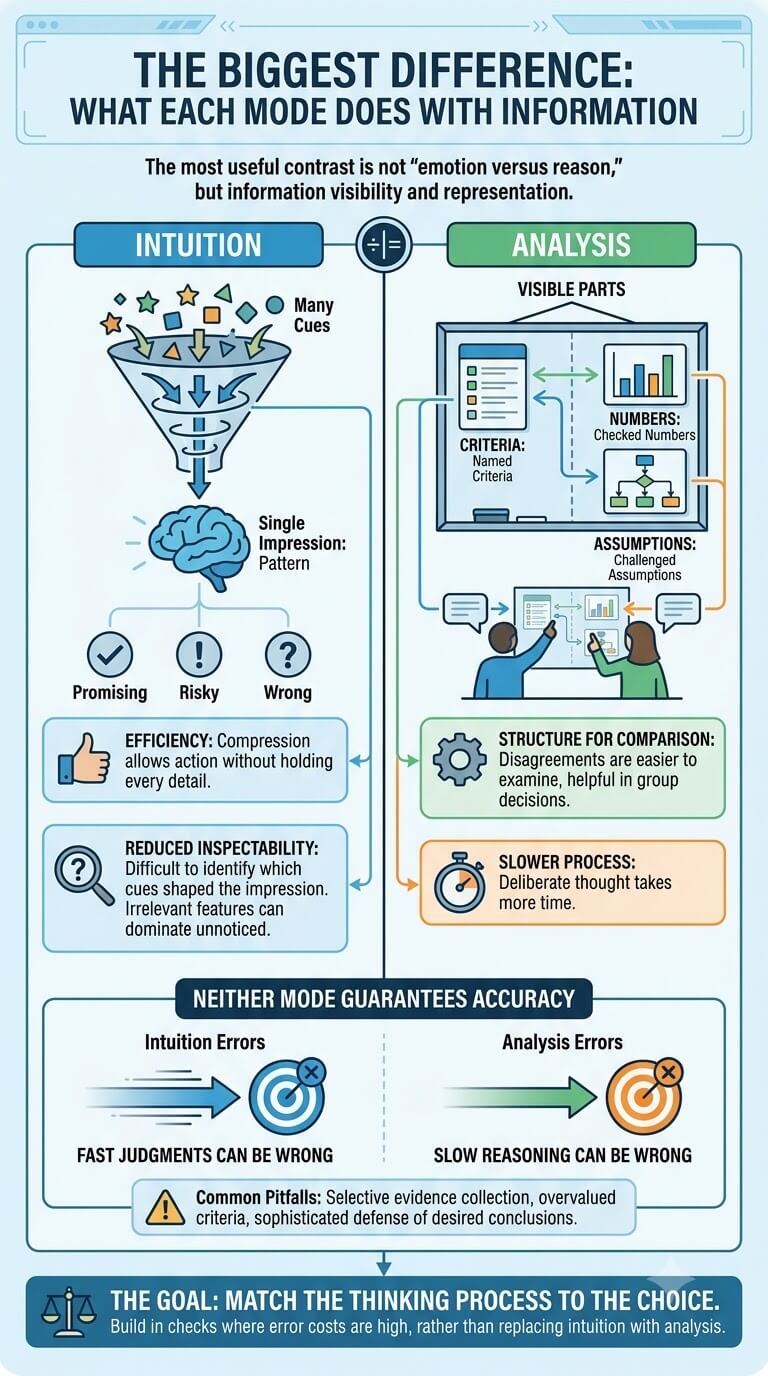
The most useful contrast is not “emotion versus reason.” It is how much of the information stays visible and how it is represented while the choice is being made.
Intuition compresses information into a pattern
Intuitive judgment often combines many cues into a single impression: promising, risky, familiar, wrong, worth pursuing. Compression is efficient. It allows action without consciously holding every detail in mind.
The cost is reduced inspectability. If you cannot identify which cues shaped the impression, it may be difficult to notice that one irrelevant feature is dominating the judgment.
Analysis keeps more parts visible for comparison
Deliberate thought tends to externalize or separate the pieces. Criteria can be named. Numbers can be checked. Assumptions can be challenged. The process is slower, but the structure makes disagreements easier to examine.
Even careful analysis operates within real-world limits on time, information, and attention, so more deliberate thought is not the same as unlimited optimization.
This is especially helpful in group decisions. “I just have a bad feeling” may be meaningful, but a team can act more intelligently when the concern is translated into checkable observations such as schedule risk, missing data, or unclear ownership.
Neither mode guarantees accuracy
Fast judgments can be wrong, but slow reasoning can be wrong too. A person can selectively collect evidence, overvalue a preferred criterion, or use a sophisticated argument to defend a conclusion they already wanted.
The goal is not to replace intuition with analysis. It is to match the thinking process to the demands of the choice and build in checks where the costs of error are high.
When Intuition Is More Trustworthy

“Trust your gut” is most defensible when the gut has had something useful to learn from. Research on expert judgment repeatedly points to experience quality, environmental regularity, and feedback as crucial conditions.
Repeated experience in a stable environment
Intuition has a better chance of becoming skilled when the environment contains patterns that repeat. Chess positions, certain technical faults, familiar operational problems, and some professional tasks provide recurring structures that people can learn over time.
An environment that changes randomly gives intuition much less to learn. Familiarity with the activity is not the same as predictability within the activity.
Fast, relevant feedback
Experience teaches only when you can discover whether your judgment worked. A review of conditions that support expert intuitive judgment highlights both predictable cues and opportunities for timely, reliable feedback.
Consider two people who have each made hundreds of forecasts. One receives clear outcome data and regularly reviews mistakes. The other rarely checks what happened. They have similar amounts of experience, but very different opportunities to calibrate intuition.
Familiar patterns with meaningful cues
Useful intuition is usually domain-specific. Being excellent at reading manufacturing problems does not automatically make someone excellent at predicting investment markets or judging unfamiliar social situations.
A practical test is to ask: Have I seen this kind of problem many times, and did I get reliable feedback about what the important cues meant? If yes, your first impression deserves more weight. If not, confidence should be lower.
When Intuition Deserves More Checking
A strong feeling can be psychologically compelling even when the environment provides little basis for confidence. Three conditions should make you more willing to slow down.
Novel situations
If the decision is unlike anything you have handled before, pattern recognition has fewer relevant patterns to draw from. The first answer may still be useful as a hypothesis, but it should not be treated as expertise.
For example, being good at negotiating salary does not necessarily tell you how to evaluate a complicated business acquisition. The surface experience of “negotiation” may be similar while the underlying risks are completely different.
Noisy or misleading feedback
Some environments make learning difficult because outcomes depend heavily on luck, hidden variables, or long delays. A good decision may produce a bad outcome, and a poor decision may get lucky.
When feedback is noisy, repeated success can create confidence without equivalent skill. That is a reason to rely more on base rates, outside evidence, or explicit comparison.
High emotional arousal or strong incentives
Emotion is part of decision making, not an enemy of it. Still, intense fear, excitement, anger, or desire can change which cues feel most important. Strong incentives can do something similar by making supportive information easier to notice.
If you desperately want a particular answer, treat your first impression as data rather than a verdict. Give yourself a chance to ask what you might be overlooking.
When Analysis Adds the Most Value
Deliberation earns its cost when the decision is consequential enough, complex enough, or unfamiliar enough that extra structure may reveal something important.
High-stakes and hard-to-reverse choices
Choices involving large financial commitments, major career moves, legal obligations, or long-term consequences usually deserve more than a momentary impression. Reversibility matters because a mistake is more expensive when you cannot easily undo it.
A useful rule is simple: the harder the choice is to reverse, the more valuable it becomes to make assumptions and trade-offs explicit.
Multiple criteria with explicit trade-offs
Analysis is helpful when no option wins on every dimension. One job pays more but offers less flexibility. One apartment costs less but adds an hour of commuting. One business plan is safer but has lower upside.
A comparison table can prevent one vivid feature from swallowing the entire decision.
| Decision condition | What intuition does well | What analysis adds |
|---|---|---|
| Familiar, repeated problem | Recognizes patterns quickly | Checks unusual details |
| Several important criteria | Provides an overall impression | Keeps trade-offs visible |
| Novel, high-stakes choice | Generates an initial hypothesis | Tests assumptions and missing information |
| Low-stakes, reversible choice | Often reaches a sufficient answer quickly | May add little after a basic check |
Decisions where missing a base rate or probability matters
If the decision depends on how often something happens, what the downside probability is, or how outcomes are distributed, explicit numbers can correct impressions that are based on a few memorable cases.
You do not need advanced statistics for every choice. Even asking “How common is this outcome?” or “What usually happens in cases like this?” can improve the information entering the decision.
When More Analysis Stops Helping
More thought has a cost. It takes time and attention, and it can create the illusion of progress after the useful information has already been collected.
Low-stakes reversible choices
If you can change your mind tomorrow with little cost, a long analysis may be unnecessary. Choosing a new lunch place, testing a productivity app, or trying a different route home rarely requires an optimization exercise.
For reversible choices, action can produce better information than continued thinking.
Diminishing returns from additional information
The first few pieces of information often change a decision more than the fifteenth or twentieth. At some point, new research mostly confirms what you already know.
Ask: What specific new fact am I looking for, and would it actually change the choice? If you cannot answer either part, the search may have reached diminishing returns.
Analysis that has become repetition rather than learning
Deliberation is useful when it updates the decision. Replaying the same pros and cons without adding evidence is different. The mind is active, but the choice is not becoming better informed.
A stopping rule helps: decide in advance what information you need, what threshold is good enough, or when the decision will be made.
Intuition vs Cognitive Biases
Intuition and cognitive bias overlap sometimes, but they are not synonyms. Treating every fast judgment as a bias misses the ways learned pattern recognition can be genuinely useful.
Fast thinking is not the same thing as biased thinking
A heuristic is an efficient strategy that may work well in many situations even though it does not guarantee the correct answer. The APA Dictionary description of heuristics makes this efficiency-versus-certainty trade-off explicit.
An experienced nurse noticing a meaningful change, a mechanic recognizing an engine sound, or a proofreader spotting a malformed sentence can all involve rapid judgment without implying error.
Why deliberate reasoning can also be biased
Slow thinking does not automatically neutralize preferences. People can reason selectively, choose convenient assumptions, or build elaborate justifications around a favored answer.
That is why “I thought about it for a long time” is not the same as “I tested my reasoning well.” Better analysis includes checks that could genuinely change your mind.
A Decision-Depth Framework: How Much Analysis Does This Choice Need?
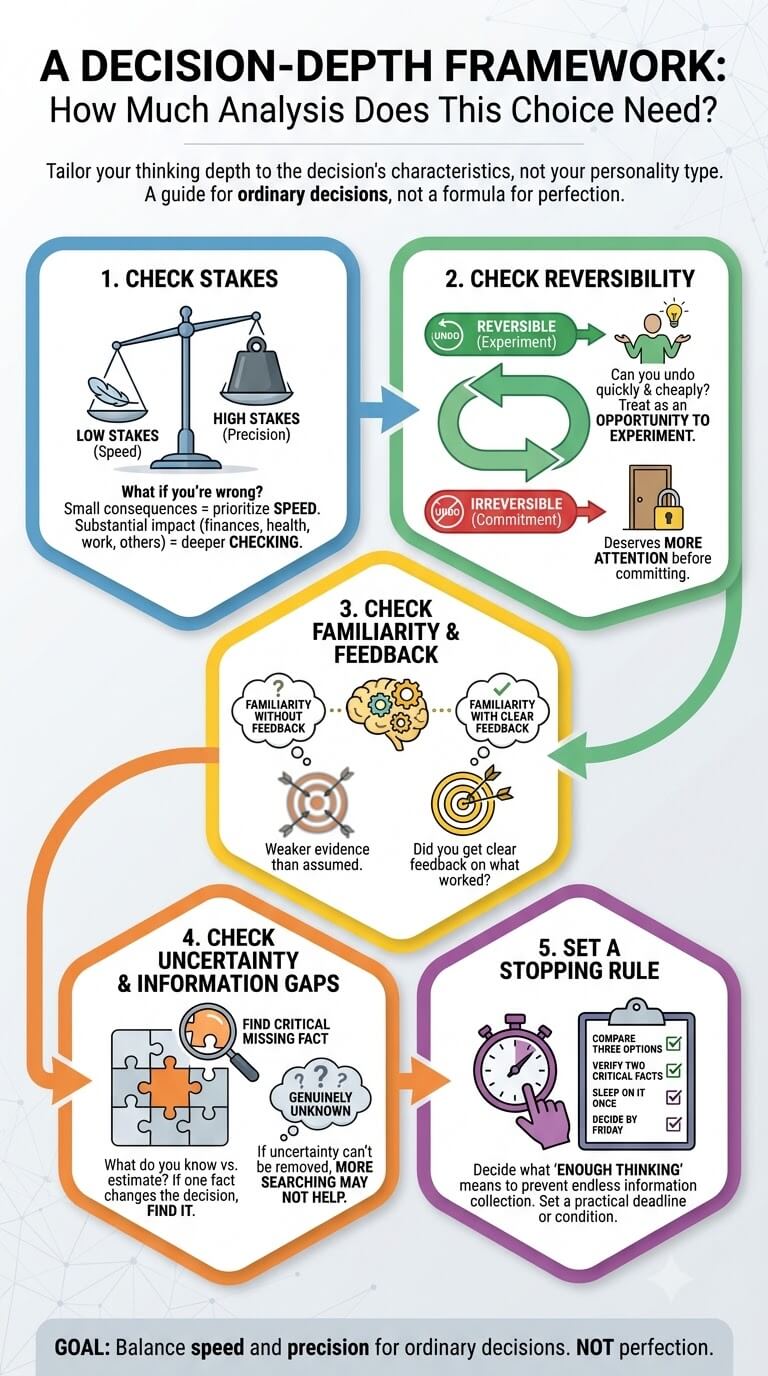
Instead of deciding in advance that you are an intuitive or analytical person, use the characteristics of the choice to set the depth of thinking. The following five-part check is designed for ordinary decisions, not as a formula for perfect outcomes.
Check stakes
What happens if you are wrong? If the consequences are small, speed may matter more than precision. If the consequences affect finances, health, work, or other people substantially, deeper checking becomes more worthwhile.
Check reversibility
Can you undo the choice cheaply and quickly? Reversible decisions are opportunities to experiment. Irreversible decisions deserve more attention before commitment.
Check familiarity and feedback quality
Have you made this kind of judgment many times? Did you receive clear feedback about what worked? Familiarity without feedback is weaker evidence than many people assume.
Check uncertainty and information gaps
What do you know, what are you estimating, and what is genuinely unknown? If one missing fact could change the decision, find it. If the remaining uncertainty cannot realistically be removed, more searching may not help.
Set a stopping rule
Decide what “enough thinking” will mean. For example: compare three options, verify two critical facts, sleep on the choice once, then decide by Friday. A stopping rule protects analysis from turning into endless information collection.
Hybrid Decisions: Use Intuition to Generate, Analysis to Test
One of the most practical approaches is to let fast judgment produce an initial answer and then give deliberate thinking a specific checking job. This respects experience without giving the first impression unlimited authority.
Start with the initial judgment
Write down the option you currently favor before researching further. Do not force yourself to justify it yet. The point is to preserve the initial signal so you can examine it rather than letting later reasoning rewrite your memory of what you first thought.
Name the reasons you can verify
Translate the feeling into observable claims. “This candidate feels stronger” might become “their examples were more specific, they have direct experience with the required tool, and they asked better questions about the role.”
If you cannot identify any relevant cues, lower your confidence rather than inventing a story.
Look for one disconfirming signal
Ask what evidence would make your preferred option less attractive. Then actively look for one such piece of information.
This does not require arguing against yourself endlessly. One serious attempt to test the favored answer is often more useful than collecting ten more reasons to support it.
Decide what would change your mind
Before new information arrives, define a threshold. “If the actual commute is over 70 minutes, I will reject the apartment,” or “If the contract contains an automatic renewal clause with a large penalty, I will ask for changes.”
Predefining the threshold makes it harder to move the goalposts after becoming attached to an option.
What Changes Under Uncertainty or Time Pressure?
Intuition and analysis do not operate in a vacuum. The amount of uncertainty and the time available can change how much deliberate search is practical and how much weight people give to initial impressions.
Uncertainty can make intuition feel stronger while evidence is weaker
When facts are incomplete, the mind still wants a coherent answer. A strong feeling may fill the gap, but subjective confidence does not necessarily mean the environment is predictable.
Under uncertainty, ask whether the intuition reflects repeated experience with this exact type of problem or whether it simply reflects discomfort with not knowing.
Time pressure can reduce deliberate search without eliminating analysis
Limited time does not always mean “use your gut.” Skilled decision makers can often perform a short analytical check even under pressure. Recent research on intuition and deliberation in elite expertise found that high-level chess experts strategically used both rapid recognition and deliberation, with performance suffering when time constraints reduced opportunities to deliberate.
A deadline adds another constraint because decision making under time pressure changes how much information can realistically be searched and compared.
The lesson is not that slow thinking always wins. It is that expertise can include knowing when a fast answer is enough and when extra thought is worth the time.
A First-Step Exercise for a Decision You Are Facing
If you are currently torn between a gut answer and more analysis, use this short exercise. It should take a few minutes and is meant to clarify the next useful step, not force certainty.
Write the gut answer and confidence separately
Complete two lines: “My first choice is ___.” “My confidence is ___ out of 10.” Separating preference from confidence makes room for a strong leaning with appropriate uncertainty.
List the two most important criteria
Choose only two. What matters most if you have to live with the decision for the next month or year? Keeping the list short forces priority rather than creating a giant inventory of minor considerations.
Identify one fact worth checking before acting
Find the single piece of information most likely to change your choice. If no realistic fact would change it, that itself is useful information. You may already be ready to decide.
FAQ About Intuitive vs Analytical Decision Making
Is intuitive decision making always faster?
It is usually experienced as fast because the judgment appears with little conscious step-by-step reasoning. However, the experience that built the intuition may have taken years. An expert’s two-second recognition can rest on thousands of prior examples.
Can intuition be accurate without conscious reasoning?
Yes. People can learn patterns and respond to informative cues without being able to describe every step. Accuracy is more plausible when the environment is learnable and the person has received reliable feedback. In unfamiliar or highly unpredictable settings, the same feeling of certainty deserves more caution.
Does analytical thinking eliminate bias?
No. Deliberate reasoning can expose assumptions and make trade-offs easier to inspect, but it can also be used selectively. A stronger analytical process asks what evidence could disconfirm the preferred answer rather than only gathering support for it.
When should I ignore a gut feeling?
You do not necessarily need to ignore it. Treat it as a signal whose weight depends on context. Give it less authority when the situation is new, the feedback history is weak, incentives are distorting attention, or the consequences are high and hard to reverse. In those cases, check facts and alternatives before acting.
Can experts rely on intuition more than beginners?
Often, but only within domains where expertise has actually developed. Experience can sharpen pattern recognition when the task contains meaningful regularities and feedback. Experts still benefit from deliberation when conditions are unusual, information conflicts, or the problem falls outside familiar patterns.
Key Takeaways
- Intuitive decision making is fast and pattern-based, while analytical decision making makes criteria, evidence, and trade-offs more explicit.
- Intuition is most credible when it comes from repeated experience in a reasonably predictable environment with timely feedback.
- Analysis adds the most value for novel, high-stakes, difficult-to-reverse decisions and choices involving several competing criteria.
- More analysis is not automatically better. Once new information stops changing the choice, a stopping rule can prevent repetitive thinking.
- Fast judgment is not the same as cognitive bias, and slow reasoning is not automatically unbiased.
- A strong practical approach is to let intuition suggest an answer, then use analysis to test the reasons, missing information, and conditions that would change your mind.
If you are facing a real decision today, do not begin by asking whether you are an “intuitive person” or an “analytical person.” Begin with the decision itself. Check the stakes, reversibility, familiarity, feedback quality, and uncertainty. Then spend only as much thinking effort as those conditions justify.

Michael Reed is the Founder and Lead Writer at Psychology Exposed. He writes about human behavior, relationships, emotional patterns, self-awareness, and practical psychology topics using research-informed, easy-to-understand content.
Read More About Michael Reed: https://psychologyexposed.com/michael-reed/