

A deadline changes more than how fast you move. It changes what you notice, how long you compare alternatives, which details receive attention, and how soon you decide that you have enough information to act. That is why a choice made in ten minutes may look different from the same choice made with a full afternoon, even when the options themselves have not changed.
This does not mean fast decisions are automatically bad. In familiar situations, a short time limit can cut unnecessary searching and push you toward the few details that actually matter. In unfamiliar or high-stakes situations, however, urgency can make it easier to miss a critical fact or commit before an important uncertainty has been checked. Understanding decision making under time pressure is therefore less about becoming perfectly calm and more about protecting the right parts of the decision process when time is scarce.
Quick Answer
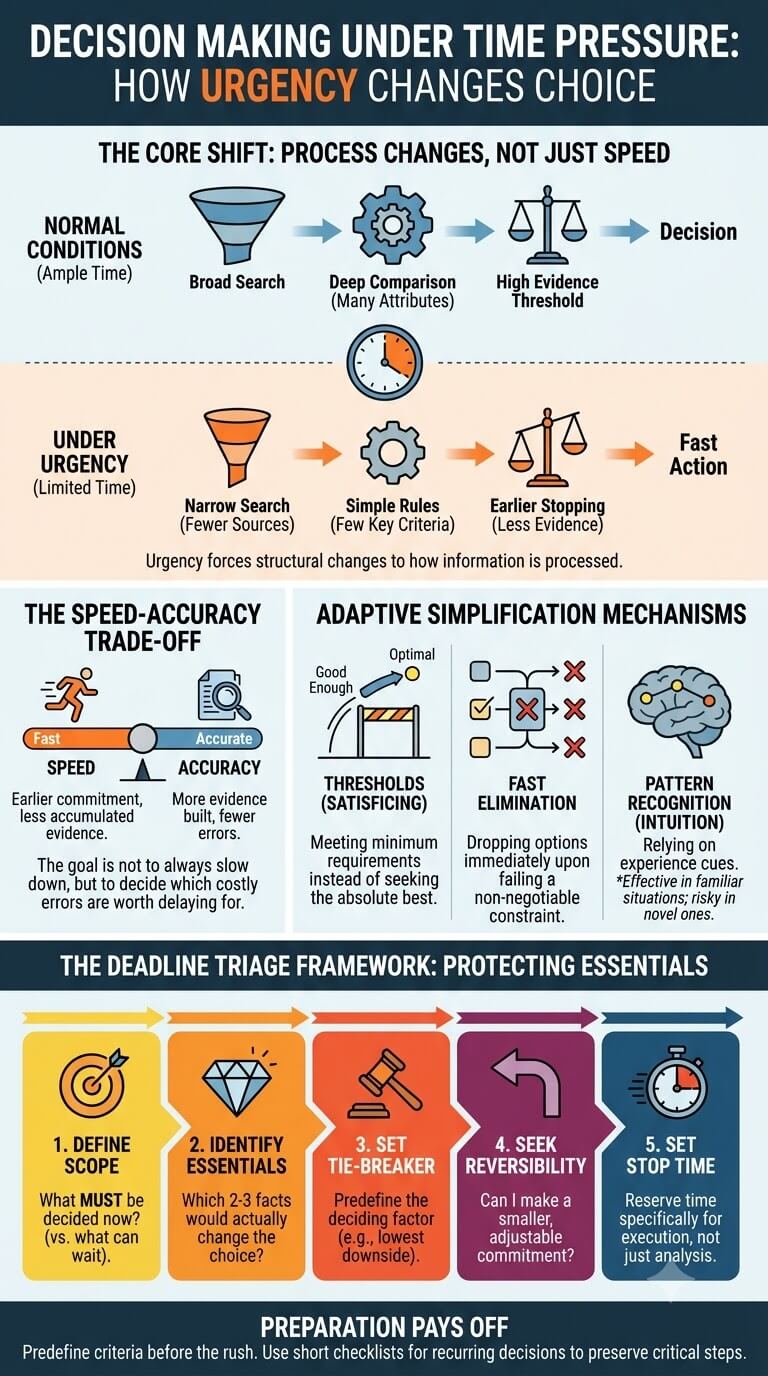
Time pressure usually reduces how much information people can search and compare, encouraging earlier stopping, simpler rules, and faster action. It can also shift the balance between speed and accuracy. The effect is not always harmful, and it does not push risk-taking in one universal direction. Better decisions under a deadline come from identifying essential information, using clear criteria, and knowing what can safely wait.
What Time Pressure Changes in a Decision

A decision has several hidden stages: finding information, deciding what deserves attention, comparing options, setting a threshold for “good enough,” and committing. When the clock becomes a hard constraint, people cannot simply run the same process faster. They often change the process itself.
A deadline does not create a completely different kind of choice; it compresses the broader process of choosing and changes which steps receive time.
Less time for information search
When time is limited, the search for information usually becomes narrower. You may read fewer reviews, ask fewer people, open fewer tabs, or stop gathering evidence earlier than you would otherwise. A recent eye-tracking study of risky choices found that time pressure was associated with fewer and shorter visual fixations, consistent with a more restricted information search rather than merely quicker reading. The study also found greater sensitivity to how information was framed, showing that what remains visible under time pressure can matter more. See the open-access research on attention and framing under time pressure.
This narrowing can be useful when most available information is redundant. It becomes costly when the skipped information contains a deal-breaker, a hidden constraint, or evidence that would materially change the choice.
A hard deadline is a clear example of bounded rationality in practice, because time limits how much information and comparison can be used before action is required.
Less time for comparing attributes
Comparison itself takes time. If two job offers differ in pay, commute, flexibility, growth, manager quality, benefits, and stability, a full comparison requires holding several attributes in mind and deciding how much each should count. Under a deadline, people often simplify. They may compare only salary and flexibility, or eliminate one option as soon as it fails a key requirement.
The important question is not whether simplification occurs. It is whether the simplification preserves the attributes that matter most. A short decision can still be thoughtful if the comparison has been deliberately reduced to the few criteria that are genuinely decisive.
Earlier stopping and greater reliance on priority cues
Without a deadline, people can keep looking for a better option or another piece of evidence. Under time pressure, the stopping point arrives sooner. The mind may rely more heavily on a priority cue such as price, safety, compatibility, previous experience, or the recommendation of a trusted person.
This is one reason two people can respond differently to the same deadline. If one person has already defined what matters most, the time limit may simply accelerate an existing rule. If another person has no clear priority, the most vivid or recent cue may end up doing more work than it deserves.
A stronger speed-accuracy trade-off
Many decisions require some balance between acting quickly and collecting enough evidence to reduce error. Cognitive research often describes this as the speed-accuracy trade-off. A broad review of the field explains that faster responses generally involve committing with less accumulated evidence, while slower responses allow more evidence to build before a choice is made. See the review of the speed-accuracy trade-off.
In everyday life, the trade-off is not a command to “always slow down.” Sometimes the cost of delay is itself important. The practical aim is to decide which errors are worth spending extra time to prevent.
Time Pressure Is Not the Same as Stress
Urgency and stress often appear together, but they are not interchangeable. Separating them helps explain why some people can make a fast choice without feeling emotionally overwhelmed, while others experience a short deadline as highly stressful.
A deadline is a structural constraint
Time pressure begins with the structure of the task: there is less time available than you would ideally use. A booking closes in fifteen minutes. A manager needs an answer before a meeting. A repair shop needs approval before ordering a part. The constraint exists even if you feel calm.
In that sense, time pressure changes the decision environment first. It limits the amount of processing that can happen before action is required.
Stress may occur but is not required
Stress is a broader response that can include emotional, cognitive, and physical reactions to demands. A person can feel stressed with no immediate deadline, and a person with extensive experience can sometimes work under a tight deadline without strong distress. The concepts overlap, but they answer different questions.
The useful focus here is what the time limit does to the choice process. If the main problem is chronic tension, exhaustion, panic, or ongoing overload, that deserves a different analysis than simply improving a deadline decision.
Keep the mechanism focused on how choice processing changes
When the deadline is the central constraint, look for concrete changes: fewer sources checked, fewer attributes compared, faster elimination, heavier use of familiar cues, and an earlier stopping point. Those changes are easier to work with than a vague instruction to “handle pressure better.”
How People Simplify Choices Under a Deadline
Simplification is not automatically a thinking failure. It is often an adaptive response to limited time. The quality of the outcome depends on what gets simplified and what is protected.
Focus on the most diagnostic information
Diagnostic information is information that can actually separate one option from another or change what you should do. Suppose you are choosing between two contractors before a scheduling window closes. Their logo design, website wording, and number of social posts may be less diagnostic than licensing, availability, written scope, price, and references.
Under a deadline, ask: “If I could verify only three things, which three could change my decision?” This turns limited time into a ranking problem rather than a frantic attempt to learn everything.
Eliminate options faster
Another shortcut is elimination. Instead of scoring every alternative on every attribute, you can remove options that fail a non-negotiable requirement. If an apartment exceeds your hard budget, a flight misses the event, or software lacks a required integration, further comparison may not be useful.
Elimination works best when the rule was defined before urgency became intense. Rules invented in the final seconds can accidentally favor whichever option already feels easiest.
Use thresholds instead of full optimization
A deadline often makes “best possible” an unrealistic goal. A threshold asks whether an option meets the requirements that matter enough to justify action. This is consistent with the broader idea that real decisions operate within limited time and information.
For a low-to-moderate stakes purchase, the threshold might be: fits the budget, meets the required function, comes from a reliable seller, and has acceptable return terms. Once an option clears the threshold, continuing to compare twenty more alternatives may have little value if the deadline is genuine.
Rely more on familiar patterns
Experience can compress a decision. Someone who has handled the same kind of problem many times may recognize the few features that predict trouble or success. A novice sees ten details; an experienced person may quickly identify the two that matter most.
Familiarity is helpful only when the current situation resembles the situations from which the pattern was learned. A familiar-looking cue in a new environment can create false confidence.
Intuition Under Time Pressure
Deadlines often increase interest in intuition because deliberate comparison has less room to operate. The useful question is not whether intuition is good or bad, but what the intuitive judgment is built from.
Experience can support rapid pattern recognition
When a person has repeated feedback in a stable environment, fast judgments may draw on learned patterns that are difficult to verbalize in the moment. A seasoned editor may quickly sense that a headline is unclear; an experienced project manager may notice that a timeline is missing a dependency.
That kind of intuition is different from a first impression formed in an unfamiliar domain. Under time pressure, the source of the intuition matters.
Novel situations make intuition less dependable
If the decision involves a new technology, unfamiliar contract, new workplace, or unusual personal situation, you have fewer reliable patterns to draw from. The feeling of familiarity may come from superficial similarity rather than useful expertise.
In novel situations, spend scarce time checking assumptions that could create large downstream consequences. One verified fact can be more valuable than several minutes of additional gut-level comparison.
Fast does not automatically mean intuitive
A rapid decision may still involve analysis. A pilot checklist, pricing rule, hiring scorecard, or prewritten set of criteria can support a fast choice through structured reasoning. Speed describes how long the decision takes, not which mental process produced it.
This distinction matters because the best response to a deadline is often not “trust your gut.” It may be “use a shorter analytical procedure.”
Analysis Under Time Pressure
Analysis does not need to mean exhaustive research. Under a deadline, good analysis is selective. It protects critical checks and lets lower-value comparisons go.
Short checklists can preserve critical steps
For recurring decisions, a checklist reduces the need to remember every step while the clock is running. It can preserve essentials such as confirming the goal, checking a major constraint, verifying a key fact, and deciding who needs to approve the action.
Checklists are especially useful when missing one item is much more costly than spending thirty seconds to confirm it.
Predefined criteria reduce comparison cost
Criteria chosen before a deadline create a stable filter. If you know that a vendor must meet a security requirement, budget ceiling, delivery date, and support standard, you do not have to rediscover your priorities while comparing proposals.
This also reduces the chance that a vivid last-minute feature dominates simply because it is easy to notice.
More analysis can be harmful if it crowds out action time
Analysis has an opportunity cost. If you spend all available time researching, you may leave no time to submit the form, make the call, review the final document, or carry out the chosen action. Under a hard deadline, the decision process must include a stopping time.
A useful rule is to reserve part of the window for execution. If you have thirty minutes, the decision may need to close at minute twenty-five rather than minute twenty-nine.
Does Time Pressure Increase Risk Taking?
There is no dependable rule that urgency always makes people more reckless or always makes them more cautious. Research has produced different patterns depending on how risks are framed, learned, and presented.
Effects depend on context, framing, experience, and available options
One open-access study found different effects of time pressure for gains and losses in description-based risky choices, while finding no clear effect on risk-taking when outcomes were learned through experience. See the study comparing risky decisions from description and experience.
Other experimental work has also found context-dependent changes rather than a universal risky shift. This matters because “I am under pressure, so I will become reckless” is too simple a story.
Urgency can increase or decrease willingness to take risk
If a deadline makes the possible gain feel especially salient, a person may accept more risk. In another setting, the possibility of a visible loss may dominate and push the person toward the safer option. Time pressure can also reduce fine-grained attention to probabilities. Experimental patterns differ across gain and loss conditions, illustrating why the direction of risk change depends on the task rather than urgency alone.
Avoid one-direction claims
For practical decisions, focus less on predicting whether urgency will make you “more risky” and more on identifying the specific risk variable that could be neglected. Are you overlooking probability, severity, reversibility, or the downside of delay? A named variable is easier to check than a personality story about being bold or cautious.
Time Pressure and Uncertainty
Uncertainty becomes harder when a deadline forces action before all the unknowns can resolve. The goal is not to eliminate uncertainty. It is to decide which unknowns deserve scarce attention.
Deadlines can force action before uncertainty resolves
You may not know whether another job offer will arrive, whether prices will fall next week, or whether a client will change scope. If the current option expires today, some uncertainty remains no matter how carefully you think.
Research on exploration under limited decision time suggests that time constraints can change how people explore uncertain options and encourage less computationally costly strategies. See the research on time pressure and exploration under uncertainty.
Identify which unknowns are decision-changing
Divide unknowns into two groups. The first contains information that could realistically reverse the choice: an eligibility rule, cancellation fee, safety issue, legal requirement, or hidden cost. The second contains information that would be interesting but unlikely to change the decision.
Spend the remaining time on the first group. This avoids treating every unknown as equally urgent.
Accept residual uncertainty after the deadline
Once the essential unknowns have been checked, some uncertainty will remain. Continuing to mentally reopen the decision after the window has closed does not create new evidence. A better standard is whether the choice was reasonable given what could be known and the time that actually existed.
Time Pressure and Decision Fatigue
A deadline and accumulated decision effort are different constraints, but they can stack. The combination can make simplification especially attractive late in a demanding day.
Urgency can compound cognitive load
If you have already made many effortful choices, a new deadline may arrive when attention and motivation are less available. That does not prove a fixed “decision energy tank” has run out. It means the decision is being made in a context with multiple demands competing for limited attention.
Repeated high-effort choices can make simplification more attractive
When possible, reduce avoidable decisions before a predictable deadline. Prepare criteria, gather documents, choose defaults, or narrow the option set earlier. That leaves the final window for information that truly requires fresh judgment.
A Deadline Triage Framework

When the clock is real, use a five-question triage rather than trying to perform a full ideal analysis. The purpose is to protect the highest-value checks while giving the decision a clear endpoint.
What must be decided now?
State the actual decision in one sentence. “I need to choose a vendor today” is different from “I need to decide whether to gather one more quote.” Sometimes the apparent deadline applies only to one step, not the entire commitment.
What can be deferred or made reversible?
Separate irreversible commitments from choices that can be adjusted later. You may be able to approve a small trial instead of a full rollout, reserve with cancellation terms instead of paying a nonrefundable fee, or make a temporary schedule rather than a permanent policy.
What information is essential before action?
Choose two to four facts that could materially change the choice. These are the checks you protect even if other comparisons are dropped.
What criterion should break a tie?
Define the tie-breaker before the final minute. It might be lower downside, better reversibility, stronger evidence, simpler implementation, or closer fit with the main goal.
What is the stop time?
Set a point when research ends and execution begins. A real stop time prevents the common problem of using every second to compare and then acting sloppily because no time remains.
| Deadline question | What it protects | Example |
|---|---|---|
| What must be decided now? | Scope | Approve a trial, not a full-year commitment |
| What can wait? | Reversibility | Defer optional features until next week |
| What must I know? | Critical evidence | Confirm total cost and cancellation terms |
| What breaks a tie? | Priority | Choose the option with lower downside |
| When do I stop? | Execution time | End comparison ten minutes before submission |
A 60-Second Version for Low-to-Moderate Stakes
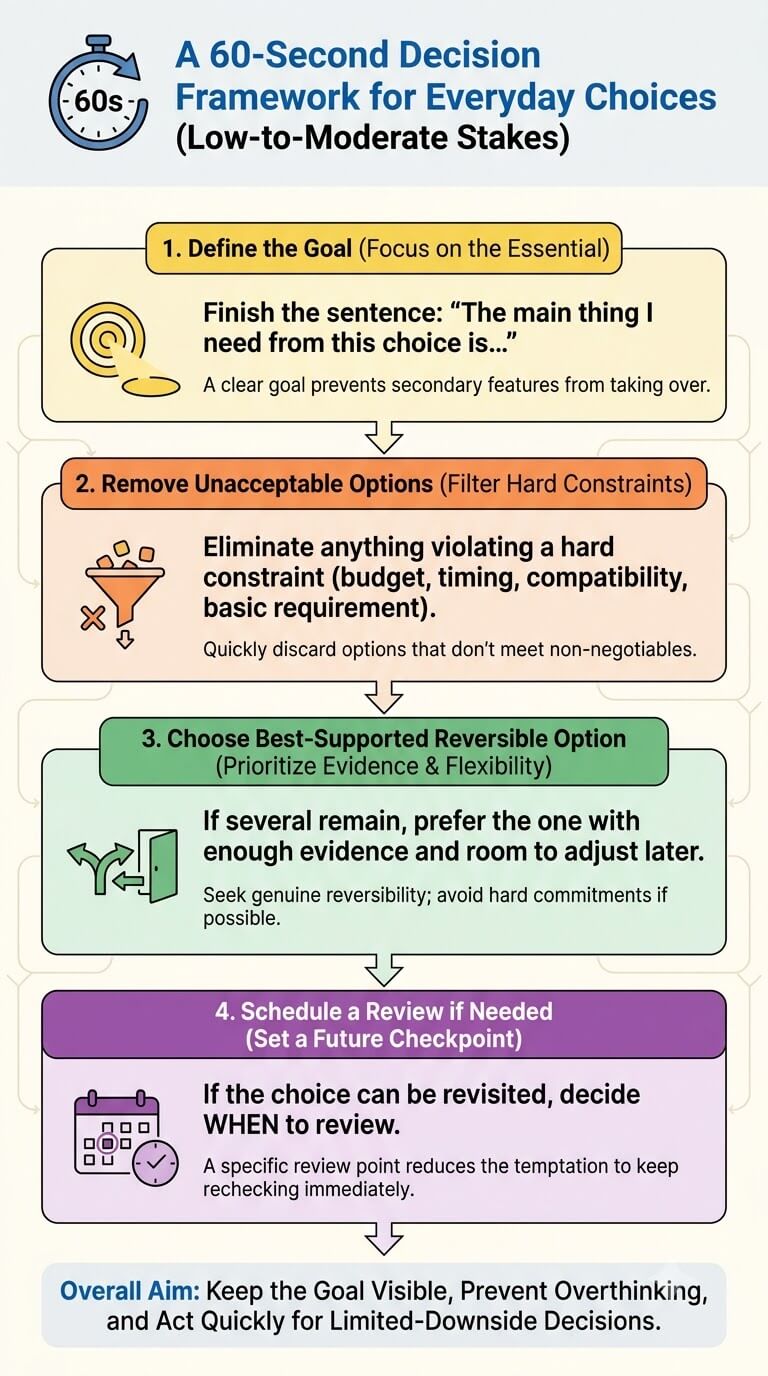
Not every rushed choice deserves a full framework. For everyday decisions with limited downside, use a compressed version that keeps the goal visible and prevents unnecessary comparison.
Define the goal
Finish the sentence: “The main thing I need from this choice is…” A clear goal reduces the chance that secondary features take over.
Remove unacceptable options
Eliminate anything that violates a hard constraint such as budget, timing, compatibility, or a basic requirement.
Choose the best-supported reversible option
If several options remain, prefer the one that has enough evidence and leaves room to adjust later when reversibility is genuinely available. Do not invent reversibility where the commitment is actually hard to undo.
Schedule a review if needed
If the choice can be revisited, decide when. A specific review point reduces the temptation to keep rechecking immediately after acting.
When Time Pressure Is Artificial
Not every demand for an immediate answer reflects a real external deadline. Sometimes urgency is created to reduce comparison, discourage questions, or make refusal harder.
Sales pressure and manufactured urgency
A countdown timer, “today only” claim, or salesperson saying another buyer is waiting may or may not reflect a genuine limit. Before treating it as a real deadline, ask what actually expires and what evidence supports that claim.
For an optional purchase, losing the offer may be less costly than committing without understanding price, terms, or cancellation conditions.
Social pressure for an immediate answer
A friend, partner, colleague, or manager may want an answer now even when the decision does not truly require one. A simple response can be: “I can give you an answer at 3 p.m. I need to check two things first.” Naming a specific return time is often more useful than saying only that you need space.
Why a legitimate pause can improve consent and choice quality
For meaningful personal, financial, or professional commitments, the ability to ask questions and consider consequences matters. Pressure involving fear, threats, coercion, humiliation, retaliation, or an inability to safely say no is not ordinary deadline management. In those situations, prioritize safety and qualified support rather than trying to optimize communication with the person applying pressure.
What to Do Next: Protect the Few Steps That Matter Most
The best preparation for time pressure often happens before the clock starts. Repeated decision types can be made faster and more reliably when criteria, checks, and escalation rules already exist.
Predefine criteria before the deadline
If you know a recurring choice is coming, write the criteria when you are not rushed. Decide what is required, what is preferred, what is unacceptable, and what information could change your mind.
Use checklists for recurring decisions
A small checklist is most valuable when the same type of decision returns: publishing content, approving expenses, choosing vendors, preparing travel, or reviewing a routine request. Research on time pressure in reasoning also suggests that even modest time constraints can alter strategy use, not merely make people move faster. See the review and experimental work on how time pressure changes cognitive processing.
Escalate high-stakes uncertain choices when appropriate
If the downside is large and the decision depends on expertise you do not have, the most efficient move may be escalation rather than faster solo analysis. Ask the qualified person, request the missing approval, or pause the commitment if a pause is safely and legitimately available.
The APA Dictionary of Psychology entry on decision making treats choosing among alternatives as a core part of the concept. Under time pressure, the central task is still choosing among alternatives, but the available process is compressed. Protecting a few decisive checks is often more realistic than trying to recreate unlimited deliberation inside a shrinking window.
FAQ About Decision Making Under Time Pressure
Deadline decisions often feel more mysterious than they are. The questions below separate common assumptions from what is more useful to watch in practice.
Why do people make different choices under a deadline?
A deadline changes how much information can be gathered and compared. People may stop searching earlier, rely on fewer attributes, use familiar rules, or lower the amount of evidence they require before acting. Differences in experience, priorities, framing, and option structure can therefore produce different choices even when the time limit is identical.
Does time pressure always cause worse decisions?
No. A time limit can reduce unnecessary search in a familiar, low-stakes task, especially when criteria are already clear. It is more likely to create problems when the situation is novel, important information is easy to miss, the options are complex, or the deadline leaves too little time for essential checks. The effect depends on the task, not simply on the presence of a clock.
Should I trust intuition when I have little time?
Trust it more when it comes from repeated experience in a reasonably stable environment with useful feedback. Be more cautious when the situation is new, incentives are unusual, or a familiar-looking pattern may hide important differences. A short checklist can sometimes be safer than either exhaustive analysis or an unsupported gut reaction.
Does urgency increase risk taking?
Not in one consistent direction. Studies have found different effects across gains, losses, framing conditions, and whether people learn outcomes from descriptions or experience. Instead of assuming urgency will make you reckless or cautious, identify which part of risk may be receiving too little attention, such as probability, severity, reversibility, or the cost of delay.
How can I make a better decision when I cannot get more time?
Define what must be decided now, remove options that fail hard constraints, identify the few facts that could change the choice, choose a tie-breaker, and set a stop time that leaves room to act. If the decision is high-stakes and outside your expertise, use the remaining time to seek appropriate help rather than trying to analyze everything alone.
Key Takeaways
- Time pressure changes the decision process by narrowing search, shortening comparison, and bringing the stopping point forward.
- Fast decisions are not automatically intuitive, and slow decisions are not automatically better.
- The speed-accuracy trade-off means scarce time should be spent on errors that are most costly to make.
- Risk-taking under urgency is context-dependent, so avoid assuming that deadlines always make people more reckless.
- A useful deadline triage asks what must be decided now, what can wait, what information is essential, what breaks a tie, and when research must stop.
- Artificial urgency, coercion, or fear should not be treated as an ordinary productivity problem.

Michael Reed is the Founder and Lead Writer at Psychology Exposed. He writes about human behavior, relationships, emotional patterns, self-awareness, and practical psychology topics using research-informed, easy-to-understand content.
Read More About Michael Reed: https://psychologyexposed.com/michael-reed/