

Some decisions are hard because the options are unclear. Others are hard because your mind keeps jumping ahead to a future version of you asking, “What if I choose this and regret it?” That imagined reaction can influence what you do long before any outcome exists.
Anticipated regret can be useful. It can expose consequences you have not taken seriously, push you to gather one more piece of relevant information, or remind you that doing nothing is also a choice. But it can also make vivid possibilities feel more important than likely ones, keep alternatives psychologically alive after you have enough information, and turn an ordinary trade-off into a search for a decision that guarantees no future disappointment.
Quick Answer

Anticipated regret is the regret you imagine you might feel in the future if a decision turns out badly or if a rejected option later looks better. It can improve a choice by making consequences and values more visible. It becomes less useful when the goal shifts from making a reasonable decision to eliminating every possible reason your future self could wish you had chosen differently.
What Anticipated Regret Means
The APA Dictionary of Psychology describes anticipatory regret as a sense of potential negative consequences that influences the choice being made. In everyday language, you mentally preview a disappointing future and let that preview affect what you do now.
Regret imagined before a choice
Experienced regret looks backward. Anticipated regret looks forward. Before accepting a new job, you might picture regretting the move if the culture is poor. Before declining it, you might picture regretting the lost opportunity. Neither future has happened, yet both can carry emotional weight in the present.
This matters because the mind is not evaluating only salary, time, convenience, or probability. It may also be evaluating how painful it would feel to discover that another path would have worked better.
How anticipated emotion becomes a decision input
Imagine choosing between two apartments. One is cheaper but farther from work. The other costs more but gives you back an hour of commuting each day. A simple comparison might list price, location, space, and lease terms. Anticipated regret adds another question: “Which downside will bother me more after I have lived with it for six months?”
Forecasting regret is one input into how people evaluate and choose, not a rule that automatically determines the best choice.
That question is not irrational. Regret can function as information about what you care about. Research reviews describe anticipated regret as one of the emotional signals people can incorporate into choice, rather than merely something that appears after a mistake. A review on research on regret and decision making discusses anticipated regret as a decision criterion that can influence future behavior.
Regret forecasts are a useful example of emotion entering a decision before the outcome exists.
Why this is different from regretting a choice afterward
Before a decision, the alternatives are hypothetical. Afterward, at least one outcome is real. That difference changes what is useful. Before choosing, it may help to compare scenarios, clarify values, and decide what evidence you still need. After choosing, repeatedly replaying the rejected option may not provide new information at all.
Keeping those two stages separate prevents a common mistake: using the fact that you might regret something later as proof that you should avoid it now. Future regret is a forecast, not a verdict.
How the Mind Simulates Future Regret

Anticipated regret depends on a form of mental comparison. You imagine one path, then imagine another, and evaluate how you might feel if the rejected path appears better.
Imagine the chosen outcome
First, the mind builds a possible future for the option you are considering. You picture taking the trip, staying home, buying the product, accepting the role, ending the search, or waiting longer. The simulation may include practical results and emotional reactions.
The problem is that a vivid simulation can feel more certain than it really is. Detail creates psychological realism. You may be able to picture embarrassment, disappointment, or missed opportunity much more clearly than you can estimate how likely that outcome is.
Imagine the forgone alternative
Regret requires an alternative. The mind does not only ask, “Will this outcome be bad?” It also asks, “Could the other option have been better?” That comparison is closely related to counterfactual thinking, the process of imagining how events might have turned out differently.
This is why choosing between one acceptable option and no alternative often feels different from choosing between several attractive options. Each rejected path creates a possible “what might have been.”
Compare what might have been
Suppose you choose a direct flight that costs more. If the trip goes smoothly, you may still imagine that the cheaper connection would also have gone smoothly. If you choose the cheaper connection and miss it because of a delay, the direct flight becomes an especially vivid counterfactual.
The emotional comparison is not simply between a good and bad result. It is between what happened and what you believe could have happened under another choice. A broad review of regret and other decision-related emotions notes that regret is strongly tied to comparisons with forgone alternatives and to a sense of responsibility for the choice.
Add responsibility for having chosen
Responsibility can intensify imagined regret. If an outcome feels largely outside your control, you may expect disappointment. If you believe your own choice directly produced the worse outcome, you may anticipate more self-blame.
That is one reason people sometimes prefer a default, delay, or recommendation from someone else. Reducing personal responsibility can feel emotionally safer. But shifting responsibility does not automatically improve the decision itself.
Why Anticipated Regret Can Change Behavior
Once future regret enters the calculation, it can change how much information you seek, how much risk you tolerate, whether you prefer reversible choices, and whether you act now or keep waiting.
It can motivate information search
If you picture regretting a poorly researched choice, you may check the contract more carefully, compare an extra supplier, inspect return conditions, or ask a question you were tempted to skip. This is one of the most constructive uses of anticipated regret: it identifies information that could genuinely alter the decision.
The key is to ask whether the new information has decision value. Reading a fifth reliable comparison may help. Reading fifty more nearly identical opinions may only create more alternatives to second-guess.
It can push toward safer or reversible options
A choice that can be changed later often feels less threatening because the imagined cost of being wrong seems lower. A month-to-month plan may feel easier than a year-long commitment. A trial period may feel easier than a permanent switch.
That preference is understandable, but reversibility has a complication. Keeping a decision open can also keep comparison open. Research on decision reversibility, counterfactual thinking, and anticipated regret found that reversible choices can be associated with more counterfactual thinking and lower post-decision satisfaction in some contexts. Reversible does not always mean emotionally easier after the choice.
It can keep attractive alternatives psychologically open
Imagine you have chosen a laptop that meets your needs, but you keep monitoring prices and reviews for the two models you rejected. Each new discount or positive review gives your mind fresh material for a counterfactual comparison. The purchase is complete, but the decision is not psychologically closed.
This is especially relevant when alternatives remain visible. Constant access to rankings, reviews, job listings, housing listings, and other people’s choices makes it easy to keep generating better-looking versions of the road not taken.
It can change willingness to act versus wait
Anticipated regret can push in either direction. You might act because you fear regretting a missed opportunity. You might wait because you fear regretting a premature commitment. The same emotion can therefore support action or inaction depending on which future regret feels more vivid.
That is why “avoid regret” is not a complete decision rule. There are usually at least two regrets available: regretting what you did and regretting what you failed to do.
Anticipated Regret vs Post-Decision Rumination

These experiences can sound similar because both involve alternative outcomes, but they occur at different stages and call for different responses.
| Question | Anticipated regret | Post-decision rumination |
|---|---|---|
| When does it happen? | Before commitment | After a choice has been made |
| Main thought | “What if I regret this later?” | “What if I had chosen differently?” |
| Potential value | Can reveal stakes, values, and missing information | Can occasionally reveal a lesson for future choices |
| Main risk | Keeping the choice open to avoid uncertainty | Repeated replay without new learning |
| Useful response | Improve the process, then decide | Separate the lesson from endless replay |
Before-choice forecasting versus after-choice replay
Before choosing, you can still modify the process. You can define criteria, gather relevant evidence, reduce avoidable uncertainty, or choose a reversible first step. After choosing, the practical question changes to whether anything useful remains to be learned or changed.
Different questions require different solutions
If your problem is anticipated regret, ask what future possibility you are trying to protect against and whether it deserves more weight. If your problem is repeated replay after the fact, gathering more pre-decision information is no longer the main solution.
Confusing the two stages can keep people searching even after the decision has been made, as if enough extra comparison could retroactively create certainty.
Anticipated Regret vs Decision Paralysis
Fear of regret can contribute to hesitation, but hesitation has many possible causes. Keeping the distinction clear helps identify the actual obstacle.
Regret can contribute to hesitation
If every option creates a vivid future in which you blame yourself, commitment becomes emotionally expensive. You may keep researching because choosing one path means accepting the possibility that another path could later look better.
Paralysis can arise from many mechanisms besides regret
People may delay because the criteria are unclear, because the options are too numerous, because information is missing, because consequences are genuinely high, because they are mentally depleted, or because they are trying to calculate an unknowable outcome. Regret is only one mechanism.
Keep the focus on the future-regret mechanism
A useful self-check is: “If I knew I would not blame myself later, would this decision still feel difficult?” If the answer is no, regret forecasting may be doing much of the work. If the answer is yes, another problem such as uncertainty, values conflict, or missing information may be more central.
Reversibility Changes Regret Forecasting
People often feel calmer when a choice can be undone, but the psychological effect of reversibility is more nuanced than “reversible is always better.”
Easy-to-reverse choices lower commitment cost
If you can test a new routine for two weeks, cancel a service, return an item, or run a small pilot before scaling up, you do not need to solve every uncertainty in advance. A reversible step can convert a prediction problem into a learning problem.
This is especially useful when real experience will teach you more than additional speculation.
Irreversible choices invite more future simulation
When changing course would be difficult, expensive, or impossible, it makes sense to imagine more scenarios. The cost of a mistake is not only the bad outcome, but also the inability to correct it easily.
The practical goal is not to make an irreversible choice feel casual. It is to make the extra deliberation proportional to what can actually be learned before committing.
Reversible decisions can still carry opportunity costs
An option may be technically reversible while still consuming time, attention, money, or a limited opportunity. Keeping three career paths open for another year may preserve flexibility, but it may also prevent deep investment in any one path.
Reversibility reduces some costs of being wrong. It does not remove the cost of postponing commitment.
Maximizing Can Create More Regret Scenarios
Trying to find the best possible option can interact strongly with anticipated regret because every additional alternative creates another possible comparison.
More alternatives create more forgone possibilities
If you compare two reasonable options, there is one main rejected path to imagine. If you compare twenty, there may be many. Even after choosing, it becomes easier to find one dimension on which a rejected option looked better.
This does not mean a broad search is always unhelpful. It means search has an emotional side effect: it creates more detailed counterfactual futures.
Searching for the best raises the comparison standard
A “best possible” standard can make a good choice feel disappointing because the comparison target is not merely acceptable. It is an imagined optimum assembled from the strongest features of several different options.
A more workable question is often whether the chosen option meets the criteria that matter enough to justify commitment. That is different from pretending trade-offs do not exist.
Risk Perception and Anticipated Regret
Future regret is not weighted by probability alone. Vividness, responsibility, severity, and imagination can change how large a risk feels.
Vivid negative outcomes can dominate the forecast
A rare but dramatic failure may be easier to imagine than a common but ordinary downside. Once the image is vivid, the future regret attached to it may feel especially compelling.
Try separating two questions: “How bad would this be?” and “How likely is it?” Severity matters, but it should not silently replace probability.
Low probability does not mean zero consequence
The reverse mistake is also possible. A low-probability outcome can still deserve attention if the consequence is large and reasonable precautions exist. Good decision making does not require ignoring rare risks. It requires giving them a weight that reflects both likelihood and consequence.
Anticipated regret is most useful here when it prompts a proportionate safeguard rather than a demand for impossible certainty.
A Better Regret Question
“Which choice will I regret less?” sounds sensible, but it is often too broad. It encourages the mind to generate unlimited future stories. More specific questions make regret useful without putting it in charge.
What would I regret not considering?
This turns regret into an information check. Perhaps you would regret signing without understanding the cancellation terms, accepting a role without asking about travel expectations, or making a major purchase without checking the total cost. Those are concrete omissions you can address now.
Which regret is about my values versus fear of uncertainty?
Some imagined regret points toward a real value. You may care deeply about time with family, creative freedom, stability, autonomy, or keeping a promise. Other imagined regret is simply the discomfort of not knowing how the alternative would have turned out.
Regret can become especially persuasive when the outcome remains uncertain, because the mind can construct vivid futures without knowing how likely they are.
The first deserves serious weight. The second may be unavoidable whenever you choose one future over another.
What information would genuinely reduce future regret?
Name the evidence that could change your decision. If you are considering two courses, maybe completion rates, schedule demands, or a sample lesson matter. If another hour of searching is unlikely to produce decision-changing evidence, more search may not buy much protection from regret.
What part of the choice is reversible?
Break the decision into components. You may not be able to guarantee the full outcome, but you may be able to run a trial, negotiate a review point, choose a shorter commitment, or make the first step smaller.
This reduces the pressure to forecast an entire future correctly before taking any action.
A Two-Regrets Exercise
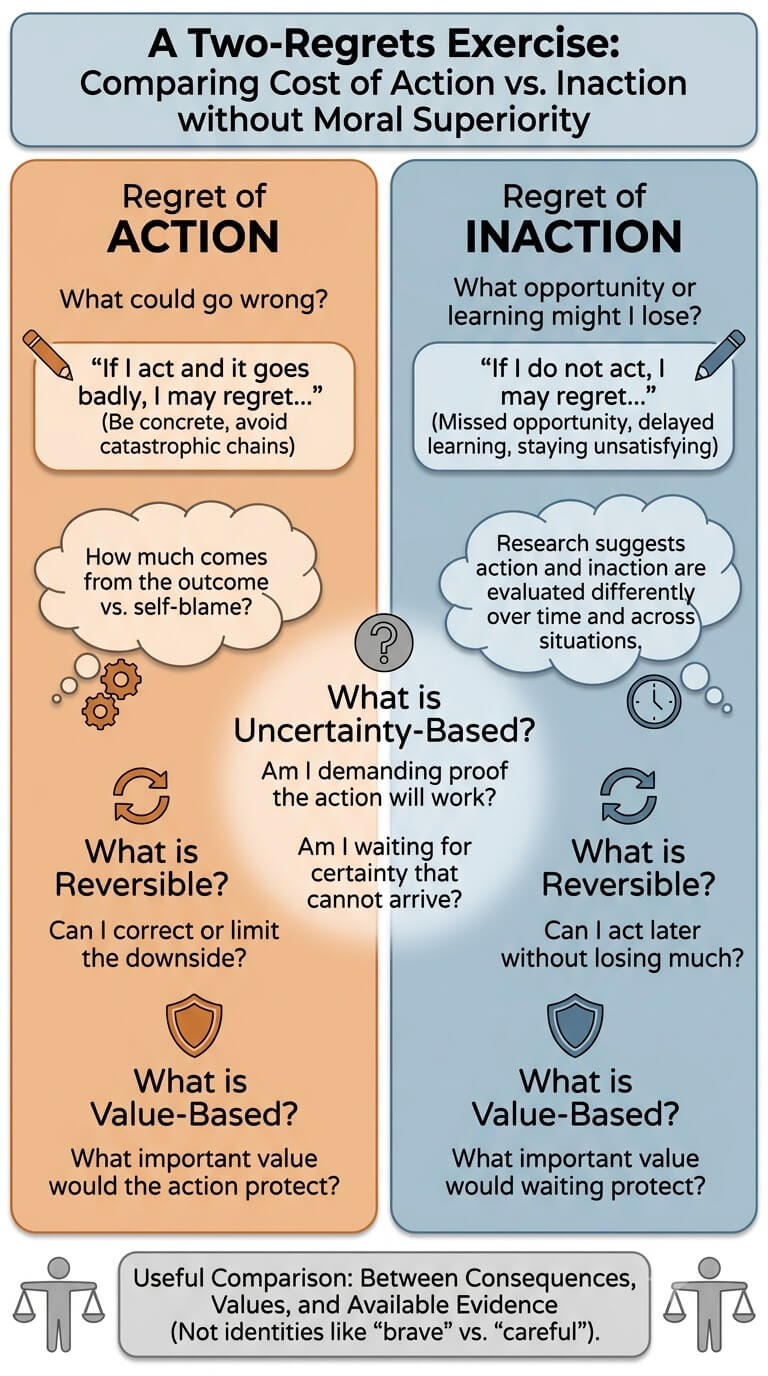
When one regret scenario dominates, compare the cost of action with the cost of inaction. The point is not to predict your future emotion perfectly. It is to stop treating only one direction as capable of producing regret.
Regret of action
Write one or two realistic sentences beginning with: “If I act and it goes badly, I may regret…” Be concrete. Avoid catastrophic chains that require several unlikely events to happen in sequence.
Then ask what part of that regret comes from the outcome itself and what part comes from self-blame for having chosen.
Regret of inaction
Now write: “If I do not act, I may regret…” This might involve a missed opportunity, delayed learning, staying in an unsatisfying situation, or never finding out whether the option fit.
Research on regret suggests that action and inaction can be evaluated differently across situations and over time. A review of what people regret and why emphasizes that opportunity and the possibility of corrective action shape regret, rather than supporting a simple rule that action or inaction is always more regrettable.
Compare both without assuming one is morally superior
Do not turn the exercise into “brave people act” or “careful people wait.” Sometimes waiting protects an important value. Sometimes acting prevents a costly missed opportunity. The useful comparison is between consequences, values, and available evidence, not identities.
| Question | Regret of action | Regret of inaction |
|---|---|---|
| What could go wrong? | What consequence might follow if I choose this? | What opportunity or learning might I lose by waiting? |
| What is reversible? | Can I correct or limit the downside? | Can I act later without losing much? |
| What is value-based? | What important value would the action protect? | What important value would waiting protect? |
| What is uncertainty-based? | Am I demanding proof the action will work? | Am I waiting for certainty that cannot arrive? |
What to Do Next When Regret Is Keeping the Choice Open
If you have enough information to make a reasonable choice but keep reopening it because of future regret, the next step is usually to improve the decision process, not to eliminate every uncomfortable possibility.
Set a decision date
A decision date prevents open-ended comparison from becoming the default. Give yourself enough time for the evidence that matters, then commit to reviewing the information at a specific point.
For high-stakes choices, the date may be farther away. For low-stakes choices, it may be later today. The principle is proportionality.
Define what new evidence would justify waiting
Waiting is more useful when you know what you are waiting for. Write down the information that would legitimately change the choice. If no such information is expected, delay may be serving emotional avoidance rather than better judgment.
A 2023 systematic review and meta-analysis of decision avoidance and post-decision regret found no simple, consistent rule that avoidance reliably reduces regret. That is a useful caution against assuming postponement automatically protects you from feeling bad later.
Choose a process you can defend even if the outcome disappoints
You cannot guarantee that a good process will produce the best outcome. Uncertainty prevents that. But you can ask whether you used relevant evidence, considered the main trade-offs, matched effort to stakes, and avoided obvious preventable mistakes.
This shifts the standard from “My future self must never wish things had gone differently” to “I want to make a choice that was reasonable given what I knew at the time.”
FAQ About Anticipated Regret Psychology
Anticipated regret becomes easier to use when you separate the emotion from the prediction you are making about the future.
What is anticipated regret in psychology?
Anticipated regret is the regret you expect you might feel if a current choice later produces a worse outcome than an alternative. It happens before the outcome exists and can influence which option you choose, how much information you seek, whether you delay, and how strongly you prefer reversible choices.
Can anticipated regret improve decisions?
Yes, in some situations. It can prompt you to notice consequences, values, missing information, and preventable mistakes that you might otherwise overlook. It becomes less helpful when you treat regret avoidance as the main objective and keep searching for a choice that cannot produce any disappointing counterfactual.
Why do reversible choices feel easier?
Reversibility can reduce the apparent cost of being wrong because you expect to have another chance to adjust. That can make action easier when uncertainty is high. However, keeping alternatives open may also encourage continued comparison, so reversibility does not guarantee greater satisfaction after the decision.
Is fear of regret the same as anxiety?
No. Anticipating regret is a normal part of many decisions and does not by itself indicate an anxiety disorder. If fear of making the wrong choice becomes pervasive, causes significant distress, disrupts sleep or daily functioning, or makes ordinary decisions consistently unmanageable, discussing it with a qualified mental health professional may be useful.
How is anticipated regret different from post-decision rumination?
Anticipated regret is future-oriented and occurs before a choice is settled. Post-decision rumination involves repeatedly revisiting a choice after it has been made. Before choosing, improving criteria and evidence may help. After choosing, repeatedly comparing alternatives may add little unless it produces a concrete lesson or a change you can still make.
Key Takeaways
- Anticipated regret is a forecast of how you might feel if a chosen option later looks worse than a rejected one.
- It can improve decisions when it identifies meaningful consequences, values, or information you have not yet considered.
- Future regret can also distort choice when vivid possibilities receive more weight than their likelihood or when the goal becomes avoiding all self-blame.
- Reversible choices may reduce commitment cost, but keeping options open can also prolong counterfactual comparison.
- Compare regret of action with regret of inaction instead of assuming only one direction can produce regret.
- A strong decision standard is a process you can justify with the information available, not a guarantee that your future self will never wish an alternative had worked out better.

Michael Reed is the Founder and Lead Writer at Psychology Exposed. He writes about human behavior, relationships, emotional patterns, self-awareness, and practical psychology topics using research-informed, easy-to-understand content.
Read More About Michael Reed: https://psychologyexposed.com/michael-reed/