

You find a laptop that meets every requirement, fits your budget, and has strong reviews. Instead of buying it, you open six more tabs. Then you wonder whether a slightly better model exists, whether a sale might appear tomorrow, or whether a feature you barely noticed should suddenly matter. The problem is no longer finding an acceptable option. It is deciding whether the search deserves to continue.
That tension sits at the center of maximizing vs satisficing psychology. Maximizing aims to identify the best available option. Satisficing stops when an option clears a meaningful standard. Neither approach is automatically wise or foolish. What matters is whether the extra search is likely to improve the decision enough to justify the time, effort, uncertainty, and opportunity cost it creates.
Quick Answer
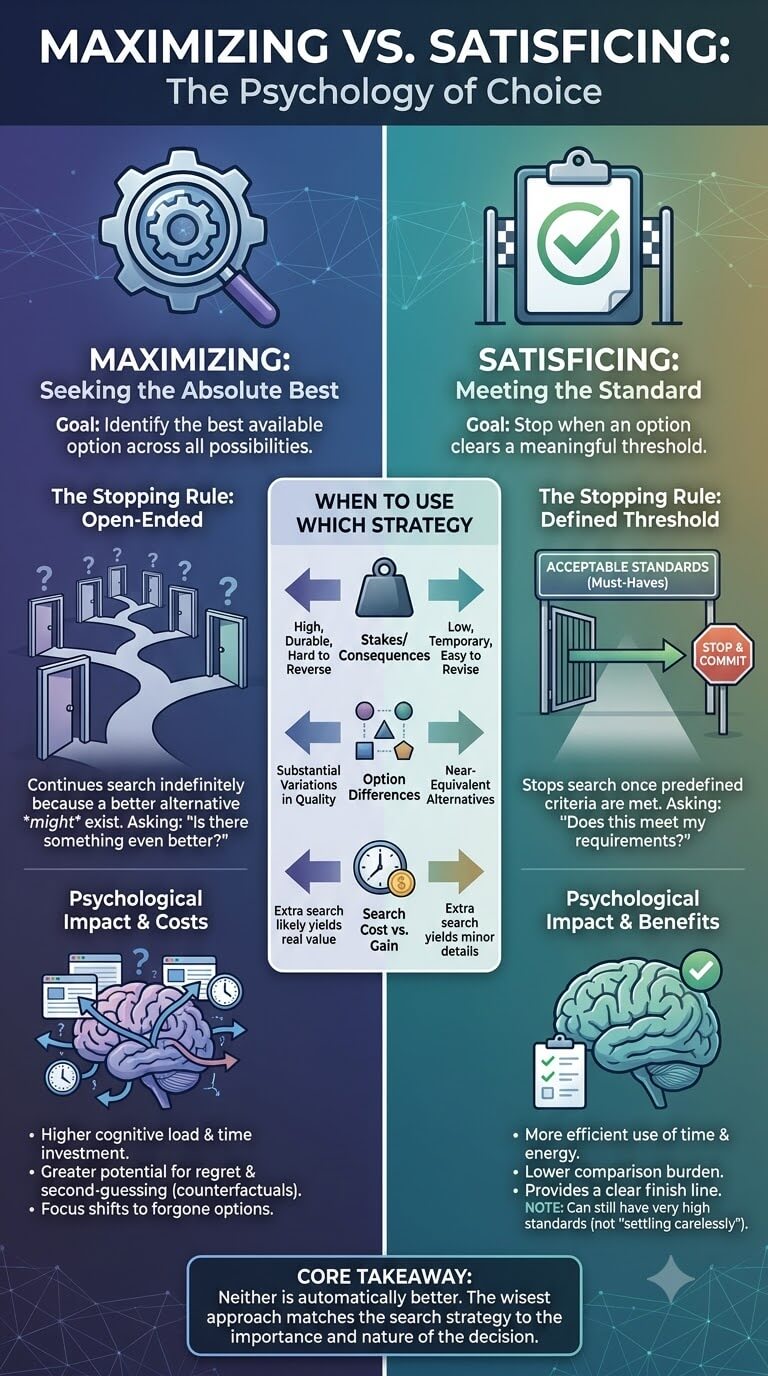
Maximizing means continuing to compare options in pursuit of the best available choice. Satisficing means setting an acceptable threshold and stopping once an option meets it. Maximizing may be useful when stakes are high and differences truly matter. Satisficing can be more efficient when options are similar, consequences are modest, or further search is unlikely to improve the outcome much.
What Maximizing and Satisficing Mean
The distinction is not really between ambitious people and careless people. It is between two ways of deciding when the option set could keep expanding. One strategy asks, “Which available option is best?” The other asks, “Does this option meet the standard I decided matters?”
The stopping rule is one part of the wider decision-making process, which also depends on evidence, uncertainty, trade-offs, and consequences.
Maximizing aims for the best available option
A maximizing strategy keeps comparison open because a better alternative may still exist. The person may gather more reviews, compare more features, consult more people, or revisit options that had already been rejected. The attraction is obvious: if additional search can uncover a meaningfully better choice, the effort may pay off.
Research on maximizing has often treated it as a tendency to pursue the best rather than merely an acceptable result. A classic study by Schwartz and colleagues linked stronger maximizing tendencies with more social comparison, regret, and lower satisfaction in some decision settings. Later work has complicated that picture, which is why it is safer to think in terms of tendencies and strategies rather than fixed types of people. An open-access study on how maximizers perceive decision importance found that people higher in maximizing tendency may treat the same choice as more consequential.
Satisficing uses an acceptable threshold
Satisficing starts by deciding what counts as acceptable. Once an option reaches that level, the search can stop even if a theoretically better option might exist somewhere else. The threshold can be simple, such as “under $1,000, reliable, and light enough to carry daily,” or demanding, such as a detailed hiring standard for a senior role.
The idea grew out of Herbert Simon’s work on decision making under real-world limits. Nobel Prize material describing Simon’s contribution notes that people often seek satisfactory solutions instead of trying to identify a theoretical optimum when information and mental resources are limited. The Nobel Prize overview of Simon’s work places this shift away from perfect maximization at the center of his contribution.
Both strategies can be rational in the right context
It can make sense to maximize when the choice is consequential, difficult to reverse, and the differences between options are large. It can also make sense to satisfice when the decision is routine, reversible, or filled with near-equivalent alternatives. The strategy becomes a problem mainly when the search standard does not match the stakes.
| Decision feature | Maximizing may make more sense | Satisficing may make more sense |
|---|---|---|
| Consequences | Large and durable | Small or temporary |
| Reversibility | Hard to change later | Easy to revise |
| Difference between options | Potentially substantial | Mostly minor |
| Cost of more search | Low relative to the stakes | High relative to likely gain |
| Decision deadline | Enough time for useful comparison | Delay itself creates a cost |
The Core Difference Is the Stopping Rule
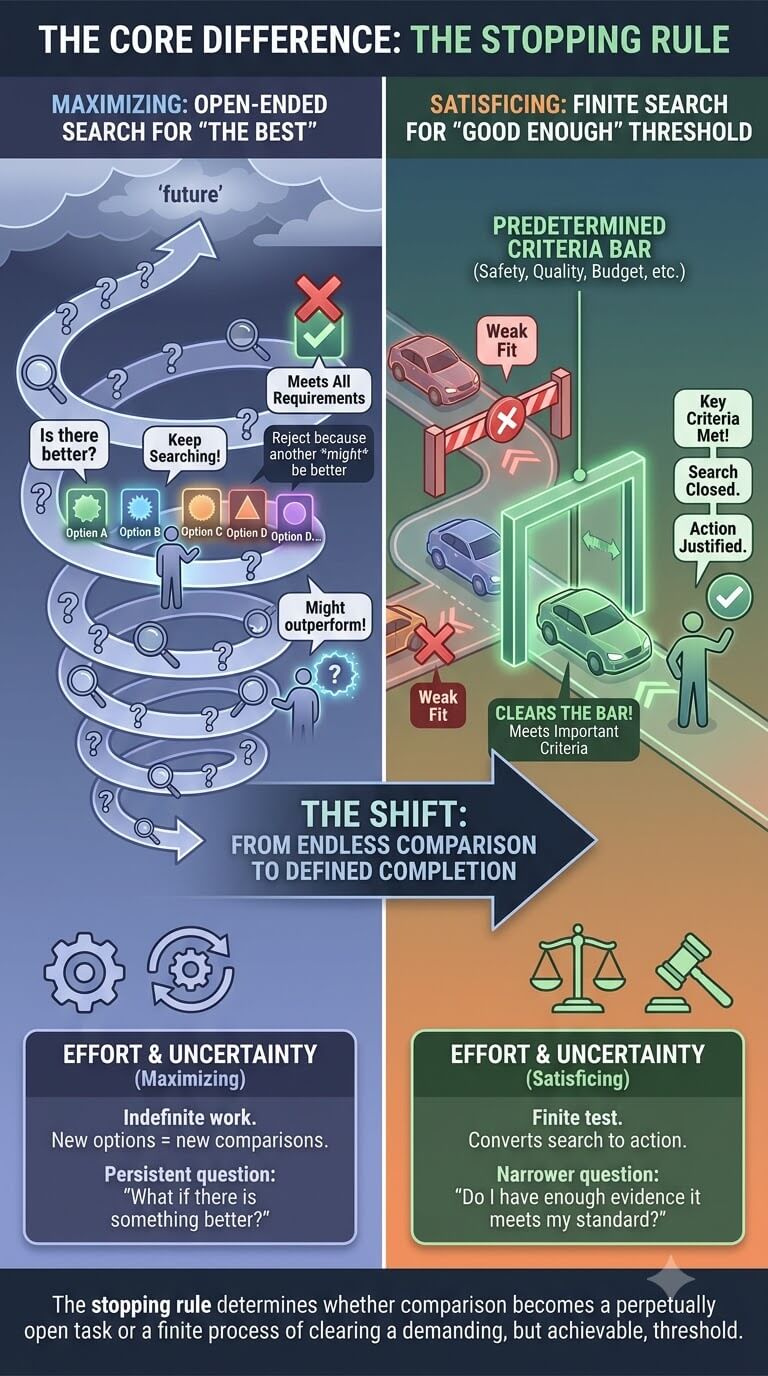
Many people assume the central difference is how much someone cares about quality. A more useful distinction is what tells the person to stop searching. Two people can both have high standards and still use very different stopping rules.
Maximizing keeps search open for a better alternative
A maximizer may reject an option not because it fails an important requirement, but because another option might outperform it. This can turn comparison into an open-ended task. Each promising alternative becomes evidence that the search space may contain an even better one.
Imagine comparing apartments. You find a place in budget, near work, quiet at night, and available when you need it. A maximizing rule says the search remains open while a better combination might still be found. That may be sensible for a major move, but the logic has no natural endpoint unless you also define a search limit.
A stopping rule becomes particularly important when time pressure limits how long the search can continue.
Satisficing stops when key criteria are met
A satisficing rule closes the search when the option clears a predetermined bar. This does not require choosing the first acceptable thing you see. You can compare several alternatives, reject weak fits, and gather evidence. The difference is that “good enough according to my important criteria” is allowed to count as completion.
This is why satisficing can be demanding without becoming endless. The threshold can include strict safety, quality, budget, compatibility, or performance requirements. What it removes is the requirement to prove that no better alternative exists anywhere.
Why the stopping rule changes effort and uncertainty
An open search keeps generating work. New options create new comparisons, new attributes to interpret, and new possibilities to imagine. A threshold converts an indefinite search into a test: does this option satisfy the requirements that matter enough to justify action?
The stopping rule also changes how uncertainty feels. Maximizing tends to leave one question alive: “What if there is something better?” Satisficing replaces that with a narrower question: “Do I have enough evidence that this option meets my standard?” The second question is often easier to answer because it does not require knowledge of every alternative.
What Maximizing Can Offer
Maximizing is not simply a mistake that should be eliminated. In some situations, greater search effort can uncover meaningful differences that a quick threshold-based choice would miss.
More extensive comparison
When quality varies widely, deeper comparison may reveal important trade-offs. Choosing a long-term software platform for a business, selecting a specialized training program, or evaluating several major job offers may justify more extensive search than picking a restaurant for lunch.
The useful part of maximizing is not perfection. It is willingness to keep gathering relevant evidence when the expected benefit of doing so remains substantial.
Potential value in high-stakes decisions
High-stakes decisions often deserve a higher bar because mistakes are costly or hard to undo. A person may reasonably compare more providers, ask more questions, or request more information before committing. In these cases, stopping too early can be more expensive than spending another hour or day on careful evaluation.
Even then, maximizing works better with a boundary. High stakes can justify more search, but they do not make infinite search possible. The practical aim is to spend effort where it can still change the decision.
Stronger search when quality differences matter
Some markets contain many nearly interchangeable options. Others contain large differences in reliability, support, fit, or long-term cost. Maximizing effort is more defensible in the second kind of environment because finding a better option can create a real advantage rather than a cosmetic improvement.
A helpful question is: “If I find an option that is 10 percent better on this feature, will that difference materially affect my life?” If the answer is no, continued comparison may be producing detail rather than value.
The Costs of Maximizing
The pursuit of the best can become expensive even when the final choice is objectively strong. The costs often appear in the process: time, attention, comparison burden, and continued awareness of what was not chosen.
More time and cognitive effort
Every additional option asks for something: reading, remembering, comparing, ranking, and resolving trade-offs. The difficulty rises further when options have different strengths, such as one laptop with better battery life and another with a better screen. More search can improve knowledge, but it also consumes the mental resources needed for other tasks.
More counterfactual comparison
Counterfactual thinking means imagining how things might have gone under a different choice. A larger search history gives the mind more alternatives to compare with the selected option. After choosing, the question can shift from “Is this working?” to “Would option B have been even better?”
One open-access study found links between maximizing and regret-related processes, while also showing that the relationship between maximizing and well-being is more complex than a simple “maximizing makes people unhappy” rule. The research on maximizing, regret, and subjective well-being illustrates why claims in this area should remain nuanced.
Greater exposure to alternatives after choosing
The search can continue mentally even after the action is complete. A person who spent weeks comparing hotels may keep noticing cheaper rates, better locations, or newer reviews after booking. Those discoveries may matter if the booking is still changeable and the difference is large. They may simply destabilize satisfaction if nothing meaningful has changed.
More opportunity for second-guessing
Second-guessing becomes easier when the decision standard was “the best.” Any newly discovered advantage in a rejected option can look like evidence of failure. If the standard was “meets my important requirements at an acceptable cost,” a forgone option can be better on one feature without invalidating the original choice.
Research involving physicians found an association between stronger maximizing tendencies and greater decision-related regret in that sample. It does not prove that maximizing causes regret in every setting, but it shows why maximizing and regret can become linked when people repeatedly revisit alternatives.
What Satisficing Can Offer
Satisficing is valuable because it gives the decision a finish line. Instead of asking whether the current option is unbeatable, it asks whether the option is strong enough for the purpose at hand.
Clear thresholds reduce open-ended search
A threshold turns vague preference into usable criteria. “I want the best phone” has no natural end. “I need a phone under $800, with reliable all-day battery life, a good camera, and at least four years of software support” creates a concrete test.
Once several options pass, you can use a tie-breaker instead of reopening the entire market. That might be price, convenience, warranty, or simply the first option that satisfies all must-haves.
Faster commitment when differences are small
Satisficing becomes especially efficient when the finalists are very similar. If three hotels are equally safe, similarly located, within the same price range, and have comparable reviews, another hour of research may not produce an improvement that matters in practice.
The aim is not speed for its own sake. It is to stop spending decision effort once the expected value of more comparison has become small.
Lower comparison burden
A threshold can reduce the number of dimensions that stay active in the mind. Once a criterion is labeled optional, it no longer needs to compete with a must-have. This helps protect the decision from feature creep, where every newly noticed attribute becomes another reason to delay.
The APA has discussed how articulated preferences can make large assortments easier to navigate. In its overview of choice and large option sets, the American Psychological Association describes how knowing what you want can reduce the burden of comparison.
Satisficing Is Not the Same as Settling Carelessly
“Good enough” can sound like low effort, but that interpretation misses the point. A strong satisficing strategy may require careful thought before the search begins. The discipline is in defining a threshold that protects what truly matters.
A good threshold can be demanding
Suppose you are choosing childcare. Your threshold might include licensing, safety practices, staff stability, location, schedule compatibility, and affordability. A center that fails any non-negotiable is rejected. Once a center meets all of them and feels workable, you do not have to prove that it is the single best center in the city.
Must-have criteria protect decision quality
The best thresholds separate requirements from preferences. Requirements are conditions that make an option viable. Preferences improve the option but do not determine whether it is acceptable. Without that distinction, optional features can quietly become reasons to reject otherwise strong choices.
High-stakes decisions may require a higher threshold
Satisficing does not mean using the same bar for every decision. A weekend backpack and a long-term business contract should not receive identical scrutiny. The threshold should rise with the consequences of error, the difficulty of reversal, and the amount of meaningful variation among options.
Maximizing vs Bounded Rationality
Maximizing and satisficing make more sense when placed inside the reality that no one has unlimited time, information, attention, or access to every possible alternative.
Everyone faces limits
Even a highly motivated maximizer cannot evaluate every apartment, job, doctor, laptop, route, or investment of time that might exist. Search has a cost, information can be incomplete, and future outcomes remain uncertain. These limits are not personal failures. They are features of real-world choice.
Maximizing describes a search strategy within those limits
Maximizing does not remove the limits. It means pushing further within them in an effort to improve the option selected. Someone may compare twenty choices instead of five, inspect more attributes, or delay commitment while seeking a stronger candidate.
Satisficing was developed as an adaptive response to limits
Simon’s insight was that an acceptable solution can be a reasonable answer to a world where perfect optimization is unavailable. The value of satisficing is therefore not that “average is fine.” It is that decision quality must be considered alongside the cost of finding, evaluating, and verifying alternatives.
Maximizing and Choice Overload
Large option sets and maximizing are closely related, but they are not the same thing. One describes the decision environment. The other describes how long and how broadly a person keeps searching for the best choice.
More options create more potential comparisons
When options multiply, a maximizing strategy has more material to process. Ten alternatives create more pairwise comparisons and more forgone possibilities than three. The burden rises faster when each option has many attributes.
Research has found that maximizing tendencies can appear across multiple decision areas rather than being confined to one kind of purchase. An open-access study of maximizing across decision domains supports the idea that some people show a broader tendency to pursue the best, while still leaving room for context to matter.
Preference uncertainty can keep the search open
If you do not know which criteria matter most, every new option can reshape the standard. You begin by prioritizing price, then discover a premium feature and decide that it may be essential, then notice a different option with better convenience. The finish line moves because the decision standard is still being built during the search.
A clear threshold can reduce overload
A threshold lets you eliminate options without fully ranking every alternative. If an option violates a must-have, it leaves the set. If it meets every must-have and enough desirable features, it becomes eligible for selection. This turns a large assortment into a screening task rather than an endless tournament.
Maximizing and Anticipated Regret
The possibility of future regret can make maximizing feel protective. If you compare enough alternatives now, perhaps you can prevent the painful thought that you chose poorly later. The difficulty is that more comparison also creates more alternatives to imagine missing.
More alternatives create more imagined missed opportunities
After examining many options, the mind has a richer library of “what if” scenarios. You may choose the apartment with the best commute but remember the one with the larger balcony. You may choose the job with better growth but picture the calmer schedule offered elsewhere. No single option can contain every advantage.
Future regret can keep a decision open longer
Anticipated regret is useful when it highlights an overlooked consequence. It becomes less useful when it demands certainty that no forgone option could ever look better in hindsight. A sound stopping rule leaves room for the fact that a good decision can still involve trade-offs.
A Domain Check: Where Is Maximizing Worth the Effort?
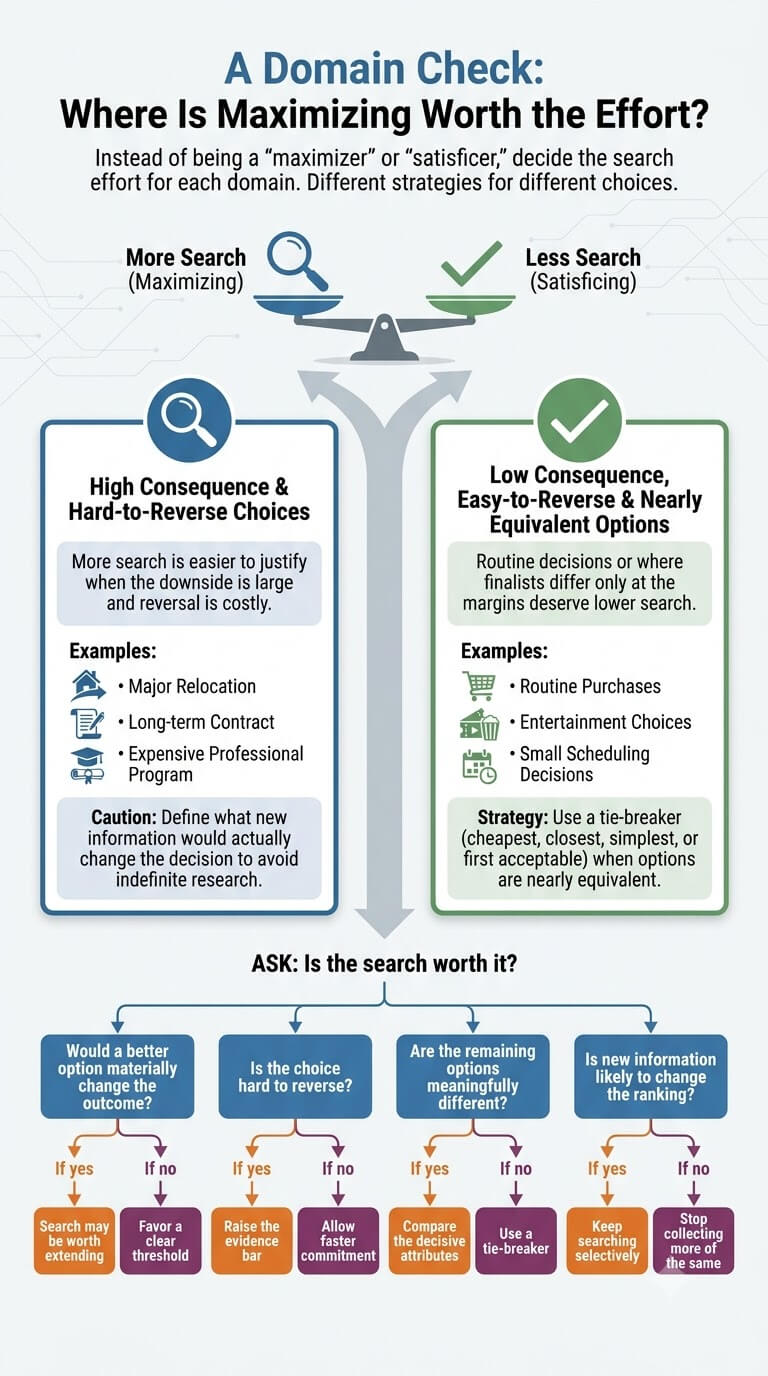
Instead of deciding that you are “a maximizer” or “a satisficer,” decide how much search this particular domain deserves. The same person can reasonably use different strategies for different choices.
High consequence and hard-to-reverse choices
More search is easier to justify when the downside of a poor fit is large and reversal is costly. Examples include a major relocation, a long-term contract, or an expensive professional program. Even here, define what new information would actually change the decision so that “high stakes” does not become permission for indefinite research.
Low consequence and easy-to-reverse choices
Routine purchases, entertainment choices, or small scheduling decisions often deserve a lower search budget. If a weak choice can be corrected next week with little cost, the value of optimization is limited.
Choices where options are nearly equivalent
When finalists differ only at the margins, searching for a winner can consume far more effort than the final difference is worth. A tie-breaker is useful here: choose the cheapest, closest, simplest, or first acceptable option according to a rule you set in advance.
| Ask | If yes | If no |
|---|---|---|
| Would a better option materially change the outcome? | Search may be worth extending | Favor a clear threshold |
| Is the choice hard to reverse? | Raise the evidence bar | Allow faster commitment |
| Are the remaining options meaningfully different? | Compare the decisive attributes | Use a tie-breaker |
| Is new information likely to change the ranking? | Keep searching selectively | Stop collecting more of the same |
Build a Satisficing Threshold Without Lowering Your Standards
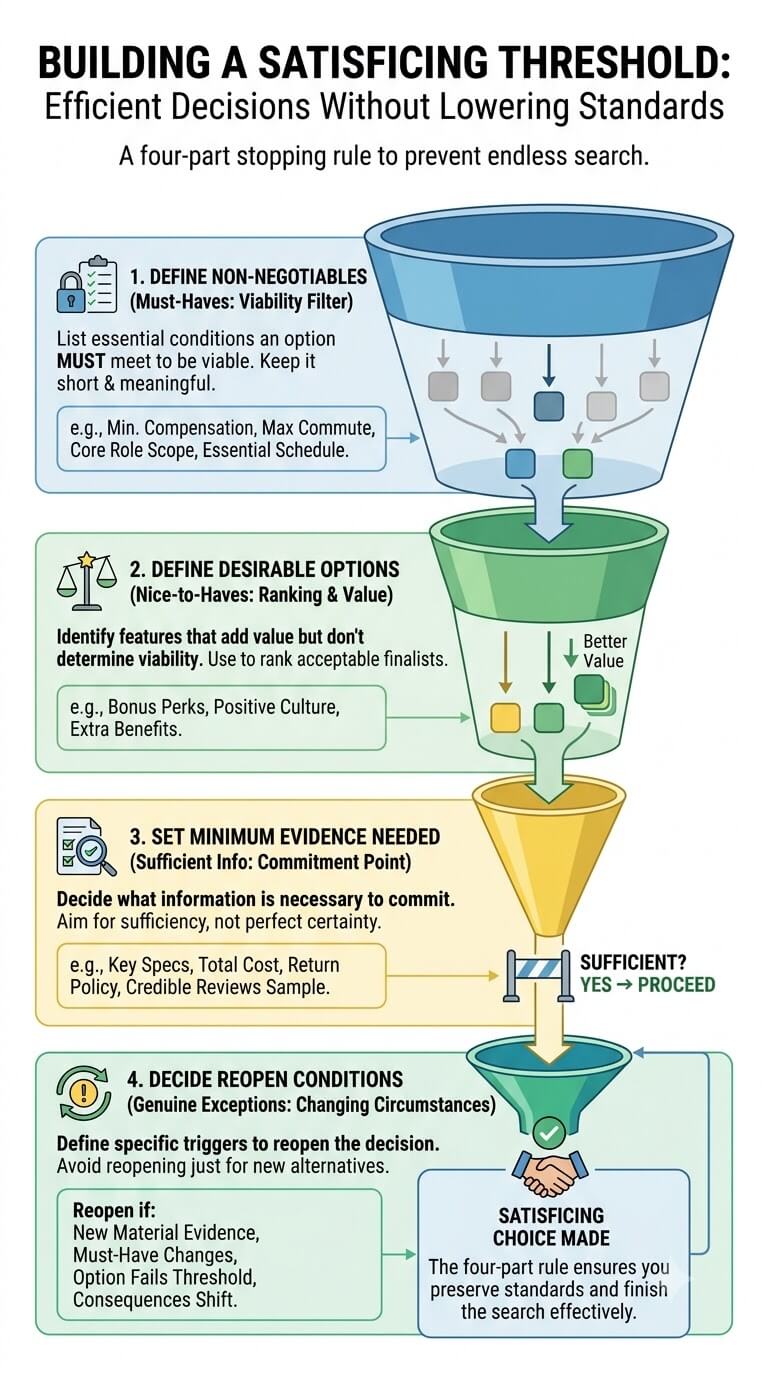
A useful threshold should be created before you are tired of comparing. The following four-part stopping rule is designed to preserve important standards while preventing the search from expanding without a finish line.
Define non-negotiables
List the conditions an option must meet to remain viable. Keep this list short enough to be meaningful. If everything is non-negotiable, nothing is prioritized. For a job, the list might include minimum compensation, acceptable commute, role scope, and a schedule that fits family obligations.
Define desirable but optional features
Next, identify features that add value without determining viability. These can help compare two acceptable finalists, but their absence should not automatically disqualify an otherwise strong option. This prevents preferences from quietly turning into an ever-growing set of requirements.
Set the minimum evidence needed
Decide what information is necessary before committing. For a moderate purchase, that might be specifications, total cost, return policy, and a small sample of credible reviews. For a harder-to-reverse choice, the evidence standard should be higher. The point is to know when the information is sufficient rather than waiting for the feeling of perfect certainty.
Decide what would justify reopening the choice
A good stopping rule includes an exception. Reopen the decision if genuinely new evidence appears, a must-have changes, the option no longer meets the threshold, or the consequences change materially. Do not reopen it simply because another plausible alternative exists.
The four-part rule: Must-haves set viability. Optional features rank acceptable choices. Evidence requirements define when you know enough. Reopen conditions protect you if circumstances genuinely change.
What to Do Next If You Keep Searching After Finding a Good Option
If you already have an option that meets your requirements, the next useful task is not automatically more comparison. It is deciding whether additional search still has a reasonable expected payoff.
Compare the cost of more search with the likely gain
Ask what another hour, day, or week of comparison is likely to produce. If the best realistic result is saving a small amount of money or gaining a feature you rarely use, the search cost may already be larger than the expected improvement.
Hide irrelevant alternatives after the decision if no new evidence exists
Continuing to browse can keep the comparison active without improving the choice. After booking a suitable hotel or buying a product with a reasonable return policy, repeatedly checking alternatives may only generate fresh counterfactuals. If no decision-changing information is expected, close the tabs, unsubscribe from alerts, or stop tracking the category for a while.
Review the process, not every forgone option
Later, judge the decision by the information and priorities available at the time. Ask whether you identified the important criteria, gathered enough evidence, and used an appropriate stopping rule. A different option performing well does not automatically mean your process was poor.
This approach matters because maximizing is not necessarily a fixed identity. Research on maximizing suggests that tendencies can generalize while still being expressed differently across decision domains. You can therefore choose to search deeply in one domain and satisfice in another without being inconsistent.
FAQ About Maximizing vs Satisficing
These questions address the distinctions that tend to matter most when people are trying to decide whether to keep comparing or stop.
Is satisficing just settling for less?
No. Satisficing means choosing an option that meets a defined standard, and that standard can be high. Settling carelessly means accepting an option that does not adequately meet your needs. The practical difference is whether the threshold protects the criteria that truly matter.
Are maximizers more successful?
Not in any simple universal sense. More extensive search can sometimes produce objectively strong options, especially when quality differences are meaningful. It can also create higher effort, more comparison, or lower satisfaction in some settings. Outcomes depend on the domain, the measure of maximizing, the quality of the search, and what “success” means in that decision.
Can someone maximize in one area and satisfice in another?
Yes. People may search intensely for a home or career move while using simple thresholds for clothing, restaurants, or entertainment. This is often sensible because different decisions have different stakes, search costs, reversibility, and consequences.
How do I know when to stop comparing options?
Stop when you have an option that meets your must-haves, you have gathered the minimum evidence you decided was necessary, and further search is unlikely to create a meaningful improvement. If the choice is high-stakes, raise the threshold and evidence requirement rather than abandoning the idea of a stopping rule.
Why does maximizing increase second-guessing for some people?
Aiming for the best makes forgone alternatives more relevant. After choosing, any newly noticed advantage elsewhere can seem like evidence that the optimum was missed. A threshold-based process is less vulnerable to this because the decision can remain reasonable even when another option is better on one feature.
Key Takeaways
- Maximizing searches for the best available option, while satisficing stops when an option clears a meaningful threshold.
- The most important difference is the stopping rule, not whether someone has high or low standards.
- Maximizing effort is easier to justify when stakes are high, reversal is difficult, and option quality varies substantially.
- Satisficing can reduce comparison burden without lowering quality when must-haves, optional features, and evidence requirements are defined clearly.
- Large option sets and anticipated regret can make maximizing harder to stop, but they are separate psychological mechanisms.
- A good next step is to decide in advance what would make an option acceptable and what genuinely new evidence would justify reopening the choice.

Michael Reed is the Founder and Lead Writer at Psychology Exposed. He writes about human behavior, relationships, emotional patterns, self-awareness, and practical psychology topics using research-informed, easy-to-understand content.
Read More About Michael Reed: https://psychologyexposed.com/michael-reed/