
Some decisions feel difficult even when your thinking is sound. You may have reasonable options, incomplete information, competing priorities, and no way to know the outcome in advance. Choosing then becomes a problem of deciding what matters, how much information is enough, which risks are acceptable, and when to stop comparing.
Decision-making psychology examines how people choose between alternatives. The APA Dictionary of Psychology defines decision making as the cognitive process of choosing between two or more alternatives. That simple definition opens into a much larger question: how does a mind with limited time, attention, knowledge, and certainty actually reach a choice?
Quick Answer
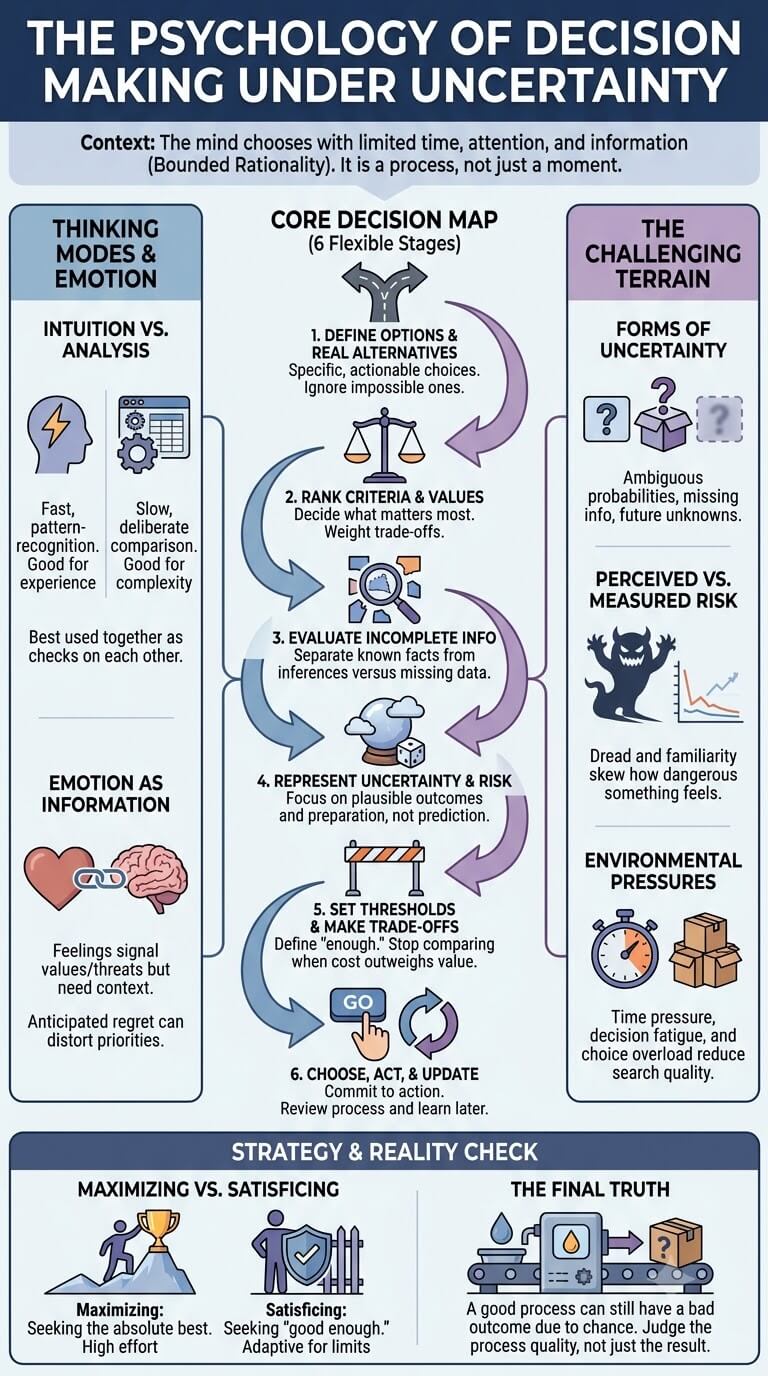
Decision-making psychology studies how people identify options, evaluate consequences, handle uncertainty, make trade-offs, and commit to a choice. Good decision making does not require perfect information or emotionless logic. It usually requires a workable process: clarify the decision, identify what matters, judge the available evidence, account for uncertainty, set a stopping rule, choose, and learn from what happens next.
What Decision-Making Psychology Actually Studies
The field looks beyond the final choice to the sequence of attention, comparison, uncertainty, and commitment that comes before it.
A decision is a process, not a single moment
A choice may look like one moment from the outside, but that moment usually follows several earlier steps. You define the options, decide which consequences matter, search for information, compare trade-offs, imagine outcomes, and eventually reach a point where continued thinking no longer seems worth the cost.
The process continues after the choice. New information may confirm your reasoning, expose a missing consideration, or show that chance mattered. Good decision making includes updating, not just choosing.
Why limited information, time, and certainty matter
Real decisions rarely provide everything you would like to know. A new role may offer better pay but an uncertain manager. A move may improve one part of life while disrupting another. Even ordinary purchases can involve features you cannot fully compare.
The difficulty is not always poor thinking. Some facts are unavailable, some outcomes depend on other people, and some consequences exist only in the future. The mind still has to act inside those limits.
Why Choosing Can Be Hard Even Without a Cognitive Bias
Some choices are difficult because the problem itself contains conflict, missing information, or meaningful costs on both sides.
Competing goals and trade-offs
Many hard choices contain values that cannot all be maximized at once. You may want higher income and more free time, or novelty and stability. The difficulty may be genuine: improving one dimension requires giving something up on another.
This is why a list of pros and cons sometimes feels unsatisfying. Ten small advantages do not automatically outweigh one value that matters deeply. Good comparison requires deciding which criteria deserve more weight, not merely counting them.
Information costs and incomplete evidence
Information can improve a choice, but acquiring it has costs. Research takes time, comparisons consume attention, and extra advice can conflict. Waiting for one more fact may also delay action.
A useful question is not “Do I know everything?” It is “What information could realistically change my choice?” If a missing fact would not alter your preference, searching for it may add effort without adding decision value.
The cost of delaying a choice
Not deciding can feel neutral, but delay has consequences. A deadline may pass, an option may disappear, or uncertainty may continue consuming attention.
This does not mean faster is always better. It means delay belongs inside the comparison. When you evaluate an option, include the cost of waiting alongside the costs of choosing too soon.
A Core Decision Map: Options to Evaluation to Uncertainty to Trade-Off to Choice
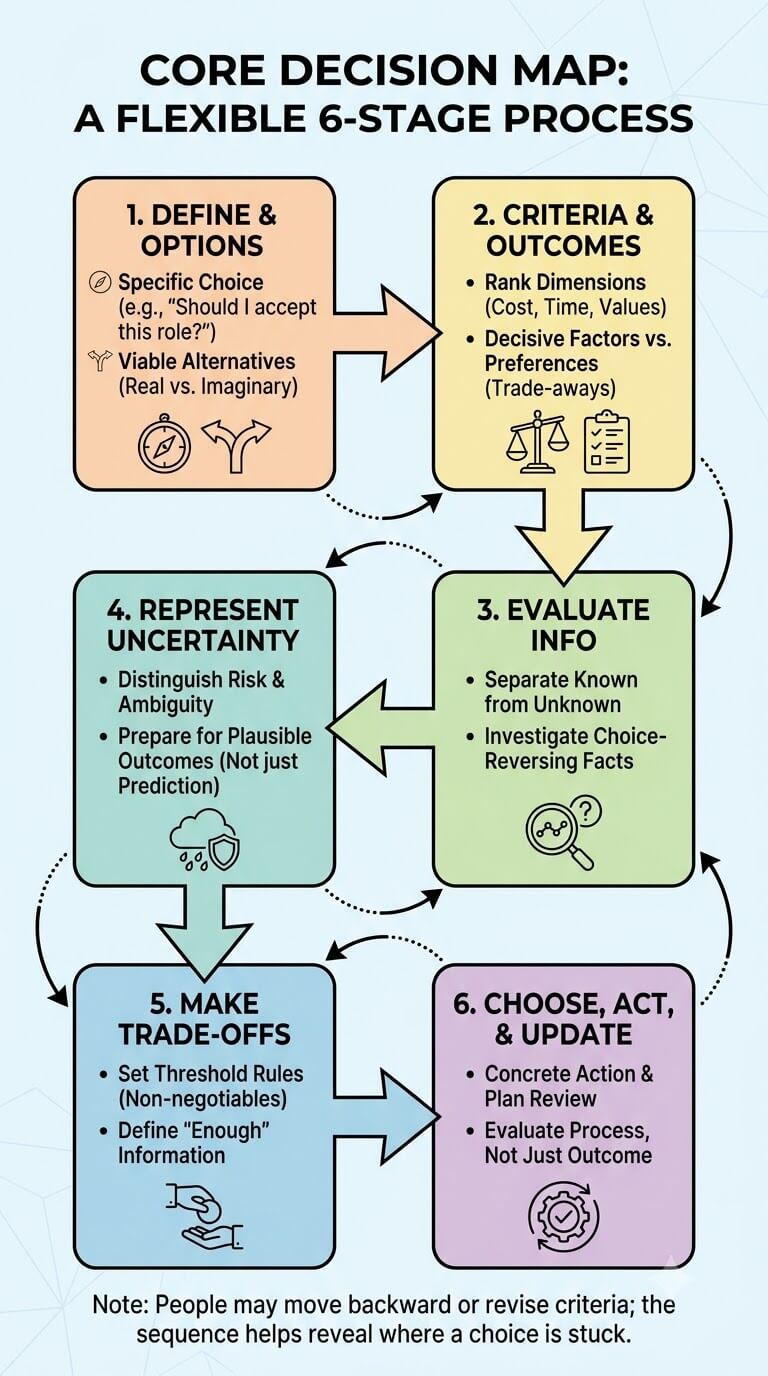
A useful way to understand complex decisions is to follow six flexible stages. People may move backward or revise criteria, but the sequence helps reveal where a choice is getting stuck.
Step 1: define the decision and viable options
Name the choice in a form specific enough to act on. “What should I do with my career?” is too broad. “Should I accept this role, stay for six months, or continue searching?” creates alternatives you can compare.
Separate real options from imaginary ones. An alternative that depends on unavailable resources or permission may not belong in the current choice. Keeping impossible options adds comparison without improving the decision.
Step 2: decide what outcomes or criteria matter
Next, identify the dimensions that would make one option better for you than another. These could include cost, reversibility, time, reliability, learning, personal values, effect on other people, or likely downside.
Try ranking the criteria rather than treating every factor as equal. A decision becomes clearer when you know which two or three considerations are decisive and which are preferences you would trade away if necessary.
Step 3: evaluate incomplete information
Separate what you know, what you reasonably infer, and what you simply do not know. This prevents a common mental mistake: treating a vivid guess as if it were evidence.
You do not need to eliminate every unknown. If one fact could reverse your choice, investigate it. If an unknown remains unavoidable, treat it as uncertainty rather than an unfinished task.
Step 4: represent uncertainty and risk
Some outcomes have probabilities that can be estimated. Others are ambiguous because the probabilities themselves are unclear. Research on decision making under uncertainty distinguishes several forms of uncertainty and emphasizes that context influences how people respond to them.
Instead of asking only, “What will happen?” ask what outcomes are plausible, how serious they are, and how much you know about their likelihood. This turns uncertainty into a problem of preparation rather than prediction.
Step 5: make trade-offs and set a threshold
At some point, comparison needs a rule for choosing. You might require three non-negotiables, set a limit on downside, or choose once one option is clearly better on your highest-ranked factors.
Without a threshold, information gathering can expand indefinitely because “enough” has never been defined.
Step 6: choose, act, and update
After choosing, take the next concrete action and decide when the choice should be reviewed. Reversible decisions may benefit from a test period. Irreversible decisions require more care, but they still cannot be guaranteed.
Later, evaluate both the process and the outcome. A good process can produce a bad outcome because of chance. A poor process can occasionally get lucky. Judging only by results can teach the wrong lesson.
Intuition and Analysis as Two Ways Through the Same Map
People can move through the same choice using fast recognition, deliberate comparison, or a combination of both.
Fast pattern-based judgment
Intuitive decisions may arrive as a rapid sense that one option fits or deserves attention. This can be useful when relevant experience has taught you patterns that are hard to explain immediately.
Intuition becomes less trustworthy when the situation is unfamiliar, feedback has been poor, or strong emotion is being mistaken for evidence. A gut reaction deserves attention, but not automatic obedience.
Deliberate comparison and calculation
Analytical thinking makes criteria explicit, compares evidence, and checks whether an appealing option survives closer inspection. It is especially useful when the choice is unfamiliar, high stakes, or numerically complex.
Analysis also has limits. A spreadsheet cannot decide how much you value autonomy, belonging, status, or peace of mind unless you first give those values weight. More calculation does not remove the need for judgment.
Why good decisions often combine both
Intuition and analysis are often most useful as checks on each other. A strong intuitive preference can tell you where to look more closely. Analysis can test whether the preference still makes sense after costs and consequences are considered.
If analysis favors one option but you feel persistent resistance, investigate why. If your gut favors something with a severe, poorly understood downside, slow down. No single thinking style fits every decision.
Real-World Limits on Rational Choice
Human decision makers work with limited time, attention, knowledge, and calculation capacity, so practical limits matter.
Bounded rationality
Classic models sometimes imagine a decision maker who knows every alternative, can calculate every consequence, and chooses the option with the greatest value. Human beings rarely operate that way. Herbert Simon’s work challenged assumptions of unlimited rationality and emphasized choice under practical constraints. The Nobel Prize’s account of Simon’s contribution highlights his argument that people often seek satisfactory rather than perfectly optimal solutions.
Bounded rationality is not the same as irrationality. It recognizes that thinking itself uses scarce resources. Attention, time, memory, and information all have limits, so an efficient decision process must decide where effort is worth spending.
Why satisficing can be adaptive
Satisficing means choosing an option that meets an acceptable threshold rather than proving it is the best possible alternative. For many decisions, a reliable option that fits the important requirements is enough.
The quality of satisficing depends on the threshold. A careless threshold can produce poor choices. A well-designed threshold can prevent low-value comparison and preserve attention for decisions where optimization matters more.
Choosing When the Outcome Is Uncertain
The future often cannot be known in advance, so good choices must sometimes be made without complete probabilities.
Probability, ambiguity, and missing information
Uncertainty takes different forms. You may have a reasonable probability estimate, unclear probabilities, or missing information that could still be obtained.
When probabilities or outcomes remain unclear, decision making under uncertainty requires separating what can still be learned from what cannot yet be known.
Different forms call for different responses. Known probabilities invite risk comparison, ambiguity may require ranges and contingency plans, and missing information invites targeted research. Some uncertainty simply cannot be researched away.
Confidence is not the same as certainty
You can make a decision confidently while acknowledging that the outcome is uncertain. Confidence can mean, “Given what I know, this process is good enough to act on.” Certainty would mean knowing what will happen, which is often impossible.
This distinction helps when people believe they should wait until doubt disappears. Doubt may remain because the future genuinely contains unknowns. The relevant question is whether the remaining uncertainty changes what you should do now.
How Risk Perception Changes a Decision
Risk is evaluated through both available evidence and the way possible harm is experienced psychologically.
Perceived risk versus measured risk
Risk has both an analytical and a psychological side. Measured risk concerns estimated likelihood and consequence. Perceived risk concerns how threatening, acceptable, or controllable the situation feels to the person deciding.
The two can diverge. A low-probability event may dominate attention because its consequences are vivid, while a familiar risk may feel smaller. The useful check is whether feelings and available evidence are describing the same thing.
Why dread, control, familiarity, and consequence matter
People do not experience risk as a number alone. Whether a risk feels voluntary, controllable, familiar, immediate, or catastrophic can shape its psychological weight. Two choices with similar estimated probabilities can therefore feel very different.
When risk feels unusually large or small, ask what drives the feeling: likelihood, severity, lack of control, unfamiliarity, or consequences for someone else. Naming the dimension improves comparison.
How Emotion Changes What Feels Important
Feelings can change which outcomes stand out, how urgent a choice feels, and what consequences receive more weight.
Emotion as information
Emotion is not simply noise that should be removed from a decision. Feelings can draw attention to needs, values, threats, losses, opportunities, and social consequences. Research reviews have described multiple ways emotion contributes to judgment, including how affective reactions influence what receives weight during a choice. An open-access review on emotional processes in decision making discusses how emotional responses can contribute to representing the meaning of options and trade-offs.
The practical task is interpretation. Fear may reflect a meaningful danger, an unfamiliar situation, or both. Excitement may reflect genuine opportunity, novelty, or a tendency to underweight costs. Feelings belong in the decision, but they still need context.
Reward, risk, urgency, and consequence weighting
Emotion can change which consequence feels most important right now. Under urgency, immediate relief may receive more weight. After disappointment, avoiding another loss may become especially salient. During excitement, future benefits may seem more concrete than future costs.
A simple check is to ask whether your weighting would look different in a calmer state. You do not have to erase the emotion. You are checking whether a temporary state is setting priorities that you would endorse later.
When the Decision Environment Becomes Too Demanding
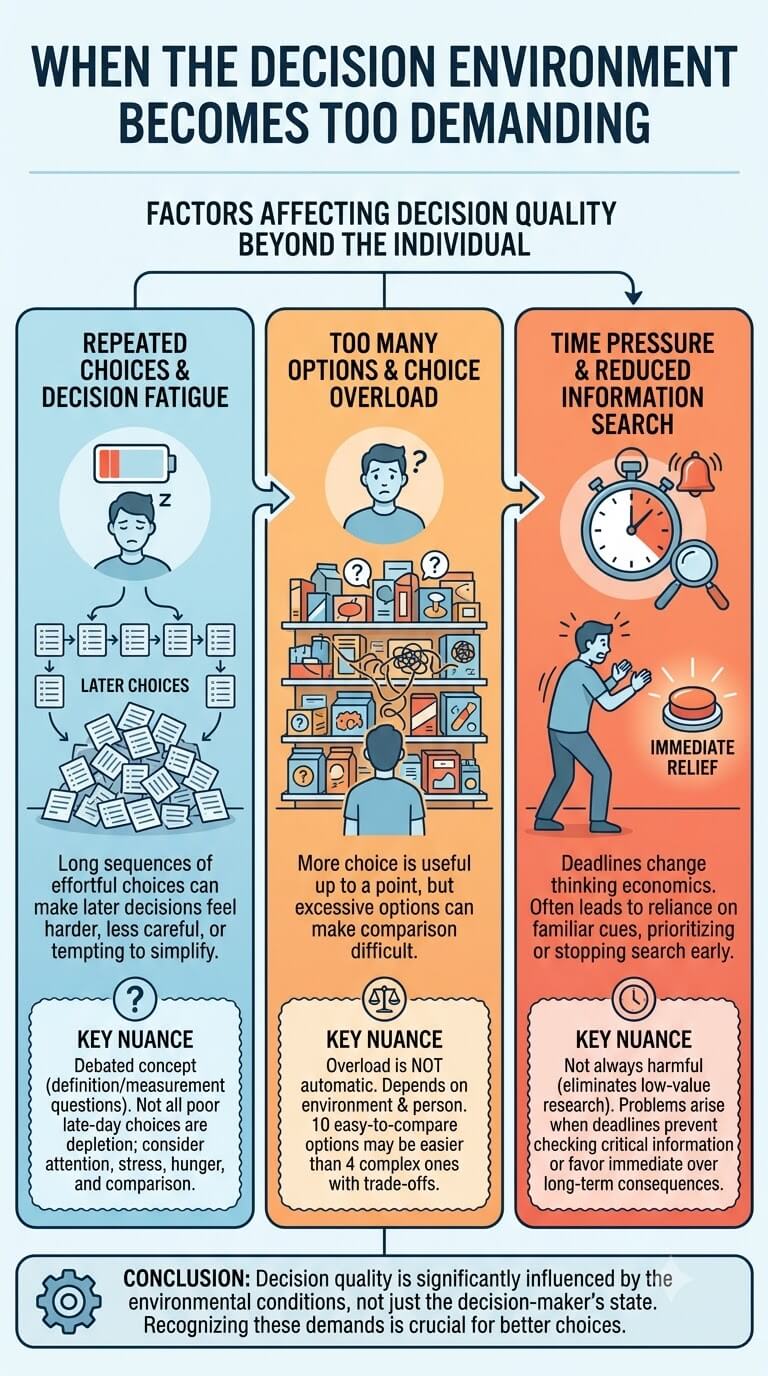
Decision quality also depends on the conditions surrounding the choice, not only on the person making it.
Repeated choices and decision fatigue
After a long sequence of effortful choices, some people report that later decisions feel harder, less careful, or more tempting to simplify. Decision fatigue has been discussed in the literature, but the construct has also faced questions about definition, measurement, and how broadly findings should be generalized. A conceptual analysis of decision fatigue noted limits in conceptual clarity and called for more precise understanding.
Not every poor late-day choice needs a special depletion explanation. Attention, time pressure, hunger, stress, and repeated comparison can all change the conditions under which you decide.
Too many options and choice overload
More choice can be useful, but beyond a certain point the comparison itself may become difficult. A recent open-access review of choice overload and its moderators emphasizes that overload is not automatic whenever many options exist. It depends on features of the choice environment and the person making the decision.
When the difficulty comes from the size or complexity of the option set itself, choice overload provides the more specific explanation.
This nuance matters. If ten options are easy to compare using one clear criterion, the set may not feel overwhelming. Four options with complex trade-offs, unfamiliar features, and no obvious priority can be much harder.
Time pressure and reduced information search
A deadline changes the economics of thinking. Under time pressure, every additional comparison consumes a larger share of the time available. People may rely more heavily on familiar cues, prioritize the most important criteria, or stop searching earlier.
That is not always harmful. Time limits can eliminate low-value research. Problems arise when the deadline prevents checking information that could materially change the choice, or when urgency makes immediate relief more influential than longer-term consequences.
Best Possible Choice or Good Enough Choice?
A major difference between decision strategies is whether the goal is optimization or meeting a sufficient threshold.
Maximizing and satisficing as different decision strategies
A maximizing approach keeps asking whether a better option exists. A satisficing approach asks whether the current option clears an acceptable threshold. Both can be reasonable depending on what is at stake.
Maximizing makes more sense when differences matter greatly, the choice is hard to reverse, and more comparison is likely to help. Satisficing is often more efficient for reversible or lower-stakes choices.
Effort, satisfaction, and second-guessing
The search strategy also shapes what happens afterward. If your rule is “find the best,” a later alternative may feel like evidence of failure. If your rule is “meet these requirements,” it may not matter.
Before researching, decide what success means. Otherwise the standard may quietly expand as you encounter more options.
Regret Before the Decision
People often imagine future disappointment before choosing, and that forecast can influence what feels safest or most worthwhile.
How anticipated regret can change choice
Regret can influence a choice before it happens. People imagine future disappointment, such as turning down an opportunity or leaving something valuable, and that forecast can change what feels safer or more meaningful.
Anticipated regret can be useful when it reveals a neglected value. It can also become misleading if one vivid imagined future crowds out other plausible outcomes.
When regret forecasting helps and when it distorts priorities
Use regret as one input, not the final rule. Ask what you imagine regretting, then compare that concern with your other criteria instead of letting the strongest imagined emotion decide by itself.
It also helps to imagine regret on both sides. “What if I choose A?” is incomplete without “What if I choose B?” Balanced forecasting exposes whether you are treating one path as emotionally real and the other as abstract.
Decision Guide: Which Topic Should You Read Next?
Different decision problems call for different explanations, so the next useful topic depends on what is making the choice difficult.
If you rely on gut feeling or over-analysis: Intuitive vs Analytical Decision Making
Compare fast pattern-based judgment with slower analysis and when each works best.
If you cannot evaluate everything: Bounded Rationality Psychology
See why limited time and information make search limits and stopping rules necessary.
If outcomes are unknown: Decision Making Under Uncertainty
Go deeper into risk, ambiguity, missing probabilities, and incomplete evidence.
If feelings are changing the choice: Emotion and Decision Making Psychology
Examine how feelings change the weight given to rewards, risks, urgency, and consequences.
If danger feels hard to calibrate: Risk Perception and Decision Making
Look at why subjective danger can differ from estimated risk and what shapes that gap.
If repeated choices are wearing you down: Decision Fatigue Psychology
Consider what repeated decision demands may do to effort, simplification, and later choices.
If the problem is too many options: Choice Overload Psychology
Focus on when option quantity and comparison complexity make more choice less useful.
If you keep searching for the best option: Maximizing vs Satisficing Psychology
Compare a best-possible strategy with a good-enough threshold and their effects on search and satisfaction.
If future regret is driving the choice: Anticipated Regret Psychology
Examine how imagined future regret can reveal values or over-weight one vivid possibility.
If a deadline is changing your process: Decision Making Under Time Pressure
Explore how urgency changes information search, comparison, and risk acceptance.
Common Misunderstandings About Decision Making
Several popular assumptions make ordinary decision difficulty seem more irrational than it really is.
Rational does not mean emotionless
A rational choice is not necessarily emotionless. If an outcome affects relationships, identity, security, or values, emotional meaning is part of its value or cost. Ask whether emotion is informing the evaluation or crowding out relevant information.
Intuition is not automatically irrational
Intuition can reflect experience compressed into rapid recognition. Its quality depends on whether the environment offered useful patterns and feedback. A strong feeling in an unfamiliar situation is not the same as trained judgment.
More information is not always better
Additional information is valuable only when it improves understanding enough to justify its cost. One decisive fact may matter more than twenty minor comparisons. More data can also create conflicting signals that make a simple choice feel artificially complex.
A difficult choice is not automatically decision paralysis
Taking time with a complicated choice can be reasonable. Difficulty may reflect real trade-offs, limited evidence, or high stakes. Concern becomes more significant when indecision repeatedly prevents necessary action, causes severe distress, or substantially interferes with daily functioning.
A Practical First-Step Decision Check
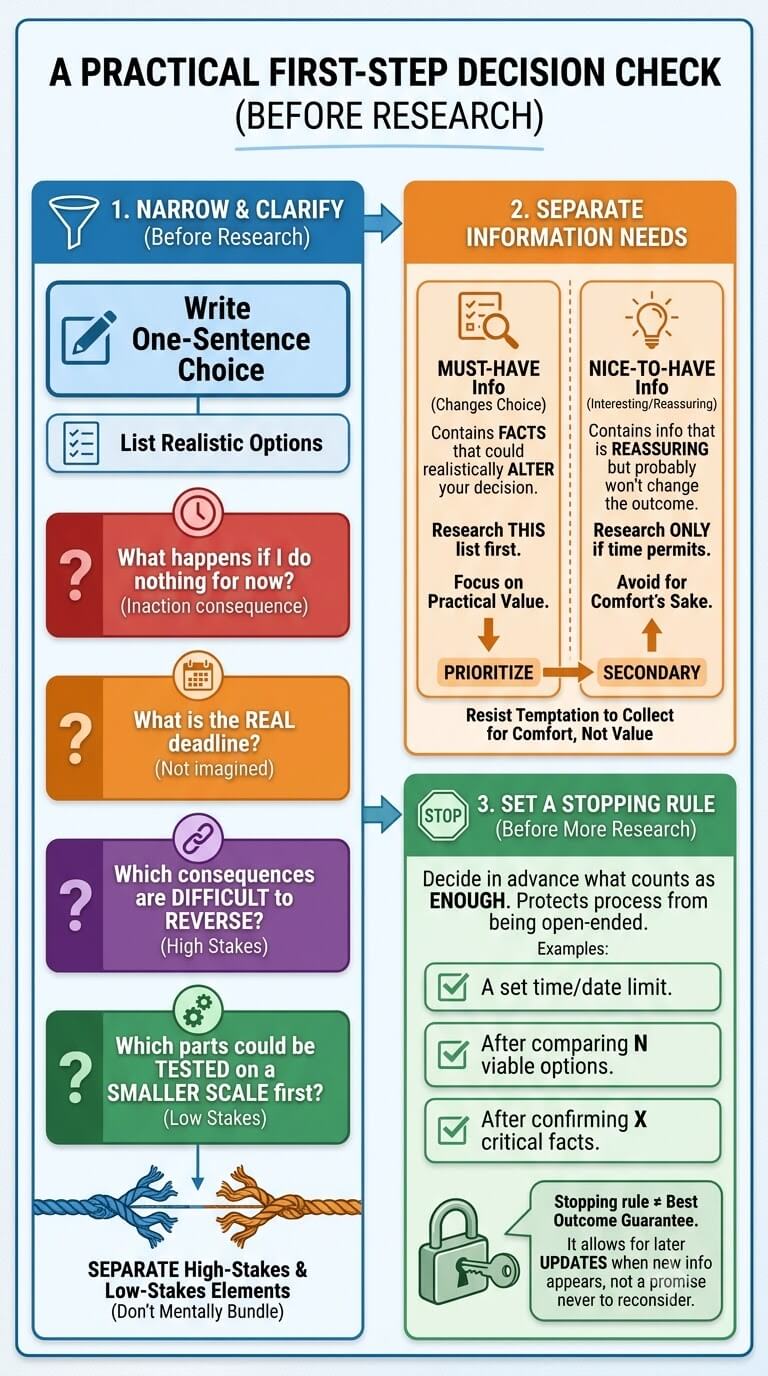
Before doing more research, narrow the problem and decide what information would actually change your choice.
Clarify the decision, stakes, deadline, and reversible parts
Write one sentence describing the actual choice. List the realistic options. Then answer four questions:
- What happens if I do nothing for now?
- What is the real deadline, not the imagined one?
- Which consequences would be difficult to reverse?
- Which parts could be tested on a smaller scale first?
This keeps high-stakes and low-stakes elements from being mentally bundled together. A decision may feel irreversible even when several components can be tried, negotiated, or changed later.
Separate must-have information from nice-to-have information
Create two short lists. The first contains facts that could realistically change your choice. The second contains information that would be interesting or reassuring but probably would not alter the decision.
Research the first list first. This reduces the temptation to keep collecting information because uncertainty feels uncomfortable rather than because the information has practical value.
Choose a stopping rule before more research
Decide in advance what will count as enough. You might stop after comparing three viable options, after confirming two critical facts, at a set time, or once one option meets all non-negotiable criteria without an unacceptable downside.
A stopping rule does not guarantee the best outcome. It protects the process from becoming open-ended. When new information appears later, you can update rather than treating the original decision as a promise never to reconsider.
FAQ About Decision-Making Psychology
These questions clarify several practical issues that often appear when people try to evaluate their own decision process.
What is decision-making psychology in simple terms?
It is the study of how people choose between alternatives, including how they represent options, value outcomes, handle uncertainty, and commit to a choice. It also examines why real decisions differ from idealized models that assume unlimited information and calculation.
Why can two reasonable people make different decisions with the same information?
They may value different outcomes, tolerate different risks, have different experiences, or interpret uncertainty differently. Facts do not determine a choice by themselves because priorities and trade-offs also matter.
Does more information always improve a decision?
No. More information helps when it is relevant, reliable, and likely to change the comparison. Minor or repetitive information can add effort without improving the choice. Ask whether another fact could realistically change what you would do.
Is intuition or analysis better for important choices?
Neither is universally better. Analysis helps with unfamiliar, complex, or numerical choices. Intuition may add useful information when it draws on relevant experience and good feedback. Often, intuitive reactions can identify concerns that deliberate comparison then tests.
What makes a decision good if the outcome is uncertain?
A good decision uses the information reasonably available, reflects important goals and constraints, considers meaningful risks, and fits the stakes. Outcomes still contain chance, so a disappointing result does not automatically prove that the choice was foolish.
Key Takeaways
- Decision making is a sequence of defining options, evaluating criteria, handling uncertainty, making trade-offs, choosing, and updating.
- Difficult choices often remain difficult because goals conflict or outcomes are uncertain, not because a person is thinking badly.
- Information is most useful when it could change the choice; searching indefinitely can create costs of its own.
- Intuition and analysis are complementary tools whose usefulness depends on experience, stakes, feedback, and complexity.
- Human rationality is bounded by time, attention, knowledge, and cognitive capacity, so workable thresholds are often necessary.
- A good process can still lead to a disappointing outcome, which is why decision quality should not be judged by results alone.
When a choice feels tangled, identify the stage that is actually difficult. You may need one missing fact, a clearer priority, a risk threshold, or a stopping rule rather than more thinking about everything. If decision difficulty becomes persistent, causes severe distress, or significantly interferes with everyday functioning, qualified professional support may be worth considering.

Michael Reed is the Founder and Lead Writer at Psychology Exposed. He writes about human behavior, relationships, emotional patterns, self-awareness, and practical psychology topics using research-informed, easy-to-understand content.
Read More About Michael Reed: https://psychologyexposed.com/michael-reed/