
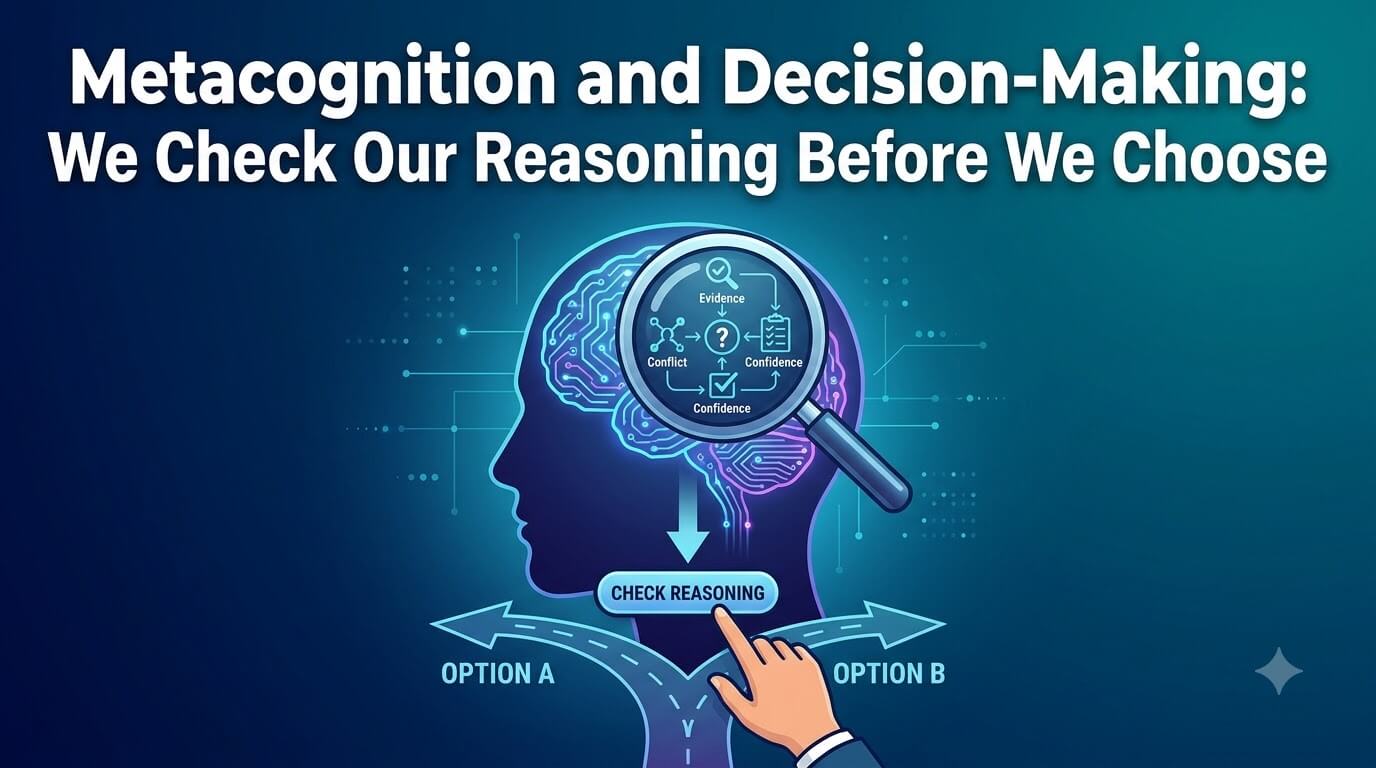
A decision does not end with choosing between option A and option B. Before acting, people also make a second judgment: how much should I trust the reasoning that produced this choice?
That second judgment is where metacognition enters decision-making. You may notice thin evidence, unusually close options, confidence that outruns the facts, or one missing detail that could reverse the choice. You may also notice that the important facts are checked and more analysis is unlikely to help.
Everyday choices rarely come with perfect certainty. The useful skill is deciding what doubt means, how much confidence the evidence deserves, and whether to act, verify, seek more information, or stop checking.
Quick Answer: Good Decisions Need a Judgment About the Quality of the Decision Process
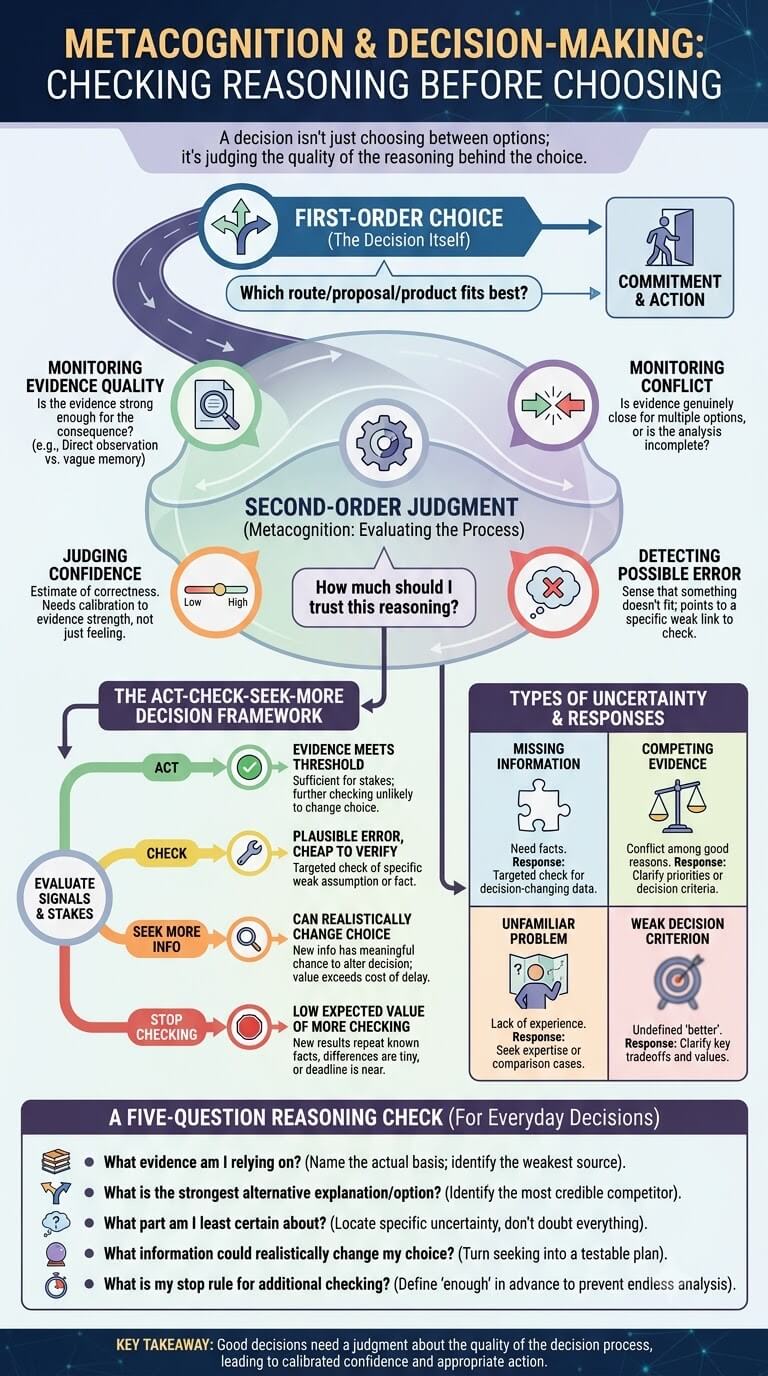
Metacognition in decision-making is the process of evaluating your own decision process. It includes monitoring evidence quality, conflict, confidence, uncertainty, and possible error. Those signals help determine whether to commit, verify, gather more information, revise, or stop checking.
The first-order choice
The first-order decision is the choice itself. Which route should you take? Which proposal should you use? Which product better fits your needs? Which explanation best matches the available facts?
At this level, the task concerns the options, evidence, goals, and consequences themselves.
The second-order question: how much should I trust this choice?
The second-order judgment evaluates the decision you just made or are about to make. Instead of asking only “Which option looks best?” you also ask “How reliable is my basis for choosing it?”
Stephen Fleming and Nathaniel Daw describe self-evaluation of decisions as a form of second-order inference about decision quality. You do not need the computational details to use the basic idea: making a choice and estimating the quality of that choice are related, but they are not identical mental operations.
Where Metacognition Enters a Decision
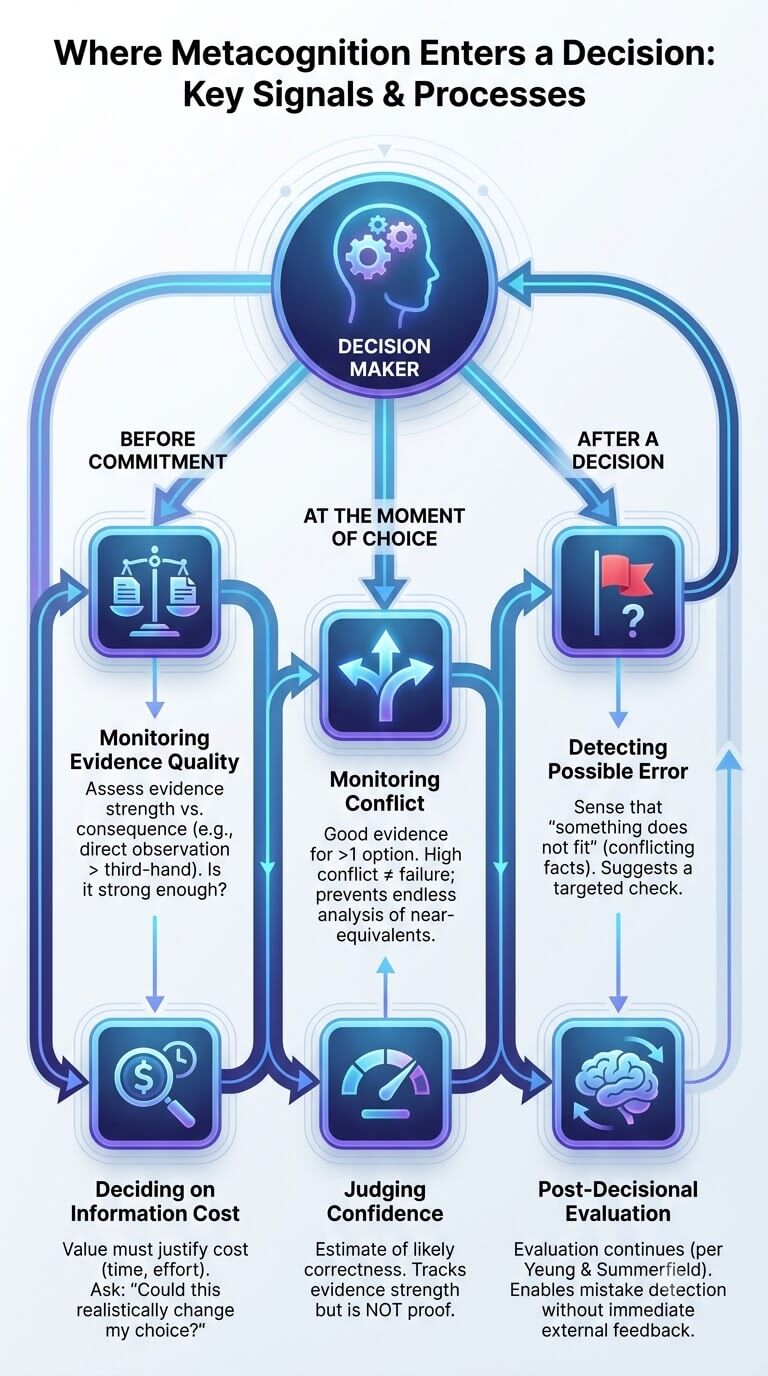
Metacognitive information can appear before commitment, at the moment of choice, or after a decision has been made. Several signals are especially useful because they tell you something about how much trust the current reasoning deserves.
Monitoring evidence quality
Not all evidence deserves equal weight. A written record is different from a vague memory. A direct observation is different from a third-hand interpretation. A repeated pattern is different from a single unusual event.
Metacognitive monitoring asks whether the evidence supporting the choice is strong enough for the consequence attached to it. You might be willing to choose a restaurant from one quick review, but you would want a more reliable basis before making an expensive purchase or accusing someone of wrongdoing.
Monitoring conflict between options
Sometimes uncertainty comes from weak evidence. Other times the evidence is fairly good for more than one option. Two work plans may each solve different parts of the same problem. Two products may have different strengths with no clear winner.
High conflict can mean the choice is genuinely close, not that you have failed to think hard enough. That distinction can prevent endless analysis of near-equivalent options.
Judging confidence
Confidence is your estimate of how likely your judgment is to be correct or appropriate. It can be informative because confidence often tracks aspects of evidence strength, but it should not be treated as proof.
Research reviewed by Nicholas Yeung and Christopher Summerfield links metacognitive decision-making closely with confidence judgments and error monitoring. Their review also emphasizes that evaluation can continue after an initial choice, which helps explain why people sometimes detect mistakes or change their minds without receiving immediate external feedback.
Decision monitoring is one application of the broader metacognitive process of evaluating your own reasoning and deciding how much to trust it.
Detecting possible error
You may choose an answer and still experience a sense that something does not fit. Perhaps two facts conflict, a calculation looks suspicious, or a remembered detail feels less reliable once you inspect it.
An error signal does not prove the choice is wrong. It suggests that a targeted check of the most fragile part may have value.
Deciding whether more information is worth the cost
Information has value only when it can improve the decision enough to justify the time, effort, money, or delay required to obtain it. A useful question is: “If I learned this missing fact, could it realistically change what I choose?”
These choices about checking, information seeking, and stopping are forms of metacognitive regulation rather than separate decision tricks.
If the answer is no, more information may add effort without improving the choice. If yes, a focused check may be worth the cost.
Decision Confidence Is a Signal, Not a Verdict
Confidence matters because action usually requires some threshold of trust. Yet confidence is only useful when interpreted in context. Feeling sure and having strong grounds for being sure are not the same thing.
Confidence can track evidence strength
When one option is supported by clearer, more consistent evidence, people often become more confident. That makes confidence a potentially useful summary signal. If you have repeatedly checked the relevant facts and one explanation continues to fit better, increasing confidence may be appropriate.
Confidence is most useful when it changes with evidence quality rather than staying fixed regardless of what the evidence shows.
Confidence can also inherit misleading cues
A quick answer may feel right because it came easily. A familiar explanation may feel more credible than an unfamiliar one. A confident speaker may make a claim seem stronger even when the underlying evidence is weak.
When a decision matters, ask what your confidence is responding to: evidence, familiarity, speed, social agreement, habit, or something else.
Why confidence should be calibrated to outcomes
Calibration means comparing confidence with what happens later. If your “almost certain” judgments are often wrong, your confidence scale needs updating. If you routinely express low confidence in judgments that turn out to be reliable, you may be underestimating yourself.
The goal is not lower confidence, but confidence that responds to evidence and outcomes. The broader process is explained in how metacognition evaluates thinking.
What Uncertainty Can Tell You
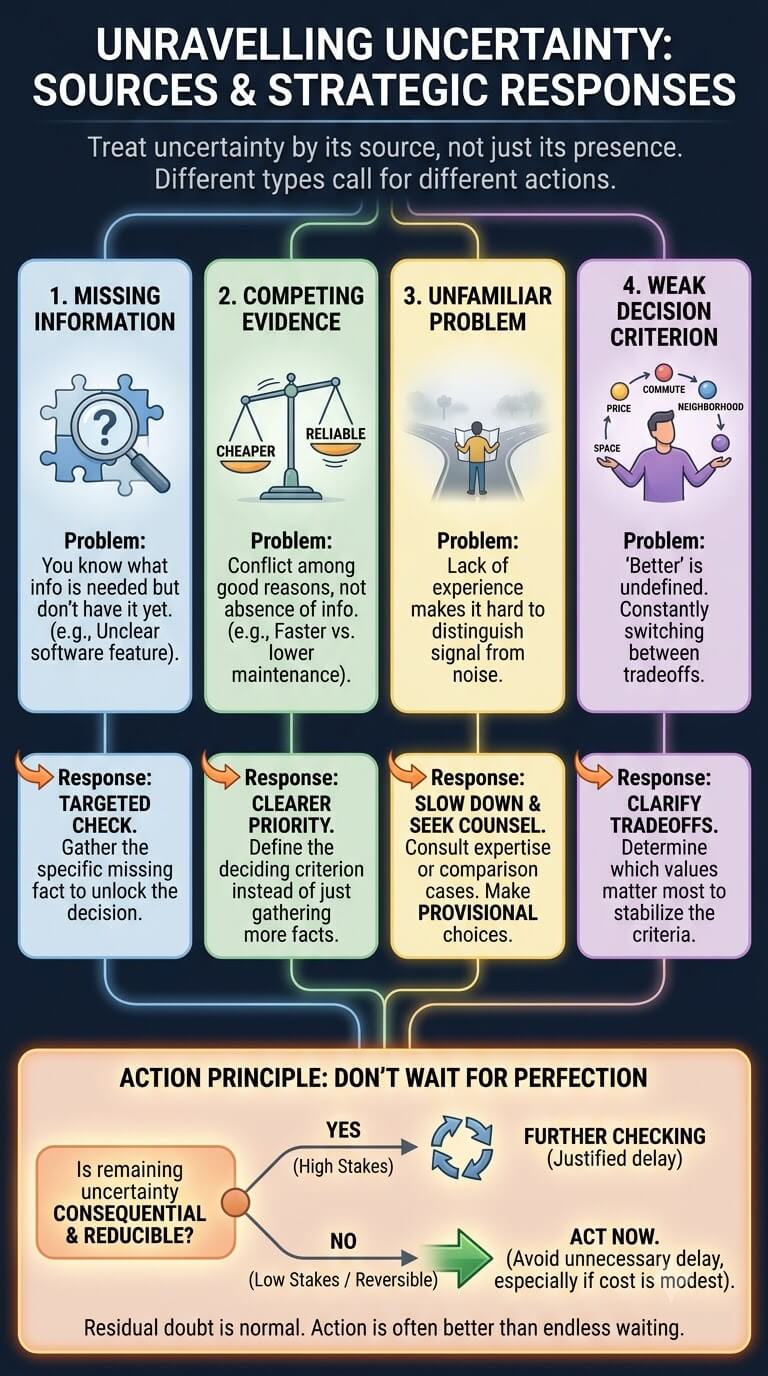
Uncertainty is often treated as a problem to eliminate, but its source matters more than its mere presence. Different kinds of uncertainty call for different responses.
Missing information
You may know what would settle the choice but not yet have that information. Two software plans may look similar while one key feature remains unclear. This is a good case for a targeted check because the missing fact could change the decision.
Competing evidence
Sometimes the problem is not absence of information but conflict among good reasons. One option is cheaper while another is more reliable. One work approach is faster while another reduces future maintenance.
In that case, gathering more facts may not solve the conflict. You may need a clearer priority or decision criterion instead.
An unfamiliar problem
Low confidence may come from lack of experience. You do not yet know which details are diagnostic and which are noise. This is a reason to slow down when consequences matter, seek comparison cases, or ask someone with relevant expertise.
Unfamiliarity does not make a decision impossible. Many ordinary choices can still be made provisionally.
A weak decision criterion
You can have plenty of information and still be stuck if you have not decided what “better” means. Imagine comparing two apartments while switching between price, commute, space, and neighborhood every few minutes.
The uncertainty is partly about values and criteria rather than missing facts. Clarifying which tradeoffs matter most may improve the decision more than gathering another dozen listings.
Why uncertainty does not automatically mean “do not act”
Everyday decisions often contain residual uncertainty. Waiting until all doubt disappears can create unnecessary delay, especially when the cost of acting is modest or the decision is reversible.
Ask whether the remaining uncertainty is consequential and reducible enough to justify further checking. If not, action may be the better next step.
The Act-Check-Seek-More Decision

A practical way to use metacognitive signals is to sort the next move into four options: act, check, seek more information, or stop checking. The choice depends on evidence quality, consequence, reversibility, and the likely value of another piece of information.
Act when evidence meets a reasonable threshold
Act when the available evidence is sufficient for the stakes, the main assumptions are understood, and further checking is unlikely to change the choice. “Sufficient” does not mean perfect.
For a reversible, low-cost decision, the threshold can be modest. Testing a draft layout does not require the same certainty as approving a consequential factual claim.
Check when an error is plausible and cheap to verify
A quick verification is valuable when one fragile fact carries a lot of weight. If your plan depends on whether a meeting starts at 2:00 or 3:00, checking the calendar is easier than reasoning about your memory.
Verify the weak link rather than reopening every settled part of the decision.
Seek more information when it can realistically change the choice
More information is worth pursuing when it has a meaningful chance of changing the decision and the benefit of improving the choice exceeds the cost of delay.
Name the missing information in advance. “I need to know whether the warranty covers this failure” is more useful than “I should research until I feel completely sure.”
Stop when more checking has low expected value
Checking should have a stopping condition. If each new search result repeats what you already know, if the remaining difference between options is tiny, or if additional information cannot be obtained before the deadline, continued analysis may add effort without adding quality.
A stop rule can be simple: “I will compare three credible options, verify the two decision-changing facts, and then decide.”
Error Monitoring Before and After a Choice
Decision monitoring does not stop at commitment. People can continue processing information after choosing, and new evidence may increase or decrease confidence in what they just did.
Detecting conflict before commitment
Before choosing, hesitation may indicate that the evidence is close, a criterion is unclear, or an important assumption is unresolved. Instead of treating hesitation as weakness, identify its source.
If the source is a small factual gap, verify it. If the options are genuinely close, accept that careful reasoning may not produce a clear winner.
Post-decision evidence that should trigger updating
After acting, pay attention to information that bears directly on the assumption behind the choice. If a trial run shows that the supposedly faster workflow creates extra errors, that evidence deserves more weight than your desire to defend the original plan.
Wokke and colleagues describe metacognition as involving monitoring and control during decision-making, including the use of internal information when external feedback is not immediately available. In practical terms, the decision process remains open to correction when new evidence becomes relevant.
Avoiding the trap of defending a choice because it has already been made
Commitment can make reversal feel costly even when changing course is sensible. You may focus on reasons that support the existing decision because changing it feels like admitting failure.
Ask: “If I had not chosen yet and saw this evidence now, what would I do?” This redirects attention from defending the past to evaluating the current evidence.
Metacognition vs Cognitive Biases in Decisions
Metacognition and cognitive-bias research can both improve how we think about decisions, but they ask different questions. Keeping those questions separate prevents this topic from turning into a catalogue of every way judgment can go wrong.
Bias research asks how judgments can systematically deviate
Cognitive biases concern recurring tendencies in judgment, such as overweighting certain information or responding predictably to how a choice is framed. Those mechanisms can influence the first-order decision itself.
Knowing a bias label does not prove that it affected a particular choice. It is a possibility to investigate, not a diagnosis of your reasoning.
Metacognition asks how well you recognize uncertainty or possible error in your own judgment
The metacognitive question is different: can you tell when your reasoning may be unreliable? Do confidence and doubt track the quality of your evidence? Do you know when another check could help?
Someone can know many bias terms and still be poorly calibrated, while another person may recognize uncertainty and update well without knowing the terminology.
Metacognition vs Cognitive Flexibility
Monitoring a problem and changing your approach are related but distinct. One identifies the need for a shift; the other makes the shift possible.
Monitoring tells you a switch may be needed
Suppose your current comparison keeps producing contradictory results. Metacognitive monitoring may tell you that the decision criterion is unstable or that your method is not resolving the problem.
That realization identifies the problem, but does not itself produce a better approach.
Flexibility helps you actually change strategy, frame, or option
Cognitive flexibility is the capacity to disengage from an ineffective frame or rule and reorganize your approach. You might stop comparing every feature equally and instead rank the three features that actually matter.
Monitoring says, “This method is not helping.” Flexibility enables the switch.
A Five-Question Reasoning Check

For an everyday decision with meaningful but manageable stakes, five questions can reveal whether you have enough basis to act or whether one more check has real value.
What evidence am I relying on?
Name the actual basis of the choice. Separate observations, records, estimates, memories, assumptions, and opinions. If most of the decision rests on one weak source, you have found the part that deserves attention.
What is the strongest alternative explanation or option?
Do not invent ten remote possibilities. Identify the most credible competitor to your current choice. If you cannot state why someone reasonable might choose differently, you may not have examined the comparison closely enough.
What part am I least certain about?
Locate the uncertainty rather than treating the whole decision as equally doubtful. Perhaps the price is clear but the long-term reliability is uncertain. Perhaps the events are clear but another person’s intention is not.
What information could realistically change my choice?
This question turns information seeking into a testable plan. If no obtainable fact would alter the decision, more searching may have little value. If one specific fact could reverse the choice, verify that fact before acting when the stakes justify it.
What is my stop rule for additional checking?
Decide in advance what will count as enough. You might set a time limit, a number of credible comparisons, or a defined set of facts to verify.
The stop rule should match the stakes and prevent checking from expanding without a reason.
Everyday Decision Examples
Everyday examples show how a judgment about reasoning quality can change the next action.
Choosing between two work approaches with incomplete evidence
Situation: Two project approaches look viable. One is faster now, while the other may reduce future maintenance.
What you may feel: The options remain frustratingly close even after several comparisons.
What it may mean: The uncertainty may come from a tradeoff rather than lack of effort. More generic research may not settle which priority matters more.
What to do next: Define the criterion that matters most for this project, then check only the uncertain fact that could change that ranking.
Revising a purchase or plan after new information
Situation: You choose a device because it fits your budget, then discover that a feature you depend on is not supported.
What you may feel: Annoyance and an urge to justify the original choice because you already spent time comparing options.
What it may mean: New evidence has changed the decision, even if the original reasoning was reasonable with the information you had.
What to do next: Reevaluate the choice using the updated evidence rather than judging yourself for not knowing the missing fact earlier.
Deciding whether a remembered fact needs verification
Situation: You are preparing a presentation and remember a statistic that would strengthen your point, but you are not completely sure of the number.
What you may feel: Familiarity makes the statistic seem probably right.
What it may mean: The memory may be usable as a cue to search, but not strong enough to present as a factual claim.
What to do next: Verify the original source before using the number. If you cannot verify it, leave it out or state the broader point without an unsupported statistic.
Recognizing when repeated checking is no longer improving the choice
Situation: You have compared several similar travel bags, read many reviews, and keep returning to the same two options without learning anything new.
What you may feel: A sense that one more review might finally remove the uncertainty.
What it may mean: The remaining difference may be preference rather than missing information.
What to do next: Return to your top two criteria, choose the option that fits them better, and stop searching unless genuinely new information appears.
Common Metacognitive Decision Mistakes
Decision errors do not come only from bad first-order reasoning. People can also make mistakes in how they interpret confidence, uncertainty, and the value of more checking.
Decision quality can also suffer when people overestimate what they know and therefore stop gathering evidence earlier than the situation warrants.
Treating fast confidence as strong evidence
Speed can feel like clarity. A quick judgment may reflect expertise, familiarity, or a practiced shortcut. Trust it more when past feedback in that domain has shown it to be reliable.
Gathering information without a decision rule
Research can become endless when you have not defined what information would change the choice. Set the decision criterion first, then gather information that speaks directly to it.
Ignoring low confidence when the cost of error is high
Low confidence is not always a reason to delay, but it deserves more attention when the consequence of being wrong is large and verification is feasible.
For medical, legal, financial, or safety-critical matters, general reasoning checks are not a substitute for qualified professional guidance. When specialized expertise is needed, the metacognitive skill is partly recognizing the limit of your own decision basis.
Waiting for impossible certainty
Some decisions cannot be made with complete information. If you require zero uncertainty, you may postpone choices long after the useful information has been gathered.
A better standard is justified action: enough evidence for the stakes, a clear view of the main uncertainty, and willingness to update when meaningful evidence appears.
What to Do Next When Confidence and Evidence Disagree
Sometimes your feeling and your evidence point in different directions. You may feel highly confident despite weak support, or feel doubtful despite a strong record of accurate performance. Treat the disagreement as a reason to investigate the basis of confidence rather than automatically trusting either side.
Verify the weakest assumption
Do not restart the entire decision. Find the assumption that would do the most damage if it were wrong and test that one first.
One well-chosen verification can be more useful than another hour of broad analysis.
Use an external check for high-stakes factual claims
When an important decision depends on a factual claim, compare it with a reliable external source, record, measurement, or appropriately qualified person. Internal confidence is not independent evidence.
Update confidence and action separately
You do not always need high confidence before taking a reasonable action. A reversible choice may justify action with moderate confidence. An irreversible or costly choice may justify a higher threshold.
Similarly, new evidence may lower confidence without requiring an immediate reversal. Separate “How sure am I?” from “What should I do at this level of certainty?” Research on individual differences in metacognitive accuracy and action control illustrates why confidence and action tendencies should not be treated as the same variable.
FAQ About Metacognition and Decision-Making
These questions clarify what metacognition can improve, when uncertainty should change behavior, and when checking should stop.
Do better metacognitive skills eliminate decision errors?
No. You can monitor your reasoning carefully and still be wrong because the available information is incomplete, the environment is unpredictable, or the evidence itself is misleading. Metacognition improves the quality of self-evaluation and adjustment; it does not create perfect information or guarantee correct outcomes.
Is low confidence a reason to delay every decision?
No. Low confidence matters more when the cost of error is high, the decision is hard to reverse, and useful verification is available. For low-stakes reversible choices, acting with moderate uncertainty may be completely reasonable. The response should depend on consequence and information value, not confidence alone.
Can people be accurate but poorly calibrated?
Yes. A person can make many correct choices while having confidence that does not match those results. For example, someone may be consistently accurate but chronically underconfident, or mostly accurate while expressing near-certainty even on their weaker judgments. Calibration asks how well confidence tracks performance across decisions.
How do you know when to stop gathering information?
Stop when the remaining information is unlikely to change the choice enough to justify its cost, or when you have reached a reasonable evidence threshold set in advance. A useful stop rule names the facts that need verification, the number of alternatives worth comparing, or the time available. If new decision-changing evidence appears later, you can update rather than treating the original stop as permanent.
Key Takeaways
- Metacognition adds a second-order judgment to decision-making: not only “What should I choose?” but “How much should I trust the reasoning behind this choice?”
- Confidence, uncertainty, conflict, and possible-error signals are useful when they change how much checking or information seeking is appropriate.
- Uncertainty has different causes. Missing information, competing evidence, unfamiliarity, and weak decision criteria require different responses.
- A practical next-step choice is to act, check one weak point, seek decision-changing information, or stop when more checking has little expected value.
- Monitoring can reveal that a strategy or frame is failing, while cognitive flexibility helps you actually switch to a better approach.
- Good stopping rules prevent both premature decisions and endless analysis, while leaving room to update when meaningful new evidence appears.

Michael Reed is the Founder and Lead Writer at Psychology Exposed. He writes about human behavior, relationships, emotional patterns, self-awareness, and practical psychology topics using research-informed, easy-to-understand content.
Read More About Michael Reed: https://psychologyexposed.com/michael-reed/