
It is easy to think you understand something until you have to explain it, predict an outcome, or use the knowledge in a new situation. A familiar topic can feel settled in your mind even when important pieces are missing. A successful experience can make a skill feel broader than it is. A confident explanation can sound convincing before anyone checks whether the steps actually connect.
That does not make people foolish or dishonest. The gaps you most need to notice may be the same gaps you do not yet have enough knowledge to recognize. Self-assessment also depends on standards, feedback, task difficulty, and the cues that make something feel known.
The useful question is therefore not, “Who is overconfident?” It is, “How well does a person’s estimate of what they know match what they can actually explain, apply, predict, or demonstrate?” That match is called calibration. Looking at knowledge this way makes the topic practical rather than insulting.
Quick Answer: You Cannot Easily Measure a Gap You Do Not Yet Know How to See

People overestimate what they know when their internal estimate of knowledge is stronger than what their performance can support. This can happen because familiarity feels informative, standards are vague, feedback is weak, experience is narrow, or a person has not yet learned enough to recognize important errors. The problem is calibration, not a fixed flaw in intelligence or character.
Overestimation is a calibration problem, not a character flaw
Imagine two ratings: how knowledgeable you believe you are, and how well you perform when the knowledge is tested in a relevant way. If those ratings repeatedly diverge, the estimate is miscalibrated. Sometimes the estimate is too high. Sometimes it is too low.
This framing removes moral judgment. A careful person can still misjudge a domain they have not learned how to evaluate, while a modest-sounding person can still be inaccurate. Calibration is a skill with conditions, not a personality badge.
It can happen to novices and knowledgeable people for different reasons
A beginner may not yet know which distinctions matter, so major gaps remain invisible. A more experienced person may generalize from a familiar subfield into a neighboring area where the rules differ. An expert can also rely too heavily on memory, outdated information, or a track record built in a forgiving environment.
Broad claims such as “beginners are overconfident” or “experts know their limits” are therefore too simple. Calibration depends on the task, the standard, and the feedback available.
What It Means to Overestimate What You Know

“Knowing” is not one thing. You can recognize a fact, recall it unaided, explain why it is true, apply it to a new case, or use it to make a reliable prediction. Overestimation often appears when people silently switch between these standards.
Perceived knowledge versus demonstrated knowledge
Perceived knowledge is your judgment of what you know. Demonstrated knowledge is what appears when the relevant ability is tested. One result can be noisy, but repeated discrepancies are informative.
Better calibration often begins with metacognitive awareness, especially the ability to notice exactly where knowledge becomes incomplete or assumption-based.
For example, “I understand compound interest” may mean you recognize the idea. A stronger test is whether you can compare two loan offers or explain why different compounding schedules change cost. The deeper task may expose a gap that recognition did not.
Breadth, depth, accuracy, and transfer are different standards
| Knowledge standard | What it asks | Example check |
|---|---|---|
| Breadth | How much of the domain do you cover? | Can you identify the major concepts and their boundaries? |
| Depth | How far can you explain beneath the surface? | Can you connect causes, mechanisms, and consequences? |
| Accuracy | How often are the claims correct? | Do your answers match reliable evidence or outcomes? |
| Transfer | Can you use the knowledge in a new situation? | Can you solve a different problem without copying the original example? |
Someone can have broad but shallow knowledge, deep knowledge in a narrow slice, or accurate recall that does not transfer well. Saying “I know this” without specifying the standard makes self-assessment much easier to inflate.
Why Self-Assessment Is Hard
Self-assessment feels direct because the judgment comes from inside your own mind. But the judgment is built from cues. Some cues reflect real competence; others mainly reflect ease, familiarity, emotion, or past success.
The same knowledge needed to perform can help evaluate performance
To notice a grammar error, you need some knowledge of grammar. To recognize a weak argument, you need some knowledge of reasoning. To judge whether a repair was done correctly, you need to know what a good repair should look like.
These errors matter most when a knowledge estimate becomes part of a decision and determines whether you verify, act, or seek additional evidence.
This was central to the original Kruger and Dunning study of skill and self-evaluation. Across tasks involving humor, grammar, and logical reasoning, lower performers showed larger errors in estimating their performance and relative standing. The researchers proposed that some of the knowledge required for good performance also helps people recognize good and poor performance.
Vague standards make “I know this” easy to claim
If the standard is simply “I have heard about it,” many topics will feel known. If the standard becomes “I can explain it without prompts and use it to predict a new case,” the estimate may change.
Vague standards also make feedback hard to interpret. Someone can receive praise for being “good with technology” after solving a few everyday problems and then assume that competence extends to cybersecurity, networking, or data privacy. The label is broad; the evidence is narrow.
Internal feelings are easier to access than objective accuracy
You have immediate access to how easy an answer felt, how quickly it came to mind, and how familiar the topic seems. You do not have equally immediate access to all the ways the answer might be wrong.
Research on self-regulated learning has repeatedly shown that people can use misleading cues when judging what they have learned. The review by Bjork, Dunlosky, and Kornell describes how beliefs about learning and subjective experiences can lead people to misassess what will later be retrievable or useful.
Six Pathways to Knowledge Overestimation
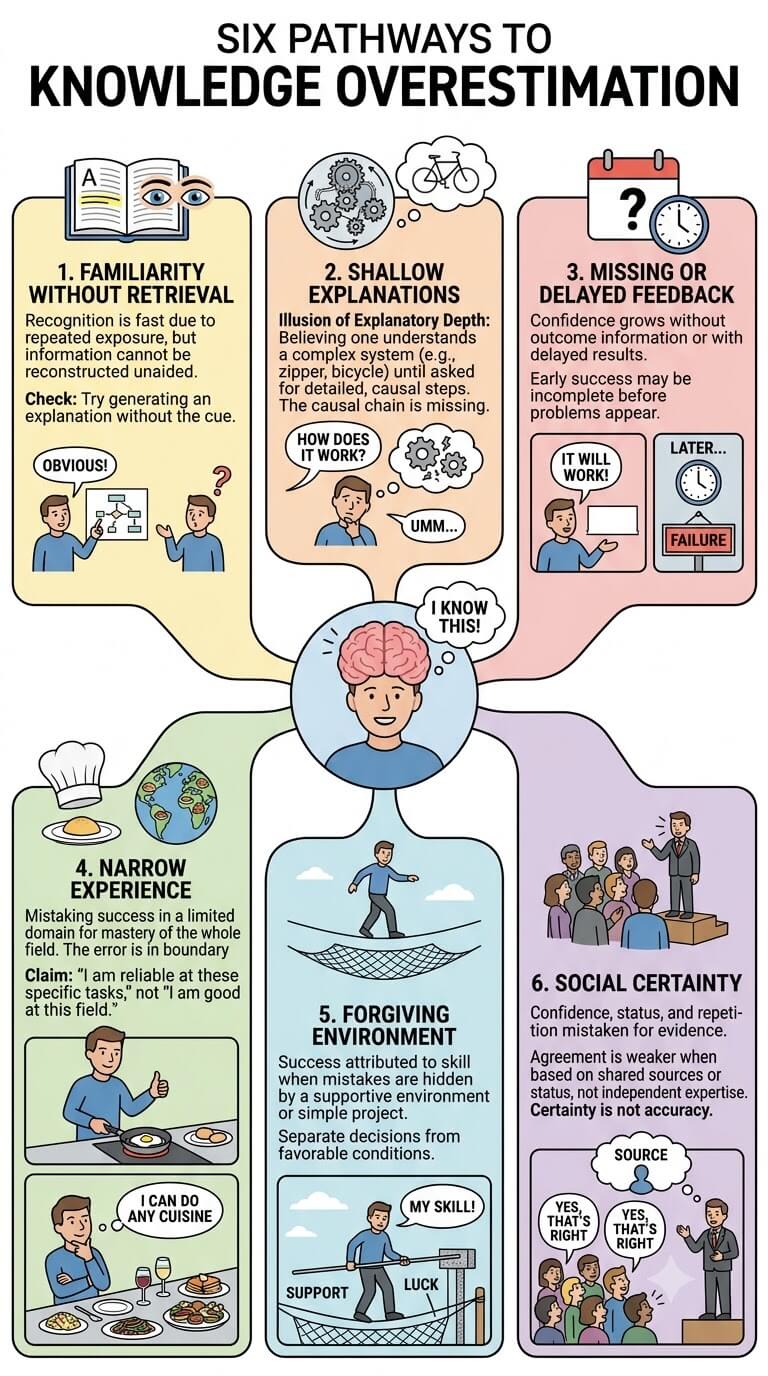
There is no single route to overestimating knowledge. Several of these six pathways can operate at once.
Familiarity without retrieval
You have seen the material many times, so recognition is fast. A name, diagram, or explanation looks obvious on the page. But if the prompt disappears, you may not be able to reconstruct the information yourself.
The mismatch is simple: the environment is supplying part of the answer, while your self-assessment credits your own memory for all of it. A useful check is to remove the cue and try to generate the explanation or example unaided.
Shallow explanations that have never been tested
Many systems appear simple from the outside. You know that a zipper closes fabric, a toilet flushes, a bicycle stays upright, or an election system turns votes into representation. The feeling of understanding can remain strong until someone asks for the intermediate steps.
Rozenblit and Keil called this the illusion of explanatory depth: people often judge their understanding of complex causal systems as deeper than it proves to be when they attempt a detailed explanation. The revealing part is not getting an obscure fact wrong. It is discovering that the causal chain was never fully represented.
Missing or delayed feedback
Calibration needs information about outcomes. If you make predictions but never record them, you mostly remember the ones that felt notable. If you give advice but rarely learn what happened afterward, confidence can grow without a matching accuracy record.
Delayed feedback creates a similar problem. A new process may look successful before quality problems become visible months later. The early impression may simply be incomplete.
Narrow experience mistaken for broad competence
Success in one environment can be mistaken for mastery of the whole domain. Someone may be excellent at cooking a small set of familiar dishes and assume they can improvise any cuisine. A marketer may succeed with one traffic source and assume the same principles transfer unchanged to another platform.
The issue is not that the original skill is fake. The error is in the boundary. Calibration improves when the claim becomes specific: “I am reliable at these tasks under these conditions” is more testable than “I am good at this field.”
Success attributed to skill when the environment was forgiving
Some environments hide mistakes. A simple project may succeed even with inefficient methods. A rising market can make many strategies look smarter than they are. A supportive team can quietly correct problems before the person responsible sees them.
Success is stronger evidence when you can separate the effect of your decisions from favorable conditions. Otherwise, a forgiving environment can teach overconfidence.
Social certainty mistaken for evidence
Confidence affects how information sounds. Fluent speech, decisive wording, status, and repetition can all make an explanation feel credible. In groups, a belief may also gain subjective strength simply because everyone around you treats it as obvious.
Agreement is stronger evidence when people have relevant expertise and independent information. It is weaker when everyone repeats the same source or follows status. Certainty in the room is not accuracy in the claim.
The Dunning-Kruger Effect Without the Clickbait
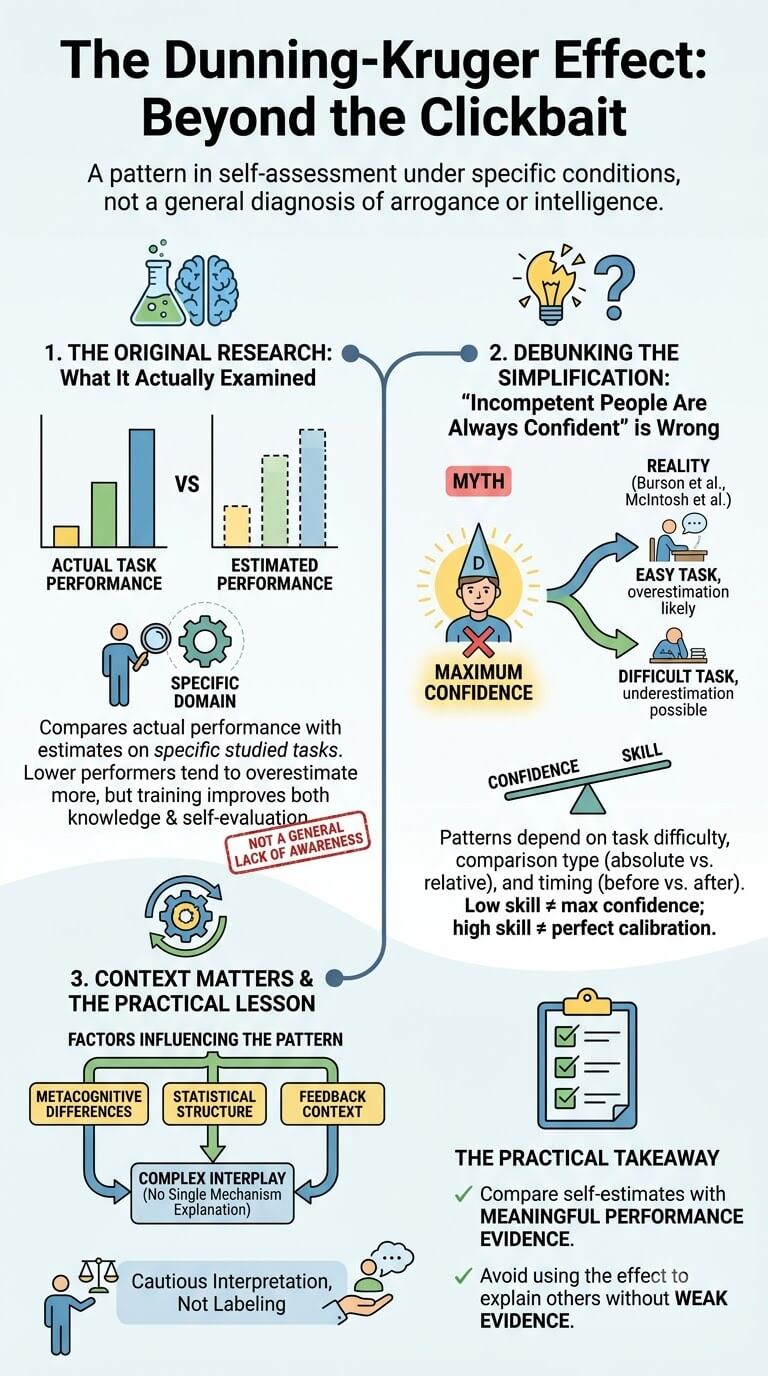
The Dunning-Kruger effect has become a popular label for people who seem confidently wrong. That popular use is much broader and harsher than the research question. A careful reading treats it as a pattern in self-assessment under particular measurement conditions, not as a diagnosis of arrogance or intelligence.
What the original research actually examined
Kruger and Dunning compared participants’ actual task performance with estimates of their own performance and relative standing. Lower performers showed larger overestimation on the studied tasks, and training that improved relevant knowledge also improved aspects of self-evaluation.
The important phrase is on the studied tasks. A poor score does not establish a general lack of self-awareness. The finding concerns skill and self-evaluation in a specific domain.
Why “incompetent people are always confident” is too simplistic
People with lower skill are not necessarily maximally confident, and skilled people are not automatically perfectly calibrated. The pattern can differ depending on whether people estimate an absolute score, compare themselves with others, judge before or after a task, or face an easy versus difficult task.
For example, Burson and colleagues found that task difficulty changes patterns of relative self-assessment. This is one reason the internet version of the effect, where ignorance supposedly causes extreme confidence in all circumstances, should be treated cautiously.
Why measurement, task difficulty, and feedback context matter
Later research has examined whether the familiar Dunning-Kruger pattern reflects metacognitive differences, statistical structure, or combinations of several factors. One study by McIntosh and colleagues found that metacognitive calibration and sensitivity were related to task skill, but their net contribution to the classic effect was limited in that dataset. Their work on clarifying metacognition in the Dunning-Kruger effect is a useful reminder not to turn one mechanism into a total explanation.
The practical lesson is simpler: compare self-estimates with meaningful performance evidence, and avoid using a famous effect to explain another person when the evidence is weak.
The Illusion of Explanatory Depth
One especially useful form of overestimation concerns explanations. Everyday mechanisms often feel more completely understood than they are because the world supplies visible outcomes while hiding many causal steps.
Why mechanisms look simpler before you try to explain them
A working object presents a smooth surface: press a button and something happens. A familiar institution also presents a smooth surface: cast a vote, make a payment, submit a claim. Your mind can represent the broad purpose without representing every mechanism underneath it.
Because the system works around you, the broad representation can feel sufficient until the explanation must become explicit.
How causal explanation exposes missing links
Try explaining a familiar mechanism step by step. Each step should answer “what happens next?” and “why?” without replacing the missing mechanism with another label.
You do not need expert-level detail for ordinary life. The point is calibration. If your explanation stops earlier than expected, update the estimate from “I understand this deeply” to something more accurate, such as “I understand the purpose and broad process, but not the mechanism.”
Overestimation vs Illusion of Knowing
These ideas overlap, but separating them prevents two articles from collapsing into the same explanation.
Familiarity-driven local error
An illusion of knowing often appears locally: one paragraph seems learned because you just read it, one answer looks familiar, or one mechanism feels obvious because the parts are visible. The misleading cue creates a momentary sense of knowledge.
Broader judgment about the depth or range of one’s knowledge
Knowledge overestimation is broader. It asks whether your overall estimate of competence or understanding exceeds what repeated performance supports. Familiarity can contribute, but so can weak feedback, unclear standards, narrow experience, forgiving conditions, and social cues.
If familiarity is the main problem, the article on that specific illusion goes deeper. Here the emphasis is on the larger calibration question: how much should your estimate change when actual outcomes disagree with it?
Overestimation vs Ordinary Confidence
Confidence is not automatically a problem. People sometimes have strong evidence and should be confident. The relevant question is whether confidence moves with evidence and outcomes.
A person can be confident and well calibrated
A technician who has completed the same repair correctly hundreds of times, knows the failure modes, and checks the result may be highly confident for good reasons. Low confidence would not make the judgment more accurate.
Likewise, a beginner who correctly recognizes a lack of experience may have low confidence that is well calibrated. The goal is correspondence between the estimate and the evidence.
The problem is repeated mismatch between confidence and outcomes
One surprising miss proves little. Miscalibration becomes more informative when predictions or results repeatedly fall short while the internal estimate stays unchanged.
That repeated mismatch is the reason feedback records are useful. Memory can preserve the feeling of being right more readily than the exact ratio of correct to incorrect judgments.
Signs Your Knowledge Estimate Needs a Better Check
These signs do not prove that you know less than you think. They tell you that your current estimate would benefit from better evidence.
You can recognize terms but cannot generate examples
Recognition shows exposure. Generation shows that the idea can be retrieved and represented without the original cue. If every example has to be copied from what you just read, understanding may still be fragile.
You cannot state what evidence would change your view
A strong knowledge claim should usually have conditions under which it would be revised. If no imaginable result could count against your position, the belief may be protected from feedback rather than calibrated by it.
You rely on one successful case
A single success is encouraging but statistically weak. Ask whether the outcome repeats across different cases, conditions, or levels of difficulty before turning it into a broad claim about competence.
Your explanation skips causal steps
Notice words such as “basically,” “obviously,” or “it just works like this” when they replace a mechanism. These words are not inherently bad, but they sometimes cover the exact step that has not been understood yet.
Feedback repeatedly surprises you
If outcomes often differ from what you predicted, the surprise itself is data. Instead of treating each miss as an exception, compare several predictions with results and ask whether the internal model needs updating.
A Knowledge Calibration Check
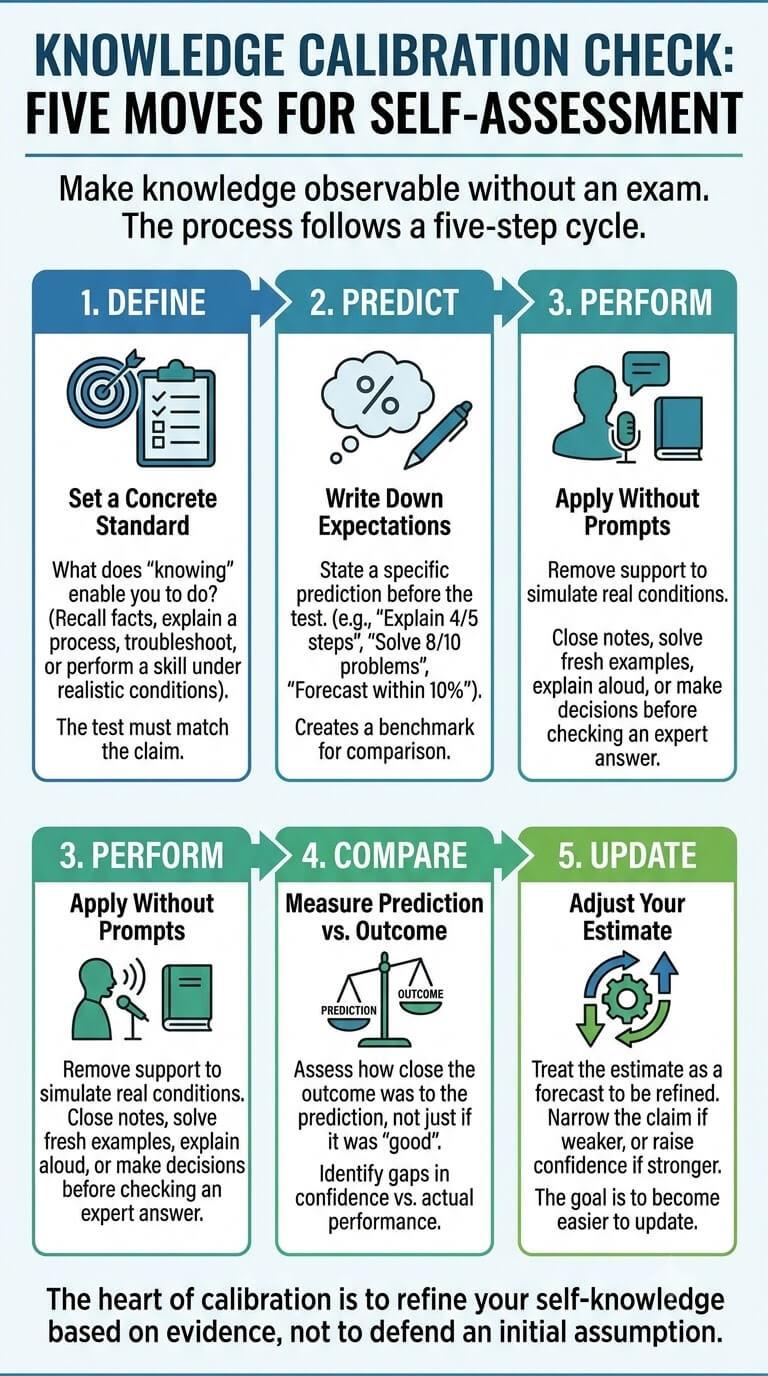
A good calibration check should make knowledge observable without requiring an exam. Use five moves: define, predict, perform, compare, update.
Define what “knowing” would allow you to do
Choose a concrete standard before testing yourself. Do you need to recall facts, explain a process, troubleshoot a problem, make a prediction, or perform a skill under realistic conditions? The test should match the claim.
Predict performance before the test
Write down what you expect. “I think I can explain four of the five steps,” “I expect to solve eight out of ten problems,” or “I think this forecast will be within ten percent.” A prediction gives you something specific to compare with the outcome.
Explain or apply without prompts
Remove as much support as the real task would remove. Close the notes, solve a fresh example, explain the mechanism aloud, or make the decision before checking an expert answer.
Compare prediction with outcome
Do not ask only whether the outcome was “good.” Ask how close it was to the prediction. You may discover that performance is strong but your estimate was unnecessarily low, or that confidence was high in the wrong subtopic.
Update the estimate rather than defend the first one
The final step is the heart of calibration. Treat the first estimate as a forecast, not an identity statement. If the result is weaker, narrow the claim. If the result is stronger, allow confidence to rise. The point is to become easier to update.
How Better Feedback Improves Calibration
Feedback works best when it says something about the exact ability being judged. General approval may feel good without telling you which part of a performance was strong or weak.
Specific criteria beat vague praise
“Great presentation” provides little calibration information. “Your examples were clear, but the recommendation did not address the cost constraint” identifies what transferred and what did not.
When possible, define criteria before receiving the result. This reduces the temptation to move the standard afterward so that every outcome counts as success.
Repeated outcomes beat one-off impressions
A sequence is more informative than a memorable case. Track forecasts, error rates, completion quality, or other relevant outcomes over several attempts. The pattern may show that you are accurate in one condition and unreliable in another.
External perspectives can reveal unseen gaps
Other people can notice missing assumptions, unclear explanations, or standards you did not know existed. The best feedback comes from someone who understands the task and can explain the criterion.
This is also where the broader process of thinking about your own thinking becomes practical: an external correction matters most when it changes how you monitor and update future judgments.
What to Do First When You Discover a Gap
Discovering a knowledge gap can sting when competence feels personal. A useful response makes the gap smaller and more specific.
Separate lack of knowledge from lack of intelligence
“I did not know this” describes a knowledge state. “I am not smart enough” turns one result into a global judgment. The second statement rarely tells you what to do next.
A gap can reflect limited exposure, weak practice, outdated information, a confusing explanation, or a standard you had never encountered. Naming the gap precisely preserves the information without adding unnecessary self-attack.
Identify the missing sub-skill or concept
Instead of “I am bad at statistics,” you might find that the missing piece is interpreting confidence intervals. Instead of “I do not understand the software,” the gap may be how permissions work. Smaller targets are easier to learn and easier to retest.
Choose a task that can produce informative feedback
Pick a next attempt where the result will teach you something. Explain the concept to someone who can question it. Solve a new case with an answer key. Make a prediction and record the outcome. Ask for critique against explicit criteria.
Calibration improves through contact with evidence, not through repeatedly telling yourself to be more humble.
FAQ About Overestimating What You Know
These questions address the most common ways knowledge overestimation gets oversimplified.
Is overestimating knowledge always the Dunning-Kruger effect?
No. The Dunning-Kruger effect refers to a particular pattern relating performance and self-evaluation, and researchers continue to debate how much of that pattern is explained by metacognitive skill versus task and measurement factors. Knowledge can be overestimated for many other reasons, including familiarity, weak feedback, vague standards, narrow experience, and shallow causal understanding.
Can experts overestimate themselves?
Yes. Expertise can improve calibration in a well-practiced domain because experts know more of the relevant standards and failure modes. It does not make someone immune to outdated knowledge, unfamiliar cases, overgeneralization, or misplaced confidence outside their specialty. Expertise should therefore be attached to a domain and conditions rather than treated as a universal trait.
Does humility guarantee accurate self-assessment?
No. A person can be humble and underestimate genuine competence. Accurate calibration means adjusting confidence in both directions. Good performance supported by repeated evidence is a reason to become more confident, not to dismiss your ability in the name of modesty.
Why can confident explanations sound more knowledgeable than they are?
Fluent delivery reduces visible hesitation, so listeners may use confidence as a cue when they cannot easily evaluate the content themselves. Status and repetition can strengthen that effect. The safest response is not to distrust confidence, but to ask whether the explanation contains evidence, complete causal steps, clear limits, and predictions that can be checked.
Key Takeaways
- Overestimating knowledge is best understood as a mismatch between perceived knowledge and demonstrated knowledge, not as a sign of stupidity or bad character.
- Self-assessment becomes harder when standards are vague, feedback is limited, or the knowledge required to spot an error is itself missing.
- Familiarity, shallow explanations, narrow experience, forgiving environments, and social certainty can all inflate the feeling of knowing.
- The Dunning-Kruger effect describes a specific research pattern and should not be used as a casual diagnosis for anyone who sounds confidently wrong.
- Calibration improves when you define what “knowing” means, predict your performance, test it under relevant conditions, compare the result, and update your estimate.
- Finding a gap is useful information. The next move is to identify the missing concept or skill and create a situation where better feedback is possible.

Michael Reed is the Founder and Lead Writer at Psychology Exposed. He writes about human behavior, relationships, emotional patterns, self-awareness, and practical psychology topics using research-informed, easy-to-understand content.
Read More About Michael Reed: https://psychologyexposed.com/michael-reed/