
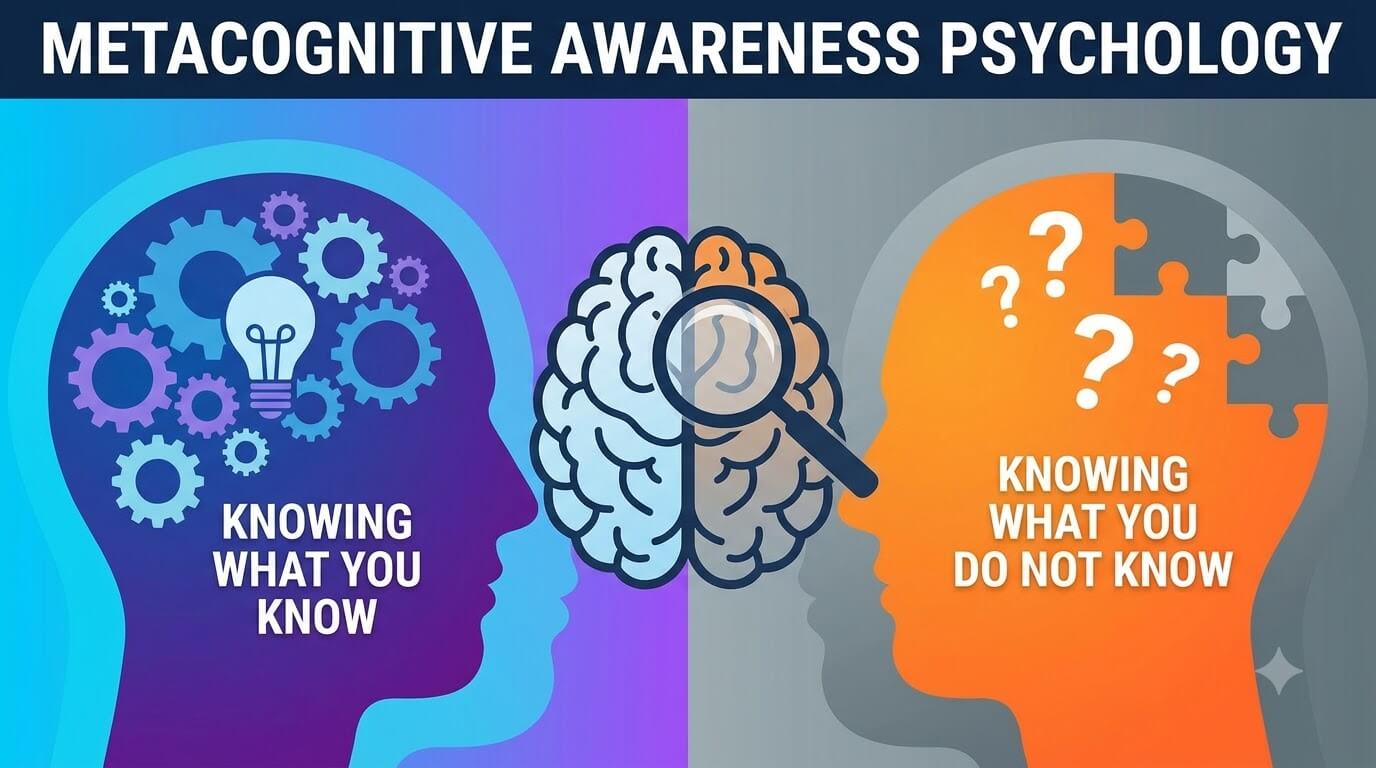
You can feel familiar with a topic and still struggle to explain it. You can finish a conversation believing you understood someone, then realize later that you filled in several gaps with assumptions. You can also know, quite accurately, that a decision rests on information you have not verified yet. These moments point to metacognitive awareness: the ability to notice and represent something about the state of your own thinking.
That awareness matters because action often depends on what you think you know. If you mistake recognition for understanding, you may stop checking too early. If you recognize uncertainty clearly, you can decide whether the uncertainty matters enough to investigate. The goal is not to inspect every thought or become perfectly certain. It is to develop a more realistic picture of what is clear, what is weak, and what your mind is currently doing.
Metacognitive awareness is narrower than general self-awareness. It is not mainly about identity, emotions, or personality. It is about your knowledge, assumptions, understanding, task demands, and thinking approach. It is also different from continuously tracking performance, which becomes more important once a task is underway.
Quick Answer: Awareness Comes Before Useful Control
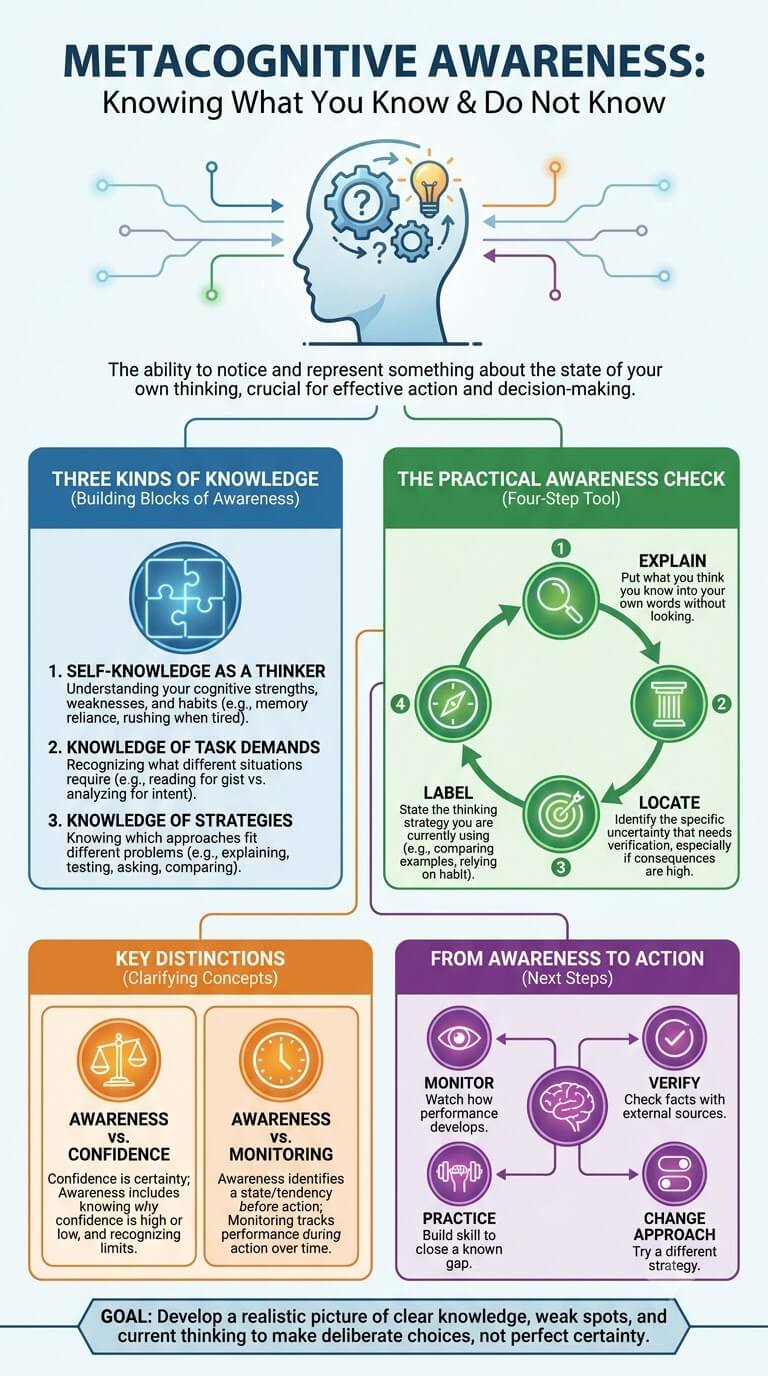
Metacognitive awareness is awareness of your own cognitive state and approach. It includes recognizing what you know, what you do not know, what a task requires, and which strategy you are using. The awareness may be accurate or mistaken. Its value comes from giving you a starting point for deciding whether to continue, verify, monitor more closely, or change your approach.
What metacognitive awareness notices
Metacognitive awareness can sound abstract until it is translated into ordinary language. It appears in statements such as “I know the conclusion but not the evidence,” “I can recognize this idea but cannot explain it,” “I am assuming I know what she meant,” or “I am using the same method because it is familiar, not because I know it fits this problem.”
These observations differ in content, but they share one feature: the mind is representing something about its own knowledge or processing. John Flavell’s foundational work on metacognition and cognitive monitoring helped establish the importance of knowledge about people, tasks, and strategies in understanding how people think about their own cognition.
Why awareness can be partial or inaccurate
Noticing your own thinking does not guarantee that the judgment is correct. You may accurately recognize a weak spot, underestimate knowledge you actually have, or feel that something is understood simply because it looks familiar. Awareness is therefore best treated as information to test rather than a perfect window into the mind.
What Metacognitive Awareness Means
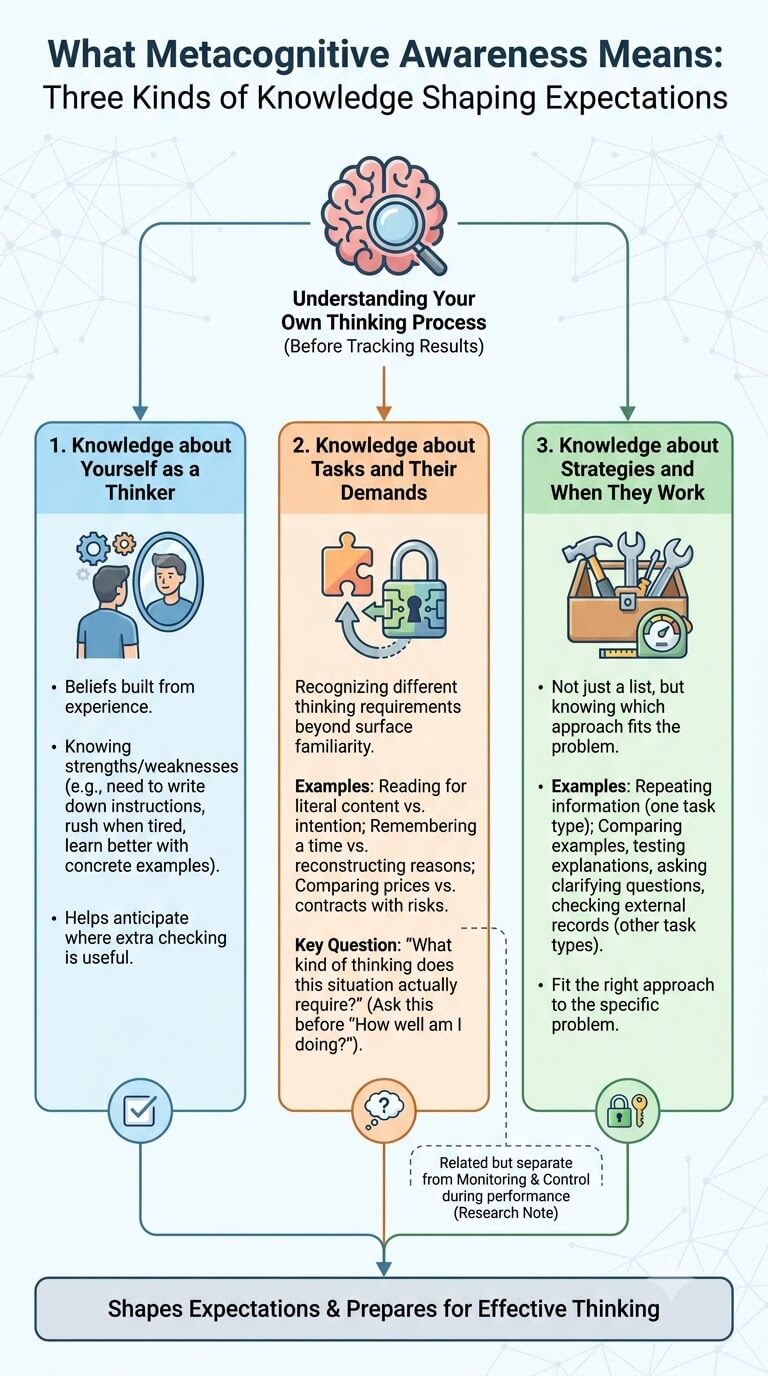
A useful way to understand awareness is to divide it into three kinds of knowledge: what you know about yourself as a thinker, what you know about the demands of a task, and what you know about possible strategies. These forms of knowledge shape the expectations you bring into a situation before you start closely tracking results.
Knowledge about yourself as a thinker
You build beliefs about your own cognition from experience. You may know that you remember spoken instructions poorly unless you write them down, that you tend to rush calculations when tired, or that you understand complex ideas better after seeing a concrete example. These beliefs can help you anticipate where extra checking may be useful.
Knowledge about tasks and what they demand
A task that looks familiar may require a different kind of thinking than the last task with a similar surface. Reading a short message for its literal content is different from judging the sender’s intention. Remembering a meeting time is different from reconstructing the reasons behind a decision made months ago. Comparing two prices is different from comparing two contracts with different risks.
Metacognitive awareness includes recognizing those demands. Before asking “How well am I doing?” it helps to ask “What kind of thinking does this situation actually require?” Research that separates metacognitive knowledge, monitoring, and control also emphasizes that these are related but distinguishable parts of the larger process. A practical overview in the American Journal of Pharmaceutical Education describes ways researchers distinguish knowledge about cognition from judgments made during performance and decisions that regulate performance.
Knowledge about strategies and when they tend to work
Strategy awareness is not the same as collecting a long list of techniques. It means knowing that different approaches fit different problems. Repeating information may help with one kind of task, while comparing examples, testing an explanation, asking a clarifying question, or checking an external record may be better for another.
The Three Awareness Questions Behind Metacognition

You do not need to narrate every thought to become more aware of your thinking. Three compact questions often reveal enough to orient yourself: What do I know? What am I unsure about? How am I approaching this?
| Awareness question | What it reveals | Useful answer example |
|---|---|---|
| What do I know right now? | The part you can explain, recall, or support | “I know the deadline and the required format.” |
| What am I unsure about? | Missing information, weak evidence, or unresolved meaning | “I do not know whether the client expects a draft or final version.” |
| How am I approaching this? | The method, assumption, shortcut, or strategy currently guiding you | “I am relying on memory instead of checking the project notes.” |
What do I know right now?
The most useful version of this question is concrete. Instead of saying “I know this topic,” try to identify what you could actually produce without help. Could you explain the idea? Give an example? State the evidence? Apply it to a new situation? Distinguish it from a similar concept?
What am I unsure about?
Uncertainty becomes more useful when it is located. “I have no idea” and “I understand the overall argument, but I am unsure whether the second claim follows from the evidence” are very different mental states. The second description gives you something specific to verify.
Being able to name uncertainty is not a sign that your thinking is weak. It can indicate that you are separating the known from the unresolved instead of forcing both into the same level of certainty. A broad review of metacognition across educational science and cognitive neuroscience highlights awareness and regulation as central themes while also showing that metacognition is not a single, perfectly uniform ability.
How am I approaching this?
This question turns attention from the answer to the route used to reach it. Are you recalling from memory, comparing examples, following a rule, searching for confirming evidence, relying on another person’s summary, or making a fast intuitive judgment?
What Metacognitive Awareness Looks Like in Everyday Life
Awareness often appears as a small interruption in an otherwise ordinary task. Nothing dramatic has to happen. You simply notice a gap between how clear something feels and what you can actually support.
Realizing you can recognize a term but cannot explain it
You read a familiar concept in a report and think, “Yes, I know that.” Then someone asks you to explain it in plain language. You can repeat a definition fragment, but you cannot explain why it works or give a reliable example.
Noticing that a conversation has become assumption-driven
A colleague replies, “Fine, do whatever you think is best.” You immediately interpret the message as irritation. A few seconds later, you realize that you do not know the tone, context, or intention with confidence. Your interpretation may still be correct, but you have separated the interpretation from the evidence.
Knowing when a familiar task is actually different this time
You have handled dozens of routine customer requests, so you begin responding to a new one using the usual procedure. Then you notice that this case includes a refund condition you have not seen before. The surface looks familiar, but one feature changes the task.
Recognizing that your first answer is weakly supported
A friend asks why a mutual acquaintance stopped replying. Your first explanation appears instantly: “They are probably upset.” Then you notice that you have no direct evidence. Other explanations are plausible, including busyness, distraction, uncertainty, or a simple missed message.
Awareness vs Self-Monitoring
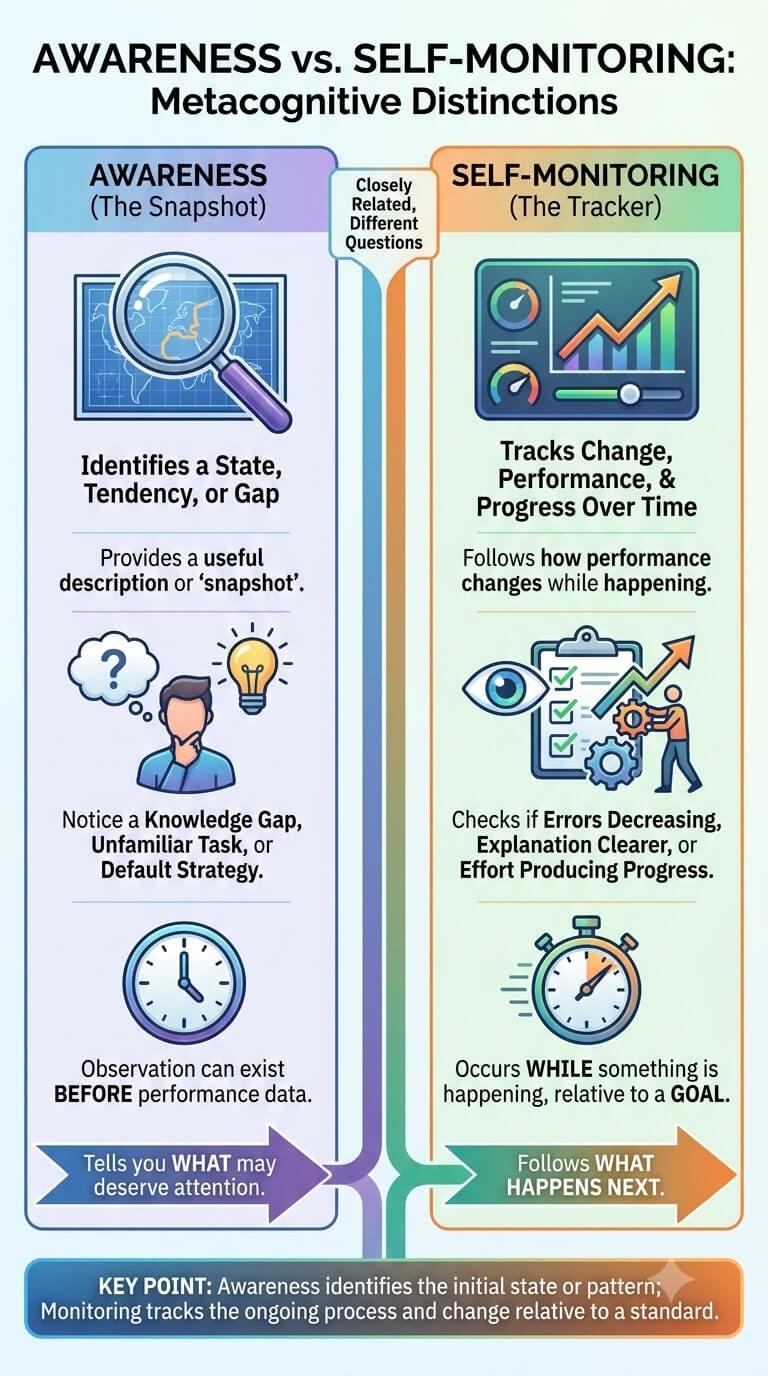
Metacognitive awareness and self-monitoring are closely related, but they answer different questions. Awareness identifies a state, tendency, gap, or approach. Monitoring follows how performance or understanding changes while something is happening.
| Metacognitive awareness | Self-monitoring |
|---|---|
| “I tend to lose details when instructions are only spoken.” | “I missed the last two steps, so I need the instructions repeated.” |
| “I am unsure what this term means.” | “After reading two more paragraphs, I am still unable to explain it.” |
| “I am relying on an assumption about his intention.” | “As the conversation continues, new information is contradicting my assumption.” |
| “This task requires more precision than my usual estimate.” | “My current calculation is still outside the required tolerance.” |
Awareness identifies the state or pattern
Awareness gives you a snapshot or a useful description. You may notice that you have a knowledge gap, that a task is unfamiliar, or that a certain strategy is your default. The observation can exist before you have any performance data from the current task.
Monitoring tracks change, performance, mistakes, or progress over time
Monitoring asks how things are going relative to a goal or standard. It may involve checking whether your explanation is becoming clearer, whether errors are decreasing, whether feedback supports your interpretation, or whether effort is producing progress.
If you want the broader distinction between the mental task and the process of checking the task, the overview of how metacognition works provides that wider frame. The key point here is narrower: awareness tells you what may deserve attention, while monitoring follows what happens next.
Awareness vs Confidence
Confidence is another nearby concept that can be mistaken for awareness. Confidence answers a question about certainty or likelihood of being correct. Awareness can include confidence, but it also includes what you know about the task, your strategy, your evidence, and the limits of your current understanding.
You can be aware that you are uncertain
Suppose you are asked a factual question and two answers seem plausible. You may have low confidence, but strong awareness of why confidence is low: “I remember the general topic, but I am mixing up two similar dates.” That is a useful metacognitive state because uncertainty has structure.
High confidence can exist with weak awareness of missing knowledge
Feeling certain can arise before you have examined the limits of your knowledge. People may be especially vulnerable when information feels fluent or familiar. Research on the illusion of explanatory depth shows how people can initially believe they understand familiar mechanisms in greater detail than they can actually explain.
Why Awareness Can Be Wrong
Self-observation has limits. The mind often uses indirect cues to judge its own knowledge, and some cues are misleading. Four sources of error are especially useful to recognize.
Familiarity can feel like understanding
Repeated exposure makes words, faces, explanations, and procedures easier to process. That ease can create a sense that the material is well understood even when you have not tested recall, explanation, or application.
A simple corrective is to change the task. Instead of rereading, close the page and explain the idea. Instead of recognizing the correct answer from options, generate it. The point is not to turn everything into a test, but to choose evidence that matches the kind of knowledge you claim to have.
Vague standards make self-assessment difficult
It is hard to know whether you “understand” something when understanding has not been defined. Do you need to recognize the concept, summarize it, teach it, apply it, compare it with alternatives, or make a high-stakes decision using it?
Missing feedback hides blind spots
You may believe your explanation is clear because no one challenges it. You may assume your memory is reliable because the errors you make are rarely checked. Without feedback, a self-judgment can remain comfortable but poorly calibrated.
Strong expectations can shape what feels obvious
Expectations influence what information receives attention. If you expect a proposal to be rejected, an ambiguous question may feel like criticism. If you expect a familiar procedure to work, early signs of mismatch may be discounted.
Metacognitive awareness does not require abandoning expectations. It asks you to recognize when an expectation is doing interpretive work: “I expected this outcome, so I should check whether I am noticing evidence that points elsewhere.”
A Practical Metacognitive Awareness Check

When accuracy matters, a short check can turn vague self-reflection into observable evidence. Think of it as four moves: explain, support, locate, label. The sequence is intentionally small so that it can be used before a decision, during learning, or after noticing uncertainty.
Explain what you think you know without looking
Put the idea into your own words. If it is a procedure, describe the steps and why they matter. If it is an interpretation, state exactly what you think happened. If it is factual knowledge, recall the relevant details before checking a source.
Name the evidence behind your current conclusion
Ask what the conclusion rests on. Direct observation? Memory? A trusted record? Someone else’s report? A repeated pattern? A feeling of familiarity? An assumption about motive?
Identify the part you would need to verify
You rarely need to verify everything. Locate the uncertainty with the greatest consequence. If you are choosing a restaurant, a small memory error may not matter. If you are approving a financial figure, interpreting a legal condition, or making a serious claim about another person, verification deserves a higher priority.
State which thinking strategy you are currently using
Finally, name the approach. “I am comparing examples.” “I am relying on memory.” “I am going with the first explanation that fits.” “I am checking the rule against the details.” “I am asking someone with direct knowledge.”
Common Mistakes in Trying to Become More Aware
Metacognitive awareness is useful when it improves orientation. It becomes less useful when it turns into endless inspection of thoughts. More reflection is not automatically better reflection.
Turning awareness into constant self-surveillance
You do not need to monitor every sentence you speak or evaluate every small choice. Doing so can consume attention that would be better used on the task itself. Awareness works best when it is selective, especially around uncertainty, repeated mistakes, unfamiliar demands, or meaningful consequences.
A practical rule is to increase checking when the cost of error rises, not simply when discomfort rises. Feeling unsure about a trivial preference does not require the same scrutiny as feeling unsure about information that affects another person’s wellbeing.
Treating uncertainty as failure
Some people try to use reflection to remove uncertainty completely. That standard is unrealistic. Many everyday judgments remain probabilistic because information is incomplete, people are complex, and future outcomes cannot be known with certainty.
A stronger goal is accurate uncertainty. “I do not know yet” can be a better representation of reality than a confident answer assembled from weak evidence.
Confusing more reflection with more accuracy
Thinking longer can improve a judgment when the extra time brings better evidence, clearer standards, or a more suitable strategy. It can also produce repeated analysis of the same limited information.
Research on the measurement of metacognition is a useful reminder that asking people to report on their thinking can itself change how they perform. Double and Birney’s review of reactivity to metacognitive measures discusses how confidence ratings, judgments of learning, and think-aloud procedures may influence the processes being measured. Self-reflection is therefore an activity, not a neutral camera pointed at the mind.
What to Do After You Notice a Gap
Awareness is valuable because it lets you choose a response that fits the kind of gap you found. The response does not always need to be “think harder.” Sometimes the better move is to gather information, test yourself, ask someone, change methods, or simply leave a low-stakes uncertainty unresolved.
Decide whether to monitor, verify, practice, or change approach
- Monitor when you know what matters but need to see how performance develops over time.
- Verify when a specific fact or assumption has meaningful consequences and an external check is available.
- Practice when you understand the gap but cannot yet perform the skill reliably.
- Change approach when the current strategy does not fit the task or repeatedly produces weak results.
These options prevent awareness from becoming an end in itself. The observation “I do not understand this” becomes useful when it leads to a more specific next move.
Use external feedback when the cost of error is meaningful
For consequential decisions, internal confidence is rarely enough on its own. Check records, compare independent information, ask a qualified professional when the topic requires expertise, or invite someone to challenge your reasoning.
This is not because outside sources are infallible. It is because blind spots are, by definition, difficult to see from inside the same perspective that created them. Independent evidence gives your self-assessment something to meet.
What Awareness Makes Possible Next
Once you can describe your knowledge state with reasonable clarity, several other metacognitive skills become easier to use. Awareness provides the starting information; what happens next depends on the task.
From awareness to self-monitoring
If you notice, “I often lose track of the argument when several conditions are introduced,” you now know what to watch as you continue reading or reasoning. Awareness identifies the vulnerability. Monitoring checks whether it is happening in real time.
From awareness to confidence calibration
If you can state what evidence supports a conclusion and what remains unknown, your confidence has a better chance of matching the strength of that evidence. The goal is not low confidence. It is confidence that changes appropriately when the information changes.
Awareness also gives confidence calibration a better foundation because you can compare certainty with the evidence and limits you have actually noticed.
From awareness to strategy adjustment
If you recognize that you are relying on a method because it is habitual, you can ask whether another method fits better. Sometimes the answer is to keep going. Sometimes it is to slow down, seek feedback, test an assumption, or switch strategies.
If awareness shows that the current approach is weak, metacognitive strategies help turn that observation into a deliberate adjustment.
That is why metacognitive awareness is best understood as an orienting skill. It does not solve the problem for you. It helps you see enough about your own thinking to choose the next cognitive move more deliberately.
FAQ About Metacognitive Awareness
These questions address common points of confusion about what awareness does and does not mean.
Is metacognitive awareness the same as mindfulness?
No. The two can overlap, but they have different scopes. Mindfulness commonly refers to attending to present-moment experience with a particular quality of awareness. Metacognitive awareness here refers more specifically to knowledge and judgments about your own thinking, understanding, uncertainty, task demands, and strategy use. Someone could notice bodily tension mindfully without evaluating a knowledge gap, or recognize a weak assumption metacognitively without practicing mindfulness.
Can someone be aware of a thinking habit but still repeat it?
Yes. Awareness does not automatically create control. You may know that you jump to conclusions when rushed and still do it under pressure. Changing a response can require practice, environmental support, better feedback, or a different strategy. Awareness helps because the habit has become visible enough to work with, but visibility alone does not guarantee change.
Does uncertainty mean low metacognitive awareness?
No. Clearly recognizing uncertainty may reflect good awareness. The more important question is whether you can locate the uncertainty and respond proportionally. A person who says “I am uncertain because I am missing one key fact” may have a more accurate view than someone who feels certain but has not noticed that the evidence is incomplete.
Can metacognitive awareness be trained?
It can be practiced through activities that make knowledge and reasoning more observable, such as explaining an idea without prompts, predicting what will be difficult, comparing confidence with later outcomes, or identifying the evidence behind a conclusion. Improvement is not about becoming perfectly introspective. A realistic aim is to become better at noticing useful gaps and choosing when they deserve further checking.
Key Takeaways
- Metacognitive awareness is the ability to represent something about your own knowledge, uncertainty, task demands, or thinking approach.
- Knowing that a topic feels familiar is different from being able to explain, apply, or support it.
- Awareness differs from self-monitoring: awareness identifies a state or tendency, while monitoring tracks performance and change over time.
- Confidence is only one part of the picture. You can be uncertain and highly aware, or confident while missing important gaps.
- A useful four-step check is to explain what you know, name the support, locate what needs verification, and label the strategy you are using.
- The best next step depends on the gap: monitor, verify, practice, change approach, or leave a low-stakes uncertainty unresolved.
Final Thoughts
The next time something feels obvious, try one small test before accepting that feeling as evidence: explain what you know in your own words and identify the part you would want to verify if being wrong mattered. If the explanation holds up, you have stronger grounds for confidence. If a gap appears, you have learned something useful before the gap becomes a mistake.
Metacognitive awareness is not about doubting yourself constantly. It is about making the boundary between knowledge, uncertainty, and assumption easier to see. That boundary gives you a better basis for deciding when to continue and when to check.

Michael Reed is the Founder and Lead Writer at Psychology Exposed. He writes about human behavior, relationships, emotional patterns, self-awareness, and practical psychology topics using research-informed, easy-to-understand content.
Read More About Michael Reed: https://psychologyexposed.com/michael-reed/