
You can notice that a problem is going badly and still keep using the same approach. You might reread a difficult paragraph, continue a weak work process, or defend an interpretation after new information makes it less convincing. The missing step is often knowing what to do after your thinking gives you a warning signal.
Metacognitive strategies are ways of managing the thinking process itself. They help you decide what success should look like, notice whether you are moving toward it, test whether your current judgment deserves confidence, and change course when the evidence says the current approach is not working. The same logic can apply to learning, work, reasoning, conversations, and everyday decisions.
This does not mean watching every thought. Useful regulation is selective. Check more carefully when the task is unfamiliar, the consequences matter, or the current method is producing weak evidence.
Quick Answer: A Metacognitive Strategy Changes How You Manage the Thinking Process
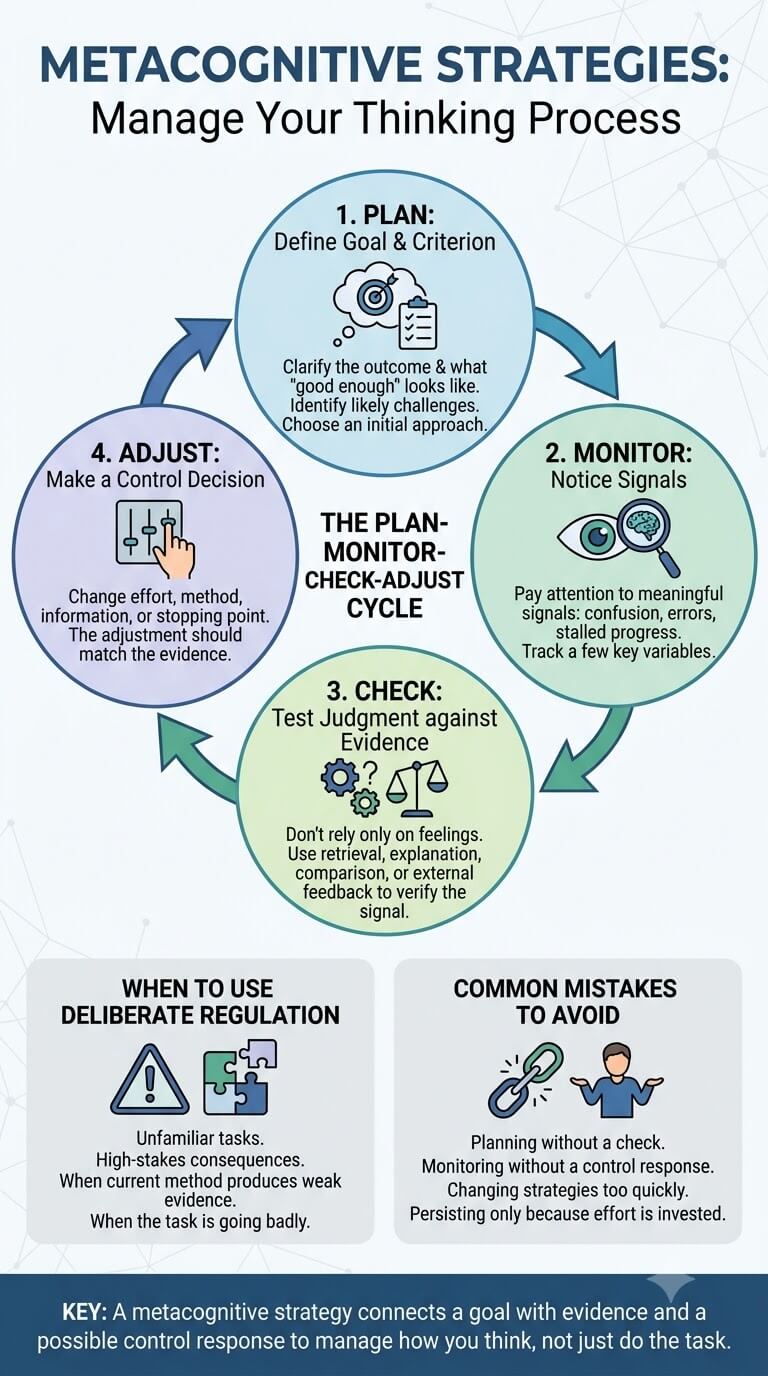
A metacognitive strategy is a deliberate way to plan, monitor, check, or adjust how you are thinking. It is different from simply doing the task. A useful strategy connects a goal with evidence and a possible control response. You decide what you are trying to achieve, observe whether the current approach is working, test that judgment, and change something when the result calls for it.
The difference between doing a task and regulating how you do it
Suppose you are trying to understand a technical explanation. Reading it is the task. Testing whether you can explain it without looking, locating where the explanation breaks down, and switching to a diagram regulate how you do the task.
The same distinction appears at work. Writing a proposal is the task. Defining the needed evidence and revising the approach when support is weak regulate the thinking behind it.
Why the strategy must respond to evidence
A plan is useful when it includes a way to learn from what happens. “I will spend another hour on this” adds effort, but without a criterion for whether the hour is helping, it does not add control.
Research on metacognition commonly distinguishes between knowledge, monitoring, and control. A review by Rivers and colleagues on metacognitive knowledge, monitoring, and control describes how judgments about performance can inform decisions such as whether to continue, change strategy, or allocate more study time. The broader lesson applies well beyond classrooms: information about how you are doing matters most when it can change what you do next.
What Makes a Strategy Metacognitive?

Not every technique is metacognitive. A checklist, timer, note-taking method, or software tool may help, but the object itself is not the defining feature. The metacognitive part is how the technique is used to evaluate and regulate thinking.
It has a goal or success criterion
Before you can judge progress, you need a target. “Understand this” is often too vague. A better criterion might be “I can explain the mechanism in plain language,” “I can identify the two assumptions behind this recommendation,” or “I can reproduce the calculation and explain where each number came from.”
The standard should fit the task. You do not need expert-level understanding to decide whether a recipe sounds appealing. You may need far stronger evidence before making a financial recommendation or interpreting information that affects someone else’s health or safety.
It includes a check on understanding or performance
A useful strategy asks for evidence rather than relying only on a feeling. The check might involve explaining from memory, comparing your output with a reference, testing the result against a new example, asking for feedback, or seeing whether your prediction matches what actually happens.
The check should match the claim. Explanation can test understanding, an independent calculation can test accuracy, and follow-through or clarification can test whether a request was understood.
It allows a control decision
The check should lead to a possible response. You may continue, slow down, seek information, change methods, reduce effort, ask for feedback, or stop. Without that possibility, monitoring can become passive observation.
These methods sit inside the broader metacognitive process of evaluating your own thinking and using that evaluation to guide action.
This is why metacognitive strategies are not simply “thinking about thinking.” They include regulation. A person can recognize that a method is failing and still remain stuck if they do not have a rule for what to change when failure becomes visible.
The Plan-Monitor-Check-Adjust Cycle

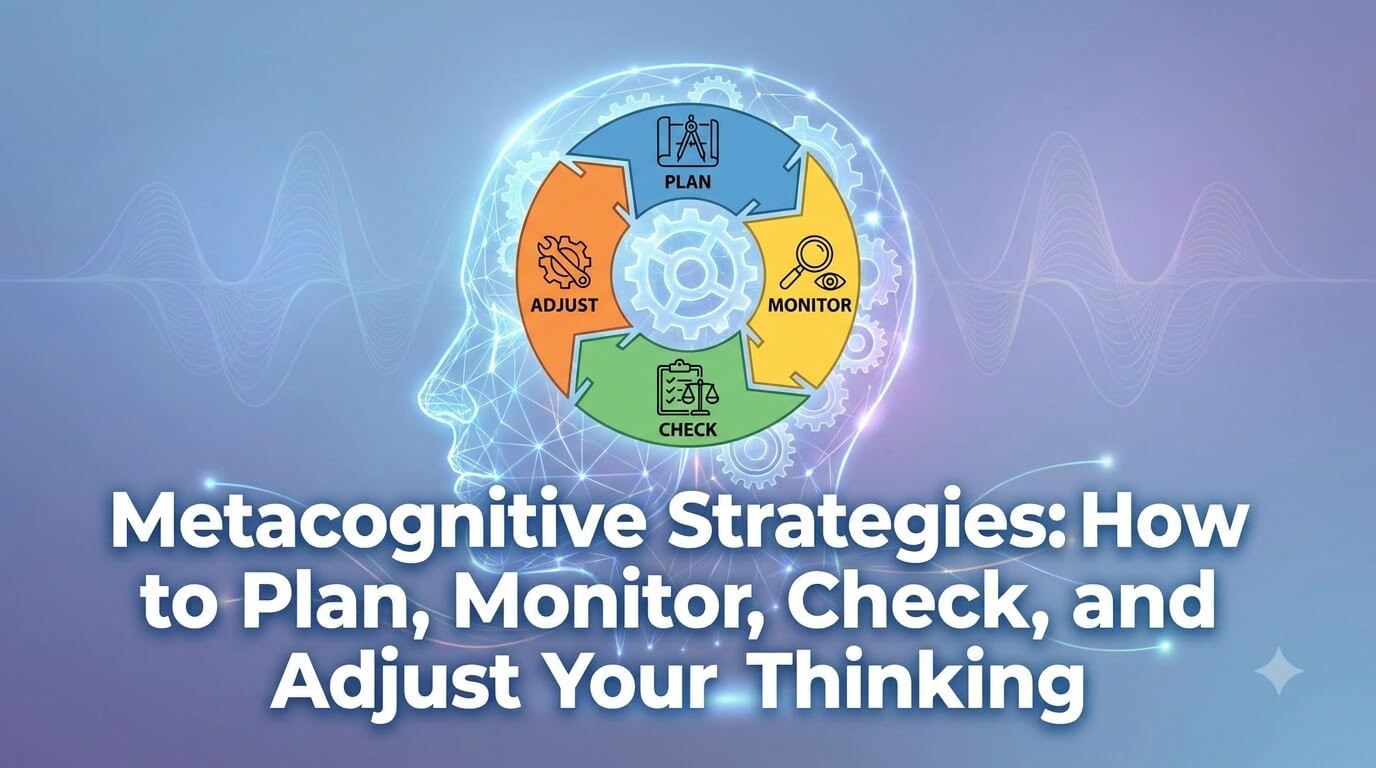
A simple way to organize metacognitive regulation is to use four stages: plan, monitor, check, adjust. The cycle is not meant to be rigid. You may move through it quickly for a small task or repeat parts of it several times for a complicated one.
Plan: define the task, goal, and likely challenge
Planning begins by clarifying what you are actually trying to do. What is the outcome? What level of accuracy is needed? Which part is likely to be difficult? What evidence would tell you that the task is going well enough?
Before comparing two job offers, define the decision criteria instead of simply asking which job is “better.” Including compensation, role fit, schedule, growth, and uncertainty prevents one vivid feature such as salary from quietly becoming the whole decision.
Monitor: notice understanding, progress, and errors
Monitoring means paying attention to signals that matter. You might notice that you cannot explain a step, that the same mistake keeps appearing, that a conversation is moving away from the original question, or that additional effort is no longer improving the result.
Monitoring works better when it tracks a small number of meaningful variables. Watch errors when accuracy matters, explanation when comprehension matters, and both quality and remaining time when a deadline matters.
Check: test the current judgment against evidence
Monitoring gives you a signal, but signals can be wrong. Checking asks whether the signal survives contact with evidence. If you feel confident, can you reproduce the reasoning? If you feel lost, are you missing the whole idea or only one link? If you think a work plan is failing, what result shows that it is failing?
This protects against both false confidence and unnecessary doubt. Bjork, Dunlosky, and Kornell’s review of self-regulated learning, beliefs, techniques, and illusions discusses how conditions that make learning feel easier can influence judgments without necessarily producing stronger long-term learning.
Adjust: change effort, method, information, or stopping point
Adjustment is the control decision. You may spend more time, use a different representation, seek missing information, ask another person to challenge your reasoning, narrow the task, or decide that further checking has little value.
The adjustment should match the problem. Missing knowledge may require new information, a confusing representation may require a different format, and a result that already meets the standard may call for stopping.
Planning Without Predicting Everything
Planning is often misunderstood as trying to foresee every obstacle. That usually creates unnecessary complexity. A good metacognitive plan does something simpler: it gives you a starting criterion, identifies likely uncertainty, and chooses an initial approach that can be revised.
Decide what “good enough” looks like
Different tasks deserve different standards. A casual preference needs less evidence than a recommendation affecting a large budget, where assumptions and uncertainty deserve clearer checks.
“Good enough” is not an excuse for low quality. It is a way to make quality measurable. If you do not know what acceptable performance looks like, you cannot tell whether more effort is useful or merely repetitive.
Identify where uncertainty is likely
Focus on places where error is plausible and consequential. Is the task new? Are you relying on memory? Is one assumption carrying most of the conclusion? Are you interpreting motives without direct information?
This creates a practical map for later checking. Instead of treating every part of the task as equally uncertain, you know where to spend attention first.
Choose an initial approach rather than a perfect approach
Metacognitive planning should make it easier to begin, not harder. Choose a reasonable method and define what evidence would make you reconsider it. That turns the first approach into a testable starting point rather than a commitment you must defend.
A project manager might begin with a familiar workflow but let repeated missed handoffs trigger a process change. The first method need not be perfect because the cycle includes revision.
Monitoring Without Constantly Interrupting Yourself
Too much self-checking can compete with the task itself. The aim is not maximum monitoring. It is well-timed monitoring that catches meaningful problems without creating unnecessary cognitive load.
Use decision points and checkpoints
Instead of asking “How am I doing?” continuously, choose moments when the answer could change your next move. Useful checkpoints include the end of a section, after a first attempt, before submitting work, after receiving new information, or when an expected result fails to appear.
Stanton, Sebesta, and Dunlosky’s discussion of fostering metacognition to support learning and performance emphasizes planning, monitoring, evaluating, and strategy decisions as connected parts of metacognitive practice. In everyday use, scheduled checkpoints help preserve that connection without turning reflection into a constant interruption.
Monitor one meaningful variable at a time
If you try to track understanding, speed, confidence, error rate, emotional state, other people’s reactions, and every possible risk at once, the monitoring system becomes another task. Select the variable most closely tied to the current goal.
During a difficult explanation, you might monitor whether the listener can follow the causal steps. While solving an unfamiliar problem, you might monitor whether each new step reduces uncertainty. During repetitive work, you might monitor the kind of error that has historically caused the most rework.
Checking: The Step That Protects Against False Confidence
Checking turns an internal impression into a more testable judgment. It is especially important when something feels easy, familiar, or obvious because those feelings can sometimes be mistaken for evidence.
Retrieval, explanation, comparison, or external feedback
Different checks answer different questions. Retrieval asks whether information can be produced without prompts. Explanation asks whether you understand relationships and mechanisms. Comparison checks whether your output matches an independent standard. External feedback gives you information that your own perspective may not provide.
The same principle applies to reasoning. State the strongest case against a recommendation, check whether another person can summarize an agreement, or compare actual completion data with your impression that a process felt faster.
Why rereading or familiarity can be weak checks
Repeated exposure often makes information easier to process. That ease can be useful, but it can also make the material feel more mastered than it is. A stronger check changes the demand. Close the document, explain the idea, solve a new example, or compare your result with a standard.
This does not mean rereading is always useless. The problem is using familiarity as the only evidence. If the goal is accurate recall or application, the check should resemble recall or application rather than recognition alone.
Adjusting When the Evidence Changes
The value of a metacognitive strategy becomes clearest when evidence changes what you do. Adjustment can involve more effort, less effort, a different method, new information, or a different stopping point.
Increase or reduce effort
More effort helps when the method is sound but performance still needs practice. Less effort makes sense when the standard is already met and further polishing adds little value.
Effort should follow expected benefit. Extra checking may be wasteful for a low-stakes message but proportionate for a figure that affects an important decision.
Change the representation or strategy
Sometimes the problem is format rather than effort. A verbal explanation may need a diagram, a broad question may need smaller questions, or facts may need grouping by cause, consequence, or priority.
Changing strategy should be connected to a reason. “This method is not showing the relationship between the parts, so I will map the relationships visually” is more useful than switching methods simply because the task feels uncomfortable.
Seek missing information or feedback
If the gap is informational, reflection cannot manufacture the missing evidence. Check a record, ask someone with direct knowledge, consult a reliable source, or request feedback.
This is especially important when you find yourself repeatedly analyzing the same limited evidence. A metacognitive response may be to stop thinking internally and improve the information available to think with.
Stop when further checking has low value
Stopping is a regulation decision too. Without a stopping rule, checking can expand indefinitely. You may continue searching for reassurance long after the remaining uncertainty has little practical consequence.
Stop when key claims are verified, the output meets the criterion, remaining uncertainty would not change the decision, or extra effort is unlikely to add enough value.
Metacognitive Strategies in Everyday Contexts

The plan-monitor-check-adjust cycle becomes easier to understand when the task changes. The specific tools vary, but the regulation logic remains similar.
Learning a difficult concept without turning everything into study tricks
You need to understand a complex process for a professional course. Success means explaining it and applying it to a new case. The terms feel familiar, but an explanation without notes breaks at the middle step.
The same regulation process appears in learning when judgments about understanding determine what to practice, revisit, or test next.
The adjustment is not “study harder.” You redraw the sequence and test it again, matching the change to the observed gap.
Solving an unfamiliar work problem
A team keeps missing a handoff deadline. Monitoring shows that most work is on time until one approval point, and timestamps confirm the bottleneck is not general speed.
The adjustment is specific: redesign the approval step or clarify ownership. Telling everyone to “work faster” would not match the evidence.
Preparing a recommendation when evidence is incomplete
You are comparing two vendors. One is cheaper, while the other has better support documentation. After defining the criteria, you notice long-term maintenance cost is uncertain and check that assumption instead of letting visible price dominate.
If reliable maintenance data remains unavailable, present the recommendation with explicit uncertainty rather than inventing precision.
Revising your interpretation during a difficult conversation
During a tense conversation, a short reply feels dismissive. Before arguing harder, check what evidence supports that interpretation and what information could distinguish dismissal from fatigue, confusion, or disagreement.
You might ask, “Are you saying you do not want to discuss this, or do you need a minute to think?” If the answer changes your understanding, adjust your response. The aim is updating, not suppressing emotion.
Strategies vs Cognitive Flexibility
Metacognitive strategies and cognitive flexibility overlap, but they are not identical. The distinction matters because changing methods is only one part of regulation.
Regulation is the full process
Regulation can include goals, monitoring, checking, changing effort, seeking information, or stopping. You may keep the same method when evidence says it is working.
In other words, effective regulation does not require frequent switching. Sometimes the most appropriate control decision is to continue with the current method.
Flexibility is the ability to switch when the current path no longer fits
Cognitive flexibility becomes especially relevant when rules, demands, evidence, or perspectives change. It concerns the capacity to move away from a no-longer-useful approach and adopt another one.
Regulation asks, “What should I do with my thinking now?” Flexibility matters when the answer is, “Change the way I am approaching this.” The broader overview of how we monitor and regulate our own thinking places both abilities in context.
Common Metacognitive Strategy Mistakes
Even a good framework can be used poorly. Four mistakes are especially common because each breaks the connection between evidence and control.
Planning without a check
You create a detailed plan but never define how you will know whether it is working. The plan then becomes something to follow rather than something to test. Add at least one observable criterion or checkpoint that could justify a change.
Monitoring without a control response
You notice confusion, repeated errors, or stalled progress but do nothing differently. This can create the feeling of being highly self-aware while producing little improvement. Pair each important warning signal with a possible response.
Changing strategies too quickly
Difficulty is not always evidence that a strategy is failing. New methods can feel slower before they become efficient. If you change every time discomfort appears, you may never gather enough evidence to judge the approach properly.
O’Leary and colleagues found evidence that metacognitive monitoring and control can function independently, which is a useful caution against assuming that a judgment automatically produces the best control choice. Noticing difficulty and choosing what to do about it are distinct problems.
Persisting because effort has already been invested
The opposite mistake is refusing to change because you have already invested time. Ask what the evidence says about the next unit of effort, not whether changing course makes earlier effort feel wasted.
A Minimal Strategy Card for Real Tasks

For tasks that deserve deliberate checking, four lines are often enough to make the regulation process visible.
| Field | Question | Example |
|---|---|---|
| Goal and criterion | What result counts as good enough? | “The recommendation has evidence for cost, risk, and implementation time.” |
| Checkpoint and evidence | When will I check, and what will I look at? | “Before the final recommendation, compare each claim with an independent record.” |
| Adjustment rule | What will I change if the check fails? | “If a major claim lacks evidence, seek data or reduce the strength of the conclusion.” |
| Stop rule | When is further checking unlikely to add enough value? | “Stop once all high-impact claims meet the evidence criterion and remaining uncertainty would not change the choice.” |
Goal and criterion
Write one sentence describing what success means for this task. Make it observable enough that you could later decide whether the criterion was met.
Checkpoint and evidence
Choose a point when checking is useful and decide what evidence matters. This prevents vague reflection from expanding throughout the whole task.
Adjustment rule
Define one response in advance. If the explanation fails, use a new representation. If the evidence is incomplete, seek information. If repeated errors appear, slow down or change the process.
Stop rule
Set a reasonable boundary for additional checking. A stop rule protects attention from being consumed by low-value refinement and helps keep the amount of reflection proportional to the stakes.
What to Do First When Your Current Approach Is Not Working
When you are already frustrated, a large framework may be too much. Use three small moves to identify the most useful next change.
Name the failure signal
Describe what is going wrong without judging yourself. “I cannot explain the middle step.” “The same correction has been needed three times.” “I have spent forty minutes searching but have not found new evidence.” A specific signal gives you something to work with.
Check whether the problem is knowledge, strategy, effort, or task definition
If you lack information, seek information. If the method does not fit, change the method. If the method fits but performance is still inconsistent, more practice or attention may help. If you are solving the wrong problem, redefine the task before investing more effort.
The monitoring stage overlaps with self-monitoring, where you track whether understanding, errors, or performance are moving in the expected direction.
These categories help prevent the default response of treating every difficulty as a need to “try harder.”
Make one testable adjustment
Change one meaningful variable and observe what happens. Ask for missing data, try a different representation, narrow the question, or set a new checkpoint. A testable change produces information whether it works or not.
If performance improves, keep the useful part. If it does not, you have narrowed the possibilities and can make another adjustment without turning the process into random switching.
FAQ About Metacognitive Strategies
The most common questions are less about memorizing techniques and more about when regulation is actually useful.
Are metacognitive strategies only for studying?
No. Learning has received substantial research attention, but the process is broader. Planning, checking evidence, adjusting methods, and deciding when to stop also appear in work, problem-solving, communication, and daily decisions. The check should match the task.
Is reflection after a task a metacognitive strategy?
It can be. “That went badly” is a reaction. “I underestimated the information required, so next time I will verify the inputs before starting” links a judgment with future control. Reflection need not be long to be useful.
How often should you monitor your thinking?
There is no universal frequency. Monitor when new information could change your next action. High-stakes, unfamiliar, or error-prone tasks deserve more deliberate checkpoints. If monitoring consumes too much attention, reduce the frequency or narrow what you track.
What if changing strategy makes performance worse at first?
Do not assume the new approach has failed immediately. It may require temporary effort while you learn it. Decide what evidence and time window would be fair, then revise again if performance remains worse. Regulation should respond to evidence, not novelty.
Key Takeaways
- A metacognitive strategy manages how you think by connecting a goal, a check, and a possible control decision.
- The plan-monitor-check-adjust cycle turns vague self-reflection into a process that can respond to evidence.
- Monitoring is most useful at meaningful decision points, not as constant self-surveillance.
- Checks should match the claim: explanation, retrieval, comparison, feedback, or independent verification may provide stronger evidence than familiarity alone.
- Adjustment can mean more effort, less effort, a different method, new information, or a deliberate stopping point.
- When an approach fails, identify whether the main problem is knowledge, strategy, effort, or the definition of the task, then make one testable change.

Michael Reed is the Founder and Lead Writer at Psychology Exposed. He writes about human behavior, relationships, emotional patterns, self-awareness, and practical psychology topics using research-informed, easy-to-understand content.
Read More About Michael Reed: https://psychologyexposed.com/michael-reed/