
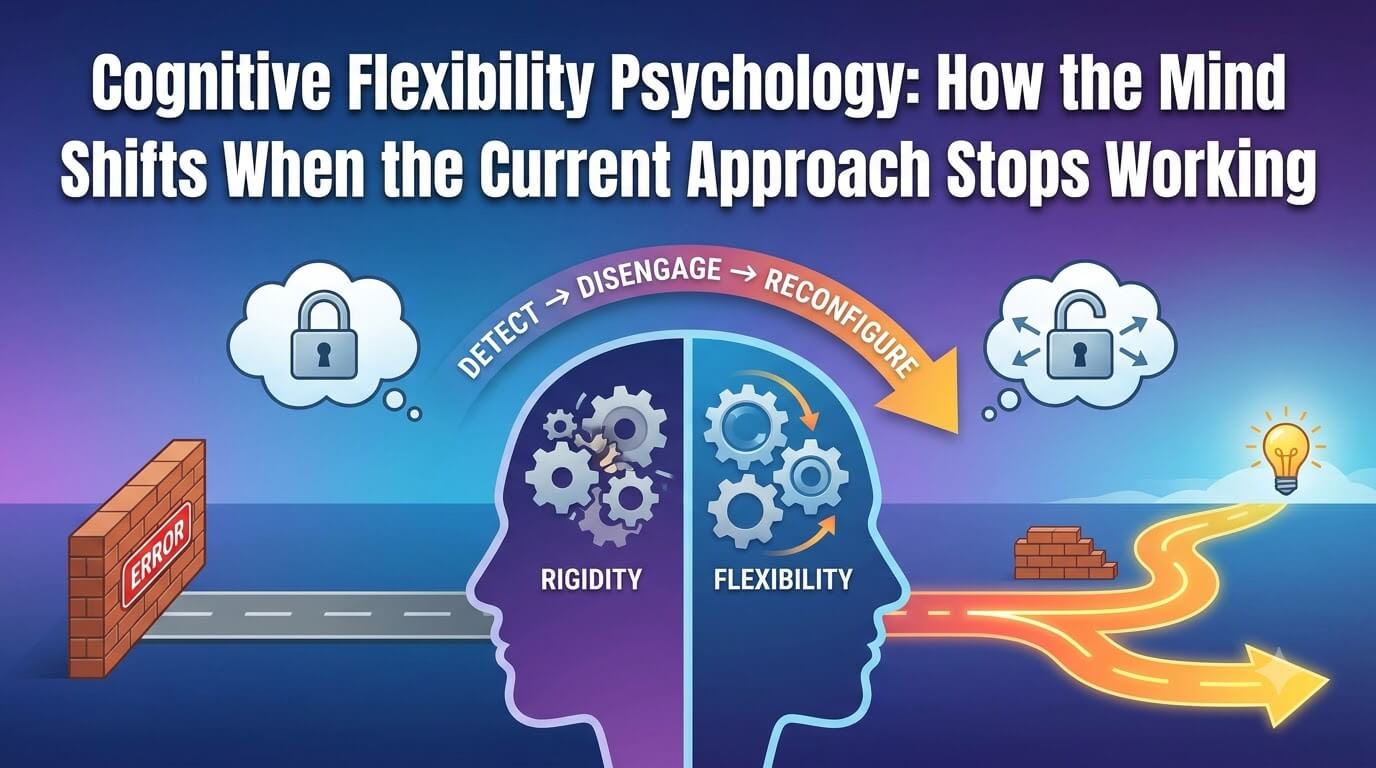
A strategy can work well for months and suddenly fail when the situation changes. A familiar explanation can make sense until one new fact no longer fits it. A conversation can improve only after you stop defending your first interpretation and consider another one. In each case, the useful move is not simply thinking harder. It is recognizing that the current mental approach has reached its limit and shifting to one that fits the situation better.
That capacity is often described as cognitive flexibility. In psychology, it refers broadly to adapting thought or behavior when goals, rules, evidence, or context change. It can include switching between tasks, shifting attention to a different rule, revising an interpretation, or abandoning a strategy that no longer produces the intended result.
Flexibility is not the same as changing your mind constantly. Nor does a preference for routine prove that someone is cognitively rigid. Useful flexibility is selective: you stay with an approach when it still works and change it when there is a good reason to do so.
Quick Answer: Cognitive Flexibility Is Adaptive Switching, Not Random Change
Cognitive flexibility is the ability to adapt your thinking or behavior when circumstances, rules, evidence, or goals change. It involves noticing a mismatch, letting go of an approach that no longer fits, and trying a more appropriate alternative. Flexible thinking is not indecision or automatic open-mindedness. The shift becomes useful when it is guided by feedback and improves your fit with the situation.
Recognize mismatch
The first sign that a switch may be needed is a mismatch between what your current approach predicts and what is actually happening. A method keeps producing errors. New information conflicts with your interpretation. A rule that worked in one setting creates problems in another. The important step is noticing that the difficulty may come from the approach itself, not simply from insufficient effort.
Release the old rule or strategy
Recognizing a mismatch does not automatically make it easy to stop. Familiar methods are cognitively efficient, and prior effort can create a strong pull to keep going. Flexibility requires enough disengagement to stop treating the current rule as the only available route.
Try a better-fitting response
A useful switch is not merely different. It should respond to the reason the old approach failed. If a problem comes from missing information, gathering more information may be better than trying a new opinion. If the problem comes from using the wrong rule, the alternative should change the rule rather than merely add more effort.
What Cognitive Flexibility Means in Psychology
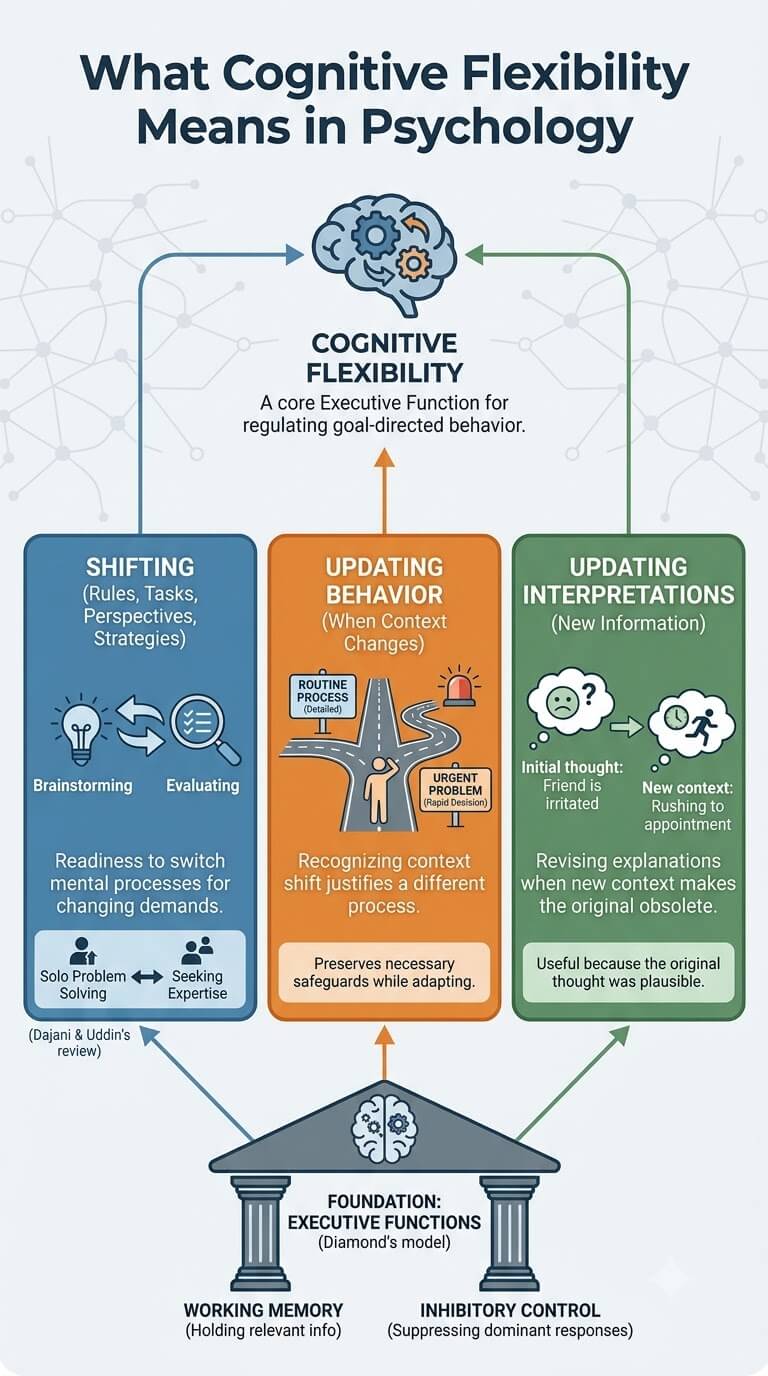
Cognitive flexibility is commonly discussed as part of executive functioning, the group of higher-order processes that help people regulate goal-directed behavior. Adele Diamond’s review of executive functions describes cognitive flexibility alongside working memory and inhibitory control, with flexibility building on the ability to hold relevant information in mind and inhibit a previously dominant response.
Shifting between rules, tasks, perspectives, or strategies
Some laboratory tasks measure flexibility by asking people to switch between rules or task sets. In everyday life, the same broad capacity can appear in less tidy forms. You may switch from brainstorming to evaluating, from listening for facts to listening for emotion, or from trying to solve a problem alone to seeking information from someone with direct expertise.
Dajani and Uddin’s review of cognitive flexibility and switching emphasizes the readiness to shift between mental processes in order to generate behavior appropriate to changing demands. This matters because flexibility is not one single action. Different tasks can require different kinds of shifting.
Updating behavior when context changes
Context determines whether persistence or switching is more useful. Imagine a manager who uses a detailed written process for routine projects. When an urgent problem requires a rapid decision, following the full routine may become inefficient. Flexibility means recognizing that the context has changed enough to justify a different process, while still preserving whatever safeguards remain important.
The same principle applies to interpretations. You may initially think a friend’s short reply means irritation. If you later learn they were rushing to an appointment, the new context gives you a reason to revise the explanation. The ability to update is useful precisely because the original interpretation was plausible at the time.
The Three-Part Flexibility Process
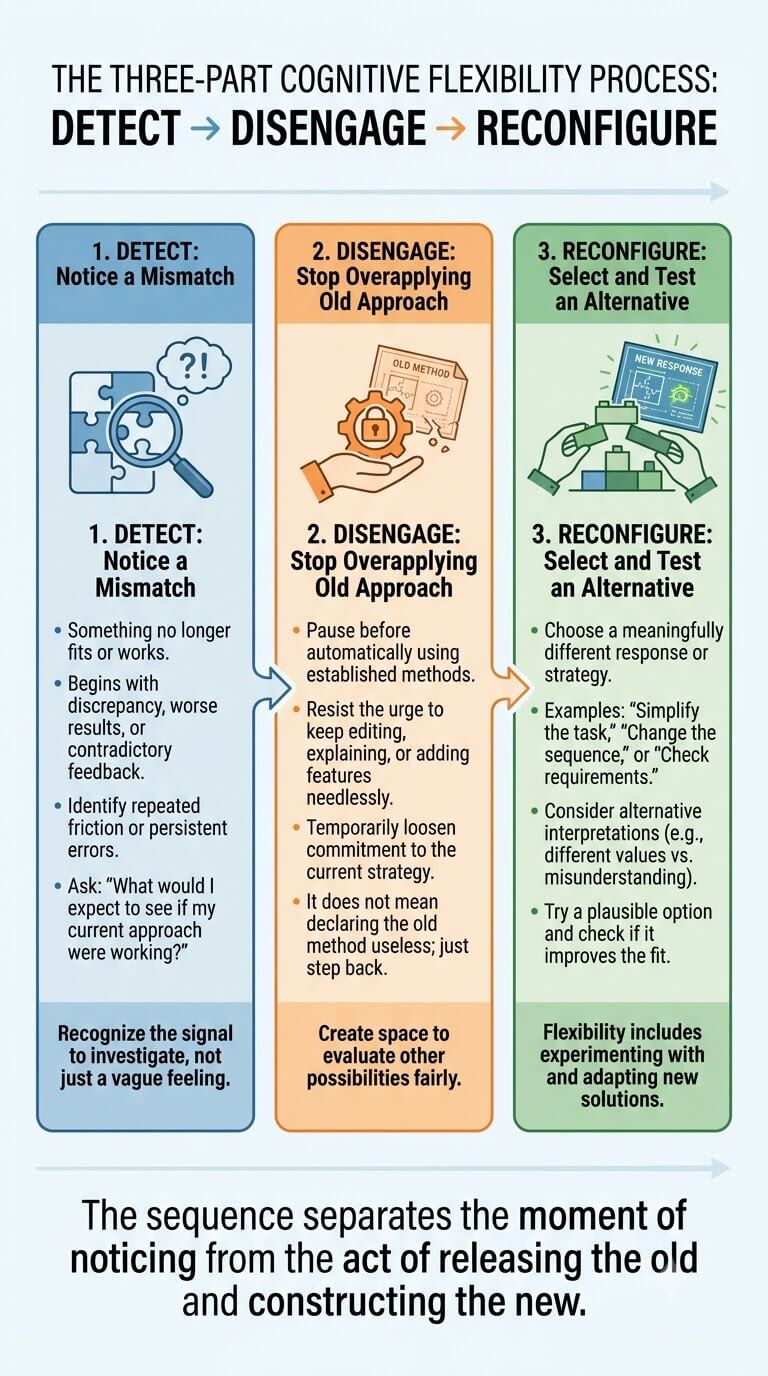
A practical way to think about cognitive flexibility is Detect → Disengage → Reconfigure. The sequence separates the moment you notice a mismatch from the harder act of releasing an old mental set and constructing a different one.
Detect: something no longer fits
Detection begins with discrepancy. Results are worse than expected, feedback contradicts your assumption, or the situation changes enough that an old rule becomes questionable. Sometimes the discrepancy is obvious. Other times it appears as repeated friction: the same error, the same failed explanation, or the same conversation going nowhere.
A useful question is, “What would I expect to see if my current approach were working?” If those signs are absent, you have a concrete reason to investigate rather than relying on a vague feeling that something is off.
Disengage: stop overapplying the old approach
Disengagement is difficult because established approaches often feel easier to retrieve and justify. You may keep editing the same paragraph when the real problem is the argument, keep explaining your intention when the other person is asking about impact, or keep adding features to a project when the underlying goal has changed.
Disengaging does not mean declaring the old method useless. It means temporarily loosening your commitment to it so that another possibility can be evaluated fairly.
Reconfigure: select and test an alternative
The final step is choosing a meaningfully different response. If the old strategy was “work faster,” an alternative might be “simplify the task,” “change the sequence,” or “check whether the requirement is correct.” If the old interpretation was “they disagree because they do not understand,” the alternative might be “they understand but value a different tradeoff.”
The best alternative is not always obvious immediately. Flexibility includes trying a plausible option and then checking whether it improves the fit between your actions and the situation.
Cognitive Flexibility vs Metacognition
These ideas overlap, but they are not interchangeable. Metacognition concerns monitoring, evaluating, and regulating your own thinking more broadly. Cognitive flexibility is one capacity that can become useful after that evaluation indicates that a change is needed.
Metacognition monitors and evaluates thinking
You might notice, “I have been rereading this explanation and still cannot state the main point,” or “I am unusually confident even though I have not checked the evidence.” Those are metacognitive observations about the state or quality of your thinking.
Recognizing that the current approach no longer fits is a metacognitive judgment before it becomes a flexibility problem.
They create information, but information alone does not guarantee a switch. You can clearly recognize that a strategy is failing and still continue using it.
Flexibility is one adaptive capacity that can follow that evaluation
Flexibility becomes relevant when the observation leads to a new mental configuration. Instead of rereading, you try explaining the idea from memory. Instead of defending the first interpretation, you ask what evidence would support another one. Instead of applying the same rule, you test whether a different rule better fits the new conditions.
You can notice a problem without successfully shifting
This distinction explains a familiar experience: “I know this is not working, but I keep doing it.” Awareness may be present while shifting remains difficult. The barrier could be habit, uncertainty about alternatives, high mental load, fear of losing prior effort, or simply the absence of a clear criterion for what to try next.
Cognitive Flexibility vs Metacognitive Strategies
Metacognitive strategies are deliberate methods for planning, monitoring, checking, and adjusting thinking. Cognitive flexibility is more specifically about the capacity to revise or switch when the current configuration no longer serves the task.
Strategies are deliberate methods for regulation
A strategy might involve predicting difficulty before starting, checking comprehension at set points, comparing a conclusion with external evidence, or deciding in advance when to seek feedback. The focus is on how thinking is managed across a task.
Flexibility is the capacity to switch or revise when the method fails
Flexibility shows up when regulation produces a signal that change is needed. Suppose your planned strategy was to solve a problem by analogy with a previous case. If the analogy breaks down, flexibility allows you to stop forcing it and reorganize the problem around a different principle.
This is also why flexible thinking is not a complete replacement for good strategy. Frequent switching without a stable goal or evaluation standard can make performance worse rather than better.
Cognitive Flexibility vs Inconsistency or Indecision
Changing direction can look inconsistent from the outside. The difference lies in why the change happened and whether the new response is better matched to available evidence or context.
Flexible change responds to evidence or context
A flexible person can hold a position firmly while the evidence supports it and revise it when meaningful information changes. The stability is in the criterion, not necessarily in the conclusion. For example, “I will use the option with the strongest safety record” can remain stable even if the preferred option changes after better data becomes available.
Indecision can involve repeated switching without a stable criterion
Indecision may look like cycling between options because each choice produces fresh doubt. The switching itself does not show flexibility if nothing new has been learned and no decision rule is being used. A useful check is whether the change has a clear reason that can be stated in advance or after the fact.
| Pattern | What triggers change | What the change aims to improve |
|---|---|---|
| Adaptive flexibility | New evidence, changed conditions, failed prediction, clearer goal | Fit between strategy and situation |
| Impulsive switching | Boredom, discomfort, novelty alone | Immediate relief or stimulation |
| Indecision | Recurring doubt without a stable criterion | Often no clear target |
| Persistence | No meaningful evidence that a change is needed | Consistency and completion |
What Makes Thinking Rigid?
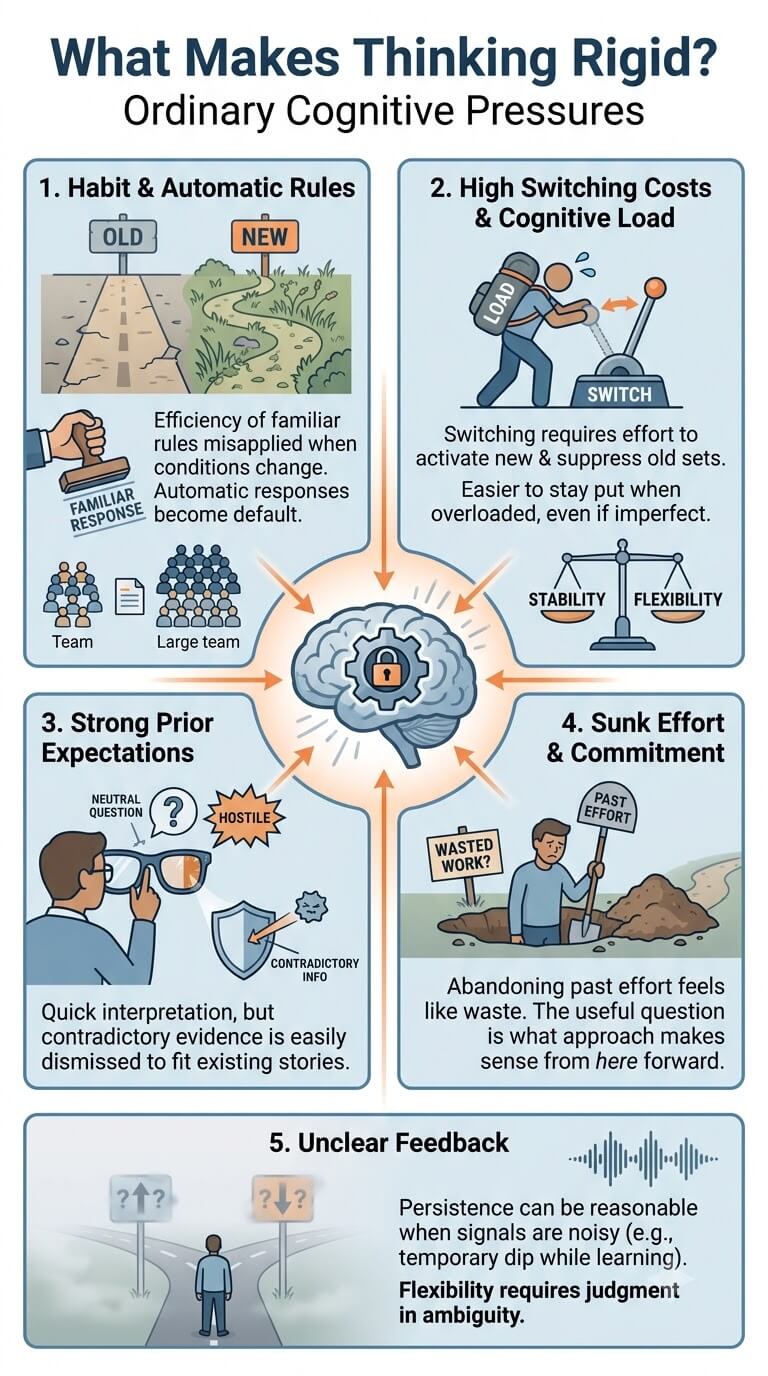
Rigid thinking does not always come from stubbornness. Several ordinary cognitive pressures make an established mental set harder to leave, especially when the replacement is unclear.
Habit and automatic rules
Frequently used rules become easy to retrieve. That efficiency is usually helpful, but it can lead you to apply a familiar response after the conditions that originally made it useful have changed. A team may keep using a reporting system designed for ten people after growing to fifty because the procedure has become automatic.
High switching costs and cognitive load
Switching is not free. A new task set has to become active while the previous one is suppressed or deprioritized. Research on task focus and task switching emphasizes the tension between cognitive stability, which protects the current task from distraction, and flexibility, which enables switching when circumstances change.
When attention is already overloaded, staying with a familiar approach may therefore be easier even if it is imperfect. This is one reason “just be more flexible” is not particularly useful advice.
Strong prior expectations
Expectations help you interpret incomplete information quickly. They also make contradictory information easier to dismiss. If you expect a meeting to be hostile, a neutral question may fit your existing story more readily than evidence that the other person is simply confused.
Sunk effort and commitment to the current approach
Effort changes how abandoning a strategy feels. After spending hours on a plan, switching may feel like wasting the work already done. Yet previous effort cannot make a poor fit better. The more useful question is what approach makes sense from this point forward.
Unclear feedback about whether change is needed
Sometimes persistence is reasonable because the signal is noisy. A strategy may produce worse results temporarily while you are learning it. A difficult conversation may feel awkward before it improves. When feedback is ambiguous, flexibility requires judgment about whether the problem is the method, insufficient practice, or unrealistic expectations.
Everyday Examples of Flexible Thinking
These examples show why flexibility is less about being generally “open” and more about changing the right part of your thinking when the evidence calls for it.
Changing a work strategy when the constraints change
Situation: You planned a project assuming two weeks and three contributors, then learn that one contributor is unavailable and the deadline has moved forward.
What you may feel: Frustration and a strong urge to push the original plan harder. What it may mean: The plan was designed for constraints that no longer exist. What to do next: Recalculate the minimum viable scope before asking everyone simply to work faster.
Reframing a problem after a failed assumption
Situation: You assume customers are abandoning a checkout because the page is too long, but shortening it does not improve completion.
What you may feel: Confusion because the original explanation sounded convincing. What it may mean: The problem could lie elsewhere, such as price clarity or payment errors. What to do next: Stop optimizing the original explanation and gather evidence that can distinguish between alternatives.
Switching from explanation to verification when uncertainty rises
Situation: You keep trying to remember whether an appointment is at 2:00 or 2:30.
What you may feel: A sense that thinking a little longer will produce certainty. What it may mean: Memory retrieval has reached a point where more internal search adds little. What to do next: Check the calendar or message instead of generating another guess.
Updating a conversation interpretation after new context
Situation: Your partner becomes quiet during dinner, and you assume they are upset with you. Later they explain that they received stressful news from work.
What you may feel: Relief, embarrassment, or residual defensiveness. What it may mean: Your first explanation was possible but incomplete. What to do next: Update the interpretation rather than trying to prove that your earlier reading was justified.
A Flexibility Check Before You Switch
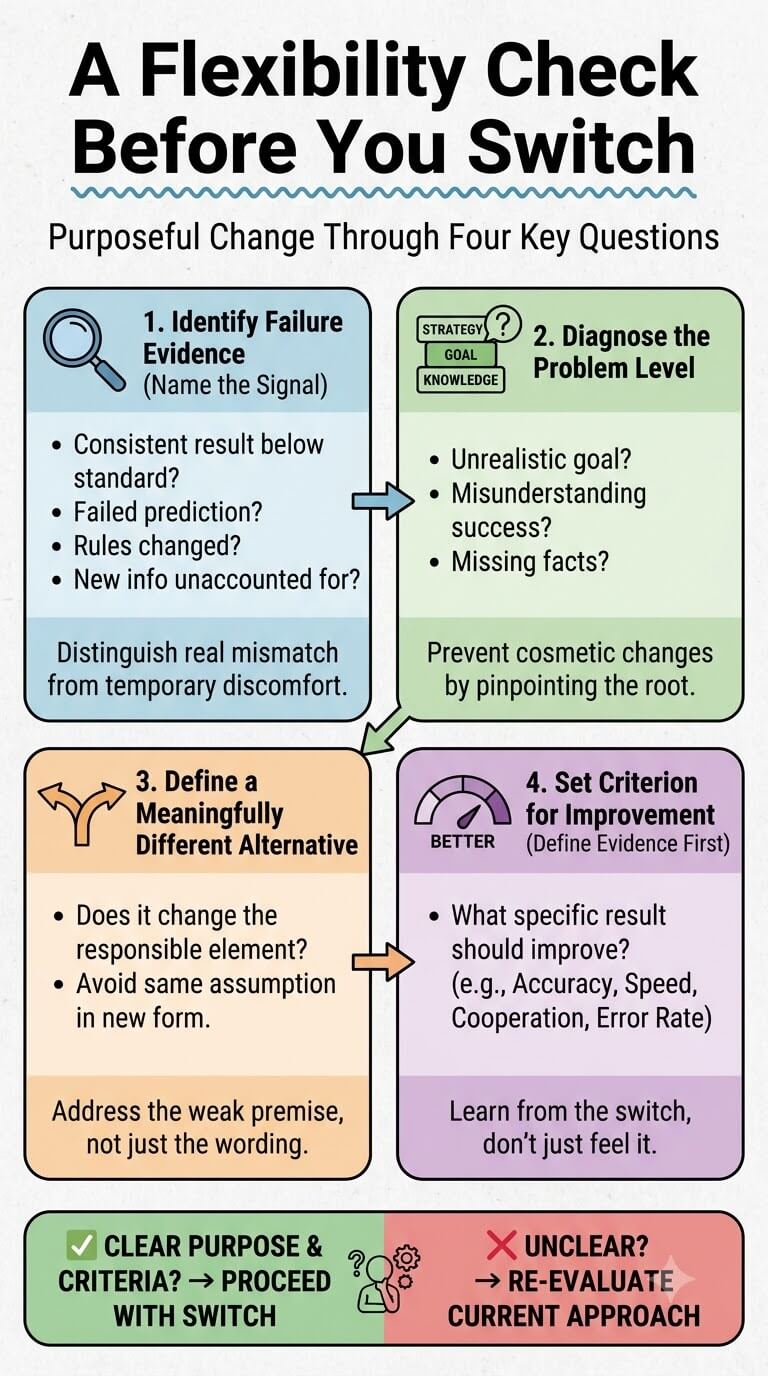
Switching too quickly can be as unhelpful as staying too long. Before changing direction, use four questions to determine whether the switch has a clear purpose.
What evidence says the current approach is failing?
Name the signal. Is the result consistently below the standard? Has a prediction failed? Did the rules change? Are you receiving new information that the current explanation cannot account for? Specific evidence makes it easier to distinguish a real mismatch from temporary discomfort.
Flexible thinking also matters in decision-making when new evidence changes the assumptions that supported the original choice.
Is the problem the strategy, the goal, or missing knowledge?
Not every failure requires a new strategy. You may be pursuing an unrealistic goal, misunderstanding what success means, or simply missing a fact that would make the existing approach work. Diagnosing the level of the problem prevents cosmetic changes.
What alternative is meaningfully different?
If the alternative uses the same assumption in a slightly different form, you may not actually be switching. For example, writing the same argument with different wording does not address a weak premise. A useful alternative changes the element that appears responsible for the mismatch.
What result would tell you the new approach is better?
Define the evidence before testing the alternative. If the new strategy succeeds, what should improve? Accuracy, speed, comprehension, cooperation, error rate, or something else? A criterion makes it possible to learn from the switch rather than judging it by how fresh or comfortable it feels.
How to Practice Adaptive Switching
Cognitive flexibility is easier to use when switching does not require inventing an alternative under maximum pressure. A few practical habits can make adaptation more deliberate.
Generate at least one alternative before you are stuck
When the stakes are meaningful, consider a second plausible route while the first is still working. You do not have to use it. Simply identifying an alternative reduces the sense that abandoning Plan A would leave you with nothing.
Use explicit switch criteria
Decide what would justify a change. “If we miss two consecutive milestones, we will reassess scope” is easier to use than “we will change if things feel bad.” Explicit criteria protect against both premature switching and endless persistence.
Test small changes before abandoning the entire plan
Some problems require a local adjustment rather than a total restart. Change one assumption, step, rule, or information source and see what happens. Small tests preserve useful parts of the original approach while giving the alternative a fair trial.
Review whether the switch improved the outcome
A switch should create feedback. After enough time to judge it, compare the result with the criterion you set. If nothing improves, flexibility may require another revision rather than defending the new approach simply because you chose it.
Common Flexibility Mistakes
The language of flexibility sounds positive, which makes it easy to treat every change as progress. These mistakes show why effective flexibility still requires stability, evidence, and a clear goal.
Switching too early because a task feels difficult
Difficulty can mean the strategy is wrong, but it can also mean the task requires practice. If you abandon every method as soon as effort rises, you never give a demanding skill enough time to become easier.
Staying too long because effort has already been invested
The opposite error is treating past effort as a reason to continue. Before investing more, ask whether you would choose the same approach now if you were starting from the current information rather than from the original plan.
Treating flexibility as lack of conviction
You can have strong values or standards and still revise tactics, beliefs, or interpretations. In fact, a stable goal can make switching easier because it clarifies what the new approach is supposed to serve.
Changing tactics without changing the assumption causing the problem
A person may try five productivity apps while keeping an impossible workload, or use five different conversation scripts while maintaining the assumption that disagreement means disrespect. Activity changes, but the controlling assumption stays fixed. Flexible thinking asks which level actually needs revision.
When Rigidity Causes Significant Distress or Functional Problems
Everyone can become mentally stuck, especially under fatigue, uncertainty, unfamiliar demands, or strong commitment to an outcome. Ordinary persistence, routine preference, or occasional difficulty changing plans is not enough to infer a psychological disorder.
Keep normal preference for routine separate from clinical interpretation
Cognitive flexibility can be measured in many ways, and those measures do not necessarily capture the same thing. Hohl and Dolcos’s review of approaches to measuring cognitive flexibility describes important differences among neuropsychological tasks, self-report questionnaires, and neuroscientific approaches. That complexity is a good reason not to turn an everyday observation such as “I hate last-minute changes” into a diagnosis.
Seek professional assessment only when persistent difficulties meaningfully impair daily life
If difficulty adapting is persistent, causes substantial distress, or repeatedly interferes with work, school, relationships, or everyday functioning, discussing the broader pattern with a qualified health professional may be useful. The point is not to label rigidity from a single trait. A professional assessment can consider context, duration, other symptoms, and possible explanations that an online article cannot determine.
FAQ About Cognitive Flexibility Psychology
These questions address common misunderstandings about flexibility, executive function, open-mindedness, context, and stress.
Is cognitive flexibility an executive function?
Yes, cognitive flexibility is commonly described as a core executive function, alongside working memory and inhibitory control. In practice, these capacities interact. To shift effectively, you often need to keep the new rule or goal in mind and inhibit the response that was appropriate under the old rule.
Is cognitive flexibility the same as open-mindedness?
No. Open-mindedness usually describes a willingness to consider alternative ideas or evidence. Cognitive flexibility is broader and can involve switching tasks, rules, attention, strategies, or responses. Someone may be open to another person’s viewpoint yet still find rapid task switching difficult, or switch tasks easily while remaining strongly attached to a particular belief.
Can someone be flexible in one area and rigid in another?
Yes. Flexibility depends partly on the demands of the situation, familiarity, motivation, available alternatives, and how strongly a response has been practiced. A person might adapt quickly to changing work procedures while finding it much harder to revise a long-held interpretation in a close relationship. It is more useful to ask where and under what conditions switching becomes difficult than to treat flexibility as a single fixed personality label.
Does stress reduce cognitive flexibility?
Stress can affect executive control, but the relationship is not perfectly simple. A meta-analysis of acute stress and executive functions found average impairments in cognitive flexibility, while some individual studies have reported different effects depending on the task, timing, and stress response. It is therefore safer to say that stress may make flexible control harder in some situations rather than assuming that every stressful state produces rigidity.
Key Takeaways
- Cognitive flexibility is adaptive switching when a rule, strategy, interpretation, or task set no longer fits current demands.
- A useful switch has a reason. New evidence, changed conditions, or a failed prediction distinguishes flexibility from random inconsistency.
- The Detect → Disengage → Reconfigure model separates noticing a mismatch from releasing the old approach and testing an alternative.
- Metacognition can reveal that thinking needs adjustment, while cognitive flexibility helps make the actual shift.
- Persistence and flexibility are both useful. The skill is knowing when the evidence supports staying and when it supports changing.
- Preference for routine or occasional rigidity should not be treated as a diagnosis; significant, persistent impairment requires broader professional assessment.

Michael Reed is the Founder and Lead Writer at Psychology Exposed. He writes about human behavior, relationships, emotional patterns, self-awareness, and practical psychology topics using research-informed, easy-to-understand content.
Read More About Michael Reed: https://psychologyexposed.com/michael-reed/