

You probably make judgments about your memory many times a day without calling them judgments. You decide whether a phone number is safe to keep in your head for thirty seconds, whether you need to write down an appointment, whether a familiar name is likely to come back if you keep searching, or whether a remembered detail is reliable enough to repeat to someone else.
Those decisions are not memory itself. They are judgments about memory. Psychology often groups them under the idea of metamemory, a part of metacognition concerned with what people believe, predict, and notice about their own remembering.
Metamemory matters because future retrieval is not directly visible. The mind relies on cues such as familiarity, processing ease, partial retrieval, prior experience, and confidence. These cues can help or mislead, so the practical task is to learn how much weight each one deserves.
Quick Answer: Metamemory Is Your Judgment About Memory, Not Memory Itself
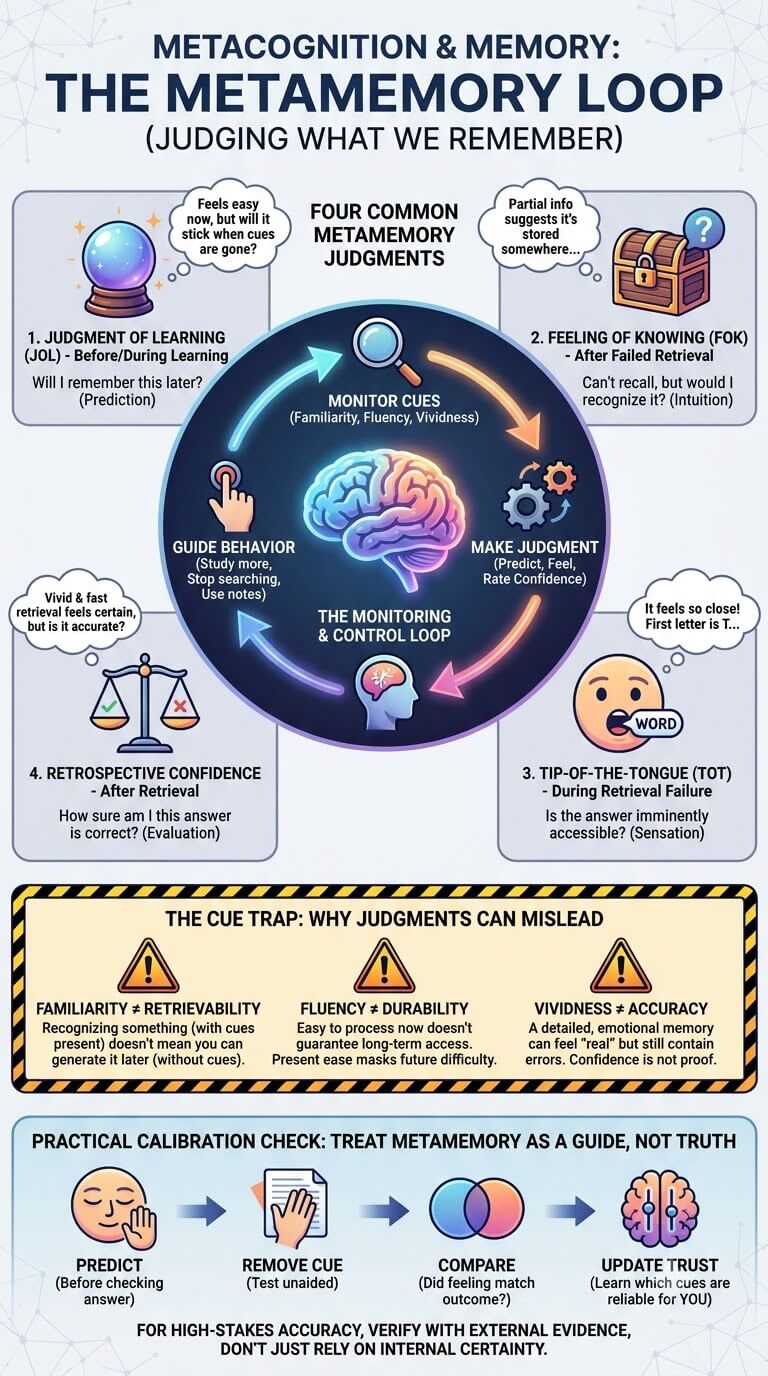
Metacognition and memory meet in metamemory, the judgments people make about what they know, what they are likely to remember, and how confident they are in a retrieved answer. These judgments can guide useful choices such as taking notes, reviewing information, or checking a record. They are informative signals, not direct proof that a memory is present, retrievable, or accurate.
The mind predicts, monitors, and evaluates remembering
Memory judgments can happen before, during, or after retrieval. Before a future need, you may predict, “I will remember that.” During a search, you may feel that an answer is close even though you cannot produce it. After recalling something, you may estimate how likely it is that the answer is correct.
Research on metacognitive monitoring and control in memory describes this relationship as a loop: people monitor internal cues and then use those judgments to guide behavior, such as continuing a search, allocating more study time, or using an external aid.
These judgments can be useful and still imperfect
Memory judgments are often useful. You can usually distinguish a well-known fact from one you barely recognize. The limitation is that subjective signals do not map perfectly onto actual performance.
A memory can feel accessible and still fail to appear when needed. A remembered detail can feel vivid and still be mistaken. A piece of information can feel difficult during learning yet become retrievable later. Treat metamemory as a guide to calibrate against outcomes, not as an internal truth detector.
What Metamemory Means
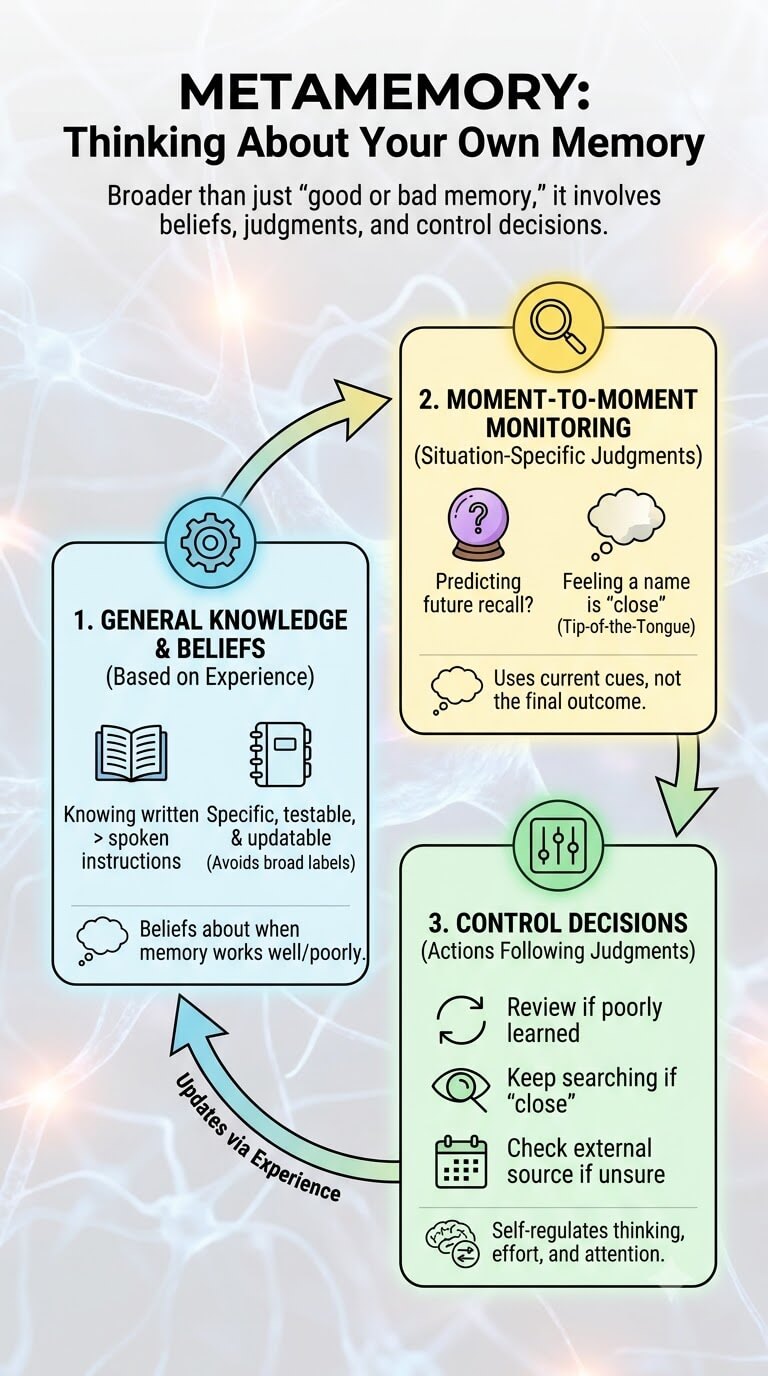
Metamemory includes both relatively general beliefs about your memory and moment-to-moment judgments about a particular item. It also includes the control decisions that follow those judgments. This makes it broader than simply asking, “Do I have a good memory?”
Knowledge about how your memory tends to work
People develop beliefs about when their memory works well or poorly. You may know that names disappear quickly unless you repeat them, or that you retain written instructions more reliably than spoken ones.
These beliefs help when they reflect repeated experience, but broad labels such as “I am terrible with names” can hide conditions under which you do better. Useful metamemory knowledge stays specific enough to test and update.
Metamemory is one specific form of the broader metacognitive process through which people judge and regulate their own cognition.
Monitoring a specific item or memory attempt
Moment-to-moment monitoring asks what memory seems capable of doing with this information right now. You may predict future recall, feel that a missing name is close, or rate confidence in a retrieved detail.
These judgments use cues generated by the current situation. The cue may be useful, but it is not the same thing as the memory outcome itself.
Controlling what you review, search for, or stop trying to retrieve
Monitoring matters partly because it changes what people do next. If you think an item is poorly learned, you may review it. If a name feels almost retrievable, you may keep searching. If you are unsure about a date, you may check a calendar instead of relying on recall.
This monitoring-to-control relationship places metamemory within the broader psychology of how people monitor and regulate their own thinking. A judgment can redirect effort, attention, or reliance on external information.
Four Common Metacognitive Memory Judgments
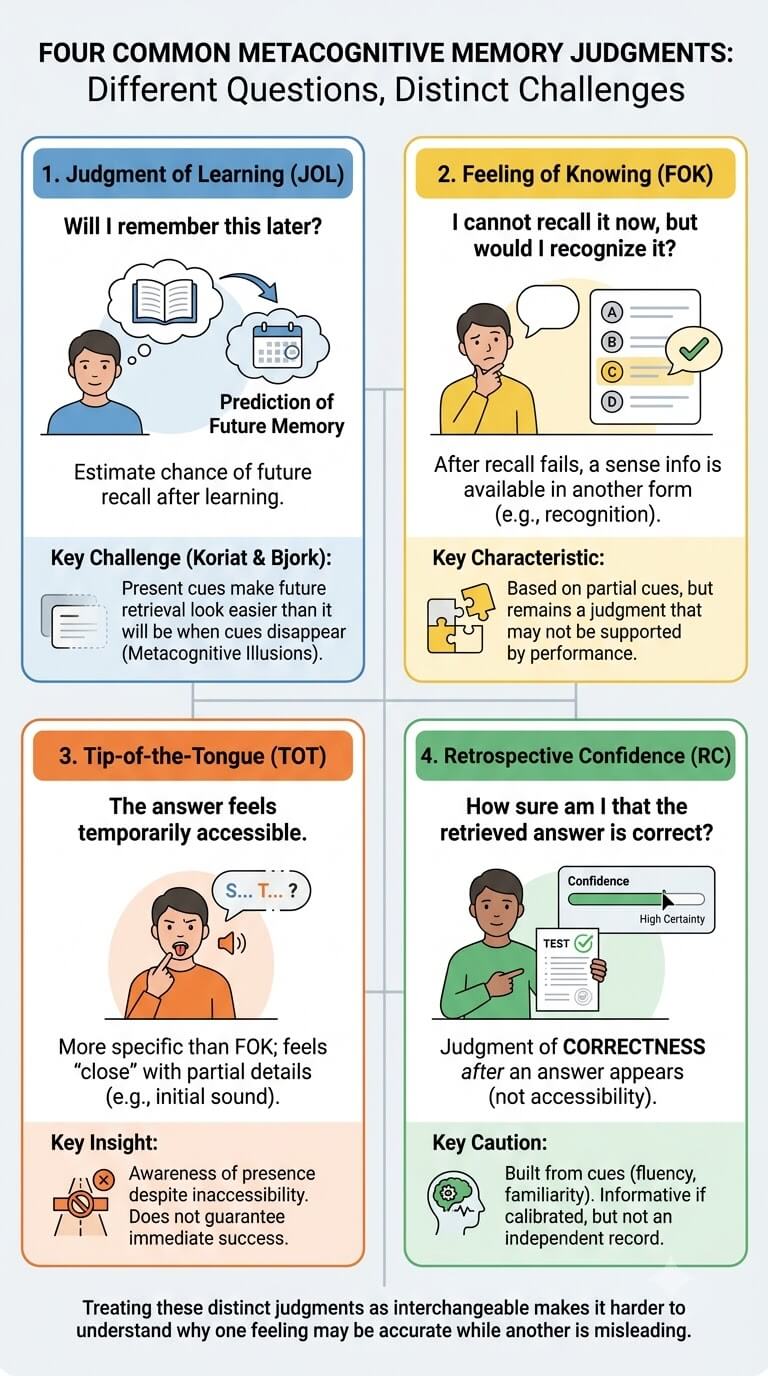
Different memory judgments answer different questions. Treating them as interchangeable makes it harder to understand why one feeling may be accurate while another is misleading.
| Memory judgment | Question it answers | When it occurs |
|---|---|---|
| Judgment of learning | Will I remember this later? | During or after learning |
| Feeling of knowing | If I cannot recall it now, would I recognize or retrieve it later? | After a failed retrieval attempt |
| Tip-of-the-tongue state | Does the answer feel close to becoming accessible? | During temporary retrieval failure |
| Retrospective confidence | How sure am I that the answer I retrieved is correct? | After retrieval |
Judgment of learning: will I remember this later?
A judgment of learning is a prediction about future memory. You learn something and estimate the chance that you will remember it later.
The difficulty is that information is often visible when the prediction is made. Koriat and Bjork’s work on metacognitive illusions in judgments of learning showed how cues present during study can make future retrieval look easier than it will be when those cues disappear.
Feeling of knowing: I cannot recall it now, but would I recognize it?
A feeling of knowing happens after recall fails but you still have a sense that the information may be available in another form. You cannot produce the answer, yet you believe you might recognize it among options or retrieve it later.
Failed recall is not always equivalent to having no relevant knowledge. Partial cues may reasonably suggest that recognition could succeed, but the feeling remains a judgment that later performance may or may not support.
Tip-of-the-tongue: the answer feels temporarily accessible
A tip-of-the-tongue experience is more specific. You cannot retrieve a word or name, but it feels close, sometimes with partial details such as an initial sound or related word.
A review of the tip-of-the-tongue state as a metacognitive experience describes it as a form of awareness that information may be present even though it is currently inaccessible. Importantly, feeling close to retrieval does not guarantee that continued searching will immediately succeed.
Retrospective confidence: how sure am I that the retrieved answer is correct?
After an answer appears, the question shifts from accessibility to correctness. “I think it was Tuesday” and “I am certain it was Tuesday” carry different levels of confidence.
Confidence can be informative when calibrated through feedback, but it is not an independent record of what happened. It is another judgment built from cues such as fluency, detail, familiarity, and expectation.
Before, During, and After Retrieval
A simple way to organize metamemory is by timing. Think of three stages: Forecast, Search, Verify. Before retrieval, you forecast what your memory is likely to do. During retrieval, you read the signals produced by the search. After retrieval, you verify how much confidence the answer deserves.
Prospective predictions before a test or future need
Prospective judgments help you decide whether an external aid is needed. A six-digit code needed immediately may be safe to hold briefly; one needed tomorrow is better recorded.
For learning, predictions become more useful when made under conditions that resemble the future memory demand.
Online signals during a memory search
During retrieval, partial information and feelings of closeness influence whether you keep searching, change cues, ask someone else, or stop.
Also ask whether continued retrieval is worth the stakes. Searching for a movie title is harmless; reconstructing a financial detail from memory when a statement exists is unnecessary risk.
Confidence after an answer comes to mind
Once a memory appears, fluency can make it feel convincing. Fast retrieval may justify confidence in well-practiced knowledge, but it should not override contradictory evidence.
For consequential information, confidence should be one input among several. Records or independent evidence may provide stronger verification.
What Memory Judgments Use as Cues
The mind does not directly read the strength of a memory as if checking a battery meter. It infers likely memory performance from available cues. Some cues reflect real knowledge. Others are only loosely connected to future recall.
Familiarity
Familiar material feels easier to recognize and process. That familiarity can support accurate judgments when repeated exposure really has strengthened memory. It can also create false confidence when recognition is mistaken for the ability to retrieve information without support.
Retrieval fluency
If an answer comes to mind quickly, people often treat that ease as evidence that the memory is strong. Retrieval fluency can be informative, but ease today does not guarantee access tomorrow, especially if the context or cue changes.
Processing ease
Material that is easy to process may feel easier to remember. Rhodes and Castel found that perceptual features such as font size can influence predictions about future memory even when the cue is not a strong guide to later recall.
Emotional vividness or detail
Strong imagery, emotion, or contextual detail can make a memory feel especially real. Vividness describes the subjective experience, not automatic proof that every detail is accurate.
When accuracy has consequences, “I can see it clearly” should be separated from independent confirmation.
Prior success and context
Your history with similar tasks also shapes expectations. Repeated success can justify higher confidence, while repeated failures under similar conditions should lower reliance on unaided recall.
Context matters because memory performance is not identical across tasks. Being good at recognizing faces does not tell you how accurately you will remember exact wording, dates, passwords, or sequences.
Why “This Feels Familiar” Can Mislead Memory
Familiarity is fast and useful but easy to overinterpret. It may tell you that something has been encountered before without telling you whether you can later retrieve it, identify its source, or distinguish it from similar material.
Recognition is not the same as future recall
Seeing the correct answer and thinking “I knew that” is not the same task as producing the answer from memory. Recognition provides the target as a cue. Free recall requires you to generate it.
Familiarity can also create an illusion of knowing when recognition feels strong even though independent recall remains weak.
This is why a page can feel mastered while it is open. The visible material does some of the retrieval work for you.
Visible cues can inflate predictions
When both a question and its answer are present, the connection between them may feel obvious. Later, with only the question available, that same connection can be much harder to reconstruct.
One practical implication is to occasionally make memory judgments after removing the answer. This does not require testing everything. It simply gives your judgment evidence closer to the conditions under which retrieval will actually be needed.
Familiarity can come from exposure without accurate source memory
You may recognize a claim yet be unsure where you encountered it. Repeated exposure can increase familiarity even when the source, context, or reliability of the information is poorly remembered.
For low-stakes trivia, that may not matter. For decisions about health, money, work, or another person’s actions, source uncertainty is a reason to verify rather than letting familiarity substitute for evidence.
Memory Confidence vs Memory Accuracy
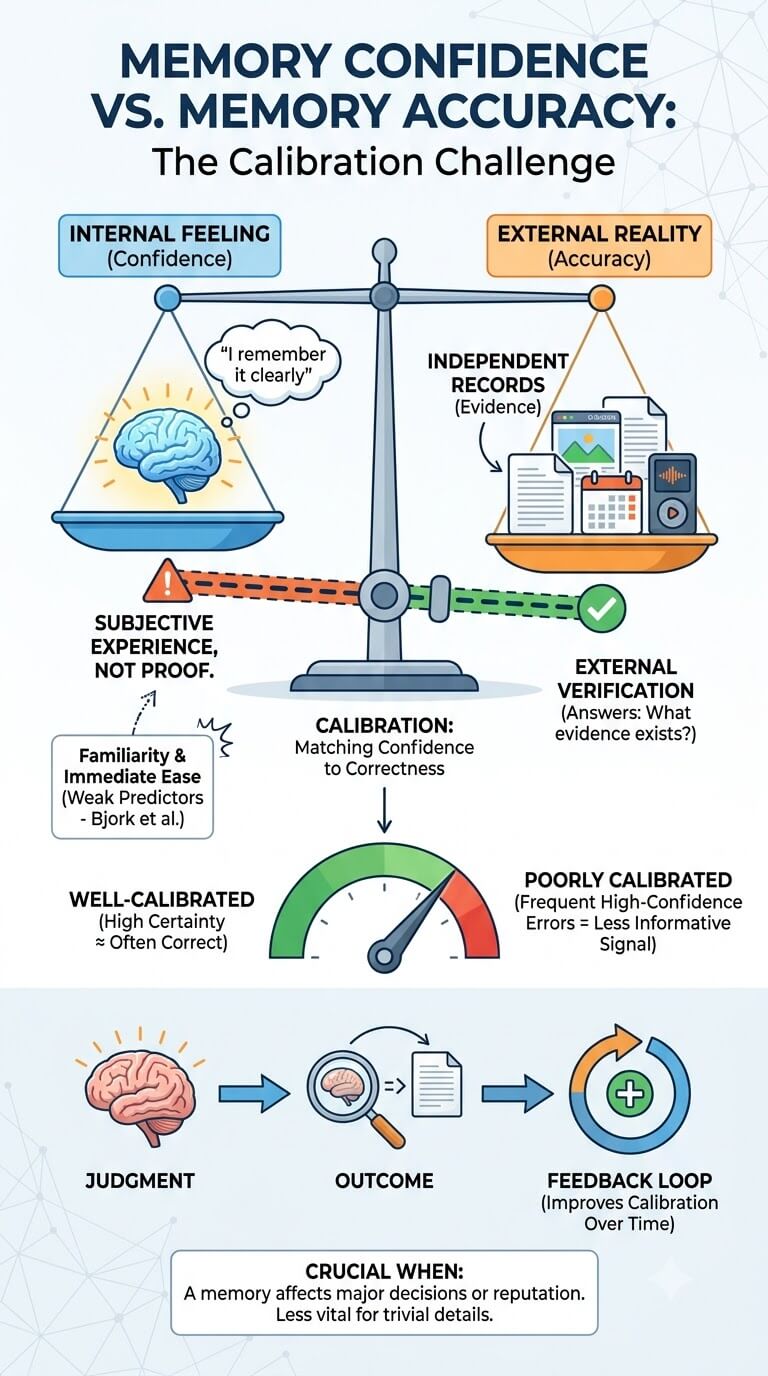
Confidence and accuracy are related often enough to be useful, but not tightly enough to treat certainty as proof. The key issue is calibration: does your level of confidence tend to match how often you are actually correct?
Confidence can track accuracy imperfectly
Confidence is better calibrated when high-certainty answers are correct more often than low-certainty answers. Frequent high-confidence errors make the signal less informative.
Calibration is a relationship between judgment and outcome. It cannot be established by introspection alone.
Strong certainty is not independent verification
The statement “I remember it clearly” describes an internal experience. A screenshot, document, recording, calendar entry, or independent record answers a different question: what external evidence is available?
External verification is unnecessary for many trivial details. It matters more when a memory affects a major decision or another person’s reputation.
Why repeated feedback matters for calibration
You learn whether memory judgments are trustworthy by comparing them with outcomes. Over time, you may discover that familiarity is a weak predictor while successful unaided explanation is stronger.
The broader research on self-regulated learning also emphasizes that people can hold inaccurate beliefs about learning and remembering. Bjork, Dunlosky, and Kornell review how beliefs and subjective impressions can mislead self-regulation, especially when immediate ease is mistaken for durable learning.
Metacognition and Memory vs Memory Psychology
The topics overlap but ask different questions. Memory psychology examines memory processes; metamemory examines what people believe and judge about those processes.
Memory Psychology explains encoding, storage, retrieval, and forgetting
If you ask why spacing helps long-term retention, how working memory differs from long-term memory, or why interference contributes to forgetting, you are asking primarily about memory mechanisms and performance.
Those mechanisms matter here only as context. This article does not try to replace a broader explanation of how memory works.
This article explains judgments about those memory processes
The metamemory question is how accurately you predict retrieval, what makes an answer feel trustworthy, and when cues such as familiarity support or distort that judgment.
Keeping the distinction clear prevents a common mistake: assuming that learning about metacognitive judgment is the same as learning how to improve memory capacity.
Everyday Memory Monitoring Examples
Metamemory is easiest to see when a judgment changes behavior. The following examples show how the same memory system can lead to different actions depending on how reliable the person believes retrieval will be.
Deciding whether you need to write something down
Situation: A coworker gives you three tasks and two deadlines while you are walking between meetings. What you may feel: The instructions seem simple enough to hold mentally. What it may mean: Familiarity with the tasks can create confidence even though the combination of details is new. What to do next: If missing a deadline matters, record the details instead of using confidence as the only safeguard.
Choosing whether to keep searching for a name
Situation: You recognize an actor but cannot retrieve the name. What you may feel: The answer seems seconds away. What it may mean: Partial information is producing a tip-of-the-tongue state. What to do next: If the answer is trivial, keep searching if you enjoy the effort or move on. The feeling of closeness does not obligate you to continue.
Predicting whether a presentation point will be retrievable later
Situation: Your slides are open and every talking point looks obvious. What you may feel: You are certain the sequence will come naturally during the presentation. What it may mean: The visible slides are supplying cues that may be weaker when you present. What to do next: Close the deck and rehearse the transitions once from memory before deciding that no notes are needed.
Feeling highly certain about a remembered detail
Situation: You remember a colleague agreeing to a deadline and feel sure of the date. What you may feel: The memory is vivid enough that checking seems unnecessary. What it may mean: Confidence may be high, but the cost of a date error is also meaningful. What to do next: Check the written message or calendar before treating the remembered detail as settled fact.
A Practical Memory Calibration Check
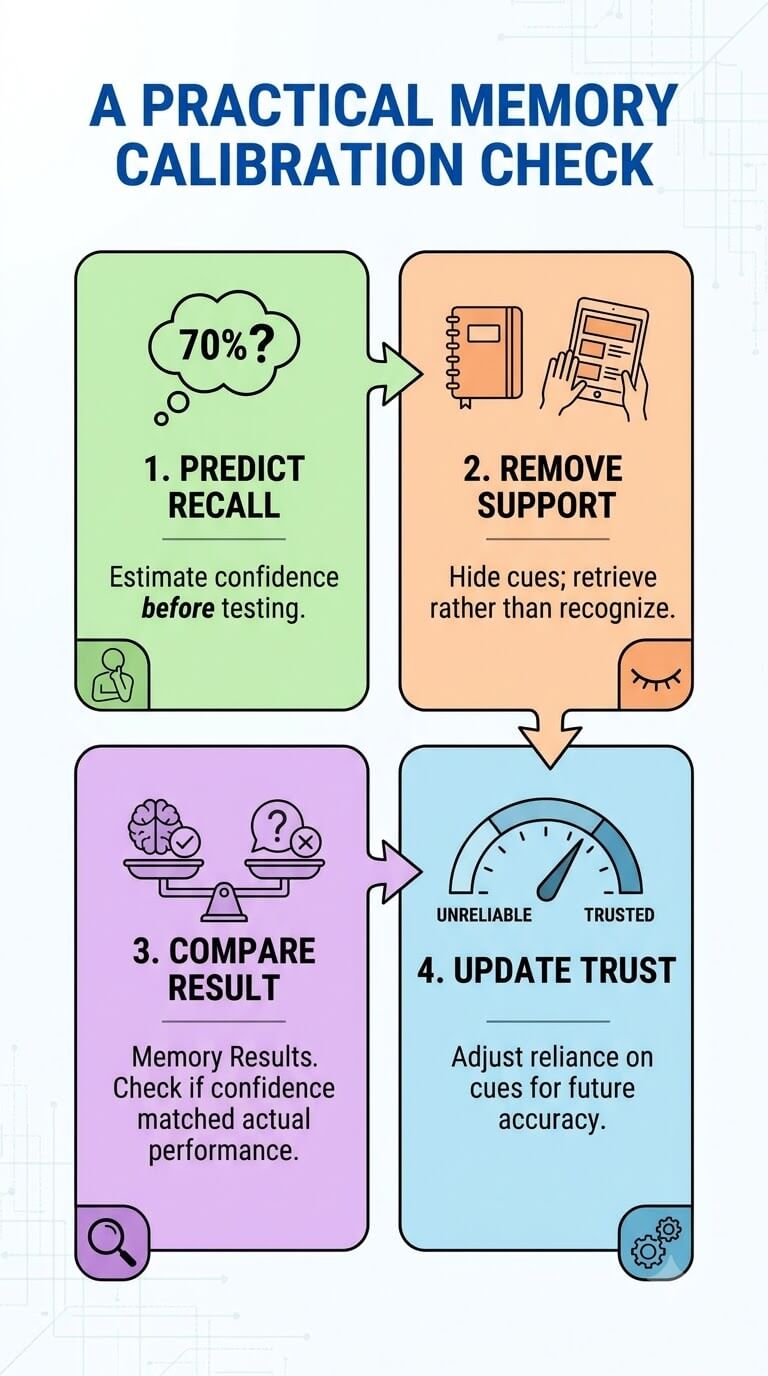
When a memory judgment matters, use four short steps: predict, remove support, compare the result, and update what you trust.
Predict recall before testing
Before checking the answer, estimate what you expect. You might say, “I am about 70 percent sure I can recall all four points,” or simply classify the item as strong, uncertain, or weak.
The exact number matters less than making the prediction before the outcome is known. Otherwise hindsight can make your earlier confidence difficult to reconstruct.
Remove the cue
If you are judging future recall, recreate the future condition as closely as practical. Close the notes. Hide the answer. Put away the slides. Ask yourself to retrieve rather than recognize.
This reduces the chance that visible information is doing work that you mistakenly attribute to memory.
Compare confidence with actual performance
Notice not only whether you were right but how your confidence related to the result. Was the item you felt certain about actually retrieved? Did something that felt difficult turn out to be remembered correctly?
Comparing a memory prediction with later recall is a form of self-monitoring because the judgment is being checked against actual performance.
One mismatch proves little. Repeated mismatches reveal which cues are misleading you.
Adjust future reliance on the cue that misled you
If familiarity repeatedly makes you overpredict recall, give familiarity less weight next time. If successful explanation without notes reliably predicts later recall, give that cue more weight.
This is calibration in practical form. You are not trying to distrust memory. You are learning which internal signals deserve how much trust for a particular kind of task.
Common Metamemory Mistakes
Metamemory errors often come from reasonable cues used for the wrong question. The issue is not having a subjective impression, but asking it to provide more certainty than it can support.
Judging while the answer is visible
An answer can look obvious when you are looking directly at it. If the future task requires unaided recall, judge your memory after the answer is hidden at least some of the time.
Treating vividness as proof of accuracy
A detailed or emotional memory may deserve attention, but vividness alone does not verify the details. When consequences are significant, look for corroborating evidence rather than escalating certainty from vividness alone.
Confusing recognition with free recall
Being able to identify the correct answer from a list does not mean you could generate it without options. Match your self-check to the kind of retrieval the real situation will require.
Assuming one failed retrieval means the memory is absent
A failed attempt can reflect poor cues, distraction, competition from similar information, or temporary inaccessibility. Sometimes the answer returns later. Treat a single failure as evidence about current accessibility, not definitive proof that no relevant memory exists.
What to Do Next When Your Memory Judgment Is Uncertain
Uncertainty does not always need to be eliminated. The sensible response depends on the stakes, the availability of external evidence, and whether the issue reflects ordinary forgetting or a broader change in daily functioning.
Match the check to the stakes
If you cannot remember who recommended a restaurant, guessing may be harmless. If you are unsure whether medication was already taken, whether a payment was made, or whether an important instruction was followed, use a reliable record rather than continuing to infer from familiarity.
High stakes call for stronger verification, not greater self-criticism.
Use external records when accuracy matters
Notes, calendars, written instructions, receipts, photographs, and message histories can supplement memory. Using them is not a failure of metacognition. Recognizing that a memory judgment is insufficient and choosing an external aid is a form of effective control.
Separate ordinary uncertainty from severe or persistent memory concerns
Occasional forgetting, tip-of-the-tongue experiences, and uncertainty are common parts of everyday memory. This article is not a tool for diagnosing a memory disorder.
If memory problems are new, worsening, severe, or regularly interfering with daily tasks such as managing medication, finances, appointments, navigation, or personal safety, consider discussing the change with a qualified healthcare professional. The important issue is the pattern of functional difficulty, not whether one name or detail occasionally fails to come to mind.
FAQ About Metacognition and Memory
These questions clarify several subjective memory experiences that are easy to confuse with one another.
Is feeling of knowing usually accurate?
A feeling of knowing can contain useful information, especially when partial knowledge or familiarity reflects real access to related material. It is not perfectly accurate. The strength of the feeling may be influenced by cues that do not guarantee later recognition or retrieval, so the most useful way to judge its reliability is to compare the feeling with later outcomes across repeated situations.
Does a tip-of-the-tongue state mean the memory is stored?
It suggests that your cognitive system is producing a strong sense of imminent access, often alongside partial information. That is not the same as direct proof that a complete, accurate memory is stored and ready to emerge. Sometimes retrieval succeeds soon afterward, and sometimes it does not. The experience is best understood as a metacognitive signal about accessibility rather than a guaranteed readout of memory storage.
Why can a vivid memory still be wrong?
Vividness and accuracy answer different questions. Vividness describes how rich or compelling a memory feels; accuracy concerns how closely remembered details correspond to what actually occurred. A memory can contain strong imagery, emotion, and narrative coherence while still including errors. When accuracy is consequential, independent records or corroborating evidence deserve more weight than vividness alone.
Is memory confidence the same as metacognitive accuracy?
No. Confidence is the level of certainty attached to a particular answer or memory. Metacognitive accuracy concerns how well such judgments correspond to actual performance. Someone can be highly confident and wrong, or cautiously confident and correct. Calibration improves when confidence is repeatedly compared with outcomes rather than evaluated only by how convincing the feeling seems.
Key Takeaways
- Metamemory concerns judgments about memory, including predictions of future recall, feelings of knowing, tip-of-the-tongue experiences, and confidence after retrieval.
- A memory judgment is different from memory performance. Feeling that something will be remembered does not guarantee later access.
- Familiarity, fluency, vividness, partial retrieval, and prior experience can all influence memory judgments, but each cue has limits.
- Recognition while an answer is visible can make future recall look easier than it will be when the cue is removed.
- Confidence becomes more informative when it is calibrated against actual outcomes and external evidence.
- For important details, effective metacognition may mean using notes or records instead of asking subjective certainty to do more than it can.

Michael Reed is the Founder and Lead Writer at Psychology Exposed. He writes about human behavior, relationships, emotional patterns, self-awareness, and practical psychology topics using research-informed, easy-to-understand content.
Read More About Michael Reed: https://psychologyexposed.com/michael-reed/