
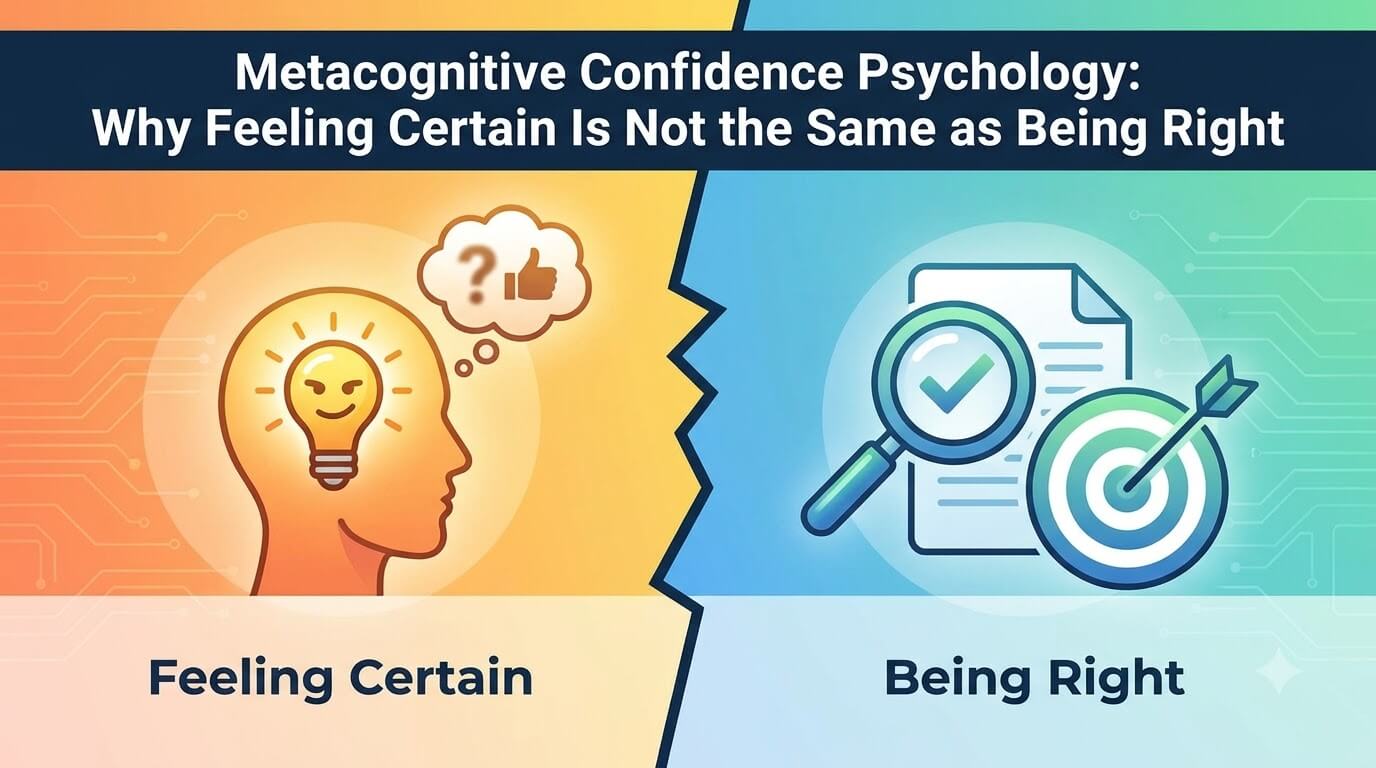
You can be completely certain about a memory that turns out to be wrong. You can also give the correct answer at work while feeling uneasy about it. These experiences are not contradictions. They show that confidence and accuracy are related, but they are not the same thing.
Metacognitive confidence is the mind’s estimate of how likely its own answer, perception, memory, or decision is to be correct. That estimate can be useful. It helps you decide whether to act, check again, ask for help, or keep gathering information. But confidence is still a judgment. It can be well calibrated, too high, too low, or based on cues that are only loosely connected to accuracy.
The practical question is therefore not, “Do I feel confident?” It is, “How well does my confidence track the quality of my judgments over time?” That shift matters because certainty can feel persuasive even when the evidence underneath it is weak.
Quick Answer: Confidence Is a Judgment About Accuracy, Not Accuracy Itself

Metacognitive confidence is your estimate of how likely your own judgment is to be correct. Good calibration means confidence rises when your evidence and accuracy are stronger and falls when they are weaker. Feeling very sure does not prove you are right, and feeling uncertain does not prove you are wrong. Confidence becomes most useful when it is compared with actual outcomes.
Confidence can be informative without being definitive
Confidence is not meaningless. If you have solved hundreds of similar problems and receive consistent feedback, a strong feeling of certainty may carry useful information. Likewise, hesitation can alert you that evidence is conflicting or that a task is unfamiliar.
The problem begins when confidence is treated as the conclusion rather than one input into the conclusion. “I am sure” describes your internal state. It does not independently establish what happened outside your mind.
Calibration is the key question
Imagine that you make ten judgments and say you are about 80 percent confident in each one. If roughly eight of those judgments are correct, your confidence is reasonably aligned with the outcomes. If only four are correct, the confidence was too high for the accuracy achieved.
This idea of matching confidence to performance is central to research on metacognition. Yeung and Summerfield’s review of confidence judgments and error monitoring describes how people evaluate their own decisions even when external feedback is not immediately available.
What Metacognitive Confidence Means
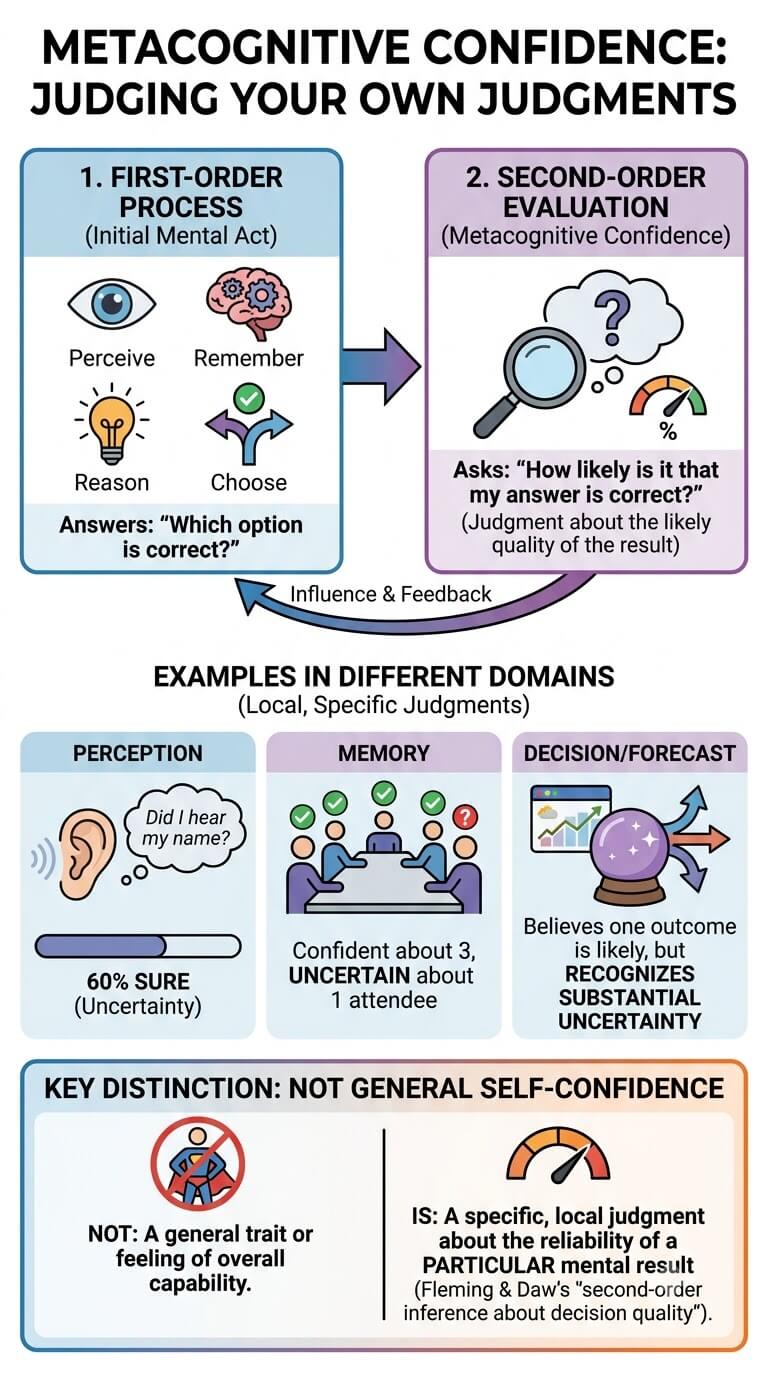
Confidence becomes metacognitive when it is a judgment about another judgment. First, you perceive, remember, reason, or choose. Then you evaluate the likely quality of that result. The two processes can influence each other, but they do not have to produce the same signal.
Confidence after a perception, memory, answer, or decision
Metacognitive confidence can appear in many domains. After hearing a faint sound, you may think you heard your name and feel 60 percent sure. After recalling who attended a meeting, you may be highly confident about three people and uncertain about a fourth. After making a forecast, you may believe one outcome is more likely but still recognize substantial uncertainty.
These are not statements about general self-confidence. They are local judgments about the likely correctness of a particular mental result.
Confidence as a second-order judgment
A useful distinction is between the first-order decision and the second-order evaluation. The first-order process answers, “Which option is correct?” The second-order process asks, “How likely is it that my answer is correct?”
Fleming and Daw formalized this distinction by describing self-evaluation as a second-order inference about decision quality. You do not need the mathematics to use the idea. It simply means that a mind can make a choice and then form another judgment about the reliability of that choice.
Confidence is one metacognitive signal within a broader process of monitoring and evaluating your own thinking.
Confidence, Accuracy, and Calibration Are Different
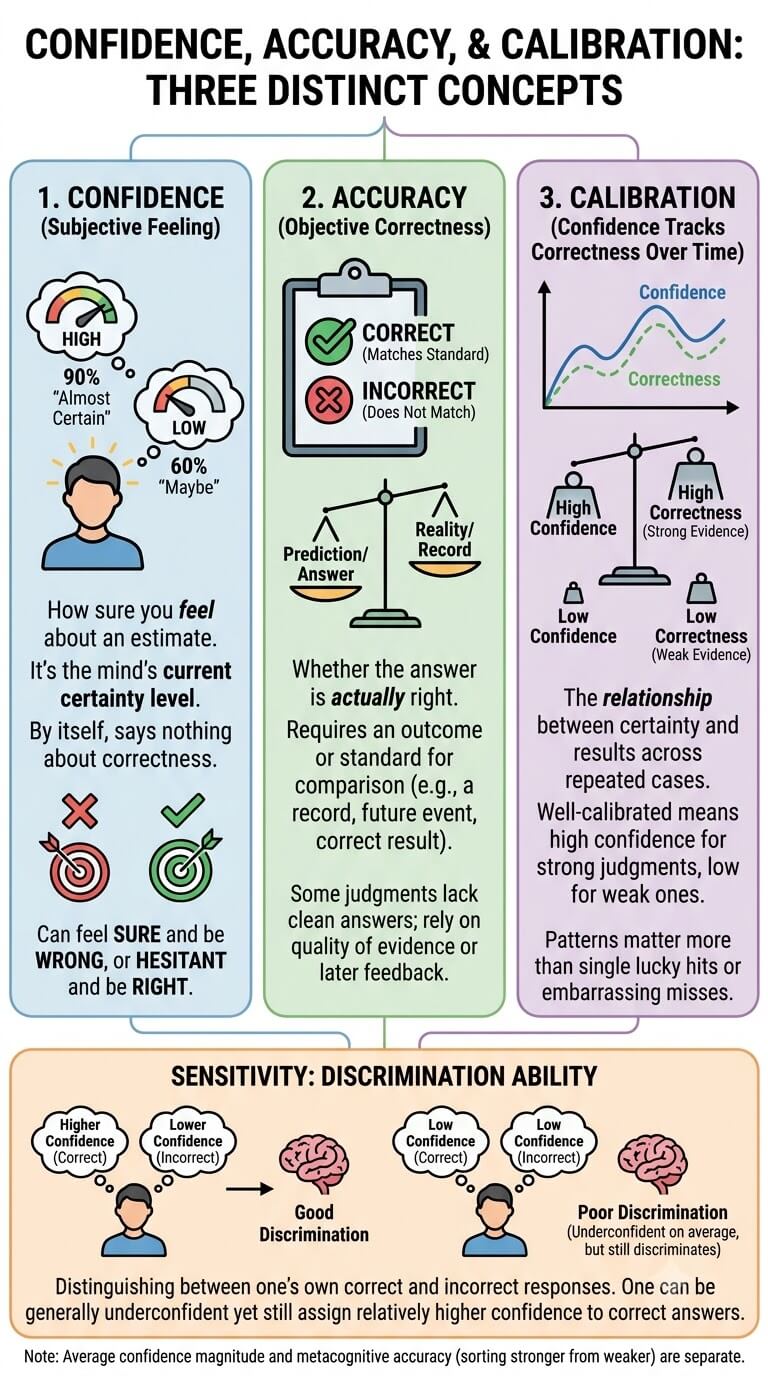
Three terms are easy to blur together: confidence, accuracy, and calibration. Keeping them separate makes it easier to understand why a person can sound certain yet be wrong, or sound hesitant yet be consistently correct.
| Concept | Main question | Example |
|---|---|---|
| Confidence level | How sure do I feel? | “I am about 90 percent sure.” |
| Accuracy | Was the answer actually correct? | The answer was correct or incorrect. |
| Calibration | Does confidence match accuracy across repeated judgments? | High-confidence answers are usually right, lower-confidence answers less often right. |
| Metacognitive sensitivity | Can I tell my better judgments from my worse ones? | I tend to feel more confident on correct answers than incorrect ones. |
Confidence level: how sure you feel
Confidence level is the subjective strength of certainty. You might report it with words such as “maybe,” “probably,” or “almost certain,” or with a numerical estimate such as 60 or 90 percent.
A confidence level tells you something about the mind’s current estimate. By itself, it says nothing about whether that estimate is well calibrated.
Accuracy: whether the answer is actually correct
Accuracy requires an outcome or standard against which the judgment can be checked. A remembered date can be compared with a record. A prediction can be compared with what happens later. A calculation can be checked against the correct result.
Some everyday judgments do not have a clean right-or-wrong answer. In those cases, calibration may involve the quality of evidence, later feedback, or whether new information consistently supports the original conclusion.
Calibration: whether confidence tracks correctness over time
Calibration is about the relationship between certainty and results. Someone may be accurate overall but poorly calibrated if they express extreme confidence in both strong and weak judgments. Another person may make some mistakes but still be well calibrated if their confidence reliably drops when their evidence is weaker.
This is why one embarrassing mistake does not prove that you are “overconfident,” and one lucky correct answer does not prove that your confidence system is accurate. Patterns across repeated cases are more informative.
Sensitivity: whether confidence is higher on correct than incorrect responses
Researchers also distinguish average confidence from the ability to discriminate between one’s own correct and incorrect responses. A person could generally rate confidence too low yet still assign relatively higher confidence to the answers that are actually correct.
Research on individual differences in metacognitive accuracy and confidence illustrates why confidence magnitude and metacognitive accuracy are not interchangeable. In everyday language, how confident you tend to be and how well confidence sorts stronger judgments from weaker ones are separate questions.
Where Confidence Comes From
The mind does not have a direct accuracy meter. Confidence is inferred from available cues. Some cues are closely related to evidence quality, while others can be misleading in particular situations.
Evidence strength
When information is clear, consistent, and strongly favors one conclusion, confidence often rises. If several independent facts point in the same direction, feeling more certain may be reasonable.
The important word is independent. Hearing the same unsupported claim repeated by five people who all copied one source is not the same as receiving five independent pieces of evidence.
Processing fluency and ease
Ideas that are easy to read, recall, or process often feel more trustworthy. A familiar explanation may come to mind quickly, and the smoothness of retrieval can be mistaken for evidence that the explanation is correct.
Fluency is not useless. Familiar knowledge often is easier to retrieve. The risk is treating ease as proof rather than asking what made the answer easy.
Confidence can also contribute to a broader tendency to overestimate what you know when self-evaluation repeatedly outruns evidence or feedback.
Response speed and conflict
A fast answer may feel more certain because little internal conflict was noticed. By contrast, two competing possibilities can create hesitation. That hesitation may appropriately lower confidence when the evidence is genuinely mixed.
Speed is not a universal quality signal. Expertise can produce fast and accurate judgments in familiar environments, while a fast answer in a novel situation may simply reflect a shortcut that was never checked.
Prior beliefs and expectations
What you already believe influences how new information is interpreted. If an explanation fits your expectations, it may feel immediately coherent. If it conflicts with them, even good evidence may initially feel less convincing.
A useful confidence check is therefore: “Would I feel equally certain if this conclusion went against what I expected?” The question does not invalidate prior knowledge. It helps reveal how much of the certainty comes from fit with expectation rather than the new evidence itself.
Feedback history
Repeated feedback can teach you whether your internal confidence signals deserve trust in a particular domain. If you routinely make predictions, record your confidence, and later see the outcomes, you gain information about where your certainty is well calibrated and where it drifts.
Without feedback, confidence can remain stable even when accuracy is not. That is one reason environments with delayed or ambiguous outcomes can make calibration difficult.
Why High Confidence Can Be Wrong
High confidence becomes unreliable when the cues generating certainty are strong but poorly connected to correctness. Several routes can produce this mismatch without implying that a person is generally careless or incapable.
Strong but misleading cues
A vivid memory, a familiar phrase, or a forceful first impression can feel diagnostic even when it is not. The cue is genuinely strong as an experience, but its strength may not map neatly onto external accuracy.
This matters especially when the judgment is hard to verify immediately. A confident memory can remain unchallenged until a written record appears later.
Missing alternatives
Confidence often rises when one explanation appears to fit. But if you have not generated plausible alternatives, the apparent fit may be artificially strong. A delayed reply, for example, may seem to confirm disinterest if that is the only explanation considered.
Asking “What else could produce the same evidence?” can reduce misplaced certainty without forcing you into endless doubt.
Familiarity and repetition
Repeated exposure can increase the ease with which an idea comes to mind. That familiarity can make a claim feel settled even when repetition has not added new evidence.
This pathway overlaps with the illusion of knowing, but the two are not identical. The present issue is broader: familiarity is one cue that can inflate confidence across memory, explanation, judgment, and choice.
Weak feedback environments
If you rarely learn whether your judgments were correct, inaccurate confidence has little opportunity to be corrected. This happens with some forecasts, social interpretations, hiring judgments, and beliefs about why another person behaved a certain way.
When outcomes are ambiguous, use softer language and seek independent evidence where it matters. “This is my best interpretation” is often more accurate than “I know why they did it.”
Why Low Confidence Can Also Be Misleading
Low confidence is not automatically a sign that a judgment is poor. Some people perform well while feeling uncertain, and some situations naturally reduce certainty even when the underlying reasoning is sound.
Hard tasks can make accurate people feel uncertain
Difficulty often lowers confidence because the task produces conflict, effort, or incomplete information. Yet a careful person may still reach the correct answer more often than not.
In this case, uncertainty is not failure. It may be an appropriate response to a demanding task.
High standards can lower subjective certainty
A person who requires strong evidence before saying “I am sure” may sound less confident than someone with a lower threshold for certainty. That difference does not tell you which person is more accurate.
It can be useful to distinguish “I would like more evidence” from “My current answer is probably wrong.” Those are different judgments.
Unfamiliarity can reduce confidence before it reduces performance
When a task feels new, people may discount correct reasoning because the experience lacks the ease of a familiar routine. A new employee may double-check a correct answer simply because the context is unfamiliar.
Feedback over repeated attempts can reveal whether the low confidence is justified. If accuracy remains strong, confidence may need to update upward rather than the performance needing to change.
Metacognitive Confidence vs Illusion of Knowing
These ideas overlap, but separating them prevents one narrow mechanism from becoming the explanation for every confidence error.
Confidence is the broader judgment
Metacognitive confidence can concern perception, memory, reasoning, prediction, or choice. It is the subjective estimate that a particular mental result is likely to be correct.
If you want the wider structure of how these self-evaluations fit into thinking, the broader metacognition framework explains awareness, monitoring, evaluation, and adjustment together.
Illusion of knowing is one pathway to misplaced confidence about understanding or recall
An illusion of knowing occurs when a person believes knowledge is stronger or more available than it really is. Familiarity, recognition, or repeated exposure can contribute to that feeling.
But high confidence can arise for other reasons too, such as strong prior expectations or misleading evidence. Likewise, not every illusion of knowing requires a dramatic “I am 100 percent sure” feeling. The concepts overlap without being interchangeable.
A Confidence Calibration Check
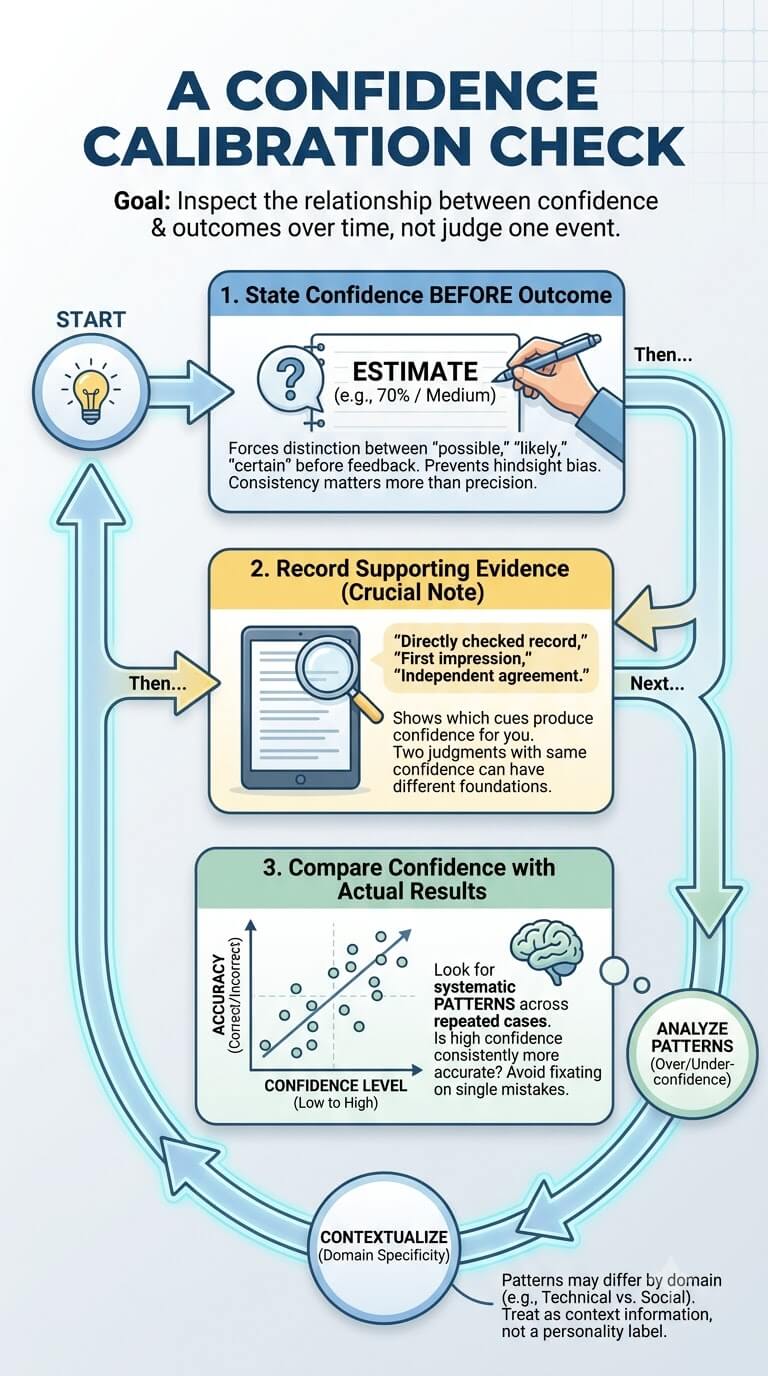
If you want to know whether your confidence is useful, inspect the relationship between confidence and outcomes rather than judging yourself from one event. A simple record can make this visible without becoming a psychometric test.
State the confidence before seeing the outcome
Before checking the answer, write a rough estimate such as 55, 70, or 90 percent. Exact numbers are not sacred. Their value is that they force you to distinguish “possible,” “likely,” and “almost certain” before feedback changes your memory of how sure you were.
If percentages feel artificial, use three levels such as low, medium, and high confidence. Consistency matters more than precision.
Record what evidence supported the judgment
Add one short reason: “directly checked the record,” “remembered from last week,” “two independent sources agree,” “first impression,” or “familiar but not verified.” This shows which cues tend to produce confidence for you.
The evidence note is crucial because two judgments with the same confidence level may rest on very different foundations.
Compare confidence with actual results across repeated cases
After enough cases, look for a pattern. Are high-confidence judgments more accurate than medium-confidence ones? Do you remain extremely certain even when evidence is indirect? Are you often correct despite rating yourself as doubtful?
Wokke and colleagues’ work on metacognitive monitoring during decision-making reflects the broader research interest in how people evaluate their decisions when deciding what to do next.
Look for systematic overconfidence or underconfidence rather than one mistake
A single wrong answer made with high confidence is memorable, but it does not define your overall calibration. Everyone can have isolated misses. What matters is whether certainty is repeatedly too high or too low relative to outcomes.
Patterns may also be domain-specific. You might be well calibrated about technical work and poorly calibrated when interpreting ambiguous social situations. Treat the pattern as information about a context, not a label for your personality.
How to Use Confidence More Wisely
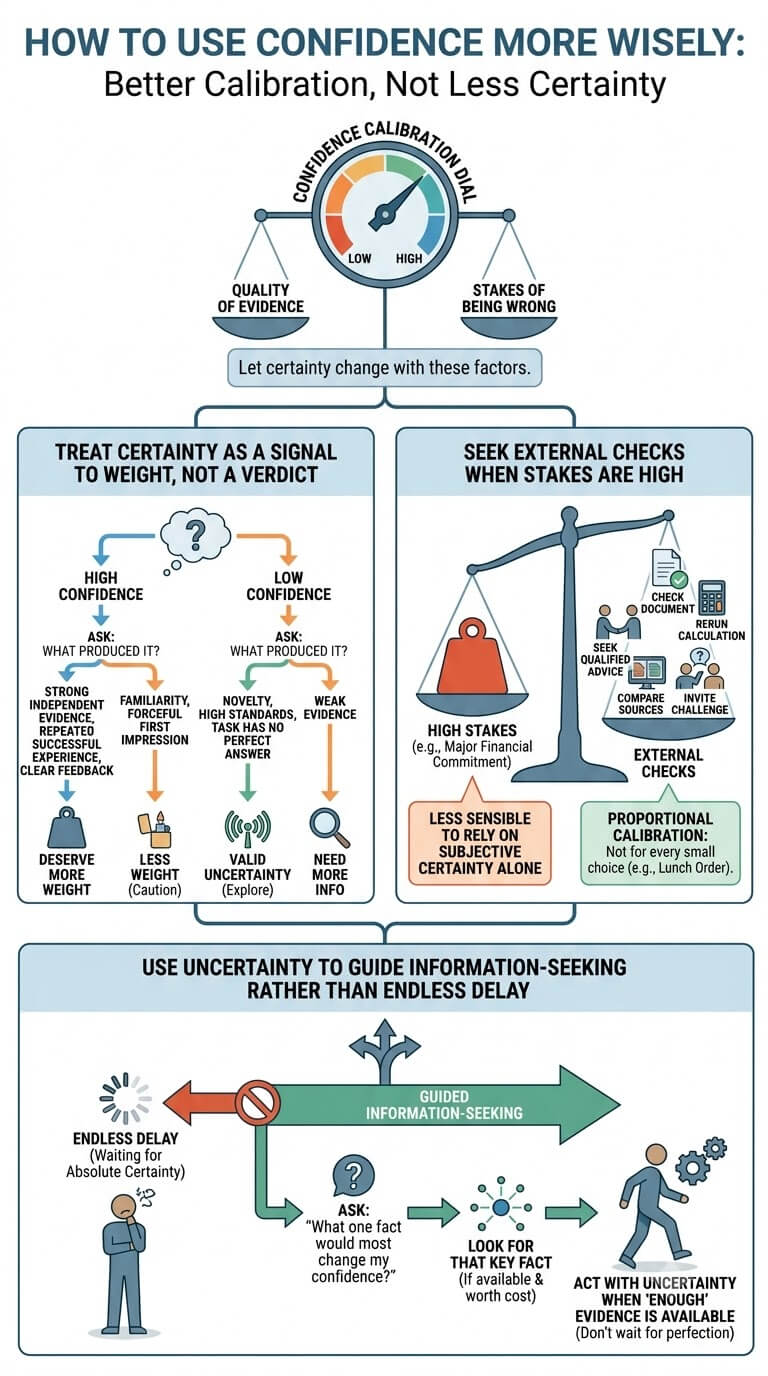
Better calibration does not mean becoming less confident. It means letting certainty change with the quality of the evidence and the stakes of being wrong.
Treat certainty as a signal to weight, not a verdict
When confidence is high, ask what produced it. Strong independent evidence, repeated successful experience, and clear feedback deserve more weight than familiarity or a forceful first impression.
When confidence is low, ask the same question. The uncertainty may reflect weak evidence, but it may also reflect novelty, high standards, or a task that naturally has no perfect answer.
Seek external checks when stakes are high
The higher the consequence of error, the less sensible it is to rely on subjective certainty alone. Check the document, rerun the calculation, seek qualified advice, compare independent sources, or invite someone to challenge your reasoning.
This is not a demand to verify every small choice. Calibration should be proportional. Choosing a lunch order and approving a large financial commitment do not require the same confidence threshold.
Use uncertainty to guide information-seeking rather than endless delay
Uncertainty can tell you what information would be most valuable next. Ask, “What one fact would most change my confidence?” Then look for that fact if it is available and worth the cost.
In decision-making, confidence becomes most useful when it helps determine whether to act, verify a weak assumption, or seek more information.
At some point, further checking produces little benefit. A calibrated thinker can act with uncertainty when enough evidence is available, rather than waiting for a feeling of absolute certainty that may never arrive.
Everyday Examples
Confidence becomes easier to understand when you separate the feeling of certainty from what the situation actually provides.
Confidently remembering a detail that is wrong
Situation: You clearly remember a meeting being scheduled for Thursday, but the calendar shows Friday. What you may feel: surprise or even resistance because the memory felt vivid. What it may mean: vividness contributed to confidence, but the external record carries stronger evidence. What to do next: update the fact and remember that vivid recall is not the same as verified recall.
Memory is one area where this distinction matters because a recollection can feel highly certain without being perfectly accurate.
Feeling unsure about a well-supported work answer
Situation: You complete an unfamiliar analysis, check the formula twice, and reach the same result, yet you still feel only moderately confident. What you may feel: concern that uncertainty means incompetence. What it may mean: unfamiliarity is lowering subjective certainty even though the evidence is solid. What to do next: use feedback from repeated cases to see whether your confidence needs to rise, rather than changing correct work just to remove discomfort.
Mistaking a fast answer for a well-reasoned answer
Situation: Someone asks why a project failed, and an explanation comes to mind instantly. What you may feel: strong certainty because the answer feels obvious. What it may mean: speed may reflect familiarity or a dominant narrative, not a complete review of evidence. What to do next: name at least one alternative explanation and check which evidence would distinguish between them.
Adjusting confidence after new evidence
Situation: You initially think a delivery delay was caused by a supplier, then see tracking data showing the shipment left on time. What you may feel: reluctance to abandon the first explanation. What it may mean: the evidence changed, so the confidence estimate should change too. What to do next: lower confidence in the original explanation and redirect attention to other possible causes.
Common Confidence Mistakes
Many calibration problems are reinforced socially because certainty is easy to notice, while the accuracy of the certainty may only become visible later.
Rewarding certainty instead of calibration
Teams sometimes treat the fastest, most decisive speaker as the most knowledgeable. That can reward confidence displays instead of evidence quality. A better question is, “What would change your mind?” Someone who can answer that clearly may be more informative than someone who never expresses uncertainty.
Assuming hesitation means incompetence
Hesitation may reflect confusion, but it can also reflect awareness of ambiguity. In complex work, a person who says “I am moderately confident because two assumptions are still unverified” may be thinking more carefully than someone who offers certainty without conditions.
Do not romanticize doubt either. The point is to evaluate whether uncertainty tracks real limitations in the evidence.
Updating the answer but not the confidence level
Sometimes people add new information to a conclusion without changing how certain they feel. If evidence weakens, confidence should usually move down. If independent evidence strengthens, confidence can move up.
A useful habit is to treat confidence as revisable. Updating is not inconsistency when the information has changed. It is what calibration requires.
FAQ About Metacognitive Confidence
These questions clarify several counterintuitive features of confidence and self-evaluation.
Can confidence be accurate even when an answer is wrong?
Yes, in a limited sense. If you say an answer is only 55 percent likely to be correct and it turns out to be wrong, that single outcome does not show poor calibration. A 55 percent estimate already allows substantial probability of error. Calibration is assessed across repeated judgments, not by requiring every high-probability event to happen and every low-probability event to fail.
Is overconfidence the same as poor metacognition?
No. Overconfidence is one possible form of miscalibration, but metacognition includes more than average confidence level. Someone might generally express too much confidence yet still distinguish their stronger answers from weaker ones reasonably well. Another person might use moderate confidence levels but fail to tell when their answers are more or less reliable. The underlying profile can differ.
Can someone be chronically underconfident but accurate?
Yes. A person can perform well while consistently rating confidence below what their results would justify. High standards, unfamiliarity, limited positive feedback, or a conservative threshold for saying “I am sure” may contribute. The useful response is not simply to “believe in yourself,” but to compare confidence with repeated outcomes and update the estimate when the evidence warrants it.
Does more knowledge always improve confidence calibration?
No. More knowledge can provide better evidence and richer feedback, which may improve calibration, but knowledge and metacognitive accuracy are not identical. People can know a great deal while misjudging which answers are strongest, especially in environments with weak feedback. Calibration improves when confidence is repeatedly confronted with outcomes, not merely when information accumulates.
Key Takeaways
- Metacognitive confidence is a judgment about the likely correctness of your own perception, memory, reasoning, or decision.
- Confidence level, objective accuracy, calibration, and metacognitive sensitivity answer different questions.
- High certainty can be based on strong evidence, but it can also be inflated by familiarity, expectations, speed, or weak feedback.
- Low confidence does not automatically indicate poor performance, especially on difficult or unfamiliar tasks.
- The most useful confidence check compares predictions with outcomes across repeated cases instead of labeling yourself from one mistake.
- In high-stakes situations, subjective certainty should be combined with external verification and a willingness to update when evidence changes.

Michael Reed is the Founder and Lead Writer at Psychology Exposed. He writes about human behavior, relationships, emotional patterns, self-awareness, and practical psychology topics using research-informed, easy-to-understand content.
Read More About Michael Reed: https://psychologyexposed.com/michael-reed/