

You read an explanation and it seems obvious. You watch someone solve a problem and feel as if you could do the same thing. You recognize every term in a meeting, so you assume the whole idea is clear. Then the source disappears, someone asks you to explain it, or you have to use the knowledge in a new situation, and the feeling of understanding suddenly collapses.
This is one form of the illusion of knowing: a mismatch between how well something feels known and what you can actually recall, explain, or apply. The feeling is not foolish or pathological. It often comes from real cues, such as familiarity and ease of processing. The problem is that those cues do not always predict the task you will face later.
The useful question is not “Can I trust my mind?” It is “What evidence would show that this particular feeling of knowing is justified?” That small shift turns a vague impression into something you can test.
Quick Answer: Recognition Can Create a Feeling of Knowledge That Recall or Explanation Does Not Support
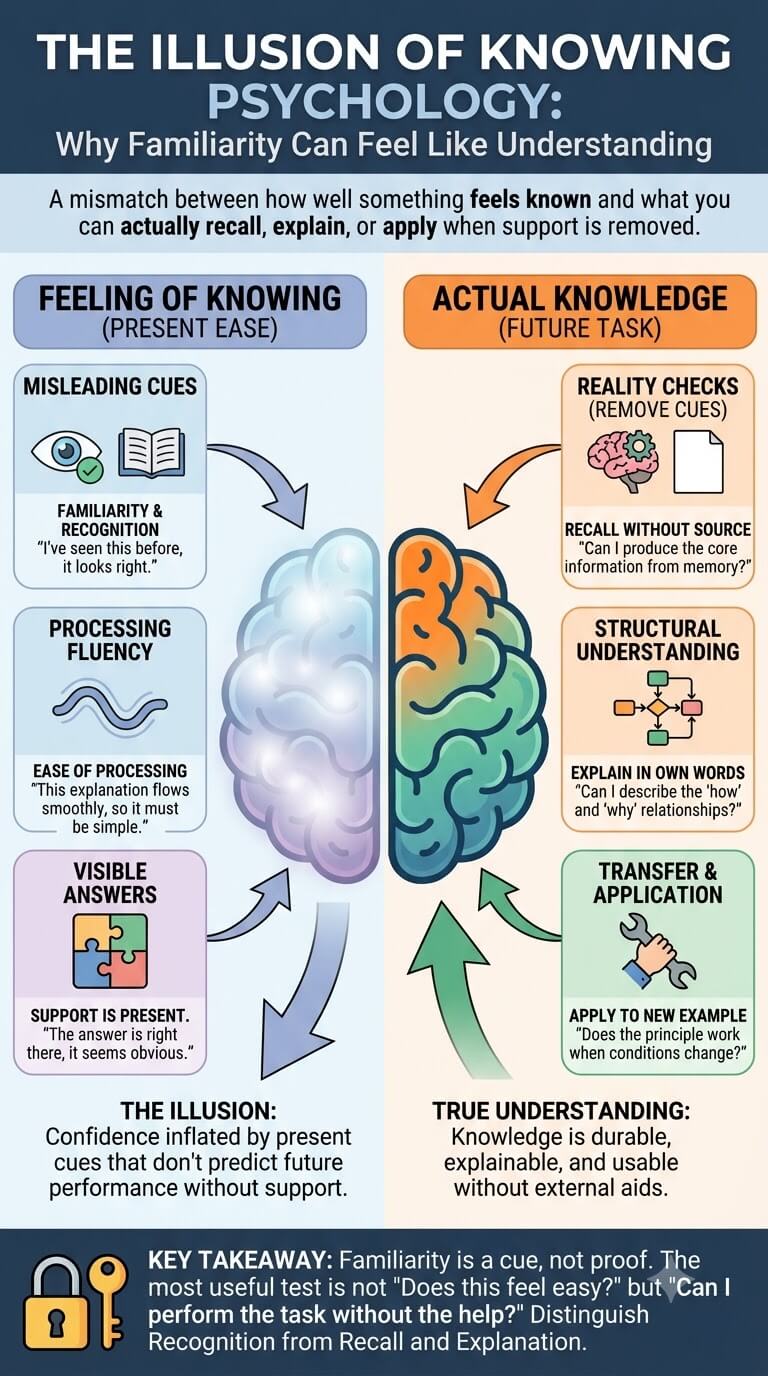
The illusion of knowing happens when a cue such as familiarity, fluency, or having the answer visible creates more confidence than your actual knowledge supports. Material may feel easy while you are looking at it, yet become hard to retrieve or explain when the cue is removed. The best correction is to test the kind of performance you will actually need later.
Familiarity is a cue, not proof
Familiarity tells you that your mind has encountered something before. That can be useful. A familiar name, concept, or procedure may genuinely be easier to work with than a completely new one. But familiarity does not tell you how detailed, durable, or usable the knowledge is.
You might recognize a term immediately but be unable to define it. You might know the steps of a process when they are listed but fail to generate them from memory. In both cases the feeling of knowledge came from a real cue, but the cue answered a smaller question than the one you cared about.
The illusion appears when the cue is easier than the later task
A common mismatch occurs when information is present during judgment but absent when you later need it. Looking at a correct answer makes retrieval feel easier because the answer itself is helping you. Watching an expert gives you a complete path through the problem, while solving it alone requires you to generate that path.
Koriat and Bjork examined this kind of mismatch in research on mending metacognitive illusions. Their work is useful because it shows that improving judgment depends partly on becoming more sensitive to the conditions under which knowledge will later need to be retrieved.
What the Illusion of Knowing Means
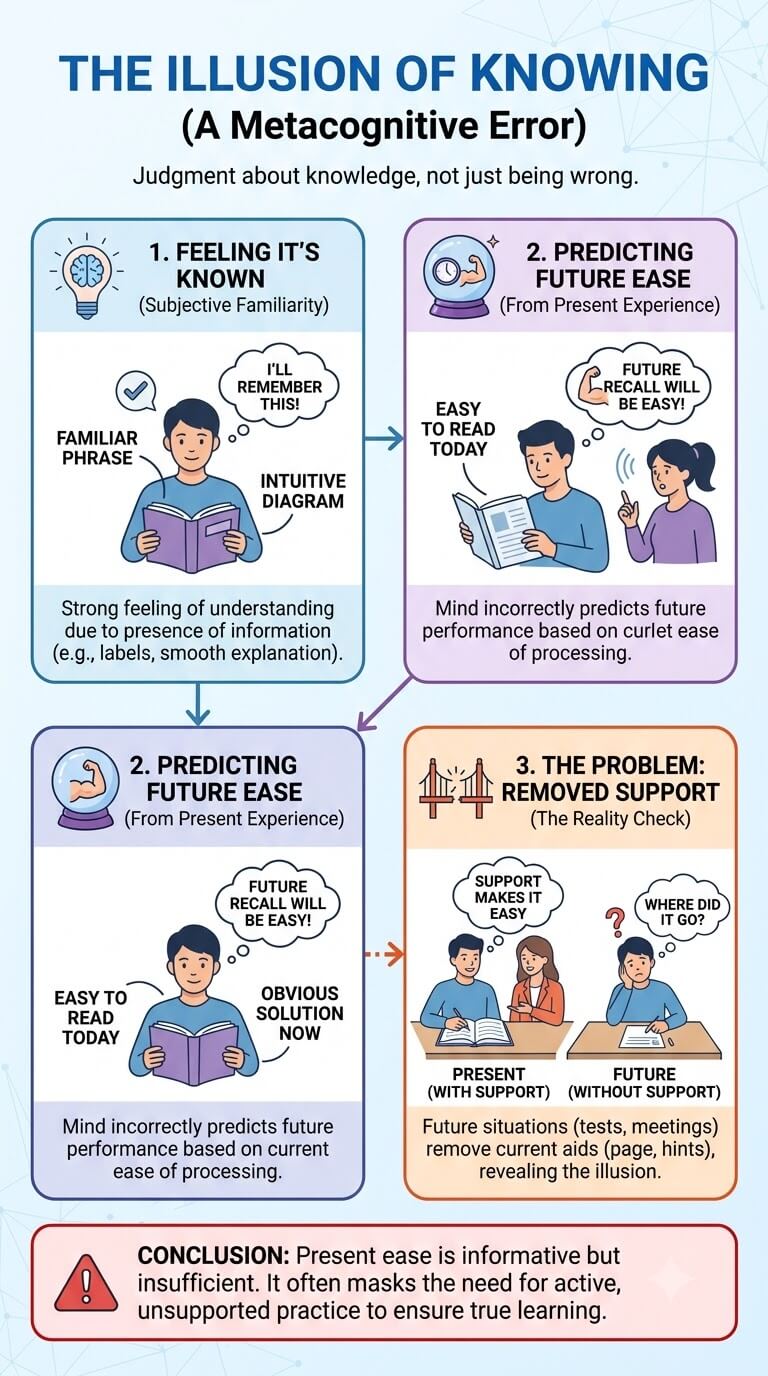
The illusion of knowing is not simply “being wrong.” It is a metacognitive error, meaning the error lies in your judgment about your knowledge rather than necessarily in the information itself. You may have learned something, but misjudge how available or complete that learning is.
Feeling that information is known
The subjective feeling can be strong. A phrase looks so familiar that you cannot imagine forgetting it. An explanation flows so smoothly that you assume you could reproduce it. A diagram seems intuitive while all the labels are present, so you feel you understand the mechanism underneath.
Predicting future performance from present ease
Many illusions arise because the mind predicts the future using the experience available now. If a page is easy to read, tomorrow’s recall may also feel as if it will be easy. If the solution is obvious after someone explains it, solving a similar problem alone may seem straightforward.
The prediction can fail because the future situation removes support that exists in the present. Tomorrow the page will not be in front of you. During the meeting, nobody may provide the missing term. On the test, you may need to generate an answer instead of recognize it. Present ease can therefore be informative without being sufficient.
Why Familiarity Feels So Convincing

Familiarity is persuasive because it changes the experience of processing information. Repeated or clearly presented material tends to feel smoother. The mind can then use that smoothness as evidence that learning is strong, even when the relationship between ease and later performance is weak.
Repetition increases fluency
On a second or third reading, sentences often move faster. You know what is coming. Difficult transitions stop feeling difficult because you have already seen them. That increased fluency can be mistaken for an increase in mastery.
Visible answers make retrieval feel easier than it will be
Imagine reviewing a list of questions with the answers directly underneath. Every answer seems obvious. Now cover the answers and try to produce them. The experience changes because recognition and retrieval are different tasks.
Clear explanations can make the reader confuse the author’s understanding with their own
A skilled writer or teacher can make a difficult idea feel simple because the steps are organized, examples are well chosen, and unnecessary complexity has been removed. That clarity is valuable, but it can create a subtle trap: following a good explanation is not the same as being able to reconstruct it independently.
Familiar labels hide missing causal detail
Words such as “inflation,” “attachment,” “algorithm,” “feedback,” or “bias” can become so familiar that the label itself feels like an explanation. You may know roughly what category the term belongs to without knowing what causes what, what conditions matter, or how the process changes across situations.
Recognition vs Recall vs Explanation

Three tasks can feel similar while asking very different things from memory and understanding. Distinguishing them is one of the fastest ways to detect an illusion of knowing.
| Test | What it asks | Typical false reassurance |
|---|---|---|
| Recognition | Can I identify something when I see it? | “That looks familiar, so I know it.” |
| Recall | Can I produce the information without the answer present? | “I will remember it later because it is obvious now.” |
| Explanation | Can I describe how or why it works in my own words? | “I followed the explanation, so I could teach it.” |
“I have seen this”
Recognition is often the easiest test. A term, face, formula, or idea triggers a sense of familiarity when it appears. Recognition matters in many real tasks, but it can be weak evidence when the future task requires generation.
If you only need to select the correct item from a familiar menu, recognition may be enough. If you need to explain the idea in a meeting with no notes, it is not.
“I can produce this without a cue”
Recall removes some of the support that recognition provides. Instead of asking whether the answer looks right, you ask whether the answer can be produced. This makes gaps visible that were hidden by the source.
“I can explain how and why it works”
Explanation goes beyond producing a fact. You need relationships, causal steps, limits, or examples. Someone may remember the definition of a concept while still lacking the structure needed to use it well.
Why these are different tests of knowledge
There is no single universal test for knowing. What counts as enough knowledge depends on the task. Recognition, recall, explanation, discrimination, prediction, and application place different demands on what you know.
Everyday Forms of the Illusion
The illusion of knowing is easiest to understand when you notice the small moments in which cues make performance look stronger than it is.
Rereading notes or instructions
You reread a set of instructions and every step looks clear. Because nothing surprises you, the procedure feels learned. Later, with the instructions closed, the middle steps blur together.
What you may feel: “I definitely know this now.” What it may mean: the material has become familiar, but independent retrieval has not been tested. What to do next: hide the instructions and reconstruct the sequence, then compare it with the original.
Watching an expert solve a problem
An expert moves through a calculation or technical task smoothly. Each step makes sense once it is shown. When you try a new version alone, you do not know which step should come first.
What you may feel: “That was easy.” What it may mean: the expert supplied choices you have not yet learned to generate. What to do next: take a fresh example and decide the first move before looking at a demonstration.
Recognizing a concept name but not its mechanism
You hear a familiar psychology term and can give a short definition. When asked how the process operates or when it would not apply, your answer becomes vague.
What you may feel: “I know this topic.” What it may mean: you know the label and broad category better than the causal structure. What to do next: explain the mechanism as a sequence and add one example that changes an important condition.
Feeling sure a memory will be available later
A name, appointment, or idea is vivid while it is in front of you, so writing it down seems unnecessary. Hours later you remember that there was something important but cannot recover the detail.
What you may feel: “There is no way I will forget that.” What it may mean: current accessibility is being used to forecast future accessibility. What to do next: when the consequence of forgetting matters, use an external reminder rather than treating vividness as a guarantee.
The Role of Processing Fluency
Processing fluency is the subjective ease with which information is processed. It is one of several cues that can influence judgments about learning and knowledge. The important point is not that fluency is always misleading, but that people can give it more weight than the situation warrants.
Easy processing can raise judgments of learning
Rhodes and Castel found that perceptual information influenced memory predictions: participants’ judgments of learning were affected by font size even though font size had little relationship with later recall in their experiments. The finding illustrates a broader point about metacognition. A feature can influence how learnable something feels without being a strong predictor of the later outcome.
Fluent cues can be valid sometimes and misleading other times
Fluency is not useless noise. Material can be easier because you genuinely know it better. A familiar vocabulary may help you understand a text faster, and well-practiced procedures often do become more fluent with expertise.
The challenge is cue validity. Ask whether the reason something feels easy is connected to the future task. If it feels easy because you have practiced retrieving and using it, fluency may reflect real learning. If it feels easy because the answer is visible, the page is familiar, or someone else has organized the reasoning, the cue deserves more caution.
Sungkhasettee and colleagues used an unusual manipulation in research on memory and metamemory for inverted words, contributing to evidence that subjective ease and actual learning can come apart. The broader lesson is that difficulty during processing should not automatically be interpreted as poor learning.
Illusion of Knowing vs Metacognitive Confidence
These ideas overlap, but they are not interchangeable. Confidence is the broader judgment of how likely you think you are to be correct or successful. An illusion of knowing describes a more specific mismatch in which cues create a feeling of knowledge that is stronger than performance supports.
Confidence is the broader judgment
You can be confident or uncertain for many reasons: evidence quality, prior experience, agreement from others, emotional state, task difficulty, memory strength, or perceptual ease. A confidence judgment combines information from multiple sources.
The illusion is a metacognitive problem because the mind is making a judgment about the quality or availability of its own knowledge.
Fluency and familiarity are specific inputs that can inflate it
In the illusion discussed here, familiarity or easy processing is doing much of the persuasive work. “I recognize it immediately” becomes “I know it.” “The explanation was easy to follow” becomes “I understand it deeply.”
This article therefore focuses on the source of the misjudgment. A broader discussion of how we monitor and regulate our own thinking helps place this specific error inside the larger metacognitive process.
Illusion of Knowing vs Overestimating What You Know
A local illusion during one task should not be confused with a broad judgment about the range or depth of your knowledge. The distinction matters because the most useful correction is different.
Local illusion during a task or learning episode
You reread a page and overpredict how much you will remember. You watch a demonstration and assume you can reproduce it. You see a mechanism explained and believe the missing steps are already understood.
These are local mismatches. The immediate problem is that the cue available now does not represent the later task very well.
Broader calibration error about the depth or range of knowledge
Someone may also overestimate their overall knowledge of a field, topic, or skill. That judgment can reflect many factors beyond familiarity, including limited feedback, vague standards, selective experience, or not knowing what expertise in the domain actually requires.
When the miscalibration extends beyond one familiar item or task, it becomes more useful to examine why people overestimate what they know.
The present issue is narrower. It asks why something feels known in the moment, especially when visible cues or smooth processing are present.
Three Reality Checks for Understanding

You do not need a complicated self-assessment system. Three checks cover many of the gaps that familiarity can hide: retrieve, explain, and transfer.
Recall it without the source in front of you
Remove the cue. Close the note, turn over the card, hide the answer, or step away from the tutorial. Then produce the important information from memory.
Do not demand perfect wording. The test is whether the central information is accessible without being shown. If you recover only fragments, that is a more useful signal than the earlier feeling that everything looked familiar.
Explain it in your own words and include the causal steps
An explanation check asks for structure. Describe what happens first, what changes next, and why the parts connect. Use an example that is not copied from the source.
If you can state the label but cannot connect the steps, identify the missing link rather than rereading everything. A precise gap is easier to repair than the vague conclusion “I guess I do not understand this.”
Apply it to a new example or predict what would happen next
Transfer is a stronger test because the surface details change. If you understand a principle, you should often be able to recognize where it applies and where it does not, even when the example looks different.
Try changing one condition. Ask, “Would the same explanation still work?” or “What would I predict if this variable changed?” A good answer shows that the idea is doing more than sitting in memory as a familiar phrase.
Why Reality Checks Sometimes Feel Uncomfortable
Removing cues often makes performance feel worse immediately. That can be discouraging, especially after a smooth reading or demonstration. The discomfort is not necessarily evidence that the check harmed learning. It may simply have exposed information that the easier activity concealed.
Retrieval difficulty can reveal a useful gap
When recall stalls, you learn where access is weak. That is actionable information. You can revisit the missing part, rebuild the connection, and test again later.
A passive review can feel better while giving you less diagnostic information. A harder check may therefore be more useful precisely because it makes the weakness visible.
Difficulty is not the same as failure
People sometimes interpret effort as proof that learning is going badly. But some effective learning activities feel less fluent than passive exposure. Bjork, Dunlosky, and Kornell’s review of self-regulated learning, beliefs, techniques, and illusions discusses how people’s mental models of learning can lead them to misassess and mismanage their own learning.
The practical takeaway is not to seek difficulty for its own sake. It is to stop using ease as the only score.
Feedback may temporarily reduce confidence while improving calibration
Discovering that you cannot explain something you thought you knew can lower confidence. That change may feel like a setback, but more accurate confidence is often more useful than inflated confidence.
After a reality check, update the judgment rather than your identity. “I cannot yet explain step three” is more precise than “I am terrible at this.” The first statement tells you what to work on.
Common Attempts That Do Not Fix the Illusion
When a gap appears, people often reach for activities that recreate the same feeling of familiarity. Those activities may have value, but they do not directly test the problem that created the illusion.
More passive exposure
Reading the same page again can increase fluency further. If the issue is that fluency already feels like mastery, additional exposure may strengthen the feeling without showing whether recall or explanation improved.
A better sequence is exposure followed by an active check. Review what you missed, then close the material and try again.
Highlighting familiarity as mastery
Highlighting can help organize attention, but the highlighted sentence remains visible. Seeing a marked passage later can make it especially familiar without showing that you could produce or use the idea independently.
If highlighting is useful to you, pair it with a question in the margin or a short retrieval prompt. The mark then points toward an action instead of serving as evidence that the material is mastered.
Asking only “does this make sense?”
“Does this make sense?” is a weak test because a clear explanation can feel coherent while you are looking at it. A more diagnostic question is “Can I explain this without the source?” or “What would happen in a new example?”
Coherence matters, but comprehension should survive some removal of support.
What to Do Next When Familiarity Outruns Understanding
Once the mismatch is visible, the response can be simple. You do not need to relearn the entire subject. Find the gap, match the check to the real demand, then update your confidence from the result.
Name the exact missing piece
Replace “I do not know this” with a narrower description: “I remember the definition but not the mechanism,” “I can follow the example but cannot choose the method alone,” or “I recognize the name but cannot retrieve the date.”
Specificity prevents wasted effort. It also makes improvement easier to notice.
Choose a check matched to the real task
If you need to remember, practice retrieval. If you need to explain, reconstruct the causal chain. If you need to solve, work a fresh problem. If you need to make a decision, identify the evidence and the assumptions rather than simply repeating the conclusion.
The closer the check is to the future use, the more informative it becomes.
Update confidence after the check
Do not keep the original feeling of certainty after new evidence appears. If the check went well, confidence has stronger support. If it exposed a gap, lower confidence only as much as the gap warrants.
This is the corrective loop: a feeling makes a prediction, performance tests the prediction, and the judgment changes in response to the result. Over time, this can make familiarity a useful cue rather than a cue you obey automatically.
FAQ About the Illusion of Knowing
The illusion is often confused with broader ideas about intelligence and overconfidence. These distinctions keep the concept useful without stretching it beyond what it explains.
Is the illusion of knowing the same as the Dunning-Kruger effect?
No. The illusion described here is a specific metacognitive mismatch in which cues such as familiarity, visible information, or processing ease make knowledge feel stronger than a later test supports. The Dunning-Kruger literature concerns relationships between performance and self-assessment under particular conditions. Using that label for every moment of overconfidence oversimplifies both ideas.
Can experts experience familiarity-based illusions?
Yes. Expertise does not remove all metacognitive error. Experts may have better domain knowledge and more informative cues, but familiar routines can also make assumptions automatic. A highly experienced person can still mistake a familiar-looking case for a routine one or overestimate how obvious a procedure will be to someone without the same background.
Why does rereading feel productive?
Rereading reduces novelty and often makes the material easier to process. That smoother experience can feel like progress, and sometimes it does accompany learning. The limitation is that rereading does not directly reveal whether you can retrieve, explain, or apply the material without the page. Pairing rereading with an active check gives you better evidence.
Is feeling of knowing always inaccurate?
No. Feelings of knowing can be useful and sometimes predict performance reasonably well. The problem is not having the feeling. It is relying on a cue without asking whether that cue is valid for the task. Familiarity earned through successful practice may be informative; familiarity created by repeated exposure or visible answers may be less so.
Key Takeaways
- The illusion of knowing is a mismatch between how well information feels known and what recall, explanation, or application actually supports.
- Familiarity and processing fluency are real cues, but they can become misleading when the future task removes the support available now.
- Recognition, recall, and explanation are different tests. Choose the one that resembles how you will need to use the knowledge.
- A clear explanation can feel easy because someone else has organized the reasoning. Reconstructing it independently is a stronger test of your own understanding.
- Three useful reality checks are retrieval without cues, explanation in your own words, and transfer to a new example.
- When a check exposes a gap, update the judgment precisely. The useful conclusion is often “this part needs work,” not “I know nothing.”

Michael Reed is the Founder and Lead Writer at Psychology Exposed. He writes about human behavior, relationships, emotional patterns, self-awareness, and practical psychology topics using research-informed, easy-to-understand content.
Read More About Michael Reed: https://psychologyexposed.com/michael-reed/