
You can spend an hour with material that feels clear and discover the next day that very little is available without the page in front of you. You can also struggle through a difficult practice attempt, feel as if you learned almost nothing, and later perform better because the struggle exposed exactly what needed work. The difference is not simply effort. It is partly about how accurately you judge your own learning.
Metacognition enters learning when you predict what will be hard, notice what makes sense, judge whether you could retrieve or apply an idea later, and use those judgments to decide what to practice next. Those decisions matter because learners rarely have unlimited time. If the signal saying “I know this” is wrong, you may stop too early. If the signal saying “I am failing” is wrong, you may abandon a useful form of practice simply because it feels difficult.
The focus here is narrower than the whole science of learning: what does your current performance actually show, and how should that evidence change what you do next?
Quick Answer: Learning Decisions Depend on What You Think You Know
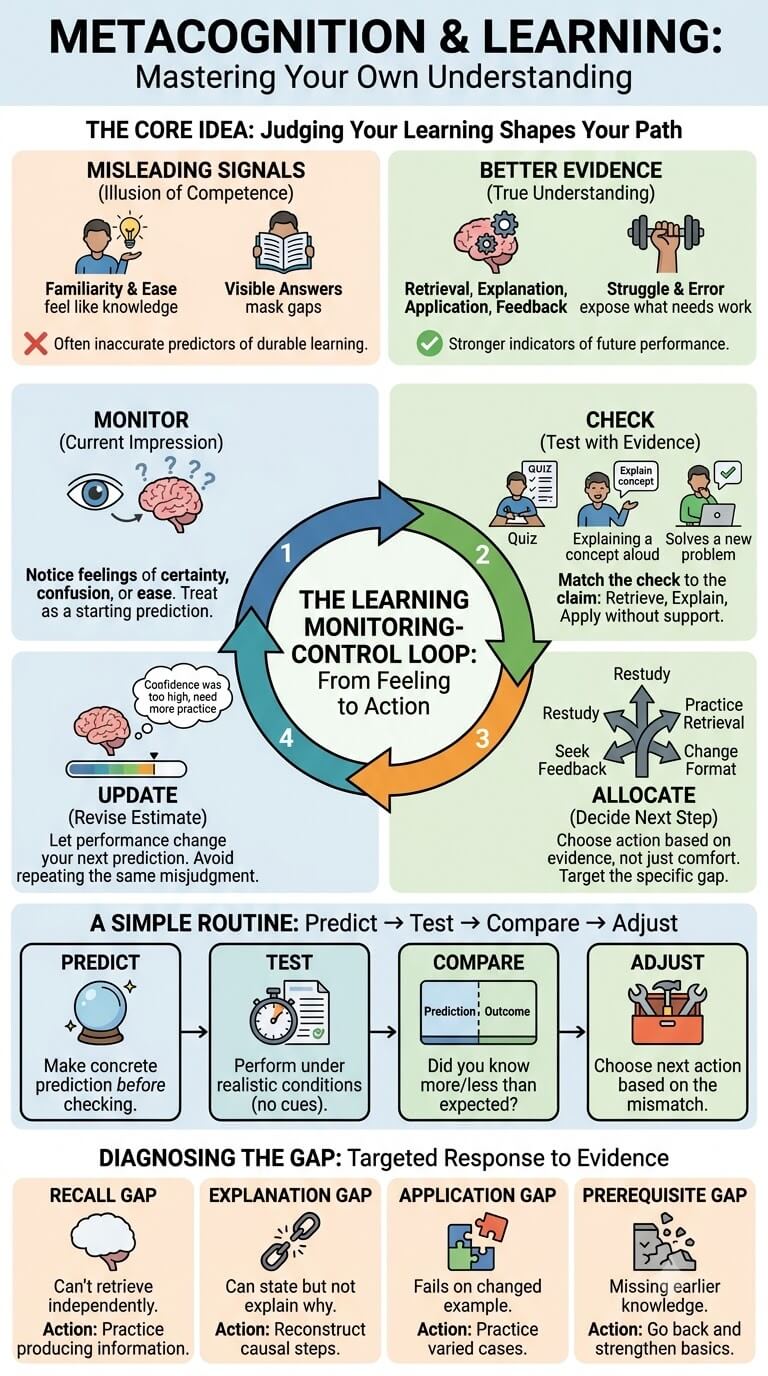
Metacognition affects learning by helping you estimate what you understand, predict what you will remember, check those estimates against performance, and decide where to spend more effort. The difficulty is that feelings of familiarity, fluency, and recent success can make learning seem stronger than it is. Better learning decisions come from comparing subjective judgments with evidence such as retrieval, explanation, application, and feedback.
Monitoring guides what you practice, revisit, or stop
Every learner makes control decisions, even without using psychological language. You decide whether to reread a section, practice another example, ask someone for clarification, move to the next topic, or stop for the day. Those choices depend partly on an internal estimate of how well things are going.
Research often separates monitoring, your judgment about learning, from control, what you do because of that judgment. Stanton and colleagues’ review of metacognition and student learning describes planning, monitoring, and evaluating as parts of regulating learning, not merely knowing that strategies exist.
The problem appears when the monitoring signal is wrong
If you believe a concept is mastered because the explanation looks familiar, you may move on before you can produce the idea yourself. If you interpret slow retrieval as proof that nothing was learned, you may replace a demanding but informative activity with an easier one that feels more successful.
Ease, confusion, confidence, and difficulty can provide information. The mistake is treating any one feeling as a direct measure of durable learning.
Where Metacognition Enters the Learning Process
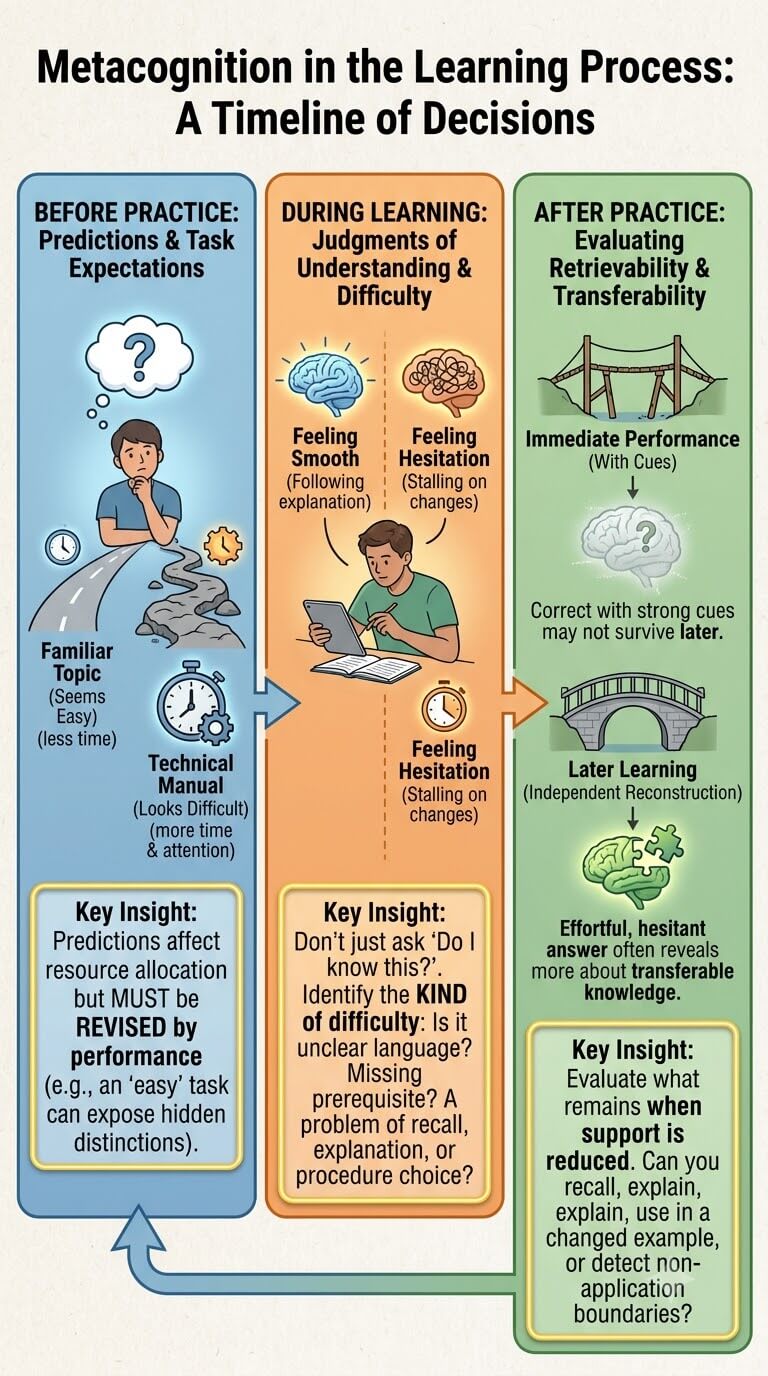
Learning decisions occur before, during, and after practice. The useful signal changes across those moments, so a single question such as “Do I know this?” is often too crude.
Before learning: predictions and task expectations
Before starting, you predict what the task will demand. A familiar topic may seem easy, while a technical manual looks difficult. Those expectations influence how much time and attention you allocate.
Predictions are useful only if performance can revise them. A task that looked easy may expose a distinction you have never made before.
During learning: judgments of understanding and difficulty
During learning, some material feels smooth while other parts produce hesitation. You may follow an explanation while it is visible yet fail to anticipate the next step, or solve a familiar example and stall when one condition changes.
Those cues become useful when you identify the kind of difficulty involved. Is the language unclear, a prerequisite missing, or the problem one of recall, explanation, or procedure choice?
After practice: evaluating what is retrievable or transferable
After practice, ask what remains when support is reduced. Can you recall the main idea, explain why it works, use it in a changed example, or detect when it does not apply?
This matters because immediate performance and later learning are related but not identical. A correct answer produced with strong cues may not survive when those cues disappear. A hesitant answer produced through effort may reveal more about what you can reconstruct independently.
What Is a Judgment of Learning?
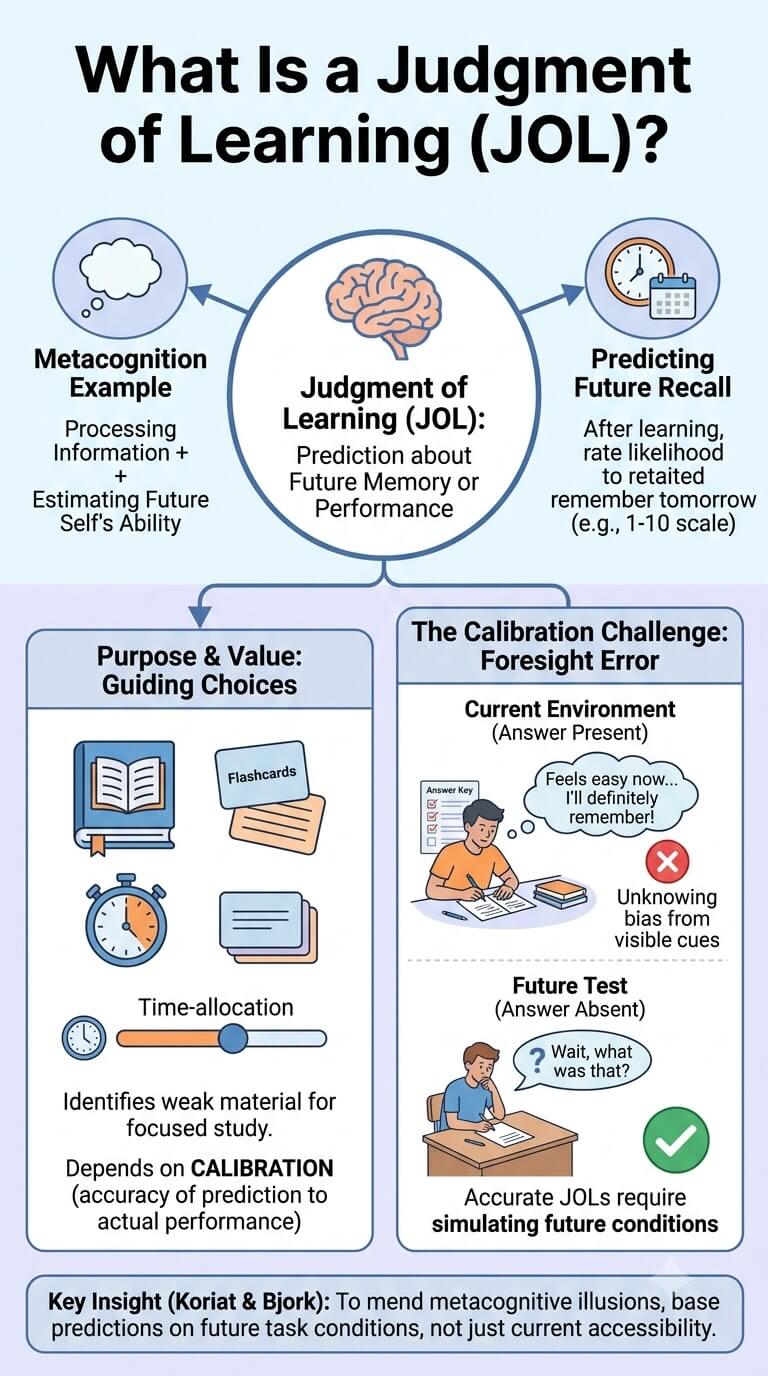
A judgment of learning is a prediction about future memory or performance. It is one of the clearest examples of metacognition because you are not only processing information. You are also estimating what your future self will be able to do with it.
Predicting future recall or performance
Imagine learning twenty new terms. After each one, you rate how likely you are to remember it tomorrow. That rating is a judgment of learning. Similar judgments happen informally when you think, “I will definitely remember this,” “I need to review that again,” or “I could explain this if someone asked me later.”
Learning judgments are closely connected with metamemory because learners are often predicting what will still be available when the material is no longer in front of them.
The judgment can guide useful choices. If it identifies weak material accurately, you can allocate more time there. But the value depends on calibration, meaning the judgment needs to relate reasonably well to later performance.
Why a judgment can feel accurate without being calibrated
People often make learning judgments while the answer, explanation, or cue is still present. That creates a special problem: the current environment contains information the future test may not contain. The learner may unknowingly use the visible answer as evidence that recall will be easy later.
Koriat and Bjork examined this kind of foresight error and found that procedures designed to reduce the bias could improve judgments and study-time regulation. Their work on mending metacognitive illusions is a useful reminder that a prediction about future knowledge should be based on conditions that resemble the future task, not only on how accessible the material feels right now.
The Learning Monitoring-Control Loop
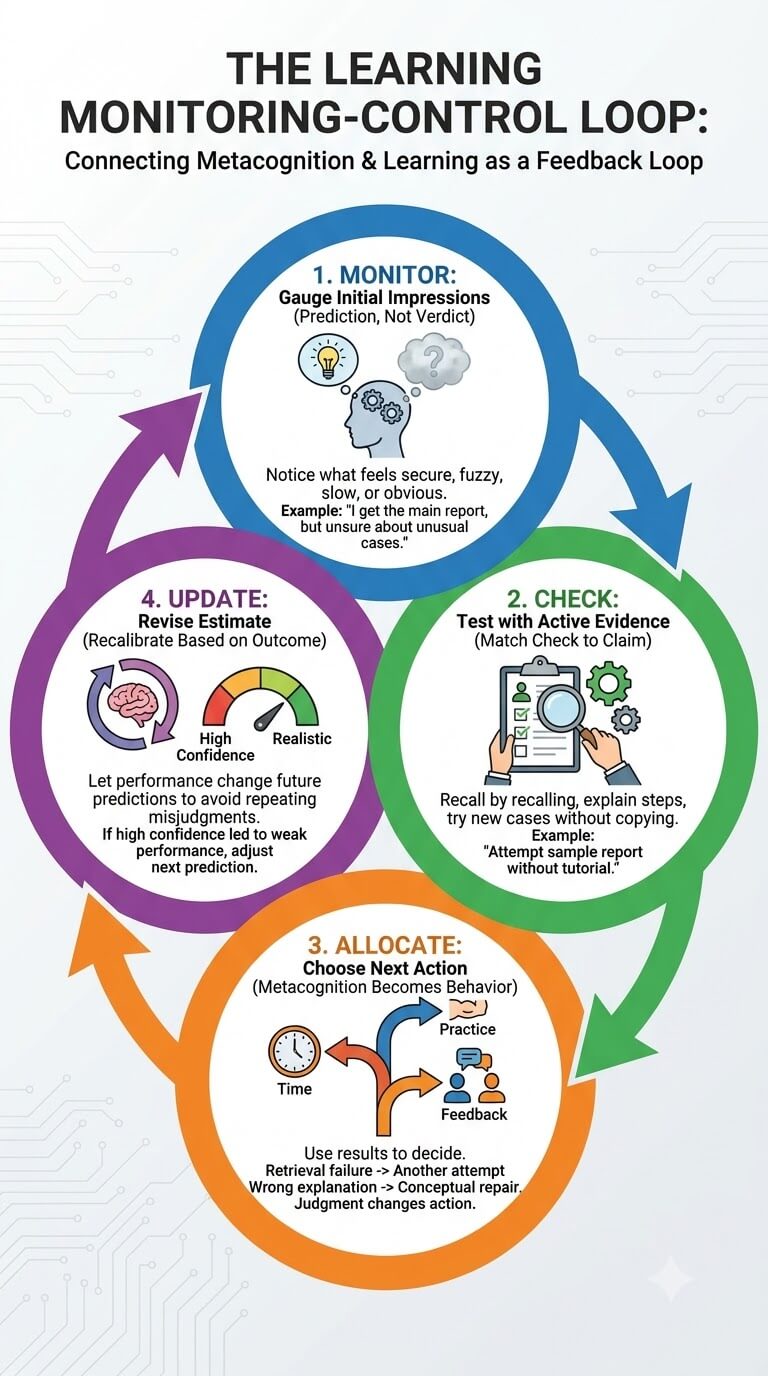
A practical way to connect metacognition with learning is to treat it as a feedback loop rather than a one-time self-rating. The loop has four moves: monitor, check, allocate, update.
These learning judgments are one application of the broader metacognitive process of monitoring and regulating your own thinking.
Monitor what feels known or uncertain
First, notice your current impression: what feels secure, fuzzy, slow, or obvious. Treat that impression as a starting prediction, not a verdict.
For example, after a training session you might think, “I understand how to create the report, but I am not sure which filters apply to unusual cases.” That statement is much more useful than “I mostly get it.”
Check with evidence
Next, match the check to the claim. Test recall by recalling, understanding by explaining the causal steps, and procedural knowledge by trying a new case without copying the completed example.
During the task itself, self-monitoring helps track whether understanding and performance are actually improving.
The check can be informal. A chef can describe a new preparation from memory, a manager can attempt a sample report without the tutorial, and a language learner can produce a sentence rather than only recognize one.
Allocate time, practice, or feedback based on the check
Use the result to choose the next action. A retrieval failure may call for another attempt, a wrong explanation for conceptual repair, and one correct example for a more varied test rather than another easy repetition.
This is where metacognition becomes behavior. The judgment changes what you do next.
Update the estimate after performance
Finally, revise the estimate. If high confidence produced weak performance, the useful response is recalibration: let the outcome change your next prediction.
Without this update, the same misjudgment can repeat. You may keep believing that rereading produces mastery because you never compare the feeling after rereading with later retrieval.
Why Learners Misjudge Understanding
Learning is full of cues that are psychologically persuasive but incomplete. Several of the most common errors come from confusing present ease with future access.
Rereading and familiarity
Repeated exposure makes material feel familiar, but familiarity can be mistaken for independent knowledge. A sentence may seem obvious partly because you have just seen it several times.
What happens after the sentence disappears matters more. If you can reconstruct or use the idea, familiarity has stronger support. If not, it was a weak proxy.
Looking at the answer while judging future recall
It is hard to imagine not knowing something while the answer is visible. The page is supplying the step that later must come from memory.
A better prediction comes after removing the answer. Give yourself enough time for the cue to stop doing the work, then ask what you can generate.
Easy processing mistaken for durable learning
Clear explanations and familiar examples make processing easier, but present ease does not automatically show that knowledge will remain accessible later.
Bjork, Dunlosky, and Kornell reviewed research showing that learners can hold inaccurate beliefs about the conditions that support learning and can mismanage their own learning as a result. Their review of self-regulated learning, beliefs, techniques, and illusions emphasizes the gap between what creates good current performance and what supports durable learning.
Recent success mistaken for flexible knowledge
Getting three similar examples correct can produce a reasonable sense of progress. The mistake is assuming that success proves you can handle changed conditions. If all three examples use the same structure, the task may be partly teaching you what to expect.
A stronger check changes something meaningful. Can you identify the principle when the wording changes? Can you choose among several possible procedures? Can you explain why a tempting alternative is wrong?
Feeling Fluent vs Being Able to Retrieve
Fluency and retrieval often feel different. Fluent processing feels smooth in the moment. Retrieval requires producing information when some of the support is absent. Both experiences tell you something, but they answer different questions.
This is also why the illusion of knowing matters in learning: familiarity can increase faster than the ability to retrieve or explain the material.
| Experience | What it may tell you | What it does not prove |
|---|---|---|
| “This looks familiar.” | You have encountered it before. | You can recall or explain it later. |
| “The example is easy to follow.” | The current explanation is comprehensible. | You can solve a changed example independently. |
| “I retrieved it with effort.” | The information was accessible without full support. | You have mastered every variation. |
| “I got this practice item right.” | Your response matched this item. | The knowledge is durable or transferable. |
Recognition is easier than recall
Recognizing a correct answer among options usually provides more support than generating the answer from scratch. That does not make recognition tasks worthless. It means the task should match the claim you want to make about your knowledge.
If your future task requires recalling a client’s requirements without a prompt, practice that kind of retrieval. If your future task requires choosing the correct safety procedure from clearly labeled options, recognition may be closer to the real demand.
A hard retrieval attempt can expose what is missing
Struggling to retrieve something makes the weakness visible. That is useful because you can respond while there is still time to strengthen access.
Not every difficulty is useful. Confusing instructions, missing prerequisites, and unnecessary complexity can make practice harder without strengthening the skill you need.
Performance during practice is not identical to long-term learning
Strong practice performance can be temporary, while harder-looking practice may still support later access. When learning matters, compare feelings with delayed or changed performance.
This distinction is especially important when choosing whether to stop. “I can do it right now” is weaker evidence than “I could still do it after a delay and when the example changed.”
Better Ways to Check Whether Learning Will Hold Up
The purpose of checking is diagnosis, not collecting techniques. Each check should answer a particular question about your current knowledge.
Try retrieval before reviewing
Before reopening the notes, produce the central idea, steps, or rule from memory, then compare with the source. The specific gap is more useful than a vague feeling that you “need more review.”
If very little comes back, that does not mean the original learning was wasted. It tells you that independent access is weaker than you predicted.
Explain the idea or mechanism from memory
Facts can be recalled without being well understood. Explanation tests relationships: why one step leads to the next, what would change the outcome, and which assumptions matter.
This can be particularly useful for professional learning. Knowing the menu sequence in software is different from understanding what each setting changes and when the default is inappropriate.
Apply it to a changed example
Change one important feature and see whether the principle still works. A salesperson can use a qualification framework with different customer constraints, or a spreadsheet user can work with data arranged differently from the tutorial.
Application reveals whether knowledge is tied too closely to the original example.
Compare your prediction with the outcome
Before checking, make a concrete prediction, such as “I can explain four of five steps,” then compare it with what actually happened.
The prediction is what makes the exercise metacognitively useful. You are not only learning the material. You are learning how reliable your own learning judgments are.
How Metacognition Changes Learning Choices
Monitoring matters because learning time has to be allocated. The same result can call for different next steps depending on the kind of gap you find.
What to restudy
Restudy is more targeted when you know what failed. Strong recall with a shallow explanation may call for reconstructing the mechanism rather than rereading the definition.
Rivers and colleagues discuss the distinction among metacognitive knowledge, monitoring, and control in authentic learning settings. Their guide to measuring metacognitive knowledge, monitoring, and control is useful here because it emphasizes that evaluating learning and choosing what to do about it are related but distinct processes.
When to ask for feedback
Feedback matters most when you know an answer is wrong but cannot tell whether the problem is interpretation, missing knowledge, procedure, or execution.
Ask for feedback that reveals the mismatch. “Which step is unsupported?” is often more useful than “Is this good?” because it gives you information you can use to revise both performance and self-assessment.
When to change the practice format
If repeated practice succeeds but a changed example fails, the format may be too predictable. Try more variation, fewer cues, or a task that requires choosing the method.
When the check shows a real gap, metacognitive strategies help determine whether to change practice, seek feedback, or spend effort somewhere else.
This is a control decision based on evidence, not a rule that difficult practice is always better.
When you have enough evidence to move on
Perfect certainty is unnecessary. Move on when the evidence matches the real demand, with stronger checks for tasks that require independent performance or carry higher consequences.
A useful stopping question is: “What would I need to be able to do later, and have I demonstrated enough of that under similar conditions?”
Metacognition and Learning vs Learning Psychology
The two topics overlap, but they answer different questions. Learning psychology examines how experience changes knowledge, skill, behavior, and performance. Metacognition in learning examines how people judge those changes and regulate what they do next.
Learning Psychology explains mechanisms of change in knowledge and behavior
Learning psychology can cover practice, feedback, reinforcement, observation, skill acquisition, transfer, and many other mechanisms. It asks how learning happens and what conditions shape it.
For metacognitive regulation, those mechanisms matter when they change the evidence you use to judge progress. The central question is not how every form of learning works, but how you evaluate whether current learning is strong enough for the task ahead.
Metacognition focuses on evaluating and regulating your own learning process
The metacognitive question is one level higher: “Given what just happened, what do I think I have learned, how sure am I, and what should I do next?” That involves self-evaluation, calibration, and control.
For the broader framework of awareness, monitoring, and regulation across many kinds of thinking, see how we think about our own thinking. Learning is one domain where those processes become especially visible because performance can often be checked.
Common Metacognitive Mistakes During Learning
Many learning mistakes are not failures of effort. They are failures to use the right evidence when deciding what needs more work.
Choosing practice by comfort
Comfort can pull practice toward material you already know. Familiar tasks produce quick success while weaker areas remain untouched because they feel slower.
A better allocation rule is not “always choose the hardest thing.” It is “choose the next task based on the most important gap you have evidence for.”
Reviewing what feels rewarding rather than what is weak
Revisiting favorite topics or neat examples feels smooth, but it becomes inefficient when the goal is to close a different, weaker gap.
Before reviewing, name the expected benefit: “I am reviewing this because I cannot yet explain the second step,” rather than “I am reviewing because it feels productive.”
Treating one correct answer as mastery
One correct answer is narrow evidence. Check whether the knowledge survives a changed problem or some delay.
Mastery is not an all-or-nothing label. You may be reliable with basic cases and still need practice with exceptions.
Never updating the original confidence estimate
If you predicted success and then failed, the mismatch teaches you something about both the material and the prediction process.
Update both your knowledge and your self-knowledge. You might learn, “I knew less about this topic than I thought,” or more specifically, “I tend to overestimate my understanding when I have just watched a clear demonstration.”
A Simple Learning Calibration Routine
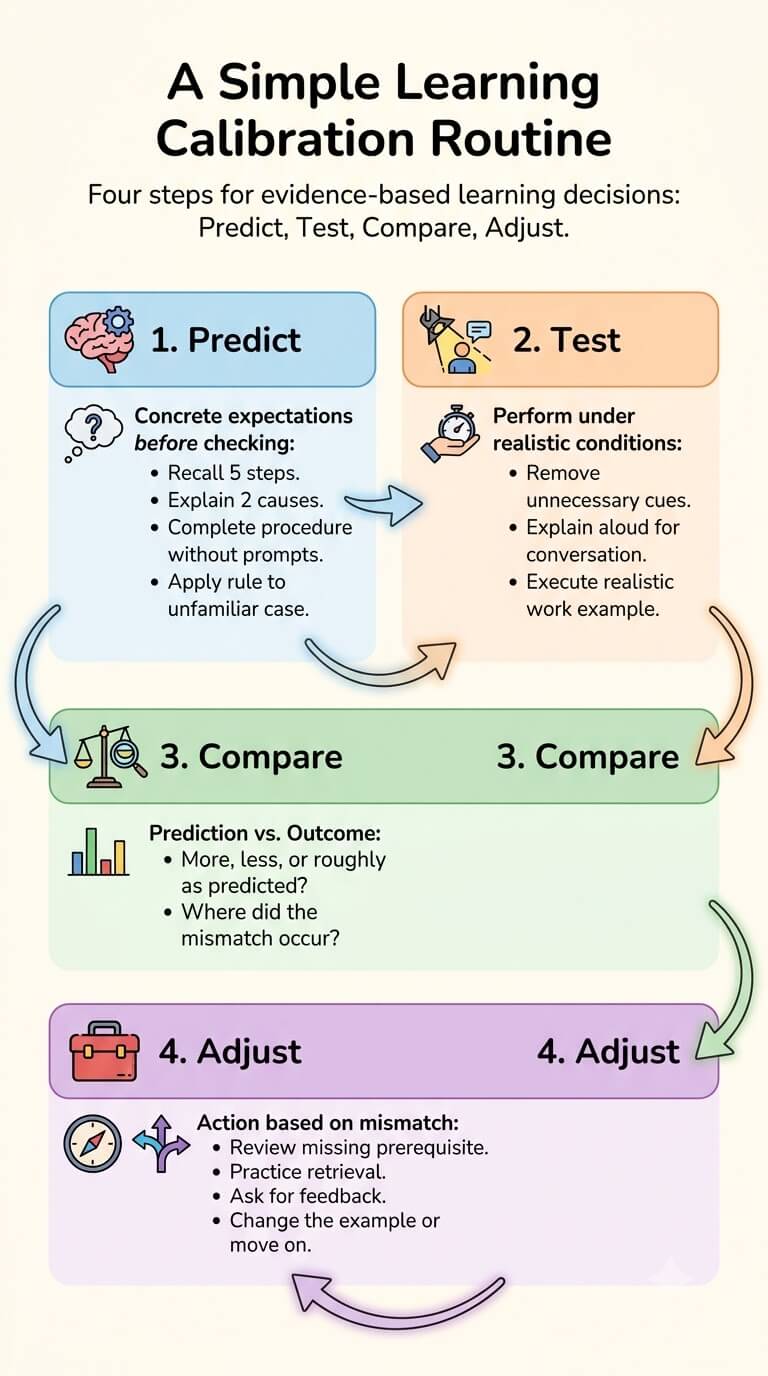
A short calibration routine can make learning decisions more evidence-based without turning every session into an experiment. Use four steps: Predict, Test, Compare, Adjust.
Predict
Before checking the answer, state what you expect to be able to do. Keep the prediction concrete: recall five steps, explain two causes, complete the procedure without prompts, or apply the rule to an unfamiliar case.
Test
Perform the action under conditions that resemble the future demand. Remove unnecessary cues. If you are learning for a conversation, explain the idea aloud. If you are learning a work process, execute a realistic example.
Compare
Compare prediction with outcome. Did you know more than expected, less than expected, or roughly what you predicted? Where did the mismatch occur?
Adjust
Choose the next action based on the mismatch. Review a missing prerequisite, practice retrieval, ask for feedback, change the example, or move on if the evidence is strong enough. Koriat and Bjork’s findings are relevant here because improved judgments can affect how learners regulate study time, although better subjective awareness does not automatically guarantee transfer to every new situation.
What to Do Next When Understanding Is Lower Than Expected
Discovering a gap is useful only if you diagnose the gap well enough to choose a matching response. “I do not know this” is often too broad.
Identify whether the gap is recall, explanation, application, or prerequisite knowledge
- Recall gap: you understand the idea when prompted but cannot retrieve the needed information independently.
- Explanation gap: you can state the fact or rule but cannot explain how or why it works.
- Application gap: you understand the principle in the original example but cannot use it when conditions change.
- Prerequisite gap: the current topic depends on earlier knowledge that is missing or unstable.
These gaps can coexist, but naming the dominant one prevents unfocused review.
Choose the next learning action that matches the gap
A recall gap calls for practice producing information. An explanation gap calls for reconstructing relationships and checking causal understanding. An application gap calls for varied cases. A prerequisite gap may require going backward before more practice on the current task becomes useful.
The next step should respond to evidence, not punish you for getting something wrong. A failed check is successful monitoring if it reveals what to do next.
FAQ About Metacognition and Learning
These questions address common misunderstandings about how monitoring and self-evaluation affect learning.
Does metacognition make learning faster?
Not automatically. Better metacognition can help you allocate effort more intelligently and avoid stopping because of misleading feelings of mastery, but careful checking can also take extra time. The benefit is better decision quality, not guaranteed speed. In some situations, spending more time diagnosing a gap can prevent much more wasted practice later.
Why can difficult practice feel less effective even when it helps?
Difficulty makes errors and retrieval failures more noticeable, so the experience can feel worse than easy, fluent practice. But the feeling of difficulty does not tell you by itself whether learning is poor or strong. Compare later performance. Useful difficulty should reveal or strengthen something relevant to the future task, not simply make the activity unpleasant.
Are judgments of learning always inaccurate?
No. People can make informative judgments, especially when they have diagnostic cues and feedback. The problem is that some common cues, such as immediate familiarity or having the answer visible, can distort predictions. Accuracy improves when judgments are compared with actual performance and updated over time.
Can metacognition help outside school?
Yes. Adults constantly learn procedures, software, job skills, hobbies, names, routes, policies, and new information. The same question applies: “What evidence shows I could do this later without the current support?” A professional learning a new workflow, a parent learning first-aid instructions, or a hobbyist learning a technique can all benefit from comparing confidence with performance.
Key Takeaways
- Metacognition shapes learning when judgments about understanding guide what you practice, revisit, verify, or stop.
- Familiarity, fluent processing, visible answers, and recent success can make learning feel stronger than later performance shows.
- A useful check should match the claim: retrieve information for recall, explain relationships for understanding, and use changed examples for application.
- Practice performance is evidence, but one correct response does not automatically prove durable or flexible knowledge.
- The Predict → Test → Compare → Adjust routine helps turn vague feelings about learning into better-calibrated decisions.
- When a check reveals a weakness, identify whether the main gap is recall, explanation, application, or prerequisite knowledge before deciding what to do next.

Michael Reed is the Founder and Lead Writer at Psychology Exposed. He writes about human behavior, relationships, emotional patterns, self-awareness, and practical psychology topics using research-informed, easy-to-understand content.
Read More About Michael Reed: https://psychologyexposed.com/michael-reed/